SINGAPORE: The first phase of Lornie Highway has been completed and will open to traffic on Oct 28, the Land Transport Authority (LTA) said in a news release on Thursday (Oct 11).
The southbound section of the new highway, which is parallel to Lornie Road, will facilitate traffic flow from Thomson Road towards the Pan Island Expressway (PIE) as well as Adam Road and Farrer Road, LTA said.
The southbound section of the new Lornie Highway will facilitate traffic flow from Thomson Road towards the Pan Island Expressway (PIE) as well as Adam Road and Farrer Road. (Graphic: LTA)
Motorists will be able to access the residential area along Lornie Road via a new underpass near the entrance of the Lornie Highway.
In addition, a temporary road connection near Sime road will connect traffic from the existing southbound Lornie Road to the southbound Lornie Highway.
“With the opening of southbound Lornie Highway, motorists heading towards PIE, Adam Road and Farrer Road are advised to use the new Lornie Highway to reach their destinations,” LTA said in its release.
“The existing southbound four-lane Lornie Road will progressively be downgraded to two lanes from Oct 28,” it added.
Bus services 52, 74, 93, 852 and 855 – which currently ply Lornie Road towards Adam Road – will be adjusted to serve the new southbound Lornie Highway. Bus services 157 and 165 will continue to ply Lornie Road.
The existing bus stop along southbound Lornie Road opposite Singapore Island Country Club will also be relocated to the southbound Lornie Highway before Kheam Hock Road.
LTA also said in its release that the northbound Lornie Highway towards MacRitchie Viaduct will be completed in phases, with the entire stretch expected to be completed in the first quarter of 2019.
When fully completed, the new highway is expected to ease congestion along Lornie Road and the PIE, and cater to expected growth in future traffic demand, the authority said.
The northbound Lornie Highway towards MacRitchie Viaduct will be completed in phases, with the entire stretch expected to be completed in the first quarter of 2019. (Graphic: LTA)
BALI: Singapore and Indonesia have signed a bilateral investment treaty (BIT) and four memoranda of understanding (MOU) at the Leaders’ Retreat between the two countries in Bali on Thursday (Oct 11).
The BIT, which promotes and protects investments between the countries, was signed by Singapore’s Minister for Trade and Industry Chan Chun Sing and Indonesian Minister for Foreign Affairs Retno Marsudi.
The signing was witnessed by Prime Minister Lee Hsien Loong and Indonesian President Joko Widodo at the Laguna Luxury Hotel in Nusa Dua.
According to Singapore’s Ministry of Trade and Industry (MTI), the treaty will protect investors’ interests and reinforce the strong economic ties and cooperation between Singapore and Indonesia.
“This is especially significant as Singapore has been the top investor in Indonesia since 2014, with realised investments reaching US$8.4 billion in 2017,” MTI added.
Singapore Prime Minister Lee Hsien Loong and Indonesian President Joko Widodo at the signing. (File photo: Amir Yusof)
The agreement also establishes rules on how Indonesia should treat investments and investors from Singapore and vice-versa.
Singapore companies operating in Indonesia will enjoy protection and have access to international arbitration in the event of investment disputes and the same will be extended to Indonesia companies operating in Singapore.
MTI highlighted that the BIT will complement the ASEAN Comprehensive Investment Agreement (ACIA) to promote greater investment flows between Singapore and Indonesia by giving investors certainty and confidence.
Commenting on the agreement, Mr Chan said: “Singapore has robust and long-standing economic ties with Indonesia and I’m glad that both countries remain committed to strengthening our economic relations.
“The signing of this BIT can boost the confidence of investors venturing into Indonesia, leading to greater trade and investment flows between our two countries.”
Singapore is Indonesia’s third largest trading partner, after trade between the two countries totalled S$59.4 billion in 2017.
Indonesia is Singapore’s sixth largest trading partner after China, Malaysia, US, Hong Kong and Taiwan.
On top of the BIT, the two countries also signed an MOU on Industry 4.0 between Enterprise Singapore and Indonesia’s Ministry of Industry.
Singapore and Indonesia ministers at the Leaders’ Retreat between the two countries, Oct 11, 2018. (Photo: Amir Yusof)
The MOU creates opportunities for both parties to learn from each other in response to the Fourth Industrial Revolution.
In the tourism sector, an MOU was signed between cruise companies Pelindo III and Star Cruises to encourage more cruises and facilitate the upgrading of Celukan Bawang port in Bali as well as explore the upgrading of other ports managed by Pelindo III, such as the Tanjung Priok port in north Jakarta.
A third MOU was signed between the Indonesian Financial Services Authority and the Monetary Authority of Singapore to strengthen cooperation in financial technology and foster innovation in financial services between both countries.
Lastly, Singapore’s Ngee Ann Polytechnic and the Indonesian Ministry of Research, Technology and Higher Education’s Directorage General of Learning and Student Affairs signed an MOU on financial technology learning for higher education providers.
Additionally, agreements were made to boost ties in cultural cooperation, human resource development as well as defence and security.
SINGAPORE: The Lions will head into November’s ASEAN Football Federation (AFF) Suzuki Cup with a brand new kit.
The Football Association of Singapore (FAS) on Tuesday (Oct 9) unveiled the Nike ensemble at Weston’s Kallang Wave Mall outlet, where national team players Hariss Harun, Faris Ramli, Jacob Mahler, Suria Priya and Nur Emilia Natasha showcased the new uniform.
The home kit, which has a Gym Red graphic across the chest of the Speed Red home shirt, was inspired by Singapore’s iconic Merlion, FAS said.
For the away kit, its Equator Blue body and Nebula Blue sleeves and shoulders boast an artistic take on Singapore’s beautiful night city skyline.
The Football Association of Singapore (FAS) unveiled the Nike ensemble on Tuesday (Oct 9). (Photo: Twitter/FAS)
“The symbolic white crescent moon and five white stars on the Singapore flag were also incorporated onto the red neck tape of both the home and away jersey collars,” FAS added.
National team forward Faris commented: “What I like most about the new jersey is the crest behind the neck – it’s definitely a unique thing for this year’s jersey. Nike also made it as lightweight as possible, so I can’t wait to wear it during the match.”
Ikhsan Fandi clad in the previous edition of the home kit. (Photo: Matthew Mohan)
Suria, who has made 11 appearances for the Lionesses, added: “I think the new jersey is really nice. The design is simple and cool; the material is nice as well.
“When we go out and play, we want to be comfortable in what we are wearing so that we can focus on the game.”
The new jerseys are currently available on Weston’s website at a discounted price of S$105.
Before the AFF Suzuki Cup, the Lions will take on Mongolia in a friendly on Oct 12. Fandi Ahmad’s team will then travel to Phnom Penh to face Cambodia on Oct 16.
Captain Hariss said that he believes it is crucial to keep the momentum going after two positive displays last month in the 1-1 and 2-0 friendly results against Mauritius and Fiji respectively.
Singapore is in Group B for the AFF Suzuki Cup, alongside Thailand, Indonesia, Philippines and Timor-Leste. The group will see the Lions play two home games at the National Stadium against Indonesia (Nov 9) and Timor-Leste (Nov 21).
CAMBRIDGE: In the surprise hit movie Crazy Rich Asians, a New York University economics professor Rachel travels with her boyfriend to Singapore to meet his family.
There, she learns, apparently for the first time, that her significant other Nick is heir to one of Asia’s largest fortunes and has a mother intent on making sure her son does not marry a commoner, Asian-American or not.
Partly because of its terrific all-Asian cast (an extreme rarity), and partly because it recalls earlier eras of great romantic comedies, the film has caused a lot of buzz.
Perhaps there will even be a long overdue Oscar for Michelle Yeoh (from Crouching Tiger Hidden Dragon), who plays the steely but loving mother.
SINGAPORE’S METEORIC RISE
But the film also stars Singapore, a place unfamiliar to most Westerners. For some, the real shocker in the movie will be just how crazy rich parts of Asia have become.
To get a sense of the island city-state’s meteoric rise, one need only compare the glittering metropolis depicted in Crazy Rich Asians with the hut-filled fishing village depicted in the 1940 classic comedy, Road to Singapore, starring Bing Crosby, Dorothy Lamour, and Bob Hope.
The comparison makes it easy to understand how the fictional Young family became ultra-rich as early real-estate investors.
With annual output of approximately US$325 billion in 2017 and 5.6 million inhabitants, Singapore now ranks with Denmark economically though its population is more diverse.
New Year fireworks burst over the Marina Bay skyline in Singapore on Jan 1, 2017. (Photo: AFP/Roslan Rahman)
This is a flattering comparison, given that Denmark typically ranks at or near the top in global quality-of-life surveys. Singapore does not redistribute income as aggressively as Denmark, choosing instead to maintain lower taxes and concentrate transfers on low-income individuals.
Nevertheless, all citizens have access to high-quality health coverage and schooling, and many are also eligible for heavily subsidised housing. In Crazy Rich Asians, poverty is depicted (rather ingeniously and hilariously) as a long-haul flight in economy rather than first class.
Although Asian Americans have embraced the film as a breakthrough for Asian actors in mainstream Hollywood productions, is hotly debated in Singapore itself. Although many Singaporeans are excited that “CRA” will catalyse a tourist boom, complaints are rife.
One is that the characters don’t use more Singlish phrases; another is that the city-state’s large Indian and Malay communities are invisible.
Most of all, there is a populist backlash against the Young family’s outsize wealth, making some question why Singapore has no capital-gains or estate taxes. Why should Nick be allowed to inherit so much money?
But the backlash is perhaps less than an American or a European might expect. This may be because the middle class has done fairly under Singapore’s unique system, which is very much a market economy, but one where the government plays a big role in long-term planning and investment.
One might cynically say that the backlash should be much more visible. But surely slowing growth, especially where it affects middle-class incomes, has been a major driver of populism in Europe and the United States, exacerbated no doubt by the financial crisis.
Although Singapore’s growth has also slowed, it still compares favorably to Europe. The Monetary Authority of Singapore is forecasting that growth will exceed 3 per cent in 2018, on par with the United States, which is now the envy of the advanced economies.
Singapore’s success is all the more remarkable given that proximity to the equator is usually associated with weak growth and poverty. Yet Singapore is situated virtually on top of it. (In one implausible scene in Crazy Rich Asians, Nick and Rachel are picked up at the airport in an open-air jeep.)
Economists who study growth almost come to blows at conferences over whether “institutions” or “culture” are more important to growth, with both sides seeking to take credit for Singapore, which inherited English institutions and elements of Chinese culture.
A view of the financial district skyline in Singapore. (Photo: AFP)
And now, one hopes, Asia will become a bigger part of Hollywood culture, with more films featuring Asian locales and actors. Produced for just US$30 million (compared to over US$300 million for Disney’s Avengers: Infinity War), Crazy Rich Asians has already grossed over US$200 million worldwide.
That’s impressive for any film, and perhaps especially for one that opens with a lesson in game theory. In the first scene, Rachel uses poker to illustrate a concept to a large class sitting in rapt attention, and she schools a graduate teaching assistant.
Of course, most courses on game theory involve a lot of mathematics about strategic relationships, not playing actual games. But they can be fun all the same. Princeton University Professor Avinash Dixit famously uses clips from films such as Dr Strangelove to illustrate key concepts.
Now perhaps Hollywood will use films like Crazy Rich Asians to illustrate key concepts about a region that is the biggest economic success story of the last several decades. There are many more stories about that story to be told.
Kenneth Rogoff, a former chief economist of the IMF, is Professor of Economics and Public Policy at Harvard University.
SINGAPORE: Swimmer Toh Wei Soong won a bronze medal in the men’s 100m backstroke S7 final at the 2018 Asian Para Games on Wednesday (Oct 10).
Toh finished the race, held at the Gelora Bung Karno Aquatic Center in Jakarta, Indonesia, with a new personal best of 1 min 20.21 seconds. His rivals, Japan’s Ejima Daisuke and the Philippines’ Gawilan Ernie, secured gold with an identical time of 1 min 19.9 seconds.
“I think that this Asian Games has confirmed some theories I have about swimming. It’s a culmination of a year’s worth of work starting from late last year and I am very happy to say that on the whole, I’m satisfied with the results, my approach to this Games and the outcomes,” said Toh in a press release.
“I don’t think I could have done much more. This has been, as an artist would say, pretty as a picture.”
Toh said that the backstroke is not his pet event. Nevertheless, he gave it his all and was the fastest during the heats, with a time of 1 min 20.67 seconds.
Handcyclist Norsilawati Saát finished third out in the women’s 100m T52 finals with a timing of 29.40 seconds. (Photo: Sport Singapore)
On the same day, handcyclist Norsilawati Saát finished third in the women’s 100m T52 final with 29.40 seconds.
However, she did not receive a bronze medal as there were only three competitors in the race. According to a minus-one rule, only the top two will receive medals.
Muhd Diroy Noordin finished fourth out of five competitors in the men’s shot put F40 finals with a distance of 8.63m. (Photo: Sport Singapore)
Muhd Diroy Noordin finished fourth out of five competitors in the men’s shot put F40 final with a distance of 8.63m
Lawn bowl player Mawjit Singh came in fourth place out of six in the men’s singles B6 event. (Photo: Sport Singapore)
Lawn bowl player Mawjit Singh came in fourth place out of six in the men’s singles B6 event. Mawjit, who struggled with a blister during the game, lost to his Malaysian rival, Norfirzan, with a score of 10-21.
With Toh’s bronze medal on day four of the Games, Team Singapore’s total haul is three golds, one silver and four bronzes.
SINGAPORE: Defence lawyers representing managing agent FM Solutions and Services (FMSS) slammed the way auditors KPMG had compared the costs incurred by the Aljunied-Hougang Town Council in employing the company, compared to if it had stuck to its predecessor CPG Facilities Management, as “inaccurate” and “highly speculative”, as the trial entered its fourth day on Wednesday (Oct 10).
Three Workers’ Party Members of Parliament – Mr Low Thia Khiang, Ms Sylvia Lim and Mr Pritam Singh – as well as AHTC town councillors are involved in two multimillion-dollar civil lawsuits over alleged improper payments.
The second set of defendants named in the suit are AHTC former deputy secretary How Weng Fan, who is also a director and shareholder of FMSS, Ms How’s late husband Danny Loh, who owned FMSS, and FMSS itself.
In his cross-examination of KPMG executive director Owen Hawkes, defence lawyer Leslie Netto, who represents the second set of defendants, disputed some of the calculations made in KPMG’s report about the price difference between the two managing agents.
The report forms part of the basis for the civil lawsuits against the eight defendants.
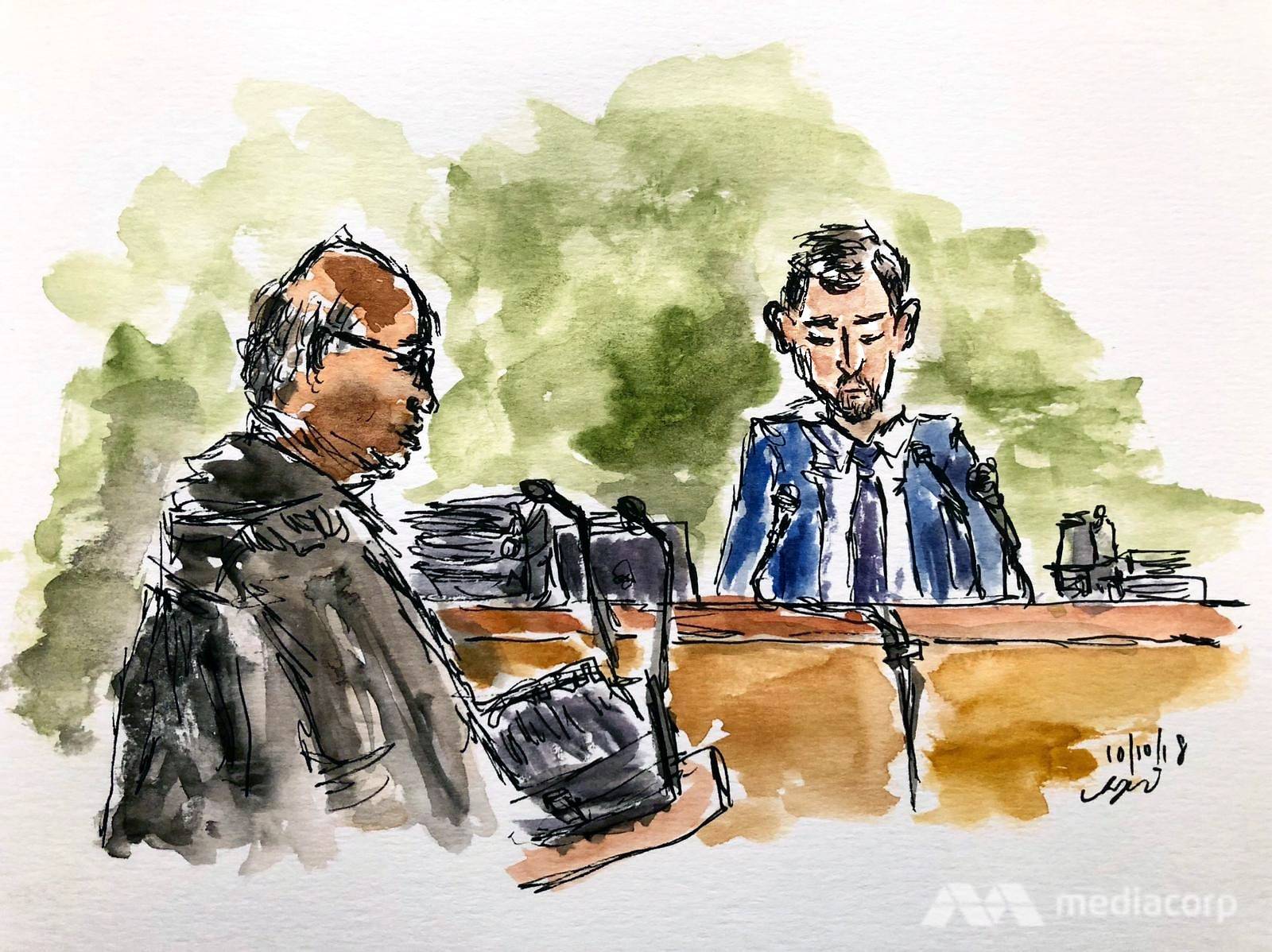
Defence counsel Leslie Netto cross-examines KPMG executive director Owen Hawkes on Wednesday (Oct 10), with Justice Kannan Ramesh observing the proceedings. (Illustration: Lydia Lam)
According to the KPMG report, AHTC’s decision to appoint FMSS as the managing agent for its first contract, which ran from July 2011 to July 2012, resulted in additional costs of more than S$515,000. This is in comparison to if it had kept CPG, which was the incumbent managing agent of Aljunied Town Council (ATC).
These costs include the difference for the takeover of Hougang division for the first year. According to the report, FMSS charged a flat fee of about S$1.1 million, while CPG’s managing agent fees for Hougang had been calculated to be about S$687,000.
In response to Mr Netto’s questions, Mr Hawkes repeatedly responded that CPG was “contractually obligated” to do so.
Further pressing the point, Mr Netto asked if CPG’s price would have remained the same even if Hougang Town Council (HTC) had not provided a computer system. “Surely CPG would’ve had great difficulty operating without a proper computer system?” he asked Mr Hawkes.
To that, Mr Hawkes responded that it is “highly speculative” to suggest that HTC would not implement any sort of computer system. “I don’t think you can run any business without a computer system,” he said.
Mr Netto also pointed out that if CPG had taken over HTC, it could have resulted in the loss of jobs for some employees, but Mr Hawkes said that KPMG was not trying to calculate the social cost of changing the managing agent.
Mr Netto then asked: “So you have ignored altogether the human element?”
To that, Mr Hawkes responded: “I am an accountant. So while I do understand these are employees of an organisation and there is a potential they would lose their jobs … What we’ve been asked to do is to account for the cost of AHTC in taking on one of two managing agents.”
He added that if the “human element” was a consideration in AHTC’s decision to appoint FMSS, he would have expected to see it referenced in the terms of FMSS and the waiver decision. “It doesn’t appear that it does,” he said.
SYLVIA LIM A RUBBER STAMP?
Mr Netto also rebutted a “suggestion that Ms Sylvia Lim was merely a rubber stamp” signing off on documents.
According to Ms How, he said, this was not true. Ms Lim was “meticulous, very careful, and she very often brought the documents home”.
Mr Netto again raised a point that had been previously discussed in the trial – that AHTC had introduced an additional step by requiring its vice-chairman or chairman to sign off on cheques to be made to FMSS.
However, while Mr Hawkes agreed that this was true, he stood firm on his view that it was not “a sufficient control in the circumstances”.
He added that the difference in the relationship between CPG and ATC and the one between FMSS and AHTC was that Mr Loh held 50 per cent of FMSS’ shares.
“That adds a significant layer of conflict, for which you would expect to have a layer of control,” said Mr Hawkes.
SINGAPORE: Innovative technology-based solutions such as an online work declaration system and smart glasses have been developed and deployed to address the unique challenges faced in the Changi East project, said Changi Airport Group (CAG).
Highlighting some of these challenges in a media showcase of the solutions on Tuesday (Oct 9), CAG said the project, which will include Terminal 5 and an industrial zone, sits next to an operating airport. Several main contractors with multiple large-scale construction works are involved, with 3,000 workers and 700 vehicles on site, it added. So solutions are needed to enhance safety, security and efficiency at the work site, CAG said.
To manage the contractors, a web-based management system which provides greater oversight and enhanced situational awareness for the worksite has been commissioned, CAG said.
The Online Work Declaration system, which was implemented in 2017, helps to manage any risks that might arise as a result of having different teams of workers employed by several contractors working alongside each other.
Work declarations used to be done manually on large printed copies of different work zone maps posted on the walls by each contractor. With the new web-based system, contractors can register and assess the information of their work areas with ease. (Photo: Gayathiri Chandramohan)
The system allows supervisors to access the website on their devices from anywhere to check on the details of any construction work and who is in charge. Without the system, work activity would have to be managed manually with contractors physically updating a large map posted at the site.
CAG’s associate general manager Marken Ang said the system was inspired by how London’s Heathrow Airport managed contractors for its own projects.
The information uploaded by supervisors is fed to the “nerve centre” of Changi East, located right next to Runway 2 where it watches over works near the operational runway. At this Changi East Command Centre (CECC), CCTVs and electronic trackers allow them to monitor the movements of their workers and equipment.
The Changi East Command Centre is manned throughout the day to ensure work safety within the airfield. (Photo: Gayathiri Chandramohan)
To enhance security at the work site, a centralised checkpoint was set up in September.
“In that way, we can account for exactly who are onsite and who are leaving the site,” Mr Ang said.
WATCHING WHERE THE WORKERS, VEHICLES GO
To ensure that workers do not put themselves in unnecessary danger, such as by crossing the runway, both workers and vehicles are each equipped with a transponder to track their movements when they are deployed to work airside.
The transponder worn by the worker on his safety vest will sound an alarm when he crosses a virtual geo-fence. On the ground, board markers were installed to indicate “no-go” areas.
Managers back at the CECC are notified of incursions through the e-tracking feature so that they can deal with them.
They can also tap on safety managers, inspectors and engineers in the field who have been issued with smart glasses. These smart glasses are able to stream back footage in real-time to the CECC.
The glasses, which were sourced from a Chinese manufacturer, also allow their wearers to make calls hands-free.
Safety inspectors, managers, and engineers can use these Smart Glasses to help relay what they see on the ground back to the Changi East Command Centre easily. (Photo: Gayathiri Chandramohan)
The smart glasses complement the CCTVS that have been installed on site, CAG said.
“For the CCTV, once it’s fixed and in a dynamic environment in the construction site, it is difficult to install everywhere,” said Mr Ang, adding that the glasses give CAG the added mobility to deploy safety managers to various locations.
With works being carried out in close proximity to an operational runway, contractors have to abide by height restrictions to ensure that the equipment used do not interfere with aircraft safety.
As no such monitoring device exists for construction use at an existing airfield, CAG engaged a local company MG&G to come up with a solution. The result is the Automatic Height Infringement Detection System which uses sensors and GPS. Sensors placed on equipment detect when it exceeds an area’s height limit.
When a breach occurs, an alarm will be triggered at the CECC and duty managers will take appropriate action. Before the system was put in place, height limits used to be checked manually.
While Mr Ang declined to reveal the cost of implementing the technological solutions because it is “commercially sensitive”, he added that the solutions sourced are equipment that are already available in the market, except for the height monitoring system and the online work declaration system.
When completed by 2030, Terminal 5 at Changi East will be able to handle an additional 50 million passengers, on top of the existing 85 million passenger capacity by the current terminals.
SINGAPORE: The Ministry of National Development (MND) and its then-minister Khaw Boon Wan had “no difficulty” accepting the fact that Aljunied-Hougang Town Council (AHTC) had waived a tender for a managing agent, and that the waiver was “properly called for and exercised”, the defence charged on Wednesday (Oct 10).
This waiver was “not justified”, according to audit firm KPMG in its October 2016 report. It also concluded that the contract which AHTC subsequently entered into with FM Solutions and Services (FMSS) was done “improperly”.
The KPMG report forms part of the basis for the civil lawsuit against Workers’ Party Members of Parliament Low Thia Khiang, Sylvia Lim and Pritam Singh, AHTC councillors as well as FMSS employees.
FMSS, a new company, was appointed as the town council’s managing agent after the Workers’ Party won Aljunied GRC in the 2011 General Election.
The three MPs are accused of breaching their fiduciary duties in appointing FMSS, which allegedly led to improper payments amounting to about S$33 million made to FMSS and its service provider.
(From left) The Workers’ Party’s Pritam Singh, Low Thia Khiang and Sylvia Lim.
In his cross-examination of KPMG executive director Owen Hawkes on Wednesday, Mr Rajah referred to an extract from a sitting of Parliament on May 13, 2013, when Mr Khaw talked about the waiving of tenders, among other town council issues.
Mr Rajah quoted Mr Khaw who said in his speech: “The Town Councils Financial Rules (TCFR) also provide latitude to town councils or their chairmen to waive requirement to call for tender altogether.
“Ms Sylvia Lim would be familiar with this because she exercised this latitude when her town council waived competition and appointed FMSS as its managing agent in 2011.
“MND left the appointment to her best judgment and did not object. We have to apply the Town Councils Act and the TCFR fairly, evenly and consistently.”
Court sketch: Senior Counsel Chelva Retnam Rajah cross-examines KPMG executive director Owen Hawkes on Wednesday (Oct 10). (Illustration: Lydia Lam)
In presenting his argument, Mr Rajah said: “So it would appear that as far as Mr Khaw was concerned, he didn’t have too much difficulty with the fact that a waiver had been given as far as the first managing agent contract agreement was concerned.”
“Do you accept that?” he asked Mr Hawkes.
“You’re correct,” he responded. “Well, it says that MND left the appointment to the ‘best judgment’.”
2013 MND REPORT SAID “THERE WAS NO COMPROMISE OF SERVICES”: DEFENCE
Mr Rajah then referred to an extract from a 2013 MND report produced after the prime minister directed the ministry to review the sale of the Town Council Management System (TCMS) software belonging to PAP town councils to IT firm Action Information Management (AIM).
In the report, MND said the review team sought input from Potong Pasir Town Council (PPTC) and AHTC.
The review team found that for PPTC and AHTC, “most major contracts and systems continued after the changeover, which ensured continuity of services to residents”, according to the MND report.
“The only exception was the managing agent contracts, where both town councils appointed new managing agents,” the report continued.
“Due to the urgency of the town councils’ needs, both town councils exercised a waiver of competition for tender for a one-year contract.”
Mr Rajah pointed out that the report went on to say “there was no compromise of services”, and that the appointment of FMSS by AHTC “allowed AHTC to ensure continuity of service to residents”.
“That appears to be MND’s view,” Mr Rajah said.
“That does indeed appear to be their view,” Mr Hawkes agreed. “I have to say I don’t entirely understand why they feel that appointing a new managing agent is the only way to ensure continuity of services, but it seems to be their conclusion.”
Mr Rajah then asked Mr Hawkes if he was aware of the statements by Mr Khaw and MND when the KPMG report was made.
To this, Mr Hawkes said he was, but did not check with MND, as “our job is to look at, for example, the exact circumstances of the waiver, whether it was done in accordance with the TCFR”.
Mr Hawkes also pointed out that the 2013 reports Mr Rajah referred to pre-dated the 2015 report by the Auditor-General’s Office, which flagged major lapses in governance and compliance at the town council. It was after this report that KPMG was appointed to look into AHTC’s accounts.
Mr Rajah wrapped up his cross-examination of Mr Hawkes on Wednesday morning – day four of the trial. Proceedings continue in the afternoon with another defence lawyer Leslie Netto beginning his questioning of Mr Hawkes.
The new rankings saw Japanese and Singaporean passports granting their holders access to 189 nations either visa-free or with visa-on-arrival, the highest number of countries accessible without a visa since borders were enforced, nations divided, and passports became mandatory.
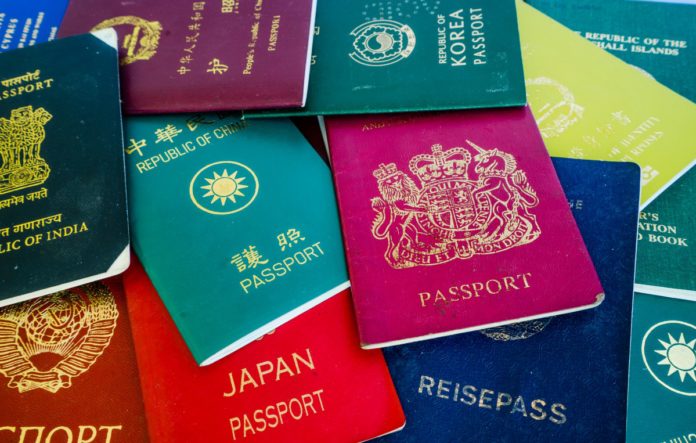
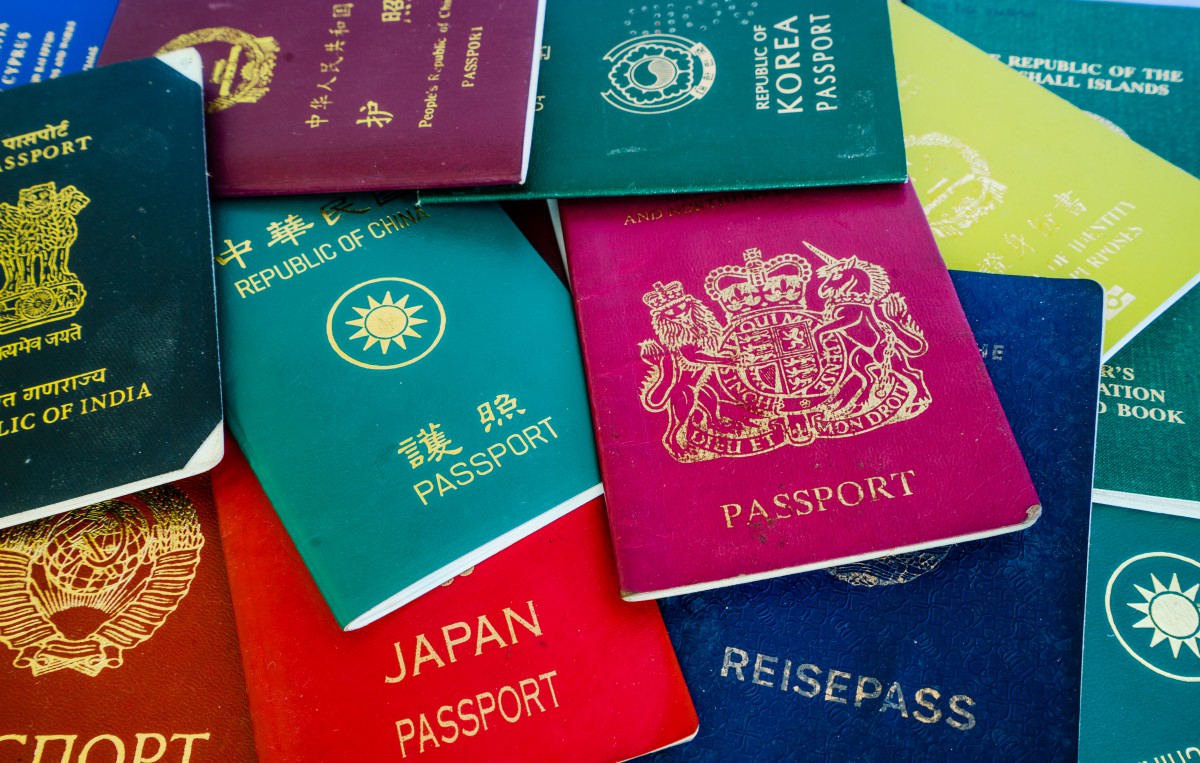
The Japanese passport is now the world’s most powerful according to the Henley Passport Index. Source: Shutterstock
The East Asian country had recently gained visa-free access to Burma (Myanmar), granting it visa-free/visa-on-arrival access to 190 destinations.
Singapore still enjoys visa-free/visa-on-arrival access to a total of 189 destinations.
Both Japanese and Singaporean passports allow travellers a 30-day visa-free stay in Uzbekistan along with Isreali, South Korean, Tajikistanian, Turkish, Malaysian, and Indonesian passport holders.
Meanwhile, Germany, which held the title since 2013 only to be knocked off by Singapore and Japan, has fallen further to third place.
Together with South Korea and France, its nationals enjoy visa-free access to 188 countries.
As for the least powerful passports in the world, Iraq and Afghanistan continue to rank poorly at 106th place, with access to only 30 countries.
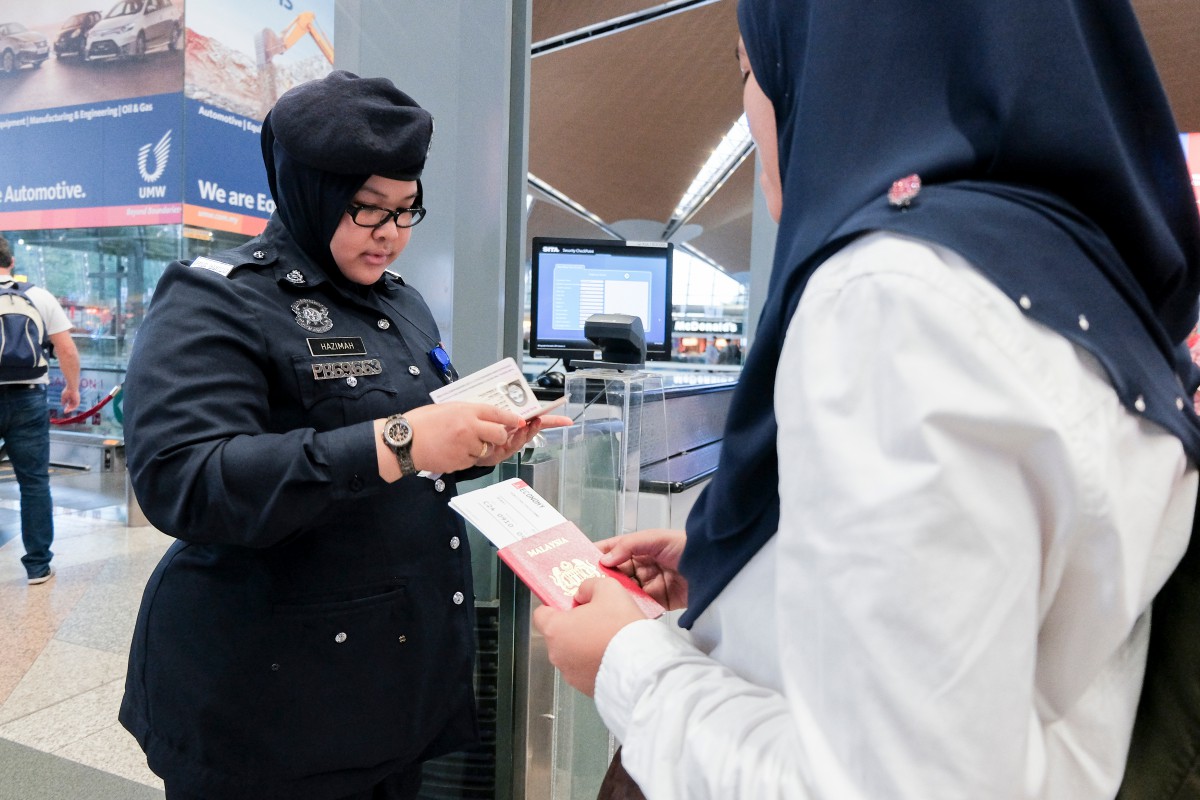
A woman gets her passport checked at the Kuala Lumpur International Airport. Source: Shutterstock
The Henley Passport Index is a ranking of all the passports of the world according to the number of countries their holders can travel to visa-free.
The ranking is based on exclusive data from the International Air Transport Association (IATA), which maintains the world’s largest and most comprehensive database of travel information, and is enhanced by extensive in-house research.
This article first appeared on our sister website Travel Wire Asia.
SINGAPORE: Google on Wednesday (Oct 10) announced it will bring both the Pixel 3 and Pixel 3 XL smartphones to Singapore from Nov 1.
The latest flagship products by the tech giant will be sold via telcos Singtel and StarHub and on Google’s own online store. Last year’s edition was sold exclusively through Singtel.
Google’s managing director for APAC Hardware Partnerships Martin Geh revealing the smartphones’ prices as well as the wireless charging Pixel Stand. (Photo: Kevin Kwang)
The 5.5-inch Pixel 3 will cost from S$1,249 while the larger 6.3-inch Pixel 3 XL will be priced starting from S$1,399.
Singtel said the Pixel 3 will come in 64GB while the Pixel 3 XL will come in capacities of 64GB and 128GB. Pre-orders will start from 10am on Oct 10, it added.
StarHub said in its press release that prices will be revealed closer to the date of the launch, but added subscribers can pay for the phone in instalments of 12 or 24 months through their monthly bills.
Alphabet Inc’s Google on Tuesday unveiled the third edition of its Pixel smartphone, alongside a Google Home smart speaker with a display and its first tablet computer, the Pixel Slate.
A guest photographs the new Google Pixel 3 and Pixel 3 XL smartphones during a Google product release event, Oct 9, 2018 in New York City. (Photo: AFP)
The Pixel 3 will launch in 10 countries, up from six for the Pixel 2 a year ago. New additions include France, Ireland, Japan and Taiwan.
The Slate is available in the United States, the United Kingdom and Canada, while Google’s Home Hub is launching in the United States, the United Kingdom and Australia.