Home Blog Page 877

Commentary: Bicentennial can be a worthwhile endeavour

0

SINGAPORE: When Singapore celebrated its 50th year as an independent nation-state in 2015, it was a national movement embraced by most Singaporeans.

The Golden Jubilee was viewed as a significant milestone that marked Singapore’s coming of age as an accidental country made good.

When plans were announced to mark Singapore’s next historical anniversary – the Bicentennial in 2019 to commemorate the 200th anniversary of Singapore’s founding by Stamford Raffles – public responses have been a lot more ambivalent. 

Raffles Hotel

Raffles Hotel, the grand old dame of Singapore. (Photo: Raffles Hotel)

A NARRATIVE IN QUESTION

Those who supported the anniversary argued that 1819 was historically significant in that it marked the beginning of Singapore’s modern history – a decisive point of inflexion that saw its transformation from an obscure regional trading post to an internationally connected colonial port city, a trajectory that led to Singapore’s current position as an economically successful nation state. 

In the two hundred years since the East India Company first set up a trading post in Singapore, the island witnessed major developments that contributed substantially to making Singapore what it is today, so the argument goes.

The colonial port city brought riches and attracted a plural migrant population that eventually became Singapore’s cosmopolitan society. Modern infrastructure as well as legal and political frameworks were introduced to underpin a polity that eventually became a city-state.  

It has been claimed that without that turning point in 1819, Singapore might not have taken off. This surely must be a historic milestone worth commemorating.

But this viewpoint is not universally endorsed. The decision to expend effort to commemorate the anniversary of 1819 has been criticised as an unnecessary and insensitive nod to colonialism. 

Many have asked: 

Why should Singapore be celebrating 200 years of colonial subjugation and exploitation?

Just as objectionable is the implication that by celebrating 1819 as a historical start point, we are acknowledging that Singapore had no history before the arrival of the colonialists. This simply reinforces the mangrove-swamp-to-metropolis national narrative that we are all familiar with, but which unfortunately cuts out at least five hundred years of history from our consciousness.

"Pre-colonial arrival, there's almost zero (written history) about Singapore," the

“Pre-colonial arrival, there’s almost zero (written history) about Singapore,” the city’s top archaeologist Lim Chen Sian says, adding that the little that is known has often been pieced together from items found in excavations (Photo: AFP/HANDOUT)

Dismissing anything that happened before 1819 as unimportant and insignificant deprives us of a heritage linked to the rich history of the region, including that of the Malay world.

For a relatively young country that has consistently and consciously embraced its colonial past as an integral part of its national narrative, it is not surprising that the Government has been keen to endorse the bicentennial. Plans are now afoot for a series of activities to mark the anniversary next year, although we have been reminded that this is not an extension of SG50.

NEEDS TO BE ORGANIC

Not unexpectedly, the Bicentennial has generated its fair share of debates in the mainstream and social media. This is not a bad thing; it is a healthy sign that citizens have taken an active interest in our history.

A monolithic, state-driven narrative is no longer sufficient; people now want the stories to resonate with them. They want to find personal meaning in our history.

It is for this reason that the Bicentennial initiative has to be sensitively framed. While the state might want to take a lead in terms of coordination of effort and resources, it should, as far as possible, refrain from imposing a top down, state-curated event. 

The Bicentennial could be used, instead, as an opportune occasion to stimulate an organic effervescence, inspiring people to be an active part of an effort to engage history. An inclusive process, involving a myriad of stories, can be a gratifying experience.

The Singapore Bicentennial Office, tasked with organising the event, is aware of these concerns and is carefully navigating its way given the complexities of the issues at stake.

The organisers have been careful to emphasise that the events are not intended to celebrate the glories of colonialism through rose-tinted interpretations of the history of the past two hundred years. They have also found it necessary to accept that Singapore has a history that far preceded the arrival of the British.

Malay Heritage Centre (Kampong Bugis)

The old Kampong Bugis located along the Rochor-Kallang River. (Photo: National Museum of Singapore, National Heritage Board)

The Bicentennial, in a way, is actually commemorating 700 years of history – hence the adoption of a logo that reflects a 700 year journey. It is now clear that 1819 was not a point of origin; it was a mere pivot in a much longer storyline.

A RICH AND COMPLEX PAST

In my view, if we accept the Bicentennial as an opportunity to turn our attention to the long history of the region and Singapore’s place within it, and, at the same time, find personal meaning in that history, the event should be welcomed.

The narratives that will emerge from this moment of reflection should veer away from the statist or elitist perspective; instead there must be greater space for a range of voices from communities and people. 

The approach should not be celebratory or didactic.  Rather, it should generate reflection of how we came to be, with a “warts and all” approach that would acknowledge the blemishes, disruptions, twists and turns of a complex past.

We might want to reflect on the larger forces that have shaped our history and, in many ways, our identity as a people. 

It is important to understand how Singapore has had a long and deep connection with the region; that globalism and the centuries-long processes of globalisation generated by trade and diaspora have been enduring factors in our history; and that openness to flows of people and ideas have consistently been the lifeline of this island and continues to be so.

And finally, if the Bicentennial can serve as a catalyst for further ruminations about Singapore’s history, and not be a one-off national effort to be forgotten once 2019 passes on, then I argue that the Bicentennial, like our golden anniversary, would be a worthwhile endeavour.

Tan Tai Yong is President and Professor of Humanities at Yale-NUS College. 

Source link

7 things to look out for at the 2018 Prudential Marina Bay Carnival

0

SINGAPORE: It’s that time of the year where you spot random people toting giant plush toys on the MRT. 

That’s right, the Prudential Marina Bay Carnival is back in town, offering more than the chance to win an over-sized toy unicorn, a rainbow lion or a pug with doe eyes.

READ: Lower prices for rides at Prudential Marina Bay Carnival this year

The carnival – touted as Singapore’s biggest – opened its doors to the public on Saturday (Dec 22) with 22 rides, three of them new. Notably, prices for most rides have been lowered this year, with the exception of that for the Mach 5 which is priced at 14 tokens.

And if you’re worried about long lines, here’s a quick cheat sheet on what’s worth the wait.

1. Freak Out/Spring Break 

Marina Bay Carnival Spring Break or Freak Out

The stomach-churning Freak Out ride at the Prudential Marina Bay Carnival.

A new addition to the carnival, this ride starts off easy, but at full throttle, it’s a heart-stopping thrill. Not knowing which or what way you’ll be spinning, while plunging down face-forward definitely adds to the exhilaration. 

Just remember to keep your game face on at all times – the ride’s seating arrangement allows full view of your fellow riders and their scream faces. 

2. Wave Swinger

Marina Bay Carnival Wave Swinger

The Wave Swinger ride at the Prudential Marina Bay Carnival.

This new ride is as family friendly as they come. It was flown in from Italy for the first time to Southeast Asia and features mural panels of iconic Singapore landmarks such as Gardens by the Bay and Marina Bay Sands. 

But be warned, it quickens to an exciting spin after a couple of slow and steady beginning rounds. Perfect reason for dating couples to cling on to each other.

3. Jumper Jumper

Marina Bay Carnival Jumper Jumper

Jumper Jumper at the Prudential Marina Bay Carnival.

An experience that would make 90s hip-hop duo Kris Kross so proud, this turned out to be the most unexpected ride of the lot. 

Incredibly harmless to start before descending into a series of stomach-churning twists, turns and giant hops. Imagine jumping and spinning around on an office chair.  

4.  The Star Flyer

No visit to the carnival is complete without an Insta-friendly shot of the neon-lit Star Flyer which rises almost poetically amongst the steely backdrop of CBD buildings. It moves at a slower pace than the Wave Swinger. 

Marina Bay Carnival Star Flyer 2

The 35-metre tall Star Flyer at the Prudential Marina Bay Carnival.

5. Mach 5

Marina Bay Carnival Mach 5

The tower of terror – the Mach 5 at Prudential Marina Bay Carnival.

Still the most expensive ride in the carnival at 14 tokens, but definitely worth going on for a stomach-dropping spin. Hop on the impressive 55m-tall monster mechanical arm for a great view of Singapore at its peak, before plunging down at 130 kmh and finishing off with 360-degree flips. 

Pro-tip: Don’t gorge at the food stands before you get on.

5. S$3 million worth of carnival prizes

Marina Bay Carnival toys

A game stand at the Prudential Marina Bay Carnival.

Tossing a ring on a bottle, flinging a hoop over a Carebear or knocking a trio of milk jugs down with a ball – it all sounds easy but let’s just say the games look deceptively simple.

They actually require some strategy, skill and a whole lot of luck. If you do manage to score a giant unicorn or banana plushie, a Yoda doll or a sequinned doughnut – remember to hoist it on your shoulders so everyone knows you’re a champion. 

There’s also a grand lucky draw with a S$10,000 prize.

Marina Bay Carnival games

A fishing game at the Prudential Marina Bay Carnival.

Marina Bay Carnival game stand 2

A game stand at the Prudential Marina Bay Carnival. 

6. Food, glorious food

Marina Bay Carnival food

Churros, IndoMie and a meatball bucket – plenty to eat at the Prudential Marina Bay Carnival.

The food on offer isn’t your usual carnival fare of hot dogs, candy floss and popcorn. You can get a bucket of meatballs (chicken or beef) from Sofnade heaped on twister fries and potato mash topped with cheese sauce and cranberry (S$12) or a bucket of milk tea or lemonade (S$7).

There’s also an assortment of churros flavours – ondeh ondeh, Oreo, chilli crab, salted egg from Loco Loco (S$6 a cup).

For those who need a bigger carb-hit, SingaIndo serves up various Indomie dishes including Aburi shrimp mentaiko, a super-spicy sambal gila, Thai basil and cheesy cheese.

Marina Bay Carnival food

A meatball bucket and various Indomie dishes.

The carnival will be open from 4pm to 11pm daily save Jan 18, Jan 24 and Feb 15, 2019 and runs all the way till Mar 24. It is just a stone’s throw away from Bayfront MRT station.

Source link

7 important rental clauses you never knew existed

0

SINGAPORE: If you’re new to renting, it is normal to be a little intimidated by all the technical language in your Tenancy Agreement (TA).

In this article, we explain seven important, yet lesser-known, rental clauses for both landlords and tenants.

Note that these clauses may apply not only to residential, but also to commercial and industrial properties.

Rental clause #1: Diplomatic clause

Who the clause may benefit: Tenants (specifically, expat tenants).

First things first- the diplomatic clause is only applicable for expats in Singapore, not Singaporeans. This clause allows the tenant to terminate their lease under certain conditions (for example, if they have been let go, or transferred to an office in another country).

Note that the landlord might require the tenant to stay for a minimum period of time before they can exercise the clause. Once the clause is exercised, the security deposit held by the landlord must be returned to the tenant upon handover.

Jervois Gardens up for collective sale

Jervois Gardens, located off River Valley Road, fetched S$72 million in an en bloc sale on Sep 26, 2017.

Rental clause #2: En bloc clause

The clause may benefit: Landlords.

If the TA comes with an en bloc clause, this gives the landlord the right to terminate the lease prematurely in the event that the building is being sold for redevelopment.

On the other hand, if the landlord does not include this clause in the TA, and a tenant has to move out due to en bloc, this tenant may claim compensation for their unfulfilled lease from the landlord – regardless of whether the landlord voted for the en bloc or otherwise.

READ: Viewing property? 5 things things to inspect to save yourself time and a headache

Rental clause #3: Forfeiture clause

The clause may benefit: Landlords

A forfeiture clause specifies how a landlord might regain possession of their property should their tenant breach the terms of the lease.

While it is implied that landlords are allowed to take steps to repossess their property in two circumstances: a tenant defaulting on their rent or using the property for illegal means, landlords who wish to repossess their property for other reasons, should specify these clearly in the TA.

An example would be a shop in a commercial property failing to meet a specified target revenue in two consecutive quarters.

A landlord that includes the forfeiture clause in the TA can exercise the clause to “free up” the unit for a potentially better-performing tenant, which could improve the footfall the property receives.

Note: The forfeiture clause, itself, does not allow a landlord to repossess a property without proper procedure. In the event that a situation matches the one specified in the forfeiture clause, landlords would have to follow formal proceedings (for example, give prior written notice) if they wish to do so.

READ: What are Jumbo HDB flats and where can you find them?

Rental clause #4: Interest on arrears clause

The clause may benefit: Landlords

The interest on arrears clause is pretty straightforward; it serves to protect landlords from tenants who consistently delay their payments.

Using this clause, the landlord can specify that in the event that the tenant does not pay their rent within a certain period of time, it is under the landlord’s jurisdiction to claim a certain amount of interest on the amount unpaid.

Again, this is more common in commercial property, as it might not make monetary sense to evict a tenant when there is existing vacancy in the property.

hammer and nails

A repair clause specifies to what extent a tenant should take care of their rented property, and helps puts landlords and tenants on the same page. (Photo: Pexels)

Rental clause #5: Repair clause

The clause may benefit: Landlords and tenants

A repair clause specifies to what extent a tenant should take care of their rented property, and helps puts landlords and tenants on the same page.

As a general rule of thumb, it is in the landlord and tenant’s best interests to go into as much detail as possible when working out their repair clause.

For instance, a repair clause might stipulate that the tenant will pay for all repairs up to S$150, with the landlord paying for repairs above that amount.

In this case, the landlord and tenant should also state in their TA whether this applies to all items within the flat, or whether it only applies to items that are damaged due to carelessness or misuse.

Here’s an example: if an expensive rug starts shedding due to normal wear and tear, is the tenant liable to pay for maintenance or a replacement? It’s up in the air, unless you word your repair clause clearly and non-ambiguously.

READ: 7 things to take note of when buying old properties in Singapore

Rental clause #6: Option to renew clause

The clause may benefit: Tenants

This clause stipulates that the landlord agrees to let the tenant have the priority option to extend their lease after a fixed term before the landlord puts the property on the market for rental or consider an offer from another tenant.

While the option to renew clause is granted at the beginning of the lease, it may only be exercised by the tenant towards the end of the lease.

Should the tenant choose to exercise the clause, the landlord will then prepare a contract for extension. Any terms stated in the option to renew clause (for example, terms specifying that the extension should be granted at the prevailing market rate) need to be satisfied in order for the clause to be exercised.

Rental clause #7: Non-disturbance clause

The clause may benefit: Tenants

Under this clause, a tenant has the right to continue occupying a property even when the property is sold or taken over by creditors. If the property’s lease is mortgaged, the bank may or may not recognise this lease, depending on whether the lease is authorised or mandated by law.

This article first appeared on 99.co.

Source link

Commentary: Does caning still have a place in modern day parenting?

0

SINGAPORE: The recent news of the father who was jailed because of the excessively harsh disciplinary measures he meted out on his son caused quite an uproar.

We live in an era where the cane and other authoritarian methods of discipline have been come into question and the scales have tipped towards “softer” and more positive parenting approaches.

It is hard to imagine that just three decades ago disciplinary tactics such as repeated caning on the legs, locking the child up in a room, or sending them to bed hungry nary raised an eyebrow.

When I was in primary school, I recall being whacked across the palm with a wooden ruler as well as being smacked on the head with a book by one of my teachers. Today, such tactics would surely draw the ire of parents and instead of the student being marched into the principal’s office, it would likely be the teacher.

What has caused such a sea-change in our attitudes towards discipline?

THE HEART OF DISCIPLINE IS LOVE

First things first – what is the heart of discipline? Why do we do the at-times unpleasant thing of taking our children to task?

We discipline because we want to teach the child to discern right from wrong, and to choose right over wrong. It is done with the end goal in mind: that they will grow to become mature, responsible adults.

READ: Raising a teenager is just like caring for a bonsai, a commentary

Very often, the focus is on correcting behaviour, but what is actually happening in effective discipline is we are helping the child develop an inner conscience – the little voice in us that warns us when we are about to do something inappropriate.

Family Singapore

A family walking in Singapore. (Photo: Gaya Chandramohan)

Harsh, authoritarian methods like caning have given way to softer, more up-to-date tactics like time-outs, time-ins, withdrawal of privileges, and natural consequences.

What do I mean by natural consequences? Well, for example, if junior tried to stay up late playing games on his phone under a blanket, a natural or associated consequence would be a new household policy to surrender his phone by 9pm every night.

READ: When should children be allowed to have their own mobile phones? A commentary

If little brother pulled his sister’s hair out of ill intent, you could give him two strokes of the rotan and teach him not to do it next time, or you could get him to apologise and do something nice for his sibling to redeem himself.

Which method is the better teacher?

I think the answer depends on which camp you’re in, as well as the temperament of your child. Some children learn better the soft way, and do not generally require any harsh disciplinary action at all. (I can attest to this with my experience with one easy-going child of my own.)

Also, are you able to mete out corporal punishment in a way that is driven by love and reason instead of anger? This is a very hard balance to reach.

Parent and child at a playground in Punggol

Parent and child at a playground in Punggol. (Photo: Gaya Chandramohan)

There is no one-size-fits-all, but we need to remember that discipline and love are both sides of the same coin.

Many people associate the word “discipline” with punishment (perhaps because of how we were brought up ourselves) but it is in fact about helping the child to develop and grow.

TO CANE OR NOT TO CANE

Apart from the child’s temperament, it also depends on the context.

The cane (and other corporal punishment) should be reserved for certain “crimes”, such as outward rebellion or serious offences like repeated lying, hitting, or stealing.

If you do choose to use it, bear in mind that its efficacy reduces with age; studies show that corporal punishment loses its effectiveness after the age of ten.

How you use the cane matters. In your hand, it can become a tool or a weapon.

We should never reach for the cane when in rage as this can lead one to over-do it and enter into the territory of abuse.

When combined with a clear explanation of the reason and loving restoration afterwards (like a hug or word of reassurance), caning can still be an effective tool for some parents to teach obedience and respect for authority for some youngsters.

child parent holding hands

(File photo: Pixabay)

In this arena, less is more. So choose your battles carefully.

Different children react differently to harsh methods. Some may learn quickly to avoid the pain; for others, it may not result in progress but instead stir up anger and resentment and push the child further away from the parent – which is the opposite of what you want to achieve.

One area where parents should think twice about meting corporal punishment is in academics and schoolwork. The reason behind this is when the child fails to meet up to their parents’ expectations, they are already bearing the consequence – the bad grade and the feelings of disappointment.

READ: Life Beyond Grades a worthy cause but be careful not to trivialise failure, a commentary

However, if junior is exhibiting a laissez-faire attitude towards his poor grades, try to understand his struggles and think of ways to motivate and support him.

students classroom

Students attending a mathematics class at a primary school. (File photo: TODAY)

ARE WE GOING SOFT?

Many parents today lean towards gentler, more respectful forms of discipline and teaching. Contrary to what some might think, this isn’t taking the easy way out.

Coming down to the level of the child, controlling one’s anger or frustration, and employing logic and reason to state your case and influence your child requires time and patience.

Gentler also doesn’t mean we swing to the other end of the spectrum, and allow our kids to get away with murder.

READ: So your child wants to be a YouTube star? A commentary

Children need to learn that every behaviour carries consequences.

In his book The New Strong-willed Child, James Dobson wrote: “Parents must be willing to let children experience a reasonable amount of pain when they behave irresponsibly.”

Parents also need to be mindful that not every crime requires maximum punishment.

If your child helps with the dishes, he’ll likely get extra hugs at bedtime.

If he mocks his sibling for losing at a game, he may get a scolding and his play-time cut short. 

If he steals a toy from the departmental store, he may get two swats on his behind and have to own up to the store manager.

sad boy leaning on a chair

(Photo: Unsplash/Chinh Le Duc)

A FIRM BUT LOVING HAND

When we yell at our children or spank them out of anger, we often suffer guilt afterwards.

Let that guilt be a signal for us to slow down and reflect on our approaches.

There are more reasonable ways to teach obedience and good conduct. These include logical consequences as mentioned above, and positive reinforcement – when we catch the child demonstrating obedience and pro-social behaviour, and affirm them in a timely way.

Let’s not let our anger get the better of us. Just as our children are learning daily, we adults can take steps towards positive change.

If we want our children to flourish under our care, adopt a firm but loving hand. It is the best way to support their development while safeguarding the parent-child relationship

Source link

Santa Claus of Marsiling returns – with a log cabin and bigger display

0

SINGAPORE: It’s the most wonderful time of the year again – for residents and Christmas-lovers in Marsiling.

Those who live around Woodlands Street 13 are no stranger to the elaborate displays that resident Tan Koon Tat has constructed every festive season for more than ten years, but this year the 58-year-old carpenter has surpassed himself, with a Christmas display spanning not one but two locations.

A life-size Santa Claus and reindeer occupy Mr Tan’s usual display area at the entrance of the car park, but his crowning glory is around the corner, where a huge, snow-covered log cabin sits with Santa’s sleigh parked beside it, the whole thing fenced off by candy canes and tinsel.

This year, Santa also gets a friend, with the addition of a “Santarina” female mannequin dressed up in a Santa costume, standing on the cabin’s porch. She’s not Santa’s wife, says Mr Tan, but rather Santa’s grandchild, as she looks “too young” to be his wife.

A snow machine will also be added over the weekend.

Marsiling Santa Claus 2018 (1)

Mr Tan Koon Tat strikes a pose in front of his Christmas decor set-up this year, which comprises a log cabin and giant candy canes. (Photo: Marcus Mark Ramos)

Child poses in Marsiling Santa sleigh

A child poses for a photo on Santa’s sleigh. (Photo: Marcus Mark Ramos)

The whole thing took Mr Tan three weeks to put together, with the help of family, friends and a few workers (though the veteran festive display builder says he could have done it in a week, if it had not been raining).

“My son helped me design (the house),” Mr Tan told Channel NewsAsia, adding that one of his daughters helped find materials while another helped decorate and his wife helped with sewing.

Marsiling Christmas decorations - inspiration

The inspiration for Mr Tan’s log cabin (left) and the actual structure he built. (Photos: Nicole Chang, Marcus Mark Ramos)

“As for me – me, my workers and my neighbours built this house together,” he said. “Building the house took three people. The decorations, the lights and so on altogether (took) about six or seven people.”

READ: Winter in Woodlands: The man who made it snow in Marsiling

The community is very much at the heart of Mr Tan’s festive projects, and people often ask him what he is going to do for the next year.

“They give a few ideas: ‘Next year why don’t you do this, why don’t you do that?'”

Said the carpenter: “Last year, they suggested: Build a house. The previous year, they said, ‘build a sleigh’. So I built a sleigh. Some people say: ‘Hey your reindeer, you should buy bigger ones’. So this year, I have bigger ones.”

These reindeer were bought on Taobao and originally intended for last year’s display; however they did not make it in time for Christmas, so Mr Tan used them in this year’s creation instead.

Marsiling Santa Claus 2018 (1)

Reindeer feature in this year’s Christmas display, but not as much as in previous years. (Photo: Marcus Mark Ramos)

Marsiling log cabin kids 1

Children pose for a photo at the log cabin. (Photo: Marcus Mark Ramos)

He declined to say how much the entire display or materials cost him, but confirmed that he was self-funded.

When asked whether he had encountered any problems from the authorities about his display, Mr Tan said he had not had any difficulties. In fact, the town council is supplying the electricity for his display this year, he said.

“The town council asked: ‘What do you need?’ I said, I need electricity here. So they said okay, we’ll provide electricity for you.”

Marsiling Santa Claus 2018 (2)

A Santarina mannequin stands on the porch of Mr Tan’s Christmas cabin. (Photo: Marcus Mark Ramos)

The carpenter, who has his own business, has been putting up the festive displays for more than ten years – “done it until I’ve forgotten how many times I’ve done it already”. The decorations go up not just for Christmas, but for other occasions including Chinese New Year, Deepavali and Hari Raya.

However, when asked if he had any particular favourites, Mr Tan said that his favourite part was to see everyone happy.

“Looking at everyone’s smiles, that’s my favourite part. It’s not that I like my design … I like that everyone is happy,” he said. “If people were to say: ‘Hey, uncle it doesn’t look good’, then it’s no use. It’s when people like it, that I’m happy.”

To that end, he has also bought presents – 120 sets of festive headbands – to distribute to children when it gets closer to Christmas, on a “first come, first served” basis.

Marsiling Santa Claus 2018

Marsiling residents posing with Mr Tan’s Christmas cabin. (Photo: Marcus Mark Ramos)

“OTHER PLACES DON’T HAVE THIS”

Residents who walked by to admire and take selfies with Mr Tan’s creation were overwhelmingly positive about his decorations.

“(It’s) very good. Other places don’t have this,” said Ms Chen Jin, a teacher who just moved into the opposite block.

“I just moved in opposite, so it’s my first Christmas decorations,” she said. “My old block didn’t have this.”

Marsiling Santa Claus 2018 (2)

Family photo? Mr Tan with one of his reindeer and of course, “Santa”. (Photo: Marcus Mark Ramos) 

Buyer Esther Lim said she used to live nearby but has since moved. She and her husband came back to look at Mr Tan’s decorations.

“It really adds to the spirit of Christmas,” she said. “We used to live nearby, (so) we know this neighbour (Mr Tan) does it.”

Marsiling Christmas decorations group of residents

Those who live around Woodlands Street 13 are no stranger to Mr Tan’s elaborate displays. (Photo: Marcus Mark Ramos)

Another resident, who gave his name as Gabriel, said he had been living in the area for five years, but that this year’s display was “the best”.

“Very nice. We purposely walked past here to look,” he said. “This is the most elaborate of all the years.”

READ: Meet the Santa Claus of Marsiling – who has something extra for the kids 

Source link

Authorities considering stiffer penalties for drink-driving offenders: Sun Xueling

0

SINGAPORE: The authorities are considering stiffer penalties for drink-driving offenders amid an increase in accidents endangering the lives of road users.

This may include heftier fines, longer driving disqualification periods and lengthier jail terms.

Ms Sun Xueling, Senior Parliamentary Secretary for Home Affairs and National Development, said this on Friday (Dec 21) at the launch of an anti-drink driving campaign.

In the first nine months of this year, on average, one person died each month from accidents related to drink driving, Ms Sun said.

“All in, we saw over 120 accidents related to drink-driving, which is a 20 per cent increase from the first nine months of the previous year, and more than 1,500 individuals apprehended,” she added. 

“Most accidents happened as drink drivers ran red lights and exceeded speed limits. This has to stop.”

Ms Xueling highlighted cases where drink driving related accidents had claimed lives, including one which involved an elderly lady who was collecting discarded cardboard along Collyer Quay. 

There were also instances where the accidents claimed the lives of the motorists themselves. Two motorcyclists, in separate occasions earlier this year, were intoxicated when they lost control of their bikes and died, Ms Sun said.

FEWER OFFENDERS

Ms Sun Xueling at the launch of an anti-drink driving campaign

(From left) Chairman of Singapore Road Safety Council Bernard Tay, Ms Sun Xueling, Senior Parliamentary Secretary for Home Affairs and National Development and Commander Traffic Police Gerald Lim. (Photo: Singapore Police Force)

However, the number of offenders arrested from January to September have reduced by about 2.5 per cent as compared to the same period last year, she said. 

Public education efforts, including those by the Traffic Police and the Singapore Road Safety Council, have contributed to bringing the drink-driving situation “under control”, she said.

Public education will be backed by “strong enforcement and tough penalties”, she said.

“As I have said, we are considering stiffer penalties – higher fines, longer disqualification periods and lengthier jail terms. This will further strengthen the deterrent effect of our laws,” she said.

Currently, a driver who is caught drink driving but did not get into an accident may be disqualified from driving for a year, fined up to S$10,000 and jailed for up to a year.

If the driver gets into an accident, there will be aggravated penalties, especially if he has harmed another person. This includes steeper fines, disqualification for 20 years or more and longer jail-terms of up to five years.

Source link

6 more contracts awarded for North-South Corridor; works to begin end-2019

0

SINGAPORE: Construction on six more sections of Singapore’s first integrated transport corridor is expected to begin by the end of 2019, the Land Transport Authority (LTA) said in a media release on Friday (Dec 21).

Contracts worth S$3.14 billion for the design and construction of six sections of the 21.5km long North-South Corridor (NSC) tunnel have been awarded to multiple companies, according to LTA. 

They are located between East Coast Parkway (ECP) and Sungei Seletar.

The North-South Corridor, which will include express bus lanes and cycling trunk routes, will connect towns in the northern region to the city centre and is expected to be completed by 2026.

The bus lanes will help reduce commuting times from Woodlands, Sembawang, Yishun and Ang Mo Kio to the city by up to 30 minutes, LTA said previously.

The first NSC contract, worth S$809 million, was awarded to Samsung C&T Corporation last year for a stretch between Novena Rise and Toa Payoh Rise.

Three other civil contracts for sections between Toa Payoh Rise and Marymount Lane, between Kampong Java Road and Suffolk Road, and from Novena Rise to Suffolk Walk were awarded this year.

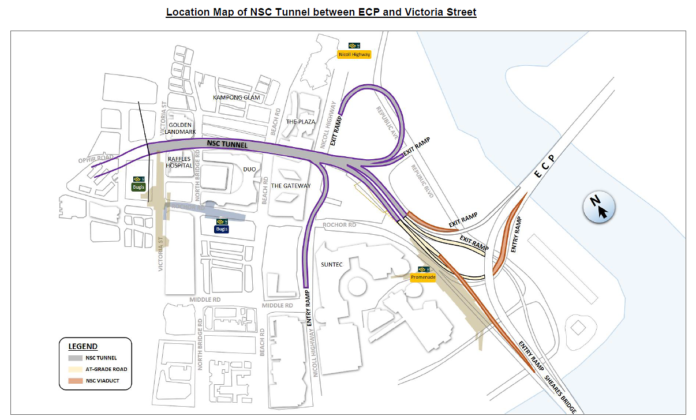
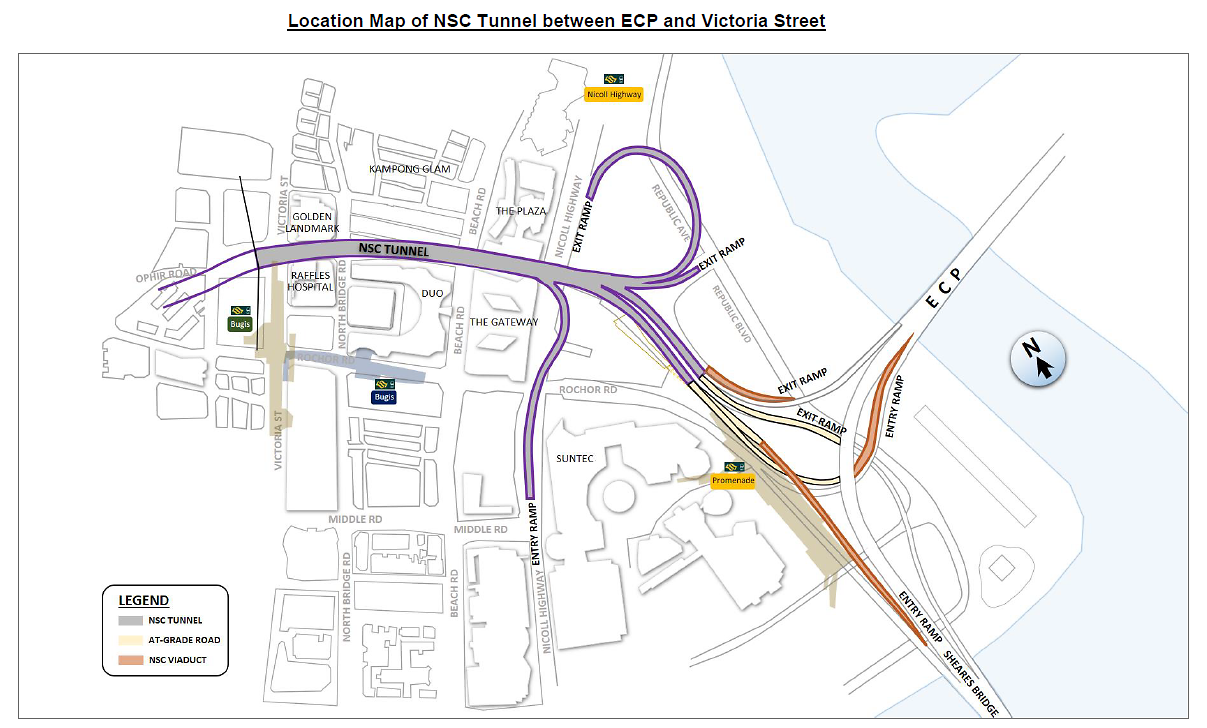
GS Engineering & Construction Corporation, a South Korean firm, was awarded a contract worth S$635.8 million to design and construct a section of the NCS tunnel between ECP and Victoria Street.

Location map of NSC tunnel between ECP and Victoria Street

Location map of NSC tunnel between ECP and Victoria Street. (Image: LTA)

Ssangyong Engineering & Construction Co and local contractor Wai Fong Construction Joint Venture were awarded a S$482.5 million contract to build the section between Victoria Street and Kampong Java Road. 

They will design and construct a 1.55km tunnel with two entry ramps and two exit ramps.

Location map of NSC tunnel between Victoria Street and Kampong Java Road

Location map of NSC tunnel between Victoria Street and Kampong Java Road. (Image: LTA)

Ssangyong was also awarded a S$537.1 million contract for the section between Ang Mo Kio Avenue 9 and Sungei Seletar. They will build a 1.3km section of tunnel, a 1.1km section of viaduct and a 340m road between the tunnel and viaduct, with one exit ramp. 

Location map of NSC tunnel between Ang Mo Kio Avenue 9 and Sungei Seletar

Location map of NSC tunnel between Ang Mo Kio Avenue 9 and Sungei Seletar. (Image: LTA)

China Railway First Group Co was awarded a S$446 million contract to build the section of the tunnel between Marymount Lane and Pemimpin Place. The company will build a 1.1km tunnel with one entry ramp.

Location map of NSC tunnel between Marymount Lane and Pemimpin Place

Location map of NSC tunnel between Marymount Lane and Pemimpin Place. (Image: LTA)

Local builders Hwa Seng Builder, Chye Joo Construction, and Ho Lee Construction Joint Venture were awarded a S$242.9 million contract to construct the section between Pemimpin Place and Sin Ming Avenue. They will build a 700m section of tunnel with one entry ramp and one exit ramp. 

Location map of NSC tunnel between Pemimpin Place and Sin Ming Avenue

Location map of NSC tunnel between Pemimpin Place and Sin Ming Avenue. (Image: LTA)

Lum Chang Building Contractors was awarded a S$799 million contract to construct a 1.95km section of the tunnel between Ang Mo Kio Avenue 3 and Avenue 9.

Location map of NSC tunnel between Ang Mo Kio Avenue 3 and Ang Mo Kio Avenue 9

Location map of NSC tunnel between Ang Mo Kio Avenue 3 and Ang Mo Kio Avenue 9. (Image: LTA)

​​​​​​​

Source link

Counterfeit goods worth S$13,000 seized, woman arrested

0

SINGAPORE: A 38-year-old woman suspected of importing counterfeit goods for trade has been arrested, police and Singapore Customs said in a news release on Friday (Dec 21).

The arrest resulted from a joint operation that spanned 12 hours on Wednesday.

Police and Singapore Customs officers raided a logistics company located at Changi South Avenue and a residence in Ang Mo Kio.

More than 400 pieces of counterfeit items with an estimated street value of more than S$13,000, were seized. 

They comprised perfume and cosmetics sets, sunglasses, handbags, bags, purses, wallets and pouches, authorities said.

counterfeit goods woman arrested 2

The seized goods are estimated to be worth more than S$13,000 in street value. (Photo: SPF)

​​​​​​​

“The authorities take a serious view on intellectual property right (IPR) infringements and will not hesitate to take action against perpetrators who show blatant disregard for Singapore’s IPR laws,” the news release added.

Those found guilty of importing, possessing or distributing fake goods for sale may be fine up to $100,000, jailed up to five years, or both.

Investigations into this case are ongoing.

Source link

Scoot passengers arrive in Singapore from Athens after 56-hour delay

0

SINGAPORE: Disgruntled Scoot passengers who were stuck in Athens for nearly three days after a 56-hour flight delay were relieved to be back in Singapore on Friday (Dec 21) but expressed anger over the airline’s handling of the situation in Greece.

Scoot flight TR713 had been scheduled to depart Athens at 11.20am local time on Tuesday (5.20pm Singapore time). There were 321 passengers, including multiple Singaporean families, on board.

But the flight was delayed at least three times and eventually departed Athens on Thursday, 7pm local time, arriving in Singapore close to noon on Friday.

Passengers and their family members, who spoke on the condition of anonymity, said that there was a lack of communication between Scoot and the passengers affected.

“We couldn’t even talk to Scoot directly, we were on the ground, our contact person was a Greek lady,” said a passenger, who was in Athens on holiday with her husband and 13-month-old baby. “It was just the crew on the flight and once we’re out (of the flight) that was it.”

Passengers were told to board and disembark from flights on three separate occasions over two days, and said they were left in limbo over their situation.

“The Greek officials in Athens were very overwhelmed,” said another passenger, who works in Greece but was flying back to Singapore to spend the Christmas holidays with her family. “They got the brunt of it because there was a lot of anger, shouting and begging to have food vouchers and to know what was going on.”

Said her mother, who was at the airport to meet her daughter: “It’s Christmas time, time when you’re together as family and that time has been eroded.”

“I have a flight back with Scoot, but that’s it, never again,” added her daughter.

TOLD TO DISEMBARK TWICE IN A DAY

In an earlier statement, Scoot had said that the passengers were first asked to disembark the Boeing 787 after it took longer than expected to resolve “operational considerations arising from equipment limitations”.

Once the issue was resolved, passengers boarded the plane again only to be asked to disembark for the second time because the operating crew’s flight time limits ran out.

“This then necessitated a grounding of the aircraft with a rescheduled departure timing of 11am local time on Dec 19. During this delay, hotel accommodation and meals were provided to customers,” Scoot said.

Scoot passengers disembarking aircraft

Photo on the left shows passengers on the aircraft, photo on the right shows passengers disembarking. (Photos: Channel NewsAsia reader)

But passengers said that the service provided to them left much to be desired.

“Some people became claustrophobic and we wanted to order food, but the captain stopped service,” claimed the passenger, who along with her husband and baby, were stuck on board the first flight for approximately three and a half hours. “On the first day, we were just brought inside and out of the flight.

“The whole day they gave us this tiny bag of crisps and one tetra pack of apple drink. They sent us to the hotel at night, at 10pm, and we were served dinner at 10.20pm.”

During the transfer to the hotel, families and children were also not given any priority, said the passenger.

“We were left standing in the cold with rain, babies all getting wet. After the first bus left we fought with the airport staff and then they let families take the second bus,” she said.

ANOTHER FLIGHT DELAY ON WEDNESDAY

When the passengers returned on Wednesday and the retimed flight was preparing for pushback, Scoot was informed that flight approval had been rescinded.

“Customers unfortunately had to disembark the aircraft. Scoot then decided to mount a ferry flight from Singapore to Athens to fetch affected TR713 customers back to Singapore,” it said.

But this was too late for one passenger who decided to buy a one-way ticket back to Singapore on Lufthansa via Frankfurt.

“I was very frustrated and tired, I had to get back before Friday and they weren’t sure of what was going to happen. In the first place they could have sent the flight from Singapore but they didn’t… I didn’t want to risk it,” said Mr Sunimal Rathnayake.

The ticket home cost him S$1,300, more than the price of the S$800 return ticket to Athens, he added.

He also said that service while they were waiting on the plane was inconsistent, with some passengers getting food and water and others getting none.

Scoot passengers stranded in Greece

Scoot passengers, including Singaporeans, stranded at Athens International Airport on Dec 19, 2018 due to a flight delay. (Photo: Channel NewsAsia reader)

Responding to Channel NewsAsia’s queries, Scoot confirmed that under European regulations, affected customers will be entitled to €600 (S$940) in compensation.

The compensation documents were sent to customers via email and in physical copies upon disembarkation in Singapore, added Scoot.

“For affected customers who have missed their connecting flights out of Singapore, Scoot has arranged to set up manned service counters in Singapore to assist them on their arrival on Dec 21 with alternative flight arrangements,” said the statement.

Source link

Fallen trees at Sembawang Park last inspected May 2017, deemed healthy: NParks

0

SINGAPORE: The two trees that fell at Sembawang Park on Thursday (Dec 20) were last inspected in May last year and assessed to be healthy, said the National Parks Board (NParks) in a media statement on Friday.

14 people were taken to hospital after one of the trees fell on a shelter where they were taking cover during a thunderstorm on Thursday evening. 

READ: 14 taken to hospital after 2 trees uprooted at Sembawang Park

On Friday, NParks said it was still investigating the cause, but added that the trees may have been uprooted due to the thunderstorm.

“Based on the same direction of falls and the large size of the two uprooted trees, they appear to have succumbed to heavy winds.”

Sembawang Park trees uprooted infographic

Trees are inspected and pruned every 12 to 24 months, sometimes more often, based on the tree care guidelines of the International Society of Arboriculture (ISA). 

“The frequency of inspection and pruning varies according to factors such as location, species, age, and the condition of the trees,” NParks said.

“This is more stringent than the recommendations by ISA.”

Areas with higher traffic, such as major roads, expressways and certain parks, are inspected more frequently.

“NParks officers also carry out regular checks of our trees when they do their routine rounds of our streetscapes and parks,” NParks said. “These checks are intensified during periods of adverse weather conditions to pick out trees for targeted tree pruning and crown reduction or more detailed inspection.”Storm-affected areas are also checked for damaged trees and mitigation measures, such as crown pruning and reduction, are taken. Severely damaged trees may be removed, though this is not often done.

The area affected by the fallen trees is cordoned off to facilitate clearance work. The rest of the park remains open to visitors.

Source link