SINGAPORE: One person was killed and 16 injured after a bus collided into a railing near Tuas Checkpoint early on Tuesday morning (Feb 26).
The heavy vehicle lane heading towards Singapore was closed after the accident. Buses and lorries were diverted back to Malaysia, the Immigration and Checkpoints Authority (ICA) said.
The Singapore Civil Defence Force (SCDF) said it responded to a call for assistance at 501 Jalan Ahmad Ibrahim at 4.25am.
A woman was pronounced dead at the scene and 16 people were taken to Ng Teng Fong General Hospital and National University Hospital, it said.
“A person was trapped and rescued by SCDF using hydraulic rescue tools,” it added.
ICA first alerted motorists to the accident in a Facebook post at 5.20am. It said buses and lorries were unable to enter the checkpoint at arrival, and advised motorists to use Woodlands Checkpoint instead.
Police and SCDF officers were at the scene, it added.
Photos posted online by Facebook users showed barricades blocking the heavy vehicle lane.
Barricades put up at the heavy vehicle lane at the Tuas Checkpoint after an accident involving a bus on Feb 26, 2019. (Photo: Facebook/William Mah)
In an update on its Facebook page just before 7am, ICA said traffic for arriving and departing cars and motorcycles had returned to normal. However, the heavy vehicle lane remains closed, it added.
This is a developing story. Please refresh for updates.
In an affidavit filed by Federal Bureau of Investigation (FBI) Special Agent Chelsea Holliday on Feb 22, Mikhy Farrera-Brochez admitted he had come “into possession of the database in Singapore” and brought it to the US.
Brochez said he would hand over the database to the FBI if it could “convince the Government of Singapore to release his husband”, Ler Teck Siang.
“But if the Singaporean Government did not release Siang (Ler), he would release the database to the public,” Holliday wrote in her official report, which has been seen by Channel NewsAsia.
Holliday also said that Brochez advised her that he would “commit suicide” before he would turn over the database.
Brochez has been charged in the US with the unlawful transfer of stolen identification documents and possession with intent to distribute these documents.
It is alleged that from June 2018 through to at least January 2019, Brochez, while living in Kentucky, had emailed links from the medical database to several media outlets, including Alvinology, Mothership, the Straits Times and CNN.
In the affidavit, Holliday said the FBI had first come in contact with Brochez when he wrote to them via the FBI website in November last year.
He alleged Ler had “married him under false pretenses” and claimed he had been falsely imprisoned in Singapore.
Two agents from the FBI, including Holliday, met with Brochez.
“Brochez went on to accuse the Singapore Government of kidnapping, lying, forging documents, falsely imprisoning him, impersonating police officers and allowing Brochez to be raped in prison,” said Holliday. “Brochez claims that he did not have HIV when he went to prison in Singapore, but contracted it there.
“Brochez was not able to offer proof or witnesses to any of the allegations that he made.”
Holliday added: “(FBI agent James) Huggins and I advised him to contact me if he could provide proof.
“We explained to him that the FBI could not begin an investigation into a foreign government based solely on his word and that there were likely jurisdictional boundaries as well.”
The Ministry of Health (MOH) has refuted his “baseless allegations” and called him a “pathological liar”.
Two months later, Brochez again contacted the FBI.
Holliday said he refused to explain what he wanted from the FBI, but “appeared to be emotionally distressed and erratic”.
The FBI became aware of the data leak from Singapore’s HIV registry in February 2019.
After a VICE News article was published the same month, in which he admitted to sharing the data with the press and Singaporean and American government, the FBI found several emails sent out by Brochez.
Dr Ler Teck Siang and his partner Mikhy Farrera Brochez are at the centre of the data leak of Singapore’s HIV registry. (Photos: Faith Medical Group, Clark County Detention Centre/Mugshots.com)
On Jan 22, Brochez had sent an email to the Singapore Government with his baseless accusations and links to an online platform, which he explained were links to the medical database, the affidavit said.
Several emails were also sent from his personal email to news outlets, before he warned in a Facebook post in February that he would continue to release the data unless Ler is released from prison.
On Feb 19, Holliday tried to get Brochez to come in for an interview, but he refused to, claiming the FBI was trying to set him up to be arrested by the Singapore Government.
Two days later, the agent spoke with Brochez’s mother, Teresa King, whom he had been living with after he was released from Singapore prison.
“King advised that her son was mentally ill and she was extremely afraid of him,” Holliday said.
She also told the FBI her son had sent her a link from his email to the stolen database, and she deleted it because she did not want to be in possession of it.
“King also explained that Brochez admitted to her that he emailed links to the database to the Supreme Court in Singapore and Singaporean diplomats,” the affidavit said.
On that same day, the FBI found out that Brochez might be in Jackson, Kentucky, and he was detained and interviewed by the FBI.
“During this interview, Brochez admitted to coming into possession of the database in Singapore then bringing it into the United States,” Holliday wrote.
He admitted to sending the database because he wanted to “clear his name” and to get Ler released.
Brochez, who had worked in Singapore as a psychology lecturer, was sentenced in 2017 to 28 months in jail on drug and fraud charges, including for using a fake blood test to lie about his HIV-positive status and gain an employment pass.
His partner Ler had access to the HIV registry as part of his work as the former head of the National Public Health Unit. The pair started living together in Singapore in 2008, and were married in New York City in 2014.
Singapore’s Health Ministry announced on Jan 28 that Brochez, who was deported last April, had leaked online information from Singapore’s HIV registry. That included names, phone numbers, addresses, test results and medical information.
He is now wanted in connection with the data leak that includes 5,400 Singaporeans diagnosed with HIV from 1985 to January 2013 and 8,800 foreigners, including work and visit pass applicants and holders, diagnosed with HIV from 1985 to December 2011.
Brochez will appear before court in Kentucky on Feb 27.
SINGAPORE: An accident involving a bus at Tuas Checkpoint on Tuesday (Feb 26), has caused the heavy vehicle lane heading towards Singapore to become blocked, said the Immigration and Checkpoints Authority (ICA).
In a Facebook post at 5.20am, ICA said that police and Singapore Civil Defence Force personnel (SCDF) were at the scene.
It added that buses and lorries were unable to enter the checkpoint at arrival, and advised motorists to use Woodlands Checkpoint instead.
Photos posted on Facebook showed barricades blocking the heavy vehicle lane at about 5.12am.
Barricades at the heavy vehicle lane at the Tuas checkpoint at about 5.12am on Feb 26, 2019. (Photo: William Mah/Facebook)
At 6.05am, ICA said the heavy vehicle lane was blocked as a result and that buses and lorries were being diverted back to Malaysia.
In another Facebook update almost an hour later, ICA said traffic for arriving and departing cars and motorcycles was back to normal. However, the heavy vehicle lane remained closed.
This is a developing story. Please refresh for updates.
SINGAPORE: In most offices across the island, it is a common sight to see employees not taking fire drills as seriously as they should, with some even lamenting that these are a waste of time.
This, despite the fact that fires are a very real threat and could have disastrous consequences in high-rise office buildings.
The same could be said for cybersecurity and all the training and policies that companies try to put in place, said Mr Erman Tan, president of the Singapore Human Resources Institute (SHRI), who used the analogy to explain the challenges that firms face in getting their staff to take cybersecurity seriously.
“People will think: ‘Why do we have fire drills when we never encounter fires? It’s the same for cybersecurity. People will always feel it will never happen to them, or it will never happen to their company.”
While Singapore has one of the best infrastructure, technologies and legislation in place to deal with cyberthreats, it is no coincidence that the human factor — long seen as the weakest link in the chain, or the first line of defence — had contributed to some of the recent data breaches which made headlines here.
In June last year, Singapore suffered its worst-ever cyberattack where hackers broke into SingHealth’s IT systems to steal the data of 1.5 million patients and records of the outpatient medication given to Prime Minister Lee Hsien Loong.
For example, an IHiS employee was singled out for misunderstanding what constituted a security incident and failed to comply with incident reporting processes. A senior manager of IHiS’ security management department was also reluctant to raise the alarm to his superiors despite knowing about suspicious logins to the patient database, for fear of working “non-stop” to “deliver answers” to top management.
Press conference on cyberattack on SingHealth’s IT system.
In another incident, the medical records of 14,200 HIV-positive people were illegally disclosed online by deported American fraudster Mikhy Farrera Brochez, whose partner Ler Teck Siang used to work at the ministry.
Ler, who was able to access the HIV registry as part of his work, was believed to have downloaded the information into a thumb drive, and later failed to retain possession of it.
Recognising the need for individuals to play their part in response to the growing cyberthreats, a new “digital defence” pillar was added to Singapore’s Total Defence framework on Feb 15.
As Singapore shores up its cyberdefences, all the best hardware and software that money can buy will not be able to fend off cyberattacks if the “peopleware” is lacking, experts pointed out.
Indeed, the latest public awareness survey by the Cyber Security Agency (CSA), released last year, indicated that many Singaporeans were still complacent when it came to cybersecurity issues.
Of the 2,035 respondents polled, about one-third stored their passwords in their computers or wrote them down, or used the same password for work and personal accounts.
The survey also revealed a slight dip in the respondents’ levels of concern towards cyberthreats, while over half of the respondents felt that cyberattacks such as malware and online scams would not happen to them.
Mikhy Farrera Brochez at the Clark County District Court in Winchester, Kentucky on Feb 18, 2019. (Photo: Chris Kenning)
Although there are many initiatives at the national level to raise cybersecurity awareness among the public, their effectiveness remains in question, said Dr Steven Wong, president of the Association of Information Security Professionals.
“While awareness of cybersecurity may have improved, such as the need to set a strong password, in reality … people may not be practising it,” he said.
According to online security software vendor Norton, 978 million people in 20 countries were affected by cybercrimes in 2017. In Singapore, 5,430 cybercrime cases were reported in the same year — or 16.6 per cent of total crimes — while the CSA detected 23,420 phishing web addresses with a Singapore link.
Other forms of cyberattacks, such as website defacement and malware infections, were also on the rise.
Governments and private organisations worldwide are beefing up both their hardware and software to deal with the transnational threat, while changes to policies, internal guidelines, and legislation have been introduced.
A Smart Nation and Digital Government spokesperson from the Prime Minister’s Office said that the Government continuously reviews the architecture and cybersecurity of its systems in response to emerging threats and will also exploit new tools to deal with them.
“We adopt a ‘defence-in-depth’ approach so that an attacker would be impeded by multiple layers of cyberdefences from the perimeter to within our systems,” the spokesperson said.
Additional measures have also been added recently to better monitor the databases of critical government systems and detect breaches faster, the spokesperson added.
The word “password” is pictured on a computer screen in this picture illustration taken in Berlin May 21, 2013. (Photo: Reuters/Pawel Kopczynski)
Experts stressed that while Singapore has one of the best infrastructure, technologies and legislation in place to counter the scourge of cyberattacks, all employees — especially the rank-and-file — have a vital role to play.
“The public and private sectors are heavily invested in the staff handling cybersecurity, information technology (IT), and technical matters by updating their knowledge. However, it’s the normal users who are the weakest link,” said digital forensics specialist Ali Fazeli.
“You can have the best IT system, best IT talent, but it’s really difficult to protect the system and organisation against cyberthreats,” the founder of cybersecurity firm Infinity Forensics added.
In the public sector, for example, there are some 145,000 officers within the Singapore Public Service, who are hired across 16 ministries and over 60 statutory boards.
All public servants will undergo cybersecurity training, the Smart Nation and Digital Government Office said.
“More exercises will be conducted to sharpen our officers’ response to a cyber incident. Regular audits will ensure that gaps are discovered and addressed,” its spokesperson said.
Dr Ori Sasson, director of cyberintelligence firm S2T, said that the challenge for the Singapore Government is the sheer volume of data and the number of systems and employees under its charge. He said:
Attackers always have the benefit of attacking the weakest link, whereas the defenders have to defend everything they have, which is an asymmetric scenario.
Employees are especially vulnerable as the majority of cyberattacks begin with one simple phishing email, said Mr Phoram Mehta, head of information security at PayPal Asia Pacific.
For example, phishing, or fake, emails allegedly provided North Korean cyberattackers with a conduit to attack Sony Pictures and the central bank of Bangladesh in 2014. In the latter case, nearly US$81 million (S$109 million) was stolen in the cyberattacks.
A wave of cyberattacks have hit dozens of country around the world in the last few years. (Photo: AFP/Daniel LEAL-OLIVAS)
Cyberattackers are also using the same tools used by cybersecurity experts, such as analytics and automation, to select their victims, Mr Mehta said.
“If you have over a hundred thousand different places to attack, which will you go after, PayPal or a food establishment?”
However, with proper training and the right culture in place, employees can make a difference in determining whether an organisation is cybersecure or vulnerable to cyberattacks.
“We don’t need to teach (rank-and-file employees) the technical things, but we need to tell them how they can misuse their data, and what are the consequences and legal implications,” said Mr Fazeli of Infinity Forensics. “It can be basic training and doesn’t need to be very deep.”
A ‘LAISSEZ-FAIRE ATTITUDE’
Most people have a nonchalant attitude when it comes to cybersecurity, noted Mr Tin Aung Win, vice-president of the Singapore Computer Society infocomm security chapter.
Mr Tin, who is also a lecturer at Nanyang Polytechnic’s School of Information Technology, said: “I think it is natural for the general public with no prior knowledge or experience of cybersecurity matters to have this attitude.”
“Even after a cyberattack such as the SingHealth incident, people may slowly go back to a laissez-faire mode after the incident is over,” he added.
Driving a mindset change is difficult as the results are not tangible, said SHRI’s Mr Tan. He said:
Cybersecurity changes are generally preventive measures so you don’t see the results, and it may cause complacency.
In a study by technology information website Comparitech this year, Singapore was ranked the 10th best country globally in cybersecurity, alongside Japan, France, the United States, Canada and the United Kingdom.
However, Singapore’s ranking was weighed down by a high proportion of mobiles infected with malware, indicating a more lax attitude towards cybersecurity, noted Mr Kevin Fitzgerald, regional director for Asia at cloud-based accounting software platform Xero.
“Efforts to educate businesses on cybersecurity issues need to be continued and deepened as cybersecurity risk has often been deemed an IT issue, not a business risk that needs to be tackled with urgency,” he said.
Senior Minister of State for Defence Heng Chee How and the Advisory Council on Community Relations in Defence (ACCORD) were given a tour of the training facility at the Cyber Defence Test and Evaluation Centre (CyTEC) at Stagmont Camp. (Photo: Ahmad Khan)
Two professionals in the finance industry, who declined to be named, said while they had to go through e-learning courses and tests on cybersecurity on their companies’ intranet systems, they were not conducted under close supervision.
Local design consultancy Space Matrix’s close brush with a cyberscam showed how alert employees could make a difference. In April last year, two emails were sent to its chief financial officer and finance controller, purportedly from their chief executive officer (CEO), asking for S$200,000 to be transferred to an unknown bank account.
“The interesting part was that the emails were composed in a manner very similar to how I write emails,” Mr Arsh Chaudhry, CEO of Space Matrix said.
Fortunately, the scam was detected due to the vigilance of his staff, who spotted the fictitious email address in both instances.
Mr Tan noted that cybersecurity solutions and IT talent are expensive. Thus, companies which are already grappling with a manpower crunch, especially small and medium-sized enterprises (SMEs), may put cybersecurity plans on the backburner.
“For SMEs, cybersecurity tends to take a backseat compared to revenue growth and productivity management,” Mr Pascal Henry, CEO of HREasily, a payroll software start-up, said.
Unfortunately, many private organisations will never discover that they have been compromised, and many will choose not to publicly disclose their breaches, said Mr Eric Hoh, Asia-Pacific president of cybersecurity company FireEye.
As the public and private sectors amass vast troves of personal information for Internet of Things devices, artificial intelligence, and analytics, the Government has introduced legislation governing cybersecurity, privacy and the misuse of such data, such as the Personal Data Protection Act (PDPA), the Cybersecurity Act, and the Computer Misuse Act.
While most parts of the PDPA do not apply to the Government, public agencies are governed by the Public Sector (Governance) Act (PSGA).
However, the PSGA does not grant the same rights to individuals under the PDPA, unlike Europe’s General Data Protection Regulation, which is considered the “gold standard” for data protection, said Mr Koh Chia Ling, managing director of law practice Osborne Clarke.
“The Singapore Government is not obliged, under either the PSGA or PDPA, to disclose to an individual how his personal data is being used or to whom it is being disclosed to,” Mr Koh pointed out.
“The inability of individuals to make such inquiries may restrict the level of constructive criticism that could be levied against the Government about its data handling processes.”
Experts and lawyers agreed that while Singapore is leading in cybersecurity laws, legislation is not the panacea for cybercrimes.
Nevertheless, building on the PDPA, laws should be fine-tuned to allow both public and private bodies to collect sensitive personal data only when absolutely necessary and retain it for the shortest period of time, said Mr Koh.
Even then, isolated and “non-personal” data can be easily pieced together to create a fuller picture, Dr Wong said.
For example, some organisations only store the last four alphanumeric characters of Singaporeans’ identity card for validation purposes. However, it is possible to mine for a person’s date of birth through social media and the web.
“If an individual tweets that he has just celebrated his 40th birthday in 2019, it is easy to guess that the year of birth is 1979,” Dr Wong said. “Thus, a hacker can piece together ‘S79_ _345G’ and just have to figure out the remaining two characters.”
A man types into a keyboard during the Def Con hacker convention in Las Vegas, Nevada, US on July 29, 2017. (Photo: REUTERS/Steve Marcus)
Mr Samuel Yuen, managing director of Yuen Law, said: “Before we legislate businesses to the death, we ought to consider if there is, in fact, a sustained and viable culture adopting the best practices for cybersecurity.”
Collaboration between governments, educational institutions, professional bodies and enterprises is needed, Dr Wong said, due to the “borderless” nature and evolving sophistication of cybercrimes.
He added: “Compliance is like mandating that all houses need to have a door. While having a door will make a house safer, it does not mean that the house is really safe.
“It is just the basic minimum protection and a lot more can be done to better secure the house.”
Mr Bryan Tan from law firm Pinsent Masons said: “We need to build our individual DNA, whether you are in government or not, on how to properly protect data.”
He added: “Relying on laws to solve cybersecurity (problems) is like trying to be a better cook by buying a new stove. It helps but is not the cure-all.”
Starting young, students are taught various aspects of cybersecurity as part of the Ministry of Education’s (MOE) cyberwellness education in schools.
MOE also works with parents and relevant agencies to monitor and review its cyberwellness syllabus regularly as the cybersecurity landscape evolves, said Madam Choy Wai Yin, Director of Guidance Branch, Student Development Curriculum Division at the ministry.
At the workplace, regular training sessions are also standard practice at companies such as Rackspace, Qlik, Carousell, PayPal and Xero.
For example, Xero employees, including the non-technical staff, are required to complete security modules on password security and phishing scams regularly.
The company also conducts internal checks and external audits as part of the information security management system ISO 27001 certification, Xero’s Mr Fitzgerald said.
To ensure the effectiveness of such training and briefings, Dr Wong suggested that companies conduct periodic internal campaigns where internal “hackers” try to test their employees’ cybersecurity awareness.
“A reward scheme can then be used for the survivors of such ‘attacks’ to create more awareness of good cybersecurity practices in the organisation,” he said.
An “assumed breached” mentality is also crucial, said Mr Andrew Mahony, regional director for commercial risk solutions at Aon’s financial services and professions group.
“Organisations that refuse to acknowledge, or consider that they are immune to, cybersecurity risks are less likely to have an incident response plan in place,” said Mr Mahony.
While it may sound defeatist to recognise that breaches are inevitable, FireEye’s Mr Hoh said that rapid detection and containment can prevent damage and reduce the impact on businesses.
According to a survey on cybersecurity perceptions and practices conducted by LogRhythm last year, less than half of the 751 companies polled worldwide could detect a major security incident within an hour. This dropped to around 30 per cent when it came to containing major cybersecurity threats within an hour.
Adopting machine learning technologies such as artificial intelligence and automation will help, suggested Mr John Lim, manager at Nanyang Polytechnic’s School of Information Technology.
Companies such as PayPal and Carousell currently adopt artificial intelligence and analytics to combat fraud at scale. PayPal, which processed a payment volume of US$578 billion last year, or US$17,022 worth of transactions per second on average, had a fraud rate of only 0.28 per cent, while Carousell’s fraud rate fell by 44 per cent after implementing these technologies, coupled with new HR policies.
“PayPal is moving away from detective and reactive measures to be more predictive and preventive, allowing us to detect and correlate anything suspicious, and then stop it before it even becomes an attack,” Mr Mehta of PayPal said.
For SMEs, migrating their infrastructure to a major cloud-based service provider will allow them to tap the latter’s cyberdefences, said Mr Lucas Ngoo, Carousell’s co-founder and chief technology officer.
The Government also has the SMEs Go Digital programme offering advice and subsidies for pre-approved cybersecurity solutions.
MINIMISING DATA COLLECTION: ‘CAN’T LOSE WHAT YOU DON’T HAVE’
Web security expert Troy Hunt, who created the “Have I been pwned?” data breach search website said companies should also consider segregating duties to prevent employees from having carte blanche to access data.
“When collecting data, do you really need the person’s name, their identity card numbers or their addresses?” Mr Hunt said.
Echoing what Mr Koh said about minimising data collection, Mr Hunt added: “This speaks to the very important principle of ‘you cannot lose what you do not have’. We just need to figure out what is the right amount (of data) to justify the benefits (of efficiency and convenience).”
At software company Qlik, confidential information is compartmentalised so that each employee can only access information that is relevant to his or her job scope, said the company’s head of legal, Asia-Pacific, Mr Daniel Sun.
SHRI’s Mr Tan reiterated that just like a terror attack in Singapore is considered to be a matter of “when” and not “if”, cyberattacks are also inevitable.
To develop a culture of cybersecurity awareness, companies need to tweak their human resources (HR) and IT policies, such as basic training during the onboarding and orientation phase for new employees, and regular training and briefings for their existing staff.
He added: “Business leaders need to show their commitment to cybersecurity, too. It cannot be led just by the IT or HR departments, which are usually bogged down by other projects and the daily grind.”
A change of mindset is needed, reiterated Ms Joanne Wong, senior regional director for Asia-Pacific at security intelligence company LogRhythm.
“Security is not the responsibility of one department but a collective responsibility across all departments. More needs to be done in creating such awareness,” she said.
Agreeing, Mr Tin of the Singapore Computer Society stressed that organisations should make a conscious and sustained investment in education, training and drills, with those at management level given visible roles related to cybersecurity.
“I still do not see most organisations take cybersecurity as a key business factor, (it’s) just as an audit checklist,” said Mr Tin.
SINGAPORE: A hotspot in southern Johor could bring “slightly hazy” conditions to Singapore if the winds change, said the National Environment Agency (NEA) on Monday (Feb 25).
The hotspot was detected about 30km to the east of Singapore, NEA said.
“Prevailing winds over Singapore have been blowing from the northeast, but a change in the wind direction could bring slightly hazy conditions to Singapore,” it added.
NEA was responding to Channel NewsAsia’s queries about a burning smell across Singapore.
Over the weekend, residents reported a smoky or hazy smell in areas like Bedok, Pasir Ris, Woodlands, Choa Chu Kang, Bukit Panjang, Sengkang, Bishan and Thomson.
On Monday, NEA said it received feedback on a burning smell in the eastern part of Singapore between 9pm on Sunday and 11am on Monday.
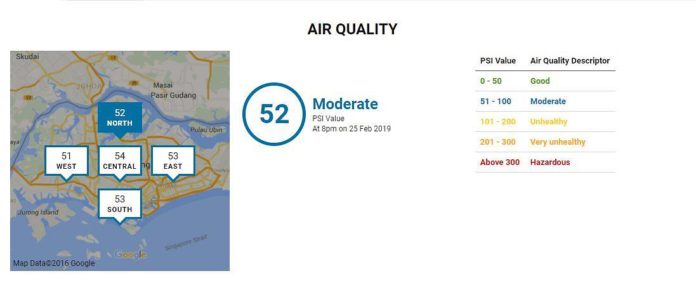
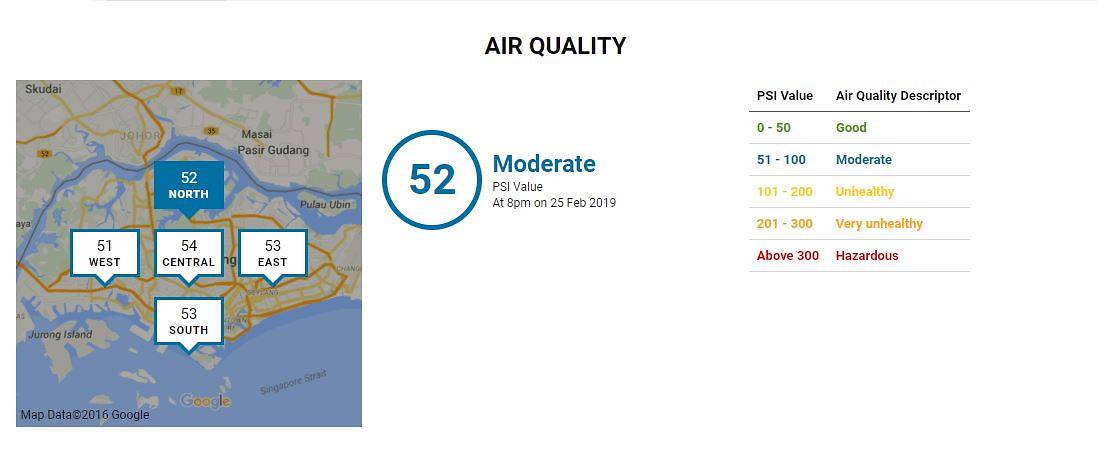
During this period, the pollution standards index (PSI) in the east was 52 to 55, which is in the moderate range. The one-hour PM2.5 readings were in the normal range, said the agency.
PSI readings as of 8pm on Feb 25, 2019. (Image: NEA)
“We are closely monitoring the air quality,” said NEA.
“Members of the public, including the elderly, children and those with lung/heart diseases, can continue with normal activities.”
Singapore needs to double down on restructuring as its labour force growth tapers or companies will find it even harder in the future, says the Finance Minister.
Finance Minister Heng Swee Keat during his visit to ST Engineering’s aerospace facility on Feb 25, 2019.
(Updated: )
Bookmark
SINGAPORE: Labour-intensive sectors will face more stress as Singapore doubles down on its economic restructuring push, Finance Minister Heng Swee Keat said during a visit to ST Engineering’s aerospace facility on Monday (Feb 25).
Mr Heng noted that Singapore’s workforce growth is tapering, and if the country does not use this narrow window to double down on restructuring, companies will find it even harder in the future, reiterating a point he had made in his Budget speech in Parliament last Monday.
“If we do not change, then we will be hitting a dead end and changes later on will be that much harder. So it is far better for us to take the more difficult road today so that we will reach the destination,” he said.
Mr Heng said companies will need to “upskill” the local workforce, and tap on technology, like automation, to address the shortage of skilled manpower.
“Rather than looking at problems, I want to focus on solutions,” he said.
Mr Heng cited the example of ST Engineering Aerospace, which has managed to reap the economic and productivity benefits of technology through initiatives like automated equipment that replaced labour-intensive processes and digital systems that encourage a paperless workflow.
“ST Engineering is among the first few companies in Singapore to set up an in-house training council, to work more closely with the National Trades Union Congress (NTUC) and to look at the training of their workers,” Mr Heng said.
“I hope that many more companies will embark on this because I think it’s important for us to devote time, attention and resources to the upgrading of our workers.”
Mr Jeffrey Lam, deputy president of ST Engineering Aerospace said the company invests millions in technology and engineering development annually.
“We realise that to stay competitive, we need to continue to invest in technology and training of our workforce, so as to ensure that they can continue to be relevant,” he said.
Mr Lam added that the company will also continue to tap on new grants and schemes as well as existing ones that have been extended in this year’s Budget.
“This year’s Budget is very useful because it’s highly focused on bringing technology to companies and improving workforce productivity and relevancy. This Budget has gone a lot further than before in terms of targeting the areas that need support,” he said.
Economic transformation was one of the long-term imperatives flagged by Mr Heng in his Budget speech.
A combination of new initiatives and expansion of existing schemes worth S$1 billion was announced to help companies scale up and digitalise.
For instance, the Enterprise Development Grant and Productivity Solutions Grant will be extended for three years, up to 2023, in order to help firms cope with changes in restructuring and upgrading.
SINGAPORE: More first-time drug abusers were arrested last year compared to 2017, with the majority arrested under 30 years old, said the Central Narcotics Bureau (CNB) in a press release on Monday (Feb 25).
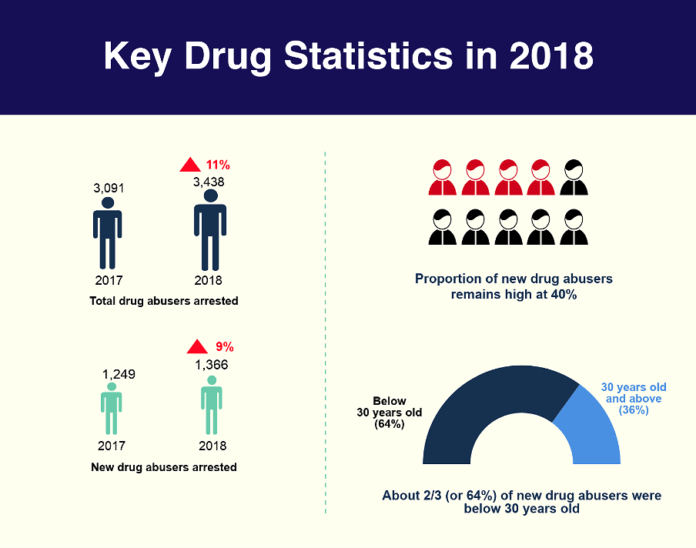
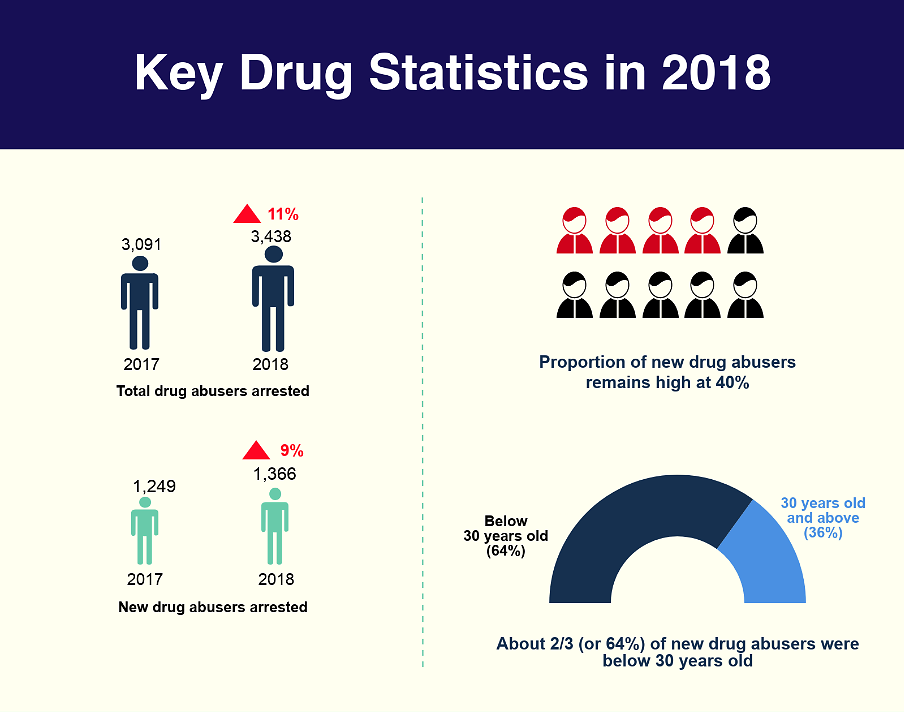
A total of 3,438 drug abusers were arrested in 2018, an 11 per cent increase over the 3,091 arrested in 2017.
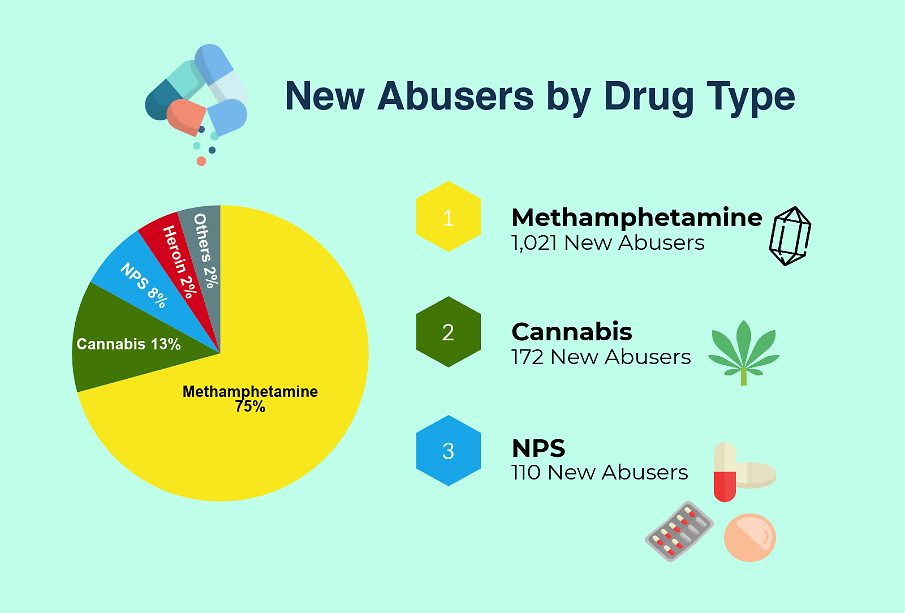
New abusers continue to form a significant proportion – about 40 per cent – of all abusers arrested.
(Source: Central Narcotics Bureau)
Of the 1,366 new drug abusers arrested in 2018, about two-thirds (64 per cent) were younger than 30.
There were also more repeat drug abusers arrested, with an increase to 2,072 last year from 1,842 in 2017 (12 per cent).
CNB attributed the rise in the number of abusers arrested to an increase in the number of new psychoactive substances (NPS) and methamphetamine abusers.
“Notably, the production and trafficking of methamphetamine have increased to alarming levels, and the market for new psychoactive substances continues to evolve,” said CNB.
The drugs seized in 2018 had an estimated street value of about S$6.65 million.
Methamphetamine, heroin and NPS were the three most commonly abused drugs in 2018.
(Source: CNB)
CNB ENFORCEMENT EFFORTS
Together with the Singapore Police Force and the Immigration and Checkpoints Authority, CNB conducted 19 island-wide operations targeting drug traffickers and abusers in 2018.
“We dismantled 26 drug syndicates, and worked closely with other Home Team agencies to conduct close to 1,600 operations targeting drug traffickers and abusers across Singapore, including at our land, air and sea checkpoints to intercept drugs entering Singapore,” said CNB director Ng Ser Song.
The regional drug situation remains of great concern, it said, adding that methamphetamine production and trafficking in Southeast Asia rose to an all-time high in 2018.
“Close proximity to such large scale drug production regions places Singapore at a high risk of being a target for drug trafficking syndicates,” CNB said.
The bureau conducted 19 joint operations with its international counterparts to tackle the transnational activities of drug syndicates.
AMENDMENTS TO MISUSE OF DRUGS ACT
CNB highlighted that recent changes to the Misuse of Drugs Act (MDA) has criminalised acts which facilitate or promote drug use, as well as acts of endangerment, such as exposing a child to drugs or drug paraphernalia, or permitting a young person to abuse drugs.
Parents of youth drug abusers under CNB’s supervision order will also need to attend the counselling sessions with their child.
“The changes to the MDA also strengthens the rehabilitation regime for drug abusers to provide them with more support to break the cycle of addiction and reintegrate into society,” said CNB.
“Those who only abuse drugs, without facing other concurrent charges, will be channelled to rehabilitation if they admit to drug abuse. Drug abusers who face other concurrent charges will continue to be charged and be liable for sentencing to long-term imprisonment, if applicable.”
CNB also stepped up outreach efforts to youths to raise awareness on the harm of drug abuse, encourage them to stay away from drugs, and it established a network of youth anti-drug advocates.
Foreign Affairs Minister Vivian Balakrishnan has been appointed Acting Minister for Transport in the Singapore-Malaysia bilateral talks.
Transport Minister Khaw Boon Wan. (Photo: Jeremy Long)
(Updated: )
Bookmark
SINGAPORE: Coordinating Minister for Infrastructure and Minister for Transport Khaw Boon Wan is on extended medical leave after fracturing his arm, the Prime Minister Office’s said in a statement on Monday morning (Feb 25).
Mr Khaw injured his left arm in a fall last week and is currently warded at a hospital and receiving treatment, the statement said. He will resume his duties when he is able to – “probably after several weeks”, it added.
Channel NewsAsia has sought further details from the Ministry of Transport, including on when Mr Khaw’s fall occurred.
The Prime Minister’s Office said Foreign Affairs Minister Vivian Balakrishnan has been appointed as the Acting Minister for Transport in the Singapore-Malaysia bilateral talks.
“This ensures that the ongoing discussions with Malaysia on several transport matters will continue to be well coordinated,” it said.
Senior Ministers of State Lam Pin Min and Janil Puthucheary, as well as Senior Parliamentary Secretary Baey Yam Keng, will assist Dr Balakrishnan on other transport matters and in the Committee of Supply debate, the statement added.
Singapore and Malaysia have been embroiled in a dispute over Singapore’s introduction of new landing procedures for Seletar Airport, which Malaysia said would hamper the construction of tall buildings at Johor’s Pasir Gudang, to the north of the airport. Singapore has disagreed with this.
Another dispute over maritime issues was sparked by Malaysia’s unilateral decision to extend the Johor Bahru port limits in October, and the subsequent intrusion of Malaysian government vessels in Singapore waters.
SINGAPORE: With the launch of RSS Invincible in Kiel, Singapore is the latest Asia-Pacific country to introduce new-generation submarines, riding on a persistent trend observed amongst regional navies in acquiring undersea capabilities.
Notably, just last year alone South Korea launched its first 3,000-ton KSS-III submarine that has enhanced long-range missile strike capabilities. Japan too has introduced the world’s first submarine equipped with lithium-ion batteries for enhanced underwater performance.
Further south, Australia just last week inked a strategic partnering agreement with France, committing to the 12-boat, US$50-billion Future Submarine programme.
But it is in Southeast Asia that Singapore’s latest addition to its navy becomes significant. Customised to the navy’s requirements, the new Type-218SG with its in-built air independent propulsion (AIP) and larger weapons load is arguably the most sophisticated submarine introduced by far in the region.
The 3,000-tonne diesel-electric submarine, Dosan Ahn Chang-ho, is seen during a launching ceremony at a shipyard on the southern island of Geoje. (Photo: AFP/YONHAP)
JUSTIFYING THE EXPENSE?
Singapore began operating submarines in the 1990s, purchasing second-hand boats from Sweden.
The first four boats, the Sjoormen (renamed Challenger) class, seeded the navy’s initial undersea operational and training capacity. They were built in the 1960s, and progressively retired as the pair of 1980s-vintage newer Vastergotland (renamed “Archer”) class entered service after 2005.
Usually a warship can serve up to 30 years, maybe 40 years with careful maintenance. But aged platforms are generally less cost-effective to upgrade for extended service, and is less safe to operate.
Acquiring a submarine capability is time-consuming and resource-intensive. Without timely replacement, a pre-existing submarine capacity may be lost over time.
Not many people know that Thailand was in fact Southeast Asia’s first submarine user, operating four Japanese-built boats from 1938 to 1951. Since then, without replacement, the Royal Thai Navy saw the erosion and eventual loss of its submarine capacity, which had to be built from scratch again at huge expense with its recent decision to purchase three boats from China.
Putting aside the practical issue of sustaining a painstakingly built military capability, the question is why pursue a submarine capability of all naval platforms?
Defence Minister Ng Eng Hen giving a speech as the submarine, christened the Invincible, is launched in Kiel, Germany. (Photo: Jeremy Koh)
A submarine, unlike a surface warship, operates unseen underwater – it can only be heard on sonar. The underwater environment is complex, and sonar technology is still short of perfect. One may mistake sounds made by a marine mammal for a submerged submarine.
The submarine’s stealth qualities when submerged makes it a formidable foe to any naval planner.
During the Falklands War in 1982, the Royal Navy expended much effort without success to hunt for a single Argentine submarine San Luis which was regarded as a single major threat to the British fleet off the isles even after Buenos Aires refrained from committing its surface fleet – including its sole aircraft carrier – following the loss of battlecruiser “General Belgrano” to the British submarine “Conqueror”.
The disproportionate amount of countermeasures undertaken by an anti-submarine force just to locate and destroy one submarine thus complicates the adversary’s strategy, causes diversion and may be potentially decisive in an armed conflict.
This may explain the persistent allure of the submarine to Asia-Pacific navies seeking to bolster peacetime deterrence.
In Singapore terms, submarines are quite literally the poison shrimp.
But doesn’t Singapore’s acquisition risk sparking off an arms race? This is a frequently asked yet cliched question. Broadly speaking, an arms race constitutes an action-reaction cycle between countries seeking to enhance their military capabilities over their perceived or actual adversaries.
Submariners from the Republic of Singapore Navy operate the Submarine Steering and Diving Trainer. (Photo: Matthew Mohan)
Such a phenomenon takes on both quantitative and qualitative dimensions. The first deals solely with pure numbers. The latter concerns the inherent capabilities of a submarine.
Whether Singapore’s latest Type-218SGs would provoke a submarine race in Southeast Asia at least, requires a nuanced examination. The Republic of Singapore Navy will ultimately have just the four Type-218SGs after 2024, which represents overall no expansion in fleet size once all ex-Swedish boats are retired.
From a mere “bean-counting” perspective, Singapore may not be altering the naval power balance in the region.
However, like many other Asia-Pacific navies because of the exorbitant expense involved, Singapore may not be introducing more submarines but at 70m long and displacing 2,200 tonnes while submerged, the Type-218SG is without doubt larger and more capable.
It has a built-in German-made fuel-cell AIP technology for prolonged underwater endurance – meaning, less frequent need to “snort” or consume air to replenish its batteries. This feature does not represent a drastic capability step-up since the Archer class already operates the Swedish Stirling AIP that serves the same function, albeit with a 50 per cent increase in submerged endurance.
But because of its larger capacity, the Type-218SG has ample room for future upgrades. This means keeping with the evolving threat environment Singapore may face in the future to progressively enhance the submarine’s capability without necessarily expanding the fleet.
This means the latent potential to equip the Type-218SG with weapon systems such as long-range offensive strike missiles even though at present it is not armed with such. A submarine paired with unmanned underwater vehicles can also greatly enhance the boat’s discretion.
Unlike a surface warship that has multiple peace- and wartime functions, a submarine is by inherent design built to shoot and destroy. In times of peace, the submarine’s primary purpose is to conduct surveillance – either shadowing targets of interest out at sea, or even sneaking up a foreign coast to collect vital intelligence.
The 70-metre long vessel, christened the Invincible. (Photo: Jeremy Koh)
Therefore, when seen in the context of the Asia-Pacific geopolitical flashpoints, such as the South China Sea disputes, it is difficult to ignore the destabilising potential of submarine proliferation.
Recall the infamous “Whiskey on the Rocks” saga involving a Soviet submarine inadvertently grounded on Swedish shores, close to a sensitive naval installation in 1981.
Tensions were high over almost two weeks of diplomatic quarrel and military posturing between Moscow and Stockholm. It is no longer the case of whether a similar incident will happen in the Asia-Pacific, but a question of when.
In January last year, a Chinese submarine was detected and tracked by Japanese naval forces before it surfaced off the disputed Senkaku or Diaoyu Islands in the East China Sea. This incident, which fortuitously did not develop into an incendiary situation, appears to be a harbinger of future risks in store.
Nevertheless, of more immediate concern would be the more likely, potential risks of an underwater accident involving submarines, especially in the congested Asia-Pacific waterways.
Political sensitivities over national sovereignty in the region may impose additional stumbling blocks against efforts to promote submarine safety.
Less intrusive preventive measures, such as Singapore’s Submarine Safety Information Portal (SSIP) and Underwater Code on Unplanned Encounters at Sea (UCUES) could be the possible starting point. These voluntary, non-binding mechanisms only promote information-sharing about navigational hazards and standard procedures to prevent and mitigate underwater accidents, not such sensitive data as submarine locations.
Submariners from Republic of Singapore Navy operating the Submarine Combat Tactical Trainer. (Photo: MINDEF)
The Asia-Pacific is witnessing the fastest rate of submarine proliferation, yet underwater safety measures ominously lag behind. Therefore, it is time for regional governments to rethink their positions on bolder submarine safety measures, along the lines of water space management and prevention of mutual interference mechanisms for submarine operations that advanced militaries have applied, including those under the North Atlantic Treaty Organisation (NATO).
These initiatives may eventually be kickstarted by a group of like-minded, Asia-Pacific navies as a minilateral framework, which can then be gradually expanded in membership. Getting more countries on board seed initiatives such as SSIP and UCUES may be a way forward. They may be modest measures, but at least much better than waiting for a submarine mishap to happen one day.
Collin Koh is research fellow with the Maritime Security Programme, at the Institute of Defence and Strategic Studies, S. Rajaratnam School of International Studies, based in Nanyang Technological University, Singapore.