Home Blog Page 761

From Lim Chu Kang to Dempsey, the enormous struggle of moving a 150kg arapaima fish

SINGAPORE: Wading through a murky pond on a private property deep in the farmlands of Lim Chu Kang, farmer Shannon Lim is on a mission to capture a monster lurking just beneath the surface.

After seeing a flash of pink scales, the 32-year-old reached into the water and grabbed an arapaima that was so big, his hands could not touch when they wrapped around the fish. (He later estimated the fish to be 2m in length, weighing 150kg.)

His next move was to trap the arapaima with a net then move it to shallower ground, where six people could somehow jump on it and haul it out of the fast-draining pond.

But as Mr Lim dug his toes in, the torpedo-shaped monster pushed back.

The arapaima moved all 92kg of him – “like when a mum drags a kid through a mall” – before knocking back its head against his chest, creating a furious splash and sending him flying into the water.

Fortunately, Mr Lim’s protective vest absorbed most of the impact. If not it would have been an emergency trip to the hospital, “or I’d be dead”. 

“It’s one of those things where you have to recognise that as a person, you can’t win,” he told CNA on Friday (Jul 5).

UNDERSTANDING THE ARAPAIMA

Still, Mr Lim is trying to rehome the arapaima and other fish in the pond before they face almost certain death beyond 2021, when the lease for the plot in Lim Chu Kang runs out.

If no-one adopts the fish, their owner, who declined to be named, said they would have to be transferred to a nearby pond that supposedly leads to Kranji Reservoir, where chances of survival are low.

arapaima move Lim Chu Kang farm

The private show pond in Lim Chu Kang. (Photo: Aqil Haziq Mahmud)

Native to South America, the arapaima is one of the world’s largest freshwater fish, capable of reaching 3.5m long and weighing up to 300kg. Common prey include a variety of fish, crustaceans, insects and land animals small enough to fit in its mouth.

Unlike most fish, the arapaima breathes oxygen through its mouth, meaning it comes up every now and then for a gulp of air. This allows it to live in murky, slow-moving waters that are usually very low in oxygen.

The fish owner said his father bought some 50 arapaima babies about a decade ago to keep as pets. As the years went by, people put other unwanted fish – like alligator gars, pacus and catfish – into the pond.

Now Mr Lim said there are about 90 fish – including at least two arapaimas – in the pond, and he has pledged to adopt and move all of them to another site at Dempsey Road. There, most of the fish would be ornamental.
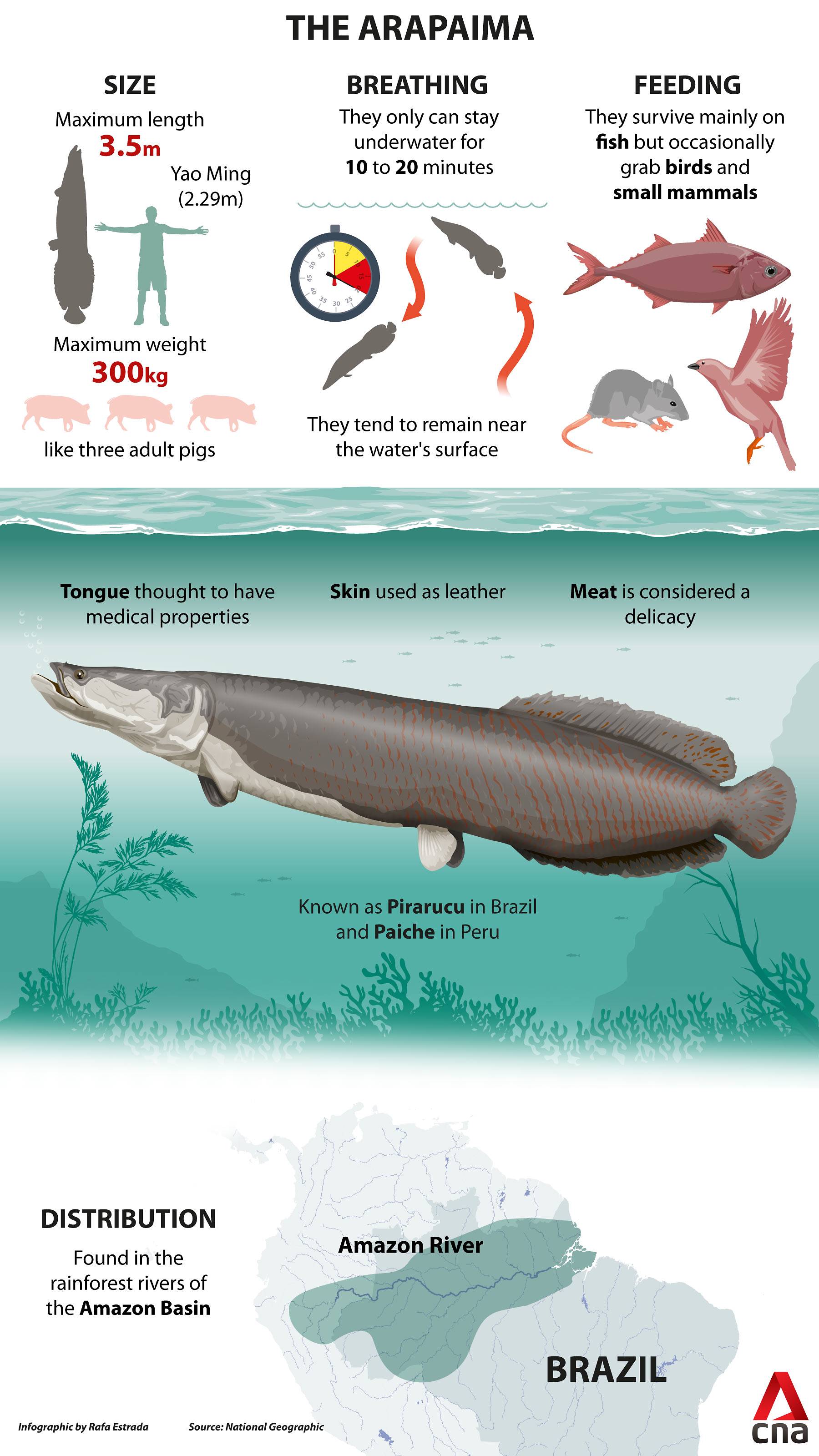
Arapaima graphic

As for the arapaimas, Mr Lim plans to breed them and export their meat – which he said costs more and tastes better than the locally popular sea bass – to major markets like Japan and China. He will also sell “small amounts” in Singapore.

This kind of business is lucrative, as arapaimas grow much faster than sea bass: Mr Lim said they can go from babies to 10kg in 14 months, while the latter can only hit 1kg in the same amount of time.

For those living in the Amazon basin, the arapaima has for centuries been part of their staple diet. So much that since the 1960s, its population has been in steady decline due to increasing human pressure.

In 1975, the arapaima received protection under the Convention on International Trade in Endangered Species of Wild Fauna and Flora (CITES) and was listed under appendix II, meaning commercial trade is allowed only with the relevant CITES permits.

arapaima move Shannon Lim

Mr Lim going into the pond to catch alligator gars. (Photo: Aqil Haziq Mahmud)

When it comes to breeding and exporting, Mr Lim will work out local regulations and partner experts in Peru who have CITES permits and experience handling thousands of the fish each day.

Ultimately, he sees his business model as “conservation through food”.

“Basically, every domestic animal runs almost no risk of going extinct because businesses have a very strong financial incentive to keep them alive,” he said.

GRAPPLING WITH FISH

It is a lofty ambition that must first start with the successful capture of the pink-scaled arapaimas, which has gone on for slightly more than two days without success.

The initial plan was to use ketamine to sedate the fish before carrying them out, but that failed when authorities would not grant permission for the use of the drug.

arapaima move volunteers moving fish

Mr Lim (extreme right) and his team of volunteers. (Photo: Aqil Haziq Mahmud)

The current plan of trapping the arapaima with a net and moving it to shallower ground was not working either, especially as Mr Lim has on each day been working with a team of about five inexperienced volunteers who are understandably afraid.

“The main challenge right now is getting them to put their hands on the fish,” said Mr Lim, who runs a number of farms and has experience handling giant fish. 

“A lot of people are unwilling to put their hands on something that could potentially kill them.”

arapaima move sighting of pink scales

The arapaima would only reveal its pink scales for a split second before disappearing again. (Photo: Aqil Haziq Mahmud)

To give a sense of the risk, Jeremy Wade, the British host of the popular Discovery Channel series River Monsters, was in 2012 slammed in the chest while drawing an arapaima in with a net.

“From nowhere, I had 100 pounds of solid bone smash into me,” he said. 

“Weeks later, a doctor described my injury as similar to the impact of striking a steering column during a car crash.”

During the first arapaima attempt on Jun 30, Mr Lim and a plucky volunteer managed to jump on the fish as a team-mate stood by almost in shock. The arapaima wriggled away and left the pair in a heap, before evading a second but equally futile attempt.

arapaima move catfish

Volunteers transporting a red-tailed catfish. (Photo: Marcus Ramos)

Even before the arapaimas, the relatively large catfish and alligator gars had proven a handful for the motley crew of volunteers, who wore black tactical vests but used basic tools like basins and fishing nets.

Once trapped, the catfish writhed in the basin and swung their muscular tails around like slabs of rubber, while the gars chomped through the nets to create a slimy, tangled mess.

arapaima move catfish up stairs

Sometimes the catfish were hoisted out using fishing nets. (Photo: Aqil Haziq Mahmud)

The sweaty and exhausted volunteers then carried the fish to makeshift holding tanks made from kiddie pools, before transferring them into a large white tank in the back of a pick-up truck. This truck made the half-an-hour journey to Dempsey.

With a process that long and physical, there are bound to be injuries. 

Mr Lim has cut and bruised himself from traversing the rough base of the pond and wrestling the fish. He also felt his shoulder pop out after getting hit by the arapaima.

arapaima move catfish kiddie pool

The fish were put in makeshift holding tanks. (Photo: Aqil Haziq Mahmud)

Every few minutes, it was not uncommon to hear roars, shrieks and expletives ring through the cavernous pond.

DANGERS OF REHOMING

Amid all the chaos, Mr Lim still has to ensure the safety of the fish.

So he came up with a new plan: Remove everything except the arapaima from the pond then drain it completely, causing it to be stuck in the mud. The volunteers would then throw a net over it and try to wrap a yoga mat around its head, protecting it from cracking its skull against concrete.

Then there was the small task of hoisting it up the sloped sides of the pond, when the arapaima was “most likely” to lash out. 

“If someone takes a bad hit, everyone’s going to let go of the fish,” Mr Lim said. “That’s when all the s*** happens.”

arapaima move action shot

The team began its mission near the evening of Jun 29 to reduce the fish’s exposure to heat. (Photo: Aqil Haziq Mahmud)

Mr Lim said nine fish have so far died during rehoming, from causes like overheating and a lack of oxygen during transport. But it was not for a lack of trying.

Mr Lim said he tried to get the most qualified personnel to help with the move, including seasoned fish farmers, divers as well as zoo and aquarium experts. None came.

He also tried getting a crane to help carry the fish, but the companies he approached said their equipment could not fit into the narrow spaces at Lim Chu Kang or Dempsey.

“Singapore is a small country and we exhausted our list,” he added.

NEW SURROUNDINGS

Nevertheless, the operation rumbled on. Mr Lim said about 40 fish have been successfully rehomed in the ponds beside Huber’s Butchery at Dempsey Road.

As each day went by, he tried to improve the process. During the transportation process, he used a smaller tank to make it easier to remove the fish from the truck. He also put ice cubes in the water for species of catfish that prefer cooler temperatures.

arapaima move Dempsey pond

The crowd that had gathered at Dempsey. (Photo: Aqil Haziq Mahmud)

As soon as the truck pulled up, a posse of curious onlookers gathered around the back, whipping out their mobile phones and gawking at the large fish in the tank.

Mr Lim knew there was no time to lose. Panting heavily, he told people to stay clear before dragging a hefty block of plants away from the pond, creating an entry point for volunteers to release the fish.

arapaima move Dempsey Road

The fish have a new home at Dempsey. (Photo: Aqil Haziq Mahmud)

The catfish, by now visibly weak, gratefully slipped into the water and slowly swam away to explore their new home. Children clung to their parents and gestured at the giants, intrigued by how fish could be so big.

But the bigger fish, the arapaimas, still prove elusive. Mr Lim said they will try again on Sunday.

When asked if he would ever give up on his mission, his reply was simple: “No.”
Source link

Commentary: Take your cardio from the shops to the great outdoors

SINGAPORE: The school holidays have ended. I know this, not because I have a brood of school-going kids of my own, but because I see fewer kids everywhere this week than the weeks before that.

My Facebook feed have been filled with selfies of parents posing with their offspring in front of Jewel Changi Airport’s waterfall. This is typically followed up with close-up photographs of a Shake Shack burger or A&W root beer float and curly fries, their victorious spoils after braving long queues to get this nosh.

READ: It’s fast food galore at Jewel Changi Airport. Aren’t parents troubled by our kids’ junk food intake?

At some of the malls which I pass through frequently, like Takashimaya Shopping Centre, I am certain there’s more people milling around these past couple weeks – a mix of bargain hunters trying to snag good deals at the Great Singapore Sale as well as parents with their little ones in tow.

marina square

Marina Square mall. (Photo: TODAY/Kenneth Cheng)

But do you know where I’m not noticing significantly more people? Singapore’s great outdoors.

HUMID WEATHER

Sure, our natural spaces are limited compared to the sprawling landscapes in many other countries, but we do have plenty of charming nooks and crannies to explore.

READ: Head out and enjoy Singapore’s nature spots, a commentary

Since the beginning of the year, I have been spending more time outdoors as part of a resolution to train for a marathon. While I am nowhere near achieving my goal yet, my jogs have taken me to pockets of greenery including the Southern Ridges, Hort Park and Gardens by the Bay.

On my evening and weekend runs, I typically see lots of joggers, cyclists as well as pet owners walking their dogs.

Understandably, tourists throng Gardens by the Bay but I have also been tickled to observe red-faced foreigners braving the heat to stroll around the not-so-typical tourist hotspots like the Southern Ridges and Hort Park. It is a lot harder to spot locals taking the time for a leisurely amble or a picnic in the park.

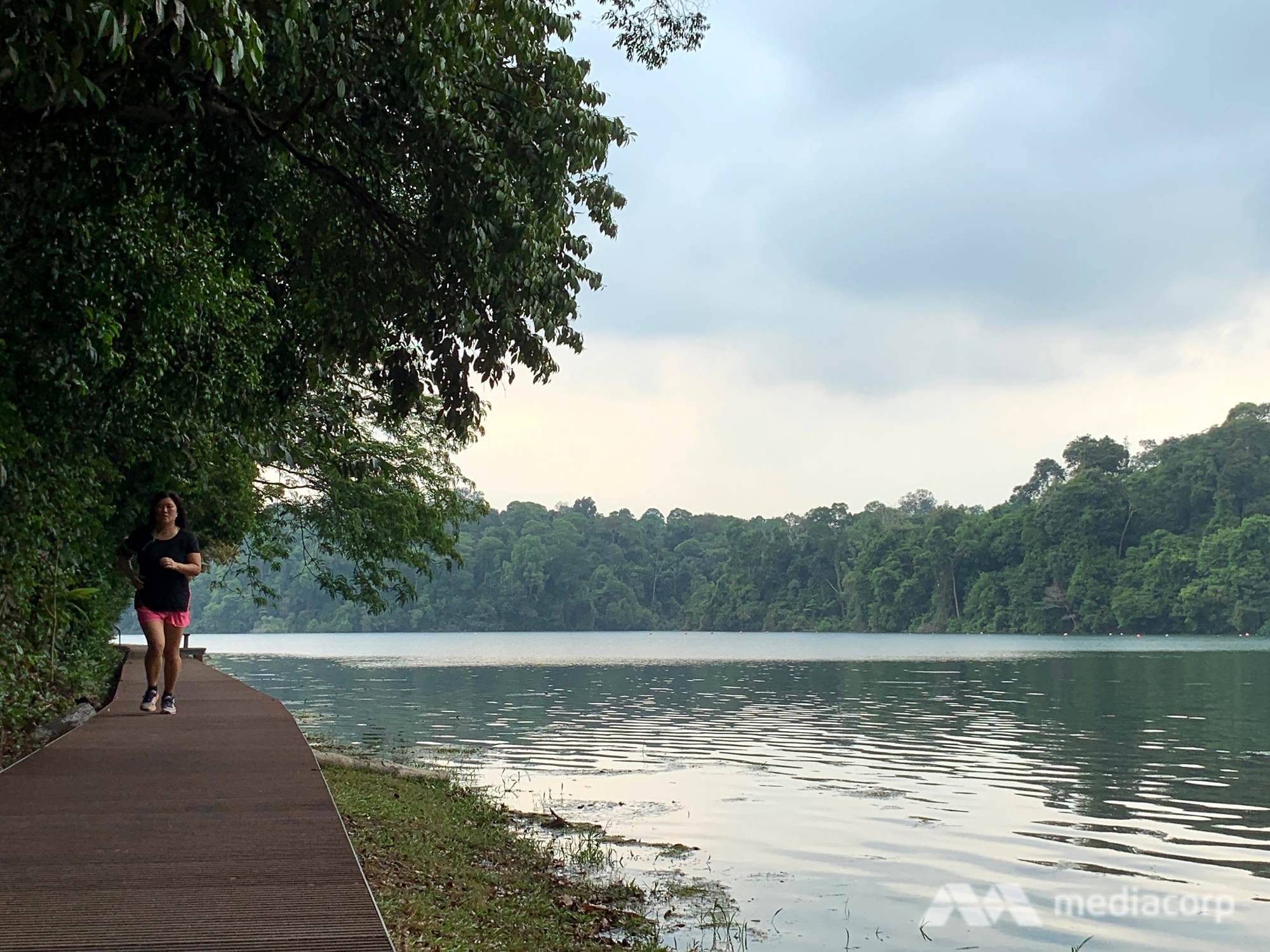
reservoir, jogger, singapore - file photo

A person jogging by the water at a reservoir in Singapore. (File photo: Jeremy Long)

It is common knowledge that the hot, humid weather is a huge deterrent for locals who much prefer air conditioned comfort where they won’t have to break a sweat or risk getting bitten by mozzies and other bugs.

In Singapore, where there are climate-controlled versions of just about every outdoor activity imaginable, from adventure parks for children to gyms and exercise studios for adults and even gardens and waterfalls enclosed in domes, there is really very little reason to step out into the open.

FRESH AIR

But these past few months of small forays into my local parks have been enlightening in many ways. 

For one, compared to trudging away miserably on a treadmill, I have discovered I much prefer running outdoors where there is fresh air to breathe, flora, fauna and passers-by to observe and Singapore’s modern cityscape to admire.

View of Farquhar Garden at Fort Canning Park

The Farquhar Garden is named after Major-General William Farquhar, the first British Resident and Commandant of Singapore. (Photo: National Parks Board)

There is also something magical about being surrounded by nature. It is surprisingly calming and soothing to huff and puff along paths that are lined with lush tropical greenery, and the shade provided by tree foliage overhead helps lower temperatures to a bearable range.

READ: A walk on the wild side: Singapore’s upcoming nature attractions

At the end of the run, instead of feeling flat-out drained, I am almost recharged, as if my time spent outdoors has replenished my energy stores. 

Oh, what a difference this is from the days when shopping was my cardio and I lived for the rush of purchasing something new and shiny, only to have that euphoria dissipate almost as soon as I step out of a boutique.

Research has shown that there are multiple benefits to spending time in nature. Studies are increasingly linking common modern day ailments such as myopia, vitamin D deficiency and a prevalence of allergies to a lack of outdoor exposure.

To get more people moving, the NParks has been working on conserving and strengthening a slew of green spaces around the island to make them more accessible to the public. The latest is the 36km Coast-to-Coast trail that traverses the island.

trail3

The Coast-to-Coast Trail is a 36 km trail that spans across Singapore. (Photo: Alif Amsyar)

Someday, I might just be able to run its entire length but in the meantime, I’ll keep up with my regimen of exploring just a little bit more of the outdoors each time I go on a run.

For now, I’m enjoying the relatively generous amounts of personal space I get at the parks but it would certainly be nice to see more people enjoying the subtle delights that nature offers.

After all, if as a nation, we have enough stamina to queue up for limited edition curry sauce bottles or the latest burgers from a newly opened American fast food chain, we certainly can afford to expend a little bit of energy to walk off those calories.

Just don’t forget to slap on the sunscreen and use an (eco-friendly) insect repellent.

Karen Tee is a freelance travel and lifestyle writer. Six years ago, people thought she was crazy to leave the security of her full-time job. Today, most want to know how she does it.

Source link

The Singaporean boxer who wouldn’t quit, in the ring and in business

SINGAPORE: He had taken more punches than he would have liked, in a fight that went the distance. But it was one that Muhamad Ridhwan Ahmad ultimately won — with one good hand.

Minutes after the cheers from the crowd had died down, off came the hand wraps, revealing a swollen knuckle on the right. The three-month-old injury had got worse since his last fight.

But nothing was going to stop him from relishing his victory on home ground over Indonesia’s second-ranked bantamweight Noldi Manakane.

As he put on an ice pack, the Singaporean pro boxer said, full of hope: “We might be the underdogs in the local Singapore sports scene, but I think we’ve proven that we can bring the people together.

“My dream is not only to be the world champion one day, but also to bring the whole nation together with my fist — my swollen knuckles.”

His swollen knuckle is "the real medal", quips Singaporean boxer Muhamad Ridhwan.

His swollen knuckle is “the real medal”, quips Muhamad Ridhwan.

Rousing words from someone who has refused to knuckle under to pressure in the past nine months, a “roller-coaster ride” that began with September’s split decision loss in a world title fight, followed by another defeat in March.

READ: Boxing: Muhamad Ridhwan fails to claim Singapore’s first IBO world title

The 31-year-old also lost his manager and his long-time trainer. He is locked in a contract battle with fight promoter Ringstar, which still owes him half his purse money from his title tilt. He almost wanted to retire.

But he is fighting for his dreams, trading blows as a pugilist while taking chances as the co-owner of a boxing gym, a business borne out of his love for boxing and desire to take the sport further in Singapore.

At a time when fitness centres and fight gyms are giving him more competition outside the ring, it has been “mentally very taxing” to manage both his personal passion and business commitments, he admitted. And he has “sacrificed so much”.

But as his comeback win a fortnight ago shows, he is intent on living up to a Japanese proverb emblazoned in his gym. It says: “Fall down seven times, stand up eight.”

Inspirational Japanese proverb, in a corner of Muhamad Ridhwan's boxing gym, Legends Fight Sport.

Inspiration, in a corner of Ridhwan’s boxing gym.

CHANCING UPON THE SPORT

Ridhwan, nicknamed The Chosen Wan (TCW), became Singapore’s first professional world champion in the sport when he won the Universal Boxing Organisation world super featherweight title in May 2017.

But he wants to rule the ring in one of the four major boxing organisations, such as the World Boxing Council, which ranked him 25th in the world at featherweight last year before he tumbled out of the top 40.

Despite the slide, his belief that “boxing is something (he) can be really, really good at” has not wavered. Nor has his love for the sport.

To Singaporean boxer Muhamad Ridhwan, "The Chosen Wan" is not just his nickname but a brand.

To Ridhwan, it’s not just a nickname but a brand.

It was not exactly love at first sight, however, when he was introduced to boxing as a 16-year-old. He was a cook in a kitchen where his older colleagues were “always talking about boxing”.

“There was a television there, and it showed classic boxing fights. And that got me interested,” he recounted.

His colleagues kept mentioning one name: Syed Kadir, who represented Singapore at the 1972 Munich Olympics. So the first boxing school the teenager joined was the Olympian’s.

But within months, he became disillusioned. Doing the basics, like skipping, running and the basic punches, were “dull”, unlike the boxing films he had watched, such as Rocky and Cinderella Man.

“I didn’t see much sparring back then. And it didn’t feel (as if) the sport was going anywhere,” he recalled.

Singaporean boxer Muhamad Ridhwan in his younger days.

In his younger days.

On the day he was going to dump his boxing gloves, his coach told him there was an opportunity to fight two months later, in a local tournament.

“I said, ‘Okay, why not? It should be easy, right?’” he recalled with a smile. “I prepared as best as I could. I was still working full-time … I was able only to train maybe once or twice a week.”

He was still full of confidence and felt “super ready”. But he lost in the first round, a defeat that “brought out the fighting spirit” in him. Lessons learnt, he worked on improving his boxing techniques.

At the age of 23, in the 2011 Southeast Asian (SEA) Games, he bagged a bronze, a feat he repeated at the next two Games.

Team Singapore fans cheering on Muhamad Ridhwan, who competed in four SEA Games, from 2009 to 2015.

Team Singapore fans cheering on Ridhwan, who competed in four SEA Games, from 2009 to 2015.

In 2014, two years before he turned pro, he and his friend Fairuz Mohamed set up their boxing gym Legends Fight Sport because he believed the sport needed coaches before it could go further in Singapore.

“I’ve travelled to Sri Lanka, Australia and many other countries to compete and to experience the coaching levels. And I realised that in Singapore, we do have a lot of talent, but we don’t have the knowledge,” he explained.

To date, he is the only boxing coach here to receive a coaching scholarship — to Hungary — from the International Olympic Committee.

SETBACKS AND COMPLICATIONS

When it comes to his pro boxing career, Ridhwan is the first Singaporean to hold the World Boxing Association’s Asia Featherweight Championship belt, which he clinched in 2017.

He started with 11 straight wins (eight knockouts), before his winning streak came to a halt last year.

Previously as an amateur who fought, by his count, about 140 to 150 fights, he had lost “a lot of times”. But the difference as a pro, he said, is that he lost “in front of thousands of people, not only in Singapore but internationally”.

“And I’m on YouTube. Everyone can see that over and over,” he added. That was how he felt before he started to accept that losing is “part of life”.

“That you have to be undefeated, I think, is overrated already. I think what matters more, what’s more courageous, is if you’ve lost and you can come back … until you reach your goals.”

In the end, losing his title fight against Namibian boxer Paulus Ambunda was not as “painful” as seeing people in his team leave — “people who I thought would be with me till the very end because they said they would”.

While his ex-trainer, former Philippine amateur boxing champion Rey Caitom Jr, had decided to return to the ring, ex-manager Scott Farrell, the then chief executive officer of Ringstar Asia — which holds Ridhwan’s contract — has switched to Ambunda’s camp.

Not once, however, did Ridhwan mention any names to CNA Insider when describing how “the negative news kept coming”.

“It opened my eyes to a lot of things: How some people just viewed me as an asset for their company or for their investment,” he said instead. “I won’t say it’s betrayal; I’d say it’s business, it’s all business.”

Bound to his contract, but with a struggle with Ringstar brewing, he threatened at first to retire — even announcing it on Facebook in January.

He has since sought out a legal team to get the S$15,000 owed to him and to “find the best solution … a middle ground”.

“But it’s a bit hard because the people in the company are avoiding me. They aren’t in the office, so it’s a bit tricky right now,” he said.

Of the lessons he has learnt from the boxing world, one is that “in life, you’ve got to give more than you take, like in boxing — you’ve got to give more punches than (you) take”.

This is something he has applied to his boxing gym, which works with groups like Trybe, a charity serving the youth, especially those facing adversity.

“(The business) must benefit the community. It must benefit the well-being of the people. That’s why our rates are … competitive, even though we’re in the Central Business District (Carpenter Street),” he said.

“We open our doors to at-risk youth and the Yellow Ribbon Project. We’ve been working with these people, and they’ve shown tremendous improvements. That’s one of the best rewards for doing what we do.”

RISING UP TO THE CHALLENGE

Ridhwan has seen how the sport can make a difference on many levels, including in his life. He has, for example, become “more focused”.

Boxing also got him to go back to school, which he had dropped out of before he first donned his gloves.

Explaining his change of heart, he said: “One day, a youngster came up to me and said, ‘You know what, Ridhwan? I want to be like you. I don’t have to go to school. I’ll just do boxing.’

“Then I realised I was creating the wrong kind of influence … Second, I learned to love to learn.”

Encouraged by others as well, he studied for a Diploma in Sport and Wellness Management at Nanyang Polytechnic. That was where he met his business partner, and how their boxing gym came to be after they graduated.

Through hard work and perseverance, Legends Fight Sport became profitable within a year. But the gym soon faced competition from fitness centres that started offering boxing classes.

That took away some business, but Ridhwan believes the true boxing enthusiast will go a training gym dedicated to the sport.

“People who love the sport, who love to learn the skills — the techniques — wouldn’t go through the motions and just get tired at the end of the day,” he said.

“And the fact that we’re only focusing on boxing (means) we make sure that this is something we’re really good at.”

But committing to training of the highest standards while competing for international titles in the ring can be “very tiring”.

“Sometimes I work the whole day, from 7am to 10pm straight. I have a two-hour break in between, and that’s supposedly my training time,” he shared. “And it goes on for days or weeks.”

He sees it as a necessary sacrifice, proffering this quote on success: “If we keep doing what’s easy, life’s going to get hard. I believe that if you keep doing what’s hard, somehow in the near future, things will get easier.”

For now, however, it is challenging times. He needs more funds to train with his new coach Alexey Volodin, who is based in Kuala Lumpur, and to get “quality sparring partners” overseas.

He plans to have at least three or four more fights by year end — his next fight is on Aug 17 — to get his ranking “up to at least top 40 or top 30”.

“I hope, by then, I can get a sponsor to show that I’m climbing up,” he said. A promoter who can give him high-profile fights, “which pay a lot more”, would also be a great help.

But with or without that kind of added boost, he has already banished all thoughts of hanging up his gloves.

“I have to retire on my own terms — not because the sport forces me to retire or because … I need to try to make the business better. For now, I believe I can make both work,” he said.

And he believes he can keep rising up to the challenges.

Muhamad Ridhwan was also featured on Money Mind, and you can watch the episode here. New episodes every Saturday at 10.30pm.

Source link

5 jailed for falsifying safety permit after Tampines work site accident left worker dead

SINGAPORE: Five people were jailed for falsifying a safety permit after an accident at a Tampines work site left one worker dead, the Ministry of Manpower (MOM) said in a press release on Friday (Jul 5). 

Among them were project manager Chan Yew Cheong, who was overall in charge of work site matters, and site manager Wang Shiyang, who was responsible for safety, work progression and quality.

Both men were sentenced to 10 days’ imprisonment. In addition, Chan was fined S$900 and Wang was fined S$7,500.

Qingjian International (South Pacific) Group Development Co, the contractor tasked with providing project management services at the work site, was also given a S$205,000 fine for failing in its duties as an employer.

CNQC Engineering and Construction, formerly known as Qingdao Construction (Singapore), has also been charged for failing in its duties as an occupier.

EXCAVATOR MISHAP LEAVES ONE DEAD

On Jan 25, 2016, Wang Shiyang, who was employed by Qingjian as a site manager, instructed site supervisor Zhu Yong Bing to construct a septic tank 3.6m-deep at the work site. To do this, a permit-to-work (PTW) had to be issued by Wang before any excavation work deeper than 1.5m could begin.

According to MOM, the construction site was in the area of Tampines North Drive 1/Street 61/Avenue 6.

Zhu Yong Bing engaged a licensed excavator operator to carry out the job without a permit, MOM said. 

The excavation work ended on Jan 29, 2016 and he tasked six workers, including Mr Xu Shangbin, to get inside the excavation pit to erect formwork structures and rebars. 

Later that day, the site supervisor decided to start concrete casting for the septic tank. He told Mr Xu and two others to get into the excavation pit so they could spread the concrete once it had been poured.

workers standing at accident sit

The excavation site where the accident took place. (Photo: MOM)

Zhu Yong Bing, who did not have a licence to use the excavator, went ahead to operate the excavator with a concrete bucket attached to the excavator’s lifting hook to pour concrete into the pit.

During his second attempt at pouring the concrete, with the excavator’s arm extended to reach the position where the concrete cement was to be poured, the excavator started to topple.

Mr Xu, who was inside the pit, was hit by the concrete bucket. He died due to the multiple injuries he sustained, MOM added.

SIGNING BACKDATED SAFETY PERMITS

MOM’s investigations revealed that several people had signed a backdated permit form after a meeting at Qingdao’s headquarters a day after the fatal accident.

They include workplace safety and health officer from Qingdao Zhu Xiaoyi, safety coordinator from Qingdao Rathinam Ramesh and project director from Qingjian Chan Yew Cheong. Zhu Yong Bing and Wang had also signed the backdated permit form.

“This was intended to give the false impression that a PTW was properly issued before excavation works were carried out on Jan 28, 2016,” MOM said.

It added that before commencing any excavation work, Zhu Yong Bing ought to have applied for the safety permit to be evaluated by safety coordinator Ramesh and approved by workplace safety and health officer Zhu Xiaoyi. 

The permit should have then been issued by Wang in his capacity as a site manager. 

“However, as Wang had not attended the construction safety course for project manager at the material time, the PTW would have to be counter-signed by Chan for approval prior to issuance,” MOM said.

“The falsification of PTW was uncovered following separate interviews conducted by MOM investigators with the five employees involved in the falsification.”

FALSE DECLARATION

“By signing the PTW, the five employees falsely declared that the necessary safety measures were put in place before excavation work began,” the ministry added.

These safety measures entailed steps such as briefing workers involved on safe work procedures and ensuring they were wearing the required personal protective equipment.

“As key members managing the project and overseeing the construction works at the work site, the five employees were responsible for ensuring that necessary safety measures were implemented before carrying out the excavation works,” Mr Sebastian Tan, MOM’s director of occupational safety and health inspectorate said.

“Not only did they fail to do so, they also wilfully misled MOM’s investigation by submitting a falsified PTW form.”

Zhu Yong Bing, who operated the excavator without a licence, was given a three-month jail term for performing a reckless act which endangered the safety of others.

For their offences, Zhu Xiaoyi and Ramesh were jailed for a week for falsifying the PTW. MOM added that Zhu Xiaoyi’s workplace safety and health registration was also revoked. 

Source link

Fire breaks out at Ang Mo Kio central

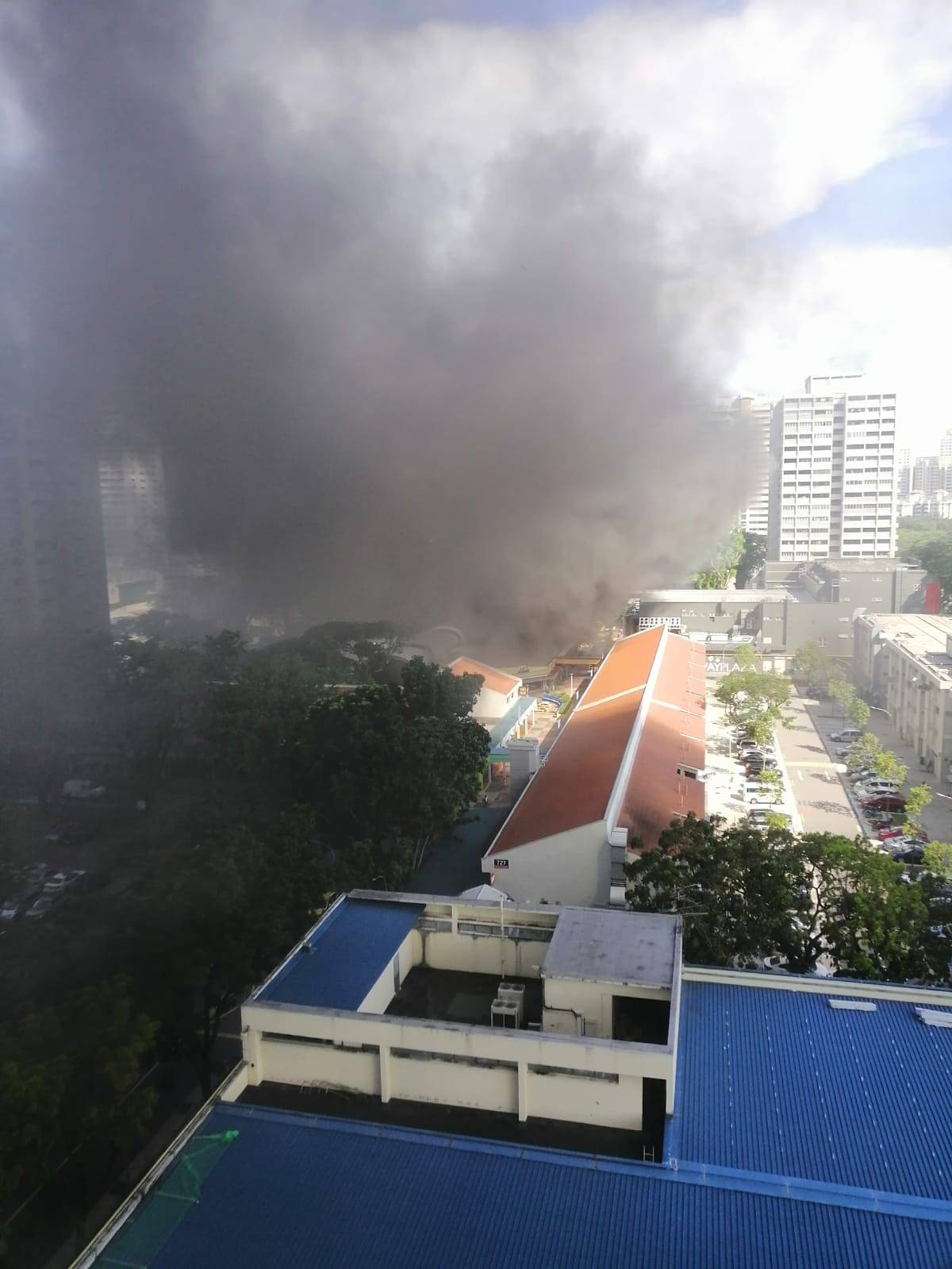
SINGAPORE: A fire broke out at Ang Mo Kio Central on Friday (Jul 5), with firefighters still battling the blaze at about 4.45pm. 

The Singapore Civil Defence Force (SCDF) said it responded to a fire at Block 720 Ang Mo Kio Avenue 6 at about 3.45pm. 

Residents have been urged to stay away from the area.

“SGSecure mobile app users, M1, StarHub and Singtel mobile subscribers within the immediate vicinity of the fire incident would have received an advisory message urging members of public to stay away from the area,” said SCDF in a Facebook post. 

Ang Mo Kio fire Whatsapp

Smoke seen from a building at Ang Mo Kio Central on Friday (Jul 5). (Photo: CNA reader)

Videos and photos posted on social media show thick black smoke rising over blocks of flats. Firefighters are seen trying to put out the fire.

Ang Mo Kio fire

A fire at Ang Mo Kio on Jul 5, 2019. (Photo: Alex Peh)

Fire at Ang Mo Kio Whatsapp

Smoke is seen from Block 729 Ang Mo Kio Avenue 6. (Photo: CNA reader)

This is a developing story. Please refresh for updates.

This story came from a reader tip-off. If you would like to send in photos or videos of something newsworthy, WhatsApp our Mediacorp news hotline at +65 8218 8281 or message us on Facebook.

Source link

New national dental centre set up to cope with rising demand for dental services

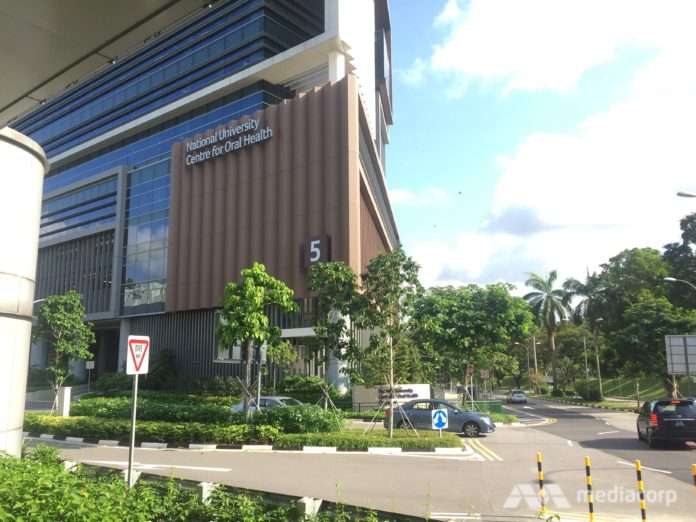
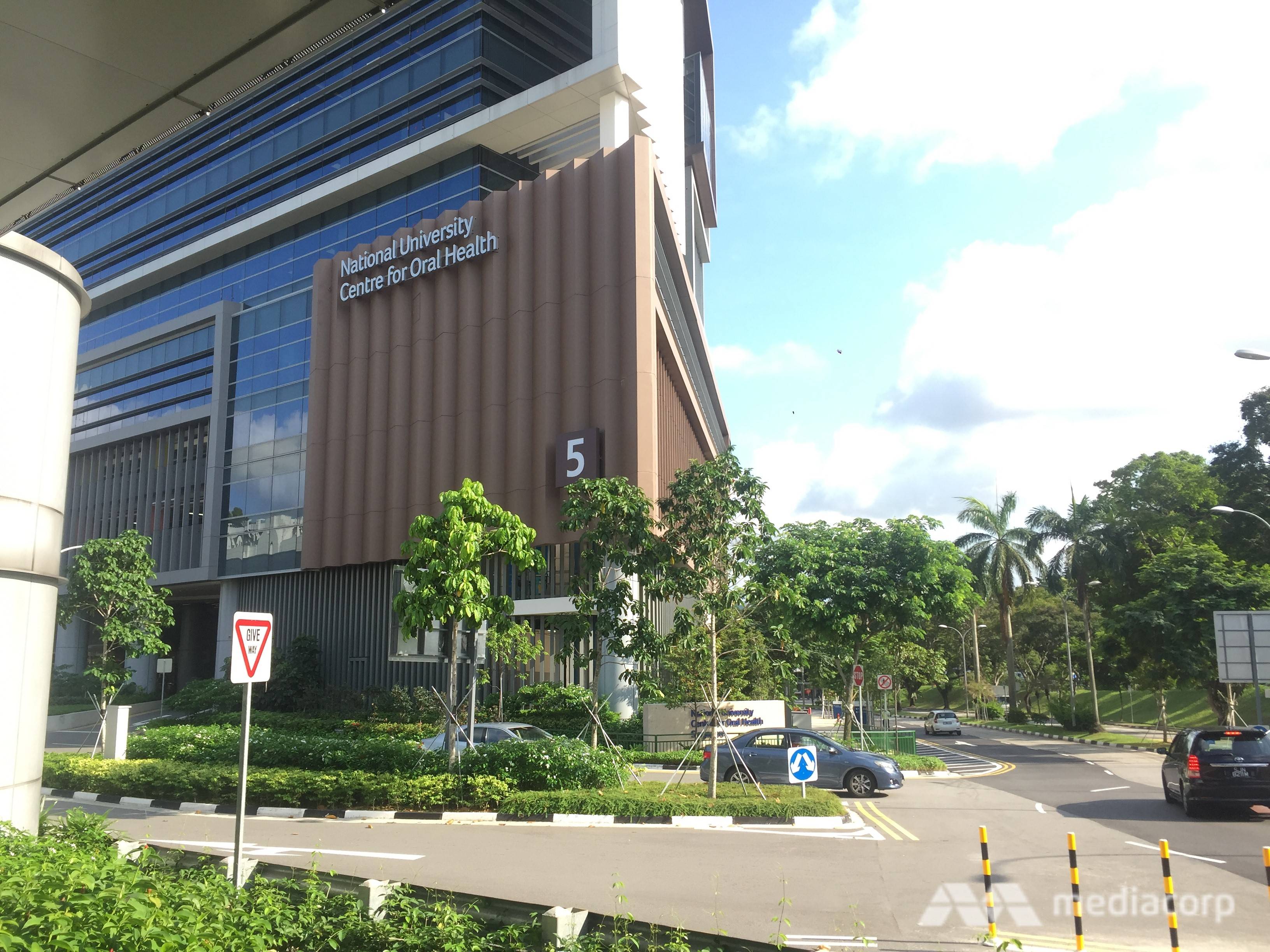
SINGAPORE: The National University Centre for Oral Health (NUCOHS) officially opened on Friday (Jul 5), becoming the second national facility in Singapore to offer specialised dental health services.

Set up to cope with the rising demand for dental services from Singaporeans, the new facility will offer services similar to the National Dental Centre, said NUCOHS director Patrick Finbarr Allen in a media briefing on Tuesday.

“I think the service requirement for Singapore has (gone) up and the population has grown, the population has aged … So the capacity of one centre to cope with that has been outstripped, hence the need for another national centre,” said Dr Allen.

He added that as more Singaporeans become aware of the importance of maintaining good oral health, more are seeking out basic and specialised dental services.

Located at the National University Health System (NUHS) Kent Ridge campus, the new dental centre has been operational since January. The centre brings together dental services from the National University Hospital, Ng Teng Fong General Hospital, Alexandra Hospital, Jurong Medical Centre and National University Polyclinics with the National University of Singapore’s (NUS) Faculty of Dentistry.

NUCOHS was set up to cope with the rising demand for dental services in Singapore

The National University Centre for Oral Health was set up to cope with the rising demand for dental services in Singapore. (Photo: Cindy Co)

Speaking at the official opening, Health Minister Gan Kim Yong highlighted the need for an increase in capacity to properly treat patients with oral health problems.

“Many oral health problems can be prevented by practising good oral hygiene and care … But for those with more complex dental problems, our two national dental speciality centres are there to care for them,” he said.

“Together with the existing National Dental Centre Singapore in Outram Campus, NUCOHS will significantly increase capacity for subsidised specialist dental treatment for more severe or complex dental conditions.”

In line with the rising demand, NUCOHS increased its capacity from 300 patients a day at National University Hospital’s (NUH) University Dental Cluster to treating 500 patients a day when fully operational. This represents a 40 per cent increase from NUH’s current patient capacity.

NUCOHS also has facilities for people with special needs.

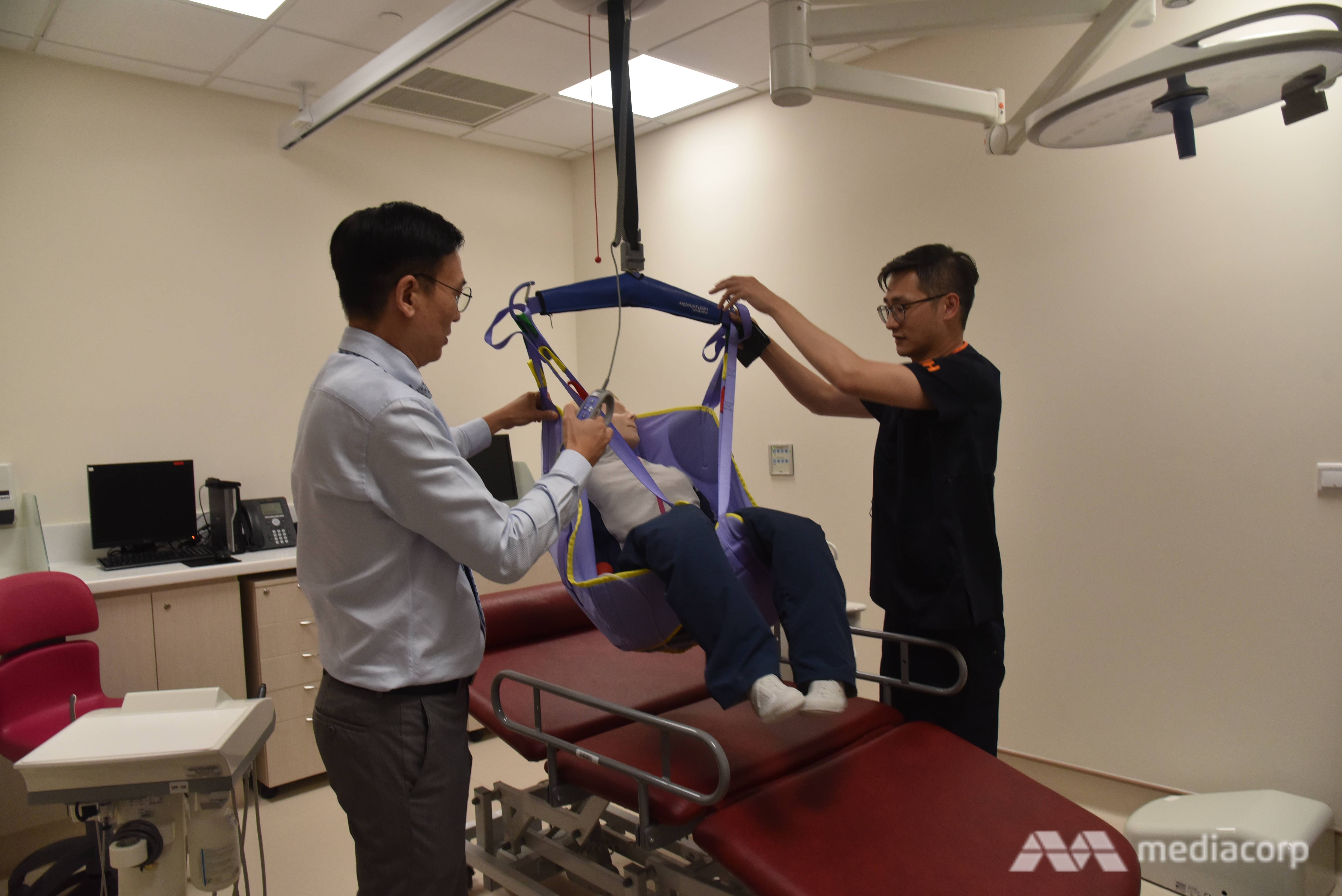
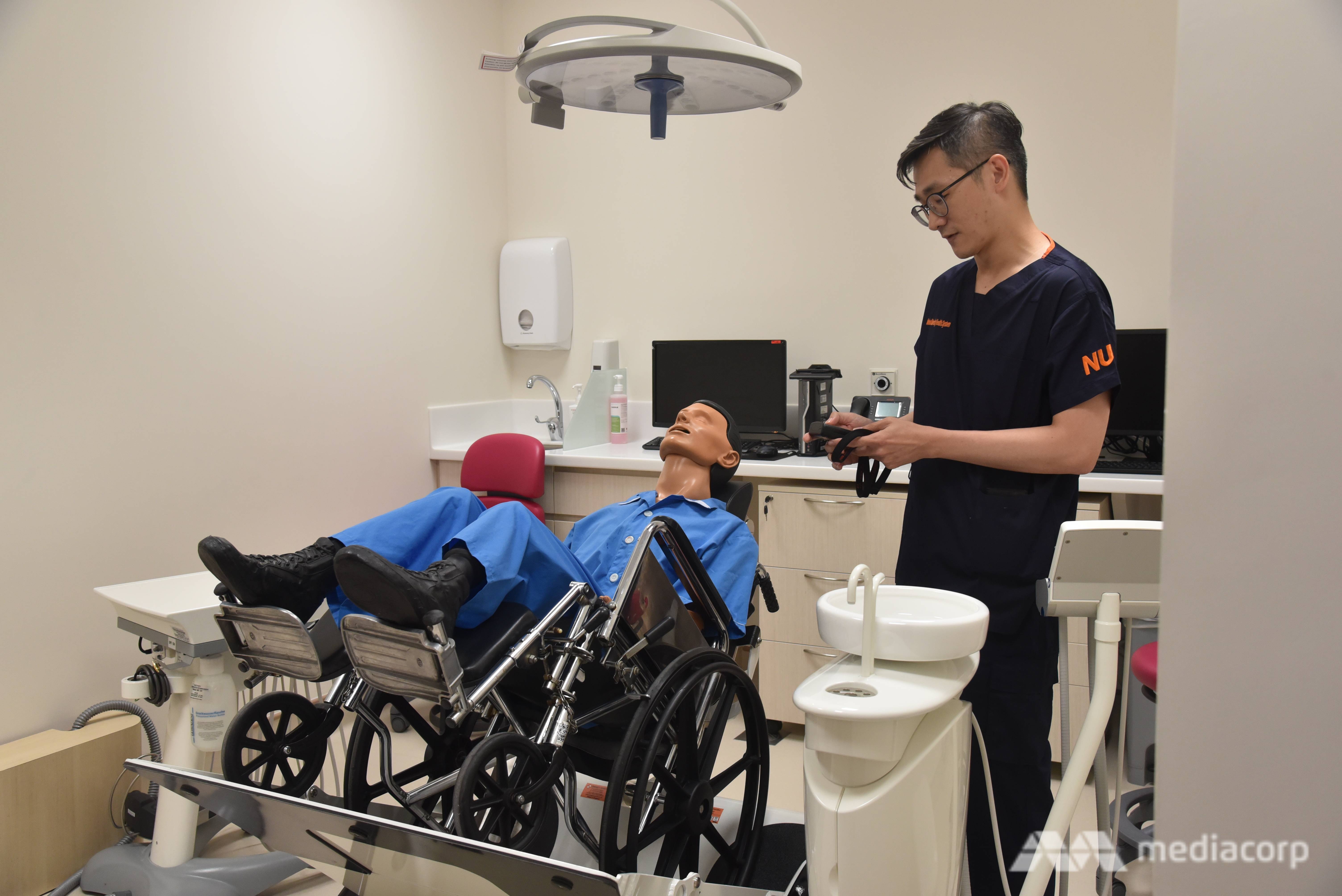
Bariatric chairs with a weight limit of 325kg are available for obese patients, and a hoisting aid helps to move immobile patients onto the chair. A wheelchair tilter allows dentists to work on patients in wheelchairs without having to carry them onto a dental chair.

A hoist mechanism lifts immobile patients to a dental chair

A hoist mechanism lifts immobile patients to a dental chair. (Photo: Cindy Co)

Wheelchair tilters allow dentists to work on patients in wheelchairs

Wheelchair tilters allow dentists to work on patients in wheelchairs without having to carry them onto a dental chair. (Photo: Cindy Co)

Four larger treatment rooms are also available for patients with special needs such as claustrophobia or behavioural issues.

NUCOHS offers subsidised patient care, and it plans to work with polyclinic groups to provide dental care for patients nationwide.

Patient Geraldine Oi, 52, has been seeing the dentists at NUCOHS – who were previously from NUH’s University Dental Cluster – for 14 years. She pays an unsubsidised average of S$80 to S$100 per visit for basic check-ups and cleaning.

She finds that service has “gotten better” and that she enjoys her visits to the dentists at NUCOHS, as it is “not fearful” and “like a family outing”.

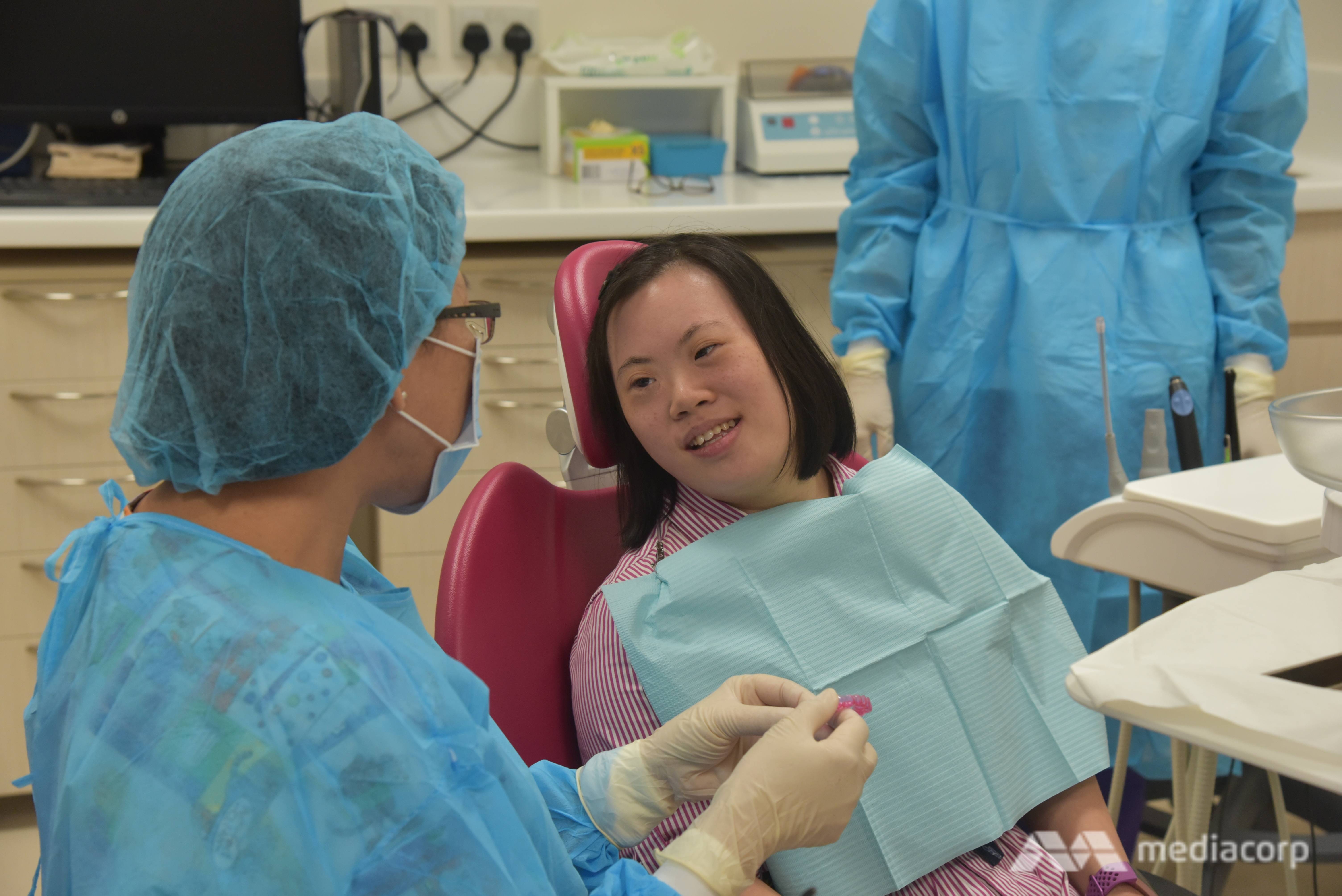
Ms Marianne Lim talks to her dentist at a consultation session

Ms Marianne Lim talks to her dentist at a consultation session. (Photo: Cindy Co)

Patient Marianne Lim, 23, has been with the dental team since 2003, and has developed a good relationship with her dentist. She said she likes the new building as it is comfortable and the decor is cheerful.

Other than patient services, the 11-storey building also has training and research capabilities, as part of its partnership with the NUS Faculty of Dentistry. Two levels are dedicated to research laboratories.

A student uses virtual reality to practise drilling a tooth

A student uses virtual reality to practise drilling a tooth. (Photo: Cindy Co)

In a first in Singapore, dental students training at NUCOHS use virtual reality (VR) technology to guide them in their learning. Using the VR simulation, they practise drilling and injections on dummies in a controlled environment, before moving on to practise on people.

NUCOHS said it hopes to eventually expand its facility, and extend its research into artificial intelligence and robotics capabilities to support its training and dental services.

Source link

Singapore Airlines to launch S$50 million upgrade of its Changi Airport Terminal 3 lounges

SINGAPORE: Singapore Airlines (SIA) customers can look forward to bigger spaces, upgraded facilities and more food selections when they visit SIA lounges at Changi Airport Terminal 3 from 2021.

The airline said on Thursday (Jul 4) it will spend more than S$50 million to revamp its SilverKris and KrisFlyer lounges to make them look “modern yet homely”. Hospitality designer Hirsch Bedner Associates has been engaged to “inject a fresh look”, SIA said.

“The new lounges will offer more generous open spaces, upgraded facilities and a wide array of F&B selections, all tailored to the needs and preferences of our customers,” the airline added in a news release.

Artist impression of SIA new Changi Airport lounges

Artist impression of Singapore Airlines’ new Changi Airport T3 lounge (Photo: Hirsch Bedner Associates) 

READ: Singapore Airlines, Malaysia Airlines sign deal to expand codeshare ties

The new Business Class lounge will be expanded and will have different zones to cater to travellers with different needs. 

“Customers with a short transit can have a light snack in a relaxed cafe setting, while those with more time to spend may explore a full selection of Asian and international cuisines in the dining hall,” the airline said.

It will also include a full-service bar that will double up as a self-service breakfast station in the morning. For those looking to catch a nap, a rest area with chaise lounges will be provided for customers. 

Artist impression of SIA new Changi Airport T3 lounges 3

Artist impression of Singapore Airlines’ new Changi Airport T3 lounge (Photo: Hirsch Bedner Associates) 

First Class customers will be treated to a new flagship bar and a full-service fine dining section within the lounge. Krisflyer Gold lounges will double in size and include dedicated work spaces, as well as large al fresco seating and dining areas. It will also be equipped with restrooms and showers.

“With extensive research and feedback garnered from our customers, we have re-looked and re-envisioned our customer journey to develop this new design concept for our lounges at Terminal 3,” said Mr Marvin Tan, SIA’s senior vice president for Customer Services and Operations.

“The project is a key part of our commitment to constantly elevate the customer experience, on the ground as well as in the air, and we look forward to revealing the exciting new offerings as construction progresses.”

Renovation is set to start in August and is expected to be completed by mid-2021.

Source link

‘Fittest will survive’: Singapore’s 4th telco TPG confident of thriving amid growing competition

SINGAPORE: “The fittest will survive.”

That was the response from TPG Telecom’s general manager Richard Tan, when asked if Singapore’s fourth telco would be able to withstand the intense competition from the mobile virtual network operators (MVNOs) that have sprung up since it won the license bid back in December 2016.

Mr Tan, in an exclusive interview with CNA on Wednesday (Jul 3), credited its entry into Singapore’s previously insular telecom sector as the reason for the ongoing market shake-up and opened the door for the re-appearance of MVNOs since the ill-fated foray by Virgin Mobile back in 2001.

“For the longest time, there wasn’t (any) MVNOs. Why? The reason is because the mobile network operators (MNOs) never provided the conditions to support the entry of an MVNO,” he explained. “Because of the fourth (telco) licence, the door was open for MVNOs to come in because the MNOs realise that the rules of the game, to some extent, for the market has changed.”

To date, there are seven virtual telcos – Circles.Life, MyRepublic, Zero Mobile, Zero 1, Grid Mobile, VivoBee and redOne – operating in the country. These companies lease existing network capacity from the three incumbent telcos Singtel, StarHub and M1 to offer mobile services to consumers here.

TPG Telecom general manager Richard Tan

Mr Richard Tan, who oversees TPG Telecom’s Singapore operations, said he first joined the Australia-headquartered company late last year and initially as a consultant. (Photo: TPG)

The industry veteran, who has had stints at Singtel and Indonesia’s Telkomsel, said the rise in the number of MVNOs is “unsurprising” as the incumbent telcos attempt to shore up market share ahead of TPG’s commercial launch. This, he revealed, will happen in a “couple more months”.

By supporting these virtual telcos, should any of them do well, the success in terms of subscriber numbers will be reflected in the partner telcos’ overall performance results, he added.

SIMPLICITY IS KEY

However, despite the growing competition, Mr Tan remained confident TPG, which is headquartered in Australia, will be competitive here as it continues with its network deployment and fine-tunes its mobile offerings ahead of the official launch.

Detailing its Singapore launch plans for the first time, the 55-year-old who oversees the telco’s Singapore operations shared that the entirely new mobile network infrastructure it is investing in will stand it in good stead.

“Operators who have their own infrastructure will have a deep intrinsic advantage,” Mr Tan said, adding they are not beholden to the terms and pricing imposed by the incumbent telcos.

TPG is also able to better develop service offerings that suit the local market, he added, citing its offer of free unlimited data roaming in Malaysia and Indonesia later this month to its nearly 200,000 mobile users here who have signed up for its year-long trial.

It decided on this as a point of differentiation as its research showed that Singaporeans travel quite a lot and particularly to the two neighbouring countries, Mr Tan said.

It is also offering unlimited calls to Singapore mobile numbers, even if the customer is in Malaysia or Indonesia.

This means no additional costs and anxiety over roaming fees for the consumer, he elaborated.

TPG is also working on a digital wallet. Customers can pre-pay and top up the wallet ahead of time, and draw down on the stored amount for things like calls and SMSes, the executive said. The top-ups can be done via its online portal, and not a dedicated app like what other providers are doing, as TPG doesn’t see the need to further clutter the user experience, he added.

These features, and the offer of only one basic mobile plan are all part of its overall aim of providing “simplicity” to its customers, Mr Tan said.

This “lean” cost structure extends to how it intends to attract customers too.

Mr Tan said the registration and delivery of TPG SIM cards can be done through its online portal, which would cut down significantly on the need to set up brick-and-mortar stores all over Singapore.

“There will be some retail presence, but we will do it only for clear reasons,” he said.

For the most part, it will be working with retail partners like Courts and Challenger to do the customer onboarding and mobile activation process. This, he said, also favours these retailers as they can “upsell” other products and services to TPG customers during this process.

EYE ON THE ELDERLY

Turning his attention to a specific segment of the Singapore demographic – the elderly – Mr Tan said the company is paying special attention to their needs as they tend to be “underserved” and not equipped to handle today’s smartphones.

As such, it has partnered an unnamed phone manufacturer to offer devices that are more senior-friendly, the general manager said.

One example is how the phone will have a call button at the side of the device that, when pushed, will cycle through a preconfigured set of numbers to reach the user’s loved ones. This would be helpful for those who may have dementia and get lost when out in public, he explained.

The phone will be come in touchscreen only and keypad variants, and will not use the two most popular operating systems (OS) in the market today. Rather it will be an OS that is “popular in India and the United States”, the executive added. 

It is also working with Mediacorp to make sure senior citizens can access local television and radio content via Toggle and MeRadio – without taxing their monthly data limits. This would be particularly helpful for those who may not have a digital TV, following the cutover from analogue signals at the end of 2018.

“Imagine streaming on Toggle for the whole day, it would be quite taxing on our networks. But I thought this was important,” Mr Tan said.

The company intends to announce this officially at an event slated for later this month.

This is not the first time TPG has stated its intention to cater to the elderly in Singapore.

Last March, it said will be targeting those 65 and above when it launches its mobile service here and they will get a SIM card, 3GB of monthly data and unlimited calls to local mobiles at no charge for the first 24 months.

TEETHING PROBLEMS

It’s not all plain sailing for Singapore’s fourth telco though.

TPG launched its free mobile service trial last December and said then that mobile calls require a voice over LTE (VoLTE)-capable handset for it to work. These devices include Huawei’s P20 and Mate 20 devices as well as Samsung’s Galaxy S9 and S9+, it added.

However, Mr Tan said while VoLTE has been around for some time and most phones support the technology, it does require adding TPG’s parameters to the device’s firmware settings. This is what device makers like Samsung, Huawei and Oppo have been doing, he pointed out.

Apple, however, has refused to add the telco’s settings to its carrier settings, he revealed.

“We have explained to them that we are a SIM-only operator and are not currently bundling phones with our service trial, and (Apple’s) decision inconveniences customers who may have signed up for a TPG service,” the executive said.

“We have also sought (regulator) IMDA’s help … but Apple has refused to budge from their position.”

This means that for those who are using TPG’s trial service, data and SMS services work but not voice calls. Given that Apple has “something like north of 40 per cent market share in Singapore”, many are not able to enjoy its services to the full, he said.

“It is disappointing that Apple is abusing their position to the prejudice of consumers,” Mr Tan said.

CNA has asked Apple for its comments on the matter.

Regardless of the bumps on the road to actual launch, Mr Tan said it intends to focus on delivering on its promises and to “excite customers” with its offerings. There are no fixed market share targets to speak off currently. The “market share will be whatever it is”, as customers buy into the experience, he said.

“I always say one thing: Customers are very smart. Customers will know who is serving them best and who is giving them the best value,” Mr Tan said.

“Over the long term, that’s where you have to build that customer loyalty … and the affinity they feel towards that operator.”

Source link

Switzerland takes top spot from Singapore as best place for expats to live and work: HSBC survey

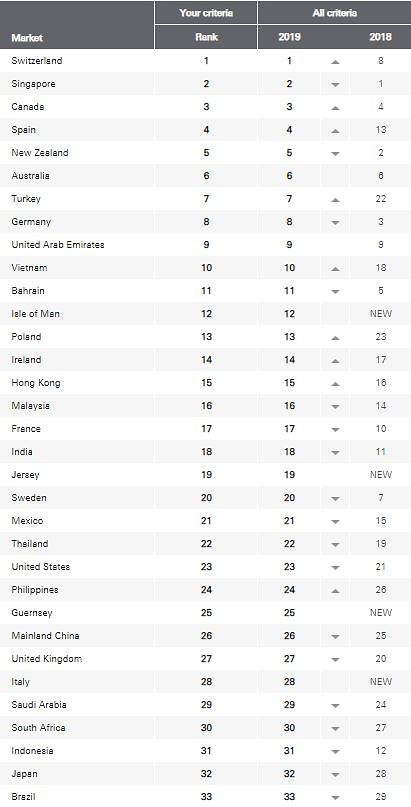
SINGAPORE: Switzerland has dethroned Singapore as the best place for expats to work and live, according to the HSBC Global Report.

Singapore, who has remained top of the rankings for the last four years, has dropped to second while Switzerland climbed seven places to number one overall.

According to the HSBC survey, Switzerland offered “the complete expat package” where expats enjoyed “an improved quality of life to complement impressive pay and swift career progression”.

Other factors credited to Switzerland’s rise include low levels of pollution, low crime rates, safe streets, and political and economic stability. 

In terms of salaries, 71 per cent of expats reported higher levels of disposable income in Switzerland, HSBC said. The average expat salary in Switzerland was US$111,587, well above the global mean of US$75,966. 

Singapore still came in top for expats with children. About 62 per cent of the expats surveyed said Singapore’s education system is better than their home country, while more than two-thirds lauded the opportunities here for their children to learn languages.

“With goods and services flowing in and out of Singapore, the country is one of Asia’s key trade hubs and a major contributor to the thriving regional economy,” said the bank.

Other countries in the top 10 include Canada, Spain, New Zealand, Australia, Turkey, Germany, the United Arab Emirates and Vietnam. Of the 33 countries on the list, Hong Kong and Malaysia ranked 15 and 16 respectively.

full hsbc list

The top 33 countries for expats according to the 2019 Expat Explorer survey. (Table: HSBC)

The 2019 Expat Explorer survey is a global survey completed by 18,059 expats across the world. The research was conducted online by YouGov between March 2019 and April 2019.

Source link

Fire breaks out in Tampines flat as PMD battery was being charged: SCDF

SINGAPORE: Fire ravaged the living room of a Tampines flat on Wednesday (Jul 3), where a personal mobility device (PMD) battery was being charged, the Singapore Civil Defence Force (SCDF) said.

Firefighters responded to the fire at an HDB maisonette, located on the fourth level of Block 125 Tampines Street 11, at about 6.20pm.

They extinguished the fire, which “involved the contents of the living room” of the unit, using a water jet, said SCDF in a Facebook post.

READ: 2 PMD fires at Ang Mo Kio, Marine Terrace; 1 injured

Charred PMD tampines hdb flat fire SCDF

The charred remains of a PMD in a Tampines HDB flat fire. (Photo: Facebook/SCDF)

No injuries were reported in the incident.

“Preliminary investigations indicate that the PMD battery was being charged when the fire occurred,” said SCDF.

READ: Fires involving e-scooters, e-bikes spike by 50% in 2018

READ: Calls to ban PMDs mount as accidents persist – but is it the best option?

To prevent the occurrence of fire, SCDF advised the public to use and purchase PMDs certified with the UL2272 fire safety certification.

More information can be found on Land Transport Authority’s website.

READ: More than 85,000 e-scooters registered as deadline closes: LTA

Source link