SINGAPORE: StarHub is investigating issues with its Internet service on Tuesday (Sep 17) as frustrated customers took to social media to complain of an outage.
“We have received reports of issues with Internet access and we are investigating,” said the telco in a Facebook post at about 6.40pm.
“We will provide an update as soon as we can.”
In an update at about 6.55pm, StarHub said: “Our engineers are working hard and we are progressively restoring services.”
“Some customers may experience temporary data congestion. Please try restarting your devices to refresh data connection,” it added.
According to user reports on the Down Detector website, issues with broadband and mobile data services affected StarHub customers nearly islandwide.
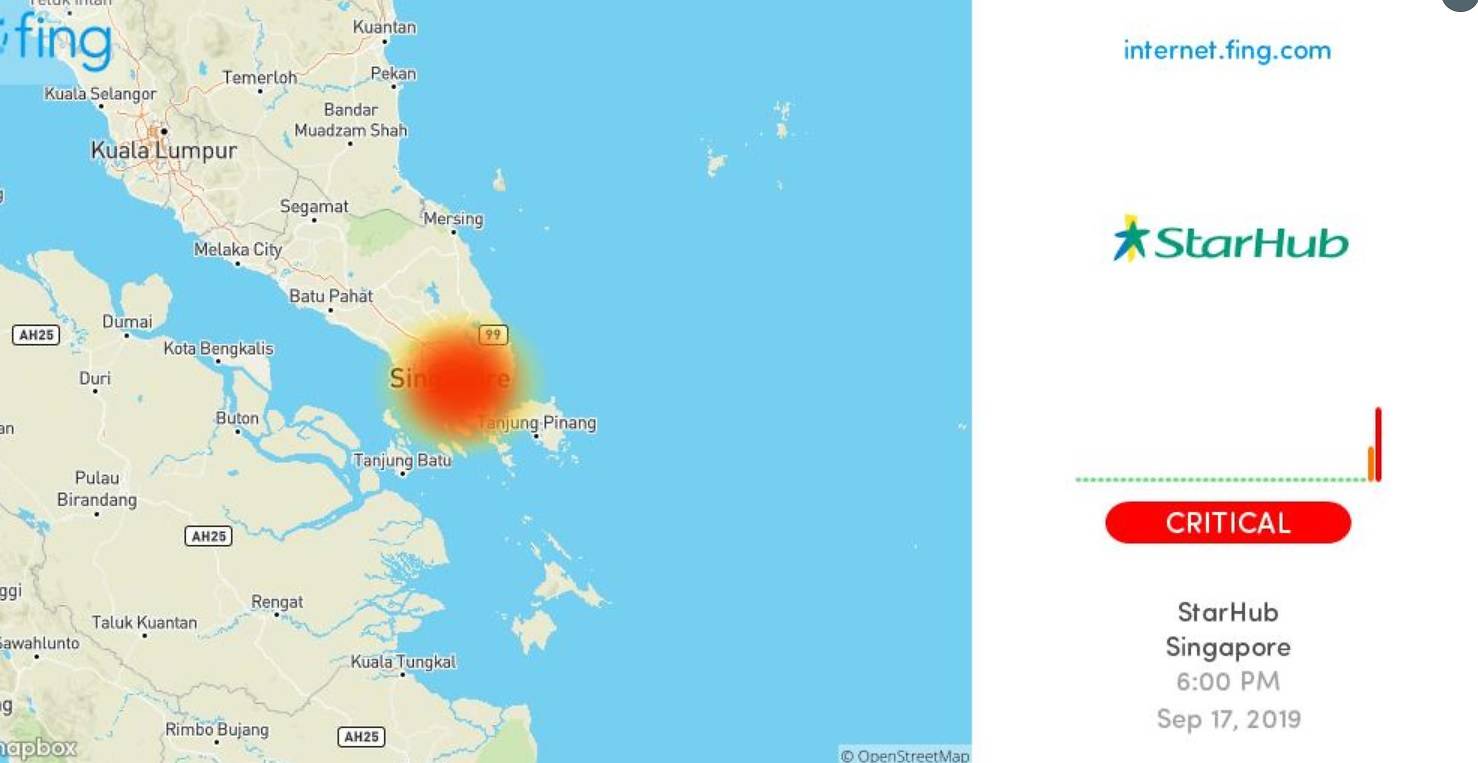
Fing Internet Alert detected the outage from 6pm on Sep 17, 2019. (Image: Twitter/outagedetect)
Those affected reported issues in areas such as Clementi, Marina Crescent, Buona Vista, Bedok, Woodlands, Bugis, Lanvender, Punggol, Bukit Batok Crescent, Katong, Choa Chu Kangand Buona Vista.
Several users said on social media that the network outage began at about 6pm.
Those affected also took to StarHub’s Facebook page to voice their complaints.
In case you haven’t heard, Bukit Merah’s ABC Brickworks Market & Food Centre has been gaining attention for having its very own Song Joong-ki lookalike. The best part? He sells bubble tea that’ll give Tiger Sugar a run for its money.
Beautea, which has been open for nine months, serves up bubble tea at hawker-centre prices. They even have their own rendition of the trending Brown Sugar Pearl Fresh Milk drink which costs just $2.50.
Cheap bubble tea and free eye candy? It almost sounds too good to be true so we went down yesterday (Sept 16) to take a look (and taste) for ourselves.
SINGAPORE: A 67-year-old man behind the wheel in an accident that injured 22 of his lorry passengers was on Tuesday (Sep 17) sentenced to three weeks’ jail and banned from driving for two years.
Loo Teck Choon pleaded guilty to one charge of causing grievous hurt to four of his passengers by a negligent act and another of causing hurt to 19 other people by a negligent act.
He had been driving the lorry along Jurong Island Highway towards Seraya Avenue at about 7.30pm on Jan 9 this year, when he did not keep a proper look-out while changing lanes.
He side-swiped a bus driving in the lane next to his and collided into the back of another bus, grievously hurting four of his passengers and injuring 18 others.
Another man, who was boarding the bus in front of him, was injured as well.
The court heard that Loo was driving the lorry at a speed of between 60kmh and 70kmh, and did not slow down as he approached the back of the stationary bus in front of him.
He then tried to change lanes, but instead swiped the rear left portion of another bus next to him, before colliding head-first into the bus in front.
The force of the accident dented both buses involved and crumpled the front of the lorry, shattering its windscreen and left passenger window.
The four seriously hurt lorry passengers suffered fractures including of their ribs and hip, and one of them sustained permanent surgical scars.
Screengrab of social media footage showing the aftermath of the Jurong Island Highway accident on Wednesday (Jan 9) morning.
The other 19 victims, including 18 other lorry passengers and one man boarding the bus in the front, suffered injuries such as abrasion, bruises and tenderness.
Deputy Public Prosecutor Chin Jincheng pointed out that Loo had been fined multiple times for traffic offences including speeding in 1990, careless driving in 2011 and 2017, and speeding again last year.
Loo, who walked slowly into the dock and spoke softly, told the court through a Mandarin interpreter that he had nothing to add, and did not drive anymore even though he had previously driven for six years.
For causing grievous hurt by a negligent act, he could have been jailed for up to two years, fined a maximum S$5,000, or both.
The maximum penalty for causing hurt by a negligent act is a six-month jail term, S$2,500 fine or both.
SINGAPORE: The National Environment Agency (NEA) said on Tuesday (Sep 17) that it pushed out additional stocks of N95 masks to retail stores over the weekend, amid reports that the masks were sold out at some shops.
Air quality in Singapore hit unhealthy levels on Saturday after the Pollutant Standards Index (PSI) went beyond the 100 mark at 4pm. It was the first time since August 2016 that the 24-hour PSI reading reached the unhealthy level.
While the NEA has said the government has “sufficient” stockpiles of the masks, here’s a guide on how and when you should wear one:
DO YOU NEED A MASK?
According to NEA’s list of frequently asked questions and answers on its website, in general, a healthy person may want to wear a mask if he has to be outdoors for several hours when the air quality forecast is in the hazardous range.
N95 masks are not necessary if you are going to be indoors or out for only a short period of time, such as commuting from home to school or work.
HDB buildings shrouded by haze in Singapore on Sep 13, 2019. (Photo: Reuters/Feline Lim)
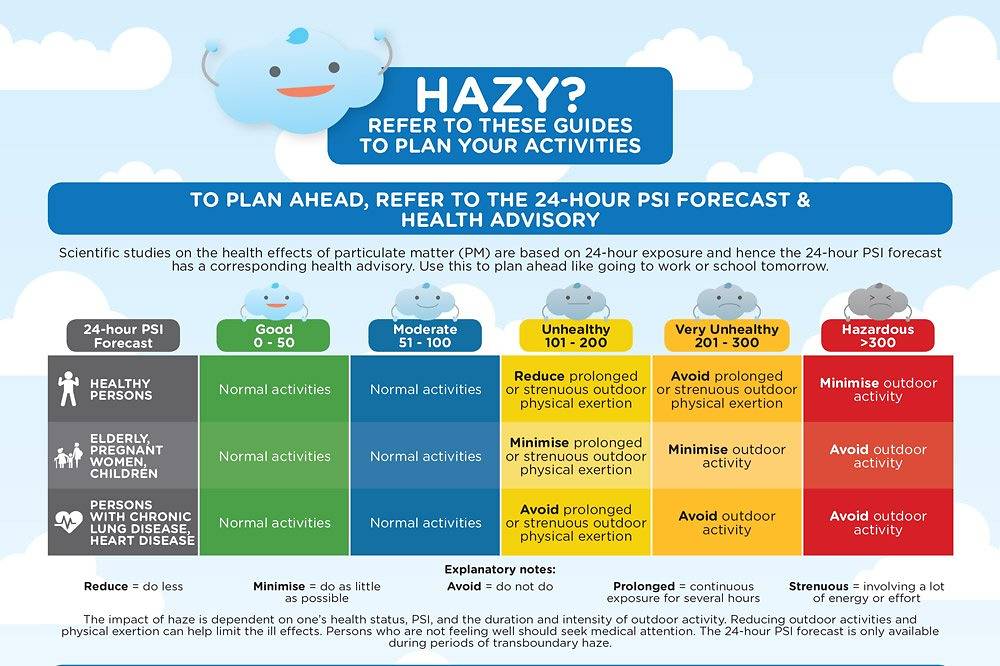
According to NEA, PSI readings below 50 denote good air quality. The air quality is moderate if the reading is between 51 and 100, unhealthy for 101 to 200, and very unhealthy for 200 to 300. A PSI reading above 300 mean air quality is considered hazardous.
When air quality reaches the very unhealthy level, children, the elderly, pregnant women, and those with chronic lung or heart disease should avoid or minimise outdoor activity. If they have to be outdoors for several hours, an N95 mask may help them reduce their exposure.
The agency cautioned, however, that the elderly, pregnant women and those with severe lung or heart problems who have difficulty breathing should consult their doctor as to whether they should use the N95 mask. If they do wear a mask, they should stop doing so if they feel uncomfortable.
Employers of workers who are required to work outdoors for prolonged periods are encouraged to maintain a seven-day stock for immediate response.
National Environment Agency’s health advisory. (Image: National Environment Agency)
WHAT DOES IT FEEL LIKE TO WEAR AN N95 MASK?
According to NEA’s website, N95 masks increase the effort it takes for one to breathe. For some people, the masks could cause discomfort in breathing, tiredness or headache.
“This may be due to the mask causing increased resistance to breathing, and a reduction in the volume of air breathed,” it said.
For most people, this is not serious.
However, some elderly people, people with lung or heart conditions, and women in the later stages of pregnancy may already have reduced lung volumes or breathing issues and should take a break from using the masks if they feel uncomfortable.
IS THE N95 MASK ADEQUATE PROTECTION AGAINST HAZE?
The mask will only work if it fits the face of the wearer. If the fit is not good, the air the wearer breathes in will go through the gaps between the mask and his face, and not through the filter as intended.
Haze can contain fine particles that are 2.5 microns or smaller (PM2.5), and studies have shown that N95 masks provide good protection against particle pollutants as they are at least 95 per cent efficient against fine particles that are between 0.1 and 0.3 microns.
WHERE CAN YOU GET A MASK?
Masks are available at major pharmacies and supermarkets, such as Unity, Watsons, Guardian, Cold Storage, Giant and NTUC FairPrice.
NEA said on Tuesday that it has been working with the Ministry of Health since April to ensure stocks of N95 masks are made available in retail shops.
“We will continue to closely monitor the availability of masks to the public,” said NEA.
“We would like to assure the public that there are sufficient stocks in the warehouses and government stockpiles,” it added.
NEA also said on its website that the national stockpile of N95 masks may be released to the major pharmacies and supermarkets if more are needed.
SHOULD YOU REUSE A MASK?
You can reuse your N95 mask, said NEA. However, the mask should be changed when it is soiled or distorted in shape. It should not be shared.
HAZE IN SINGAPORE
Haze conditions took a turn for the worse on Friday when PSI readings hiked to high-end of “moderate” level. On Saturday, it reached an unhealthy level for the first time in three years as it surpassed the 100 mark, and remained high through Sunday morning.
On Tuesday, NEA also said government agencies in Singapore have put in place “robust action plans” to minimise and manage the impact of haze on the public.
The plans by the Haze Task Force, comprising 28 government agencies and led by NEA, allow “tiered responses depending on the intensity of haze which is based on the 24-hour Pollutants Standard Index (PSI) readings”, NEA added.
SINGAPORE: A coroner on Monday (Sep 16) recommended policy changes to patients’ care after a 78-year-old woman died from multi-organ failure following knee surgery.
Mrs Yuen Ingeborg, a Singapore permanent resident, died on Nov 7, 2016 after she underwent total knee replacement surgery conducted by Dr Sean Ng Yung Chuan at Mount Elizabeth Hospital on Nov 1, 2016.
A seven-day coroner’s inquiry, which heard from Mrs Yuen’s family, doctors and nurses involved in Mrs Yuen’s care, as well as independent experts, learnt that Dr Ng had left for a medical conference in Tokyo less than two days after the operation, leaving Mrs Yuen without specialist care.
Following surgery, Dr Ng said he saw the patient twice in her ward – once on Nov 1 and again on the morning of Nov 2.
He continued to observe Mrs Yuen for recovery and ordered the necessary post-surgery care including a blood transfusion, the court heard.
Mrs Yuen also began physiotherapy that day and “did not complain of anything” to her doctor, coroner Kamala Ponnanpalam recorded in her findings.
On the night of Nov 2, Dr Ng left for a medical conference in Tokyo without handing Mrs Yuen’s case over to another specialist.
Consultant orthopaedic surgeon Dr Sean Ng Yung Chuan operated on Mrs Yuen Ingeborg, but left for a medical conference in Tokyo less than two days later, leaving her without specialist medical cover. (Photo: Mount Elizabeth Hospital)
That evening, a nurse found Mrs Yuen’s left foot to be cold and that the patient was in a lot of pain.
After not being able to find a pulse, the nurse alerted a resident medical officer, Dr Jeffrey Mah, who was also unable to find a pulse.
When he could not contact Dr Ng, Dr Mah got in touch with Dr Chin Pak Lin, an orthopaedic surgeon who had helped Dr Ng during surgery. He came to the hospital and took over.
A scan found that severed blood vessels had caused an ischaemic limb, which is a lack of blood flow to a limb.
An emergency operation was conducted successfully but Mrs Yuen continued to deteriorate. Dr Chin decided on emergency high above knee amputation to save her life but post-surgery, Mrs Yuen went into cardiac arrest and developed multi-organ failure.
She died on the night of Nov 7.
In her findings, Ms Ponnampalam stated that Mrs Yuen’s children were concerned about the post-surgery specialist and nursing care given to their mother.
“Mrs Yuen’s children were unhappy over the fact that Dr Sean Ng had chosen to leave the country soon after the surgery and was not present to attend to her when complications arose,” the coroner wrote in her findings.
“In their view, the patient management by Dr Sean Ng had been inadequate.”
They wanted to know if early detection of the vascular injury, which had led to Mrs Yuen’s follow-up operations, would have changed her probability of survival.
They also questioned the “competencies and training” of the five nurses who took care of their mother after the surgery, and asked if there had been “lapses in terms of documentation and observations”.
“Specifically, Mrs Yuen’s daughter was aggrieved that despite pointing out to the nurses on two separate occasions, on the evening of Nov 1, 2016 and on the morning of Nov 2, 2016, that the operated limb felt icy cold, she was informed that this was normal and nothing further was done.”
POST-SURGERY MEDICAL CARE
Dr Ng, who has been a practising orthopaedic surgeon since 2011, said he had told Mrs Yuen about the conference in Tokyo and had suggested performing the surgery upon his return.
“According to Dr Sean Ng, Mrs Yuen was quite insistent on having the surgery done before his departure but did not say why,” the coroner recorded.
Dr Ng said that prior to his departure, he had checked how Mrs Yuen was progressing and was told “everything was fine”. He said it was not mentioned to him that her lower left limb was cold.
Dr Ng said that while he was in Tokyo, ward nurses told him Mrs Yuen complained of leg numbness and he called the anesthetist who assisted him on the knee replacement surgery Dr Adrian Ng to review her. Dr Adrian Ng told him to continue with his trip, Dr Ng said.
When the elderly woman’s condition worsened, the surgeon said he cut his trip short and returned to Singapore on Nov 5.
“Dr Sean Ng stated that he did not hand over care of Mrs Yuen to another specialist during his absence because there were no post-surgical complications prior to his departure and her progress was acceptable,” the coroner wrote in her findings.
“He added that he was unable to comment if there would have been a significant difference to life and death if the vascular damage had been identified and managed intra-operatively.”
In addition, Ms Ponnanpalam found that Dr Ng had documented his reviews of Mrs Yuen’s condition retrospectively in the case notes, instead of at the time of the reviews on Nov 1 and Nov 2, 2016.
“The making of retrospective case notes is a clear contravention of SMC guidelines,” the coroner wrote.
According to the coroner’s report, the hospital also had concerns about the nurses who cared for the patient, with one being given a “verbal warning” for having documented circulation as normal in the care pathway chart when she did not personally assess the patient.
“ACTED WITH BEST OF INTENTIONS”
In her conclusion, Ms Ponnampalam said the evidence showed that an artery and vein were likely transected during the initial knee replacement operation conducted by Dr Ng, and that although a “relatively rare complication”, it was a known risk and should have been accounted for during the surgical approach.
Ms Ponnapalam also said: “Dr Sean Ng leaving the country on post-operative day two after performing a major surgery with a failure to hand over the patient’s care to an appropriate specialist was injudicious and may have resulted in the delayed recognition of the ischaemic limb.”
“The decision not to arrange for a covering specialist during his absence was short-sighted,” she said.
The coroner also said that the documentation of Mrs Yuen’s post-surgery care was “less than ideal” and “found to be unreliable” by the medical expert.
There was a “dire lack of details” in Dr Ng’s notes and that the retrospective entries days after were “unhelpful” as the patient’s condition had “severely deteriorated”.
The nurses’ notes were also “brief and in some instances, inaccurate”, and one nurse had relied on Dr Ng’s observations instead of making independent checks.
Ms Ponnampalam noted that an inquiry is not meant to make a determination of guilt or negligence, but it does assess “if an act has fallen short of reasonable standards”.
She said there was no basis to suspect foul play.
“It is accepted that all the medical professionals involved in Mrs Yuen’s care acted with the best of intentions,” she added.
She said that the independent experts found gaps in the post-operative medical management.
“Dr Sean Ng’s failure to arrange for cover and then not to have made conscientious notes knowing that he is going to be away, goes beyond mere human error,” she said.
“It demonstrated a clear departure from the standards expected of a physician who had primary care of a post-surgery patient.
“It may be prudent in my view, to introduce a policy which mandates that a doctor delivering primary care to a post-surgery patient, must arrange for another doctor to cover him if he is going to be unavailable.
“There should also be guidelines for a proper handover.”
The coroner noted that Mount Elizabeth Hospital had reviewed its nursing protocols for post-surgery care for total replacement knee procedures, with effect from April 2018.
Nurses are also now required to conduct limb circulation assessment and document their findings on the limb circulation chart for all patients who have undergone total knee replacement surgery.
Additional notes and details have also been included in the revised protocols to make the intervention required more specific.
“These are important and necessary improvements to the documentation process,” said Ms Ponnanpalam, adding that “it is hoped that the changes instituted … to improve patient monitoring and documentation would increase clinical awareness”.
With three laps remaining at the Formula 1 Singapore Grand Prix last year, championship leader Brendon Leigh made a crucial pass that allowed him to storm to victory.
And when he backed it up with another win in Austin, Texas, in the next race, he became the first repeat champion in the F1 Esports Series.
The Esports Series is a key part of the strategy of Formula 1 owners Liberty Media as they look to reach a younger audience, including through social media platforms Facebook, YouTube, Twitter and Instagram.
Organisers of the competition will be reaching out to local fans during the build-up to the Formula 1 Singapore Airlines Singapore Grand Prix this weekend, when Mercedes’ five-time world champion Lewis Hamilton is expected to face a huge challenge from Ferrari’s Charles Leclerc in the night race along the Marina Bay Street Circuit.
SINGAPORE: Government agencies in Singapore have put in place “robust action plans” to minimise and manage the impact of haze on the public, the National Environment Agency (NEA) said on Tuesday (Sep 17) in a media release.
The plans by the Government’s Haze Task Force, comprising 28 government agencies and led by NEA, allow “tiered responses depending on the intensity of haze which is based on the 24-hour Pollutants Standard Index (PSI) readings”, NEA added.
According to NEA, PSI reading of 50 and below denote “good” air quality, “moderate” for 51-100 , “unhealthy” for 101-200, “very unhealthy” for 201-300 and “hazardous” above 300.
Pre-school operators have been required to monitor the air quality levels and comply with health advisories by the Early Childhood Development Agency (ECDA).
They have been advised to minimise outdoor activities when the air quality is in the Unhealthy range, and avoid strenuous indoor physical exercise and activities for children, NEA said.
Children with underlying chronic heart and lung conditions should not participate in physical exercise, NEA added.
ECDA has also reminded pre-schools to ensure that there is at least one air-conditioned room with an air purifier to temporarily accommodate children who may become unwell or develop respiratory problems, NEA added.
The haze seen from an HDB block in Chinatown on Sep 14, 2019. (Photo: Zoey Low)
“Should any child fall sick or exhibit respiratory problems, the school should inform the parents and seek immediate medical attention for the child,” NEA said.
Schools are also ready to respond and take appropriate haze management measures taking guidance from the Ministry of Health’s (MOH) advisory, NEA added.
“The Ministry of Education (MOE) and schools have in place a school continuity plan to ensure the well-being of students and staff during a haze situation.”
All classrooms of primary and secondary schools, MOE Kindergartens and Special Education schools have been equipped with air purifiers to enhance the well-being of students during a haze situation, according to NEA.
It added that if school closures coincided with national examinations such as the PSLE, the affected examination papers would be rescheduled and the examination period extended.
HEALTHCARE INSTITUTIONS
Healthcare institutions have been reminded by MOH to put in place haze preparedness measures and be ready for any increase in the number of haze-related cases.
The measures include using air purifiers, fans and portable air coolers, NEA said, adding that the healthcare institutions are also monitoring patients closely for possible health effects of the haze.
NEA and MOH have also been working with retailers since April 2019 to ensure stocks of N95 masks are made available, with additional stocks pushed out to retail shops on Sep 13 and Sep 15, according to the agency.
“Our public healthcare institutions are also monitoring patients closely for possible health effects of the haze and will institute appropriate medical intervention where necessary,” NEA said.
WORKPLACES
The Ministry of Manpower (MOM) has also reminded employers to follow its haze guidelines and tripartite advisories.
MOM advised employers to take the necessary measures to prepare their companies and workforces to minimise or mitigate the effects of the haze.
In the event that the 24-hour PSI reaches the Unhealthy range, NEA said the measures include:
Reducing prolonged or strenuous work for healthy employees
Minimising prolonged or strenuous outdoor work for elderly or pregnant employees
Avoiding prolonged or strenuous outdoor work for employees with chronic lung or heart disease
Taking risk mitigating measures such as use of mechanical aids, job rotation, instituting indoor rest breaks and ensuring adequate hydration etc.
A blanket of haze seen near the Singapore Flyer on Sep 13, 2019. (Photo: Try Sutrisno Foo)
Among other measures, training and outdoor activities are also being calibrated by the Singapore Armed Force and the Home Team Departments according to the air quality.
Motorists have also been advised by the Land Transport Authority (LTA) to drive with care and switch on headlights when visibility is low. This is in addition to haze mitigation measures that have been implemented for LTA and public transport employees.
Organisations conducting sports and community activities have been advised to conduct their own risk management based on the health advisories to determine whether to go ahead with the events.
While outdoor and indoor sports facilities may remain open, members of public are advised to take necessary precautions to ensure personal safety, NEA said.
“Community activities organised by the People’s Association and its grassroots organisations will be guided by the 24-hour PSI forecast issued by NEA and the accompanying health advisory,” NEA added.
In general, NEA said the health impact of haze is dependent on individuals’ health status, the PSI level, and the duration and intensity of outdoor activity.
“Reducing outdoor activities and physical exertion can help limit the ill effects from haze exposure. Singaporeans are advised to drink plenty of water to stay hydrated, and those with chronic heart and lung conditions should ensure that medications are on hand and readily available.”
Vulnerable persons, especially the elderly, pregnant women, children, and those with chronic heart and lung conditions, who develop symptoms or feel unwell, should seek medical attention promptly, NEA added.
The Government’s Haze Task Force will continue to monitor the situation closely and provide further advisories if the haze situation deteriorates, the agency said.
SINGAPORE: A couple was on Tuesday (Sep 17) charged with murdering their two-and-a-half-year-old daughter in March 2014.
The 31-year-old man and 30-year-old woman, who cannot be named due to a gag order, are accused of killing their child at an eighth-storey flat in Block 52 Chin Swee Road.
The girl’s remains were only discovered last Tuesday.
The parents have been remanded since June 2018 for other unrelated offences.
The numbers, which exclude oil, reflect a drop in exports to the majority of Singapore’s top markets, except China to which it rose 38.5 per cent.
Hong Kong (-32.0 per cent), United States (-15.0 per cent) and Malaysia (-19.7) were the largest contributors to the decline.
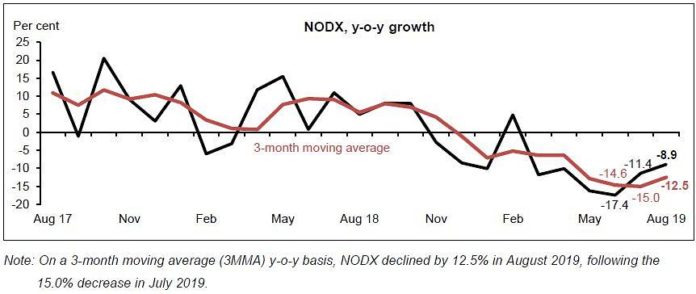
Singapore’s non-oil domestic exports (NODX) up till August 2019. (Graphic: Enterprise Singapore)
Total trade decreased by 8.6 per cent year-on-year in August – after a 6.2 per cent drop the previous month – reflecting declines in both exports and imports.
On a seasonally adjusted basis, non-oil domestic exports (NODX) rose 6.7 per cent month-on-month in August, after the previous 3.5 per cent increase. The growth is seen in both electronic and non-electronic exports.
Both electronic and non-electronic exports declined last month from the previous year.
Electronics recorded a 25.9 per cent drop, on the back of a 24.2 per cent decrease in July. The decline was most prominent in integrated circuits, personal computers and disk media products.
Non-electronic exports fell by 2.2 per cent, easing from the 6.7 per cent drop in July. Pharmaceuticals (-23.6 per cent), petrochemicals (-20.8 per cent) and primary chemicals (-29.3 per cent) contributed the most to the decline.



.jpg "170919_beauteamainimg_asiaone-1.jpg")