SINGAPORE: Air quality in Singapore remained at unhealthy levels on Thursday (Sep 19).
The 24-hour Pollutant Standard Index (PSI) readings went up to 154 in the south early Thursday before dropping slightly as morning broke.
As of 8am, the PSI readings were:
124 in the north
134 in the east
144 in the south
130 in the west
123 in the central region
According to the National Environment Agency (NEA), PSI readings of 50 and below denote “good” air quality, “moderate” for 51-100 and “unhealthy” for 101-200.
The one-hour PM2.5 reading was 24-39µg/m3 at 8am, in the normal band which ranges from 0-55µg/m3.
PM2.5 is a measure of tiny particles less than 2.5 micrometres in diameter in the air. When the PM2.5 reading is in the elevated range, haze particles can affect the heart and lungs, especially in people who have chronic heart or lung conditions.
According to NEA, one-hour PM2.5 readings are a “good indicator of current air quality”, and can be used for those deciding whether to go for immediate outdoor activities, such as a jog.
This follows a day of unhealthy readings on Wednesday, when PSI levels ranged from 90 to 149 across the day.
On Wednesday evening, the environment agency said PSI readings are expected to be in the high end of the moderate range and the low-end of the unhealthy range for the next 24 hours.
This could enter the mid-section of the unhealthy range if denser haze from Sumatra is blown in, it added.
The one-hour PM2.5 readings for this period are expected to range between normal and elevated.
“Given the air quality forecast for the next 24 hours, healthy persons should reduce prolonged or strenuous outdoor physical exertion,” said NEA.
“The elderly, pregnant women and children should minimise prolonged or strenuous outdoor physical exertion, while those with chronic lung or heart disease should avoid prolonged or strenuous outdoor physical exertion.”
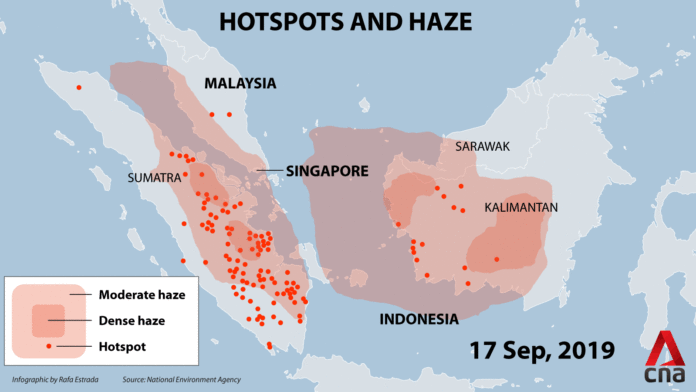
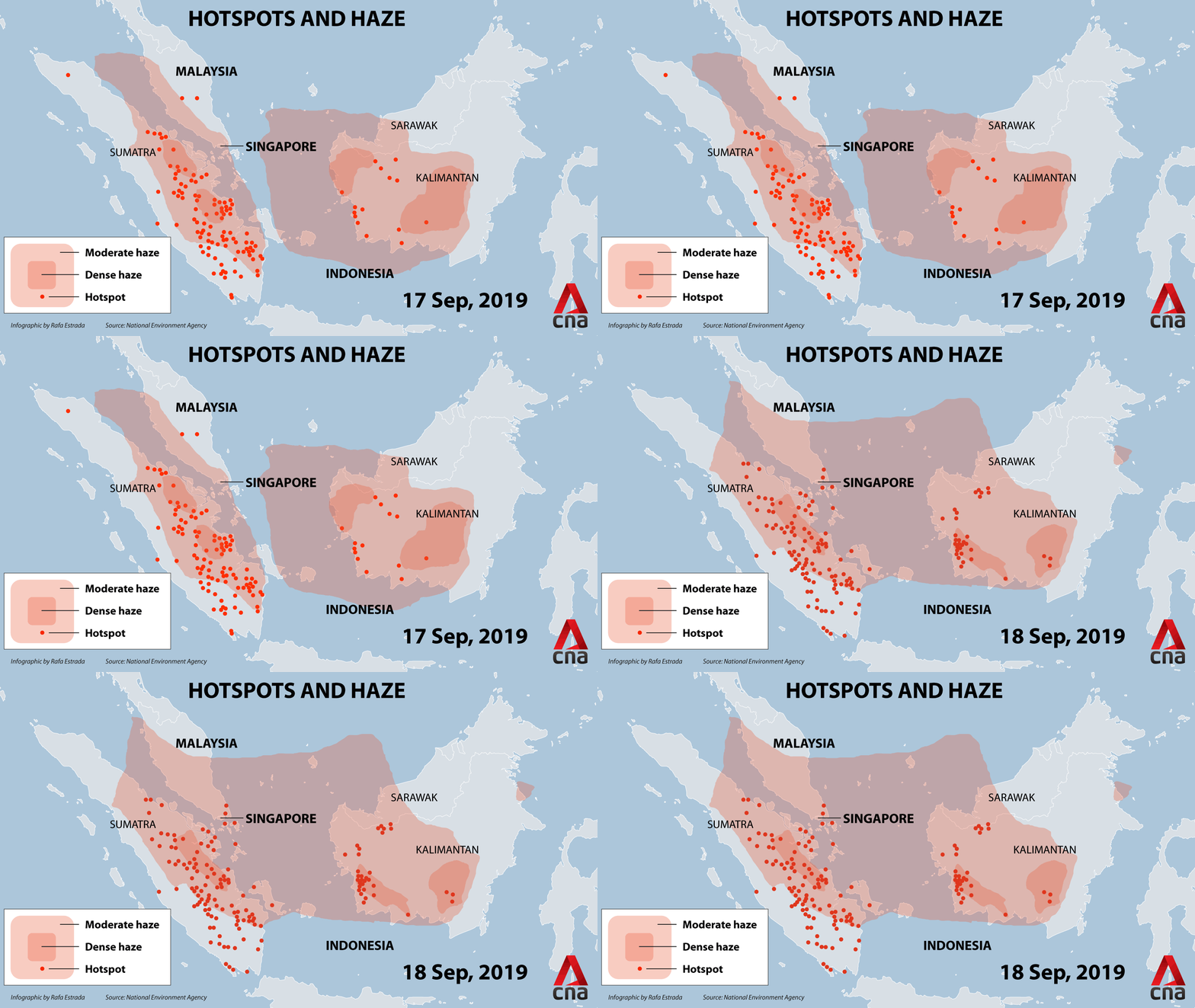
A total of 238 hotspots were detected in Sumatra on Wednesday, up from 109 on Tuesday.
There is still moderate to dense smoke haze in Indonesia’s central and southern provinces of Riau, Jambi, South Sumatra and Lampung, said NEA.
The married man who hired a hitman on the Dark Web to kill his former lover’s new boyfriend was jailed for five years yesterday.
During sentencing, District Judge Shaiffudin Saruwan said the crime was committed in cold blood, with a high degree of premeditation.
Allen Vincent Hui Kim Seng, 47, a risk management executive, began an extramarital affair with his colleague, Ms Ng Woan Man, 30, in 2016.
After they broke up last year, Hui got jealous that she was seeing Mr Tan Han Shen, 30, and ordered a hit on him from a website called Camorra Hitmen that he had found on the Dark Web.
Deputy Public Prosecutors Kumaresan Gohulabalan and Grace Chua had asked for Hui to be jailed for at least five years. They called the crime a highly sophisticated act which leveraged on the convenience and anonymity of the Dark Web.
Asking for 2-1/2 years’ jail instead, Hui’s lawyer, Mr Lee Teck Leng, said in his mitigation plea that the murder would not have happened, citing several articles that reported the website as a scam.
LONDON: Everybody loves a good productivity hack. Clever tips on getting more from each working hour are a well-loved genre, from complicated to-do lists and tomato-shaped timers, to advice on mindfulness and the merits of going barefoot.
That’s not to mention the supposed gains in creativity and concentration from surrounding your desk with the colours red and blue.
But there is one action that seldom appears on these lists, despite a growing volume of evidence to suggest it has a pronounced effect on both physical and mental productivity: Working in a location with good air quality.
IMPACT ON COGNITION AND WORK
Particulates — especially fine and ultrafine particles below 2.5 micrometres in diameter — are widely recognised as a long-term health issue, even if many people do not appreciate the scale of the harm or how extensive the evidence has become.
Inhaling particulates leads to a higher risk of dementia and causes one-third of all deaths from stroke, lung cancer and heart disease, according to the World Health Organisation.
Recent research, however, suggests air pollution is not just a long-term health issue that causes unpleasant diseases as you age.
It also stunts child development and appears to have an instantaneous effect on productivity: You become slower and dumber while breathing polluted air. This should have a profound effect on attitudes to air quality.
Humans are notoriously good at discounting long-term health risks from cigarettes and alcohol. But to have your cognition impaired right here, right now, as you try to work or study is something else.
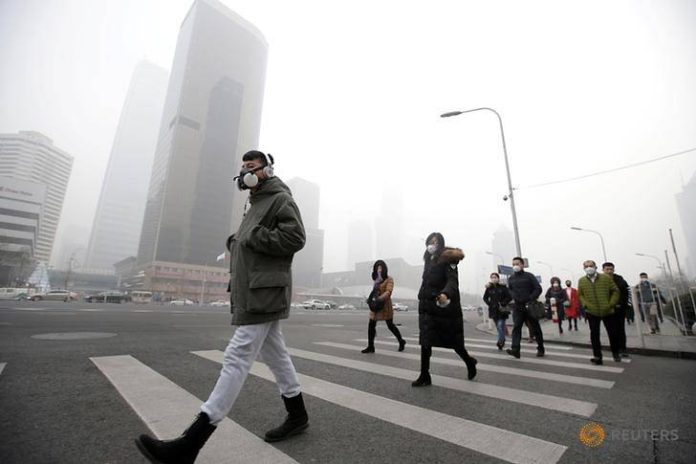
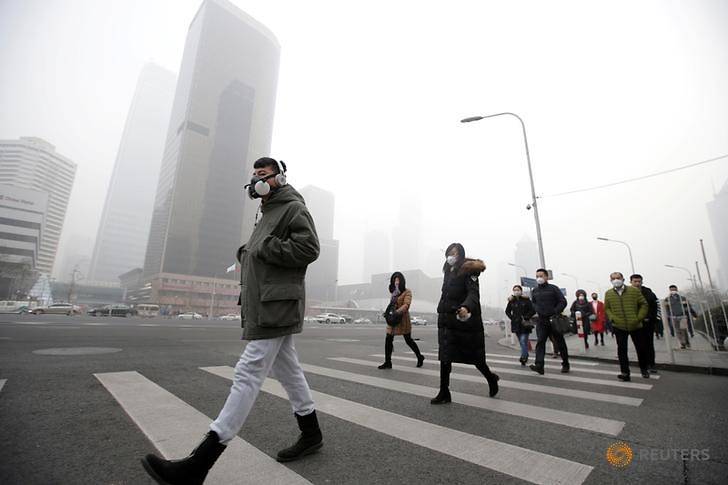
A man wearing a respiratory protection mask walks toward an office building during the smog after a red alert was issued for heavy air pollution in Beijing’s central business district, China, December 21, 2016. (Photo: REUTERS/Jason Lee/Files)
The evidence increasingly suggests that particulates do not just penetrate the heart and lungs but also the brain.
The health impact should be enough to motivate action. But if confirmed, these effects also change the economics. Ill-health at the end of life subtract from the sum of human health and happiness, but damage to young brains suggests a direct, accumulating effect on productivity and human capital. Tackling particulates, in other words, might raise not just output but its growth rate.
IMMEDIATE EFFECTS ON SCHOOL PERFORMANCE AND PRODUCTIVITY
The immediate, on-the-day effects of air pollution can be surprisingly large. The economists Avraham Ebenstein, Victor Lavy and Sefi Roth show that a modest increase in particulates on the day of an Israeli student’s high school exams is associated with a significant decline in exam results.
These exams shape a student’s life career so that brief exposure to air pollution has lasting consequences, leading to an average of 0.15 fewer years of university education and ultimately US$30 less in monthly salary.
Every child has to take the exams and the date is fixed, so richer students cannot dodge the pollution and the authors can control for factors such as school quality.
Consider the extremes parents will go to improve their child’s exam results or get them into a better university. Yet their life chances can be blighted by a single day of air pollution.
A student and his father wear masks outside a public school, as classes in over 400 Bangkok schools have been cancelled due to worsening air pollution, in Bangkok, Thailand, Jan 30, 2019. (File photo: REUTERS/Athit Perawongmetha_
Another recent study by Tom Chang, Joshua Zivin, Tal Gross and Matthew Neidell looks at call centre staff working for the same company in different Chinese cities.
On polluted days, productivity fell by 5 to 6 per cent, and the effect was evident at air pollution levels often found in Europe and the US. Again, consider what else companies will do for a 5 to 6 per cent gain in productivity.
THE IMPACT ON PHYSICAL LABOUR AND CHILD DEVELOPMENT
The effects on physical labour are less surprising but still striking. There are studies showing lower productivity for citrus pickers exposed to higher ozone levels.
There are studies showing that German professional footballers — who cannot change the date or venue for a fixture — make fewer passes on days with greater air pollution.
Then there are the horrible effects found in many studies of child development. One shows that living in an area of the US with high carbon monoxide pollution does more harm to a baby in utero than the mother smoking 10 cigarettes a day.
A study of almost 3,000 schoolchildren in Barcelona found that kids exposed to more air pollution suffered slower cognitive development. This affects the poorest most of all, but nobody who lives in a city is safe.
TACKLE AIR POLLUTION FIRST
In recent years, climate change has come to dominate environmental policy — for good reason. Yet that is a challenge for which humans are psychologically ill-equipped.
There are essentially no gains from stopping climate change, only losses averted, and the problem is totally resistant to individual action. Nothing a single person does makes any difference.
Tackling air pollution, on the other hand, benefits everybody and is amenable to action at every scale. What is more, it appears the benefits will be felt straight away.
Individuals can install filters to improve indoor air quality. Small groups can monitor and publicise local air quality. Once particulates start to affect property prices, watch how seriously people take them.
Cities and nations can regulate polluting vehicles and power generators. Since most particulate emissions come from the same fossil fuel sources as greenhouse gases, it is also a policy to tackle climate change, framed in a way more likely to find public favour.
If there was a pill available that improved exam results, reduced your chances of dementia and made you more productive at work, it would sell by the billion.
Since reducing air pollution is such a pill, why not take it?
SINGAPORE: Six Firefly flights between Malaysia and Singapore on Thursday (Sep 18) have been cancelled due to the ongoing haze, the budget carrier said late Wednesday night.
Replying to queries from CNA, a Firefly spokesperson said that the company was “looking at reports carefully” to manage possible situations affecting the airspace.
“Tomorrow’s first three SZB-XSP (Subang Airport to Seletar Airport) flights are cancelled due to the haze forecast that might result bad visibility,” said the spokesperson on Wednesday night.
The three flights, FY3122, FY3124 and FY3126, were scheduled to depart Subang at 6.50am, 7.30am and 9.30am respectively.
Another three flights scheduled to depart Seletar Airport, FY3123, FY3125 and FY3127, at 8.40am, 9.20am and 11.20am respectively have also been cancelled.
Tickets for the flights are not available anymore.
The city is shrouded with haze in Kuala Lumpur, Malaysia, on Sep 18, 2019. (Photo: AP/Vincent Thian)
Firefly is making arrangements to transfer affected passengers to parent company Malaysia Airlines.
“We need to provide certainty to (passengers) and will continue to monitor the situation,” said the spokesperson.
Tourist seems unfazed by the haze as they ride on e-scooters at downtown Singapore, on Wednesday, Sep 18. (Photo: Gaya Chandramohan)
SINGAPORE: Singapore was shrouded in haze on Wednesday (Sep 18), with the 24-hour Pollutant Standards Index (PSI) readings hitting unhealthy levels across the island.
Air quality across the island worsened throughout the day. At 8am, the 24-hour PSI ranged between 103-118, with the highest readings in southern Singapore. The one-hour PM2.5 readings were between 84 to 111µg, which falls under the Elevated range.
The 24-hour PSI readings reached 112-128 at about 1pm, with the one-hour PM2.5 reading at was 79-101µg.
Air quality in Singapore continued to worsen on Wednesday, Sep 18, as the haze hit unhealthy levels across the island. (Photo: Try Sutrisno Foo)
Air quality in Singapore continued to worsen on Wednesday, Sep 18, as the haze hit unhealthy levels across the island. (Photo: Try Sutrisno Foo)
The iconic Marina Bay Sands was partially obscured by thick haze in the early afternoon.
Air quality in Singapore continues to worsen as haze hit unhealthy levels across the island on Wednesday, Sep 18. (Photo: Rauf Khan)
Marina Bay Sands as seen in this photo taken on Wednesday, Sep 18. Air quality in Singapore worsens on Wednesday as PSI readings across the island hit unhealthy levels. (Photo: Hanidah Amin)
The areas surrounding Gardens By The Bay was also covered in haze.
A worker is seen with his mouth and nose covered near Garden by the Bay East on Wednesday, Sep 18. (Photo: Rauf Khan)
A man sits on a bench at Garden by the Bay East on Wednesday, Sep 18. Air quality in Singapore on Wednesday continued to worsen as haze hit unhealthy levels across the island. (Photo: Rauf Khan)
Tourists, however, were not deterred from taking photos outdoors.
Tourists take a photo with Singapore’s hazy skyline, on Wednesday, Sep 18. (Photo: Gaya Chandramohan)
A couple is seen walking at downtown Singapore on Wednesday, Sep 18, as air quality in Singapore continued to worsen with PSI readings across the island hitting the unhealthy level. (Photo: Gaya Chandramohan)
Around the city, people were seen wearing face masks while outdoors.
Office workers at Singapore’s central business district are seen wearing mask on Wednesday, Sep 18, as haze worsens and PSI readings across the island hit unhealthy level. (Photo: Marcus Mark Ramos)
A woman walks with a mask on at Singapore’s central business district on Wednesday, Sep 18, as air quality in the island continued to worsen. (Photo: Marcus Mark Ramos)
A man is seen wearing a mask on Wednesday, Sep 18, as haze in Singapore remains at unhealthy level. (Photo: Gaya Chandramohan)
Readings continued to go up throughout the day, with the 24-hour PSI reaching 111 to 131 and the one-hour PM2.5 readings rising to 60-95µg by 6pm.
A view of Orchard Road, taken from Ion Sky, on Sep 18, 2019.
At 11pm, the 24-hour PSI reading reached 145 in southern Singapore, the highest reading so far since readings entered the unhealthy range on Saturday. Other areas around the island showed readings between 122-137.
Hazy skies were seen at one-north on Sep 18, 2019.
Hazy skies were seen at one-north on Sep 18, 2019.
The one-hour PM2.5 readings were between102-150µg/m3, with the highest recorded in southern Singapore just shy of entering the High range.
PM2.5 is a measure of tiny particles less than 2.5 micrometres in diameter in the air. When the PM2.5 reading is in the elevated range, haze particles can affect the heart and lungs, especially in people who have chronic heart or lung conditions.
Haze seen in the area around the Singapore River, on Sep 18, 2019. (Photo: Say XiangYu)
Haze seen in the area around the Singapore River, on Sep 18, 2019. (Photo: Say XiangYu)
SINGAPORE: Carbon emissions generated from forest fires in Indonesia present a “major setback to the global fight against climate change”, Minister for the Environment and Water Resources Masagos Zulkifli said on Wednesday (Sep 18).
“The forest fires in Indonesia and the resulting haze have affected the health and well-being of people in Indonesia and the ASEAN region,” Mr Masagos said.
“It is regretful that so many lives and livelihoods have been impacted.”
He noted that the fires in Indonesia in 2015 generated nearly 1 gigatonne of carbon dioxide.
“This was more than half of the 1.5 gigatonnes that was saved from the increased use of renewable energy globally in 2015,” the minister added.
Mr Masagos also reiterated that Singapore stood ready to provide aid to Indonesia to fight forest fires.
“We have been in touch with the Indonesian Ministry of Environment and Forestry. We have offered technical firefighting assistance to Indonesia and stand ready to deploy help if requested by Indonesia, just as we did in 2015,” he wrote.
Air quality in Singapore continued to worsen on Wednesday as the haze reached unhealthy levels across the island.
As of 11pm on Wednesday, the 24-hour Pollutant Standard Index (PSI) readings were:
122 in the north
137 in the east
145 in the south
127 in the west
124 in the central region
According to the National Environment Agency (NEA), PSI readings of 50 and below denote “good” air quality, “moderate” for 51-100, “unhealthy” for 101-200 and “very unhealthy” for 201-300.
The one-hour PM2.5 reading ranged from 102-150µg/m3 at 11pm, in the elevated band which ranges from 56-150µg/m3. The southern region had the highest levels of 150µg/m3.
PM2.5 is a measure of tiny particles less than 2.5 micrometres in diameter in the air. When the PM2.5 reading is in the elevated range, haze particles can affect the heart and lungs, especially in people who have chronic heart or lung conditions.
According to NEA, one-hour PM2.5 readings are a “good indicator of current air quality”, and can be used for those deciding whether to go for immediate outdoor activities, such as a jog.
A man is seen fishing near Tanjong Pagar on Wednesday, Sep 18. (Photo: Try Sutrisno Foo)
The Singapore Government said it has put in place “robust action plans” to minimise and manage the impact of haze on the public.
These include making sure that there are enough N95 masks and for hospitals to be ready for any increase in haze-related cases.
Looking to flex on others with the latest iPhone model on launch day but not willing to queue up overnight? Lazada claims to have a fuss-free solution to your Apple fanboy needs.
The e-commerce site promises to deliver a fresh iPhone 11 model into your hands on the very same day that it goes on sale (that’s this Friday) — before noon, even.
The important thing to note here is that you don’t even have to suffer through the heat, haze, and boredom of waiting in line to get the phones early. Buyers simply need to be one of the first 200 customers to complete the purchase on the Apple LazMall store before 10am on Sept 20 to receive their iPhones before 12pm.
It’s often tough when kids run amok, but this alarming find at a neighbourhood playground is a warning to parents to stay alert.
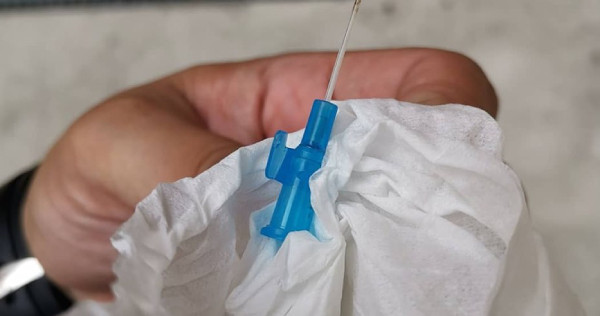
Muhammad Alamin took to Facebook on Sept 15 to share a picture of an intravenous (IV) needle that he said he had found at a Tampines playground, reminding parents to be vigilant.
He wrote: “Dearest parents, I know your children are excited to play. But please please please… Please check the playground for hazards. Found this on the playground. Imagine a kid falling and [this] accidentally [stabs] them, or if a curious kid picks it up and plays with it.”
Dearest parents. I know your children are excited to play, especially at playgrounds. But please please please.. Please…