If you’re wondering what one becomes after winning Singapore Idol, the answer is: limitless career choices.
The winner of second season of Singapore Idol Hady Mirza became a tempe seller before becoming a Grab driver. Taufik Batisah, the first ever winner of the show, is now a property agent.
His profile is found on Propnex, a real estate company is Singapore.
His brother, Mus Batisah, is an Associate Group Director in the same company.
His brother had congratulated him on his new role last week on Facebook.
So does this mean he is giving up singing?
The answer is no, his agency Hype Records says. The company told Mothership that this will be one of his side projects that he will dabble in during his free time, similar to his F&B business.
SINGAPORE – The suspect in a theft case that spread on social media after it was posted on Facebook has already been arrested and charged, the police said.
Facebook user Evelyn Tan, 31, posted on Sept 18: “My grandma was recently drugged by a middle age man at a polyclinic and subsequently robbed of her gold necklace, wedding ring, together with her wallet and keys.”
She added that she had been informed by the police that her grandmother was not the only victim in such a ploy.
Her post had been shared at least 1,000 times as of Tuesday evening (Sept 24), and had also been shared on WhatsApp.
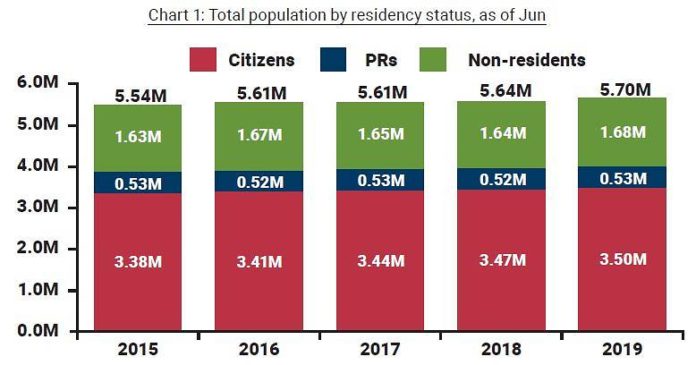
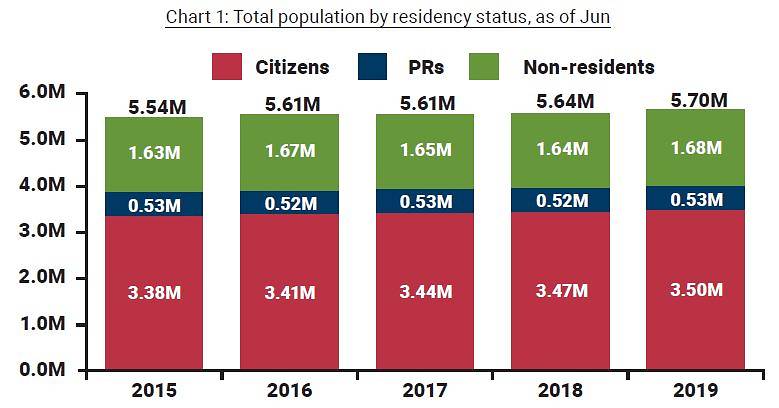
SINGAPORE: Singapore’s population grew by 1.2 per cent to reach 5.7 million in June, boosted by a jump in the number of foreign workers, according to official statistics released on Wednesday (Sep 25).
At the same time, the number of Singapore citizenships granted was the highest in at least 11 years, said the annual Population in Brief report.
As of June 2019, there were 3.5 million Singapore citizens, an increase of 0.8 per cent from the previous year. The permanent resident (PR) population remained relatively stable at 530,000, while non-residents – which include dependants, international students and people working in the country – rose by 2 per cent to 1.68 million.
Singapore’s population by residency status as of June 2019. (Source: Department of Statistics)
The bump in non-residents was mainly due to an increase in work permit holders, driven by growth in the services sector and a turnaround in the construction industry.
Foreign employment – excluding domestic workers – grew by around 22,000 people between June 2018 and June 2019.
This follows two consecutive periods of decline. Between 2017 and 2018, the number of foreigners working in Singapore went down by 10,000; and between 2016 and 2017, it fell by around 36,000.
Foreign employment growth from June 2018 to June 2019. (Source: Ministry of Manpower)
There were 22,550 new citizens last year, up from 22,076 the year before.
The majority (61.6 per cent) were from Southeast Asian countries, with 32.4 per cent from other Asian countries and 6 per cent from countries outside Asia.
About 1,576, or 7 per cent, of the new citizenships were granted to children born overseas to Singaporean parents, roughly the same number as the previous year.
Number of Singapore citizenships and permanent residency status granted between 2008 and 2018. (Source: Immigration and Checkpoints Authority)
Singapore grants between 15,000 and 25,000 new citizenships a year “to individuals who are committed to making Singapore their home”, said the report, which is published by the Prime Minister’s Office Strategy Group.
“Immigration helps to moderate the impact of ageing and low birth rates in our citizen population, and keeps it from shrinking over the longer term,” it said.
The number of PRs granted was also slightly higher last year at 32,710, compared to 31,849 the year before.
Of the new PRs, 62.5 per cent were from Southeast Asian countries, 31.2 per cent from other Asian countries and 6.3 per cent from countries outside Asia.
SINGAPORE: The number of citizen marriages in Singapore last year fell to its lowest since 2013, according to the annual Population in Brief report released by the Prime Minister’s Office Strategy Group on Wednesday (Sep 25).
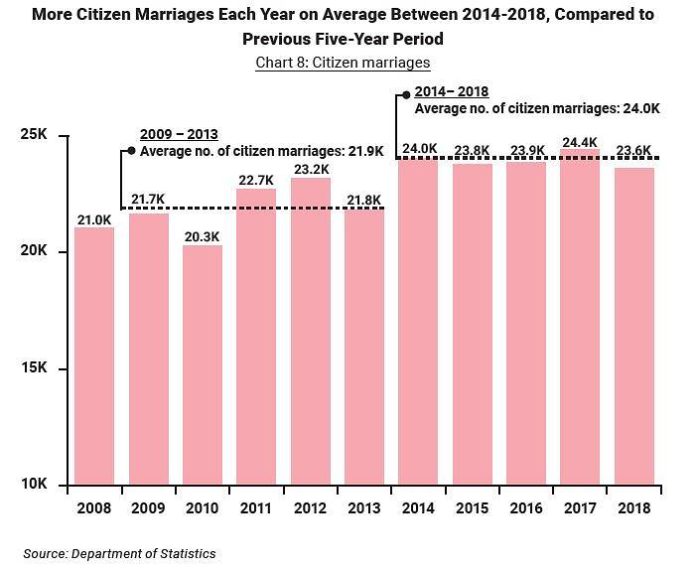
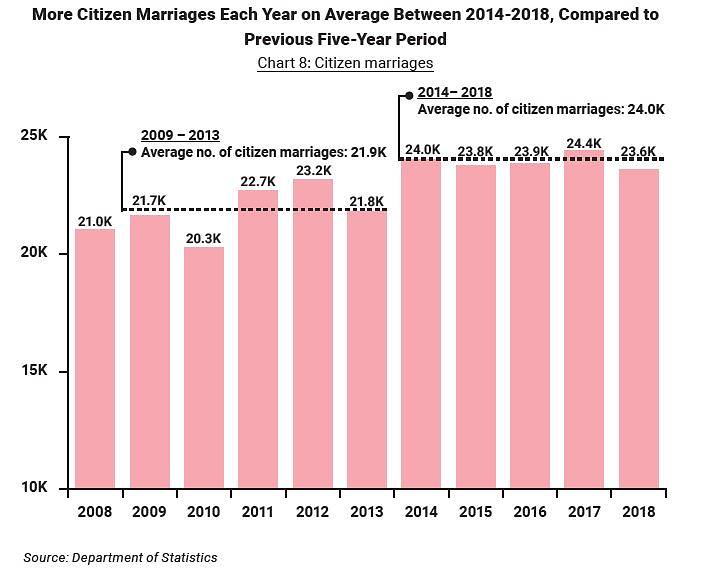
There were 23,632 citizen marriages in 2018, compared with 24,417 citizen marriages the previous year. This is the lowest since 2013, where there were 21,842 such marriages.
Citizen marriages refer to those involving at least one Singapore citizen.
The median age at first marriage in 2018 was 29.9 years for citizen grooms and 28.2 years for citizen brides, similar to the previous five years, according to the report.
More than one in three citizen marriages last year involved transnational couples, which involve one Singapore citizen and one non-Singapore citizen, broadly in line with the past few years.
About one in five citizen marriages last year were between people of different races, the same as the previous year.
Over the last five years (2014 to 2018), there were about 24,000 citizen marriages on average each year, higher than the average of 21,900 annually between 2009 and 2013.
(Image: Prime Minister’s Office)
CITIZEN BIRTHS EDGE UP, TOTAL FERTILITY RATE FALLS
There were 32,413 citizen births in 2018, compared with 32,356 the previous year.
The median age of citizen mothers at first birth was 30.4 years in 2018, remaining similar to the median age of 30.3 years in 2017.
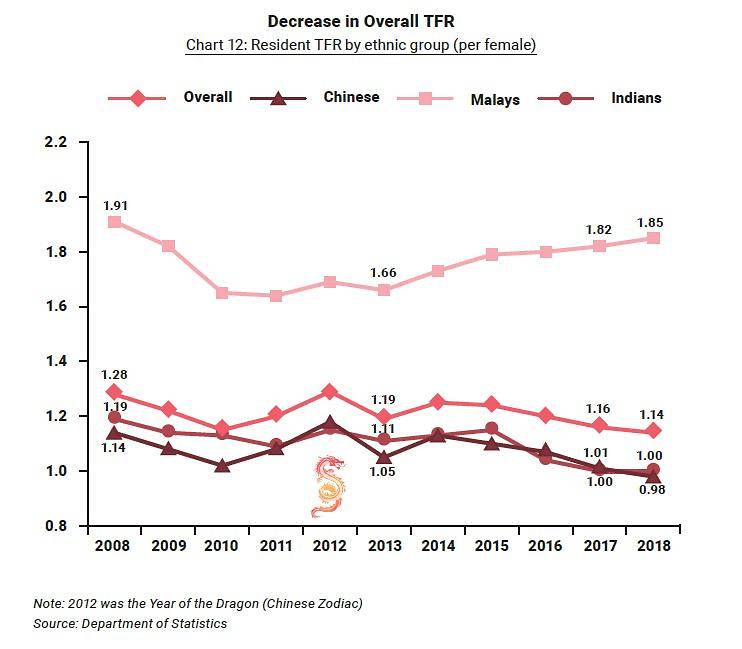
However, the resident total fertility rate (TFR) fell from 1.16 in 2017 to 1.14 in 2018.
This was due partly to a larger cohort of young Singaporeans (aged 20-30 in 2018) entering “peak childbearing ages” but not having children yet, said the report.
(Image: Prime Minister’s Office)
Meanwhile, “ever-married” Singaporean women aged between 45 and 49 had fewer children on average compared to a decade ago.
Ever-married women refer to those who are married, widowed, divorced or separated.
In 2018, they had an average of 1.91 children, down from 2.14 children in 2008.
Most citizen ever-married women had two or more children last year, with this proportion remaining stable at 43.3 per cent, compared with 42.7 per cent in 2008.
Over the same period, the proportion of women with three or more children fell from 33.9 per cent to 25.4 per cent, while the proportions without children and with one child increased.
STILL AGEING
Singapore’s citizen population continues to age.
About 16 per cent were aged 65 and above as of June 2019, compared with 15.2 per cent last year and 9.9 per cent in 2009. This number is expected to increase to about 23.7 per cent in 2030.
“With increasing life expectancy and low fertility rates, the proportion of our citizen population aged 65 years and above is rising, and at a faster pace compared to the last decade,” said the report.
Large cohorts of baby boomers have also begun entering the post-65 age range, it added.
The median age of Singapore’s citizen population rose from 41.7 years in 2018 to 42 years as of June 2019.
Currently, 63.1 per cent of citizens are aged between 20 and 64 – a decrease from 64.4 per cent a decade ago in 2009. This is projected to decrease further to about 56.1 per cent in 2030.
(Image: Prime Minister’s Office)
The number of citizens aged 80 and above has also more than doubled over the last decade.
As of June this year, about 112,000 citizens were over the age of 80, compared with about 63,000 in 2009.
SINGAPORE – Have you seen an article online promoting Samsung’s Galaxy S10 phone for an unbelievable price of $3? It is fake, said the tech giant.
Samsung also warned the public to beware of “too-good-to-be-true” deals after the fake article on the $3 deal made the rounds online.
The Galaxy S10 smartphone, which launched here in March, retails for $1,298.
The phone maker told The Straits Times on Tuesday (Sept 24) that it has contacted Facebook to request the removal of any posts on the fake article.
A Samsung spokesman said: “We wish to confirm that this promotion is not organised, authorised or endorsed by Samsung Electronics Singapore and has no relation to us or any of our affiliates.”
The article was brought to ST’s attention on Monday by a reader. It was “updated” later in the day to remove any mention of the deal but was back again by Tuesday evening.
The fake report claimed that Samsung was working with its distribution partner to give out the Galaxy S10 phones because the company was trying to increase its market share in Singapore.
Singapore sold more luxury homes to foreigners in three months ended June than any other quarter during the past 12 years, as Chinese and Hong Kong investors sought a safe haven to park their money amid the escalating US-China trade war and deteriorating public order in Hong Kong.
Up to 140 super luxury homes, those priced at more than $8 million, or $3,000 per square foot, were sold to foreigners in the second quarter, even with a 20 per cent additional buyer’s stamp duty imposed on foreign buyers.
“There has been a spike in that category and we suspect that a lot of them actually could be a mixture of Hong Kong residents and mainland Chinese,” said Alan Cheong, head of Savills Singapore’s research and consultancy.
“We have not seen those numbers (of foreigners buying super luxury homes in Singapore) since the first quarter of 2007.”
The record sales to foreigners underscore how the Lion City has become one of the hottest residential property markets on the planet, driven by Hong Kong and Chinese investors.
A skimming software is said to have infected multiple e-commerce websites that are frequented by Singaporeans, resulting in the data of more than 1,700 credit cards being stolen and sold on the Dark Web in a single database – one of the biggest cases here.
Singapore-based cybersecurity firm Group-IB said that this database is one of the many that have contributed to the 26,102 compromised payment cards issued by Singapore banks that it has found sold on the Dark Web from January to August this year. The estimated underground value of these cards is US$1.8 million (S$2.5 million).
The firm said that online card skimmers use malicious software designed to intercept payment card details from infected websites and sell the data on the Dark Web, which is a part of the Internet that is accessible only through special software, allowing users to remain anonymous or untraceable.
The case involving the e-commerce websites contained details belonging to 1,726 payment cards issued by Singapore banks.
SINGAPORE – What you see is not what you get, at least when it comes to the haze, as poor visibility could be due to water vapour instead of haze particles.
On Monday (Sept 23) and Tuesday, some hazy conditions were observed even though air quality measures did not suggest the haze had suddenly worsened.
While people might be tempted to gauge air quality on how clear the air seems, it is actually not reliable, a researcher pointed out on Tuesday.
The National Environment Agency (NEA) also clarified as much last week and, again, on Monday.
Air pollution researcher Erik Velasco told The Straits Times: “Do not just trust your visual perception as hazy skies can also be triggered by mist. The one-hour PM2.5 readings are a better indicator of the actual air quality.”
Dr Velasco added that for specific haze events such as those caused by wildfires on neighbouring islands, PM2.5 readings could even be better than the 24-hour Pollutant Standards Index (PSI), which reflects air quality during the previous 24 hours.
SINGAPORE – The haze is back. And as forest fires rage on in Indonesia, a Singapore connection has surfaced.
Three Indonesian firms with offices in Singapore have been linked to the haze-belching fires.
One company, Hutan Ketapang Industri, sealed off by the Indonesian authorities after fires were discovered on its land, has links to Singapore-based Sampoerna Agri Resources.
The other two – pulp giants Asia Pulp and Paper (APP) and April, have also been linked to the haze-belching fires by Indonesian news site foresthints. Both have offices in the Republic.
Singapore’s National Environment Agency (NEA) said it is monitoring the current haze situation closely, although it has not taken any action against firms under the Republic’s Transboundary Haze Pollution Act this year.
The Act targets those responsible for causing or condoning fires if burning results in unhealthy levels of haze in Singapore – defined as a 24-hour Pollutant Standards Index (PSI) value of 101 or greater for 24 hours or more.
Those guilty can be fined up to $100,000 a day, capped at a total of $2 million.