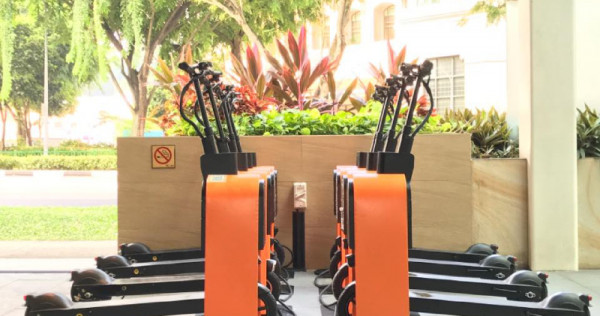
The authorities continue to have cold feet over the sharing of personal mobility devices (PMDs) with a second delay in the decision to award licences for the services in public places.
Originally slated for the second quarter of this year, it was postponed by three months by the Land Transport Authority (LTA) because of safety concerns.
This time, LTA did not commit to a specific timeline, just saying that it will announce the licence application results at a “later date”.
This comes after what is believed to be the first fatality from a PMD collision on a public path, which has sparked calls for a ban on such devices.
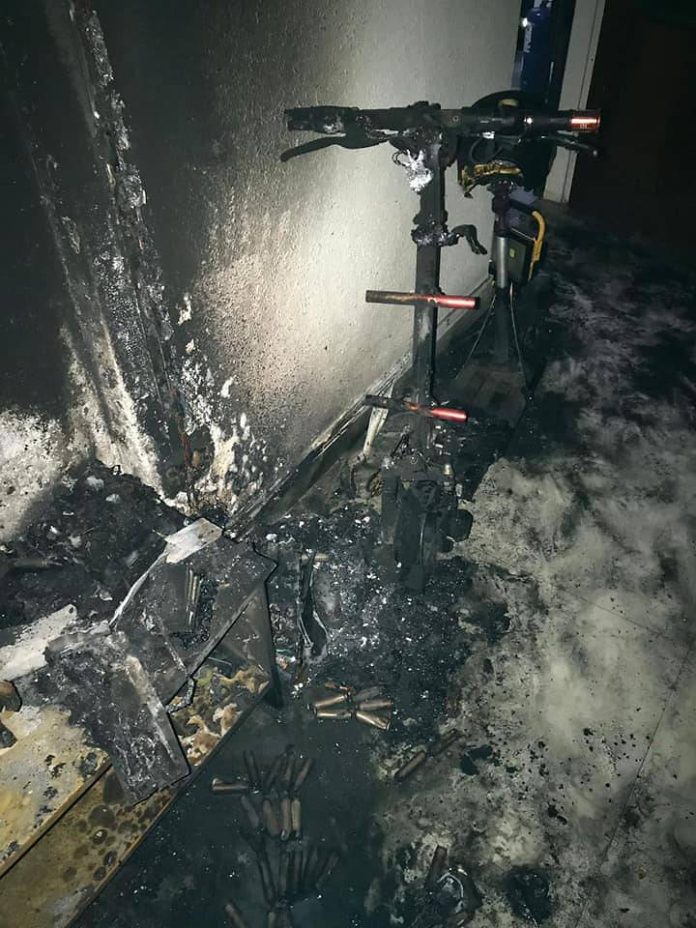
SINGAPORE: An elderly man was taken to hospital after a fire broke out in a flat at Marsiling early on Tuesday (Oct 1), in an incident involving several personal mobility device (PMD) batteries.
The Singapore Civil Defence Force (SCDF) said it responded to the fire on the 11th floor of Block 214, Marsiling Lane at about 4.30am.
The fire was extinguished with buckets of water by an occupant in the house before SCDF arrived, it said in a Facebook post.
The elderly man, who was in the unit at the time, was taken to Khoo Teck Puat Hospital for smoke inhalation.
“Preliminary investigation into the cause of the fire indicates that it was of electrical origin from one of three PMD batteries which were charging at the time of the fire,” said SCDF.
Preliminary investigations indicate the fire was sparked by one of three personal mobility device batteries that were being charged. (Photo: Facebook / Singapore Civil Defence Force)
The safety of PMDs has come under scrutiny in recent weeks.
About two weeks ago, a fire broke out in the bedroom of a flat in Sengkang. Preliminary investigations indicated the fire was caused by a PMD that was charging at the time.
Authorities are offering cash and free disposal of PMDs that do not meet new fire-safety standards ahead of next July’s ban on the use of such devices.
Those with PMDs that do not meet the UL2272 standard can bring them to one of 181 locations across the island to dispose of them for free.
Registered e-scooter owners who come forward with their non-UL2272 e-scooters for disposal at the designated disposal points until Nov 30 will qualify for an early disposal incentive of S$100 per registered e-scooter.
German startup Volocopter said Singapore is emerging as one of the most likely destinations for the commercial launch of its electric helicopters, where it hopes to offer short-hop flights for the price of a limousine ride.
The co-founder of the company, which is working with Singapore regulators to conduct a public test flight in coming months, said the city-state, Dubai and Germany were the markets most open to its air taxis.
A number of firms are trying to bring so-called air taxis to the mass market but a lack of regulation and infrastructure, and safety concerns have proved barriers.
Volocopter, which counts Daimler, Intel and Geely among its backers, is targeting a planned commercial rollout in two to three years of its drone-like taxis that resemble a small helicopter powered by 18 rotors.
SINGAPORE – The chief editor of The Online Citizen (TOC) has applied to bring in Prime Minister Lee Hsien Loong’s siblings as third parties in the defamation suit that PM Lee filed against him last month.
Mr Terry Xu, who filed his application in the High Court last Thursday (Sept 26), said he wanted Mr Lee Hsien Yang and Dr Lee Wei Ling to bear the damages if he is found to have defamed PM Lee in an Aug 15 article published by TOC.
He explained in a separate document filed last Friday that the article, “PM Lee’s wife, Ho Ching weirdly shares article on cutting ties with family members”, was meant to be ironic and meant no malice.
PM Lee is suing Mr Xu for defamation over the article, which his lawyers said contained “false and baseless” allegations, including that PM Lee misled his father, the late Mr Lee Kuan Yew, into thinking the family home in Oxley Road had been gazetted by the Government. The article was also shared on TOC’s Facebook page.
The lawyers also said PM Lee “has been gravely injured in his character and reputation, and has been brought into public scandal, odium and contempt”.
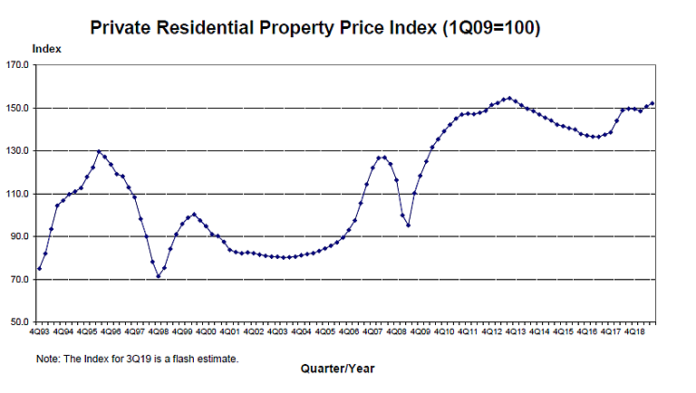
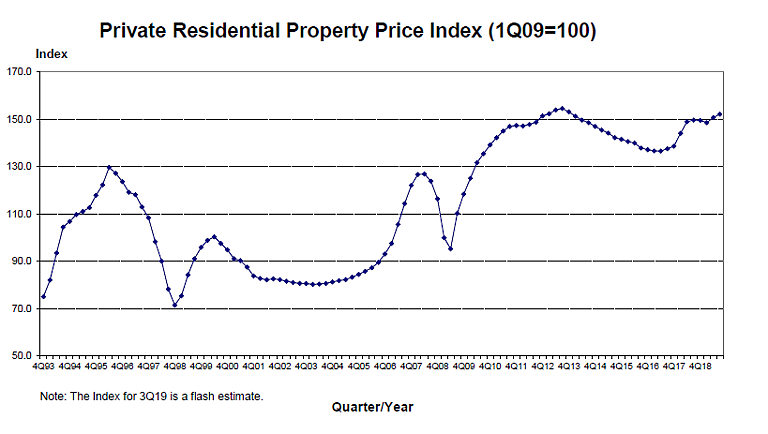
SINGAPORE: Private home prices in Singapore rose for the second consecutive quarter, with apartments in the central region proving most popular with buyers.
The private residential property index increased 0.9 per cent to 152.2 points in the third quarter, data from the Urban Redevelopment Authority (URA) showed on Tuesday (Oct 1).
Private home prices had fallen 0.7 per cent in the first quarter and 0.1 per cent in the October to December period following cooling measures implemented by the Government in the middle of last year.
In the last quarter, prices rose 1.5 per cent.
In the landed property segment, prices fell by 2.2 per cent in the third quarter, compared with the 0.1 per cent decrease in the previous quarter.
Prices for private homes in the non-landed segment rose 1.7 per cent, compared with the 2 per cent increase in the previous quarter.
Those in the Core Central Region (CCR) rose the most at 2.9 per cent, followed by apartments in the Rest of Central Region (RCR) at 1.6 per cent and those in the Outside Central Region (OCR) at 0.7 per cent.
“The slower pace of price increase is within expectation possibly because most developers and sellers of resale homes have kept prices at attractive levels to clear their existing stock,” said Christine Sun, head of research and consultancy at OrangeTee & Tie.
“Lesser luxury homes (CCR) were also sold last quarter when compared to the prevailing quarter, whereas more mass-market (OCR) and city fringe private homes (RCR) were being transacted last quarter, which may have lowered the average pricing for the entire market as reflected by the slower pace of price growth in the third quarter.”
She added: “While the housing market may continue to be influenced by global forces in the wider economy, our robust population growth, rising household income, and positive employment numbers will remain key drivers for both home prices and demand over the long term.
“In view of the current economic uncertainties, Singapore will remain an attractive safe haven for foreign investors to park their funds here.
“We expect prices to remain relatively stable for the rest of the year as the underlying demand for private homes is still healthy despite the current macro-economic uncertainties.”
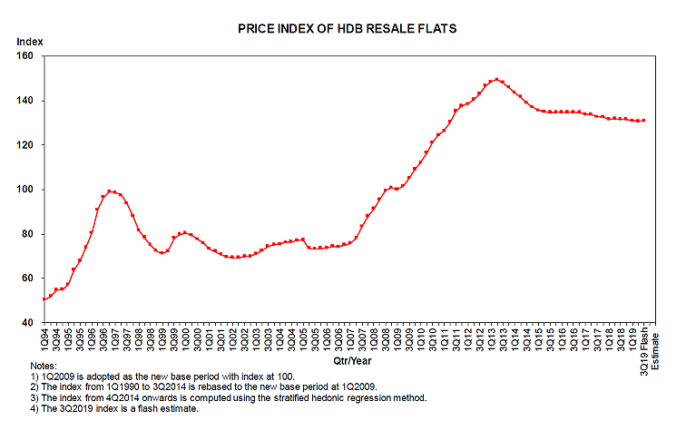
SINGAPORE: Prices of resale flats for the third quarter of this year rose 0.1 per cent from the second quarter, according to flash estimates released by the Housing and Development Board (HDB) on Tuesday (Oct 1).
The resale price index – which provides information on the general price movements in the resale public housing market – is estimated to have jumped slightly from 130.8 to 130.9, following four consecutive quarters of decline.
Prices fell 0.1 per cent in the third quarter and 0.2 per cent in the fourth quarter of last year and dipped 0.3 per cent and 0.2 per cent in the first and second quarters of this year respectively.
HDB also announced that it will offer about 4,500 Build-To-Order (BTO) flats in Ang Mo Kio, Tampines and Tengah in November 2019.
In February 2020, HDB said it will offer about 3,000 BTO flats in Sembawang and Toa Payoh.
Some flats are available for open booking, HDB added. Eligible flat buyers may apply online at HDB InfoWEB on a first-come-first-served basis, and can book a unit as early as the next working day.
While the nation awaits the outcome of an appeal by the Attorney-General’s Chambers over a contentious court verdict, a local gym has a proposed solution to prevent such sexual misdemeanours from happening in the first place.
If you can’t beat them in court, at least make sure you can beat them down for real.
Detactical — a gym offering self-defence courses and training for security purposes — strongly believes that the sentence of supervised probation handed to convicted molester Terence Siow is entirely unacceptable.
The 23-year-old National University of Singapore undergrad avoided jail time, due to his academic grades that apparently showed he has “potential to excel in life”.
SINGAPORE: Recession rumblings have gotten louder with the recent raft of increasingly gloomy economic data and surveys.
Singapore’s 2019 growth forecast has been slashed to 0.6 per cent, down from an earlier estimate of 2.1 per cent in June, said a Monetary Authority of Singapore (MAS) survey report earlier this month.
Local business confidence is at a near two-year low for the final quarter of 2019, according to Singapore Commercial Credit Bureau (SCCB)’s recent Business Optimism Index study. This is in line with the latest findings of the SBF-Experian SME Index which shows dampened optimism among small- and medium-sized enterprises (SME) for the next two quarters.
The job market has also taken a hit. Workers face weaker hiring prospects as employers turn cautious; unemployment has also inched up in the first half of this year, according to the Ministry of Manpower.
The softer job market has made it harder for workers to find a job within six months of being laid off.
Should the economy take a sharp turn for the worse, the Singapore Government has made it clear that help would be ready for businesses and workers.
Some companies are counting on Budget 2020 due early next year to beat the downturn, while others are looking to the S$20.5 billion Resilience Package of 2009 as a model, with its focus on helping good, viable companies to stay afloat so as to keep employment figures as high as possible.
PREPARE NOT PANIC
But rather than wait for policymakers to act, our companies need to move quickly and focus on how to best to position themselves for the future – recession or otherwise.
The economic challenges the Singapore economy faces today are more complex than before. Technological disruption across industries is making knowledge, skills and jobs obsolete faster than ever.
An engineer monitors a live video feed sent by a surveillance drone at a command centre in Singapore. (Photo: AFP/Roslan RAHMAN)
This is compounded by other structural hurdles to growth. We’re faced with a labour pool that is rapidly aging and shrinking, which the Government is addressing with postponed retirement and a drive to get employers to redesign jobs with mature workers in mind.
To improve productivity, there has also been a concerted push for companies to automate and digitise.
With all that comes a pressing need for our workers to be able to unlearn, relearn and be rapidly reskilled to take on new roles that have and will emerge with Singapore’s future economy.
The Government has poured resources into schemes such as Adapt and Grow’s Professional Conversion Programmes and SkillsFuture’s Earn and Learn to help workers remain relevant, all with a certain measure of success.
Last year, SBF’s training arm, the SBF Business Institute (SBI), together with Enterprise Singapore and Workforce Singapore, launched the Professional Conversion Programme for Southeast Asia Talent (PCP SEA) for the wholesale trade and logistic sectors to help companies build manpower capabilities for expansion into regional markets.
To date, over 90 companies have benefited from the programme with 150 candidates matched to suitable vacancies. Next year, we expect the numbers to grow.
Office workers at Raffles Place in Singapore. (File photo: Marcus Mark Ramos)
A SENSE OF URGENCY
While there is no lack of schemes or training incentives for workers and businesses to tap on to keep up with the economic transformation, what’s lacking is a sense of urgency and realisation that investing in skills training will help companies and workers emerge stronger through good times and bad.
Earlier this year, SBF’s annual National Business Survey showed that companies are not investing enough in their employees to address manpower challenges. Only 12 per cent of the over 700 companies surveyed had invested in better training for their employees.
In today’s business environment of continuous change, disruption is the new norm. To brace themselves for short-term headwinds and to thrive in the future, our companies need to press with business transformation and invest in both technology and their workers.
A recent study by the Boston Consulting Group which analysed more than 5,000 companies across the last four downturns in the United States found that while almost three quarters of the companies experienced a decline in revenue, 14 per cent of the companies flourished both competitively and financially.
Workers in Raffles Place, Singapore. (Photo: AFP)
What did these one in seven companies have in common? They acted early, took a long-term perspective and focused on growth, not just cost-cutting.
No organisation can reap the benefits of technology without putting employees at the heart of its strategy.
PURPOSE BEYOND PROFIT
During a dialogue at the Singapore Summit this month, Deputy Prime Minister Heng Swee Keat called on business leaders to do more to address the widening inequality brought on by globalisation and advances in technology and the growing intergenerational gap as society ages.
Companies, he says, can do well and do good.
This comes on the heels of a historic declaration by the Business Roundtable, a body that represents the chief executives of close to 200 America’s largest companies, last month that shareholder profit is no longer the sole purpose for corporations.
Equally important now is improving society, investing in employees and dealing fairly and ethically with suppliers.
In stepping up to do more for their workers through retraining and upskilling, our companies are also helping to address the 21stt-century economy challenges of low wage jobs and growing inequality.
This is also giving employees a career pathway to more advanced, better-paying jobs and a relevant set of skills, improving the efficiency of businesses and boosting productivity in the economy.
Deputy Prime Minister Heng Swee Keat speaking at the Singapore Summit on Sep 20, 2019.
Helping our workers succeed eventually helps our businesses to prosper.
As jobs change, so must the mindset of our workers and businesses. While the learning curve may be steep, workers need to embrace these changes and be open to upskilling, reskilling and second-skilling. Employers on the other hand need to prioritise change management and training for their existing workforce to adapt to the new technologies for growth.
The question here is not if or when a recession will come, but how well prepared our businesses will be to respond. To our companies we say, keep calm and transform on.
Ho Meng Kit is CEO at Singapore Business Federation.
SINGAPORE: Singapore was on Saturday (Sep 28) re-elected to the council of the International Civil Aviation Organization (ICAO), an agency of the United Nations.
This took place at the 40th session of the ICAO Assembly in Montreal, Canada, which runs from Sep 24 to Oct 4.
“We are honoured to be re-elected to the council of ICAO and by the support of our fellow ICAO member states,” said Coordinating Minister for Infrastructure and Minister for Transport Khaw Boon Wan, who led the Singapore delegation to the ICAO Assembly.
“We will continue to contribute actively to the advancement of the ICAO’s mission.”
The council is the ICAO’s governing body and comprises 36 members elected for a three-year term.
Singapore was first elected to the ICAO council in 2003, at an extraordinary assembly session that was convened to fill three new council seats. It was re-elected in 2004 and in subsequent elections at the triennial assemblies.
Coordinating Minister for Infrastructure and Minister for Transport Khaw Boon Wan (centre) with the Singapore delegation at the 40th Session of the International Civil Aviation Organisation (ICAO) Assembly in Montreal, Canada. (Photo: Facebook/Khaw Boon Wan)
“Grateful to our friends from around the world for their strong and consistent support. We are moved by their friendship and their confidence in us,” said Mr Khaw in a Facebook post on Sunday.
“We are committed to deepening our partnerships with the ICAO, all fellow members, as well as other transport and civil aviation authorities.”
In a media release, the Ministry of Transport said Singapore contributes as a member of more than 100 ICAO expert groups to help shape international standards in areas such as civil aviation training and human resource development, air traffic management, aviation safety, aviation security and facilitation.
It holds leadership positions in around 20 of these groups.
“We will continue to play a constructive and effective role to achieve the goals and vision of ICAO, to help raise the standards of safety and efficiency of global aviation and to ensure that no country is left behind,” said Mr Khaw.
Singapore’s re-election to the ICAO council comes as the organisation is debating ways to minimise the civil aviation sector’s impact on the environment.
The ICAO assembly was suspended for a day as Swedish teenage activist Greta Thunberg led a march through Montreal as part of a global wave of strikes against climate change.
Coordinating Minister for Infrastructure and Minister for Transport Khaw Boon Wan (left) walks during a Greta Thunberg Climate Rally in Montreal, Canada. (Photo: Facebook/Khaw Boon Wan)
Commercial flying accounts for 2.5 per cent of carbon emissions, but with passenger numbers forecast to double by 2037, experts say emissions will rise if more is not done.
“Indeed the aviation industry needs to clean up further using better fuels that pollute less,” Mr Khaw said in an earlier post on Friday. “In land transport, electric vehicles are good solutions. We need such equivalents in aviation.”
While ICAO cannot impose regulations, it sets standards that are approved by its 193 member countries.
In 2016, it brokered the first global industrial climate initiative with a medium-term scheme to help airlines avoid adding to their net emissions from 2020.
The Carbon Offsetting and Reduction Scheme for International Aviation requires most airlines to limit emissions or offset them by purchasing credits from environmental projects.
SINGAPORE: Aspiring hawkers will be given more support by the National Environment Agency (NEA) through a new programme and an enhanced incubation scheme, announced Senior Minister of State for Environment and Water Resources Amy Khor on Monday (Sep 30).
This is part of NEA’s efforts to support and sustain the hawker trade.
The Hawkers’ Development Programme, available to aspiring and existing hawkers, is a three-stage programme which offers classes to hawkers in practical areas.
The first stage will have certified trainers teaching classes on cooking skills, menu design, pricing strategy, stall layout and social media marketing, with support from SkillsFuture Singapore. It will be available to existing and aspiring hawkers.
The second and third stages, which are only open to aspiring hawkers, will offer a mentorship programme with veteran hawkers, and an opportunity to join NEA’s Incubation Stall Programme (ISP).
The ISP was introduced last year to allow aspiring hawkers to learn the ropes and test out business plans in a practical setting.
Dr Khor added that NEA will be looking into providing subsidies for the Hawkers’ Development Programme to make classes more affordable for hawkers.
Ten veteran hawkers have signed up to be mentors with the Hawkers’ Development Programme, which will be rolled out at the end of this year, she said.
Mdm Hajjah Roziah, 59, is a veteran hawker who has volunteered to mentor aspiring hawkers under the new Hawkers’ Development Programme.
Madam Hajjah Roziah, 59, who runs Nur Indah’s Kitchen at New Upper Changi Road, was one of the veteran hawkers who volunteered to mentor aspiring hawkers.
She explained that it was important for young hawkers to have mentorship and practical experience in a stall so that they would know “all the things that (they) would have to face”.
“We will assist them from scratch, from the ingredients, from the recipe, menu and how to flip prata, if (they are running a) prata stall. Then they must know what is the pricing, what is the costing, what (is) the equipment they need to set up when they want to start their business,” she said.
The Hawkers’ Development Programme was put in place after receiving feedback from a hawker workgroup that was set up earlier this year, said Dr Khor.
INCUBATIONAL STALL PROGRAMME ENHANCEMENTS
Dr Khor also announced two enhancements to the ISP.
In March 2019, NEA extended the 50 per cent rental rebate for hawker stalls under its ISP from six months to nine months to provide incubation stallholders with more time to establish their businesses.
To provide greater support, NEA will be providing these stallholders with an additional six months of 25 per cent rental rebate.
“This actually means an effective rental rebate of 40 per cent over the 15-month period, and this, we believe, will help to strengthen our support for the ISP stallholders as they stabilise their businesses and transit to a permanent stall,” said Dr Khor.
Senior Minister of State for Environment and Water Resources Amy Khor announced a new Hawkers’ Development Programme and enhancement to the Incubation Stall Programme at the inaugural Hawkers’ Seminar on Sep 30, 2019.
Additionally, incubation stall owners will now be able to convert their incubation stall to a permanent stall directly, at the location they are operating from.
“This is to better support these new entrants as they would have established their local clientele at the particular stall/centre that they are operating from,” said NEA in a press release.
Two of 20 successful incubation stall applicants have indicated their interest to convert their incubation stalls to permanent stalls, said Dr Khor.
Madam Michelle Yee, 35, who runs the Hakka Hamcha and Yong Tou Fu stall at Smith Street, is one of the incubation stall applicants who will be converting to a permanent stall from Jan 1 next year.
She joined the incubation programme in April last year, she said, as she and her husband were tired of their jobs.
“(We thought), why don’t we create something that belongs to ourselves?” she said.
They decided to make their foray into the food and beverage business, and settled on a hawker stall as the smallest way to start.
She said that the incubation programme has helped her with “investment costs”, and that she has “saved a lot (with) the rental subsidy”.
“We learned about how to control our cost through the course organised by ITE (Institute of Technical Education), how to do the set-up, search for our supplies,” she added.
“What NEA has done is really above our expectations.”
These developments were announced at the inaugural Hawkers’ Seminar, organised by the Federation of Merchants’ Association, where 27 hawkers received awards in three categories – Hawker Mentors Appreciation Award, Promising New Hawker Award and the Productive Hawker Centre Appreciation Award.