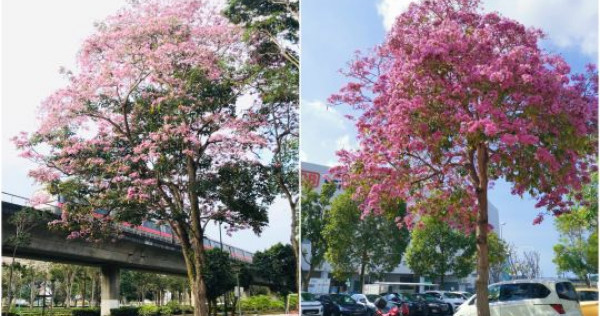
SINGAPORE – The Republic’s version of Japan’s famed cherry blossoms made a surprise return this month after the usual flowering season ended in September.
The trumpet trees, known mainly for their pink blooms, continued flowering in the first two weeks of October due to the recent unusual weather, according to the National Parks Board (NParks).
The board told The Straits Times on Wednesday (Oct 16) that the flowering of trumpet trees, or Tabebuia rosea, is triggered when heavy showers occur after a hot and long dry period, such as that from July to September.
Based on past observations, the flowering of trumpet trees should only be between March and April, as well as between August and September, NParks added.
With the rare out-of-season flowering, the board encouraged the public to look out for the 15,000 trumpet trees currently planted here, noting that blooming flowers have been observed in areas like Punggol Park, Bishan-Ang Mo Kio Park and the Singapore River Promenade.
Infested with cockroaches and flies, the caterer’s kitchen was filthy, with water dripping from the ceiling into the cooked food.
Dirty water from the kitchen floor also splashed into uncooked food placed on the ground.
In the first such case prosecuted by the Singapore Food Agency (SFA), the caterer was hauled to court yesterday for its unhygienic premises.
Adrian Lim Teck Lien, 42, the sole proprietor of AG (Global) Events Catering, was fined $5,000 after pleading guilty to two charges under the Sale of Food Act.
The charges were for breaching regulations on the storage of food and the maintenance of the food establishment.
According to the Singapore company’s website, AG (Global) Events Catering was the caterer for several big events, including the Standard Chartered Marathon in 2013 and the arrival ceremony of the giant pandas Jia Jia and Kai Kai in 2012.
It also said it has catered food for numerous government agencies and schools, including the National Environment Agency and the National University of Singapore.
SINGAPORE: Veteran opposition leader Chiam See Tong has stepped down as secretary-general of the Singapore People’s Party (SPP) after 23 years at its helm, following the election of its new Central Executive Committee (CEC) on Wednesday (Oct 16).
“Mr Chiam has given to politics for 40 years already. It’s time for him to have a rest,” Mrs Lina Chiam, SPP’s chairman prior to Wednesday’s election, told reporters after the event.
Mrs Chiam was re-elected to the CEC, although her official position is still undetermined.
“I think he has given all what he can for Singaporeans, what he can do to his ability,” she added.
SPP’s Lina Chiam at the Ordinary Party Conference on Oct 16, 2019. (Photo: Najeer Yusof/TODAY)
Mr Chiam’s departure from the party’s top decision-making body was announced during the biennial SPP Ordinary Party Conference on Wednesday, during which 12 members were elected to form a new CEC.
Although Mr Chiam will no longer lead the party, he will still remain a member, Mrs Chiam said.
Of the 12 members elected, four are new to the committee: Mr Jose Raymond, Mr Ariffin Sha, Mr Eman Lim, and Mr Jalil Wari.
“The meeting went on very well, amicably,” said Mrs Chiam. “Everybody was like a family and we all voted consciously and happily.”
Mr Chiam, 84, is the longest-serving opposition MP. He started his career in politics as an independent candidate in 1976 and was elected to the Potong Pasir constituency in 1984.
Mr Chiam has been with the SPP since 1996, after an acrimonious split led to his departure from the Singapore Democratic Party, which he had founded in 1980.
Mr Chiam last contested in the general elections in 2011, where he left his Potong Pasir stronghold to lead an opposition team in the five-member Bishan-Toa Payoh Group Representation Constituency (GRC).
SPP’s Jose Raymond speaking to reporters after the Ordinary Party Conference on Oct 16, 2019.(Photo: Najeer Yusof/TODAY)
SPP members indicated at a prior meeting the possibility of leadership going to either Mr Raymond, a former Singapore Environment Council executive director and press secretary to Dr Vivian Balakrishnan, or Mr Steve Chia, SPP’s organising secretary who headed the National Solidarity Party at one point.
Mr Chia was also elected to the CEC on Wednesday.
According to Mr Raymond, the official positions of the CEC members will be announced within three weeks from the date of the Conference.
BRUSSELS – Three Asian metropolises – Tokyo, Beijing and Singapore – are the world’s leading environmentally friendly commuting cities, a report to be released by data insight company Kantar on Thursday (Oct 17) says.
The three rank highly because their huge populations mostly walk to work or use public transport, with relatively few commuters travelling by car.
“Every second person takes public transport to work,” Mr Rolf Kullen, senior director for mobility at Kantar, told Reuters about Beijing commuters.
The study questioned 20,000 commuters in 31 cities around the world about their journeys to work. Seoul boosted the Asian showing, coming in at seventh place.
Four European cities – London, Copenhagen, Amsterdam and Moscow – are also in the top 10, along with Nairobi and Sao Paulo. No North American city made the higher rankings.
London snagged the top spot in Europe thanks to its expansive public rail network, but high levels of car commuting in the suburbs of European “bike capitals” Amsterdam and Copenhagen pushed them down the list.
SINGAPORE: The first Singapore Mental Health Study, published in 2010, revealed that one in eight in Singapore had experienced a mental disorder in their lifetime.
Just six years later, that number had risen to one in seven.
These statistics have concerned many Singaporeans and forced us to reflect on the reasons behind the reported increase.
Concerns are likely highest among youths. Youth, after all, is the “peak period” where the majority of mental disorders emerge, according to Dr Swapna Verma from the Institute of Mental Health.
Mental health was also a top concern reflected in the 2018 Youth Conversation online poll, carried out by the National Youth Council.
In recent years, youth discourse on mental health has increased significantly, coupled with a greater awareness of World Mental Health Day, observed annually on Oct 10.
According to the World Health Organization, World Mental Health Day is observed with the main objective of raising awareness of mental health issues around the world and shoring up efforts in support of mental health.
However, it is also a timely opportunity for youths like myself to reflect on our own mental health in the broader context of the challenges we face – in a world of disruption.
MENTAL HEALTH IN AN AGE OF DISRUPTION
The relationship between mental health and the notion of a disrupted future is not often explicitly discussed in-depth, but it should be.
Stress can make you smell. (Photo: Unsplash)
As famed historian Yuval Noah Harari questioned in his bestseller 21 Lessons for the 21st Century:
Change is always stressful, and the hectic world of the early 21st century has produced a global epidemic of stress. As the volatility of the job market and of individual careers increase, would people be able to cope?
In the context of Singapore’s youth, some recent statistics may clue us in to this relationship.
Youths in Singapore are among the most pessimistic in Southeast Asia about the impact of technology on their employment prospects and earning potential according to a 2018 World Economic Forum, though this can be partially explained by higher education levels and age.
Separately, according to the latest available National Youth Survey (2016), “future uncertainty” ranked as the biggest source of stress among the youth surveyed; they were also not entirely confident about their own ability to respond to challenges.
These nascent statistics suggest that youths may not be coping as well as they should with the pressures of a disrupted future.
MENTAL HEALTH – NECESSITY OR LUXURY?
So what precise mental pressures does disruption bring?
Consider what psychologist Sara-Ann Lee wrote in a CNA commentary earlier this year: “Employees are encouraged to hustle and work relentlessly to strive for ‘more’, but this is a tantalising fiction; once reached, one inevitably finds that there is ‘even more’ to work towards.”
(Photo: Unsplash/Mimi Thian)
The pervasiveness of this sense of “never enough” is keenly felt by youths who have yet to enter the workforce.
If the future is so uncertain, you can never know if you’ve done enough to secure that disrupted future.
Indeed, “never enough” is something I see playing out among my peers, as they seek to juggle multiple commitments while keeping their grades up, sacrificing sleep and rest to secure a disrupted future.
While my generation is rightly concerned about mental health as an issue in and of itself, I would argue that there is still an ironic tendency for us to see our own individual mental health as a “good to have”, rather than a “must have”.
As we strive for success, we may still feel that self-care and rest is something which can be put off for some future time, without fully realising the detriment to our mental health.
And unfortunately, such a myopic view of mental health cannot be sustainable.
Indeed, such a view cannot be sustainable because this is only the beginning of our lifelong dance with disruption, something we may not have fully grasped.
Rather than neglect our mental health so we can come first in a race that never ends, it would be wiser to put our mental health first so we can keep running this marathon.
Office professionals at work. (File photo: Unsplash/Mimi Thian)
In this regard, I have three suggestions on how we can all chart a more mentally sustainable path and prioritise our mental wellbeing in an age of disruption.
First, if we have too much on our plate, the most logical response must to be to remove some of what’s on the plate, doing so in a gradual, responsible manner.
But, some may ask, with less to show for ourselves, will this affect future employability? Not quite.
In the future economy, employers look out for the ability to create, not just add, value.
But value-creation needs time and effort to hone specific skills and engage in deep learning for deep mastery. Focusing on a few manageable commitments in greater depth will paradoxically give us the time and space needed to do just that, possibly making us more employable.
Second, we need to shift from the mindset of “never enough” to a mindset of “good enough for now”.
Writing in the New York Times earlier this year, author Avram Alpert talks about the “good-enough life”, and how the desire for greatness can be an obstacle to our own potential.
But if “good enough” seems too much like “settling for less”, consider “good enough for now”.
(Photo: Unsplash/The Creative Exchange)
This mindset suggests it is perfectly okay if we can’t do as much as others at the moment. In an age of disruption, teeming with disruptive openings, the future truly holds more opportunities for us to try again.
Third, individual efforts can only go so far without community support. It is in all our interests to actively participate in de-stigmatising mental disorders and talking about mental health, starting with friends and family.
Of course, there’s a lot more to the issue of mental health, and individual efforts to improve it must be complemented by feasible societal changes, such as re-looking at institutional arrangements which give rise to excessive competition.
But that’s another commentary for another day. For now, it would be sufficient to remember to put our mental health first to give ourselves the best chances to face a disrupted future.
Envisioning the decades ahead, I believe my generation can still make the best of disruption, and chart our own futures. But that’s only if we can put our mental health first.
Ng Chia Wee is a second-year student at the National University of Singapore’s Faculty of Arts and Social Sciences and Tembusu College. He is also Director (Strategy) at Access Singapore, a ground-up organisation which seeks to provide mentorship and externship opportunities to less privileged students.
SINGAPORE: They get their fair share of criticisms from the older generation, and now, a nationwide survey has found out what Singaporeans really think of millennials.
Impatient, overconfident and materialistic — these are among the top perceptions of those aged 19 to 36 years old.
This demographic ranked the lowest — versus Generation X and the pre-independence generation — for being disciplined, loyal and taking ownership of work. Being cautious or hardworking are not seen to be millennial traits either.
The stereotypes Jade Rasif hears most often are: Millennials are “entitled”, “lazy” and lack respect for traditional institutions of power. There is “some truth” there, she admitted.
Jade Rasif thinks free and fast Wi-Fi is not only an entitlement but a “human right”.
But the 25-year-old — the winner of a model search, with 324,000 Instagram followers, and Singapore’s highest-paid DJ — has another view of her peers.
“The amount of tech savviness that you find in my generation is insane. And they have so much power to be agents of change,” she said.
It’s about steering them towards the right path. The way the older generation can do that is to guide them, not criticise them.
Indeed, of the 20 characteristics listed in the survey of 1,200 people, millennials were described most as being tech-savvy, and innovative at number three.
But Dr Janil Puthucheary, a senior minister of state, is worried it is a generation that feels neglected, with no voice in an ageing Singapore. He has also noticed “increasing divisions between the young and old”.
And while “no one’s really explored” Singapore’s generation gap, it is a fault line that cuts across race, religion and class, he highlighted. The documentary Regardless of Generation finds out how wide the chasm is.
WATCH: Millennials vs seniors: On Hong Kong protests & other stuff (5:00)
IN THE MIND OF MILLENNIALS
In the door-to-door survey Dr Puthucheary commissioned, which he worked on with CNA, only 15 to 17 per cent of people thought millennials were disciplined or loyal, whereas 84 to 91 per cent thought so of the 55-72 demographic.
Some 27 to 32 per cent saw millennials as taking ownership of work and being hardworking, traits the middle and older generations scored the highest on respectively.
But at local content creator SGAG, where the oldest employee is 38, its millennials disagreed, citing the overnight and weekend shoots or seven-day working weeks, for example, they sometimes have.
“Everyone has a generalised view of the millennials, like how we seem to have a generalised view of the elderly,” said SGAG senior content strategist Nadia Ongkowidjaja, 26.
SGAG’s morning meeting, which started with a funny video.
The survey showed, however, that millennials think of themselves in a similar way. For example, only a fifth of them see their generation as disciplined, while 83 to 84 per cent agree that they are impatient and materialistic.
“I love to buy things. I’m part of the 84 (per cent),” attested SGAG senior content strategist Ee Chiou Huey, 31.
Because if not, we earn money for what?
As for their impatience, she put it down to the “instant gratification” they can get today, for example from food delivery apps.
“I don’t even have to stand at the side of the road to flag for (a taxi), like how we used to,” she said.
Ms Ongkowidjaja added: “We always try to fit a lot of things into our schedules. We don’t want to just do one thing … so we might seem a bit impatient in that sense.”
At the SGAG office, an Instagram story moment with Dr Janil Puthucheary.
There are bound to be “some differences in behaviour” and expectations of it, even between millennials and Generation X, owing to the “huge shift to digital disruption”, said SGAG co-founder Karl Mak.
“I see millennials as a generation in transition, from pre-internet living to basically being digital-first natives. I think that transition isn’t necessarily one that the world has seen before,” the 31-year-old said.
“For example, dating is on the mobile phone: You swipe left, you swipe right. You don’t need to go out and buy somebody a drink in a club to have a conversation.
“The digital way that we approach every single area of life … is naturally going to cause a bit of conversation and a rift.”
SGAG co-founder Karl Mak with Dr Puthucheary.
Singapore’s most educated generation is, however, also the least socially gracious, according to surveys done by data analytics platform Milieu Insight.
“For example, helping the needy cross the road, giving up seats to the needy on the train and greeting your neighbours. Millennials scored lower than the other generations,” said the company’s chief executive officer and founder Gerald Ang, 35.
“Maybe millennials get lost in the digital world (in such a way) that sometimes they lose touch with the real world.”
The problem is “situational awareness”, rather than negative intent, though he agrees that it “needs to be fixed”.
Gerald Ang (seated) at work.
DIFFERENT VIEWS ON SINGAPORE?
What worries private educator Tong Yee, on the other hand, is whether Singapore will become less “clear” and “intentional” as a society if there is a generational gulf in opinions about national issues.
“If we have an entire generation of Singaporeans who truly believe that stability is the way to go, and another whole generation that believes in change-makers … imagine the impact on just the voting,” he said.
“What kind of leader becomes important for them? I think in the political sphere alone, we’re looking at some level of fragmentation … It’s deeply polarising.”
It is a “dilemma” looming for 47-year-old Dr Puthucheary, who is part of the fourth-generation leadership.
Private educator Tong Yee with Dr Puthucheary.
He pointed out that the majority of the population, and the largest voting bloc, are over 40 years old, who “naturally shape the status quo”. And last year, a million residents were aged 55 and above.
“But can we really afford to ignore a generation that will be the future of our country?” he questioned.
To find out what the generations disagree on, and their commonalities, the CNA survey explored views on issues like the environment, foreign talent, trade-offs, sexuality and politics. The result? There was much in common.
Most people (87 per cent) would protect the environment even at some cost to economic growth. A majority (57.5 per cent) across generations also want a minimum wage for low-income workers, even if it means costlier goods and services.
Discussing the survey, which took months of fieldwork.
A minority (38 per cent), from young to old, are willing to pay more taxes (such as income tax and GST) to address inequality.
Even work-life balance, which millennials are known to prioritise, is important across the age spectrum: The top job criteria for Generation Xers and the older generation.
Differences showed up most on two issues. The first is how people feel about lesbian, gay, bisexual and transgender (LGBT) issues. Millennials are the most accepting, as opposed to the pre-independence generation.
Dr Puthucheary was not surprised at the finding, “considering the global push for those rights”.
The other issue was foreign talent. Three-quarters of the pre-independence generation felt that there are too many foreign talents here, about two-thirds of Generation X felt the same way, while 56 per cent of millennials agreed.
Millennials surveyed were more accepting of foreign talent.
This, at a time when “much of the world is moving in the other direction, becoming less accepting and inclusive”, noted Dr Puthucheary.
To Mr Tong, these two issues suggest how the younger generation is “more liberal” than the rest. “They really respect the experience of the individual,” he said.
It may not mean, however, that millennials are unconcerned about jobs. When Dr Puthucheary asked 12 Singaporeans if there were enough good jobs here, he saw a “generational split”, with all four millennials disagreeing.
“More of us are getting short-term contract jobs,” said Ms Adora Tan, 23.
Most of my friends are still unemployed. We’re very worried.
Besides work-life balance, a good job also means having a good career progression, added Mr Thung Yi Tian, 24.
Millennials in maroon, Generation Xers in green, and the pre-independence generation in blue.
Their views made Ms Diana Koh, 51, wonder if there was a mismatch in expectations. “Maybe they’re looking for more comfortable, cushy jobs,” she suggested.
CONSENSUS AND CONVERSATION
While millennials may hold some different views from the older generations, their own views also diverge, including on foreign talent and LGBT issues.
Among the generations, they are the most racially diverse and the least likely to be married or have a religion. There are students, working adults and those with both young children and elderly parents.
This is why Dr Puthucheary found one set of survey results “quite striking”: 79 per cent of the pre-independence generation were willing to put aside personal preference for the greater good, compared with 68 per cent of millennials.
The young, and some not so young, at the annual Pink Dot.
The same percentage of millennials — fewer than the rest — were willing to “accept decisions that make Singapore a better place” if these do not fit their personal interests.
“If they have diverse views, yet are unwilling to (make sacrifices) for a greater good, how do we deal with this? And what does that mean if we want to strive for consensus?” he questioned.
Recently, when the controversy over the rap video and an e-payment advertisement “gripped our nation”, he was surprised to find a lack of consensus “about what’s deemed offensive”. Much of the public commentary, he said, was split along generational lines.
Stand-up comedian Rishi Budhrani is one who felt that the reaction to the rap video was disproportionate.
“For a part of the population, and I’d imagine a bit more of the younger generation … this was a parody. This was a satirical piece. This was comedy, in a way also speaking truth to power,” said the 35-year-old.
Rishi Budhrani.
To those who had not lived during Singapore’s racial riots, “it was just a video”. The “problematic question”, he believes, is about what the boundaries should be. “Our general boundaries are almost too strict,” he added.
There’s a sense of gratitude for the folks who effectively helped to build the nation … (but) when are our voices going to be heard?
The first step towards building consensus, he reckoned, is to acknowledge the “generational issue” in Singapore.
It is a conversation that has barely started, agreed Mr Tong, because while the younger generation has a “stronger appetite” for talking about contentious issues, the older generation does not.
To persuade millennials that they have a voice, those in a position of authority have a “responsibility to create a space for dialogue”, said editor Kit Chua from online magazine Junk Asia.
Kit Chua.
“Being typical kiasu Singaporeans, millennials feel that if something can be better, why not?” said the 31-year-old, who cited room for improvement in areas such as freedom for expression and “liberalism in general”.
Nonetheless, stability is not taken for granted, she stressed while also acknowledging that millennials must accept different viewpoints as part of a “two-way conversation”.
BY FORCE OF CIRCUMSTANCE
For three young overseas Singaporeans Dr Puthucheary reached out to, the question he had was whether they still felt connected to their homeland.
There are 25 per cent more Singaporean millennials living overseas, compared with 10 years ago, and he wondered “how much of it is due to the double whammy of life stresses and how society treats them”.
On Skype with three young overseas Singaporeans.
Mr Kevin Toh, 27, the founder of lifestyle membership app Sweego Vietnam, thinks Singapore is still the best place in the region to settle down because of its infrastructure and education, for example.
Mr Jeriel Tan, 29, would return for something significant, like working with a “cutting-edge, pioneering company in the tech world that’s able to compete on the global stage”, and with “people who have great initiative (and) great technical capabilities”.
“In China, I get that through the energy that I find … in the young people here in the city and the country,” said the communications specialist with an AI enterprise. “This is something that I find quite lacking in Singapore.”
A “shift in mindset” is what nurse Gina Fernandez in New Zealand hopes for, as “it’s quite a rat race in Singapore” and she sees many ex-colleagues here being “burnt out”. But she knows “that can’t happen overnight”.
On Skype with three young overseas Singaporeans.
“Different types of jobs (and) successes need to be celebrated. I feel that we don’t have to all fit into one box,” said the 34-year-old.
While there are pessimistic observations about millennials, for example that they are coddled, Dr Puthucheary suggested that their “sense of entitlement” may be “a result of their circumstances”.
“An ageing population will mean a greater strain on resources, and a future that the next generation will have to bankroll,” he explained.
“The economic outlook is uncertain. They’ll have to cope with a rising cost of living and, potentially, a greater level of debt.”
A 3-D model of Singapore’s population pyramid come 2030.
Amid the changing population dynamics, and as the “different generations’ lives are increasingly converging”, he described the current gap as an “overlooked, yet particularly urgent divide”.
“As retirement ages rise, workplaces are now more intergenerational than ever. In fact, compared to a decade ago, there are 10 per cent more workers (aged) 55 years old and above,” he said.
“The young and old will need to work together, not apart.”
Although “age isn’t an explosive fault line, so perhaps we don’t talk so much about it”, the gap is growing, he added. “We need to start paying attention and do something about it.”
SINGAPORE: Veteran opposition leader Chiam See Tong will be replaced as secretary-general of the Singapore People’s Party (SPP) after 23 years at its helm, following the election of its new Central Executive Committee (CEC) on Wednesday (Oct 16).
“Mr Chiam has given to politics for 40 years already. It’s time for him to have a rest,” Mrs Lina Chiam, SPP’s chairman prior to Wednesday’s election, told reporters after the event.
Mrs Chiam was re-elected to the CEC, although her official position is still undetermined.
“I think he has given all what he can for Singaporeans, what he can do to his ability,” she added.
SPP’s Lina Chiam at the Ordinary Party Conference on Oct 16, 2019. (Photo: Najeer Yusof/TODAY)
Mr Chiam’s departure from the party’s top decision-making body was announced during the biannual SPP Ordinary Party Conference on Wednesday, during which 12 members were elected to form a new CEC.
Although Mr Chiam will no longer lead the party, he will still remain a member, Mrs Chiam said.
Of the 12 members elected, four are new to the committee: Mr Jose Raymond, Mr Ariffin Sha, Mr Eman Lim, and Mr Jalil Wari.
“The meeting went on very well, amicably,” said Mrs Chiam. “Everybody was like a family and we all voted consciously and happily.”
Mr Chiam, 84, is the longest-serving opposition MP. He started his career in politics as an independent candidate in 1976 and was elected to the Potong Pasir constituency in 1984.
Mr Chiam has been with the SPP since 1996, after an acrimonious split led to his departure from the Singapore Democratic Party, which he had founded in 1980.
Mr Chiam last contested in the general elections in 2011, where he left his Potong Pasir stronghold to lead an opposition team in the five-member Bishan-Toa Payoh Group Representation Constituency (GRC).
SPP’s Jose Raymond speaking to reporters after the Ordinary Party Conference on Oct 16, 2019.(Photo: Najeer Yusof/TODAY)
SPP members indicated at a prior meeting the possibility of leadership going to either Mr Raymond, a former Singapore Environment Council executive director and press secretary to Dr Vivian Balakrishnan, or Mr Steve Chia, SPP’s organising secretary who headed the National Solidarity Party at one point.
Mr Chia was also elected to the CEC on Wednesday.
According to Mr Raymond, the official positions of the CEC members will be announced within three weeks from the date of the Conference.
TIANJIN: As Singapore and China work together on creating smart, sustainable cities, Deputy Prime Minister Heng Swee Keat has called on Singapore companies to seize the opportunities that come with it.
These could be in areas such as urban planning and design, as well as on the technology front.
Mr Heng made the comments to the media on Wednesday (Oct 16) during his first visit to Tianjin Eco-City – the second government-to-government project between Singapore and China.
Now in its 11th year of development, Mr Heng said both countries are looking at they can set the vision for the “next level of development”.
For instance, Singapore is working with China to turn the Eco-city into a Zero Waste City.
It was selected by China to be one of 16 such cities in April and is the only international collaboration project involved.
During the trial period, which ends in December next year, both sides intend to develop a zero-waste masterplan, implement policies to support innovation and experimentation, and test out advanced waste management technologies.
These could possibly be adapted and transposed to other parts of China eventually.
Making the Eco-City a smart city is also on the cards, with the likes of autonomous public buses and smart carparks being tested.
During his visit, Mr Heng visited an operations centre built last year, where city-wide data is monitored and analysed to allow better delivery of services.
There are plans to pilot a live digital modelling tool to improve city planning next.
“There is a lot of benefit because we are working with various parties to try different ways in which we can pilot new ideas and look at how we can bring it to scale,” said Mr Heng.
“In that way, what is tried here can be brought back to Singapore, and what is tried in Singapore can be extended to other places. In fact, we can look at how these projects which we are doing can be extended to many other parts of the world.”
Mr Heng added that there are broad opportunities for Singapore companies.
“Singapore is an excellent testbed for many of these new developments and innovation. But to realise its full potential, we will have to extend this across the whole world and in particular, Asia,” said Mr Heng.
“Asia is going through a period of rapid urbanisation. What works in one city is likely to be useful to many other cities around the world. For us, if we put a strong emphasis on what works for Singapore, then I think we have many opportunities to extend our solutions to others.”
Deputy Prime Minister Heng Swee Keat during his first visit to Tianjin Eco-City – the second government to government project between Singapore and China – on Oct 16, 2019. (Photo: MCI)
REPLICATING THE TIANJIN ECO-CITY EXPERIENCE
Another key goal moving forward is to replicate the Eco-City development experience in other Chinese cities, as well as in countries along the Belt and Road.
A memorandum of understanding on this was signed on Tuesday in Chongqing.
Speaking to Singapore media at the Eco-City, Second National Development Minister Desmond Lee said replication work had begun even before the agreement was signed.
Mr Lee, who was appointed as Singapore’s Minister-in-Charge of Tianjin Eco-City in August, said many officials from other parts of China have visited the Eco-City to see how it is planned, maintained and continues to “push the boundaries of green sustainable living”.
Water rehabilitation methods used in the Eco-City are also being looked at to clean up the Baiyangdian lake basin in the Xiong’an area.
“Work has already begun in earnest. We’ll work together with our partners, inter-government, corporate to corporate, to explore opportunities in different cities and countries along the (Belt and Road),” said Mr Lee.
“Each city, each country will have a different pace of development, different needs, and applying the learning from Tianjin Eco-City as well as from the joint research we’re going to undertake together will allow our companies from both China and Singapore as well as other partners to be able to explore such developments in those places.”
Earlier on Wednesday, a new one-stop co-working office initiative was launched at the Eco-City.
The opening of the Singapore Centre – a new one-stop co-working office initiative was launched at the Eco-City. (Photo: SSTEC)
Known as the Singapore Centre, it will support businesses looking to grow their presence in the Eco-City, as well as in Tianjin and the Beijing-Tianjin-Hebei region.
There are now more than 100,000 people living or working in the Eco-City, up from 20,000 compared to 2014.
There are 8,200 registered companies, covering areas such as information technology and energy conservation.
The police said that between December 2018 and September 2019, they received several reports from victims that an unknown man was using their identities for various transactions without their prior knowledge or approval.
“The man had kept records of the victims’ identity cards which he had procured when they responded to his online advertisement, requesting to rent vehicles from him,” said police in a statement on Tuesday (Oct 15).
The man subsequently misused the victims’ identities by pasting his own image on copies of their identity cards.
He then used these doctored copies to apply for loans with the banks, rent accommodation, register for telecommunication services, and rent cars.
The man was arrested following investigations and will be charged in court on Wednesday (Oct 16) with cheating by personation.
SINGAPORE: With those in their 40s and 50s increasingly worried about losing their jobs amid economic uncertainties, the National Trades Union Congress (NTUC) will set up a new work security taskforce to offer older workers better protection.
Such a taskforce will look at stepping in at the “pre-retrenchment” phase by partnering employers and ensuring workers have the necessary technical skills, NTUC secretary-general Ng Chee Meng told reporters at the end of the NTUC Delegates’ Conference on Wednesday (Oct 16).
Mr Ng, who is also a Minister in the Prime Minister’s Office, first mooted the idea of the taskforce in his opening speech at the start of the two-day conference on Tuesday.
He pointed out that older workers may find it hard to be re-employed in a similar job after being retrenched, with some driving private-hire cars to make a living.
Even those who are still employed are worried, said Mr Ng. While the numbers of such workers are not large, the anxieties, especially among the professionals, managers and executives (PMEs), are “high”.
Given this emerging problem, NTUC needs to be pre-emptive, he said.
“Can we rethink our protection model to go upstream – partner our employers and see how we can go into the pre-retrenchment phase to help our workers? I think we can,” said Mr Ng, adding that the taskforce will propose solutions to “reduce the window between retrenchment and emplacements” in a bid to allay concerns on the ground.
The idea was approved by delegates at the conference, with Mr Gilbert Tan, chief executive officer of the Employment and Employability Institute (e2i), heading the initiative. More details will be announced in time to come.
“When we talk about work security, it’s not just in the space of pre-retrenchment but also training philosophy,” Mr Ng toldreporters on Tuesday.
Pre-retrenchment training will ensure that workers have deeper skillsets and remain valuable to their companies, he elaborated.
When it comes to partnering employers, Mr Ng explained: “Companies trust our unions and they do let us know ahead of time, so that we can help workers to transit into other jobs in the same industry. In some cases, maybe (take up) other training to go into other industries.
“Because we have this experience, when we see the new problem of retrenched PMEs (in their 40s and 50s), we want to see if we can play a role in this space.”
The NTUC on Wednesday also announced a new target to attract 1.5 million members by “an aspirational timeline” of 2025.
But given the global uncertainties, Mr Ng said the labour movement is “also quite happy” to realise this goal by 2030.
This new target comes against the backdrop of falling union memberships around the world.
Unions in several countries in the Organisation for Economic Co-operation and Development (OECD) have lost nearly half of their members over the last three decades, Mr Ng said.
For example, the unionisation rate in the United States has fallen from 35 per cent in the 1950s to the current 10 per cent. In Malaysia, the rate stands at 7 per cent.
In Singapore, the NTUC has about 950,000 members – about 30 per cent of the workforce. Although this number has bucked global trends, growth has tapered, according to Mr Ng.
Asked about the feasibility of the 1.5 million target during the press conference, the secretary-general said that membership numbers are the “strategic performance indicator” for the labour movement.
“If you want to be representative and relevant, it is the clearest sign of how we are doing,” he added.
While acknowledging that the target is “ambitious”, Mr Ng said the labour movement is confident and that its plans to innovate in three key areas will be “substantive strategies”.
These refer to innovating its union, membership and training models – all of which were discussed at the conference and received broad consensus among the delegates present.
NTUC secretary-general Ng Chee Meng speaking at the end of the NTUC Delegates’ Conference on Oct 16, 2019.
INNOVATING ITS MODELS
The new taskforce is one such way of changing its union model, with the other being to enhance its representation of workers in new sectors as well as take into account the changing workforce here.
Apart from rank-and-file professionals, PMEs and those employed by small- and medium-sized enterprises, NTUC said Singapore is also seeing a growing pool of freelancers and self-employed workers.
“To be a representative labour movement for all workers, we will need to innovate the current way in which we protect and represent our workers,” it added in a media release.
To do so, new unions can be created, such as the Supply Chain Employees’ Union that represents workers regardless of whether they are rank-and-file or PMEs.
A digital union, where “the digital relationship predominates”, is also among the ideas being explored.
Mr Ng said this remains at the “very early stages” but he noted that the union is looking at this as a possible idea for the freelancing community.
“Because many of the freelancers are increasingly tech-savvy and they are … not so much location-dependent. So we can actually consider using a different model to organise these freelancers on a digital platform,” he said.
The NTUC could also expand its “worker-centric” membership model to become more “family-centric”.
This will be done by exploring a family membership model, where the family of a union member can also benefit from the services under NTUC, such as affordable food from Foodfare or Kopitiam, groceries from FairPrice, childcare and elderly care at My First Skool and NTUC Health.
But beyond its members, NTUC has remained committed to helping all workers in Singapore, he said.
Citing the recent retrenchments at duty-free operator DFS, Mr Ng said the union stepped in to help workers despite the LVMH-owned company not being a unionised company.
Asked if that contributes to the thinking that one does not have to join the union to receive help, Mr Ng replied that the labour movement must stick to its “core principles”.
“It is a dilemma for the labour movement, but if we stick to the core mission of helping workers … the most important thing is we do the right thing at the right time for the workers.”
“But indeed, if the majority don’t become members, then the labour movement will be weak and (it) cannot do what we do – to represent workers in the economic and socio-political space.”
The new NTUC Central Committee elected at the end of the two-day NTUC Delegates’ Conference 2019. (Photo: NTUC)
At the end of the two-day conference held at the Orchid Country Club, the NTUC delegates also elected a new 21-member central committee for the next four years.
This was done via a secret ballot that involved more than 400 delegates from NTUC’s 59 affiliated unions.
Ms Mary Liew will serve a second term as president, while Mr Ng also got re-elected as secretary-general to the central committee, which forms the planning, policy and executive organ of NTUC.