Dining “experiences” are becoming increasingly popular in Singapore, offering a chance to experience of an evening of food, themed music and decorations, along with storytelling or an informative talk about the meal’s historical or geographical connections.
These extras can turn an ordinary lunch or dinner into an experience to be remembered.
This way of eating out probably began in Singapore sometime in 2017, says Nithiya Laila, a culinary anthropologist who founded Brunch Bandits, a culture-themed dining club.
PHOTO: Instagram/brunchbandits65
Brunch Bandits offers Singaporean diners music, table decorations and food chosen, Laila says, to “reflect the culture we are exploring and for us to be a place of storytelling, with the medium being food”.
SINGAPORE – A female passenger who hailed a taxi at Golden Mile Complex on Tuesday (Oct 15) was in for an unpleasant surprise when she found several cockroaches inside the vehicle.
Ms Tang Ru Ting, who had taken along her packed lunch for the ride to People’s Park Complex, was shocked to see a cockroach crawling out of the seat in front of her a few minutes after she got into the red cab.
The 31-year-old sales executive later realised the insect was but one of many crawling in the taxi.
In a video she submitted to citizen journalism website Stomp, at least seven bugs can be seen crawling in the vehicle, such as the back of a seat and an armrest. It is not clear if all the insects are cockroaches.
“There were many cockroaches and they were crawling on the passenger seat in front of me. I told the taxi driver about the cockroaches and he said they could have come out because of the rain,” Ms Tang told The Straits Times on Thursday.
KUALA LUMPUR – Prime Minister Mahathir Mohamad on Thursday (Oct 17) said Malaysia will proceed with the 4km Johor Baru to Singapore rail line.
His comments about the Rapid Transit System (RTS) rail link followed that of Malaysian Transport Minister Anthony Loke on Tuesday that details of the project will be decided by the Malaysian Cabinet within two weeks.
Tun Dr Mahathir said when asked by reporters on Thursday: “We will proceed with the RTS but we will take some time.”
Asked if this meant the Malaysian government had resolved a land dispute involving a plot in Bukit Chagar, Johor, owned by the state’s ruler Sultan Ibrahim Sultan Iskandar, Dr Mahathir declined to provide a firm answer, Malaysiakini news site reported.
“That is something which will be announced later,” he said.
The RTS line would link Johor Baru’s Bukit Chagar Station to the upcoming Woodlands North Station in Singapore.
SINGAPORE – Customers will no longer have to pay a plastic bag surcharge at the seven FairPrice supermarkets involved in the chain’s month-long “no plastic bag” trial, which ended on Wednesday (Oct 16).
But FairPrice said it was too early to reveal the results of the trial, which also involved a consumer sentiment survey, saying more updates will be available next month.
A spokesman thanked customers for supporting the initiative to reduce the amount of plastic bags taken, and added that the survey findings and consumer feedback will be studied and analysed “to develop a well-informed and sustainable action plan to reduce plastic bag use”.
However, she added: “Customers will not be charged at the seven stores that were involved in the trial upon its conclusion on Wednesday.”
Amid growing global awareness about the excessive use of single-use plastics including plastic bags, FairPrice launched its month-long “no plastic bag” trial on Sept 16 at several of its outlets.
SINGAPORE: Senior Minister Tharman Shanmugaratnam on Thursday (Oct 17) received the Distinguished Leadership and Service Award by the US-based Institute of International Finance (IIF).
Mr Tharman, who is also Coordinating Minister for Social Policies, was awarded “in recognition of his contributions to global financial governance and public service”, said the Prime Minister’s Office in a media release.
The senior minister is in Washington DC for this year’s annual meetings of the World Bank Group and the International Monetary Fund (IMF).
“It is my privilege to receive this award from the IIF,” said Mr Tharman.
“It is to the credit of my colleagues at the Monetary Authority of Singapore and in the Singapore Government, and internationally, whom I have been working with to build resilient and growth-oriented financial markets,” he added.
“There is still much to be done to put in place the cooperative international networks and global financial reforms needed for more inclusive and sustainable growth.”
Senior Minister Tharman speaking at the Institute of International Finance Annual Membership Meeting on Oct 18, 2019. (Photo: MCI)
Apart from speaking at the IIF’s annual membership meeting, Mr Tharman also spoke at the Peterson Institute for International Economics’ conference on the topic of rethinking inequality policies.
He will also chair the International Banking Seminar as the Chair of the Group of Thirty and participate in meetings at IMF.
According to the New York Times, the former deputy prime minister was considered among other names like Agustín Carstens, a former deputy managing director of the monetary fund; Mohamed El-Erian, the former chief executive of Pimco; and Mark Carney, the outgoing governor of the Bank of England.
SINGAPORE: The take-up rate for insurance has been slow among individual personal mobility devices (PMD) users here, but some insurers that offer such policies said they have seen an uptick in interest recently and are expecting more sign-ups ahead.
This came after new regulations, such as mandatory registration of electric scooters, kicked in, while others are being mulled by the authorities. Accidents involving PMDs, meanwhile, have continued to rise, they said.
Currently, insurance policies targeted at users of PMDs, which include the likes of e-scooters, power-assisted bicycles, hoverboards and electric unicycles, are offered by NTUC Income, Etiqa Insurance, AXA Insurance and the Automobile Association of Singapore (AA Singapore).
Premiums range from S$65 to S$96 for a year’s coverage against injuries, permanent disabilities or accidental death while using a PMD in Singapore. Etiqa Insurance also offers plans that cover one, three and six months at premiums of S$26, S$39 and S$59, respectively.
All four insurers also cover third-party liability when a PMD rider gets into an accident. Such a coverage allows victims to lodge claims for damages, and this ranges from S$200,000 to S$1 million.
This is not typically found in personal accident plans, insurers said, and is an “important” coverage given that the rising popularity of PMDs has also led to an increase in the number of accidents involving these devices.
“Along with safe riding practices, being insured against the potential risks associated with the use of these bicycles and PMDs is taking responsibility not only for self, but also for others should an unfortunate accident occur,” said NTUC Income’s vice president Annie Chua.
Ms Chua, who is also the head of personal lines, said NTUC Income has sold about 200 policies every year since launching the insurance in April 2016.
There has also been a 10 per cent increase in claims year-on-year, though she did not elaborate on the number, type and quantum of these claims.
Etiqa Insurance, which became the second insurer to launch such a product in 2016, declined to reveal the number of policies sold so far but said that between January and October, its take-up rate rose 55 per cent compared to the same period a year ago. Organic search interest in its PMD insurance also saw a 60 per cent jump over the 10 months.
This is due to the mandatory registration for PMDs which kicked in on Jan 2, said its head of business Jazzreal Wong.
“With the recent regulations and accidents, we are expecting (the take-up rate) to increase in the coming few months,” he added.
AXA Insurance noted that about 100 people took up its insurance within the first 3 months since launching it in March.
Similarly, it has observed increasing awareness and interest “in part due to the Government’s regulations around the registration of PMDs”, said its managing director Ankush Bhardwaj.
There are about 90,000 registered e-scooters in Singapore.
In reply to similar queries from CNA, AA Singapore would only say that “take up rate has been slow but increasing”.
Its policy for individual PMD users has been available since last May, while that for commercial riders was launched a month ago. Both cover PMDs that are registered and compliant with the Land Transport Authority’s (LTA) rules.
“As there is currently no mandatory framework for PMD riders to purchase insurance, riders may feel it is unnecessary to purchase the insurance and do not see the importance of having it,” its spokesperson added in an emailed response.
Last month, the Active Mobility Advisory Panel (AMAP) made several recommendations, which included mandating that businesses procure third-party liability insurance. This allows victims to file claims for damages if they are involved with e-scooter riders who use the vehicles for work.
But the panel, which looks into rules governing the use of PMDs, bicycles and others, stopped short at calling for insurance to be made compulsory for all PMD users.
Cost was an issue for many riders as they find existing premiums to be “significant compared to the cost of an e-scooter”, especially when the insurance has to be renewed annually.
Current insurance plans also contain certain exclusions where compensation would not be paid out if the rider is using the PMD for work or have contravened a rule. “This would undermine the intention to ensure access to compensation for victims of accidents,” the AMAP report wrote.
It added that it recommends the Government “lay the foundation for widespread insurance adoption and continue working with the insurance industry to develop and promote the uptake of affordable and comprehensive third-party liability insurance products for individuals”.
“In the year ahead, the panel will actively monitor the situation and prepare the industry and community to move towards mandatory insurance for all e-scooter users,” said AMAP.
PMD retailers that CNA spoke to echoed the panel’s take on gaps in existing insurance plans.
Mobot general manager Chew Boon Hur said many riders feel that insurance is “too expensive”.
“If you need to pay about S$80+ per year (and) if you’re talking about an S$800 scooter, it’s going to be 10 per cent of the price you paid for a scooter. Two (to) three years down the road, this becomes a significant cost to the rider,” he said.
Owner of PMD retailer Mighty Velo, Vivian Yuan, had questions about the exclusion clauses in some insurance policies. For instance, those that deny third-party liability protection if a rider has broken the law.
Citing the lowered speed limit of 10kmh on footpaths, she said: “It is very hard to maintain that on a bike or scooter. If there is an accident and the speed was found to be 12 kmh, does it mean then the insurance will be void?”
Ms Yuan also raised the need for existing insurance policies to specify “acceptable rules on what can be modified and what cannot be modified” on PMDs.
Noting that the rules on PMDs in Singapore remain “very fluid”, insurers seem to be playing catch-up still, she added.
“Then that makes no sense to buy insurance because why buy them when we are not sure if we can use them?” she told CNA.
Many PMD riders also do not see the value in having a third-party liability insurance as insurance is still viewed as “a kind of ‘touch wood’ thing”, Mr Chew said.
“If it happens, it covers. But most people don’t feel it will happen so they don’t feel there is a value.”
The General Insurance Association of Singapore (GIA), which has had discussions with AMAP, said insurance premiums are commercial decisions taken on by individual insurers.
“The average premium is affordable compared to the benefit (as) insurance pays the cost of medical expenses, future medical expenses, caregiver expenses, loss of earnings and other losses incurred by victims in the event of an accident,” its chief executive Ho Kai Weng told CNA.
With rules regarding PMDs in Singapore still evolving, Etiqa Insurance noted that it is reviewing its policy to “safeguard the general public and to cater to the needs of PMD users”.
Others said they will continue to monitor and their policies are already regularly reviewed where necessary.
A man riding a kick scooter on a shared path. (File photo: TODAY)
THE CASE FOR MANDATORY INSURANCE
Alongside the increase in the number of accidents involving PMDs, so has calls to mandate a similar insurance framework as vehicles on public roads.
Between 2017 and 2018, there were 228 reported accidents involving PMDs on public paths, of which 196 resulted in injuries.
There have been about eight deaths reported in the media resulting from PMD-related accidents since 2016, with the most recent being the death of 65-year-old Madam Ong Bee Eng.
In Parliament earlier this month, Senior Minister of State for Transport Janil Puthucheary said that a ban on PMDs is possible if rider behaviour did not improve.
At the sitting, Nee Soon GRC Member of Parliament (MP) Lee Bee Wah had said that she hopes the Ministry of Transport would consider allowing only those who passed tests and bought third-party insurance to ride PMDs.
This is so that victims can see proper recourse, she told CNA.
Putting aside the improvements that need to be made to existing policies, PMD retailers like Mr Chew and Ms Yuan also noted the general benefits of having insurance.
“What we try to communicate is that getting insurance is just a rider doing your part,” said Mr Chew. “If one day you really accidentally knock into someone (and) the hospital bills are high, at least you know the insurance company will come in and pay.”
Moving forward, the GIA said it will have another meeting with the AMAP Secretariat “shortly”.
“GIA and its members are focused on and look forward to working closely with the AMAP to cultivate a safer path-sharing culture for all road users,” said Mr Ho.
As for insurers, some like the AA Singapore are doing their part to promote a safe riding culture.
Its two subsidiaries have joined hands to offer policyholders complimentary safety courses, which will help riders identify their risk perceptions and improve behaviours.
“Through the course, they will also be educated on the consequences of unsafe riding habits, and be able to identify hazards on roads to prevent getting into an accident. With this, the aim is to impart and instill a safe riding culture for all road users,” said the AA Singapore spokesperson.
SINGAPORE: When Dyson announced plans for an electric vehicle (EV) plant in Singapore about a year ago, I was sceptical. Dyson would have to overcome immense challenges to succeed in making EVs.
Dyson’s recent announcement about abandonment of the electric car project confirmed that despite the support of its founder and the commitment of substantial resources to the project, the challenges it faced in the new business were insurmountable.
While I continue to believe any new entrant in electric cars faces stiff odds, my thinking about the attractiveness of the car industry in general has evolved over the last few months.
GREATER URBANISATION AND GROWTH OF PUBLIC TRANSPORT SYSTEMS
Car-making is on the wrong side of history. It goes against three megatrends reshaping our world.
One of the most important trends today is urbanisation. More people are flocking to cities.
According to one estimate, by 2018, 58 per cent of China’s population and 33 per cent of India’s lived in cities, a marked surge compared to 30 years ago when the figure was closer to a quarter.
The infrastructure in these urban centres, especially roads, however, is cracking under the weight of expanding populations, leading to pollution, congestion and the sub-optimal use of limited land, among other issues.
While several cities in Asia have tolerated the agonising headache of traffic jams over the last couple of decades, many federal governments and city administrators are now devoting greater resources to tackle this scourge decisively through the development of accessible, affordable public transport.
Over the last two decades, cities such as Beijing, New Delhi, Mumbai, and Singapore have witnessed the enhancement of public transport networks in the form of more extensive train lines with wider coverage and better connectivity.
New rail networks and feeder bus options are sprouting up in cities like Jakarta and Kuala Lumpur.
The skyline of the Malaysian capital, Kuala Lumpur. (File photo: Bernama)
At the same time, many city administrators are driving down the benefits of having a car by imposing restrictions on car ownership, curbs on when and where cars can be driven, and additional charges on usage in the form of tolls or parking charges.
Since the utility of car ownership and usage in a city is inversely related to these restrictions and how extensive the public transport network is in the particular city, these trends do not bode well for car sales.
Cars are an aspirational product whose value goes well beyond the utility they provide as means of transport.
However, even many aspirational users will recognise that at some point the additional costs – tolls, parking, depreciation, fuel, road taxes to name a few – and inconvenience simply overwhelm the value of owning a set of wheels.
British industrial design engineer James Dyson said his company’s electric car project was not commercially viable. (Photo: AFP/Christophe Archambault)
MILLENNIALS DON’T SEE A NEED TO OWN A CAR
The second headwind facing the car industry includes changes in consumer attitudes and behaviours, especially that of millennials.
While past generations (of which I am a representative) attached high value to owning assets (like a home, a car, the music they listen to), millennials seem to have no qualms about renting.
This is evident in the emergence of a sharing economy with new concepts such as co-living and shared rides taking flight.
I see many young people (including my children and their friends) shunning car ownership and preferring to use ride-hailing services such as Grab.
Though the drivers of ride-hailing services (or the companies renting vehicles to them) buy cars, the numbers are going to be much lower than a scenario where a good proportion of users of the services bought their own cars, as was the case a decade or two ago.
A person using the Grab mobile app. (Photo: Bernama)
Climate change is another key concern of millennials which might turn them away from personal transport that contributes to carbon emissions, including electric cars (which cause lower, but not zero, pollution).
A SUBSCRIPTION ECONOMY
A third important trend, which can become a headwind for car industry’s sales, is the emergence of new business models, as the world shifts towards a subscription economy, with new pay-per-use lifestyle services, even in private transport.
In June this year, Mercedes expanded its car subscription service to a third city (Atlanta) in the US.
The company also noted that car subscription service has been “an especially fruitful programme at attracting younger customers and those who have never owned a Mercedes”.
The Mercedes-Benz logo is seen before the company’s annual news conference in Stuttgart, Germany, February 4, 2016. (File photo: REUTERS/Michaela Rehle)
For now, car subscription prices remain high, and steady-state costs are difficult to foresee.
Still, despite their uncertain profitability, if subscription services become more popular, the volume of car sales will be significantly impacted since any car in a fleet will be shared across multiple subscribers.
HUGE SHIFTS FOR CAR MAKERS
In this world, car manufacturers such as Toyota and Hyundai face structural shifts that make their current markets less attractive for the foreseeable future.
While torrid growth in emerging markets compensated for slow growth or even decline in sales in developed countries, prominent developing countries, especially India and China, are now facing sluggish growth and other challenges, and carmakers may not be able to count on these markets for continued growth.
Looking ahead, I would venture that the global growth of car sales is going to be slow if it is there at all.
British technology company Dyson is closing its automotive division. (Photo: Dyson)
Additionally, car manufacturers have to face fresh challengers in the form of EV manufacturers such as Tesla, BYD and Nio, deal with overcapacity in the traditional car business, manage phasing out overcapacity over time, and spend resources on researching and developing new technologies such as autonomous cars.
Electric cars, a segment of the car market, will suffer from these same three megatrends. Nobody can tell who the winners in the EV race are but my guess is it will be dominated by a few players.
Potential EV entrants are pumping in a whole lot of investments and taking on uncertainty for what will probably be a shrinking market.
Many will be shaken out. Few will have the needed acumen, distribution networks and resources. Most new entrants will face poor odds and undergo a winnowing process until there are a few survivors.
Incumbent car manufacturers, like Toyota and Hyundai, face better prospects if they make the transition to electric. Tesla has a reasonable shot, despite their financials, but it must be remembered that they started in 2003. Starting in 2019 would be a different proposition.
THE OUTLOOK FOR CAR OWNERSHIP IN SINGAPORE
One might wonder what the outlook is for car ownership in Singapore, which has been a peculiarity since the introduction of the Vehicle Quota System and Electronic Road Pricing (ERP).
An ERP gantry in Singapore.
Despite the high costs of car ownership and usage, there has been a strong demand for cars in Singapore because of the convenience personal transport offers and the aspirational nature of car ownership.
But going forward, Singapore will reflect the global trends in car ownership and usage as well, because of several reasons.
First, the expansion of ride-hailing services will erode the incremental convenience of owning a car.
Second, while usage costs were comparatively low in the past because ERP coverage had been sparse, a new ERP system based on GPS technology can be vast and pervasive, potentially taxing all usage of personal cars.
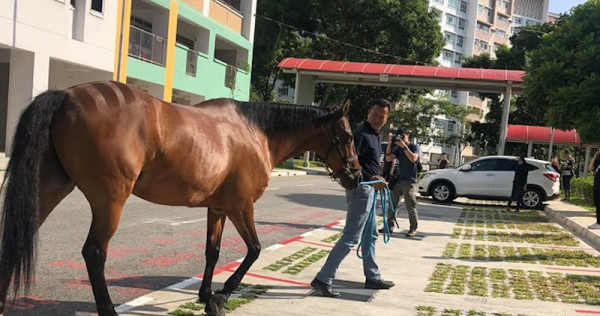
Yishun’s a district known for the wild wild west antics that (for some reason) takes place yonder frequently, but nobody expected it to be a literal one-horse town.
Netizens jockeyed for pole position in the comments section of a viral Facebook post yesterday (Oct 16) made by a man who goes by the name of Honda William. The pictures who posted were surreal, to say the least — a horse being led through a carpark in the middle of an HDB estate. How’s that for actual horsepower?
The equine sighting took place in Yishun, the “best place to stay” for being an “adventures town”, noted Honda. The steed had been led down from a truck (they really got the horses in the back!) and brought somewhere unknown, with Honda having no idea why it was there in the first place.
But pictures gotta be taken for the social media clout, of course.
Singapore has set its sights on up to four 5G networks, instead of the two initially planned for, as the authorities take bolder steps to spearhead developments believed to be crucial to the nation’s economic growth.
All four networks can be rolled out by next year, although nationwide coverage will take much longer and be limited to only two networks due to the scarcity of 5G airwaves for islandwide reach.
The Infocomm Media Development Authority’s (IMDA) more aggressive push to have two extra smaller 5G networks will take into account immediate industrial needs, for example, in smart ports and smart factories to remotely operate cranes or vehicles to move shipping containers or goods round-the-clock.
The IMDA’s decision comes after a two-month-long public consultation completed in July this year that heard calls for the involvement of all four telcos here – Singtel, StarHub, M1 and TPG Telecom – to spur innovation.
BEIJING: Deputy Prime Minister Heng Swee Keat on Thursday (Oct 17) said that Singapore should continue to “focus on structural policies” instead of “extraordinary measures” during this period of weakness in the global economy.
Mr Heng also announced that the Government intends to hold more extensive consultations with business leaders in the coming months as it maps out measures to weather the storm.
Singapore has not been spared from the economic fallout as the US-China trade war continues.
The economy grew at 0.1 per cent year-on-year in the third quarter, at the same pace of growth in the previous quarter, which was the slowest in a decade.
“We are at a state of the global economy where there are significant weaknesses,” said Mr Heng, who was speaking to Singapore media in Beijing.
“We have been monitoring this very closely over the last few months already and there are a number of things that we can do.”
“Budget 2020 is coming up in a few months’ time and we will continue to monitor the state of the global economy and there are many sectors in our economy that are still growing,” added Mr Heng.
“So you see, while overall there is weakness, you see fairly uneven performances across the different areas. But we are not at the stage where we need to amount to extraordinary measures. So what we need to continue to focus on, is on structural policies.”
The country’s industry transformation maps are an important part of this and Mr Heng said that launching this early has given Singapore a head start.
This is because people now have a better understanding of the opportunities offered by technological advances.
“I think that the fourth industrial revolution is coming – we are at a very early stage. But the earlier we prepare for it, the better we are able to ride this wave of growth,” said Mr Heng.
“What I am hoping to do is to get businesses and business leaders to be much more involved in thinking about these issues and working together even as they compete with one another.”
US-CHINA TRADE RELATIONS
On Thursday, Mr Heng met Chinese Vice Premier Liu He, who has been China’s lead negotiator in ongoing trade talks with the US.
Singapore Deputy Prime Minister Heng Swee Keat shakes hands with Chinese Vice Premier Liu He (right) in Beijing during a four-day visit to China on Oct 17, 2019. (Photo: MCI)
“Vice Premier Liu He shares the view which we have also articulated publicly that the US-China trade conflict is negative for both countries and for the world and the earlier that there is some resolution to it, the better it is for the whole world,” Mr Heng said.
“I think it is not realistic to expect that a whole range of issues will be resolved in a few meetings. Some are fairly long-term issues that will take time to resolve,” Mr Heng added.
“Being able to agree on a number of key areas will be important progress and in turn that will provide for greater confidence to investors, not just in the US and China, but all around the world,” said Mr Heng.
“I think the restoration of global confidence is important for investors. It is important for us to tackle these longer-term challenges and important for us to harness the use of better technology in the coming years.”
FOURTH-GENERATION LEADERSHIP
During his four-day visit to China, Mr Heng travelled to Chongqing, Tianjin and Beijing.
He was asked about the relationship between Chinese leaders and Singapore’s fourth-generation (4G) leaders.
Mr Heng told reporters the various members of the 4G leadership have been involved in various bilateral and business councils for several years and have become more deeply involved as they rise through the ranks.
“Take for example Minister Desmond Lee. Yesterday was my first visit to Tianjin but it was his third visit. He’s been there because he’s been a deputy for some of the meetings already. So he’s not alien to them,” said Mr Heng.
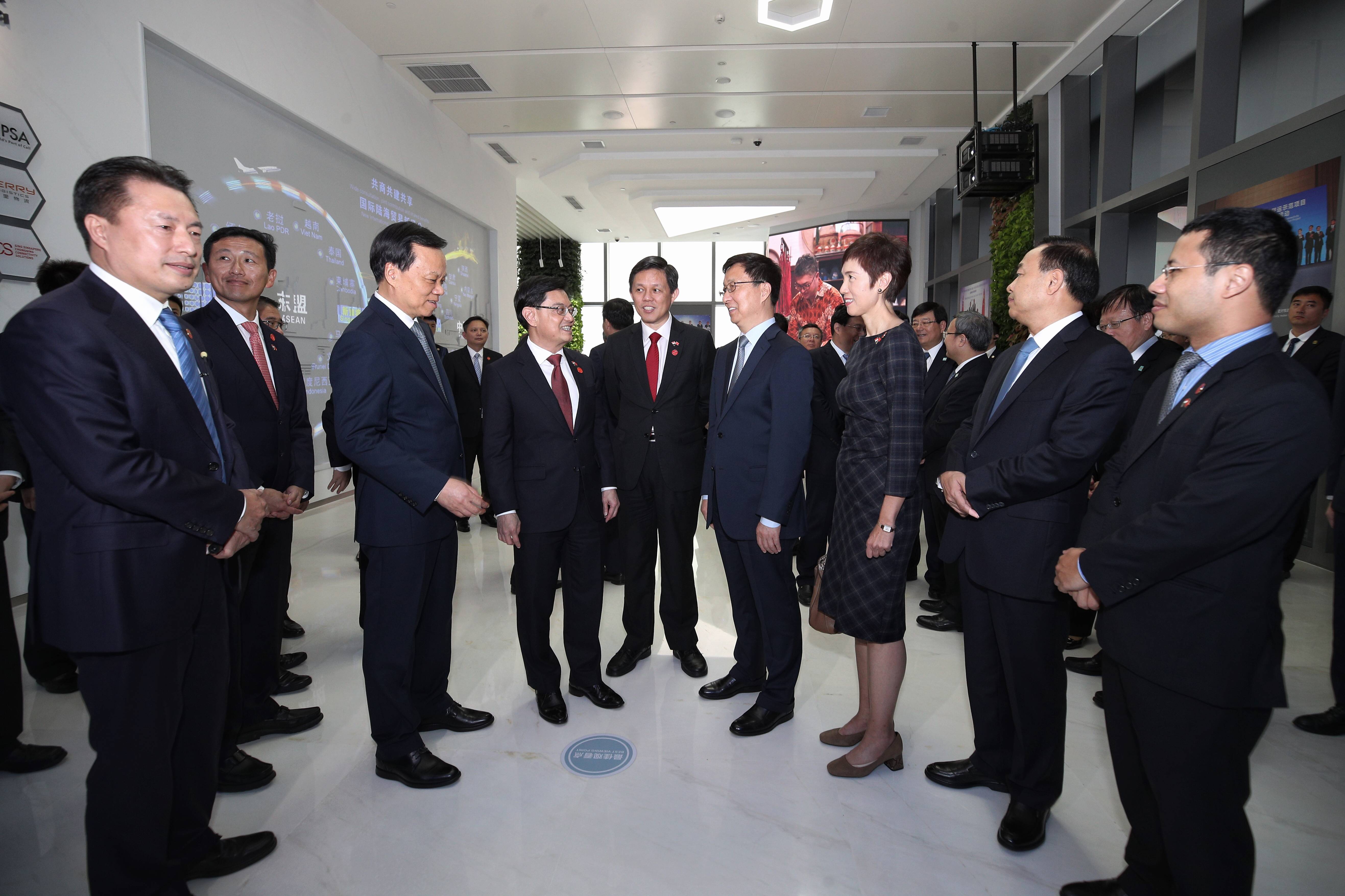
DPM Heng Swee Keat and the Singapore delegation in Chongqing on Oct 15, 2019. (Photo: MCI)
This is the case for other ministers as well.
“They’ve all been involved in various ways. So the engagements did not just start,” said Mr Heng.
Moving forward, Mr Heng added that Singapore must stay relevant and see how it can play a role at various stages of the country’s development.
PAP HAS “FAIRLY GOOD SLATE” OF CANDIDATES
Turning to domestic issues, Mr Heng was asked how 4G leaders are preparing for the next General Election, which has to be held by April 2021.
Mr Heng said that preparations have been made “all along” and the party has been interviewing a range of candidates.
“The party has a policy of regular renewal of our Members of Parliament and political office holders, so we have been searching and interviewing a whole range of candidates,” said Mr Heng.
“I would say we have a fairly good slate, but of course until the election itself, we will continue looking for candidates so we can have a stronger team in the coming years.”