SINGAPORE: Three men, including two off-duty police officers, helped to put out a fire that led to thousands being evacuated at Century Square mall on Tuesday afternoon (Nov 5).
In a Facebook post, the Singapore Civil Defence Force (SCDF) said that about 4,000 shoppers and staff were evacuated from the building as a precautionary measure.
The fire, which started at about 4.10pm, involved a floor cleaning machine in a food court on the third floor.
A fire broke out on the third floor of Century Square Mall on Nov 5, 2019. (Photo: Facebook/Gng Yeo Thuang)
Pre-school teacher Siti Nur Nabilah, 27, said she was at the food court with her husband, police officer Muhammad Farhan, 31, when the incident occurred.
They were queueing at separate food stalls when she heard an explosion and felt the floor shaking.
“I looked behind me, people were screaming and running away, so I went over to see. There was a fire and the smoke was thick,” said Ms Nabilah.
“I was looking for my husband, and he was nowhere to be found – until I saw someone trying to extinguish the fire and realised it was him.”
Shoppers make their way out after a fire broke out on the third floor of Century Square Mall on Nov 5, 2019. (Photo: Facebook/Gng Yeo Thuang)
After hearing the explosion and spotting the fire, Mr Farhan grabbed a nearby fire extinguisher and moved to put it out.
“I was anxious and nervous but I felt that it was my duty to act and ensure that the fire was contained before it got worse,” said Mr Farhan.
He was aided by two other men, one of whom was an off-duty traffic police officer. The other man called the SCDF.
After the fire was put out using the extinguisher and by water sprinklers, the three men asked members of the public to keep their distance.
Police and SCDF vehicles outside Century Square Mall on Nov 5, 2019. (Photo: Facebook/Gng Yeo Thuang)
There were no reported injuries, said SCDF, adding that it was investigating the cause of the fire.
At about 6pm, Century Square said in a post on Facebook that the tenants started to re-enter the mall at about 5.45 to begin cleaning up.
In an update on its Facebook post at about 6.17, Century Square said that the mall has been reopened to the public, although some shops have chosen to close for the day.
The food court will remain closed until further notice.
SINGAPORE: Three new initiatives were announced on Tuesday (Nov 5) as part of efforts to help households use electricity more efficiently.
Details of the measures were provided in a joint news release by the Energy Market Authority (EMA), the Ministry of the Environment and Water resources (MEWR) and SP Group.
The measures include advanced electricity meters which are being installed at all households. The meters allow residents to access their half-hour electricity usage using the SP Utilities mobile app.
The analogue electricity meters currently being used are read manually only once every two months, which means residents are billed based on estimated and actual consumption in alternate months.
With the advanced meters, they can get a better picture of their consumption patterns and reduce usage to be more energy efficient.
By the end of September, about 290,000 such meters have been installed in households across Singapore, the release said.
“These meters were installed at new residential buildings and when the analogue meters were due for replacement,” it added. “The remaining 1.1 million households will have advanced meters installed within the next five years.”
SP Group will notify residents by mail of the installation schedule for the advanced meters. No payment will be required, unless residents choose to have it installed ahead of schedule. In such cases, a S$40 one-time installation fee (before GST) will be charged.
EMA’s chief executive Ngiam Shih Chun said: “With advanced electricity meters, all households can have more timely information on their electricity usage which will help them be more energy efficient and lower their electricity bills.”
The SP Utilities mobile app will also undergo enhancements to provide more timely and useful information to help households be more energy efficient.
It will include new features, such as a Carbon Footprint Tracker, to aid customers in making changes to their lifestyle habits to save energy.
Screenshots of the enhanced SP Utilities mobile app. (Images: SP Group)
SP Group will also launch the GreenUP initiative in-app, where users can earn “leaves” when they complete eco-challenges and adopt sustainable habits, such as opting for electronic bills.
They can then use the “leaves” earned to redeem shopping rewards from CapitaLand malls, the press release said.
CUSTOMISED REPORTS
EMA and MEWR will also conduct a six-month study involving 1,000 households in Jurong who already have advanced meters. Participants in the study, which starts in December, will receive an energy efficiency report every month to help them understand their electricity usage. It will also include customised energy-saving tips.
MEWR permanent secretary Albert Chua said these reports aim to “empower households to make simple, positive changes to their daily routines”.
“The effort of every Singaporean counts. Together, we can help reduce Singapore’s carbon footprint and fight climate change.”
Malaysia-born, New York-based comedian Ronny Chieng can get quite aggressive when he delivers his jaunty yet unapologetic stand-up act that is often loaded with expletives, so much so that his Vietnamese-Australian wife has called him out for having “tone issues”.
The 33-year-old, who is a correspondent on The Daily Show With Trevor Noah on Comedy Central, told The New Paper over the phone from New York: “She has an issue with my tone because apparently the way I talk sounds offensive, which is also the reason why I named my latest tour Tone Issues.”
Chieng – who last performed in Singapore in 2015 – will be bringing his Tone Issues Tour to Esplanade Theatre on Nov 29.
He grew up in Singapore and returns here every four months to visit his family and friends who are living here.
When asked about the subjects he will be tackling during his latest tour, Chieng, without elaborating much, said he will be covering his wife, the UK and bloggers.
“It’s a bit difficult to classify them into topics because I will just be saying anything that comes to my mind.”
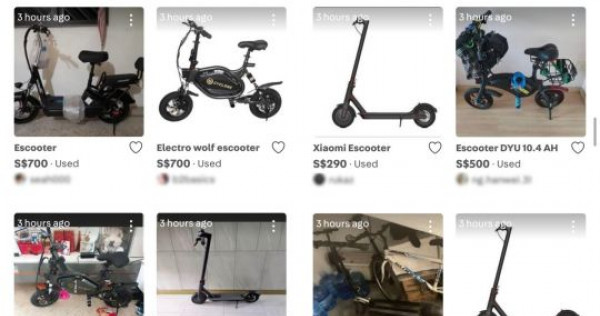
SINGAPORE – At least 40 e-scooters were listed on online marketplace Carousell as of 7pm on Monday (Nov 4), the same day it was announced that electric scooters will be banned from footpaths from Tuesday.
This is a jump from at least nine that were listed on Sunday.
Listings on Carousell range from $0 to $1,500. But it is not clear if sellers would let their e-scooters go for free or extremely low prices.
Under the new ban, e-scooters will be confined to 440km of cycling paths islandwide, instead of the 5,500km of footpaths. Those caught flouting the rules can be fined up to $2,000, jailed for up to three months, or both.
From now until the end of the year, the authorities will mainly issue warnings to errant riders, but a zero-tolerance approach will be taken from next year.
SINGAPORE: Are personal mobility devices (PMDs) really that bad?
The numbers tell a terrible story. Six PMD riders dead between January 2017 and September this year reported by Tan Tock Seng Hospital alone.
‘DO SOMETHING’
It wouldn’t be Singapore if someone didn’t say “the Government should do something”. Member of Parliament (MP) Lim Biow Chuan obliged last month, among a sea of many other MPs calling for harsher punishments for errant e-scooter riders.
There was a public petition to ban them from public footpaths, with more than 69,000 signatures.
So, came new rules. The Active Mobility Act, made effective in May 2018, specified conditions PMDs and bicycles must meet like the maximum speed.
And more new rules again in 2019, mandating the registration of e-scooters, electric bikes and compliance with UL2272 certification.
Then the rules were changed on Monday (Nov 4) when a ban on e-scooters on footpaths was announced.
Yet, all of these, in my mind, are stop-gap measures.
The casualties include e-scooter riders themselves. As far back as 2017, the warning signs were already being noticed by trauma doctors at Tan Tock Seng Hospital, who admitted close to four such casualties a month.
By September this year, that was nearly nine a month.
File photo of e-scooter riders in the CBD. (Photo: AFP/Roslan RAHMAN)
WHO IS AFFECTED?
The reaction thus far demonstrates one thing very clearly: That the e-scooter explosion caught our leaders and senior bureaucrats by surprise.
Perhaps, they do not ride such devices and are less likely than most people to haunt public footpaths.
Who rides e-scooters? There are said to be some 7,000 food delivery riders using e-scooters here. Most work for Grab.
Interestingly, Grab seems willing to sacrifice customer goodwill as well as rider welfare. Its reaction to the rule banning e-scooters is to pass the buck to customers, highlight the delays to delivery and essentially tell them “Wait, lah!”
But these food deliverers depend on their e-scooters to make a living and complete enough deliveries.
Therein lies the seeds of the underlying problem. The approach from those in authority and from what seems to be the majority of the people, judging from the speed with which the public petition was able to gather so many signatures, has been to impose bans and restrictions. That’s too easy.
WHAT THE REAL PROBLEM IS
The transport and building infrastructure builders and regulators must swallow their share of blame too. They have clearly been blindsided by this phenomenon.
They need to come up with real solutions that incorporate the use of e-scooters at some point, and not be content to ban them.
Aftermath of a PMD-related fire in a Geylang e-scooter shop, Oct 28, 2019. (Photo: Facebook/SCDF)
A more densely populated and congested city is our reality. So is the use of new technology in mobility.
To its credit, the LTA responded promptly when I brought to its attention how a recently beautified public footpath leading from my estate to Clementi Road was too narrow to allow a cyclist or e-scooter rider to pass a pedestrian safely.
On a recent evening, I was walking home when a burly man and a young boy, both on e-scooters, came up behind me. I heard them talking.
So I quickly stepped off the path and onto the grass verge. They zipped past with nary a glance at me, nor a pause in their conversation.
Not long afterwards, on a public footpath near Lucky Plaza, I noticed an e-scooter rider coming towards me.
Ahead of him walked a grey-haired man oblivious to the danger approaching. I grabbed the old guy and shoved him into the bushes.
The e-scooter dodged the man and zoomed past us, the rider still looking at his cellphone.
When the startled old man began to berate me, an onlooker stopped him. “Uncle, this auntie just saved you,” he said.
PMD users at Boon Lay Place on Sep 23, 2019. (Photo: Corine Tiah)
Today, with e-scooters banned from public footpaths, Singapore, like all the places wrestling with the problem, is just at the starting gate to a solution.
We must take a good hard look at the businesses and business owners who imported this e-scourge into Singapore and have so far been largely able to dodge blame.
The importers and sellers of these machines are the source of the problem. They are the ones who have profited most from e-scooters, and they must now be made to become part of the solution.
The fallout from e-scooters is not limited to death and bodily harm. There have been too many fires resulting from the charging of these devices.
PERSONAL RESPONSIBILITY
Beyond that, we also have to look inwards. What about personal responsibility?
Whenever I spend time in the Netherlands, I have always been impressed by the skill, deftness and consideration with which the people move around on bicycles.
What do we have to do as a nation to develop that same wonderful consideration for other people – no matter what passport they hold – so that we look out for one another, sometimes in a very literal way?
File photo of a man riding an e-scooter. (Photo: AFP/Tobias Schwarz)
And then, how do we hardwire that into our national psyche?
While I could not oppose the petition to ban e-scooters in Singapore, or ban them from public footpaths, I cannot support either move, simply because I realise that to thousands of people, it represents the ability to support themselves and their families. It is their lifeline.
Whatever solutions are considered, we cannot lose sight of that.
Irene Hoe is a writer, editor and coach and has been a journalist for many decades.
SINGAPORE – Owners of non-compliant e-scooters can continue to dispose of their devices and collect the $100 incentive until the end of the year.
The Land Transport Authority (LTA) said it will extend by a month, the deadline for users to dispose of their non-UL2272-certified e-scooters.
This is to encourage more people to come forward, the authority said.
More than 30 additional disposal points will also be added islandwide, taking the total number of such centres to about 200.
Since the introduction of the early disposal incentive in September, LTA has received more than 9,000 applications from owners to dispose of their registered non-UL2272-certified e-scooters.
Of the 100,000 registered e-scooters here, about 80,000 are not UL2272-certified and will be banned from public places from July 1, 2020.
Today marks the end of an era — no longer will Singaporeans enjoy the sweet harmonies of trashy trance music blaring out from cheap speakers as youngsters on electric scooters speed past on pavements.
Starting today, e-scooters are officially banned from footpaths. It’s a hardline regulation enacted by the Singaporean government after years of horrible accidents, petitions and general online vitriol against all personal mobility device (PMD) users. No matter if they’re errant or law-abiding.
In Parliament, the Senior Minister of State for Transport Lam Pin Min mentioned that the number of accidents involving motorised e-scooters have continued to rise despite efforts to clamp down on non-compliant devices and dangerous riding.
SINGAPORE: Coin enthusiasts will be able to pre-order commemorative coins for the Year of the Rat from Tuesday (Nov 5).
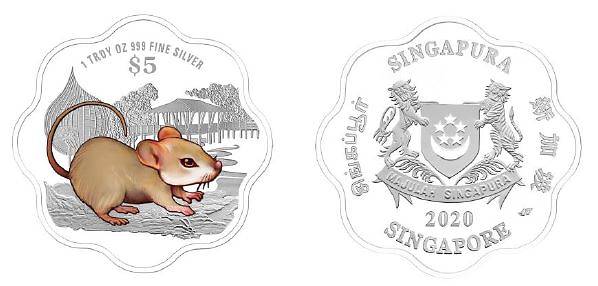
The Monetary Authority of Singapore (MAS) on Tuesday unveiled the limited-edition coins, which feature an image of a rat against the backdrop of the Sungei Buloh Wetland Reserve – Singapore’s first ASEAN Heritage Park.
The reverse side of the coins bears the Singapore Coat of Arms with the year 2020.
The coins are the fourth in the Singapore Fourth Chinese Almanac Coin Series. The series will be issued over 12 years from 2017 to 2028, with each year’s issue depicting a zodiac animal in a park or natural landscape setting in Singapore.
Ten versions of the Year of the Rat coins will be issued on Jan 1 next year.
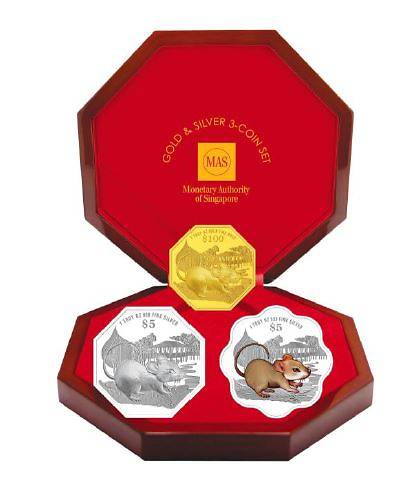
An octagonal coin in 999.9 fine gold with a face value of S$100. (Image: MAS)
The coins will come with varying metallic compositions, shapes and minting relief effects, as well as in special premium sets with different coin combinations.
Floral-shaped coin in 999 fine silver with a face value of S$5, and the image of the rat in full colour. (Image MAS)
They include 50,000 nickel-plated zinc coins with a face value of S$2, as well as 12,000 floral-shaped coins made from 999 fine silver with a face value of S$5 and the rat in full colour.
There is also a premium gold and silver three-coin set.
A gold and silver three-coin set. (Image: MAS)
The coins will be sold by the Singapore Mint. Pre-orders can be made between Nov 5 and Dec 16, and balloting will be conducted if demand exceeds supply.
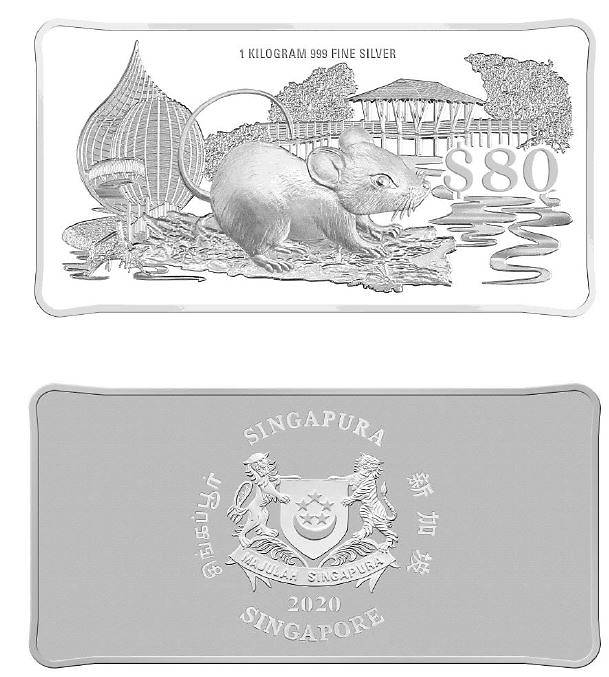
A rectangular coin in 999 fine silver coin with a face value of S$80. (Image: MAS)
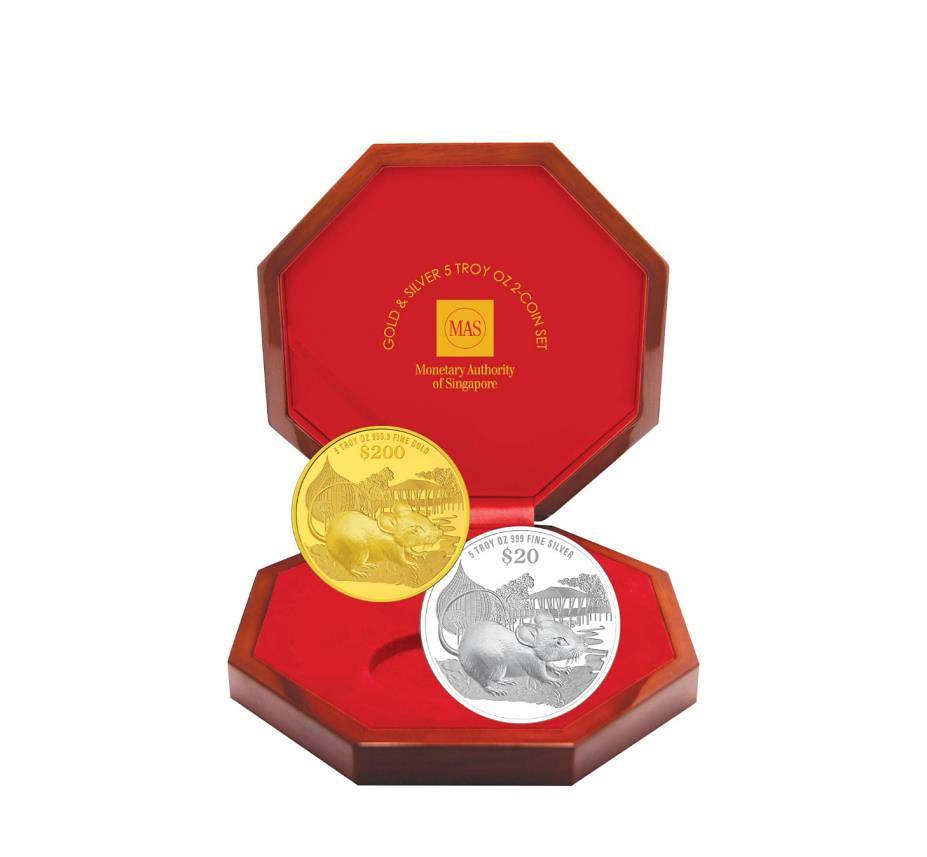
A premium set of 5-troy-oz gold proof coin and a 5-troy-oz silver proof coin, positioned to form the auspicious figure “8”. (Image: MAS)
Hey! Wait! Don’t go out! It’s unsafe! Wild Pokemon live in the tall grass! Take this uh… A4 plastic folder along on your travels.
The first official Pokemon Centre outside of Japan is located right here at Jewel Changi Airport, and its idea of what an exclusive freebie should be is a hoot.
But some context first. The latest outing in the long-running Nintendo video game series — Pokemon Sword and Pokemon Shield — is launching on Nov 15. Pokemon Center Singapore, which opened back in April, is a massive haven of all things Pokemon that holds an insane array of related merch, from plushies to posters.
So forgive us if we’re having a little laugh that folks who’ll purchase the new games (ranging from $89.00 for the standard version to $299.90 for the collector’s version) will walk away with something as nominal as a plastic sleeve to keep paper.



.jpg "20191105_escooter_st-1.jpg")