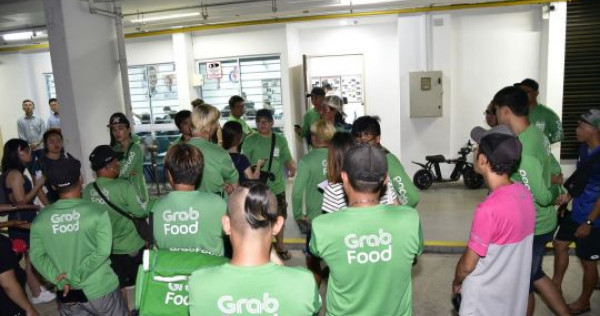
SINGAPORE – About 30 food delivery riders met Home Affairs and Law Minister K. Shanmugam on Tuesday evening (Nov 5) to voice their concerns that the ban of e-scooters from footpaths would affect their livelihoods.
They had gathered at Mr Shanmugam’s Meet-the-People Session in Yishun over the ban, which came into effect on Tuesday.
In a Facebook post on Wednesday, Mr Shanmugam said it was a “good, civil meeting”, and that he would call for another one.
The Nee Soon GRC MP met three of the riders in his branch office, before moving outside to meet the rest in an open area outside his branch office.
He said: “I explained the reasons for the move on personal mobility devices (PMDs). They explained their position, their difficulties.
“I said we understood their position, but I would also convey their views to the Ministry of Transport, and to Cabinet.”
The minister was among several MPs that e-scooter users have approached for help. Tampines GRC MP Desmond Choo said: “They asked if food delivery riders could be given special licenses if they passed tests and were insured. That could be viable and should be studied further.”
SINGAPORE: The ban on e-scooters from footpaths was announced suddenly. But let us be honest, it was a long time coming.
The warning signs were there: Fights and accidents playing out in full view for all to see and judge, and efforts at mediation were insufficient to calm the tension hanging in the air, too thick to be tenable over the long term.
The co-habitation arrangement between pedestrians and e-scooters wasn’t going to stand the test of time.
AN OVERDUE BREAK–UP
Now that the break-up has happened, e-scooters have been ordered to pack their bags and move out.
Tech-savvy Singapore has embraced the e-scooter craze but accidents triggered calls for a ban AFP/Roslan RAHMAN
As with most break-ups, there is also a lot of finger-pointing going on – towards everyone from the reckless riders down to the sellers of non-compliant e-scooters. Even the graciousness and kindness of Singaporeans, as a whole, is on trial.
Interestingly, there is one factor that seems to be flying under the radar despite the central role it has played in the drama: The lack of sufficient infrastructure.
THE GOOD NEWS? NOT A COMPLETE BAN
In their announcement, the Singapore Government did not impose a full ban on e-scooters. They are still able to use dedicated cycling paths and the Park Connector Network.
The Government also stated that they would construct approximately an additional 310km of such pathways, primarily in intra-town networks (i.e., to connect to local destinations within neighbourhoods), by 2025 – creating a total of approximately 750km of pathways that e-scooters can avail themselves of.
This is approximately 13 per cent of the existing network of 5,500km of footpaths, and less than 8 per cent of the 9,405km of vehicular road lanes.
File photo of cars, motorcycles and goods vehicles on Singapore roads. (Photo: Jeremy Long)
A GOOD COMPROMISE?
On the face, this sounds like a good compromise. Indeed, e-scooters never belonged on a footpath to begin with.
Transportation modes that travel at vastly different speeds have almost always been separated from each other for reasons of efficiency, speed and, most of all, safety.
It is why separated bicycle paths are still the gold standard for transportation-forward cities around the world.
A goal of 310km of additional pathways in six years will be a good contribution, and well ahead of many other cities.
Cycling paths in Singapore. (Photo: MEWR)
But Singapore is not just any other city. It is a city that prides itself on being fast, efficient, effective and inventive. The home of the Jewel, Marina Bay Sands and a wide array of other impressive high budget engineering feats that have literally moved earth.
IMAGINE THE WORLD’S MOST IMPRESSIVE TRANSPORT INFRASTRUCTURE
What could happen if we were to apply that ingenuity to creating the world’s most impressive infrastructure – not only for bicycles, but for e-scooters, hover boards, unicycles, skateboards and other modes of transport that are too fast for a footpath and too slow for a roadway?
Indeed, infrastructure for these emerging forms of transportation is so new that there is not even consensus on what to call it.
I have seen terms including “clean paths,” “green paths,” “third paths,” and an array of other path-isms.
This is because it seems counter-intuitive to call something a bicycle path when bicycles may not even be its dominant user. But it is better than the tongue twister: “Bicycles, e-bikes, e-scooters, PMDs and other emerging forms of low-impact transport.”
File photo: TODAY/Nuria Ling
For the sake of simplicity, I’ll call them “car-lite modes”.
REDESIGNING SINGAPORE’S CAR-LITE PATHS
We are in new territory, and this presents a critical moment to consider how to successfully integrate these car-lite modes into the city.
The demand is now proven, and it is waiting for the infrastructure to catch up to allow it to thrive. This is where I hope we can transfer our energy to next, and with speed.
This time would be well spent rethinking how to create great, intuitive infrastructure for car-lite modes. A well-considered design has the ability to help reconfigure the relationships we have with one another on the road.
A man pushes his e-scooter during car-free Sunday in Singapore. (Photo: Mediacorp)
To create a truly multi-modal transportation network, it will not be enough to simply widen existing footpaths in neighbourhoods.
We need to consider everything from how different car-lite modes interact with one another within the path, to how the paths interface with pedestrians, cars, buses, intersections, bus stops, footpaths and more.
Further, we need to look at how to create linkages not only within towns, but across the city to allow people to get to where they want to go safely, comfortably and easily.
Even on the existing Park Connector Network, there are a number of potential design improvements that could enhance its appeal.
It is great to have a dedicated recreation pathway, but many sections of it still require significant effort to use including navigating overhead bridges, busy traffic intersections with long signal wait times, steps, narrow shared footpaths that snake around busy bus stops, unsigned detours around construction sites and unclear entrance and connection points.
An e-bike rider in Singapore. (File photo: TODAY)
Applying intuitive and user-friendly design to these types of infrastructure will elevate Singapore to the next level of transport, opening a whole new range of mobility options that can change the way that we see, move within and interact with the city.
DISRUPTIVE INNOVATION NEEDED
To create a diversified and future-proof transportation network, it is unlikely that incremental improvements will be sufficient. We need disruptive innovation.
Industry will continue to introduce new innovations with different modes of transport.
If the Government can look towards innovation on the side of the design and infrastructure, building upon all that we have experienced in the past two years, I am optimistic that we can reintroduce car-lite modes to the city, with the right conditions to set it up for success.
Julienne Chen is a research fellow at the Lee Kuan Yew Centre for Innovative Cities at the Singapore University of Technology and Design, where she focuses on urban processes and systems.
Several came on e-scooters and parked their devices at the nearby connector and void deck.
A representative from the group of riders met with an MPS volunteer, while another rider spoke to ward grassroots adviser Dr S Vasoo.
By about 9pm, only around five riders remained.
The PMDs parked alongside a pathway at Ang Mo Kio on Nov 6, 2019.
Speaking to CNA, one delivery rider said she could not do her work because of the ban.
“A lot of the (people) here … they have children to pay for, instalments to pay for, they have house to pay for. Some of them don’t even have a house, they have to rent,” said delivery rider Dana.
“So, you suddenly tell us one day, the next day we cannot work. How are we going to pay all these instalments, how are we going to pay all the expenses? It’s not possible, physically not possible really,” she added.
Ms Kelly Lee, another delivery rider, also said she hoped the Government could help the riders with their predicament.
About 50 e-scooter riders gathered at an Ang Mo Kio Meet-the-People session on Nov 6, 2019.
“(We) hope the Government can help, do something for us. We need this job,” said the 46-year-old in Mandarin.
“Let us ride if we follow the rules … How do I find a job? Today you said ban, tomorrow it takes effect. I can find a job immediately? How many can find jobs?”
She added: “At least provide us some alternatives, like giving food delivery riders wearing uniforms who use compliant e-scooters a licence to ride on footpaths.”
E-scooters have been banned from footpaths, with offenders facing fines of up to S$2,000 and jail time of up to three months once the ban is strictly enforced from 2020.
The use of e-scooters remains banned on roads, although such devices are allowed to be used on cycling paths and park connector networks.
There will be an advisory period until Dec 31, during which errant users will be given warnings, to allow e-scooter riders time to adjust.
Earlier on Wednesday, Home Affairs and Law Minister K Shanmugam – who is an MP for Nee Soon GRC – said he met with 30 PMD riders who had come to see him at his MPS in Yishun.
“They explained their position, their difficulties,” said Mr Shanmugam in a Facebook post, adding that while he “understood their position”, they would have to convey their views to the Ministry of Transport and to Cabinet.
SINGAPORE: The Indian worker who died in a crane collapse at a construction site in Novena was the sole breadwinner of his family.
Mr Velmurugan Muthian, 28, was pronounced dead at the scene after a crane collapsed during a lifting operation at the construction site of a new rehab facility in Jalan Tan Tock Seng on Tuesday (Nov 5).
The site of a crane collapse on Nov 4, 2019 that left one worker dead. (Photo: Try Sutrisno Foo)
A Bangladeshi worker was also taken to hospital with injuries.
Mr Velmurugan’s body is set to be flown back to India early on Thursday, accompanied by his cousin who is also a worker here, said Ms Dipa Swaminathan, founder of ItsRainingRaincoats, an initiative that gives help to migrant workers in Singapore.
As he was a Hindu, his body is likely to be cremated sometime on Thursday, she added.
Mr Velmurugan, who was from Tamil Nadu, was employed by LKT Contractors and had only been working in Singapore for about three months.
He previously worked here for more than five years, then returned to India to get married.
His wife, elderly parents and younger brother rely on his paycheck, and a few days before the accident, he received news that his wife was expecting their first child, said ItsRainingRaincoats.
In a post on its Facebook page, the volunteer organisation shared a link to a crowdfunding campaign, which has raised more than S$57,000 at the time of writing. Two volunteers also gave white packets to Mr Velmurugan’s cousin, Ms Dipa said.
The money will be sent to his family in India.
“We will likely wait for his cousin to return from India and pass him the money in person so he can give it to the family,” Ms Dipa said.
She said they want to make sure that the money is spent well and that it will go to the family.
She told CNA that the crowdfunding campaign will likely remain up until Mr Velmurugan’s cousin returns to Singapore on Nov 14.
Of the decision to put Mr Velmurugan’s details on the social media website, Ms Dipa said: “Our real goal, more than the money, was that we didn’t want him to be another statistic. We wanted everyone to know his name and story.”
SINGAPORE: Singapore has accepted Saudi Arabia’s invitation to participate in the G20 meetings in the kingdom next year, the Ministry of Foreign Affairs (MFA) said on Wednesday (Nov 6).
In a press release, MFA said President Halimah Yacob landed at the Royal Terminal in Riyadh on Tuesday for Singapore’s first state visit to Saudi Arabia. She was received by Riyadh governor Prince Faisal bin Bandar bin Abdulaziz Al Saud.
On Wednesday, President Halimah called on King Salman Bin Abdulaziz Al Saud and attended a state banquet lunch he hosted in honour of the president and her husband Mohamed Abdullah Alhabshee.
During their meetings, President Halimah and King Salman affirmed the two nations’ “warm and longstanding bilateral relationship and discussed ways to expand cooperation, including through Singapore’s support for Saudi Arabia’s Vision 2030 economic agenda and G20 presidency in 2020”.
Singapore President Halimah Yacob is welcomed by Saudi Prince Faisal bin Bandar bin Abdulaziz Al Saud, governor of Riyadh, on Nov 5, 2019. (Photo: Ministry of Communications and Information)
President Halimah also thanked King Salman for inviting Singapore to participate in the G20 meetings in Saudi Arabia, which Singapore was “honoured to accept”, said MFA.
King Salman also conferred on Mdm Halimah Saudi Arabia’s highest civilian honour, the King Abdulaziz Medal.
Earlier on Wednesday Mdm Halimah met with Prince Faisal and discussed development projects in Riyadh and the resulting opportunities for Singapore companies.
Mdm Halimah’s trip to Saudi Arabia follows Singapore’s second state visit to Kuwait.
She then made a brief visit to the Saudi city of Madinah, where she visited historical sites such as the Qiblatayn Mosque, Quba Mosque and Hejaz Railway Museum.
“Madinah is a deeply religious place for Muslims and I am glad to learn so much about the history of the place, including its pre-Islam history,” said Mdm Halimah in a Facebook post.
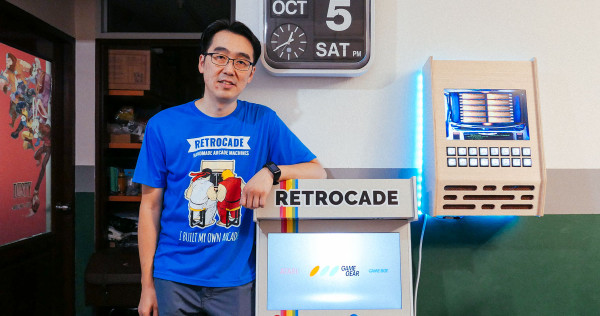
Analogue amusements like vinyl players, VHS, and cassette tapes used to be a dying format until hipsters started reanimating them into the present life. Nostalgia is a lucrative business to get into, and the demand for ghosts of pop-culture past remain the driving force behind so many comebacks; why else would Disney movie reboots, emo nights, and chunky dad shoes become such a raging success?
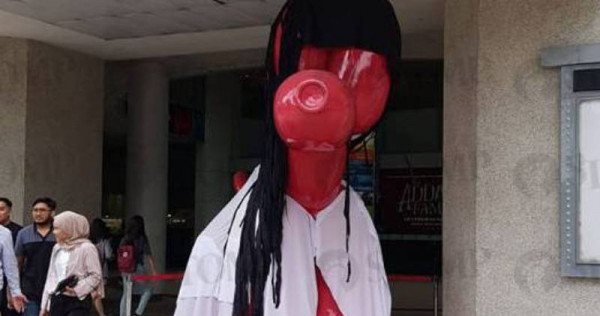
At the entrance of The Cathay shopping mall sits an eye-catching dog sculpture, but not everyone is pleased with how it has been decorated for Halloween.
Known as POPek, the striking red sculpture is part of the Singapore Cathay Center Balloon Dogs art exhibition.
The iconic pooping balloon dog was designed by London-based artist Sebastian Burdon, who goes by the online moniker whatshisname.
Stomp contributor Gina, however, is incensed at how the sculpture has been decorated for Halloween.
She contributed a photo that shows POPek being dressed up in a wig and costume.
She told Stomp: “This is a tasteless, disastrous and less than half-hearted attempt at a Halloween dress-up in public.
“I can’t believe this is something that the mall management approved and think is of quality to be exhibited in public.
“Above all, it is an insult to the original POPek sculpture and I feel extremely bad for the original artist that his beautiful work has been subjected to such a senseless violation.”
Gina also provided feedback about the sculpture to The Cathay and shared a screenshot of the response that she received.
SINGAPORE: Animals like mousedeer, civet cats and pangolins will have a safer way to cross Mandai Lake Road when the new Mandai Wildlife Bridge raises its barricades at the end of the month, in anticipation of its official opening in December.
The area has seen some roadkill in recent years. A pangolin was killed in an accident along Mandai Lake Road in September 2017, while a leopard cat, Sambar deer and pregnant wild boar were found dead in February 2018.
Previously Eco-Link, the bridge is part of Mandai Park Holdings’ (MPH’s) rejuvenation project and is the first of its features to be completed.
Also part of the project is the development of two new wildlife parks – a Rainforest Park and a new Bird Park – plus nature-themed indoor attractions, accommodation offerings and green public spaces.
These will augment the existing Singapore Zoo, Night Safari and River Safari to form a new integrated wildlife and nature destination at Mandai.
Connecting the bridge to the buffer zones instead of the actual nature reserve ensures that the infrastructure does not encroach into the reserve. To cross the bridge, wildlife will have to travel from the CCNR to the buffer zone.
The Mandai Wildlife Bridge measures between 35m to 44m wide at different points and is about 140m long.
Source: Mandai Park Holdings
It connects two buffer zones in the Central Catchment Nature Reserve (CCNR), each on one side of Mandai Lake Road, for the first time in 60 years, said Dr Lee Hui Mien, vice-president for sustainable solutions at Mandai Park Development.
Each zone is made up of a strip of land 45m to 50m-wide, protected from any development works. Together, they comprise 15 per cent of land set aside for the Mandai project.
Mandai Park Development’s assistant vice-president for sustainable solutions Chua Yen Kheng said the bridge keeps animal crossings safe.
“When there are two forest patches, some animals won’t cross, but some will. (The bridge) forms a safe passage for these animals,” said Ms Chua.
The bridge will eventually have more than 31,000 plants. (Photo: Rauf Khan)
Another function of the bridge is to promote movement of animals to allow them to breed with each other, improving the genetic diversity of species.
Increased connectivity also helps restore ecological processes such as the dispersal of plant species by animals, said Ms Chua.
“CONTINUOUS CANOPY”
The Mandai Wildlife Bridge will have what is described as a “continuous canopy”, which helps encourage even animals that live in trees to use the link as a crossing, said Dr Lee.
“Vegetation cover is needed for shy, forest-dependent animals such as (the) shrew-faced ground squirrel and short-tailed babbler to move across the landscape,” according to a press release.
To create this, MPH will build a multi-layered forest structure with fast-growing species of trees that grow to various heights at maturity, it said in a press release.
When planting is completed, MPH estimates that the bridge will have more than 31,000 plants, with a mix of more than 1,000 native trees and 30,000 shrubs.
There will also be fruit and flowering trees in the central belt, and a living forest floor with nectar bushes and shrubs to attract birds, butterflies and insects into the crossing.
Permanent fencing will be erected to “funnel” wildlife onto the bridge, said Dr Lee. The fencing will be completed by 2020.
Planting is currently still ongoing at the Mandai Wildlife Bridge with help from volunteers. (Photo: Rauf Khan)
To protect wildlife, there will also be “minimal human activity”, as some animals might be afraid of using the bridge with the presence of humans, added Dr Lee.
“The whole idea is to make this wildlife bridge for the animals to use,” she said.
Since construction began in 2017, MPH has been monitoring wildlife species found in the area with six cameras placed all around the bridge.
As of Wednesday, MPH has collected about 400,000 pictures of wildlife species to analyse the animals’ movements.
“Analysis from the data will not only provide a fuller picture of the type of wildlife in the area, but also enable appropriate measures to be taken to ensure effectiveness of the bridge.
“This will be done in consultation with wildlife experts, the nature community and relevant Government agencies,” said MPH.
SINGAPORE: Retrenched DFS Group employees were offered better severance packages on Wednesday (Nov 6) following discussions with the Singapore Manual and Mercantile Workers’ Union (SMMWU).
The retrenched workers will now receive one month’s salary for each year of service, capped at 25 years, said a DFS Group spokesman in a statement. This is the standard for a unionised company.
According to affected employees who met with HR staff on Wednesday, payouts will be made at the end of November.
These new terms come after two rounds of revisions of the severance package.
The original package offered, when about 60 people were retrenched on Sep 26, was two weeks’ salary for each year of service, capped at 13 weeks of pay. The cap was later upped to 13 years, or the equivalent of 26 weeks’ pay, before the current deal was negotiated.
Affected employees were invited to meet with HR staff on Wednesday, Nov 6.
A DFS Group spokeswoman said the company has had “several positive meetings” with the SMMWU since early October.
It is committed to carrying out the retrenchment exercise in a “fair and sensitive manner”, following feedback and concerns from their employees as well as input from the SMMWU, she said.
“We sincerely thank all affected staff for their past service to DFS. We have increased the severance payout to all affected staff to one month’s salary for each year of service, capped at 25 years.”
The spokeswoman also said that DFS Group will continue to work with tripartite partners and outplacement agencies to support affected workers.
The LVMH-owned company met with affected employees at its Chai Chee office on Wednesday to announce the new severance package terms and will be meeting employees on Thursday as well.
“A KIND OF VICTORY”
Affected employees CNA spoke to said they were satisfied with the new terms.
“All of us are elated, it’s kind of a victory for us,” said one former employee, who had worked with DFS Group for 14 years before being retrenched.
An ex-employee, who worked for DFS Group for about 20 years, said: “I think it’s way more fair to us. They did what they should have done from the beginning.”
The employee told CNA that she has been looking for a job since the retrenchment exercise, but has had no luck.
“Because of our age and current resume experience, it’s a bit difficult, and the job market is tough at the end of the year. This new package is a bit of comfort … I will have something to tide me over,” she added.
Another former employee, who has worked for DFS Group for about 30 years, commended DFS Group for giving out long service awards to affected employees who would’ve worked 25, 30, 35 or 40 years this or next year, along with the retrenchment packages.
Affected employees also told CNA that about 30 of them met DFS Group’s Chief Financial Officer Zac Coughlin in mid-October.
“He apologised and took personal responsibility for how the retrenchment was carried out on Sep 26,” said an employee who was present at the meeting.
“He also mentioned that he didn’t expect that the American way of retrenching staff was not appropriate in Singapore’s context. He said DFS will need to rebuild the broken trust and image.”
LOTTE TO TAKE OVER
DFS Group announced in August that it would not retain its duty-free liquor and tobacco concession at Changi Airport when the lease expires in June 2020.
It had previously said that about 500 people were employed at DFS’s liquor and tobacco duty-free outlets at Changi Airport and that staff members would be offered options regarding their employment, which include deployment to other DFS concessions and working for the new operator.
South Korea’s Lotte Duty Free announced on Oct 24 that it will be taking over the liquor and tobacco stores at Changi Airport.
SMMWU secretary-general David Yeo told CNA that the union will be helping affected employees secure positions with Lotte.
In response to CNA queries, a Lotte spokesman said that he could not confirm whether they will be hiring former DFS Group employees in need of a job.
“One thing we can clarify is that we are definitely willing to consider hiring those who have the relevant expertise. We believe that Lotte Duty Free and Changi Airport Group are on the same page regarding this matter,” he said.
“We are well aware that the employment is the very first thing to care for in this transition process.”