SINGAPORE: The State Courts will relocate to new premises at the State Court Towers in December.
Some services will be available at the new location from Dec 9 and the State Courts will be fully operational at the new location on Dec 16, authorities said in a media release on Friday (Nov 29).
Located next to the current State Courts Building, the new State Court Towers will have 53 courtrooms and 54 hearing chambers.
There will also be facilities for court users and members of the public, including a business centre, a library, a heritage gallery and a legal aid help centre.
The interior of the central registry. (Photo: State Courts)
A one-stop Central Registry on level two will act as a service cente for court users who need assistance.
Services include help with magistrates’s complaints, neighbour disputes, harassment matters, small claims and bailiff matters among others.
The Mentions Court’s interior. (Photo: State Courts)
The Mentions Court viewing gallery. (Photo: State Courts)
Court users can also file magistrate’s complaints, appeals and applications for court records there.
The collection and submission of documents and affirmation of legal documents can also done at the registry.
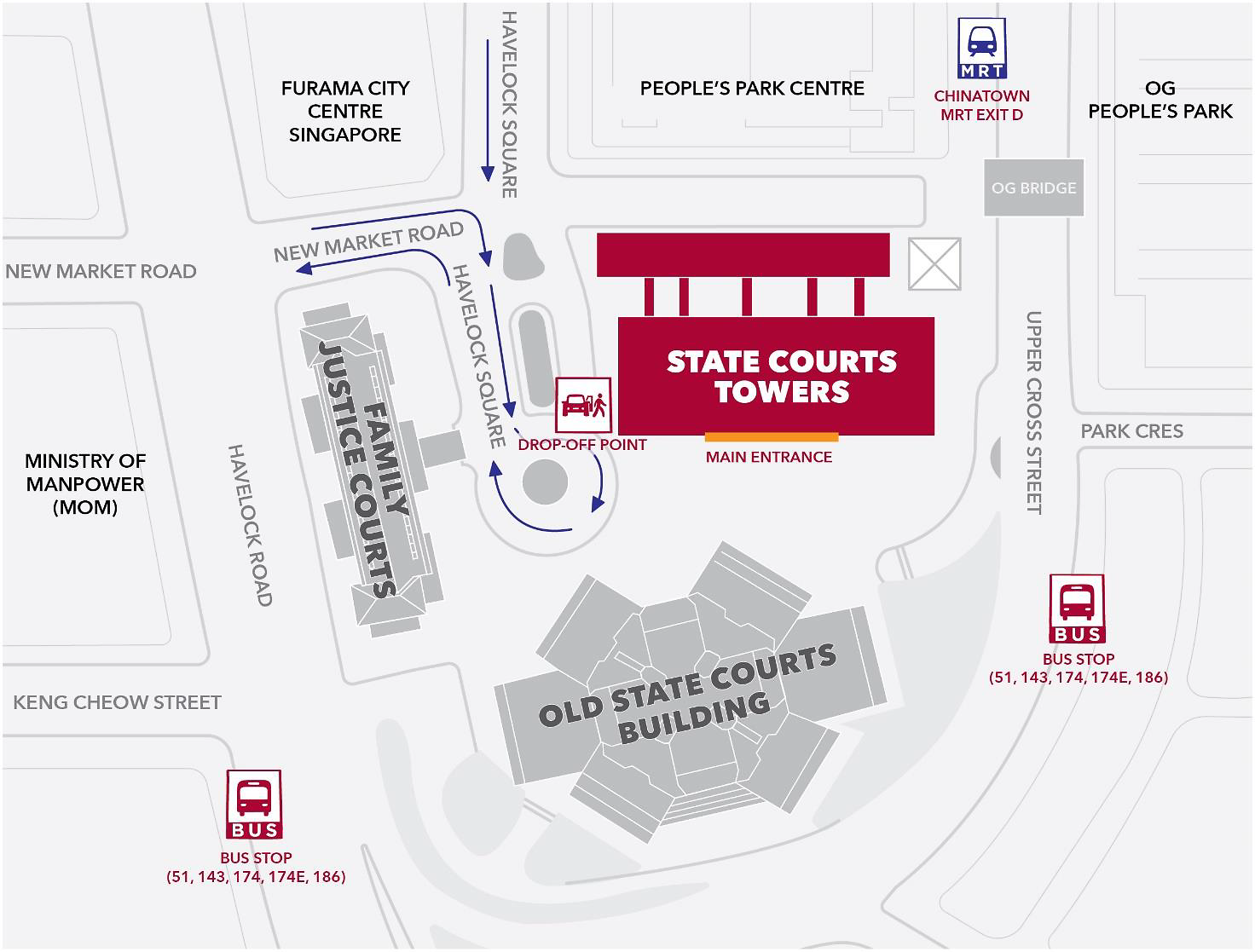
The new building’s main entrance faces Havelock Road with a vehicle drop-off point at Havelock Square. Pedestrian and wheelchair access is available from Upper Cross Street and Havelock Square.
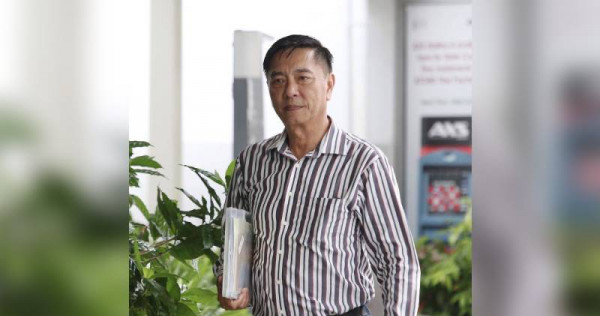
SINGAPORE – Veteran local actor-director Ng Aik Leong, better known as Huang Yiliang, appeared in court on Friday (Nov 29) after he allegedly attacked another man with a metal scraper.
Ng, 58, was charged with one count each of causing hurt with a weapon and an unrelated affray charge involving another man.
Affray is committed when two or more people disturb the public peace by fighting in a public place.
Ng is accused of using a metal scraper to attack a man identified as Mr Jahidul at a canteen of the Singapore Islamic Hub in Braddell Road at around 4.30pm on Dec 11 last year.
He allegedly used the weapon to hit Mr Jahidul twice on his abdomen and one on his head.
The alleged victim suffered a head injury and an abrasion over his abdomen.
Separately, Ng allegedly disturbed public peace by fighting with Mr Morgana Raj Saravanan in Buffalo Road at around 7.50pm on June 9 this year.
The Singaporean is said to have hit the back of Mr Morgana Raj’s head with a mobile phone.
Ng was unrepresented in court on Friday and he told District Judge Terence Tay that he intends to engage a lawyer.
SINGAPORE – A staff sergeant with the Singapore Police Force has appeared in court to face charges of corruptly obtaining sexual gratification from two women who were the subjects of investigations.
Mahendran Selvarajoo, 31, allegedly received gratification from one of them to help her avoid criminal prosecution.
Mahendran was charged on Friday (Nov 29) with two counts each of corruption, performing unauthorised modification to the contents of a computer, as well as being in possession of obscene material in his mobile phone and USB flash drive.
The Singaporean is also accused of accessing without authority the photo gallery in a woman’s mobile phone to snap three of her personal pictures.
In a statement on Thursday, the Corrupt Practices Investigation Bureau (CPIB) said law enforcement officers have the duty to maintain law and order, and conduct themselves with integrity and discipline.
It added: “Those who abuse their position to obtain or solicit any form of gratification in the course of their duties must bear the full brunt of the law.
Singaporeans can now use their Nets ATM cards to make payments in Malaysia at more than 7,400 points across tourist and retail hot spots in Johor Baru, Melaka, Kuala Lumpur and Penang.
Likewise, Malaysia’s PayNet MyDebit ATM cards can be used at about 500 spots in Singapore.
Nets and its Malaysian counterpart, PayNet, launched their cross-border payments service yesterday. They had embarked on a pilot last November, which saw an initial 4,500 points in Johor Baru accepting Nets payments.
Nets said yesterday that the use of these cards in Malaysia will not incur any currency conversion fees, and card holders will enjoy competitive exchange rates.
The e-payments provider has not made available a list of all the locations in Malaysia where Singaporeans can use their Nets cards, but said many of these shops can be found in popular shopping malls such as Sunway Pyramid in KL and Mahkota Parade in Melaka. Over 100 shops in JB City Square mall, where Nets held its launch event yesterday, accept Nets payments.
SINGAPORE: Singapore’s projected 2019 growth rate in gross domestic product (GDP) of 0.5 to 1 per cent comes as a shock to many but is expected given current geopolitical instability and weakening global demand.
October marked the third quarter in a row that Singapore exports have fallen.
Global headwinds and geopolitical tensions have been blamed. When big powers like China and the United States fight, admittedly, nearly everyone else suffers – especially small states whose exports account for a high percentage of GDP.
Still, while there is currently much hand-wringing around the world about tepid GDP growth, the dramas of global economic cycles hardly deserve to monopolise public attention and policy intervention.
WHY GDP IS NOT A GOOD MEASURE OF NATIONAL GOALS
For one, GDP itself reflects an economic model based on unsustainable and inequitable foundations.
Between 2008 and 2019, the United States went through the longest period of economic expansion, as measured by GDP, in its history.
Despite this growth, the country is now experiencing its highest levels of income inequality in 50 years, an enduring opioid crisis, and increasing rates of suicide and so-called “deaths of despair”.
GDP – the preeminent comparative measure of development – draws attention away from social and environmental issues that are crucial to human well-being.
A view of Singapore’s central business district. (File photo: Reuters)
Credited with first establishing the idea of GDP, Nobel prize laureate Simon Kuznets made clear decades ago that the measure concerned only economic production and not human well-being.
However, commentators and policymakers routinely conflate the two, with the troubling consequence that governments focus on economic output to the exclusion of welfare issues in measurable and unmeasurable forms.
IN INDIA, WHERE PROMISES OF GROWTH OBSCURE CHALLENGES
The pitfalls of this approach can be seen in India, where Prime Minister Narendra Modi’s government rode to power promising higher GDP growth.
The administration has endeavoured to realise this promise by strengthening the country’s fiscal position through demonetisation and the 2017 introduction of a consumption tax.
However, these policies have disproportionately impacted informal sectors, raising costs of business and threatening the livelihoods of millions of lower-middle class and poor workers.
Adding to the confusion is the Modi administration’s publication of potentially misleading statistics. The country’s stated 7 per cent yearly GDP growth rate was later said by the government’s former Chief Economic Advisor to be overestimated by more than 2 percentage points.
India is not alone in such data anomalies. China also faces questions about the quality of its economic data, including the overstatement of yearly GDP growth by 2 percentage points between 2008 and 2016.
China’s normally steady unemployment rate rose to 5.3 percent in February while retail sales growth remained near a 15-year low. (File photo: AFP/NICOLAS ASFOURI)
Such phenomena have been attributed in part to political pressure; economic data are often collected by local government officials whose job security and promotion are tied to economic growth.
For many rapidly growing countries, China included, the excessive focus on GDP is a priority that filters down to all levels of government.
Economic growth is also a source of international prestige. GDP estimates by global institutions such as the International Monetary Fund are treated as a horse race in which the winners attract foreign investment and command greater geopolitical influence.
China is emblematic of the grow-now-develop-later mindset.
According to World Bank data, China now has the highest GDP in the world at purchasing power parity.
Yet, the country faces substantial environmental and public health costs from pollution, along with unsustainable levels of household debt – two of many challenges concealed by a slavish focus on GDP growth.
For the governments of China, India, and many other countries, these outcomes are no surprise; economic growth is the primary source of political legitimacy.
China’s economy expanded at its slowest pace for nine years in the third quarter of 2018. (Photo: AFP/Johannes EISELE)
WHAT CITIZENS WANT
Part of the problem with using GDP as a measurement of economic success is that it doesn’t quite measure what citizens feel are important. Such economic metrics are typically focused on output, and can be immediately and straightforwardly measured.
But desired national outcomes are typically more distant in time. These can also be impacted by numerous intervening factors within and outside the scope of public policy.
GDP figures also make it more difficult to place blame for failed outcomes.
Many publics around the world want better. There is growing dissatisfaction about lax consideration for long-term outcomes in policymaking.
One example is the climate action movement, seen in recent protests and strikes by young people around the world.
ALTERNATIVE METRICS
Pressure to find a replacement for GDP has yielded several alternatives, including the OECD’s Beyond GDP initiative and the ecological and socially focused Genuine Progress Indicator.
Country-level efforts can also offer globally scalable alternatives. Within New Zealand’s Living Standards Framework, the definition of capital is broadened to include environmental, human, and social capital and is applied to the preparation of a “well-being budget” that targets child poverty, mental health, and wealth inequality.
Other alternatives, such as the notion of Green GDP pursued by China and others, have gained less traction.
Efforts to mainstream a new way of viewing GDP, if used to compare countries, have the potential to shame underperformers – dampening prospects of full and universal participation.
Some countries might also lack the capacity to measure softer aspects of growth and development.
China and India will together account for more than half of the growth in energy concumption, though China will remain the largest market AFP/Johannes EISELE
TOWARDS A FRAMEWORK COUNTRIES CAN AGREE ON
One path towards a comprehensive framework is the UN Sustainable Development Goals. Adopted in 2015, the SDGs include 17 social, economic, and environmental goals specified by 232 indicators.
Measuring SDG indicators in a way that is meaningful for global comparison requires high-level universal reporting standards and guardrails to prevent gaming.
Additionally, implementation of SDGs must consider practical challenges facing local policymakers, who must interpret metrics based on unique conditions and capacity constraints. Metricising development can also lock policymakers into a “streetlight” perspective that focuses efforts only on what can be measured.
So maybe we’re back at square one. GDP is an imperfect metric, as its inventor stated decades ago. However, it continues to be used as a benchmark for national performance and for policymaking in an era of social, economic, and environmental disruption.
Extinction Rebellion climate change activists block an entrance to general aviation terminal at the Geneva Airport, Switzerland November 16, 2019 REUTERS/Denis Balibouse
While there is a movement to find development metrics to replace GDP, these too are at risk of falling into the same streetlight effect and one-size-fits-all traps as GDP itself.
Countries must consider their own practical realities as they develop alternative measures, and analysts must be mindful of national-level capacity and political constraints.
Broadly, sweeping indices like the World Happiness Report can draw casual public interest to social well-being; indeed, Singapore’s 34th rank in the 2019 index could be cause for discussion given the country’s top-10 position in GDP per capita.
At the same time, more substantive indices regarding sustainability and social progress address detailed issues with which national policymakers can engage on issues beyond economic growth.
Ultimately, the difficult work of understanding and confronting the 21st century’s complex mix of policy challenges does not excuse governments from the urgency of looking beyond GDP growth.
Asit K Biswas is Distinguished Visiting Professor of Engineering at the University of Glasgow. Kris Hartley is an Assistant Professor of public policy at The Education University of Hong Kong.
JOHOR BAHRU: Singaporean shoppers headed to Kuala Lumpur, Penang and Melaka will now be able to make purchases with their NETS ATM card.
The number of NETS acceptance points across Malaysia have increased from 4,500 to 7,400 points, and they can now be found in the three major cities in addition to Johor Bahru, said NETS and its Malaysian counterpart Payment Network Malaysia (PayNet) on Friday (Nov 29).
The service has expanded since it was first introduced in November 2018, when NETS said that Singapore consumers could use their NETS ATM cards in Johor Bahru malls like JB City Square, Sutera Mall and KSL City Mall.
Now, Singapore bank card holders who shop at KLIA 2 and Sunway Pyramid in Kuala Lumpur, Queensbay Mall in Penang as well as Makhota Parade and Dataran Pahlawan in Melaka will be able to pay with NETS.
The services will be available at multiple outlets, including retailers that are popular among Singaporeans such as Giant Hypermarket, pharmacy Guardian, medicinal store Eu Yan Sang and bak kwa chain Bee Cheng Hiang.
Malaysian travellers to Singapore may now also make purchases using MyDebit ATM cards, Malaysia’s national debit card scheme through 500 acceptance points.
MyDebit may be used through NETS’ network of merchants at Bugis Village, as well as outlets like Apple retailer iStudio, Pandora, Awfully Chocolate and Salad Stop!.
In an interview with CNA, Group CEO of NETS Jeffrey Goh highlighted that exchange rates will be competitive for Singaporean visitors who can now use NET ATM cards instead of bringing wads of cash when they shop in Malaysia.
“So for example, when Singaporeans go to the grocer, and you don’t have enough cash, (this NETS service) gives them an option. It also gives them peace of mind knowing that we don’t charge them high forex rates,” said Mr Goh.
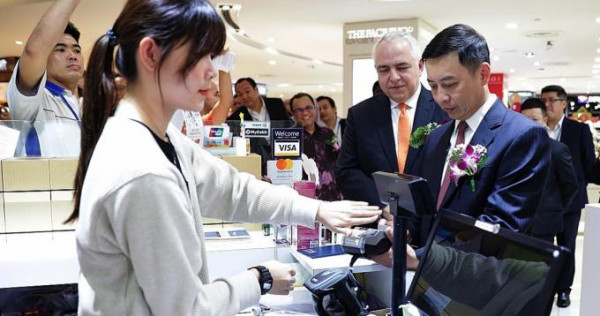
This shop in Johor Bahru’s City Square offers NETS payment services for Singaporean customers. (Photo: Amir Yusof)
While the exchange rate could vary with every purchase, Mr Goh said that it was “almost the same as the money changers”.
“For merchants, NETS service will bring customers to them. And customers (might) make bigger orders too as it’s convenient for them,” he said.
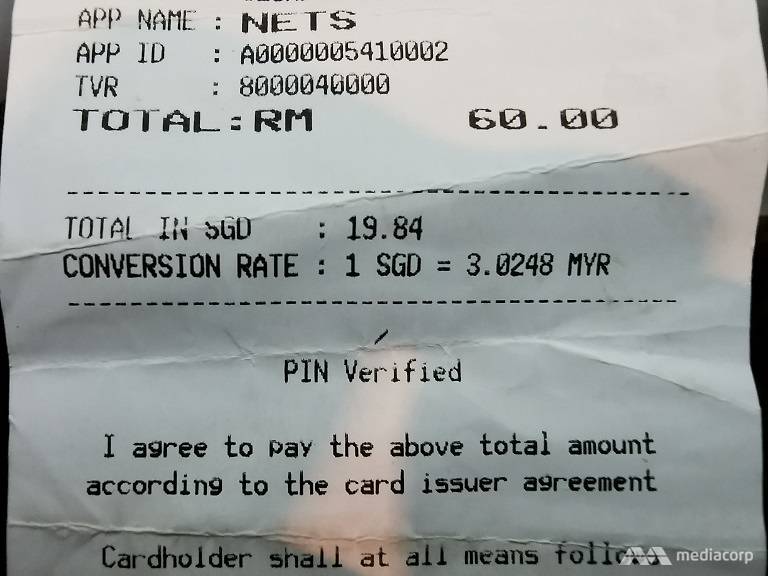
When CNA visited an optician retailer at JB City Square, a Singaporean shopper who bought contact lenses with his NETS ATM card was charged with a conversion rate of S$1 to RM3.0248.
A Singaporean shopper purchased contact lenses for a conversion rate which is similar to the rate offered at a money changer within the same mall. (Photo: Amir Yusof)
The rate was similar to the selling rate of S$1 to RM3.03 offered at a money changer at the same mall.
Singaporean Muhd Ismail Hassan, who visited JB City Square for a day trip, told CNA that expanding the use of NETS ATM card services to Kuala Lumpur, Melaka and Penang was a good idea.
“When we travel up, we don’t have to carry S$1,000 to S$2,000 of cash anymore. It’s more convenient for us when we shop at the malls in these places,” he said.
Mr Goh said that NETS is looking to increase the number of acceptance points to restaurants and shopping outlets in Malaysia that are popular among Singaporeans. He added that NETS is working with PayNet to offer QR code payments “within the next six months” for customers.
This means that Singaporean visitors to Malaysia, or Malaysian visitors to Singapore, will be able to make purchases via cashless payments services such as DBS PayLah via QR code transactions through their smartphones.
NETS was also working with partners in Indonesia and Thailand to enable cross-border instant fund transfers and QR payments in the future, he said.
In recent years, many Singaporean families have become all too familiar with the struggle to speak Mandarin, despite it being one of our country’s national languages.
According to the Speak Mandarin Campaign – a government initiative to encourage Singaporeans to speak Mandarin – 71 per cent of Chinese households speak English as their main language at home, leaving only minority speaking mandarin.
In order to tackle this issue and increase focus on bilingualism, the Speak Mandarin Campaign conducted a nationwide Family Talent Competition earlier in June, where parents and children were able to bond and have fun with their children, all while learning and speaking Mandarin!
The winner of this year’s competition the Chua family who comes from a predominantly English-speaking family took up the challenge this year to script, speak and perform a short skit in Mandarin.
We caught up with Mr. Chua Chye Poh to find out how he, his wife and his youngest daughter Mona prepared for the competition and how parents can encourage their kids to speak Mandarin.
Q: In what language do you normally use to converse at home?
Google made a big impact in the home networking space when they launched Google Wifi back in 2016.
It offered performance that belied its compact looks. Though it might lack features found on full-fledged routers, it was dead simple to use. I bet even your grandma could set it up in less than 10 minutes.
Three years on, Google has updated its mesh networking system in a big way with the new Nest Wifi.
The Nest Wifi system consists of a dedicated Nest Wifi router which you plug into your modem, and the network can then be expanded with Nest Wifi points.
According to Google, the router itself can cover an area of up to 120 square metres, while a router and a single point can cover up to 210 square metres. Slap two points to the router and the network covers up to 300 square metres.
SINGAPORE – An insurance agent, who underdeclared her commission income by nearly $2 million and did not account for goods and services tax (GST) of about $320,000, has been fined more than $660,000.
Chew Wai Ling, 56, was ordered to pay a total of $663,008 in fines and penalties after she was found guilty of her offences.
Investigations by the taxman showed that Chew did not declare her total commission income of $1.96 million that she earned in 2009 and 2010.
The investigations also found that she had made taxable supplies amounting to more than $1 million in 2007, the Inland Revenue Authority of Singapore (Iras) said in a statement on Wednesday (Nov 27).
She was required to notify the Comptroller of GST and register for GST by January 2008. She failed to do so.
As a result, she did not account for $320,412 in taxes.
For filing incorrect returns without a reasonable excuse, Chew was fined $6,000 and ordered to pay a penalty of $621,967, which is twice the amount of income tax undercharged due to the commission income she underdeclared.
Being a staple hawker fare in Singapore, the humble Hainanese chicken rice is often regarded (by both locals and foreigners alike) as one of the Lion City’s national delicacies.
Berlin-based travel vlogger and home cook Antoine Shapiro loves it so much that he created it from scratch for his first cooking video on his YouTube channel (My Name Is Andong) back in January 2018.
After gaining 120,000 subscribers within two years, Andong decided to revisit that same video by taking his love for Hainanese chicken rice to a whole new level.
“This time we are gonna do it right,” he emphasised.