Facebook has complied with a directive under Singapore’s fake news law to publish a correction notice on a post which the Government says contains false information.
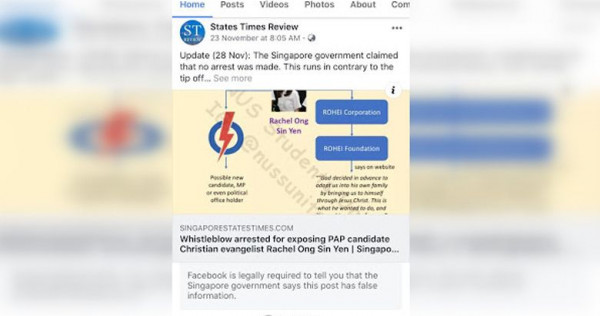
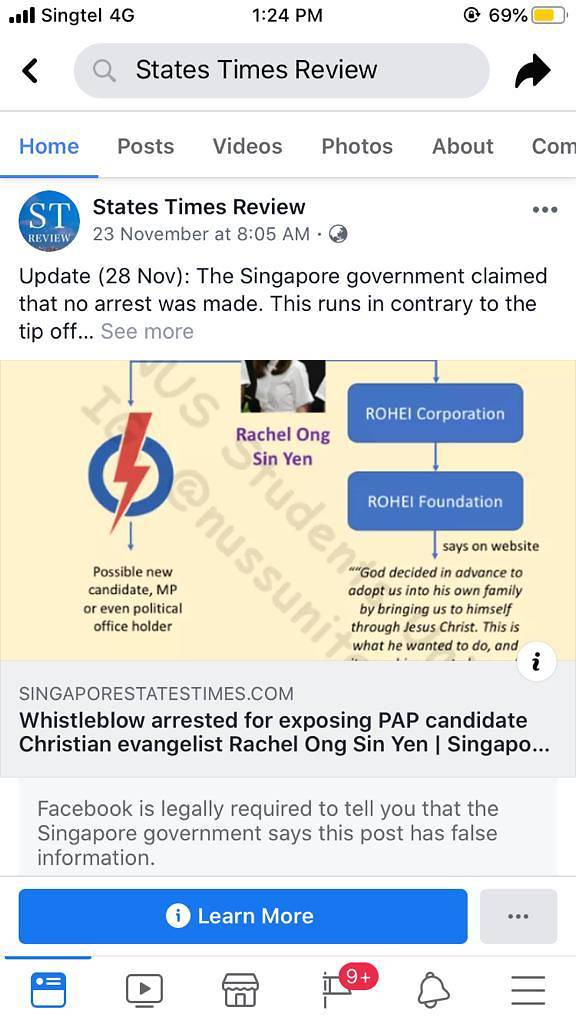
On Saturday (Nov 30), Facebook put up a notice at the bottom of a post in the States Times Review page.
It read: “Facebook is legally required to tell you that the Singapore government says this post has false information.”
The States Times Review website, which the Ministry of Home Affairs (MHA) says spreads “outright fabrications”, is blocked in Singapore.
On Nov 23, the website posted on its Facebook page remarks concerning an earlier post on the Nussu-NUS Students United page, which parodies the National University of Singapore Students’ Union or Nussu.
Police have identified a 42-year-old taxi driver who was caught on camera punching a driver’s car window and being verbally abusive towards a couple in two separate disputes.
Several Stompers alerted Stomp to videos of the two incidents that have gone viral online.
In the first video, the Trans-Cab driver, who is wearing a mask, can be seen repeatedly flashing his middle finger at a motorist.
Besides using his fist and elbow to hit the latter’s car, he also kicks it.
The cabby can be heard repeatedly telling the car driver to come out of his vehicle and even tries to open the car door himself.
SINGAPORE: Facebook has issued a correction notice for a States Times Review Facebook post in a first for the platform, after it was instructed to do so on Friday (Nov 29) by the office overseeing the Protection from Online Falsehoods and Manipulation Act.
On Saturday, the notice could be seen at the bottom of the original post.
“Facebook is legally required to tell you that the Singapore government says this post has false information,” the notice said.
A Facebook spokesperson told CNA the company, as required by Singapore law, applied a label to these posts.
“As it is early days of the law coming into effect, we hope the Singapore Government’s assurances that it will not impact free expression will lead to a measured and transparent approach to implementation,” the spokesperson said.
The post alleged that a “whistleblower who exposed a People’s Action Party (PAP) candidate’s Christian affiliations” has been arrested and that the owner of the NUSSU – NUS Students United Facebook page, which published the claims about the PAP candidate, is under police investigation.
“These claims are false and baseless,” said the Ministry of Home Affairs (MHA) on Thursday. “No one has been arrested or charged arising from the NSU post.”
The correction direction under the new law was issued to Mr Alex Tan Zhi Xiang, a 32-year-old Singaporean who runs the States Times Review website and Facebook page.
A post on the page on Thursday morning said that States Times Review and its editor “will not comply with any order from a foreign government”.
For Miss Zenith Chan Hoi Yu, 21, Friday (Nov 29) was an important day: It marked the first time she showcased her art at the C3 Anime Festival Asia (AFA), Singapore’s largest Japanese pop-culture event.
Miss Chan was one of the many artists who set up shop at the AFA on Friday, to sell their anime-inspired art to festival-goers.
The AFA kicked off on a high note on Friday morning, as anime and cosplay fans flocked to the Suntec City Convention Centre in droves – some to see their favourite cosplayers, and others to support budding artists like Miss Chan at the Festival’s Creators Hub, flooding into the artists’ alley to get their hands on beautiful, original art.
The festival also happens to be a valuable occasion for Miss Chan to share her art with a wide audience, as it regularly draws over 100,000 visitors over three days.
In preparation for the large turnout, Miss Chan has made prints of over 20 of her illustrations, enamel pins and T-shirts, that she intends to sell over the weekend.
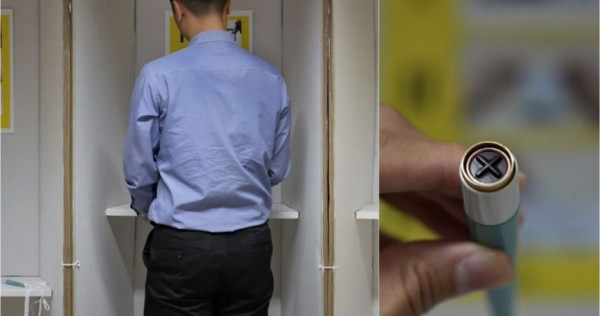
The Elections Department (ELD) will introduce a number of changes in the upcoming polls, including self-inking pens and new polling booths.
Candidates will also be able to fill in most of the required paperwork online. These include appointing their election agents, paying their election deposits, and preparing their nomination papers.
However, hard copies of nomination papers must still be submitted on Nomination Day.
The Electoral Boundaries Review Committee was convened in August, marking the first step towards the next general election, which must be held by April 2021.
In the past three general elections under Prime Minister Lee Hsien Loong, the period between the announcement of the committee’s formation and Polling Day has ranged between two and six months.
The new self-inking pens, which have been used in countries such as South Korea, allow voters to easily stamp an “X” for the party of their choice.
The ELD said it made the decision to change the pens provided after feedback that some older voters had difficulty gripping regular pens to cast their votes.
More wet weather can be expected in the first two weeks of December with temperatures falling to as low as 22 deg C, the weatherman said on Friday (Nov 29).
This comes as the north-east monsoon conditions over the island since early this month are expected to continue till March next year, said the National Environment Agency’s Meteorological Service Singapore (MSS).
In the first week of December, Singapore can expect a monsoon surge lasting from two to four days, bringing cloudy and occasionally windy conditions with periods of moderate to heavy showers over the island.
These strong north-easterly winds over the South China Sea are likely to weaken in the second week.
Short moderate to heavy thundery showers are also expected in the afternoon on five to seven days. This is due to strong daytime heating of the land coupled with local convergence of winds.
SINGAPORE: Gojek users here will have access to a larger pool of vehicles when booking a ride, as the Indonesian ride-hailing firm announced a partnership with taxi operator Trans-Cab.
Trans-Cab is Singapore’s second-largest taxi operator, with a fleet of 2,954 taxis as of September according to figures from the Land Transport Authority.
The move is expected to reduce waiting times for passengers as well as allow Trans-Cab drivers to enjoy the same benefits as Gojek’s private-hire car drivers, which include insurance and medical coverage.
This comes after Gojek had partnered with Trans-Leasing – Trans-Cab’s vehicle rental arm – in May this year.
“As part of the agreement, we are also exploring new joint benefits for Gojek driver-partners and Trans-Cab drivers, including preferential home electricity rates by Union Energy,” said Trans-Cab chief executive officer Teo Kiang Ang, noting the energy provider is Trans-Cab’s parent company.
Trips on Trans-Cab taxis booked through the Gojek app will be priced at a flat rate, rather than by a metered fare.
Gojek co-chief executive officer Andre Soelistyo and Gojek Singapore general manager Lien Choong Luen at an event marking the ride-hailing firm’s first year of business in Singapore on Nov 29 2019.
Gojek Singapore general manager Lien Choong Luen said there will not be an option to choose taxis specifically through the app – an option already available on Grab’s app – though he did not rule out the possibility of such a feature in the future.
Mr Lien noted the Gojek app is likely to allow passengers to choose different vehicle types, such as larger vehicles, by next year, and may eventually also allow for ride-sharing services similar to Grab’s GrabShare service.
In September, Trans-Cab had partnered with local ride-hailing and carpooling start-up Ryde to allow its taxis to be booked through its app.
Speaking to the media on Friday, Mr Soelistyo noted that while Singapore has only 800,000 active monthly users – compared to 29.2 million users per month in Indonesia – the country is Gojek’s second-largest transport market after Indonesia, based on the amount spent by customers.
While Gojek aims to eventually diversify into offering services such as food delivery and financial services here – which are already available in its home market of Indonesia – it is taking a cautious approach to doing so.
While it has received the financial backing of companies such as Google and TenCent, the firm’s new leadership is focused on making the company “sustainable and enduring” rather than relying on outside funding, said Mr Soelistyo.
“You have to make sure the product speaks for itself, to be able to continue to grow the business,” he added.
“The concept of weaponising capital, that whoever has the biggest balance sheet wins the market, that concept is no longer the right model.”
SINGAPORE: Like many other private-hire car drivers in Singapore, Stephen Chong spends long hours on the road.
For five days a week, the 41-year-old wakes up at 6.30am and starts driving half an hour later, picking up passengers until about 1pm.
He then takes a break for an hour or two for lunch and to meet friends before continuing to drive, ending his day between 8pm and 10pm.
However, Mr Chong is not like most of the more than 41,000 people here who hold a private hire car driver’s vocational licence (PDVL). He is hard of hearing.
The private-hire car driver of three years has hearing loss of 50 decibels – or about the loudness of a normal conversation.
He is one of about 30 to 40 Grab drivers here who are deaf or hard of hearing, said the company’s Singapore head Yee Wee Tang, who adds the firm also has about 10 to 15 delivery riders who are deaf or hard of hearing.
In September, the Singapore-based ride-hailing firm signed an agreement with the Singapore Association for the Deaf (SADeaf), with the aim of promoting deaf awareness as well as making the Grab platform more inclusive for those who are deaf or hard-of-hearing.
As part of this initiative – part of its Grab for Good social responsibility programme – the company introduced a scheme that halves the commission it collects from existing and new drivers who are also SADeaf beneficiaries. Drivers typically pay Grab a commission of about 20 per cent of the fares they collect.
On its part, SADeaf will provide skills upgrading programmes for deaf Grab drivers and delivery riders.
The Grab app will notify passengers that their driver is deaf.
They are advised to use the chat feature in the app to communicate, and the call function is turned off to prevent them from calling their drivers.
A sticker in the vehicle helps inform passengers how they should communicate with their drivers, while flip-cards indicating common requests – such as directions, adjusting the temperature of the air-conditioning and where to drop off – are provided to help in communications between drivers and passengers.
Private-hire car driver Stephen Chong, who is hard of hearing, hanging the flip cards provided by Grab for deaf drivers, which show commonly used instructions.
“THEY CAN DO EVERYTHING EXCEPT HEAR”
Mr Chong previously worked as a delivery driver, transporting electrical equipment until the company he worked for closed down.
He subsequently took up driving for Uber, later joining Grab after the American ride-hailing giant exited the region last year.
When it still operated in Singapore, Uber had a similar programme for deaf and hard-of-hearing drivers called Beethoven – after the 18th century composer who lost his hearing in his 20s.
Speaking to CNA at Grab’s Guoco Tower office through a sign language interpreter, Mr Chong said he chose to remain as a private-hire car driver because he enjoys driving and visiting new places.
He also enjoys the experience of interacting with passengers, which he does through brief sentences – he is able to vocalise some words – as well as gestures and chat messages.
To avoid fatigue, Mr Chong spends no more than eight to 12 hours a day driving.
He also takes the weekend off, spending Saturdays and Sundays with his wife and his six trained pet parrots and chihuahua.
Besides the long hours on the road, his friend Aloysius Lee, 32 – who is also deaf and driving with Grab – said the hardest part of being a driver was obtaining his PDVL, noting he had to take the test four times before he passed.
Mr Chong said he had to sit for the test six times before passing.
The test involves 100 multiple-choice questions spread across the two papers, and Mr Lee found it difficult to remember the answers to health-related questions, as well as the demerit points and fines associated with traffic offences.
“I kept repeating the answers to myself, but when I go for the test I forget them,” he signs.
Mr Lee and Mr Chong said they regularly meet other deaf drivers, to chat and share their experiences on the road.
Deaf drivers are more capable than some might expect, said SADeaf acting executive director Judy Lim.
“Indeed, they can do everything except hear,” she said.
The response from passengers who are assigned deaf drivers has been positive, said Grab’s Mr Yee, pointing to social media posts praising the move towards inclusivity.
Most trips are uneventful, with passengers not making a fuss about his deafness, said Mr Lee.
He also recalled picking up a passenger who was also deaf. Unfortunately they were unable to communicate much during the trip as Mr Lee would not be able to sign with his hands on the steering wheel.
Mr Chong’s most memorable experience with a passenger was slightly different however.
“Even though they were in the back seat, the husky’s snout was so long that it was licking my face as I was driving!” he recalled, noting the passenger was apologetic and offered him tissue paper to wipe the saliva from his face.
Deaf private-hire car driver Aloysius Lee, 32, shows off the flip cards provided by Grab, which are aimed at making communication between passengers and drivers easier.
CREATING MORE INCLUSIVE WORKPLACES
In recent years efforts have been made to make the workplace more inclusive.
In 2014, the government-funded Open Door Programme – which provides grants to employers to hire, train and integrate people with disabilities – was introduced.
He noted then that more than half of this employment comes from four sectors – community, social and personal service, food services, administrative and support services and lastly manufacturing.
On Grab’s part Mr Yee notes the firm has made other efforts towards improving the accessibility of its services, such as making its app usable by those with visual impairments. The firm is also looking at improving its mapping functions, so delivery riders with physical disabilities are directed to routes with ramps or other accessibility features.
There are about 60 companies who are currently partnered with SADeaf on employment opportunities for the deaf, said Ms Lim, who notes over the years their partners have included Marina Bay Sands, fast food chain KFC and caterer Select Group.
“We do realise that employers nowadays are more inclusive, and they would like to give opportunities and choices to people with disabilities. So our deaf and hard-of-hearing clients are able to approach us to get matched with employers who are inclusive.”
Ms Lim notes the deaf are able to take on a wide range of jobs, although those that require answering the phone or “lots of communication” may not be suitable for them.
What employers can do is make the workplace more accommodating for them, for example through the use of alternative communication methods such as messaging platforms or equipping staff with skills such as sign language, she suggested.
“With greater deaf awareness, it will definitely make it easier for our deaf and hard-of-hearing clients to be able to get into employment and have their own livelihood,” she added.
Ms Lim notes SADeaf is looking into a “serious and professional programme” to allow employment for people with both hearing and vision loss.
“Right now we do understand that most of these people are simply staying at home,” she said.
“We really hope that one day people with both hearing loss and vision loss will be able to get on board the workforce.”
SINGAPORE – Two people here have contracted the C. canimorsus infection since 2017 but both have since recovered.
The rare disease made headlines on Wednesday (Nov 27) when a German man died from the infection after being licked by his dog.
The 63-year-old man went to a hospital in Germany with a burning sensation in his left leg and muscle pain in both. His flu-like symptoms were severe, with laboured breathing for three days.
He had petechiae, or rounds spots on the skin that look like rashes as a result of bleeding capillaries, which made his legs look discoloured.
He died after 16 days of care, according to doctors.
The infection could be severe or even fatal for people with poor immune systems, said Dr Shawn Vasoo, acting clinical director at the National Centre for Infectious Diseases (NCID).
“The man, who was reported to be healthy, may have had an undiagnosed medical condition which predisposed him to this infection, or a less robust immune system,” added Dr Vasoo.
Of all the memories and experiences that George Lee had in the past 64 years of his life, one continues to haunt him till today: seeing a young boy drown in his old kampung’s pond.
The boy was merely a few years younger than he was when he witnessed the tragic accident in the village, formerly located along Lorong Ah Soo. George was only 10 back then, with no knowledge of how to rescue the boy who’d somehow fallen into the pond that day — a reservoir of water deep enough to be well above a child’s height.
Eventually, two older villagers jumped in and managed to grab hold of the boy and dragged him to dry land. He was already unconscious by that time, and he could have stirred back to life if someone, anyone, knew how to conduct immediate mouth-to-mouth resuscitation.
Alas, no one did. Instead of cardiopulmonary resuscitation (CPR), what the drowned boy got was a village shaman praying, chanting, and dancing over him — a futile effort to appeal to the supernatural to aid in his revival. The boy died, but from that tragedy, it gave birth to George’s resolution to learn and impart lifesaving skills.