Garmin Pay is now enabled for use on public transport in Singapore.
As part of a partnership with OCBC Bank, Garmin users can link their OCBC MasterCard or Visa credit/debit cards to their Garmin Pay Wallet in their compatible smartwatches and pay for bus/train rides.
Garmin also shared that Garmin Pay is available on the latest venu and fēnix 6 series.
The Venu has a 1.2-inch AMOLED display and a battery life of up to five days in smartwatch mode.
A global governing body for esports was launched in Singapore on Monday (Dec 16), hoping to marry the fast-growing modern sport with Olympic values often tied to traditional ones.
To that end, the Global Esports Federation (GEF) will be helmed by Singapore National Olympic Council secretary-general Chris Chan, who is its president.
One of its three vice-presidents, Ms Charmaine Crooks, represented Canada at the Olympics, winning a silver medal in 1984 as part of a 4x400m relay team. The other two vice-presidents are Mr Wei Jizhong, an honorary life vice-president of the Olympic Council of Asia, and Mr Edward Cheng, vice-president of Chinese technology giant Tencent, which is also GEF’s global founding partner.
Describing esports as “misunderstood”, Mr Chan noted that the GEF, whose vision is to be “the voice and authority for the worldwide esports movement”, is not the first organisation trying to lead esports globally.
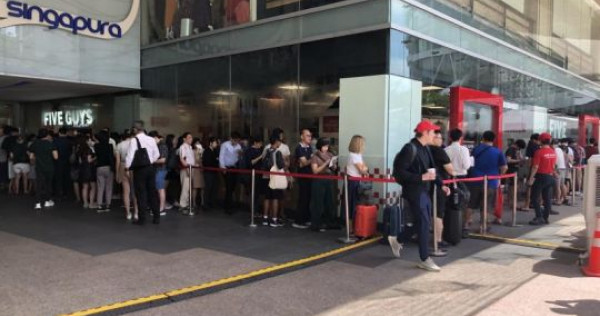
SINGAPORE – American burger joint Five Guys Singapore marked its launch at Plaza Singapura on Monday (Dec 16) with about 100 people in line prior to the store’s opening at 11am.
The first person started queueing from 4am, says a Five Guys Singapore spokesman, and the average queue time today was about one hour. As of 7pm today, more than 1,000 burgers and 500 milkshakes were sold.
The brand prides itself on its hand-cut fries cooked in peanut oil, as well as its burger patties with an 80-20 lean meat-to-fat ratio. Its burger buns – made with Five Guys’ recipe – are freshly baked five days a week at a local bakery.
Order your burgers, fries (original or with Cajun spices, from $7) and drinks (from $4 for a bottle of water) separately as there are no set meals here. Prices start at $11 for a single patty Little Hamburger, and from $10 for a hot dog.
The burgers and hot dogs can be customised at no extra cost. Just select your favourite toppings or go “all the way” to have everything included in your burger or hot dog. Toppings include grilled onions, grilled mushrooms, and pickles.
SINGAPORE – The Government has called out The Washington Post for “perpetuating false allegations” after the American newspaper ran only parts of a letter from Singapore’s ambassador to the United States.
Mr Ashok Kumar Mirpuri had responded to a Dec 2 article in the online edition of the Post about Facebook complying with the Government’s directive to issue a correction under the Protection from Online Falsehoods and Manipulation Act (Pofma) last month.
The article had pointed out that Pofma could have a “chilling effect on online free expression” and “open the door to broad government censorship”, points which Mr Mirpuri rebutted.
On Monday (Dec 16) evening, the Ministry of Communications and Information (MCI) made public a letter that Mr Bernard Toh, director of the ministry’s information policy division, had written to Washington Post publisher Fred Ryan.
In the letter, Mr Toh noted that the Post had declined to publish Mr Mirpuri’s response on the grounds that it only ran letters on articles that appeared in the print edition of its paper. The Government was then directed to the article’s author, Ms Cat Zakrzewski.
SINGAPORE: By now, most, if not all, companies in Singapore would agree digital transformation is no longer an option.
Integrating digital technology into aspects of a businesses to fundamentally change how they operate and deliver value to their customers is what’s needed to survive and thrive.
As early as 2010, the Government has been urging companies in Singapore, including small- and medium-sized enterprises (SMEs), to transform their businesses in order to stay relevant and competitive.
Numerous initiatives like the now defunct Productivity and Innovation Credit scheme, Technology Adoption Programme and SMEs Go Digital Programme, which provides incentives and resources for SMEs to invest in automation, robotics and other technology solutions, have also been rolled out over the years.
Nearly 10 years on, the message has come through loud and clear, with companies, both big and small, responding to the call.
SBF’s annual National Business Survey shows that the importance of business transformation has gained considerable ground among companies.
In 2016, only 15 per cent of Singapore SMEs surveyed strongly agreed with the need to transform to counter slowing economic growth and technological change. Among large companies, the message resonated twice as strong but this was still a low number.
Today, nine in 10 recognise the importance of business transformation to remain relevant and competitive, as the world becomes increasingly digital.
This shift in mindset is a big step in the right direction. Yet, companies, especially SMEs, seem to be lagging in this innovation drive.
In 2018, more than half of Singapore companies reported implementing some form of business innovation, but findings revealed that smaller companies were less likely to innovate — larger businesses reported a higher rate of implementing new technologies (40 per cent) compared to SMEs (31 per cent).
Awareness, clearly, has not quite translated into action. Why are companies sitting on the sidelines when doing nothing means taking a bigger risk?
BRIDGING THE DIGITAL TALENT GAP
Years since companies began marching to Singapore’s digital transformation drum beat, the key challenges hindering businesses in their transformation efforts today boil down to talent and technology, our research reveals.
This echoes a 2018 Cisco study which shows that most companies in Asia are slow to adopt technology due to budget constraints, a lack of adequate talent and an unfit IT infrastructure.
A robotic arm assembles an electronic calculator at the Convention on the Exchange of Overseas Talents in Guangzhou, Guangdong province, China December 20, 2017. (file photo: REUTERS)
The growing demand for digital skills in the workplace has resulted in a talent deficit in Singapore’s tech sector, despite the Government’s push to encourage students to pursue careers in science, technology, math and engineering.
Demand for technology jobs in Singapore rose by 20 per cent the past year, according to a 2019 salary benchmark report by recruiting firm Michael Page.
For businesses, especially SMEs, this tech talent crunch presents a huge problem. Coupled with a tight foreign quota, the high demand across sectors has driven up wages and salary expectations.
This puts pressure on smaller companies who find it harder to hire talent with this right set of skills when competing against larger, more established outfits with better learning and development opportunities and benefits.
If there aren’t enough people to fill the gaps, companies need to explore other ways – over and above hiring – to overcome the problem.
INVESTING INTERNALLY
For one, they need to start investing in their existing workforce and look at ways to develop talent internally.
This means ensuring employee access to quality digital skills training, while also encouraging a company culture of continuous learning and providing employees opportunities to take on roles that are more valued-based and rewarding. Not only will this help employees prepare for the jobs of tomorrow, it will drive innovation in the company.
Office workers at Raffles Place in Singapore. (File photo: Marcus Mark Ramos)
Key to success is also anticipating digital trends so that training remains relevant and useful not just for the jobs of today but also the jobs of the future.
In this regard, institutes of higher learning and companies can look to win-win partnerships.
Take for example, Singtel’s info-communications technology solutions provider subsidiary, NCS, which has joined hands with the National University of Singapore’s Institute of Systems Science to train more than 1,000 digital ICT employees and new hires over the next two years.
Apart from providing technical training for mid-career NCS employees and training for new software engineers, the collaboration allows NCS’s subject matter experts to teach in the institute, while NCS offers internship and project opportunities to its students.
File photo of the National University of Singapore.
Trade Associations and Chambers (TACs) and industry leaders can also play a leading role. Specific to industry needs, they can reap benefits of scale to set up digital academies which can effectively support the digital upskilling of SME owners and their employees.
Last week, SBF announced a partnership with V3 Fintech, the digital financial services unit of V3 Group, to establish Beyond Lab, a regional academy focused on supporting SMEs in adopting digital technology to increase operational efficiency and competitiveness.
Through the academy, we hope to help our SMEs transform, and equip them to tap the opportunities of the digital economy in the region.
From digital leadership development courses to cybersecurity, data analytics and artificial intelligence, these digital academies can help smaller companies cultivate a digital culture and develop the full suite of digital capabilities they need affordably.
This also gives them the flexibility to hire for potential, not just credentials. Instead of competing for people with the right skills, they can, instead, bring onboard people who can develop the skills they need.
TACKLING THE TECH GAP
The lack of adequate talent aside, the other major challenge companies cite in our research is the cost of adopting digital solutions. Some of these companies also lack a comprehensive strategy and are unsure of which solution to adopt, and where or how to deploy it to their best advantage.
One of the biggest misconceptions among companies, perhaps, is that digital adoption is expensive and something only big companies can afford.
An employee works at the factory of Guangdong LiShun Yuan Intelligent Automation Co, a paper box packaging machinery in Dongguan, Guangdong province, China on Jul 4, 2019. Picture taken July 4, 2019. (File photo: REUTERS/Shu Zhang)
But companies can start small. It could be as simple as getting on social media or setting up a website, which can spark more experiments with digital technology as these firms grow in experience, competence and confidence.
For a start, SMEs can leverage the Infocomm Media and Development Authority’s (IMDA) SMEs Go Digital Programme.
The programme offers a self-assessment tool as well as a Start Digital pack where SMEs can adopt any two solutions ranging from accounting and digital marketing to cybersecurity and digital transactions at a lower cost.
The SME Portal’s Tech Depot also has a wide range of readily adoptable technology solutions. Companies can also tap on other schemes such as the Enterprise Development Grant and the Productivity Solutions Grant for more complex projects which may require significant investment upfront.
HELP IS AT HAND
To address some of these issues, the SBF Digitalisation Committee, led by Janet Ang, SBF Council Member and former Vice President of Industry Solutions and Business Development at IBM Asia Pacific, ramped up its efforts this year to show companies what they can readily do to embark on their digitalisation journeys.
Chief executive of IMDA Tan Kiat How speaking at a SME Go Digital event. (Photo: Calvin Hui)
These include industry-specific forums and the SBF-SMEs Go Digital “Leaders for Transformation” Series which shed light on the strategies detailed in the Industry Transformation Maps, and the Industry Digital Plans and showcased businesses who have successfully digitalised.
SBF is also partnering the NUS Institute of Systems Science to offer a suite of Digital Transformation programmes to upskill companies and their workforce.
Former General Electric CEO Jack Welch once said: “If the rate of change on the outside exceeds the rate of change on the inside, the end is near.”
Now that businesses realise they need to align themselves with how the world has change, they have a choice to make – lead the pack, match the pace of change or fall behind. Doing nothing is no longer an option.
Ho Meng Kit is CEO at Singapore Business Federation.
SINGAPORE: Flying to Brussels is about to become more convenient with the introduction of a new Singapore Airlines non-stop route to the Belgian capital from Singapore.
The airline on Monday (Dec 16) announced it would be introducing non-stop flights to the city from Oct 25 next year.
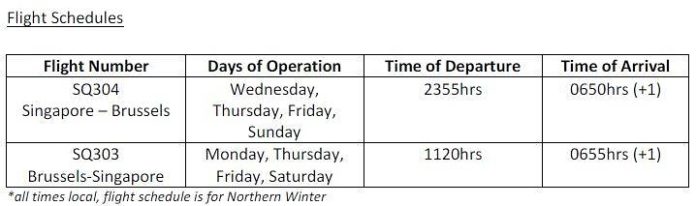
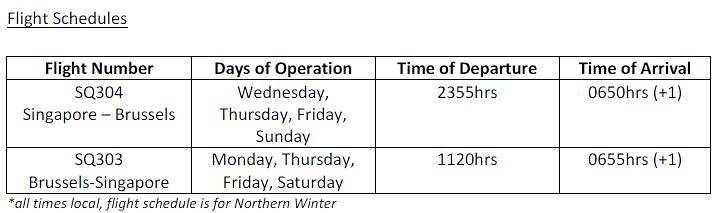
Flights from Singapore to Brussels will depart Singapore on Wednesdays, Thursdays, Fridays and Sundays at 11.55pm, subject to regulatory approval, said Singapore Airlines in a media release.
The return flights from Brussels to Singapore will depart Brussels on Mondays, Thursdays, Fridays and Saturdays at 11.20am Belgian time.
The airline will operate the Airbus A350-900 on these flights.
(Image: Singapore Airlines)
The capital of Belgium, Brussels is home to the Council of the European Union (EU) and is also dubbed the EU’s capital city.
“We are delighted to welcome Singapore Airlines’ non-stop passenger service to Brussels, which serves as a valuable link between Singapore and the headquarters of the European Union and NATO,” said Changi Airport Group’s managing director of air hub development Lim Ching Kiat.
“With this new link, Changi Airport will, for the first time, be connected to 20 cities in Europe.”
Passenger traffic between Singapore and Europe totalled 5.4 million in the past year, rising 7 per cent, he added.
Changi Airport also has a “close partnership” with Brussels Airport on the freighter front, added the managing director, with Singapore Airlines Cargo operating freighter flights between Singapore and the Belgian capital.
Noting Brussels’ importance as an economic and political hub in Europe, Singapore Airlines’ senior vice president of marketing and planning Tan Kai Ping said the move shows the airline’s commitment to “constantly expand our network reach”.
Tickets for the new flights will be available from Tuesday.
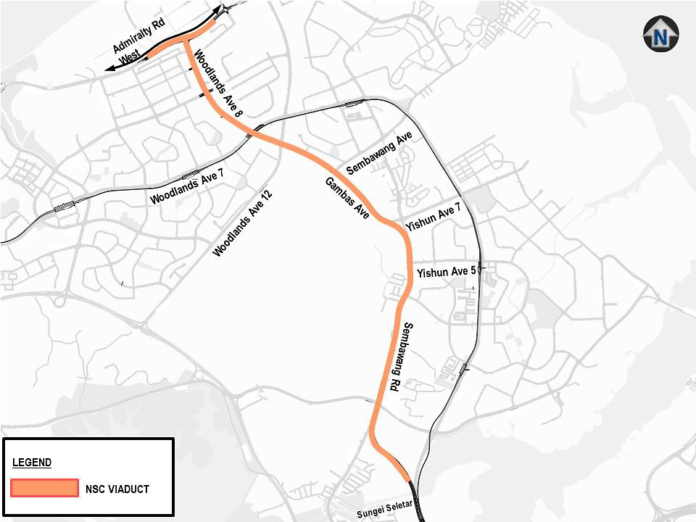
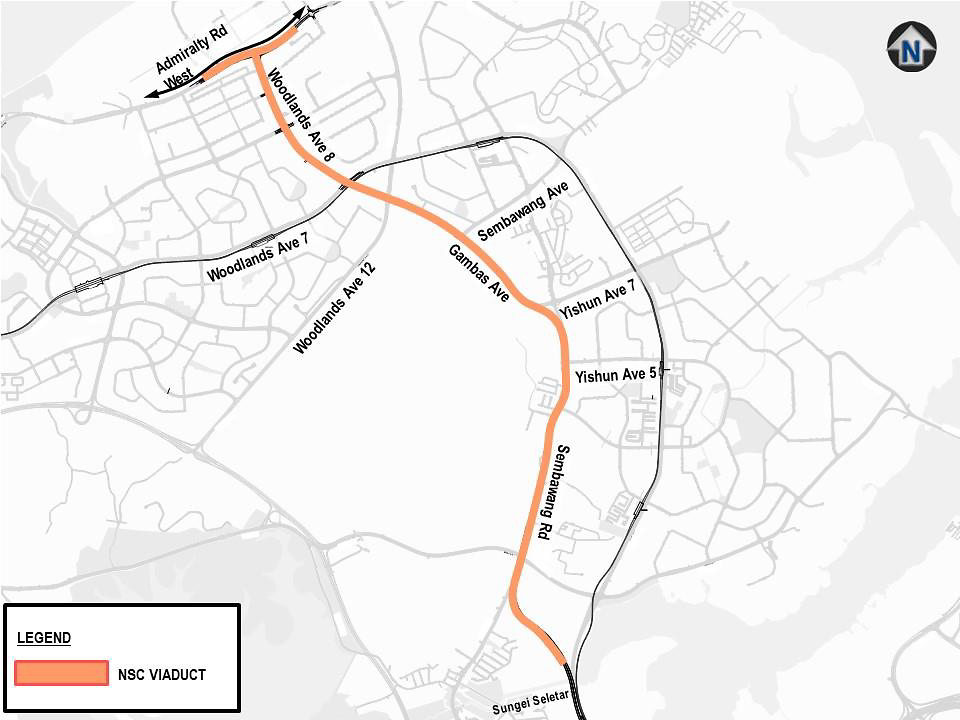
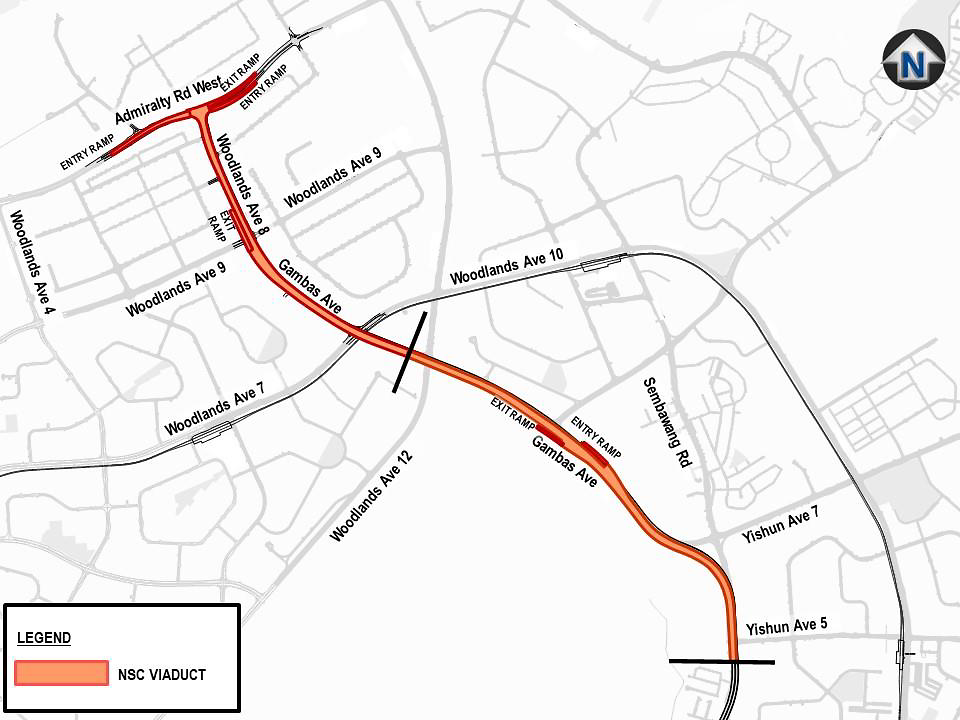
SINGAPORE: Work on the North-South Corridor (NSC) viaduct between Sungei Seletar and Admiralty Road West is set to begin in the first quarter of 2020 after the final three civil contracts were awarded by the Land Transport Authority (LTA).
The contracts are worth S$954.1 million in total, the authority said in a media release on Monday (Dec 16), adding that all 14 civil contracts to build the NSC have now been awarded.
The location map of the section of the North-South Corridor viaduct between Sungei Seletar and Admiralty Road West. (Image: Land Transport Authority)
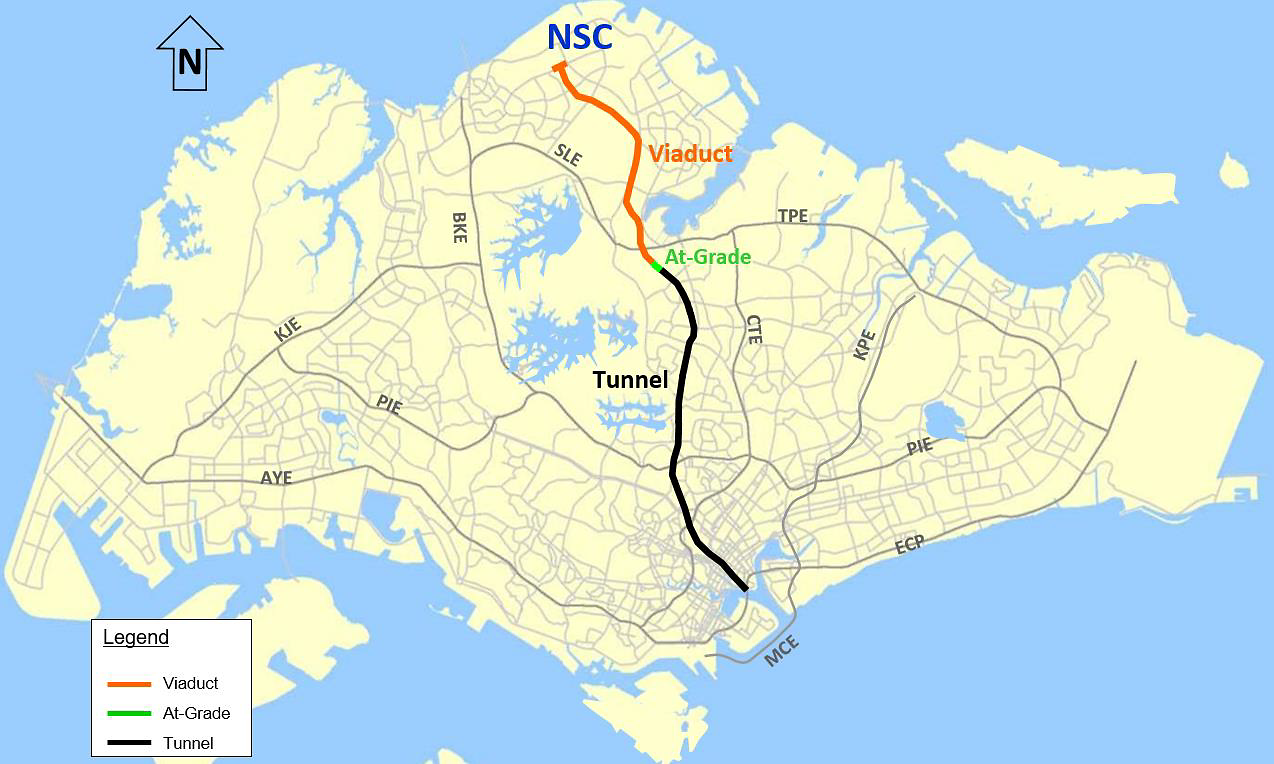
The 21.5km NSC will better connect the Northern and Central parts of Singapore, serving motorists travelling between the city centre and towns including Woodlands, Sembawang, Yishun, Ang Mo Kio, Bishan and Toa Payoh.
It will intersect various expressways, including the Seletar Expressway (SLE), Pan Island Expressway (PIE) and East Coast Parkway (ECP).
Expected to be completed by 2026, the NSC will include bus lanes and cycling trunk routes.
The continuous bus lanes are expected to cut commuters’ journey times by an average of 10 to 15 minutes per trip, said LTA. Cycling routes will link up with the Park Connector Network and local cycling paths within HDB towns along the entire corridor.
“The NSC has been specially designed to support our car-lite vision by also catering to the commuting needs of non-motorists,” LTA said.
The location map for the upcoming North-South Corridor. (Image: Land Transport Authority)
FINAL CONTRACTS AWARDED
The first contract, worth S$365.9 million, was awarded to a consortium comprising of Wai Fong Construction, China Civil Engineering Construction Corporation Branch Office Singapore and China Railway 11 Bureau Group Corporation (Singapore branch).
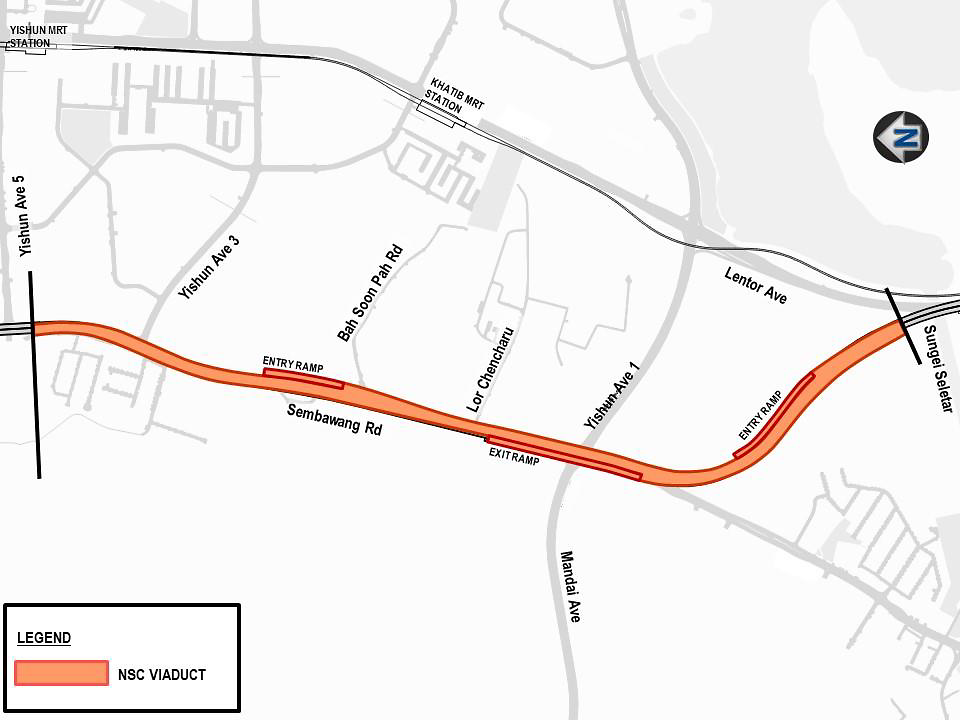
They will design and build a 3.1km stretch of the NSC between Sungei Seletar and Yishun Avenue 5.
The location map of the section of the North-South Corridor viaduct between Sungei Seletar and Yishun Avenue 5. (Image: LTA)
The members of the consortium are contractors with “strong track records”, said LTA.
Wai Fong Construction is currently involved in the construction of the upcoming Jurong Region Line (JRL) stations Hong Kah and Corporation, as well as several of the Thomson-East Coast Line (TEL) stations and tunnels.
They also constructed the Downtown Line Stage 3 (DTL3) Xilin station and tunnel.
China Railway 11 Bureau Group Corporation (Singapore Branch) was recently awarded the contract to build the JRL’s Tengah depot and two of its stations.
SINGAPORE – A property agent was so incensed that her 81-year-old father had tried to stop her from assaulting a maid, she kicked him in the stomach and bit his left forearm.
That was not all. When Bibianna Lim Poh Suan’s brother tried to stop her from leaving in her car, she accelerated and he was forced to jump onto the car bonnet before rolling off the side.
The identities of her parents were not disclosed in court documents while her brother was identified as “Winston” in the prosecutor’s submissions.
Lim, 47, was sentenced on Monday (Dec 16) to 12 weeks’ jail and a fine of $800. She was also disqualified from driving all classes of vehicles for a year.
District Judge Salina Ishak had convicted her, after a trial, of two assault charges as well as one count each of mischief and causing hurt by performing a rash act.
During the trial, Lim said the maid was initially “polite, cordial and pleasant” to her. But she claimed that Ms Theresa Elevencione Gamuzaran later morphed into someone who hurled “false allegations” at her.
The Filipina’s age was not disclosed in court documents.
SINGAPORE – Train service on the North-South Line was disrupted between four MRT stations on Monday morning (Dec 16) after a signalling fault hit the line.
In a post on Twitter at about 8.15am, rail operator SMRT announced that there were no train services between Kranji and Bukit Gombak MRT stations as a result of the fault.
It added that free regular bus and bridging bus services have been made available between Kranji and Jurong East stations.
Some commuters said on social media that the fault started at around 8am. Some were on the trains when the signalling fault occurred.
Pictures posted online after the fault occurred appeared to show large crowds waiting for the train at Choa Chu Kang bus interchange.
The operator said in an update at about 8.50am that the fault was rectified and that train services were progressively returning to normal.
SINGAPORE: The number of fires involving personal mobility devices (PMDs) has reached a record high, with 73 fires between January and September this year.
There were 50 PMD-related fires in 2018, 40 in 2017, nine in 2016 and just one in 2015, according to Singapore Civil Defence Force (SCDF) statistics. No fires involving PMDs were reported prior to 2015.
One person died and at least 70 people were injured in these fires, said SCDF on its Facebook page on Sunday (Dec 15).
A 40-year-old man died after a fire caused by e-scooters broke out in a Bukit Batok flat in July.
Since September, more fires involving PMDs have broken out. On Dec 5, three people were evacuated from a Clementi flat after an e-scooter left charging in the common corridor caught fire.
On Oct 28, two fires involving PMDs broke out on the same day, with one incident forcing 40 residents from the affected block in Bedok North to evacuate.
A fire broke out at Block 106 Bedok North Ave 4 on Oct 28, 2019. (Photo: Facebook/SCDF)
In July, Singapore banned the sale of PMDs that do not meet the UL2272 fire safety standard. The UL2272 standard is a set of safety requirements which cover the electrical drive train system of PMDs, including the battery system.
The deadline for PMDs to be certified was brought forward by six months to Jul 1 next year.
An early disposal incentive scheme – where S$100 is given for the disposal of non-UL2272 compliant registered e-scooters – is in place until the end of this year.
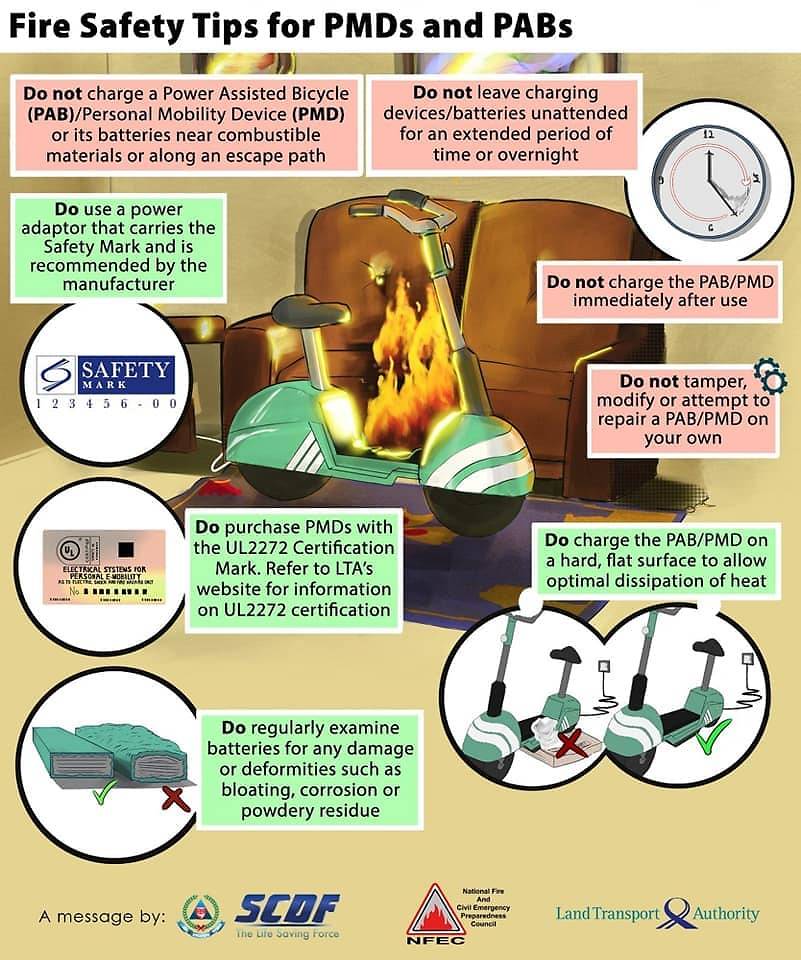
Fire safety tips on preventing PMD fires. (Graphic: Facebook/SCDF)
In a video on its Facebook page, SCFF advised PMD users to dispose of devices that are not UL2272-certified.
PMDs should also not be tampered with or left charging for an extended period of time, and their batteries should be regularly examined for damage and deformities such as bloating, corrosion or powdery residue, SCDF said.