SINGAPORE – Retiree Victor Louis De Foe, 73, a Christian, rarely decorates his home for Christmas.
But his one-room rental flat in Woodlands is looking a lot more festive this year, thanks to the efforts of volunteers from the Jamiyah Halfway House.
As part of Project Happiness, a programme that aims to bring cheer to needy Singaporeans during festive seasons, the volunteers gave his home a fresh coat of paint in blue — his favourite colour — and installed new appliances such as a microwave and a ceiling fan.
A Christmas tree also now sits jauntily in the corner.
“It’s like I’m living in a condo now,” a beaming Mr De Foe, who lives with his wife Audrey Chelliah, 51, told reporters at an event held to mark the completion of the redecoration works on Friday (Dec 20).
Volunteers from the Eurasian Association, who had helped to identify Mr De Foe as a suitable beneficiary for the programme, also sang Christmas carols to add to the festive joy.
Mr De Foe, who used to work as an undertaker, added that he was particularly thankful for the new microwave.
SINGAPORE: When Achik Ithnin, 70, was asked about his past as a prison warden, he reacted with some surprise.
“How do you know?” he replied, eyes narrowing behind silver-rimmed glasses and lips parting behind bushy moustache.
Mr Achik worked as a warden at the old Changi Prison from 1969 to 1979. Now he volunteers as a counsellor at the current Changi Prison. Seeming to explain his reluctance to speak about that period of his life, he said conditions then were very different.
But he did open up eventually.
The old prison had poor ventilation, he recalled, so it was warm and stuffy for everyone inside. There were no cameras, so wardens had to maintain a fierce physical presence to account for every inmate. The heavy cell doors had to be manually cranked, so Mr Achik got swollen hands from repeatedly manipulating them with his bare hands.
But perhaps the biggest difference was how prisoners were dealt with.
Then, some wardens got the job straight out of primary school, Mr Achik said, adding that many inmates were poorly educated too. “They were very stubborn; it was difficult for them to understand us,” he stated.
“We were very strict, very strict. The punishment was also very heavy.”
Mr Achik walking the prison grounds. (Photo: Jeremy Long)
In the quiet halls of the Singapore Prison Service (SPS) headquarters in Changi, Mr Achik’s voice grew softer as he described how he had to maintain discipline.
“To tell you the truth, last time I was very naughty,” he told CNA, stating that he “hammered” inmates. “I feel regret about that. I cannot accept what I had done. Actually, you’re not supposed to do that. You must help them and talk to them.”
After a decade in the job, Mr Achik decided he had had enough. He quit and vowed never to return. “I’m not happy with (the job),” he said. “When I resigned, I said I would never, never enter prison any more.”
NEVER SAY NEVER
Following that, Mr Achik worked as a technician with the former Public Utilities Board until he retired. Soon after, a friend asked if he would like to volunteer as a counsellor with the Singapore Anti-Narcotics Association (SANA). He agreed.
In 2004, the association asked him to help out with counselling at the old Tampines Prison. While Mr Achik knew how to handle inmates, he admitted he was out of his depth when it came to counselling them. So the SPS put him through a three-month course, something he’s grateful for.
Mr Achik leading inmates in prayer. (Photo: Jeremy Long)
Mr Achik found that volunteering in prison was a way of giving back to the community and making amends for his past.
“The job is about how to support other people,” he said, noting that he felt good helping the inmates. “These people need help – their families, their parents, everything. That’s why I continue in this job.”
So when SANA asked him to help with counselling at the current Changi Prison because of a lack of manpower, he decided to return despite his vow.
Fifteen years on, he’s still volunteering there as a senior religious counsellor with SPS. Under the Family and Inmates Throughcare Assistance Haven programme, he counsels Muslim inmates six days a week. Mr Achik is a registered Quranic teacher.
He usually volunteers for two sessions a day from Tuesday to Sunday. The morning session runs from 9am to 11am. Lunch is provided by the prison, before an afternoon session from 2pm to 4pm. He also leads the Muslim inmates in the Friday prayers.
Mr Achik said he gets anywhere between 10 and 35 inmates per session. Discussions can cover their character, behaviour and future. “It’s about how to build up their mind to think,” he said. “You cannot scold them or condemn them. Try your best to talk nicely to them.”
He believes that deep down, many of the inmates are good people and with the right approach, will listen to advice.
“I believe they can change,” he said. “But how do you help them? You don’t give up. Carry on. Keep an open heart, and be ready to listen to their problems. Try your best to help them solve their problems.”
KEEPING COOL
Still, Mr Achik conceded that the job is not for everyone. It is a job that requires commitment, patience and an ability to recognise when things are about to go south, he said.
“When you see an inmate who is very quiet – doesn’t want to talk, sits in one corner – you must be careful,” he said. “Inmates can scold you because they are under pressure. They can hammer their head on the seat, they can take the chair and (hit) you.”
Because of the challenges, Mr Achik said some volunteers could not last in the job, although he added that it was never supposed to be easy.
“You think you cannot handle the inmate, don’t blame the inmate,” he said. “You say these inmates are very stubborn, but is it the inmate or you? These people don’t want to be scolded. They need advice, then they are happy.”
Mr Achik teaches inmates how to apply good values in life. (Photo: Jeremy Long)
It does not mean that Mr Achik is soft on the inmates. He makes it a point to ensure that those who attend his session are disciplined. They should form neat rows, tuck their shirts in and be reminded of punishments for bad behaviour, like being stripped of their recreational privileges.
There are also guidelines for him to follow. Inmates who refuse to go for counselling cannot be forced. Counsellors should not react when they are provoked. And if inmates start to get aggressive, counsellors should immediately inform prison officers.
“Talk to them very softly,” Mr Achik said, referring to his gentle yet firm style of engagement. “Explain things to them nicely; the inmates can listen.”
Still, Mr Achik will raise his voice when needed.
“Don’t act based on emotions and fight your urges!” he cautioned in Malay to the 15 inmates seated in a row – some heavily built and tattooed – who attended one of his sessions at cluster A3 of Changi Prison.
“It cannot be that you stay in prison forever. It is my duty to help you.”
Inmates take note of important points. (Photo: Jeremy Long)
When an inmate dozed off, he walked up close to him and asked him to repeat what he had just learnt. “This is not school, this is prison,” he said as he strode purposefully across the multi-purpose room.
He is also eager for them to ask questions. He would approach someone who has a question, lower his head and listen attentively. He would ponder for a few moments in silence before answering.
SOLVING PROBLEMS
Several times during the interview with CNA, Mr Achik reiterated the importance of listening carefully to inmates’ problems and helping to solve them.
These could include making available different reading materials quickly to them. Mr Achik would explain why the request would take a bit of time. There is a prescribed approval process to follow and there could also be other inmates with requests ahead of them in the queue.
“If you want a Quran, you first get an endorsement,” he said, offering an example. “Where do you get the Quran? If it’s from the mosque, you have to get it from them. After that, you must bring it to the programme officer for endorsement.
“Hard covers must be torn off. The programme officer would have to hand it over to the inmate. You cannot do it by yourself. This is procedure. That means it takes time, at least one to two weeks.”
Mr Achik said inmates usually worry about the problems they are going to face once released (Photo: Jeremy Long)
Inmates would also share the problems they have outside the prison walls. Mr Achik has heard many: From an inmate whose wife demanded a divorce just before he was released, another who refused permission for his daughter to marry, to stories of loansharks waiting to harass inmates once they are released.
Mr Achik made it clear that counsellors like him are only authorised to handle internal prison matters. External issues should be referred to parties like the Syariah court or aftercare officers.
“Inmates inside the prison usually have no problem; everything is provided,” he said. “The problems come when the time comes for them to go out, (be it) jobs or having a place to stay.”
A view inside Changi Prison. (File photo: TODAY)
Mr Achik said he constantly advised inmates to think about themselves and their future when they return to society.
“Wake up and think,” he added, telling inmates that they should always go out with a trusted person and not stay idle and risk mixing with the wrong company. “Build up a new life. Don’t get involved in criminal activity.”
ROAD TO REHABILITATION
But some do re-offend, and he would see them again in his counselling sessions.
“Of course, I’ll be disappointed,” he said. “But I never give up. Give them the opportunity to change. Whatever it is, you cannot scold them. Sometimes they come in and cry. They regret it.”
Mr Achik said he tells re-offenders to “take the right path”. “You come to prison, you’re not troubling me; you’re troubling yourself,” he added. “I try to help you not trouble yourself.”
Inmates who show good behaviour can also take up jobs in prison, like being a cook or carpenter. (Photo: Jeremy Long)
He was also keen to share success stories of inmates who showed very good conduct taking on leadership roles in prison, like escorting other inmates.
He recalled one particular incident when he was assigned to an inmate who kept refusing to eat and didn’t change after attending sessions with other counsellors.
“You cannot be stubborn,” he remembered telling the inmate. “We are doing a good thing for you. If you don’t want to eat, you’ll trouble yourself and make yourself suffer. It’s an offence (to harm yourself).”
After a few sessions with Mr Achik, the inmate’s attitude not only improved but he was able to maintain his good behaviour. “That’s why, if you explain nicely, the inmate can listen,” he said.
Mr Achik said some inmates have “become family” to him even after being released. “When inmates are happy with you, they are always looking for you,” he said.“Even when they are out, they look for you.”
NOBLE REWARDS
Beyond the satisfaction of seeing inmates turn over a new leaf, Mr Achik likes the job as it gives him something to do in his retirement. He leaves his Yishun flat at 8am every morning and rides his motorbike to the prison in Changi.
“You see, now I’m retired,” he said. “Early morning, I go out to prison. Evening, I go home and sleep with my wife. Then on Monday, I am off. I am happy. Every day I see inmates, inmates are also happy with me.”
Mr Achik’s message to the community is that helping prisoners reintegrate cannot be done “by one person”: “Make sure we believe that they can change.” (Photo: Jeremy Long)
But Mr Achik is careful not to bring his work back home with him.
“I never tell anything about the prison to my wife and children,” he added. “I never tell them about my counselling job. They also do not ask.”
Mr Achik has no plans to stop volunteering as long as he is healthy. He is also taking advanced religious courses to help with his counselling. In October, he received a long service award (gold) at an SPS ceremony for volunteers.
“The reward I get is not materialistic,” he stated, adding that he sees his work as a “noble” cause. “The reward is when I see inmates improve … when they get married, when they get a job. Then I’m very happy. That’s what encourages me to continue as a volunteer.”
SINGAPORE: The official projection, by the Centre for Climate Research Singapore, is that the country could experience a mean sea level rise of up to a metre by 2100.
But climate scientist Benjamin Horton thinks Singapore, of all places, should be worried because it could get higher.
“What about a high emission (scenario)?” questions the professor at Nanyang Technological University’s Asian School of the Environment. “We’re looking at a full 1.5 metres for Singapore … That’s our best estimate.”
To protect residents and infrastructure, he says Singapore must look at an even higher number. “You’d want to know what the extremes are … what the one-in-20 possibility is. We’re looking at greater than 2.5 metres.”
The implication is that inland areas as far as Bishan and Toa Payoh could be at risk.
Prof Benjamin Horton shows the sea level rise at the high end of estimates.
That is how badly climate change could affect the island, even as the government prepares to spend probably S$100 billion over the coming decades to protect Singapore.
And as the programme Why It Matters finds out, Singaporeans might see the effects of the climate crisis sooner than they think. (Watch it here.)
TIP OF THE ICEBERG
The present-day sea level rise of 3.2 millimetres a year is “the fastest … we’ve seen for around six or seven thousand years”, notes Horton. And that does not add up to only six centimetres over the next 20 years.
“What you want to think about is totalling that … with an acceleration,” he says. “For Singapore, in the next 20 to 30 years, we’ll get about 20 to 30 cm of sea level rise.”
Singapore is a “hot spot” because the effects of the melting ice at the poles are “amplified in the tropics”.
“These ice sheets are massive. Anything that has mass has attraction to it … (As) the ice sheets lose mass, that attraction is diminished and the water flows away,” he points out. “And it goes back to the tropics.”
Greenland, if it were all to melt, would raise global sea levels by six metres, while Antarctica has enough ice to raise sea levels by 10 times that.
“And all our observations of Antarctica and Greenland are indicating that we’re approaching a tipping point,” he adds.
PERFECT STORM
Singapore’s rainfall trend is already enough to cause concern, reckons senior research scientist Muhammad Eeqmal Hassim from the Meteorological Service Singapore.
Annual rainfall has trended upwards at a rate of 9 mm per decade from 1980 to last year.
“Nine millimetres doesn’t seem a lot, but … we’ve seen an upward trend in terms of the intensity and also the frequency. So heavy rainfall events are becoming more frequent and more severe,” he says. “When it rains, it pours.”
He notes that heavy rainfall occurring over a short period is a “key ingredient” for a flash flood, “so with climate change, we can expect more of these events”.
Adam Switzer, a principal investigator for NTU’s Earth Observatory of Singapore, is inclined to agree that there is an increased likelihood of inland flooding, especially if such rainfall events coincide with a storm surge.
A storm surge occurs when low atmospheric pressure causes a swell in the ocean and wind blows the water mass against the coastline — which means a “temporary elevation of sea level”.
“So we’ll see … up to 30, 40 cm over several hours, moving through the Singapore Strait,” says the associate professor.
“You have a baseline of rising sea level, but on top of that, you have these temporary storm surges. This is where you get to the perfect storm.”
How often Singapore will experience these perfect storms, however, is a question mark, he acknowledges.
“In Southeast Asia in particular, the data gap is so significant that it’s hard to put solid numbers on where we’re going to be in 2050 or 2100.”
EVALUATING THE COSTS
NTU’s head of economics, Euston Quah, says “proper data” is also needed to measure, in dollar terms, the damage flooding could cause.
Between 2000 and 2015, economic damages from floods were estimated to have exceeded S$32 million. Just the floods in June to July 2010 had cost S$23 million, from 868 insurance claims for business interruptions, property damage and motor vehicle damage.
But there is more to measuring damages than that, says the professor of environmental economics.
There is a cost to health, including treatment delays caused by traffic congestion; productivity loss is another aspect, for example if people cannot get to work or goods cannot be delivered; and there is lost tourism.
Any loss of life must also be factored in, Quah points out, citing a study he and a colleague did in which the valuation of a person’s life here was S$4 million.
There are also intangible costs, such as loss of reputation, lost recreation and the psychological impact on people. “All of these feed back to the economy,” he adds.
This is why Singapore is spending S$400 million upgrading and maintaining drains in the next two years, on top of the S$1.8 billion spent since 2011.
But care must be taken not to overspend, says Quah, an expert in cost-benefit analysis. “If the cost of damages is S$10 million, (and) let’s say the cost of (the control measures) is S$12 million, then it makes no sense.”
He calls for a “more detailed study” of the two costs so that a “better decision” on spending can be made.
RISK TO WATER SUPPLY
Political and business leaders must also understand the scale of the “missing risks” in climate change, according to a recent joint report by the London School of Economics, the Columbia University and the Potsdam Institute for Climate Impact Research.
“Economic assessments of the potential future risks … have been omitting or grossly underestimating many of the most serious consequences for lives and livelihoods because these risks are difficult to quantify precisely and lie outside of human experience,” the report states.
One obvious scenario, however, is that a warmer climate means more droughts, so the reservoirs here and in Malaysia will be less than reliable.
NEWater and desalinated water can close the gap, but they cost more. Their production requires between five and 17 times more energy, compared with the treatment of rainwater.
These two water sources will also be affected by climate change, points out Nanyang Environment and Water Research Institute executive director Shane Snyder.
“If we don’t have enough fresh water to begin with, we can’t recycle what we don’t have,” says the NTU professor.
Seawater is not a simple solution either, as the warming of the oceans increases the amount of plankton such as algae.
Most planktonic organisms, which drift in water, are microscopic. But in the right heat and light conditions, they can multiply and create blooms that are visible even from space. And scientists predict that climate change could make blooms more frequent.
“We could have a decrease in the quality of the water,” says Snyder, who has focused on water issues for two decades and is a member of the World Health Organisation’s Drinking Water Advisory Panel.
“In Singapore, we rely on primarily on membrane technology that separates the salt from the fresh water … So essentially, the increasing plankton in the ocean is more than the current filters were designed to handle.
“They can still filter the water, but they can’t filter as much water. So it lowers production, and it makes the entire system less efficient.”
Watch the episode here. Why It Matters is telecast every Monday at 9pm.
SINGAPORE: “It began when I started drinking socially with my friends. They would order towers of beers while watching football. It was fun and harmless.”
“But when I started to work, I grew dependent on alcohol. It was my form of escape as work became more demanding and tiring.”
“The thought of a stiff drink at the end of the day kept me going through the work pressures – though it was never just a single drink. I would feel anxious if I did not get my dose of alcohol in the evenings.”
Does this story sound familiar? Even as alcohol consumption remains legal, alcoholism is a real problem.
A BLURRED LINE BETWEEN SOCIAL DRINKING AND ALCOHOLISM
Singapore has one of the lowest alcohol consumption rates in Asia, according to the World Health Organisation, but the number of binge drinkers has been on the rise.
Youths aged 18 to 34 were twice as likely to drink excessively and binge drink, according to an Institute for Mental Health 2010 study.
Part of this arises because social drinking has become an acceptable norm, so binge drinking and alcohol abuse go unnoticed and are deemed normal behaviour.
Drinking is a widely popular activity that is socially and cultural accepted. How then does a person transition from enjoying an alcoholic drink to becoming an alcoholic?
(Photo: Unsplash/Yutacar)
Job stress, peer pressure, family background, and even genetic factors play a part in a person getting addicted.
It’s easy to tell someone to quit or “fight” their addictions. But people struggling with addictions cannot control their actions or make rational decisions about their behaviour, even while consciously facing up to their negative consequences.
For an alcoholic, after a long period of drinking, his or her brain begins to rely on alcohol to produce certain chemicals. This is what makes it difficult for heavy drinkers to quit and can cause uncomfortable withdrawal symptoms.
UNDERSTANDING THE ADDICTIONS
Addiction is a chronic, relapsing disease affecting the brain’s reward and motivation systems.
It is a global phenomenon; one that affects people regardless of socio-economic status, race or religion. Addiction has an impact on more than the abuser – affecting their family, friends, the healthcare system and wider society.
The reality is that no two addictions are the same. To successfully address and treat an addiction – whether to alcohol, drugs or smoking – perhaps we ought to first understand the factors that fuel it.
Addictive substances get people hooked because they initially provide a sense of relaxation allowing the user to feel “rewarded”. People consume such substances believing they will not get addicted; that they will be able to manage how much they consume.
Little do they know that their bodies organically builds a tolerance for the substance, requiring more of it until the use turns into a need.
(Photo: Unsplash/Alfonso Scarpa)
Unfortunately, some people are predisposed to becoming dependent on certain substances due to their biological and psychological background.
Do you know people who only smoke when they enjoy an alcoholic beverage? Or gamblers who use certain type of drugs to stay alert? There is a tendency for addictions to co-exist.
Very often addictions come with another problem – a phenomenon known as comorbid disorders or dual diagnosis. This happens when an abuser or substance dependent person not only suffers from an addiction, but also from a mental health disorder.
Bipolar disorder, depression or schizophrenia are common diagnoses that result from or lead to substance dependency. In fact, a nationwide epidemiological study funded by the Ministry of Health and Temasek Foundation Innovates showed a rise in the prevalence of people having two or more mental disorders, including alcohol addiction, at the same time.
BEYOND A COOKIE-CUTTER APPROACH
We need to look beyond a one-size-fits-all approach to help individuals fight their addictions. A comprehensive treatment programme would be customised to individuals.
Addictions take time to form, so they also take time to overcome. Treatment needs to be flexible and long-term.
When treating alcoholism, the approach would generally be the abstinence model – especially if the person is diagnosed as an alcoholic or a binge drinker.
(Photo: Unsplash/Nik Shuliahin)
However, alcoholism is a chronic relapsing disorder, meaning that those afflicted compulsively seek alcohol despite possibly knowing about its harmful effects.
Once an alcoholic drinks, the reward system of his or her brain is activated, and a vicious cycle kicks into play – the person generally loses control and the drink takes over.
Though there are claims about reduced drinking, more research has to be done before we can safely say we found a credible alternative for abstinence.
We need to address addiction through treatment – not punishment in the form of fines, jails, bans or forced rehab.
A tailored, humane and person-centred treatment is our best bet in helping people quit.
DRINKING THIS HOLIDAY SEASON?
With many social events happening around this holiday season, it is especially the time of the year to be more mindful of our alcohol consumption.
As people become health-conscious, it may also be the case that there will be more demand for non-alcoholic cocktails, as more people are choosing to party with alcohol-free drinks.
Yet, if you must, keep in mind that just one occasional glass of wine is good for you – not more.
Dr Prem Kumar Shanmugam, is the CEO and clinical director of Solace Asia Treatment Retreat.
We’re all familiar with Precious Thots (sorry). It’s that chain of gift stores that sell cutesy knick-knacks, from greeting cards to figurines to soft toys.
It ain’t my cup of tea, but I’m sure there’s a decent enough market of kids, secondary school girls and mothers who’re fans of twee bric-a-brac like Disney-themed mugs, oversized teddy bears and inspirational quote books.
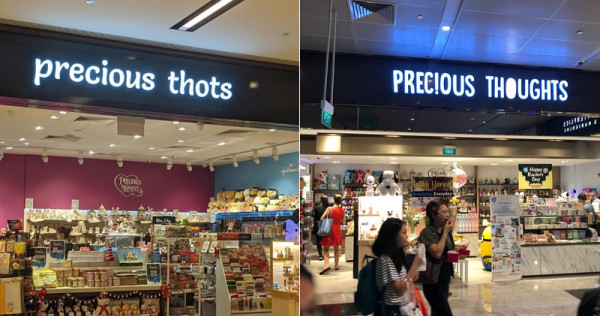
In case you haven’t noticed, they’re no longer known as Precious Thots. Since September, the retailer rebranded themselves as Precious Thoughts — a nominal change, but something they presumably felt obliged to do, considering the long, amusing legacy their previous name left on the Internet.
Redditor u/crunchystuff97 posted on the Singapore subreddit yesterday (Dec 19) about the new name at its Raffles City Shopping Centre outlet.
SINGAPORE – A Singapore Armed Forces (SAF) full-time National Serviceman, Private Joshua Quek Shou Jie, 21, sustained a cervical spine injury on Wednesday (Dec 18) during unilateral parachute training conducted in Taiwan.
Pte Quek was immediately evacuated to the nearest tertiary hospital, where he underwent surgery on Thursday morning, the Ministry of Defence said in a statement on Friday.
Mindef said that his surgery proceeded without complications and his condition is currently stable.
Pte Quek is being monitored in the intensive care unit in a Taiwan hospital and further treatment to stabilise the cervical spine injury is planned.
An orthopaedic specialist from Singapore has been flown in to help coordinate medical care.
Mindef said Pte Quek’s family was also flown in to visit him at the hospital. Both parents have spoken with him, and he is conscious and lucid, Mindef said.
“The family has asked that their privacy be respected while Pte Quek undergoes further treatment for his recovery. The Ministry of Defence and the SAF will continue to render full support and assistance to the family,” Mindef said.
If there’s one Christmas gift that’s going to be in the stockings of chefs and other avid cooking enthusiasts this year, it’s likely to be a Thermapen.
No less than four F&B personalities that we spoke to recommended this latest infrared meat thermometer that has been hailed as the best in its class for its ability to read the internal temperature of your expensive rib roast in less than three seconds – crucial when you’re juggling an open oven door and an excruciatingly hot roasting pan.
If you’re still cracking your head over what to get your favourite food lover (a Thermomix or large tin of caviar with vintage champagne notwithstanding), chefs and food-loving personalities offer up some suggestions which range from gadgety to stylish; quirky to heartfelt.
Everything you need to spread some tasty holiday cheer.
1. JEREMY NGUEE Chef-owner of Preparazzi and Batu Lesung Spice Company
Today’s the day! The biggest Dota 2 event ever held here — the really mouthful One Esports Dota 2 Singapore World Pro Invitational — has kicked off proper at the Singapore Indoor Stadium. And unless you took leave or an “urgent sick day” (or just don’t have a job), you’re probably, like us, watching it all unfold on Twitch.
Twelve of the best professional teams from around the world were invited to to compete for a US$500,000 (S$677,835) prize pool, which doesn’t seem to be that much, but respectable enough to attract the globally-renowned likes of Evil Geniuses, Team Liquid, Natus Vincere, Vici Gaming, and more.
Don’t worry, the US$1 million tournament will be landing here next year for the first-ever Dota 2 Singapore Major. Plus, the event in June 2020 will be the last Major tournament before the big one: The International in Stockholm, Sweden.
“If anything happen(s) I want you all to promise me something okay… Please be united among you all must not leave anyone behind, must help out each other love each other and support each other, okay…”
This was part of a WhatsApp message that a father sent to four of his seven children in the early hours of Saturday Dec 14.
In his message, the man penned his last wishes — for his children to stay together, and for them to take care of their mother, whom he believed had suffered by marrying him — as well as his regrets for failing to provide a stable life for the entire family.
On Dec 14, the 47-year-old experienced two instances of sudden and extreme pain in his heart as well as numbness in one half of his head, prompting him to write what he thought might be his last message.
“Seems like wanna die le now better le,” he wrote. “Really can’t move… Just in case so I write first…”