Eureka Park isn’t located on the main CES show floor at the Las Vegas Convention Center, but that doesn’t mean that there’s nothing to see there.
The arena is buzzing with startups, many of them working on ambitious ideas and novel tech often focused on solving a specific problem.
Here’s a look at five Singapore startups that were at the Singapore Pavilion, where they got to showcase their ideas to industry attendees and media from around the world.
1. A BLOCKCHAIN SMARTPHONE THAT YOU CAN BUILD
PHOTO: Pundi X Labs
Pundi X is a blockchain company that focuses on data privacy and empowering more secure transactions and connections through blockchain technology. Their latest product is the Blok-On-Blok, or BOB, a modular smartphone that’s fully powered by the blockchain.
SINGAPORE: He used to teach mathematics at a junior college but after taking a leap of faith to make a mid-career switch in 2018, Kok Chee Kean now works with numbers and problem solving in a different way.
As a software engineer at business consulting group Maltem, the 39-year-old builds monitoring dashboards, application programming interfaces and other web applications for his projects.
Like his days as a teacher, Mr Kok said he is still required to apply mathematical analysis at his new job. He has also been given opportunities to solve different problems.
“There’s a breadth of new experience that I really value,” he said.
To make the switch into the information and communications technology (ICT) sector, Mr Kok signed up for a three-month, full-time web development boot camp at coding school General Assembly after he left his job at the Ministry of Education.
There, he picked up various programming languages and tools. The projects he had to complete under tight deadlines also gave him a taste of working in the industry.
Mr Kok said his interest in programming started in 2011 after he tried to fiddle with the codes of an online multiplayer battle arena game.
“The game was in Chinese and I was playing with English-speaking friends from other countries. I was the only one who could understand Chinese so I have to do the translations all the time. I got tired of that.
“So I decided to take a part of the game and add in translations. Now everybody can play without bothering me,” he recalled with a laugh.
After 10 years in the education sector, Mr Kok Chee Kean made a career switch in 2018 and signed up for IMDA’s Tech Immersion and Placement Programme. Today, he is a software engineer. (Photo: Tang See Kit)
The changes he made caught the eye of the original game developers who invited him to join the team. It was then that Mr Kok began learning the programming language C++ through “an unbelievable amount of Googling and experimentation”.
When he started teaching, he would programme online quizzes, simulations to teach mathematical concepts like randomness, and even automated email replies.
“I love teaching. I also like programming and I kind of miss the feeling of building things … So after 10 years in the education sector, I thought why not? It was time to make the switch,” he told CNA.
HELP TO SWITCH CAREERS
Mr Kok is among those who have sought a second career in the booming technology sector as Singapore works on transforming into a digital economy.
As the relentless march of technology leaves its mark across industries, jobs have changed. While some became obsolete, new opportunities emerged in other sectors.
According to recruitment consultancy Robert Half, these new in-demand roles include those in software development, robotics process automation, big data analytics and information technology (IT) security.
Meanwhile, certain existing roles, such as business analysts and product managers, now require new skills like data analytics.
Soft skills are also increasingly important, said Robert Half Singapore’s managing director Matthieu Imbert-Bouchard.
These include communication skills, as well as having a collaborative and adaptable mindset to cope with a rapidly-changing workplace.
To help Singaporeans handle new technology, the Government has rolled out a variety of initiatives.
These include the two-day SkillsFuture for Digital Workplace courses that aim to help people gain foundational digital skills such as understanding emerging technology and data trends; as well as professional conversion programmes for those mulling a career switch.
For Mr Kok, he tapped on the Tech Immersion and Placement Programme (TIPP) which provided a subsidy for his boot camp at General Assembly. The subsidy more than halved his course fees from S$12,000 to about S$5,000.
With the help of General Assembly, Mr Kok also went for a couple of job interviews and was hired by Maltem within a month after finishing the boot camp.
The Infocomm Media Development Authority of Singapore (IMDA) said as of last October, about 1,400 trainees have completed the TIPP, which converts individuals unfamiliar with ICT into industry-ready professionals through immersive training.
More than 90 per cent of these trainees have found jobs, such as cybersecurity specialists and data analysts, in firms ranging from start-ups to large enterprises, the spokesperson said.
As for the broader TechSkills Accelerator (TeSa) initiative, which TIPP comes under, more than 93,000 training places have been taken up or committed since its launch in April 2016.
This has benefitted more than 5,000 companies in upskilling their existing workforce or employing trained local individuals in ICT, said IMDA in response to queries.
NOT EVERYONE IS READY
But even with these options, not everyone is ready or as receptive to riding the digital wave.
A 2019 survey by PwC showed one in five Singaporeans being concerned about the future impact of technology on their jobs. This put Singapore as the second-most anxious country in the 11-nation poll.
When asked why they felt nervous or scared, 58 per cent of respondents were worried about being made redundant by technology and 36 per cent feared about not having the right skills.
Slightly more than half also thought that it is likely their roles will be made obsolete or significantly changed by automation over the next 10 years, the survey said.
Recent labour market data also seem to be showing the strains of a changing economy.
While total employment grew in the third quarter of 2019, the unemployment rate also crept up. This reflects the growing mismatch between jobs and skills available, said Mr Imbert-Bouchard.
The top five roles that are finding it most difficult to hire are those in IT security, business intelligence, technology risk, cloud technology, and software and application development, according to research done by Robert Half.
Singapore’s Manpower Minister Josephine Teo said last month that the jobs and skills mismatch here will not go away.
In fact, Singapore must expect it “if we are transforming our economy at a fast enough rate” and see it as an opportunity instead.
Asked if Singapore is making the digital transition too quickly, OCBC’s head of treasury research and strategy Selena Ling said given how the rise of the digital economy is a global phenomenon, the pace of transformation is not something that can be controlled.
Overall, an unemployment rate of 2.3 per cent remains low compared to the country’s historical data as well as other parts of the world.
“So even if you have upward creep in terms of jobs-skills mismatch, you still have a stable and fairly resilient labour market,” she said.
Professor Sumit Agarwal from the National University of Singapore (NUS) Business School said: “Once the genie’s out of the bottle, which is digitisation, we have to move in that direction. We can’t stop.”
“The only thing to do is how we can help workers to keep up.”
MORE CAN BE DONE
Mr Imbert-Bouchard said the Government should continue existing efforts like TeSA and the wider SkillsFuture initiatives, while the education system needs to evolve alongside the rapidly-changing technology landscape.
With the addition of more technology-centric programmes into the formal curriculum here, Ms Ling said the education sector is now “a lot more plugged in with the general economic direction and industry needs”.
The challenge remains on how to manage the digital push for the existing workforce, especially those that have a higher risk of lagging behind like the professionals, managers, executives and technicians (PMETs).
This is because PMETs typically develop deep skillsets required for their roles, which make it difficult for them to transit into other industries. Those with higher financial obligations, especially middle-aged PMETs, also find it hard to accept lower-paying jobs, said DBS economist Irvin Seah in a 2019 report on how PMETs are “exceptionally vulnerable”.
Moving forward, Ms Ling said more help could come in the form of expanding the professional conversion programmes.
There should also be more support measures to nudge businesses, especially the small- and medium-sized enterprises, to not only adopt technology, but also to help retrain their workers.
“The easy thing would be to retrench and hire new workers. You need to have businesses that are willing to help incumbent workers to transit along with the jobs,” added the OCBC economist.
Office workers at Raffles Place in Singapore. (File photo: Marcus Mark Ramos)
ADVICE FOR EMPLOYEES
Employees will also need to rise to the challenge, embrace new skills and stay ahead of the curve.
Ms Jaya Dass, managing director of recruitment firm Randstad in Malaysia and Singapore, said: “We recommend workers to actively keep up with the trends that are happening in their industry by participating in networking events and subscribing to trade reports.
“These third-party interactions and learning can provide workers with new perspectives on how they can improve themselves to be prepared for the new digital economy and stay employable.”
Workers can also schedule regular chats with their managers and colleagues about upskilling opportunities, she added.
For Mr Kok, his advice to those mulling a career switch would be to find out the resources, such as grants and skills upgrading options, that are available.
Noting that the loss of income was one of his biggest hesitations, he did his sums and began saving up at least two years before quitting his job.
“I didn’t know about the TIPP until General Assembly mentioned it,” he said. “If I had known about it earlier, maybe I would have made the switch earlier.”
“If you are worried about not having technical skills, it is also good to find out what resources are available, such as these boot camps. There are also courses online.”
Mr Kok said over the past two years, he has also had to cope with questions about why he is leaving the civil service and making a career switch when he is nearly 40 years old. But it has all been worth it.
“Especially for mid-career switches, don’t discount the skills that you’ve built up over the course of your existing career because a lot of that will be transferable.
“Probably the only difference is the technical skills, but that can be learnt with time,” he said.
SINGAPORE – Workers’ Party chief Pritam Singh has laid out his party’s plan to woo voters in the upcoming election, saying it will field quality candidates who will ask tough questions in Parliament and manage their town councils well.
These candidates will come from a range of backgrounds and also life experience, he added without naming any of them.
He said he believes they will become competent MPs who “will do Singapore and our people proud”.
In his speech at the WP’s annual members forum on Sunday (Jan 19), Mr Singh rallied party members to ready themselves for the coming general election, including some who are tipped to be new candidates.
He also made his pitch for why Singaporeans should vote for the WP. The party’s value proposition for voters, he said, is that it can ensure a better balanced Parliament.
To that end, it is important for the party to have at least one-third of the elected seats, so that the People’s Action Party cannot change the Constitution at its pleasure like it can today, he added.
While the general election is due by April next year, it is widely expected to happen this year.
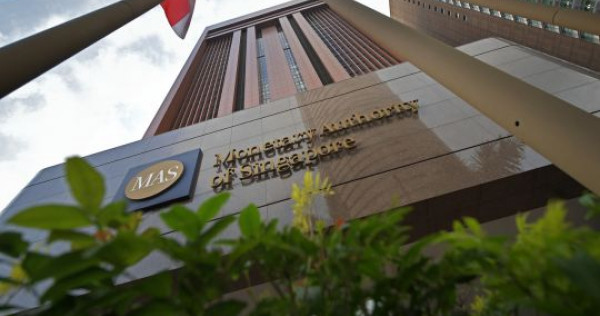
SINGAPORE – Critical security flaws have been discovered in Microsoft Windows operating systems affecting millions of machines running on them, prompting the Monetary Authority of Singapore (MAS) to issue an alert on Wednesday (Jan 15) and another one on Friday (Jan 17).
“These vulnerabilities could allow malicious files or applications to bypass detection from security applications and gain control of the computer systems,” said the MAS on Friday (Jan 17) in a statement.
This could lead to unauthorised financial transactions and data alterations, among other fraudulent activities.
“MAS will continue working closely with financial institutions to monitor the cybersecurity developments and ensure that IT systems in the financial sector are safeguarded and remain resilient against cyber threats,” according to the MAS, urging financial institutions to install software patches which are already available.
Affected Microsoft products include Windows 10 and several versions of Windows Server from 2008 to 2019.
The Cyber Security Agency of Singapore (CSA) classified the flaws as “highly critical and require immediate prioritisation”.
A mystery box website offering electronic gadgets, fashion wear and beauty products as prizes has been blocked here after a Singaporean actor promoted it on YouTube.
Drakemall, a virtual mystery box website headquartered in Ireland, was promoted by Ah Boys To Men actor Ridhwan Azman in a sponsored YouTube video on Dec 22 last year.
The site, which touts itself as a “mystery box marketplace”, promises users the chance to win gadgets by opening virtual boxes that they can buy at prices ranging from less than US$1 (S$1.35) to about US$140 (S$188).
Responding to queries from The New Paper, a police spokesman said the authorities had assessed Drakemall to be a remote gambling service.
The site was blocked sometime last week following a directive by the Ministry of Home Affairs (MHA).
IPHONE 11
In the 13-minute video by Ridhwan, who goes by the username Ridhwannabe, he claimed to have won an iPhone 11 by opening a box for $6.50.
The phone’s retail price is about $1,000.
He also takes users through the sign-up process, encouraging them to use the referral code with his name for extra perks.
They had just wrapped up a birthday party at the childcare centre in Bukit Panjang on Tuesday last week when the children and staff got an unexpected guest.
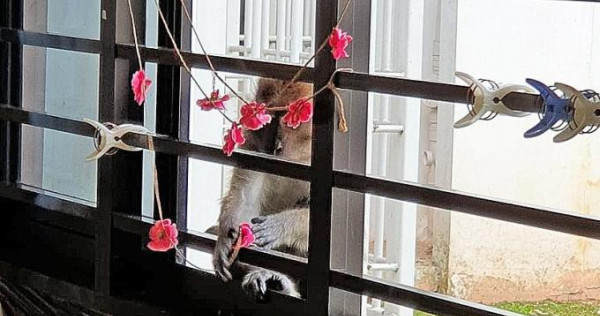
At about 4pm, a long-tailed macaque appeared by the window of a classroom at Ichiban Montessori Childcare Centre (Segar) on the ground level of Block 546A Segar Road.
Ms Alice Ow, 48, the centre’s principal, said they tried to shoo it away, but after lingering outside for a while, the monkey moved into the classroom.
She told The New Paper: “My immediate thought was to make sure the children were safe, so I evacuated everyone… They were actually excited to see a real monkey.”
Over 90 children and staff were evacuated according to the centre’s usual fire drill procedures, and about 10 infants were carried into another room.
Ms Ow stayed behind with another teacher, contacted the authorities and managed to lure the macaque out of the classroom by throwing leftover cupcakes from the birthday party out of the window.
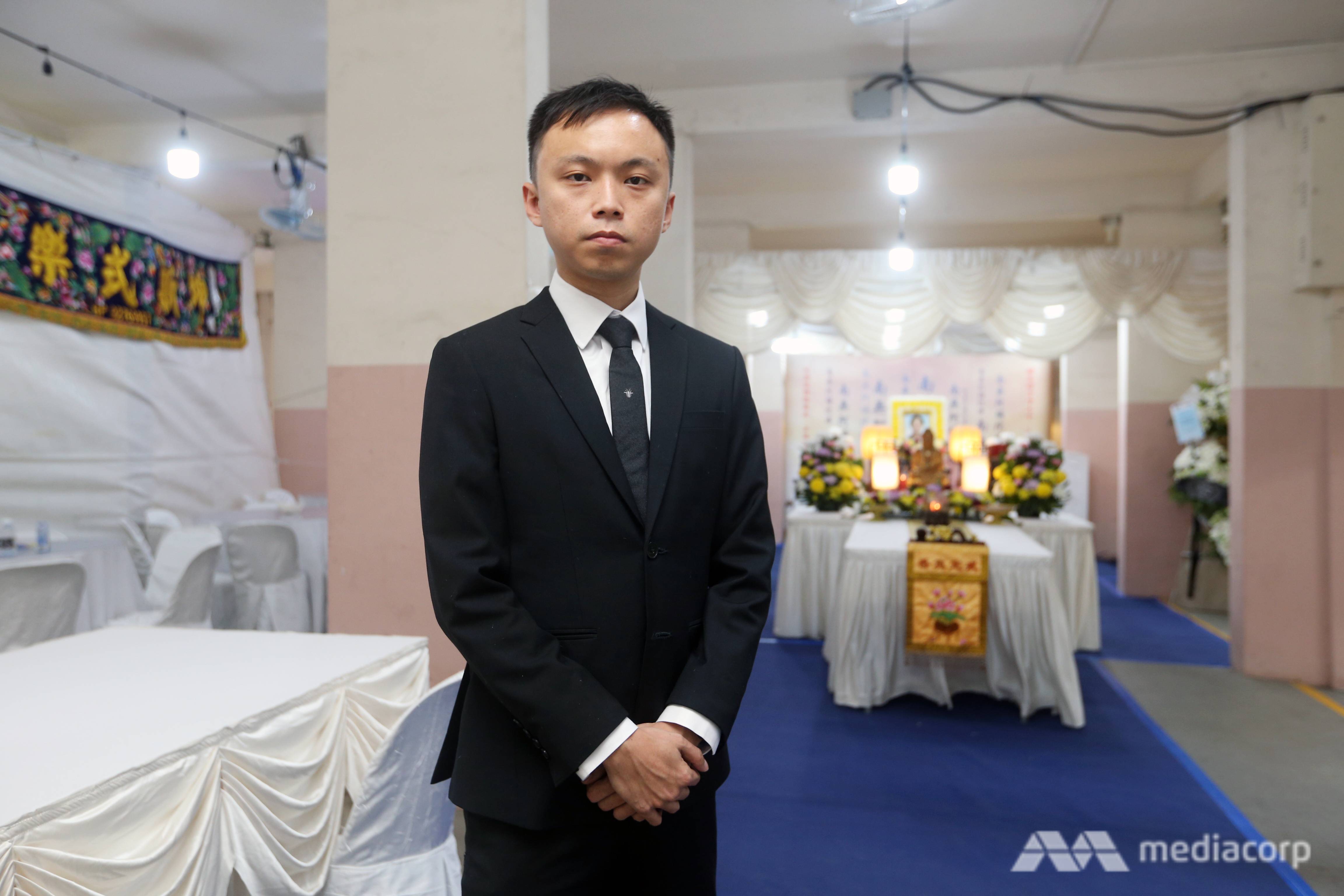
SINGAPORE: When funeral director Eugene Tan fell out with his former boss at a funeral service firm in 2018, the young man resolved to start his own business.
He was then two and a half years into the job, having joined the industry in early 2016.
Armed with an arsenal of contacts — from tent providers and florists to members of religious communities — Mr Tan, now 24, was able to get business at his firm, Entrust Funeral Service, off the ground almost immediately.
While he tapped the services of various providers for starters, he gradually began carrying out more tasks in-house. For instance, he has a funeral supplies department equipped with mobile toilets and fridges, funeral attire, urns as well as snacks for funeral wakes.
Spurred by low barriers to entry, Mr Tan is among a wave of new blood to start their own business in the funeral trade.
At the Ang Chin Moh Group of Companies, there is a range of training programmes for employees, who first undergo an orientation, and are trained in transferring, cleaning and dressing the bodies of clients and applying make-up as well as in serving bereaved families. (Photo: Ang Chin Moh Funeral Directors)
Once shunned by many, the industry is now bustling, with close to a thousand firms gunning for a slice of the pie.
There are more than 800 businesses providing funeral and related services, based on industry estimates.
It is unclear how this figure has changed over the years, but the industry is a revolving door for companies. Some barely last a year, while others operate under multiple entities, said industry players.
Operators that do not focus on funerals as their primary business — such as tent companies — are also elbowing their way in.
The infusion of fresh blood has revitalised a once-grotty industry, but with it come headaches: The quality of funerary services — only parlours with embalming rooms are licensed for now — varies widely, training is patchy (or non-existent in some firms), and inexperienced workers end up having to pick up skills on the job.
In the past year alone, two high-profile incidents have thrust the industry into the spotlight.
After the mix-up, the National Environment Agency (NEA), which regulates parlours, has toughened the rules.
Parlours must now use body identification tags, and keep embalming rooms locked and off-limits to all but authorised crew. Those who fail to comply could have their licence suspended or revoked.
Separately, The Straits Times reported in June last year that a man had his mother’s body moved to another funeral parlour after Fook Sow Undertaker in Geylang Bahru allegedly left her body uncovered.
MEDLEY OF SERVICE PROVIDERS
At present, the funeral industry is made up of a melange of service providers. At its heart are undertakers who provide, for instance, coffins and manpower for funerals. Some have their own embalming facilities.
Working with undertakers are independent funeral directors — event coordinators who see to funeral arrangements. Some operate as one-man firms that assemble different providers, such as tent and mobile-toilet firms.
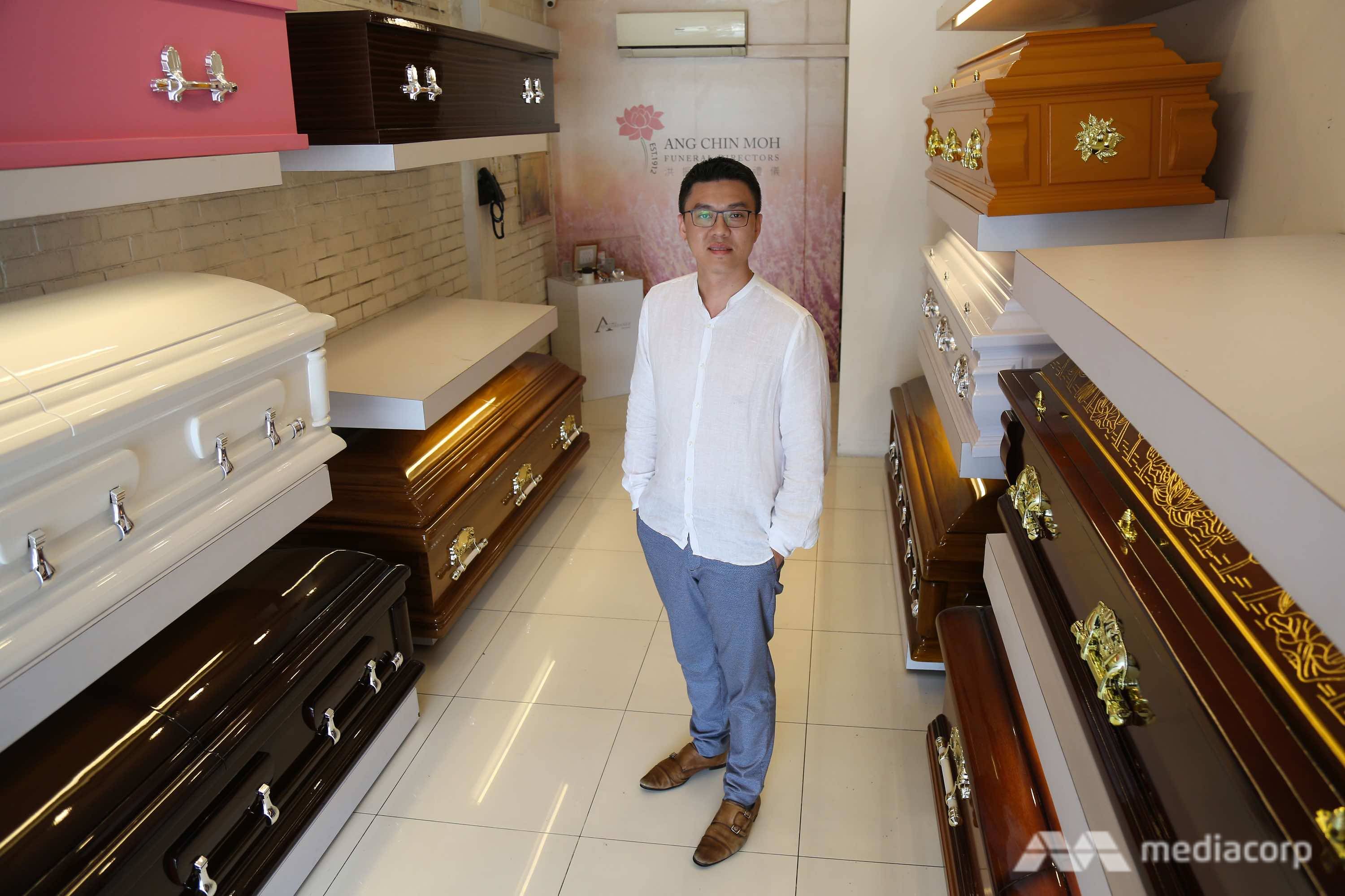
But arrangements vary. Established players, such as Direct Funeral Services and Ang Chin Moh Funeral Directors, house some of these services under one roof — including their own embalming rooms.
The NEA website directs the public to a list of funeral directors published by the Association of Funeral Directors Singapore (AFD), which represents established players in the profession. It has 36 members.
The public can also seek the services of other providers.
If embalming is needed, this is done at the 22 NEA-licensed funeral parlours with embalming facilities.
Established players, such as Direct Funeral Services and Ang Chin Moh Funeral Directors, house a range of services under one roof — including their own embalming rooms. (Photo: Ang Chin Moh Funeral Directors)
The agency licenses these spaces to uphold environmental hygiene standards, with parlours required to abide by sanitary rules for fittings, furniture and apparatuses.
NEA does not regulate providers of other funerary services, such as businesses supplying wake halls and funeral directors without embalming services.
NEW WAVE SWEEPING THE INDUSTRY
The past decade has seen gradual albeit discernible shifts in perceptions of the funeral industry, as it shed its scruffy image of dingy parlours and boisterous, sloppily dressed workers.
Funeral parlours underwent makeovers to appeal to those who prize professionalism and the personal touch, and more funeral directors ditched singlets and shorts for suits, said industry players.
Greater awareness of dying and the death trade, and more media attention on young workers in the profession, have also made the industry more palatable to the young, they said.
The industry is in a “transitional phase” as industry veterans take a backseat and hand over the reins to younger people, said Mr Nicky Teo, 31, chief executive officer of the Singapore Funeral Company.
Most of AFD’s members are family-owned and family-managed businesses, and the association said the new generation of funeral directors are proactive in taking their business further.
Many attend business management and facial reconstruction courses. “They also attend international funeral conferences, such as the National Funeral Directors Association (US) annual conference and exhibition — the largest of its kind globally, and the Asia Funeral Expo, just to name a few,” said the association, some of whose members are now run by second-, third- and fourth-generation entrepreneurs.
The industry is in a “transitional phase” as industry veterans take a backseat and hand over the reins to younger people, said Mr Nicky Teo, 31, chief executive officer of the Singapore Funeral Company. (Photo: Ooi Boon Keong/TODAY)
In 2013, veteran undertaker Roland Tay, 73, the founder of Direct Funeral Services, handed over the reins to his daughter, Ms Jenny Tay, 34.
Mr Tay had operated his funeral business as a sole proprietorship, which he started in the 1990s.
Ms Tay set improvements in motion: Among other things, the firm put in place rigorous standard operating procedures and underwent rebranding. Its pool of full-time workers also grew from about five to 65.
Away from family-owned businesses, younger professionals — including those with some years of experience in the sector — are also starting their own firms.
Mr Zhuo Weijie, 32, set foot in the industry about five years ago as an odd-job undertaker for various funeral firms.
In March last year, he started New Century Funeral Services and took on jobs from friends and those in his network by tapping a pool of freelance workers. He now has five or six workers, two of whom are full-time.
Mr Zhuo said: “As freelance workers, we were unable to voice our point of view. When we set up our own company, we have more freedom to do things our way.”
Mr Ang Ziqian, deputy chairman of the Ang Chin Moh Group of Companies, said that the industry’s low barriers to entry have their pros and cons.
“We allow people who are very entrepreneurial and like the profession to join the industry,” said Mr Ang, whose group runs two licensed parlours — Ang Chin Moh Funeral Directors and Flying Home.
In 2013, veteran undertaker Roland Tay, 73, the founder of Direct Funeral Services, handed over the reins to his daughter, Ms Jenny Tay, 34. (Photo: Direct Funeral Services)
The downside is that some would not follow the rules governing the trade.
Mr Daniel Wong, 35, a funeral consultant at Amazing Grace Funeral, said some entrants lack experience and are unconcerned about doing things well.
Mr Ang added: “When someone doesn’t fall in line (with the rules), the rest of us suffer.”
WHAT’S DRIVING INTEREST IN THE TRADE?
Once spoken of in hushed tones and avoided by young people, the funeral trade has seen the tide turn steadily in its favour.
Mr Tan of Entrust Funeral Service said young people tend to stay in the industry because of a sense of fulfilment that other jobs cannot provide. The industry is also better managed now.
“It’s a noble job… I won’t be able to find this kind of feelings if I work elsewhere,” he said.
Others may also find that the industry gives them a chance to build a career, as there are no educational prerequisites, he said. It is also not as developed as other sectors, and there is room for businesses to expand, Mr Tan added.
Mr Zhuo of New Century Funeral Services said that as more young people helm funeral businesses, those joining the industry have more opportunities to learn from a younger group of industry leaders.
“Ten years ago, what (the industry seniors) did was they reprimanded you and not many youngsters were able to take it,” he said.
Mr Teo of the Singapore Funeral Company said that the sector’s improved image was the result of a years-long effort by businesses to brand and package their services, introduce technology, and change the way funeral services are presented and conducted.
The industry is now more “service-oriented”, he said.
He noted that young people join the industry for various reasons. “Some of them just want a job that is meaningful and different from an 8-to-5 job,” he added.
The funeral trade used to be seen as a profession of last resort. While some still join the sector out of desperation, he said such workers would not last in the industry, which operates round-the-clock, including on weekends and public holidays.
Agreeing, Mr Ang said that sentiments towards the trade — once viewed as an “outcast job” — had changed radically.
From 2004 to 2009, Mr Ang said he received just five job applications every year for operational roles, such as funeral directing or embalming. He now gets at least five resumes every month.
ISSUES FACING THE INDUSTRY
As the industry evolves on the back of heightened interest from the younger generation, it has made strides towards professionalising its workers and raising the quality of services.
But standards remain uneven.
Mr Ang Ziqian, deputy chairman of the Ang Chin Moh Group of Companies, said that the industry’s low barriers to entry have their pros and cons. (Photo: Najeer Yusof/TODAY)
The success of such efforts hinges on various factors, not least the resources companies have at their disposal.
Unsurprisingly, the established players tend to have more comprehensive systems for training and development. Meanwhile, workers in other firms languish without proper training.
LACK OF TRAINING
Most funeral workers acquire the tools of the trade on the job, and training standards vary across companies.
Employees at Direct Funeral Services are put through training that spans the “A to Z of funeral work” from embalming to logistics and operations, said Mr Tay.
At the Ang Chin Moh Group of Companies, there is also a range of training programmes for employees, who first undergo an orientation, and are trained in transferring, cleaning and dressing the bodies of clients and applying make-up as well as in serving bereaved families. They also learn about diseases and precautions when handling the remains of those with infectious diseases.
But some workers in other firms receive less training.
Mr Tan of Entrust Funeral Service said that he does not send his 10 staff members for courses as their jobs are mostly logistics-based. Employees carry out tasks based on instructions.
At New Century Funeral Services, Mr Zhuo said he, too, does not train his employees since they are already familiar with the tasks at hand. “But sometimes when there are things that we see that can be improved, we will let them know.”
At present, the profession lacks a standard course for funeral directors.
Mr Chen Jiaxi, a former acting operations manager at Ang Chin Moh Funeral Directors, described the lack of formal training for funeral workers as an institutional problem.
“We are a developed nation without a mortuary college,” said Mr Chen, 34, who left the industry last year and is now a corporate investigator at a research consultancy.
Colleges in the United States, Canada, Taiwan, Australia and New Zealand, among others, offer programmes that lead to degrees, diplomas or certificates in mortuary science and funeral service.
In New Zealand, there are no specific requirements to qualify as a funeral director, but aspiring professionals may enrol in funeral directing and embalming courses if they are at least 20 years old, employed in the industry and sponsored by their employers, and have worked in a funeral home for at least a year.
So far, funeral directors here who wish to be certified have had to turn to overseas colleges.
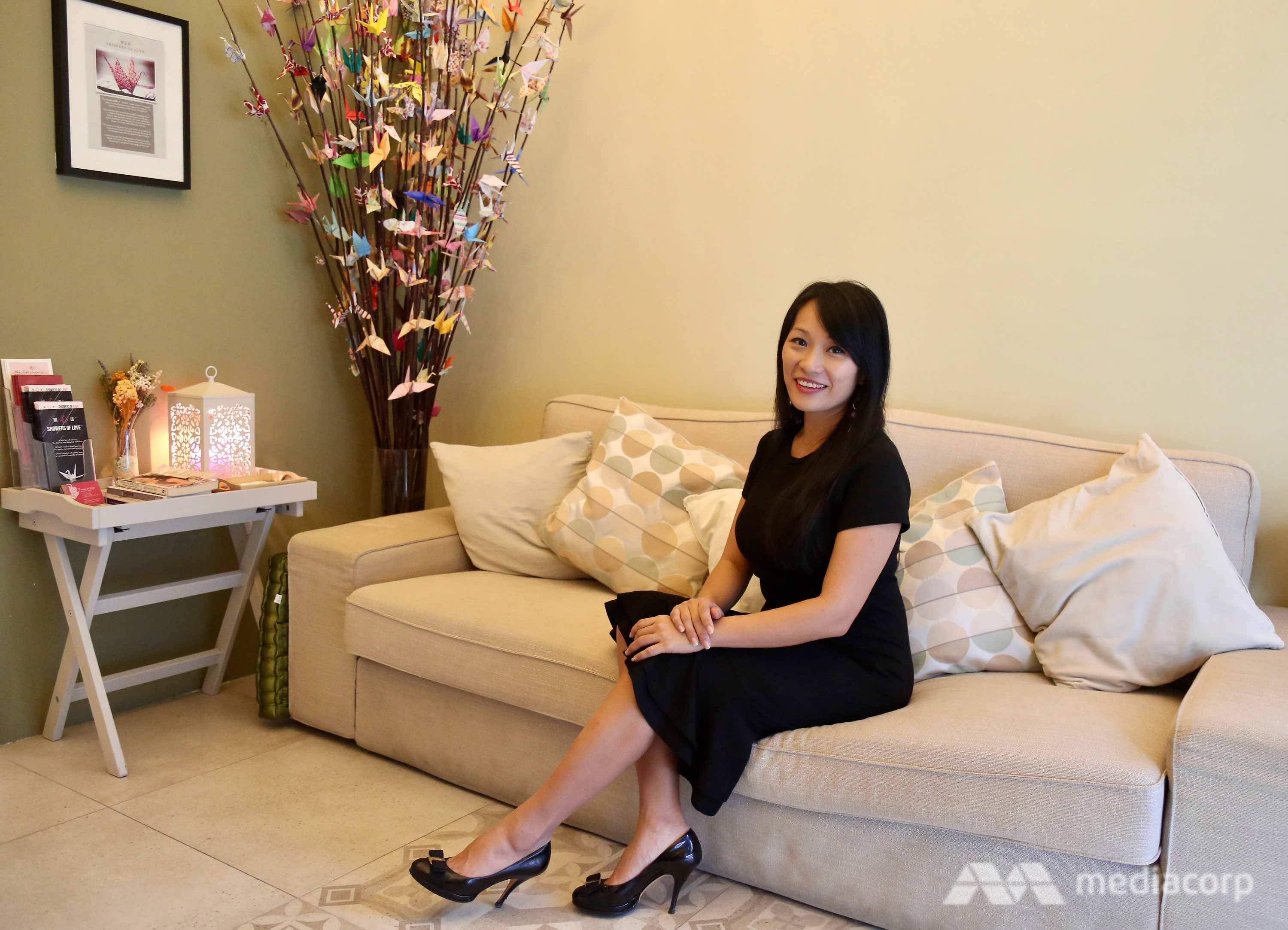
Ms Ang Jolie Mei, 39, managing director of The Life Celebrant, did a two-year course at Mount Royal University in Canada to become a certified funeral director. She completed the programme via distance learning in 2012.
It taught her how to manage conflicts within grieving families as well as how to handle the media during high-profile funerals — skills that she has applied to funerals here. “The certification helped me a lot,” she said.
Ms Ang Jolie Mei, 39, managing director of The Life Celebrant, did a two-year course at Mount Royal University in Canada to become a certified funeral director. She completed the programme via distance learning in 2012. (Photo: Najeer Yusof/TODAY)
Apart from the absence of a training programme for funeral workers, Mr Chen said Singapore lacks a nationally recognised code of conduct for the profession.
At present, AFD has a code setting out the conduct expected of its members providing funeral and bereavement services — but its membership is just a fraction of the industry.
The code, which covers matters such as client confidentiality and the provision of advice on funeral services, is “too skimpy”, said Mr Chen.
Nevertheless, NEA said in response to queries that it encourages all funeral directors here to conduct their businesses in accordance with the association’s code.
LACK OF SPACE TO EXPAND
Funeral businesses also lament the dearth of sites parcelled out by NEA for funeral parlours. This, they said, impairs their growth and ability to improve their services and standards.
Right now, licensed funeral parlours are located at six sites — mainly at Geylang Bahru, Sin Ming Drive and Toa Payoh Industrial Park, with others in Tampines Link, Lavender Street and Upper Serangoon Road.
While NEA has announced five sites — in Bidadari, Ang Mo Kio, Bukit Batok, Mandai and Woodlands — that will be developed over the next decade or so, firms said the schedule was too long and called on the agency to speed up development.
Mr Vincent Ng, 42, director of A.Life Grad Funeral Services LLP, said he would like to have his own embalming facility, but space is limited.
His firm uses an embalming room in Sin Ming that is tapped by various firms.
“The embalming room is in a mess … you may see four or five bodies (at one time),” he said.
Mr Tan of Entrust Funeral Service, which has an office in Yishun, said he cannot display caskets there and welcomes having a store of his own.
“I am unable to expand my business in certain areas because of this,” he said.
Mr Zhuo, whose New Century Funeral Services is based in Bedok, said that because of limited space, he has had to keep his supplies, such as funeral reception tables, at a storage space in Marymount.
On the industry’s suggestion to accelerate development, NEA said that while there is a planned development schedule for the new funeral parlours, it would make adjustments where necessary “if projected demand is expected to exceed supply, based on the latest updates on the planning parameters over the next 10 years”.
Among the five new locations, the site in Woodlands will be the first to be launched for development around the middle of this year.
“We will monitor the demand for funeral space, adjust the timelines if necessary, and launch the new funeral parlour sites progressively over the next couple of years,” NEA added.
WAYS TO UPLIFT THE TRADE
To raise standards, funeral businesses said Singapore needs a formal course for funeral directors, which could lead to licensing.
Others are in favour of raising the barriers to entry by imposing basic requirements before a person can start a funeral business.
Standard training leading to licensing: Most industry players interviewed suggested that AFD, working with NEA and educational institutions, could start a programme to groom funeral professionals.
Mr Calvin Tang, 44, assistant general manager of the Singapore Casket, said that the bigger market players in AFD could share resources to train committed professionals who join the industry.
Mr Alex Tan, 29, an independent funeral director who received his grounding in the trade at Ang Chin Moh Funeral Directors, suggested that experienced professionals could conduct this course.
Scholars from Taiwan and Malaysia could be invited to teach students about customs and beliefs, too. “It will uplift the funeral trade,” he said.
Formal training could count towards a licence for funeral directors, suggested Mr Teo of the Singapore Funeral Company, who noted that professionals in Taiwan need a licence to practise as funeral directors.
In 2014, Taiwan began issuing funeral director licences as part of the government’s efforts to protect consumers and raise the quality of funerary services. At that time, 16 colleges and universities offered related courses, news site Taiwan Today reported.
Even so, some firms here noted that certification is not a cure-all.
Mr Zhuo said that elements of the vocation, such as customs and religious practices, cannot be learnt from books. “It would be better with on-the-ground training,” he said.
Responding to the suggestion for more training, NEA said employers have largely provided new employees with on-the-job training. This has served the needs of the industry so far.
“But we will be working with the industry to strengthen this further by identifying and developing the skill sets needed by the industry,” NEA said.
“In areas where there is environmental hygiene impact, such as embalming services and premises, where a licensing framework is already in place, we are working with (AFD) to review how standards can be further strengthened, drawing on the expertise and contributions of industry players to build stronger capabilities.”
NEA said it has also received feedback that while there is no shortage of embalmers in Singapore, few among them are locals owing to the lack of training opportunities.
“We will review with (AFD) on how to offer assistance to locals who wish to practise as embalmers,” said the agency.
Freelance embalmer Queenie Ng, 37, who obtained a diploma in embalming from the Philippines, said offering training here would make it easier for those wishing to become embalmers, but she wondered if there would be enough demand to sustain it.
Some people still see embalming as a “dirty job”, she said.
For a course aimed at funeral directors to materialise, AFD said that there must be commitment from everyone in the funeral profession.
“Our established members are keenly aware of education and upgrading, and make full use of lull periods in activity by investing in employee training for their full-time staff,” it said.
In devising a course, the association said the challenges include agreeing on the syllabi that all funeral professionals must undergo to achieve certification and the availability of qualified teachers.
AFD noted that Ang Chin Moh Foundation, a charity that raises awareness about end-of-life conversations in Singapore, had engaged an institution of higher learning in an attempt to develop a course on funerals and embalming.
“However, this did not go beyond the working-level stage, as the institution was of the opinion that parents and the public would not support such a course of study and that the demand will not be cost-effective to run it,” the association said.
Raise barriers to entry: The industry’s low barriers to entry mean that “any Tom, Dick or Harry” including newcomers can establish a funeral service, said Mr Tang of the Singapore Casket.
He suggested that those wishing to start a funeral firm must first have an office, a full-time embalmer, an embalming theatre and a certain number of full-time employees.
NEA and the association could discuss how to put these requirements in place, Mr Tang said.
MORE REGULATIONS ‘MAY LEAD TO HIGHER COSTS’
In response, NEA said it was prepared to consider more regulations where needed.
“But the trade-off of potentially higher costs, which will eventually be passed on to the families, will have to be carefully assessed,” the agency said.
Mr Ang of the Ang Chin Moh Group of Companies agreed, saying that regulations preventing firms from entering the industry would hurt consumers by potentially raising costs and prolonging waits during times of grief.
In the meantime, NEA said it would review workflows at the licensed funeral parlours with embalming facilities to identify areas for improvement and roll out guidelines to raise standards of funerary services.
To appreciate the problems affecting the industry, Mr Chen suggested that NEA appoint an independent committee to review potential gaps in the profession, and in existing procedures and guidelines.
This could lead to a robust code of conduct that licensees and operators must follow, he said.
8 COMPLAINTS LAST YEAR: CASE
As far as statistics on complaints go, consumers do not appear hugely dissatisfied with funeral services.
Over the past three years, NEA said it had received four pieces of feedback about embalming work. Two cases were about access control and process issues in the embalming room, and one was related to improper disposal of embalming waste.
There was one case about embalming work done by suspected illegal embalmers, but this was found to be unsubstantiated, the agency said in a response published in The Straits Times’ Forum page in December last year.
Meanwhile, the Consumers Association of Singapore (CASE) received at least 11 complaints about funeral-related services in the last three years — eight of them in 2019.
The complaints were about overcharging, sales tactics and misleading claims, said its executive director Loy York Jiun.
Mr Teo of the Singapore Funeral Company suggested that all funeral firms be accredited under CaseTrust, a scheme by CASE for fair trading practices. Among other things, CaseTrust should bind accredited companies to price guidelines for basic funeral services, he said.
Right now, three funeral service providers, Casket Fairprice, The Life Celebrant and Unity Casket Funeral Planner, are accredited under CaseTrust’s “storefront” accreditation scheme. Under the scheme, applicants must commit to clear, ethical and transparent communication, a dispute resolution process, and fair business practices.
CASE president Lim Biow Chuan said the association would be happy to devise an accreditation scheme for the funeral industry if firms are found to be taking advantage of consumers.
But he noted that CASE is not a regulator, and if firms breach their commitments, the only recourse is to remove their accreditation.
To help the public make informed choices on funerary services, NEA said it has made more information available to raise consumer awareness and increase transparency in the after-death industry, and it would do more in this area.
“With our ageing population, and growing demand for after-death services and facilities, it will be helpful if each of us can be more aware of the after-death arrangements available and make our wishes known to family members early,” the agency added.
“NEA will continue to study how we can raise consumer awareness of the after-death industry, and work closely with (AFD) on improving training standards and process workflow within the industry.”
SINGAPORE: He used to teach mathematics at a junior college but after taking a leap of faith to make a mid-career switch in 2018, Kok Chee Kean now works with numbers and problem solving in a different way.
As a software engineer at business consulting group Maltem, the 39-year-old builds monitoring dashboards, application programming interfaces and other web applications for his projects.
Like his days as a teacher, Mr Kok said he is still required to apply mathematical analysis at his new job. He has also been given opportunities to solve different problems.
“There’s a breadth of new experience that I really value,” he said.
To make the switch into the information and communications technology (ICT) sector, Mr Kok signed up for a three-month, full-time web development boot camp at coding school General Assembly after he left his job at the Ministry of Education.
There, he picked up various programming languages and tools. The projects he had to complete under tight deadlines also gave him a taste of working in the industry.
Mr Kok said his interest in programming started in 2011 after he tried to fiddle with the codes of an online multiplayer battle arena game.
“The game was in Chinese and I was playing with English-speaking friends from other countries. I was the only one who could understand Chinese so I have to do the translations all the time. I got tired of that.
“So I decided to take a part of the game and add in translations. Now everybody can play without bothering me,” he recalled with a laugh.
After 10 years in the education sector, Mr Kok Chee Kean made a career switch in 2018 and signed up for IMDA’s Tech Immersion and Placement Programme. Today, he is a software engineer. (Photo: Tang See Kit)
The changes he made caught the eye of the original game developers who invited him to join the team. It was then that Mr Kok began learning the programming language C++ through “an unbelievable amount of Googling and experimentation”.
When he started teaching, he would programme online quizzes, simulations to teach mathematical concepts like randomness, and even automated email replies.
“I love teaching. I also like programming and I kind of miss the feeling of building things … So after 10 years in the education sector, I thought why not? It was time to make the switch,” he told CNA.
HELP TO SWITCH CAREERS
Mr Kok is among those who have sought a second career in the booming technology sector as Singapore works on transforming into a digital economy.
As the relentless march of technology leaves its mark across industries, jobs have changed. While some became obsolete, new opportunities emerged in other sectors.
According to recruitment consultancy Robert Half, these new in-demand roles include those in software development, robotics process automation, big data analytics and information technology (IT) security.
Meanwhile, certain existing roles, such as business analysts and product managers, now require new skills like data analytics.
Soft skills are also increasingly important, said Robert Half Singapore’s managing director Matthieu Imbert-Bouchard.
These include communication skills, as well as having a collaborative and adaptable mindset to cope with a rapidly-changing workplace.
To help Singaporeans handle new technology, the Government has rolled out a variety of initiatives.
These include the two-day SkillsFuture for Digital Workplace courses that aim to help people gain foundational digital skills such as understanding emerging technology and data trends; as well as professional conversion programmes for those mulling a career switch.
For Mr Kok, he tapped on the Tech Immersion and Placement Programme (TIPP) which provided a subsidy for his boot camp at General Assembly. The subsidy more than halved his course fees from S$12,000 to about S$5,000.
With the help of General Assembly, Mr Kok also went for a couple of job interviews and was hired by Maltem within a month after finishing the boot camp.
The Infocomm Media Development Authority of Singapore (IMDA) said as of last October, about 1,400 trainees have completed the TIPP, which converts individuals unfamiliar with ICT into industry-ready professionals through immersive training.
More than 90 per cent of these trainees have found jobs, such as cybersecurity specialists and data analysts, in firms ranging from start-ups to large enterprises, the spokesperson said.
As for the broader TechSkills Accelerator (TeSa) initiative, which TIPP comes under, more than 93,000 training places have been taken up or committed since its launch in April 2016.
This has benefitted more than 5,000 companies in upskilling their existing workforce or employing trained local individuals in ICT, said IMDA in response to queries.
NOT EVERYONE IS READY
But even with these options, not everyone is ready or as receptive to riding the digital wave.
A 2019 survey by PwC showed one in five Singaporeans being concerned about the future impact of technology on their jobs. This put Singapore as the second-most anxious country in the 11-nation poll.
When asked why they felt nervous or scared, 58 per cent of respondents were worried about being made redundant by technology and 36 per cent feared about not having the right skills.
Slightly more than half also thought that it is likely their roles will be made obsolete or significantly changed by automation over the next 10 years, the survey said.
Recent labour market data also seem to be showing the strains of a changing economy.
While total employment grew in the third quarter of 2019, the unemployment rate also crept up. This reflects the growing mismatch between jobs and skills available, said Mr Imbert-Bouchard.
The top five roles that are finding it most difficult to hire are those in IT security, business intelligence, technology risk, cloud technology, and software and application development, according to research done by Robert Half.
Singapore’s Manpower Minister Josephine Teo said last month that the jobs and skills mismatch here will not go away.
In fact, Singapore must expect it “if we are transforming our economy at a fast enough rate” and see it as an opportunity instead.
Asked if Singapore is making the digital transition too quickly, OCBC’s head of treasury research and strategy Selena Ling said given how the rise of the digital economy is a global phenomenon, the pace of transformation is not something that can be controlled.
Overall, an unemployment rate of 2.3 per cent remains low compared to the country’s historical data as well as other parts of the world.
“So even if you have upward creep in terms of jobs-skills mismatch, you still have a stable and fairly resilient labour market,” she said.
Professor Sumit Agarwal from the National University of Singapore (NUS) Business School said: “Once the genie’s out of the bottle, which is digitisation, we have to move in that direction. We can’t stop.”
“The only thing to do is how we can help workers to keep up.”
MORE CAN BE DONE
Mr Imbert-Bouchard said the Government should continue existing efforts like TeSA and the wider SkillsFuture initiatives, while the education system needs to evolve alongside the rapidly-changing technology landscape.
With the addition of more technology-centric programmes into the formal curriculum here, Ms Ling said the education sector is now “a lot more plugged in with the general economic direction and industry needs”.
The challenge remains on how to manage the digital push for the existing workforce, especially those that have a higher risk of lagging behind like the professionals, managers, executives and technicians (PMETs).
This is because PMETs typically develop deep skillsets required for their roles, which make it difficult for them to transit into other industries. Those with higher financial obligations, especially middle-aged PMETs, also find it hard to accept lower-paying jobs, said DBS economist Irvin Seah in a 2019 report on how PMETs are “exceptionally vulnerable”.
Moving forward, Ms Ling said more help could come in the form of expanding the professional conversion programmes.
There should also be more support measures to nudge businesses, especially the small- and medium-sized enterprises, to not only adopt technology, but also to help retrain their workers.
“The easy thing would be to retrench and hire new workers. You need to have businesses that are willing to help incumbent workers to transit along with the jobs,” added the OCBC economist.
Office workers at Raffles Place in Singapore. (File photo: Marcus Mark Ramos)
ADVICE FOR EMPLOYEES
Employees will also need to rise to the challenge, embrace new skills and stay ahead of the curve.
Ms Jaya Dass, managing director of recruitment firm Randstad in Malaysia and Singapore, said: “We recommend workers to actively keep up with the trends that are happening in their industry by participating in networking events and subscribing to trade reports.
“These third-party interactions and learning can provide workers with new perspectives on how they can improve themselves to be prepared for the new digital economy and stay employable.”
Workers can also schedule regular chats with their managers and colleagues about upskilling opportunities, she added.
For Mr Kok, his advice to those mulling a career switch would be to find out the resources, such as grants and skills upgrading options, that are available.
Noting that the loss of income was one of his biggest hesitations, he did his sums and began saving up at least two years before quitting his job.
“I didn’t know about the TIPP until General Assembly mentioned it,” he said. “If I had known about it earlier, maybe I would have made the switch earlier.”
“If you are worried about not having technical skills, it is also good to find out what resources are available, such as these boot camps. There are also courses online.”
Mr Kok said over the past two years, he has also had to cope with questions about why he is leaving the civil service and making a career switch when he is nearly 40 years old. But it has all been worth it.
“Especially for mid-career switches, don’t discount the skills that you’ve built up over the course of your existing career because a lot of that will be transferable.
“Probably the only difference is the technical skills, but that can be learnt with time,” he said.
SINGAPORE: When the global financial crisis hit Singapore in 2009, the shock left the country with real GDP growth of 0.1 per cent.
But the economy rebounded quickly. The following nine years delivered an average annual growth of 5.2 per cent, owing largely to a sharp rebound in 2010, registering a growth of 14.5 per cent.
The mood is discernibly more downbeat this time. With estimates showing that Singapore’s GDP grew by 0.7 per cent in 2019, the Government now forecasts that the economy will grow only within the range of 0.5 to 2.5 per cent in 2020.
Is low growth the new normal for Singapore?
As a small, open economy heavily dependent on external demand, Singapore’s national output is subject to the vagaries of the global economy. The negative impact of the global financial crisis was transmitted mainly through a sharp decline in the republic’s net exports.
By the same token, the sharp rebound in 2010 came primarily through an expansion of net exports. The question is whether we can expect a similar recovery in the next couple of years.
One reason to think we are less likely to see a strong recovery this time around is that the US-China trade war is affecting the Singapore economy by disrupting global supply chains.
With deep integration into the international production network being the country’s lifeblood, even tariff barriers elsewhere present strong headwinds for our economy.
Higher tariffs on Chinese goods, for example, result in diminished demand for Singapore’s exports of intermediate products to China and other importing nations that are part of the global value chain.
Global trade growth has slowed in 2019 according to the WTO. (File photo: AFP/Roslan Rahman)
The implications could move beyond trade into the reshaping of global production lines, if distrust seeps into technology and other sectors that deal with critical infrastructure with potential national security implications.
Looking ahead, growth accounting provides a way for us to think about how Singapore’s economic growth can continue to keep up.
The growth of Singapore’s total real GDP today depends on labour force growth, capital investment, and growth of total factor productivity.
DECLINING CITIZEN WORKFORCE
Singapore’s total labour force, made up of residents and foreigners, grew on average by 2.2 per cent over the period 2010 to 2018. Growth in labour inputs contributed to nearly a quarter of the GDP growth, with technology, capital and productivity gains making up the rest.
According to Singapore’s Population White Paper, the number of citizens in the working ages of 20 to 64 years will start to decline from this year onwards due to more retiring and fewer entering the workforce, as the number of babies dropped to an eight-year low in 2019.
This factor, taken alone, will be a drag on growth.
While raising the retirement age, and boosting the labour force participation rate, particularly of women, can attenuate this drag to some extent, it is unlikely to be enough to substantially increase the total number of hours worked or even maintain current levels.
The case of Japan is instructive. Over the period 2010 to 2018, the average annual growth of Japan’s real GDP was 1.4 per cent.
The decline in the Japanese working-age population is, no doubt, a factor contributing to its anaemic growth, with the IMF calculating the impact of ageing could drag down GDP growth by 1 percentage point over the next three decades.
For Singapore, a combination of policy efforts to boost the total fertility rate as well as to relook immigration seems inevitable if we are to avoid a labour crunch leading to a growth drag.
Workers cross the road in the central business district of Singapore. (File photo: AFP/Simin Wang)
MAINTAINING A HIGH INVESTMENT RATE
Quite remarkably, the share of investment in GDP has averaged 27.2 per cent over the period 2010 to 2018, a portion of which is in the form of inward foreign direct investment.
Public investment in infrastructure, including the building of several MRT lines and construction of huge projects such as Jewel Changi Airport, also contributed to the internationally high investment rate, compared to the median of about 20 per cent according to World Bank 2018 figures.
Growth of capital input contributes to about two-thirds of GDP growth.
Singapore’s reputation as a reliable destination for foreign direct investment built up over several decades, no doubt, contributes to its ability to attract multinational corporations to place a segment of their manufacturing process, which will require a number of years for costs to be recovered, here.
Its strong institutions, supported by secure property rights and a sound legal system, is a comparative advantage. An education system responsive to market needs in supplying workers with the relevant skills has also served us well.
Semiconductors giant Micron, for instance, announced it plans to invest billions more and add 1,500 more jobs over the next five years at the opening of its expanded facility in Singapore in August 2019.
However, with advances in information and communications technology and artificial intelligence making it possible for foreign firms to employ workers to perform many tasks remotely, Singapore will face greater challenges in attracting foreign direct investment.
Singaporeans will also have to adapt to this changing nature of work, and undergo the necessary training to gain relevant skills but this is not an easy ask for older workers in their 50s and 60s.
A shrinking citizen workforce will also reduce the talent pool that Singapore can offer, which could sway the calculations of multinationals deciding whether to locate their facilities here.
Since capital investment ultimately faces diminishing returns, the source of sustained growth comes from indigenous innovation.
When the technology gap was huge, Singapore’s ability to attract multinational corporations that brought the technological knowhow contributed to its GDP growth. With a narrower technology gap now, Singapore has to expand its own capacity to innovate.
The shift in the education system to inculcate innovativeness and encourage risk-taking, through initiatives such as the Applied Learning Programmes, will help to increase the supply of innovators.
Strengthening the eco-system to encourage new start-ups and growing the venture capital industry are all necessary moves to foster innovation and thus generate growth in total factor productivity.
In recent years, the Government has placed more emphasis on nurturing start-ups, through the creation of various grants, loans and co-investment funds investing in accelerators and Singapore-based companies with high growth potential, and the creation of SGInnovate, an organisation dedicated to helping deep tech start-ups grow.
The Government has also continued to place emphasis on building up enterprise research, with over S$19 billion committed under the Research, Innovation and Enterprise 2020 plan.
The new anti-cancer drug was developed by Assoc Prof Giorgia Pastorin, Assoc Prof Ang Wee Han and Dr Maria Babak. (Photo: National University of Singapore)
These efforts, however, will take time to bear fruit. For the period 2010 to 2018, growth in total factor productivity contributed to less than 10 per cent of GDP growth.
IS THERE A CASE FOR OPTIMISM?
A shrinking citizen workforce, the law of diminishing returns to capital, and the time needed to bring about a culture shift towards indigenous innovation all portend low growth for Singapore. Is there any reason to remain optimistic?
The answer is yes. Singapore has been able to achieve domestic social and political consensus to reinvent itself to ride on opportunities thrown up by the global economy, and find new ways of overcoming our constraints.
When it faced a severe recession in 1985, caused in part by wages running ahead of productivity, workers accepted a 15-percentage point cut in employers’ CPF contribution rate, which was gradually restored.
Having recovered, workers’ skills were developed to take advantage of the growing financial sector fuelled by funds flowing into a booming region from 1989 to 1998.
Through government initiatives announced over recent Singapore Budgets, firms have also been encouraged to embrace automation, digitalisation and reskilling, and rely less on foreign labour in a manpower-lean economy.
Finance Minister Heng Swee Keat delivers the Budget 2019 statement on Feb 19, 2019.
More recently, bold plans for the Greater Southern Waterfront after the ports are relocated away from Tanjong Pagar to free up valuable land to be redeveloped in the downtown region were announced just last year.
So Singapore can surely find the necessary gumption to reinvent itself again and overcome its constraints.
Hoon Hian Teck is Professor of Economics at the Singapore Management University. The views expressed here are his own personal opinion.
SINGAPORE: Transport operators SMRT and SBS Transit will roll out trains decorated for Chinese New Year on all five rail lines from Sunday (Jan 19) until Feb 15.
“These themed trains and buses feature adorable zodiac motifs, blooming flowers and gold ingots to help bring the festive cheer to commuters,” the Land Transport Authority (LTA) said in a news release.
The trains will be decorated from Jan 19 to Feb 15. (Photo: Land Transport Authority)
One train on each of Singapore’s five rail lines has been decorated.
Clarke Quay and Dhoby Ghaut MRT stations has also been decked out as a themed stations, as a way to “encourage commuters to take public transport for their festive errands”, LTA added.
Chinese New Year decorations at Clarke Quay MRT station. (Photo: Land Transport Authority)
Chinese New Year decorations at Clarke Quay MRT station. (Photo: Land Transport Authority)
Buses for services 80, 143, 166, 147, 174, 61, 960 and 963 will also be decorated progressively from next week.
“These buses ply through areas like Chinatown, Toa Payoh, Sengkang, Jurong East and Clementi, bringing celebrations to the heartlands,” LTA said.
The themed trains are a collaboration with Kreta Ayer-Kim Seng Citizens’ Consultative Committee, said LTA.