Home Blog Page 4621

Guantanamo closure spells trouble for Indonesia

0

Indonesia is in a bind over the prospect of Hambali, one of the deadliest terrorists from the country, being sent home from Guantanamo Bay where he has been held by the United States since 2006.

The former operations chief of the Jemaah Islamiah (JI) terror network, who is an Indonesian citizen, may be repatriated if US President Barack Obama succeeds in shutting down the detention centre, also known as Gitmo.

Mr Obama on Feb 23 announced his plan to close the facility in Cuba, which for years has been synonymous with the rendition of suspected Islamists and the torture of detainees.

He added that it was time to decommission the military prison because it undermines the country’s national security and was against its values and interests.

At its peak, Gitmo housed more than 700 terror suspects, most of whom were captured in the aftermath of the Sept 11, 2001, attacks in New York and Washington.

There are now only about 91 detainees left and Hambali, the chief architect of the Bali bombings which killed 202 people in 2002, is among three detainees from South-east Asia still being held in the controversial facility.

The remaining two – Mohd Farik Amin alias Zubair, 41, and Mohammed Nazir Lep alias Lillie, 39 – are Malaysians involved in an Al-Qaeda plot to crash a plane into Los Angeles after the 9/11 attacks.

Indonesia, still recovering from the Jan 14 terror attack on its capital Jakarta by domestic militants linked to the Islamic State in Iraq and Syria (ISIS), does not want Hambali back.

The Straits Times has learnt that a ministerial-level meeting is being held today in Jakarta to discuss how he can be denied entry to his country of birth.

A source close to the Joko Widodo administration, who asked not to be named, said the government is concerned that Hambali’s return may rejuvenate domestic terror cells, particularly remnant elements of the disbanded JI network.

“Indonesian militants, whether they are former JI or followers of Aman Abdurrahman, will see Hambali as their new leader even if he is imprisoned here, and that may pose a threat to Indonesia’s security,” said the source.

Aman is the jailed cleric believed to have ordered the recent terror attack in Jakarta.

Indonesia is now in the process of reviewing its anti-terrorism law, introduced in 2003 following the bombings in Bali.

Proposed revisions being discussed by lawmakers include revoking the citizenship and barring entry of any Indonesian who engages in terrorism activities overseas.

Counter-terrorism experts such as Mr Adhe Bhakti, however, said even if passed, the new laws will not apply to Hambali.

“Indonesia’s constitutional court has previously ruled that laws, such as the 2003 Anti-Terrorism Bill, cannot be applied retroactively,” he said.

Still, the 50-year-old JI operative can be charged with premeditated murder under Indonesia’s criminal code because there is evidence that Hambali was “the mastermind” of the Bali incident, said Mr Adhe.

“Prosecutors would seek at least a life sentence for him,” he added.

These arguments, however, are premature, say some experts.

A key part of Mr Obama’s plan to close Guantanamo Bay is to redistribute the remaining detainees, mainly those the US still wants to hold, to 13 prisons across the country and six other detention centres on military bases.

That proposal, however, has attracted strong opposition from US lawmakers.

tkchan@sph.com.sg


This article was first published on March 8, 2016.
Get a copy of The Straits Times or go to straitstimes.com for more stories.

Image: 
Category: 
Publication Date: 
Tuesday, March 8, 2016 – 17:00
Keywords: 
Send to mobile app: 
Source: 


Story Type: 
Others

Source link

Questions on the Cross Island Line

0

Do we need the Cross Island Line? Can we do without it?

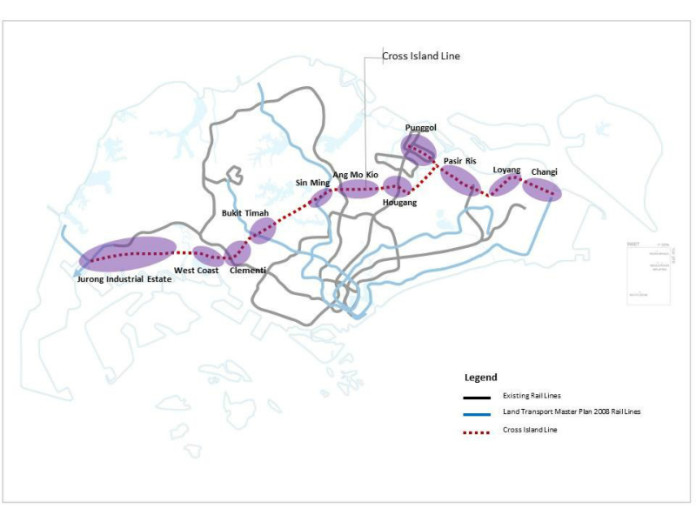
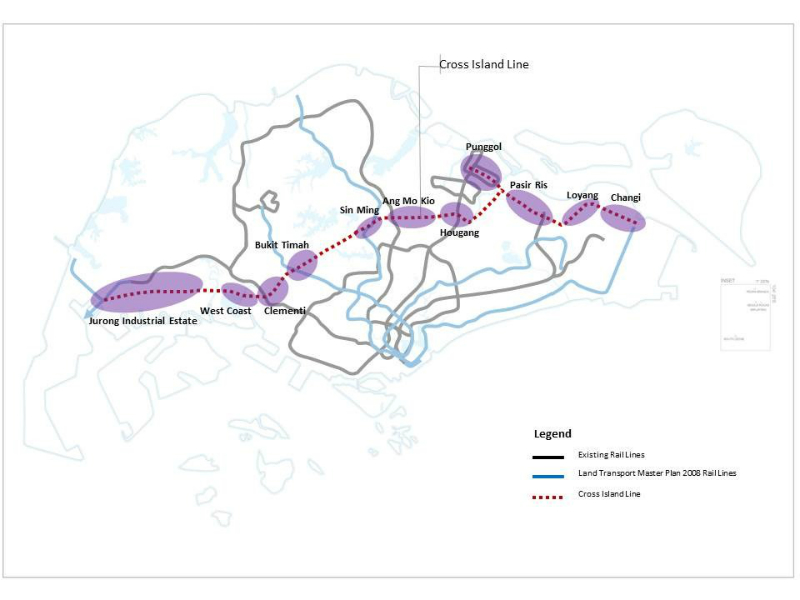
The Cross Island Line (CRL) will be an important part of our MRT network. It will provide a faster commute between the east and the west, from Changi to Jurong, stretching more than 50 km with about 30 stations. Nearly half of these stations will be interchange stations. Our preliminary estimate is that commuters from residential areas like Loyang, Pasir Ris, Hougang, Ang Mo Kio, Sin Ming, Bukit Timah, Clementi and West Coast will make at least 600,000 trips on the CRL every day. This will place the CRL higher, in terms of capacity and usage, compared to the North East Line. The CRL will also significantly enhance the resilience of our network, as the CRL will connect with all radial lines to provide commuters with many more travel routes to their destinations.
Why can’t the government just go with the alignment that does not cut through the CCNR?

To make an informed decision on the alignment option that best serves the public, the Government has to understand the total impact of both alignments, including on transport connectivity, engineering feasibility, the CCNR and the environment, as well as the nearby homes and families. It is for this reason that LTA is conducting an Environmental Impact Assessment (EIA) study, site investigation works, and an engineering feasibility study

The direct alignment is 4km long, with 2km of the tunnel running beneath the CCNR and the other 2km located outside it. As a shorter alignment, it will provide commuters faster East-West connectivity. The tunnels for the direct alignment will be about 40m deep and there will not be any construction of infrastructure on the surface within the CCNR. However, members of the public and nature groups have voiced concerns over the environmental impact of the direct alignment on the CCNR.

The skirting alignment, about 9km long, does not cross under the CCNR. However, the longer alignment will incur an additional travel time of six minutes for commuters crossing between the East and the West. It will also require longer tunnels and extra ventilation facilities. Besides land and home acquisitions that could affect families, the extra works could incur $2 billion more in expenditure.

What is an EIA? Is it a standard process as part of planning for all our MRT lines?

An Environmental Impact Assessment (EIA) evaluates the possible impact of a proposed project on the environment. The EIA on the two possible CRL alignments assesses the impact to the ecology, geology and hydrology of the Central Catchment Nature Reserve (CCNR).

Two years of planning, evaluation and consultation had been taken to develop the Phase 1 EIA report. An EIA of this scale is new for rail development and is necessary because the Government, too, cares about minimising the impact on the CCNR.

What is being done to mitigate the impact of site investigations?

Following extensive consultations with the nature groups for the first phase of the Environmental Impact Assessment, the site investigation to determine the geological properties of the ground, will adopt mitigating measures including reducing the number of boreholes within the gazetted boundary of the CCNR.

– First, only 16 boreholes will be drilled to extract vertical columns of soil samples, down from the earlier estimate of 72. These boreholes are 10cm in diameter and will be confined to public trails/existing clearings so as not to affect any vegetation. The drilling machines will also be modified to reduce the noise level and prevent spillage of slurry and fluid.

– Second, engineers will use non-intrusive geophysical survey methods.

– Imposing strict criteria to guide off-trail movements. The contractors will be supervised by NParks officers at all times.

– Avoiding ecologically sensitive areas such as streams, and swampy areas. For example, a 30m buffer zone is applied from these areas and no boreholes are allowed.

– All site investigation activities will also be restricted to daylight hours, so as not to affect nocturnal animals.

– With the mitigating measures, the number of machines and human movement within the reserve will be minimised.

Are the two proposed alignments for the Cross Island Line (CRL) running aboveground? Do you need to chop down any trees?

No. Both proposed options are underground and any tunnels beneath the CCNR will be located deep below the nature reserve at about 40m (equivalent to 12 storeys). There is no need to remove any vegetation for the site investigation works.
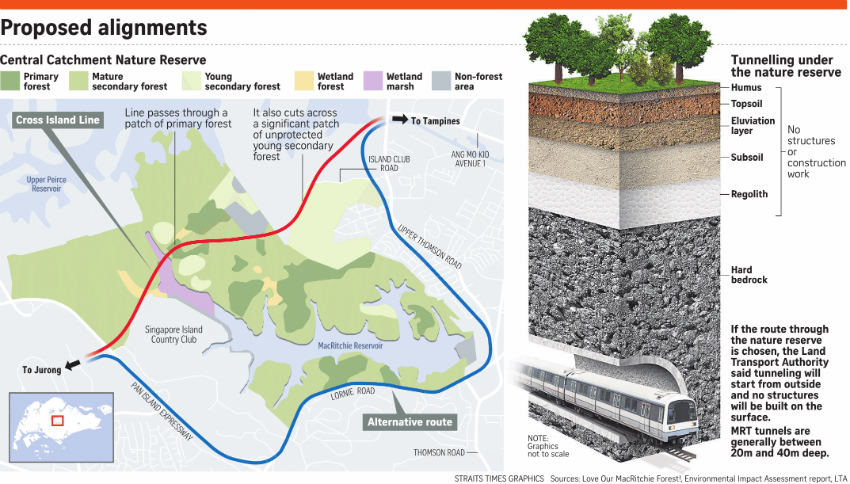
In addition, there will not be any construction work on the surface level within the gazetted boundary of CCNR. For both options, construction will be undertaken by tunnelling method using a Tunnel Boring Machine that starts from outside the nature reserve (see diagram below)
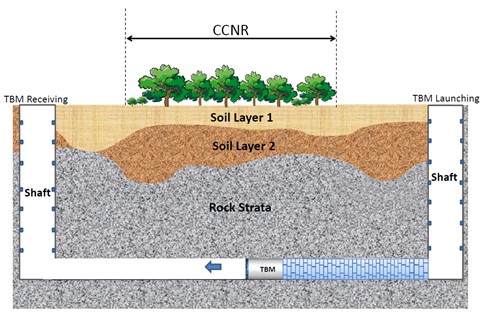
Similarly, the ventilation shafts or facility buildings will be sited outside the gazetted boundary of CCNR

Is the EIA report available online for public viewing? How can I give my views?

The first phase of the EIA report for the CRL is available on the LTA website for public viewing. Members of the public can email their views to LTA_CRL_CCNR_EIA@lta.gov.sg.

What was the consultation process like?

When LTA first announced the possible alignment of the CRL in 2013, nature groups raised concerns about the potential environmental impact on the CCNR. In response, LTA formed a working group, including representatives from NParks and nature groups, to serve as a discussion/consultation forum for the EIA study in the CCNR for the proposed Cross Island Line.

Since 2013, MOT, LTA and the nature groups have held many formal and informal meetings, including walkabouts in the CCNR with Senior Minister of State for Transport Josephine Teo.

Over the course of more than two years, LTA consulted the nature groups extensively in preparing for Phase 1 of the EIA report. For example, when studying the impact of the proposed site investigation works on the ecology and biodiversity of the CCNR, LTA’s EIA consultant took into consideration a study that the nature groups had done.

Separately, some residents living near the CCNR have expressed concern that the possible alignments may affect their homes. LTA has been engaging them by keeping them informed about the CRL study as well.

LTA will continue its engagement with stakeholders including the nature groups and residents in the area.

Image: 
Category: 
Publication Date: 
Tuesday, March 8, 2016 – 11:06
Send to mobile app: 
Source: 


Story Type: 
Others

Source link

No compensation from SAF accepted, family of Pte Dominique Sarron Lee clarifies

0

SINGAPORE – The family of the late Private Dominique Sarron Lee has clarified that they have not accepted any compensation from the Singapore Armed Forces (SAF), apart from a grant to defray their son’s funeral costs, as they raised further questions…

Source link

Full-day bus lanes to have extended hours from March 21

0

SINGAPORE – Full-day bus lanes around Singapore will be extended by an extra three hours and will end at 11pm from March 21. Currently, the operating hours for the full-day bus lanes run from 7.30am to 8pm on weekdays and Saturdays.
The Land Transport…

Source link

LTA off-peak programme halves travel time for some

0

Mr Tan Shu Jie still takes the same route to work via a bus and the MRT, but now reaches his office in about half the time that he used to take.

For the past three months, Mr Tan, 26, a management consultant, has been setting out earlier from his Bishan home to reach his Raffles Place office by 7.30am. This means a shorter commute of 30 minutes.

“When I get to the office earlier, I can plan ahead and make my day more productive,” said Mr Tan, who now goes home half an hour earlier.

His company is taking part in the Land Transport Authority’s Travel Smart Network programme, aimed at easing the public transport crush during the morning peak from 8am to 9am. Firms can get a grant of up to $160,000 annually from LTA for three years, to co-fund the costs of flexi-work arrangements.

Ninety companies, with 190,000 employees in all, have signed up since the scheme’s launch in 2014.

Yesterday, a food truck was stationed in Raffles Place to promote the programme. LTA plans to do more to expand the scheme, said LTA chief executive Chew Men Leong.

The Travel Smart Network is part of LTA’s broader plan to ease the morning rush-hour public transport load, along with initiatives like free pre-peak travel and the recently announced off-peak pass.

Commuters can also get perks, such as cash rewards, from LTA by accumulating bonus points for off-peak trips.

At law firm Rajah & Tann, about 10 per cent of its 600 staff turn up for work before 8am. They are offered free breakfast.

Accounting firm EY also gives free breakfast to the first 100 staff who get in before 8am. Mr Max Loh, EY’s managing partner for ASEAN and Singapore, said about a quarter of the staff who take the train have signed up. “This fits in with our flexible work arrangement scheme,” he said.

kxinghui@sph.com.sg


This article was first published on March 08, 2016.
Get a copy of The Straits Times or go to straitstimes.com for more stories.

Image: 
Category: 
Publication Date: 
Tuesday, March 8, 2016 – 10:57
Send to mobile app: 
Source: 


Story Type: 
Others

Source link

Kranji Farms recognised as tourist spot

0

The small farms dotting the north-western landscape that have offered eco-tourism activities for years have been recognised as a tourist attraction called the Kranji Farms.

Two brown directional signs, endorsed and approved by the Singapore Tourism Board (STB) and the Land Transport Authority (LTA), identifying the area as a tourist point of interest, were put up late last year in Jalan Bahar and Kranji Road.

There are over 100 farms in total, and at least 40 are open to the public, offering farmstays, tours and food & beverage outlets.

Farmers hope that Kranji countryside’s new status as a tourist destination – which will be launched on Saturday by the owners, STB, LTA and MP for Chua Chu Kang GRC Yee Chia Hsing – will help the agriculture industry attract new blood, and be an incentive for the authorities to make the area more visitor-friendly.

Mr Kenny Eng, 42, president of the Kranji Countryside Association (KCA), said: “The recognition is critical for the future of farms, because it makes farm businesses more dynamic, more sustainable in the digital age and more able to attract young talent.”

The non-profit KCA, which has 40 member farms, has lobbied for the Kranji farms to be recognised as a tourist spot – and for the road signs – since it was set up in 2005.

KCA’s founding president Ivy Singh-Lim, 66, owner of organic farm Bollywood Veggies, hopes the authorities will add cycling and walking paths, to help the countryside attract not only local families but visitors from abroad as well.

“Things here are reasonably cheap, and they can enjoy the kampung lifestyle,” she said. “I would like to appeal to the authorities to leave this place alone … so that we can continue to sell coffee at $2.”

Over the years, the farms have introduced activities for school children, company retreats and amenities such as restaurants for walk-in visitors, as interest grew in the unusual experiences they offered.

Bollywood Veggies attracted 15,000 visitors a month last year, compared to 6,000 per month in 2010. The official tour operator for Kranji Farms, Uncle William, held 250 tours last year, up from the 160 in 2010.

The farms that are open to the public grow an array of produce and live stock including organic vegetables, ornamental fish, food fish, frogs and goats.

Shuttle buses make seven trips daily between Kranji MRT station and points of interest such as Sungei Buloh, Kranji marshes and five of the more popular farms.

Two years ago, Jurong Frog Farm started organising small group tours at $40 for a minimum of five people. The 25-minute tour lets visitors hold and feed frogs, watch them breed, and ends with a sampling of frog meat. It now attracts three to five groups per week, said its director Chelsea Wan, 32.

The 105-year-old nursery and landscaping business Nyee Phoe Group, where Mr Eng is a director, has an F&B outlet, four villas for farmstays and conducts workshops on terrarium-making and plant potting.

Farm owners say demand keeps growing, with people hungry for something different.

Ngee Ann Polytechnic’s senior tourism lecturer Michael Chiam said tourists tend to think of Singapore as an urbanised environment.

“Kranji countryside presents a different side of Singapore,” he added.

mellinjm@sph.com.sg


This article was first published on March 08, 2016.
Get a copy of The Straits Times or go to straitstimes.com for more stories.

Image: 
Category: 
Publication Date: 
Tuesday, March 8, 2016 – 10:30
Keywords: 
Send to mobile app: 
Source: 


Story Type: 
Others

Source link

Resale prices of private homes dip 0.3% in February: Property index

0

Prices dropped 1.6 per cent on a year-on-year basis, according to flash estimates by SRX Property.

Source link

More priority for bus commuters from March 21

0

March 08, 2016 10:45 AM

SINGAPORE – The operating hours of full-day bus lanes – those marked in red – will be extended to 11pm from March 21, up from 8pm now.


Source link

Next stage in battle to stub out smoking

0

In Australia, cigarettes come in drab brown packages. Their sides are plastered with pictures warning of the dire consequences of smoking, and one can barely make out the brand.

And in Brazil, all flavoured tobacco – from cherry to chocolate and even the ubiquitous menthol – has been banned since 2012.

As Singapore mulls over ways to bring down smoking rates, it is looking at these countries that have gone full steam ahead with efforts to stop people from lighting up.

“The concern really is that the (smoking) prevalence now is plateauing,” said Ms Vasuki Utravathy, who is the deputy director of the Health Promotion Board’s (HPB) strategic planning and collaborations department.

Two years ago, the board announced that it was aiming to get smoking rates down to 12 per cent by 2020.

But that is easier said than done. “We know that for the past six or seven years, the smoking rate has always been between 13 per cent and 14 per cent,” Ms Vasuki said.

Last December, HPB mooted four tobacco control proposals for public discussion.

Two are “hard” measures: raising the minimum legal age for smoking, and, like Brazil, banning additives in tobacco products.

The two other proposals aim to reduce the appeal of cigarettes by selling them in generic packages and enlarging the graphic health warnings on their packaging.

Last Friday, Senior Minister of State for Health Amy Khor held an online chat about the issue, during which some people suggested banning smoking for those born after a certain year.

One supporter of the proposal to raise the minimum smoking age is former smoker Tan Ho Guan, 33, who is self-employed.

He picked up the habit at 18, but managed to quit for good last year after many unsuccessful attempts. The birth of his second child was the driving factor. Still, he said, it would have been better if he had never started at all.

“I was young, and all my friends around me were smoking,” he said. “If you weren’t doing it, you were the odd one out.”

Mr Tan added that he believes young people are less susceptible to peer pressure at 21 – the proposed new minimum smoking age – and, therefore, less likely to pick up smoking. “Your thinking between 18 and 21 becomes very different,” he said. “I believe that many smokers want to quit, but if you don’t start, you won’t have that problem.”

There is solid scientific evidence to back this, said Professor Lee Hin Peng from the Saw Swee Hock School of Public Health at the National University of Singapore.

Citing a World Health Organisation report from 2008, he said: “We know that people who do not start smoking before the age of 21 are unlikely to ever begin. The younger children are when they first start smoking, the more likely they are to become regular smokers.”

A town called Needham, in Massachusetts in the United States, raised the minimum age for buying tobacco from 18 to 21 over three years. Teen smoking rates subsequently fell by half, from 13 per cent to 7 per cent.

Both the US and European Union have also passed laws that ban the addition of flavours to tobacco – the EU as recently as in 2014.

Typically, unadulterated cigarette smoke irritates the throat, and can turn younger smokers off.

Ms Vasuki said: “If you talk to anybody who has had their first puff, they will say something like: ‘I started off with a Marlboro Red and I coughed – I couldn’t take it because it was very harsh on my throat.'”

But cigarettes laced with the flavours of vanilla, chocolate and menthol go down more easily, making it easier for the first-time smoker to get hooked.

These sweet flavours tend to be especially popular among younger smokers and women, Ms Vasuki said, although smokers in Singapore are typically male.

She added that such flavours often mislead people into thinking they are not as bad as regular cigarettes.

“When things are easier to smoke, the tendency is to think that this cannot be as harmful as anything else,” she said.

In many countries, generic packaging and gory pictures are designed to make cigarette packets as nondescript or unappealing as possible.

Australia was the first country to implement plain packaging in 2012, after which calls to Quitline – its phone service for people who want to kick the habit – increased by 78 per cent.

Its graphic health warnings are also the second-largest in the world – after Thailand – and cover three-quarters of the front and nearly all of the back of the packaging.

Apart from alerting smokers to the possible impact on their health, larger warnings also mean less space for company logos and other marketing gimmicks, Ms Vasuki said.

In Singapore, these graphic pictures, which have been printed on cigarette packets since 2004, are rotated every few years, so that they do not lose their impact.

If standardised packaging is also implemented here, all tobacco companies would have to repackage their cigarettes uniformly, with different brands adopting the same colours.

Dr Jimmy Wong, who is a senior lecturer in the marketing programme at SIM University, said the impact of such measures in Singapore could be limited as smokers tend to disregard the packaging. “In perceptual studies, humans are very capable of blocking out images they do not want to see,” he said.

And, sometimes, smoking is associated with attractive lifestyles. Then, no amount of graphic pictures on cigarette boxes can reduce smoking among the young, he said.

But Ms Vasuki said the measures are not just to deter those who are already smokers, but also to stop people from picking up the habit in the first place.

“Such things reduce the attractiveness and appeal of tobacco products – both to the consumers and to the people who may be thinking of experimenting,” she said.

linettel@sph.com.sg


This article was first published on March 08, 2016.
Get a copy of The Straits Times or go to straitstimes.com for more stories.

Image: 
Category: 
Publication Date: 
Tuesday, March 8, 2016 – 10:30
Keywords: 
Send to mobile app: 
Source: 


Story Type: 
Others

Source link

家中也可阅览国家音像档案

0

对国家音像档案感兴趣的公众,今后可能无须亲自到国家档案馆翻查资料,在家中直接阅览就可以了。

国家档案馆昨天推出Berita Singapura档案集,让公众在网上自由浏览。这个新闻短片系列上世纪60年代由当时的文化部推出,收藏新加坡独立前后的珍贵影像,包括1966年本地举办的大赛车活动、首批公共住屋落成等。放上网的70多个完整系列影片,除了以四种官方语言解说,也有一部分以广东话和福建话呈献。

这是国家档案馆将档案数码化后,放在网上让公众浏览的第一批档案资料。

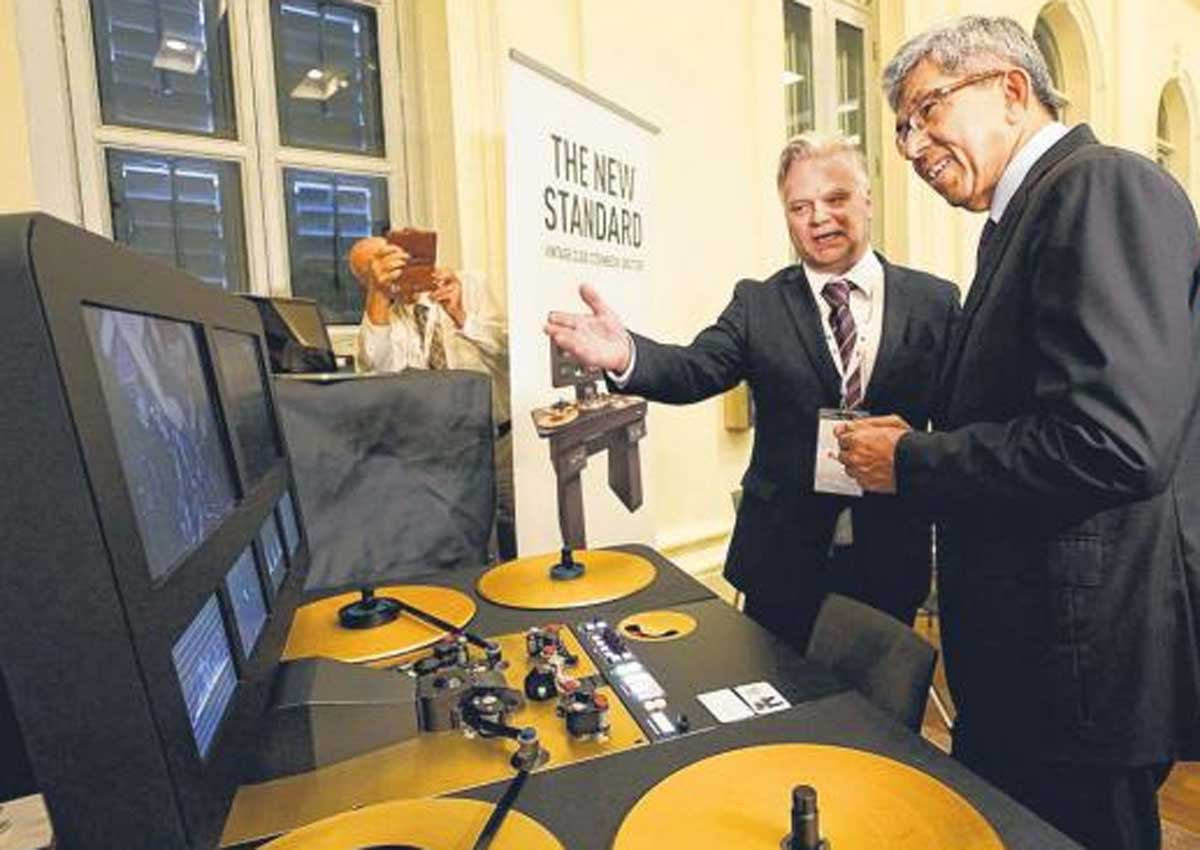
通讯及新闻部长雅国博士昨天出席第六届”联合技术研讨会”(Joint Technical Symposium)时说,将档案资料数码化并让公众上网浏览是政府在保留和推广历史档案资料方面的三大方向之一。

一站式网站方便查找资料

雅国指出,公众过去如果要查阅像Berita Singapura的档案资料,必须亲自到档案馆,不过当局将这些资料挂上网后,公众可在家中浏览,方便得多。

雅国也以国家图书馆和国家档案馆设立的统一搜索门户OneSearch为例说,这个一站式网站让用户更便捷地查找资料。使用者经常查找的关键词也以本地名人和地标为主,因此雅国认为,该网站扮演了让国人了解本地历史和文化的重要角色。

此外,政府将加快搜集档案资料的步伐。在语音资料方面,口述历史录音的累计时长已超过两万小时,但雅国指出,未来几年必须加紧采录建国一代的生活细节和对我国重大历史事件的回忆。像Berita Singapura等影像资料,由于格式老旧,当局正如火如荼地将它们数码化,接下来几年内急需数码化的资料超过两万份。

国家档案馆高级助理馆长彭莱娣博士解释,早期的音像档案为模拟式(analogue)媒体,这类格式随着科技进步逐渐遭淘汰。

她说:”科技日新月异,档案馆在这方面也要跟着潮流和时代走……档案馆必须在短时间内抢救这些音像档案,把它们数码化,以更好地长期保存这些档案。”

雅国鼓励更多新加坡人加入”公民档案管理员”计划,丰富档案集。这个项目去年推出至今,已有超过280人为1600多张照片做注解,所做笔录的历史文件页数也超过9000页。

联合技术研讨会是为音像档案保护和修复工作者举办的国际活动,这是该活动第一次在欧洲以外地区举办。研讨会昨天起一连三天,让200多名各国档案管理者交流心得。

有意浏览Berita Singapura档案资料的公众,可上网www.nas.gov.sg/archivesonline,并输入相关搜索词条。


Get the full story from Lianhe Zaobao

Image: 
Category: 
Publication Date: 
Tuesday, March 8, 2016 – 04:00
Keywords: 
Send to mobile app: 
Source: 


Story Type: 
Others

Source link