Home Blog Page 4574

It's much easier to love a dog than a person

0

He took one look and said: “Oh, it’s serious.”

My heart sank.

I have three dogs and while I love them all, Nicky the chihuahua is the one whose photo I use on my smartphone case cover.

He’s a rescue dog I adopted five years ago. His owner had used him as a breeding dog and when he closed the business, he didn’t want him anymore.

A friend introduced me to the woman who was housing Nicky before his adoption.

They came to my place to check us out. Nicky, who was probably five years old then (no one knew his real age), liked the house. He strutted around confidently and left his mark in many spots.

I thought he was adorable. DeeDee, my bichon frise, didn’t mind him, which settled it – Nicky joined the family.

He quickly established himself as the top dog, bossing over DeeDee and another chihuahua, Hidey, which we adopted later.

Chihuahuas tend to be one-person dogs and, for some reason, I became that person to Nicky.

I am his favourite human. His eyes perk up when he sees me, he cuddles up to me, lays his head on my lap and is totally relaxed. With everyone else, he is more wary.

A week ago, he started walking funny. His back right leg seemed to hurt and he couldn’t bear weight on it. We waited a few days to see if he got better, but he got worse. All four legs were weak and splayed when he walked. His mood was low.

Last Saturday, we took him to the vet. He got Nicky to walk and he didn’t like what he saw.

Oh, it’s serious, said the vet.

The diagnosis – he had torn his cranial cruciate ligament, which is similar to the anterior cruciate ligament (ACL) in humans. In other words, he had a bad knee injury.

These injuries are serious and happen more often in bigger dogs. In Nicky’s case, both back legs were already weak. He is also on the chunky side and likes to jump, which don’t help his spindly legs.

The vet said he would need surgery and we were looking at a long eight-week recovery period.

My heart went out to my dog because he has had too many health scares of late.

In November last year, he had an operation to treat a hernia in his groin. He had two worrying lumps – one on his back and the other on his right paw – removed too.

He went under general anaesthesia and was utterly miserable for the first four, five days. His eyes had a stricken, haunted look, he hardly ate and had to endure wearing an e-collar to prevent him from licking the wounds.

Luckily, he recovered fairly quickly and the lumps were found to be benign. He was back to his old self in two weeks.

Earlier this month, he had trouble opening his right eye, which meant another visit to the vet and a week of eye drops and anti-inflammatory and pain medication.

Just when he had recovered from that, he busted his knee and was now looking at another surgery.

Even as all this happened, DeeDee, who’s 11 this year, was diagnosed with Cushing’s disease, a hormonal disorder.

He used to be an active dog who was never without a tennis ball in his mouth, but had grown listless over the past half a year.

He was also drinking (and peeing) excessive amounts of water. His body took on a strange bony look, but he had a pot belly. Something definitely was wrong.

An ultrasound and blood test showed that he has a large tumour on his adrenal gland.

He is now on lifelong medication but his energy level and mood have improved, and he is drinking less water. He’s more like his old self.

He might need an operation to remove the tumour, but for now we’re relying on the medicine and taking it one step at a time.

As pet owners will know, the cost of medical care for animals is very high, in many instances higher even than when people fall sick and visit a GP.

Each visit to the vet goes into hundreds of dollars, operations go into thousands, and medication is not cheap.

You have to pay upfront, there are no subsidies you can claim and because there aren’t that many vets around – or at least good ones you trust your dog’s life with – your choices of care are limited.

Nicky’s ACL operation alone was $3,500. His earlier operation was also a four-figure amount, as has been the tests and care for DeeDee.

While pet insurance is common in countries like Britain, there are only two I know that are being offered in Singapore, but both have limitations.

For example, the cut-off age for one of the policies is nine years, which means two of my three dogs are not eligible. To keep premiums low, owners must also pay quite a substantial proportion of the bill as co-insurance and also a deductible.

Cost is just one concern animal lovers have when their pets fall ill. But if treatment will guarantee the animal gets better, it is something many of us will accept and come up with the money somehow.

The bigger issue is the heartache you feel when your pet is sick. You feel so helpless watching them suffer.

There is no way a dog or cat (or hamster or horse) can tell us what’s wrong, so we look out for signs – dry nose, loss of appetite, lethargy, panting, vomiting, tail tucked in, listless eyes. It’s a painful period for the owner.

Nicky went for the knee operation the next day, on Sunday. We brought him home on Monday. He had to be kept in a small and quiet corner away from the other dogs so he could rest and recover.

H ingeniously fashioned a cage by tying an Ikea clothes drying rack against a wall. That way the dog could still see what was happening around him even though he would be confined. We lined the spot with rugs so he wouldn’t slip on the floor and hurt his leg, and placed cushions to help him sit better.

It’s been five days since the operation and he’s still pretty glum.

Every day will be a better day Nicky, I tell him, as though he can understand what I say. You will only get better.

I talk to him a lot.

Actually, I sing to him too, nonsense songs I make up while I stroke him and gaze into his eyes.

I sound crazy, don’t I?

People who don’t love dogs (or other animals) will think so.

A dog ‘s just an animal, they’ll say. They eat, sleep, bark, bite, soil, smell and shed. What’s the big deal? Why go gaga over them and spend tonnes of money and time on them? It’s not like they understand what’s going on or can repay your kindness, love and care, not the way people can. They might offer companionship, but that’s about it.

Besides, dogs have such short life spans so why invest so much money and feelings in something that will be around at most 10-plus years?

The reason I love dogs is actually a selfish one – they make me happy.

The late Charles M. Schulz, creator of the Peanuts comics strip, once said that “happiness is a warm puppy”. It’s a feeling I fully understand.

And it’s not just my own dogs that make me feel all tingly and happy.

I follow about 100 dogs from around the world on my Instagram feed and the antics of every one of them brighten my day.

When one of the dogs – a famous black pomeranian called Barkley The Pom – unexpectedly died last October, I sobbed, really sobbed, and felt a grief that stayed with me for a long time.

I wasn’t the only one. More than 17,000 people around the world “liked” the post announcing his sudden death, that is, they sympathised with the owner. More than 8,200 took the trouble to pen their condolences.

It’s easy to love dogs because they show happiness so easily and simply.

Give them a toy, a treat or take them for a walk and they go mad with joy. They live for the moment, their needs are so innocent and their enthusiasm infectious. How wonderful it is to be a part of that.

Dogs, unlike people, are uncomplicated. They don’t scheme, they don’t plot, they don’t disappoint or betray.

A dog has never let me down, which is why the love I have for them is pure and simple.

Romantic love, familial love, love between friends, on the other hand, are fraught with hurt, slights, hopes and expectations.

A dog’s company provides a safe haven in a world that humans make so complicated.

In his book Marley And Me, American journalist John Grogan wrote: “A person can learn a lot from a dog, even a loopy one like ours. Marley taught me about living each day with unbridled exuberance and joy, about seizing the moment and following your heart. He taught me to appreciate the simple things – a walk in the woods, a fresh snowfall, a nap in a shaft of winter sunlight. And as he grew old and achy, he taught me about optimism in the face of adversity. Mostly, he taught me about friendship and selflessness and, above all else, unwavering loyalty.”

As I write this, Nicky’s resting in his make-shift cage, DeeDee is sitting under my chair and Hidey is sleeping in his corner.

I’m happy, and my life feels quite complete.


This article was first published on March 13, 2016.
Get a copy of The Straits Times or go to straitstimes.com for more stories.

Image: 
Category: 
Publication Date: 
Sunday, March 13, 2016 – 14:00
Keywords: 
Send to mobile app: 
Source: 


Rotator Headline: 
Opinion: It's much easier to love a dog than a person
Rotator Image: 
Story Type: 
Others

Source link

Iron Maiden stranded by Chile plane mishap

0

SANTIAGO – British heavy metal band Iron Maiden said Saturday they were temporarily stranded when their plane was badly damaged in a runway accident in Chile that injured two ground crew.

The band, which is in South America on a world tour, said its members and equipment were not on board at the time, and later announced it had found new transportation to get to its next show, in Cordoba, Argentina Sunday.

The plane, a Boeing 747 nicknamed “Ed Force One,” was being towed for refueling when it came untethered, the band said on its website.

“On making a turn the aircraft had no steering and collided with the ground tug, badly damaging the undercarriage, two of the aircraft’s engines and injuring two ground tug operators, both of whom have been taken to hospital,” it said.

It later said both people injured were expected to fully recover.

The “Book of Souls” tour was launched last month in support of the heavy metal legends’ latest album.

The band is often flown to its tour stops by lead singer Bruce Dickinson, a trained pilot.

Image: 
Category: 
Publication Date: 
Sunday, March 13, 2016 – 10:20
Send to mobile app: 
Source: 


Story Type: 
Others

Source link

Japan region seeks full-time 'ninjas' for tourism

0

Wanted: six full-time ninjas who have a way with words and can do backward handsprings. Pay: about $2,200 a month.

Central Japan’s Aichi prefecture said it is hiring full-time ninjas – the martial-arts masters and stealth special assassins of feudal times – to promote tourism in the area known for historic Nagoya castle.

Newly hired ninjas will receive a one-year contract with monthly pay of 180,000 yen (S$2,170) plus bonus, said Satoshi Adachi of the prefectural government’s tourism promotion unit.

They will also perform acrobatics, demonstrate the use of their trademark “shuriken” – ninja star – weapons and pose for photographs with tourists, he told AFP on Friday.

A poster the prefecture created says the ideal candidates are ones who “enjoy being under the spotlight even though he or she is a secretive ninja”.

Japanese speaking ability is preferable, but non-Japanese individuals passionate about history and tourism are welcome as the troupe will sometimes perform in English, Adachi said.

“Our ninjas also have to be good at talking to promote tourism, although ninjas are basically required to be secretive,” he said.

They also “have to be able to do backward handsprings and some dance moves”, he added.

Successful candidates will go through a one-month training course in April.

The prefecture is accepting applications until March 22. Men and women aged 18 or above of any nationality can apply.

Nowadays ninjas are mostly confined to history books and fiction.

But they are also used to promote Iga, some 350 kilometres (220 miles) southwest of Tokyo, a city near the ancient imperial capital of Kyoto that was once home to many ninjas.

And last year, governors and mayors from prefectures around the country traded their usual suits for ninja costumes to announce the launch of a “ninja council”.

The not-so-stealthy move comes as local governments turn to tourism as an economic growth driver ahead of the 2020 Olympic Games in Tokyo.

Image: 
Publication Date: 
Sunday, March 13, 2016 – 10:17
Keywords: 
Send to mobile app: 
Source: 


Regions: 
Country: 
Interest: 
Story Type: 
Others

Source link

Top-ups to CPF for loved ones on the rise

0

For most of us, the Central Provident Fund (CPF) scheme is an essential component of our financial planning for our golden years.

Over the years, enhancements have been made to the scheme to enable us to boost our retirement savings as well as improve the flexibility of withdrawals and the timing of payouts.

Efforts have also been made to encourage CPF members to make top-ups – with cash and/or CPF savings – to their CPF accounts and those of their loved ones to boost their retirement savings.

Top-ups provide a means to enjoy some tax relief while enabling these CPF members or their loved ones to benefit from the compounding effect of the CPF’s interest rates so as to grow their nest eggs.

It is heartening to note that this practice is on an uptrend.

In terms of the number of top-ups – excluding self top-ups from OA to SA – they have risen 15 per cent from 2014 and have nearly doubled from the 2012 figure.

Self top-ups from OA to SA are also trending north with 26,300 top-ups worth $289.1 million last year compared with 23,400 top-ups ($257.7 million) in 2014 and 17,100 top-ups ($156 million) in 2012.
RETIREMENT SUM TOPPING-UP SCHEME

This scheme allows you to build your retirement savings by topping up your own CPF accounts or those of anyone including your loved ones. You can opt to top up your own or your loved ones’ Special Accounts (below age 55) or Retirement Accounts (RA) for those aged 55 and above.

Top up your own or loved ones’ account

You can make a cash top-up to anyone.

In total, you may enjoy tax relief of up to $14,000 per calendar year if you make top-ups for:• •Your parents, parents-in-law, grandparents, grandparents- in-law, spouse or siblings, if their income does not exceed $4,000 in the year preceding the year of top-up or if they are handicapped. • •Yourself (or your employer makes a cash top-up for you).

However, you can enjoy tax relief for cash top-ups to your own or your recipient’s RA only up to the current Full Retirement Sum (FRS) which is $161,000 for those who turned 55 from July 1 last year. Cash top-ups beyond the current FRS will not be eligible for tax relief.

Your employer will receive an equal amount of tax deduction.

Enhanced Retirement Sum (ERS)

On Jan 1, several enhancements kicked in, including an additional retirement sum option – ERS of $241,500 – aimed at boosting our nest egg so we can enjoy more retirement income in our golden years.

Recipients aged 55 and above can receive cash top-ups or CPF transfers to their RA up to the current ERS, which is three times the Basic Retirement Sum (BRS) of $80,500.

Mr Johnny Chua, 57, was among those who topped up their RA to get higher payouts in the future. In January, CPF members made 1,700 top-ups worth $80 million to their RAs to boost their retirement savings beyond the FRS.

During that month, Mr Chua made a one-time cash top-up of about $90,000 beyond his FRS for his cohort to make up the amount to the ERS. “The lower level of payouts would not be enough based on my needs. So it is great that the CPF Board introduced the ERS which allows me to receive higher payouts later,” he said. Mr Chua plans to supplement his retirement income with rent from his investment property.

Previously, the maximum amount members could set aside was the FRS, allowing estimated monthly payouts of $1,220 to $1,320 from the age of 65.

The current ERS of $241,500 translates to estimated monthly payouts of $1,770 to $1,920 from 65.

However, do note that tax relief will be given for cash top-ups to your own or recipient’s RA only up to the current FRS. This means that cash top-ups beyond your own or recipient’s current FRS will not be eligible for tax relief.

And depending on your financial situation, you may wish to defer your payouts from your eligibility age up to 70 years old and enjoy 6 per cent to 7 per cent more in monthly payouts for each year deferred.
Top up your spouse’s account using CPF or cash

This will benefit non-working spouses who have made sacrifices to stop work for their families, and have low CPF balances.

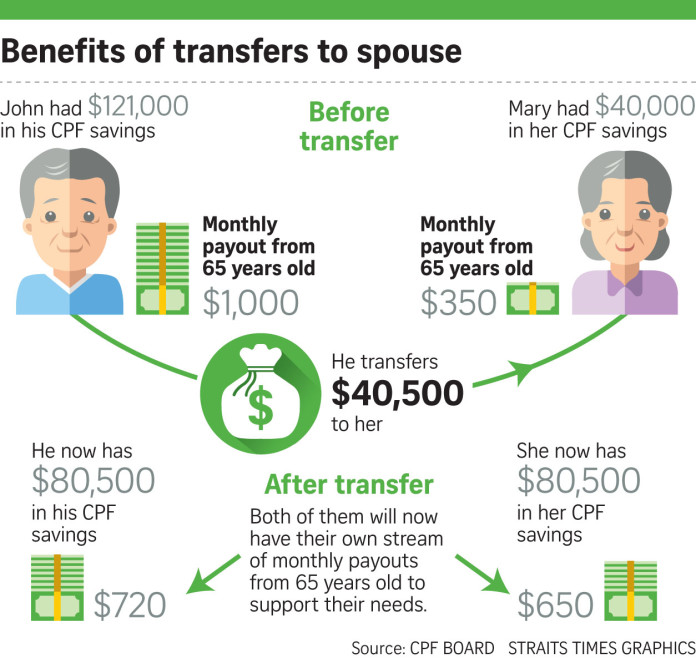
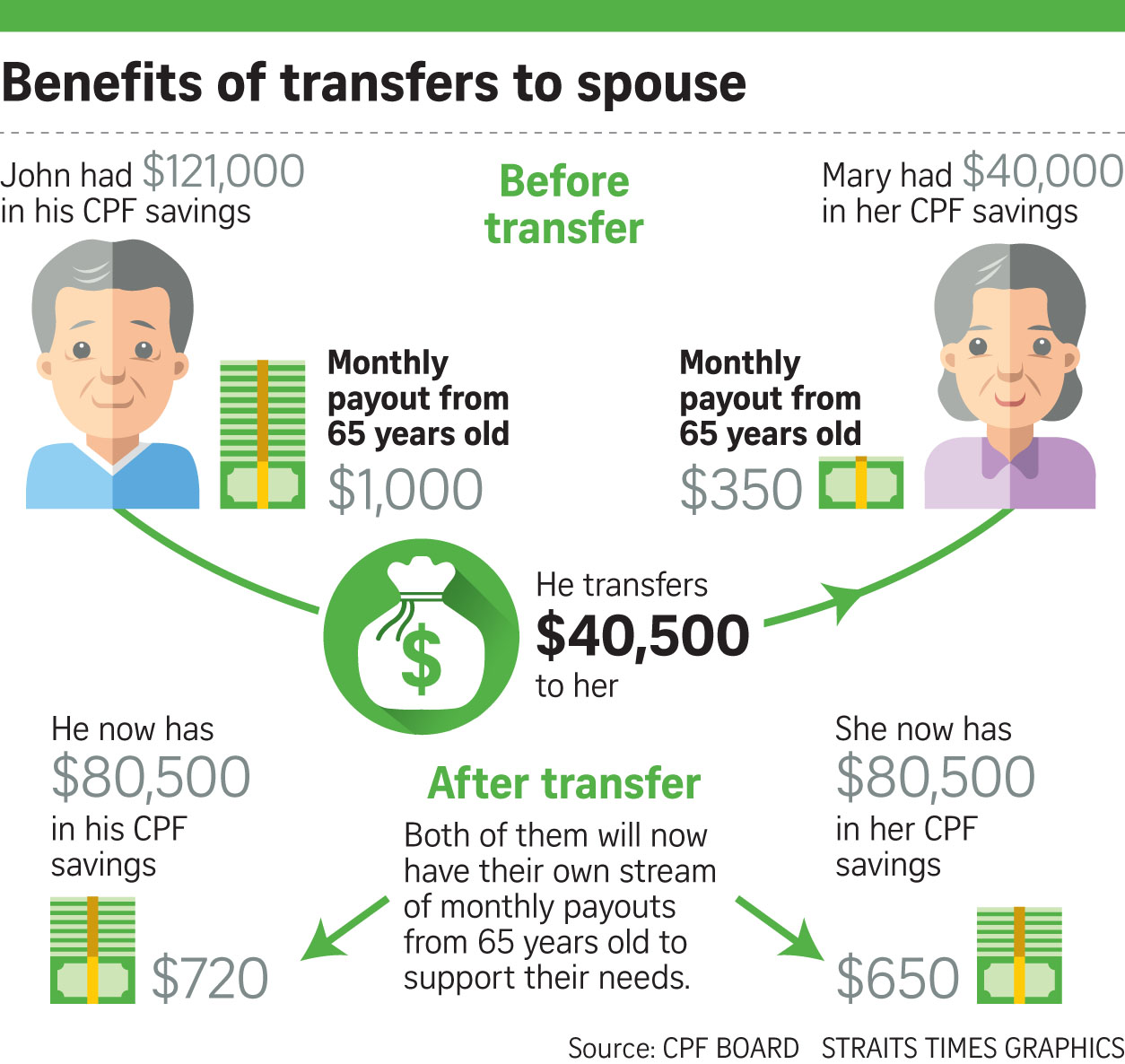
Before the changes on Jan 1, only CPF savings above your FRS could be transferred to your spouse.

There is now a lower threshold so members can transfer their net CPF money after setting aside the BRS in their own CPF accounts to top up their spouse’s CPF account up to the ERS.

Both will benefit from the extra interest that will be paid in the respective accounts and there is peace of mind as the spouse will have her or his own source of retirement payouts.

For cash top-ups, you can top up any amount up to the ERS.

According to the CPF Board, there were more than 400 transfers of CPF savings to spouses in January, around 21/2 times that of the corresponding month last year. About 20 of the spousal transfers were made possible only after the scheme was changed.

For housewife Margaret Tan, 59, having her RA topped up every year by her hubby Richard Tan, 53, gives her peace of mind. The couple have two sons, aged 26 and 24, and she had left the workforce after her first child was born.

Mr Tan, in the police force, started the annual cash top-ups of $7,000 for his wife two years ago on their 25th wedding anniversary. He also tops up her RA on an ad hoc basis when he has surplus cash.

Mrs Tan has about $80,000 in her RA and her hubby wants her CPF to eventually reach an amount of about $161,000 when she is 65.

“It’s my anniversary present every year now. He used to give me roses and chocolates. Richard said we should plan ahead…We must think of our old age and have our own money. Then the two of us can go for holidays, sit on the beach and sip coconut juice while listening to music,” said Mrs Tan.

She can look forward to receiving $808 to $857 monthly from the CPF when she hits 65 and starts receiving the payouts.

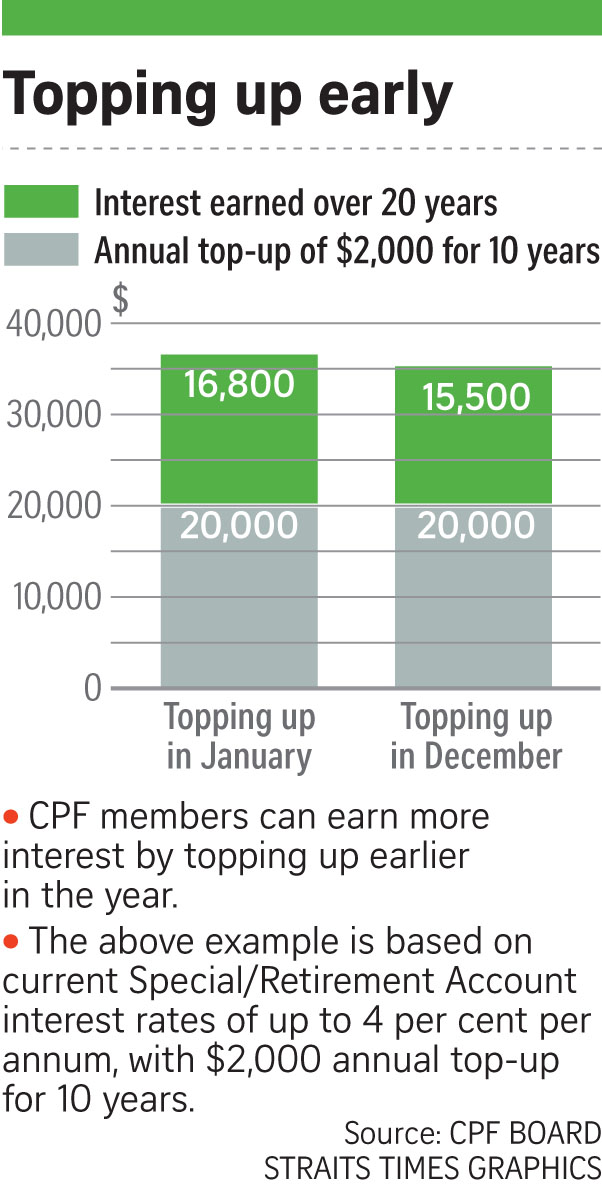
TOPPING UP EARLY CPF

members can earn more interest by topping up earlier in the year. So don’t procrastinate and wait till the end of the year to do a top-up.

From Jan 1, you stand to earn more interest on your CPF savings, depending on your age.

Members over age 55 are getting an additional 1 per cent interest on the first $30,000 of their CPF savings, making a significant 6 per cent interest a year.

This is on top of the 1 per cent extra interest on the first $60,000 in CPF combined balances – of which $20,000 comes from your Ordinary Account – which everyone enjoys. CPF savings in the SA and RA currently earn guaranteed interest rates of 4 per cent a year.

GIRO TOP-UP

are encouraged to make regular monthly and/or yearly top-ups to your own or loved ones’ CPF accounts through Giro, which can be monthly and/or yearly arrangements.

This makes it convenient for members to do top-ups on a regular basis to benefit from the Retirement Sum Topping-Up Scheme, without the hassle of having to complete forms or make cheque payments.

INVESTING CPF MONIES

Mr Justin Chua, senior vice-president of investment products at DBS Bank, advised that while CPF monies can be invested in certain instruments to make them work harder, the individual needs to consider the risk-return trade-off.

This is because investing in higher-risk investments requires a longer timeframe to exhibit long-term growth and these returns are not guaranteed. In addition, the CPF member may potentially suffer capital losses in adverse market situations such as during the global financial crisis from 2008 to 2009.

Subject to specific limits, CPF monies can be invested in financial instruments like shares, unit trusts, government and statutory board bonds, endowment and investment-linked insurance policies, exchange-traded funds and gold.

“The individual will need to consider his risk tolerance, investment time horizon and current financial situation before deciding on an appropriate investment tool. Diversification into various asset classes and markets would be an appropriate strategy to potentially assist the individual in achieving an overall targeted return,” said Mr Chua.

Some financial experts advise that for CPF accounts that earn at least a risk-free interest rate of 4 per cent a year, it is better to leave them alone.

Still, CPF members who want higher returns can also look forward to a low-cost, simple-to-understand alternative investment scheme for their retirement savings, which should be announced in the first half of this year.


This article was first published on March 13, 2016.
Get a copy of The Straits Times or go to straitstimes.com for more stories.


Image: 
Publication Date: 
Sunday, March 13, 2016 – 09:56
Keywords: 
Send to mobile app: 
Source: 


Rotator Image: 
Story Type: 
Others

Source link

$167m in subsidies given out last year under Chas scheme: Health Minister Gan Kim Yong

0

March 13, 2016 9:55 AM

SINGAPORE – A total of $167 million in subsidies was given out under the Community Health Assist Scheme (Chas) last year, Health Minister Gan Kim Yong said on Sunday (March 13).


Source link

More cases of vulnerable adults being abused by their families

0

Social workers have noticed an uptick in the number of cases of abuse by family members of vulnerable adults, such as those who are intellectually or physically disabled, or who suffer from dementia or who are mentally ill.

The training of more people in the community to spot cases accounts for the increase in the number of cases reported, they said.

Two of the three centres that specialise in tackling family violence have seen the number of such cases almost doubling in the past five years.

Care Corner Project StART, which started in 2011 and specialises in abuse cases involving vulnerable persons, saw 11 such cases in 2012.

Last year, it handled about 20.

Safe Centre, which focuses on abuse cases involving the elderly, saw 26 such cases last year, almost double the 14 cases in 2011.

Ms Kristine Lam, team leader of Project StART, said the organisation has been training hospital staff, grassroots leaders and people working with the disabled and the elderly, among others, to detect abuse.

With greater awareness, more cases are surfacing.

“These people (due to their conditions) may not know they are abused and can’t really cry out for help. So it really depends on the community to report the abuse,” she said.

Abuse ranges from financial exploitation to sexual assault, but mostly involves physical violence and neglect, social workers said.

An example cited was that of an intellectually disabled man in his 50s who also has schizophrenia.

His son, a student in his 20s, used cigarettes to burn him, bamboo poles to hit him, and tied his hands when he did not do as he was told.

This went on for at least 10 years before hospital staff spotted scores of cuts and bruises on the man.

Project StART social workers applied for a personal protection order for the man against his son and the violence has since stopped.

Violence aside, social workers say that neglecting to provide sufficient care to vulnerable adults who are unable to look after themselves is another concern.

Over time, neglect, including not being given medication regularly or taken to the doctor promptly, could lead to health complications and even death.

Said social worker Soh Siew Fong at Pave: “Neglect can kill.”

While there are caregivers who neglect their charges as they are overwhelmed by the task, social workers are more concerned about those with ulterior motives who intentionally neglect those under their care.

Said Ms Lam: “They are after the person’s money. So the sooner the person dies, the quicker they get the money.”

Some cases appear to be a means of taking revenge, she added, recalling the case of an elderly women whose husband, in his 80s, had dementia. The wife would dictate when he could be bathed and have his diapers changed. He was also not given his medication regularly and suffered a seizure – which led to complications and his death.

Ms Lam said: “We found out from their daughter that the wife wanted to punish him as they had a bad marriage. This is intentional neglect.”

Ms Odelia Chan, a social worker at TRANS Safe Centre, said caregivers who have ulterior motives usually reject all offers of help.

In one case, a woman lived with her intellectually disabled sister, purportedly to use the regular financial aid her sister gets from the Government. And she abused the sister by biting her when instructions were not followed. The abuse was detected during a hospital visit, when a nurse noticed blood that had seeped through the victim’s T-shirt. Hospital staff alerted TRANS Safe Centre and the woman was eventually placed in a shelter.

Social workers said these vulnerable adults are the most defenceless victims as some have no inkling that they are being abused, while others tolerate the caregivers’ actions.

WHERE TO GET HELP

If you are a victim of family violence or know someone who is, you can call these charities for help.

Pave

Tel: 6555-0390

TRANS Safe Centre

Tel: 6449-9088

Care Corner Project StART

Tel: 6476-1482


This article was first published on March 13, 2016.
Get a copy of The Straits Times or go to straitstimes.com for more stories.

Image: 
Category: 
Publication Date: 
Sunday, March 13, 2016 – 09:45
Keywords: 
Send to mobile app: 
Source: 


Story Type: 
Others

Source link

CHAS subsidies in 2015 more than 6 times that of amount in 2013

0

SINGAPORE – The amount of subsidies given out last year under the Community Health Assist Scheme increased to more than six times the amount beneficiaries received in 2013.
Close to half of the 1.4 million CHAS or Pioneer Generation cardholders received…

Source link

Bus interchange rolls out free buggy rides and more

0

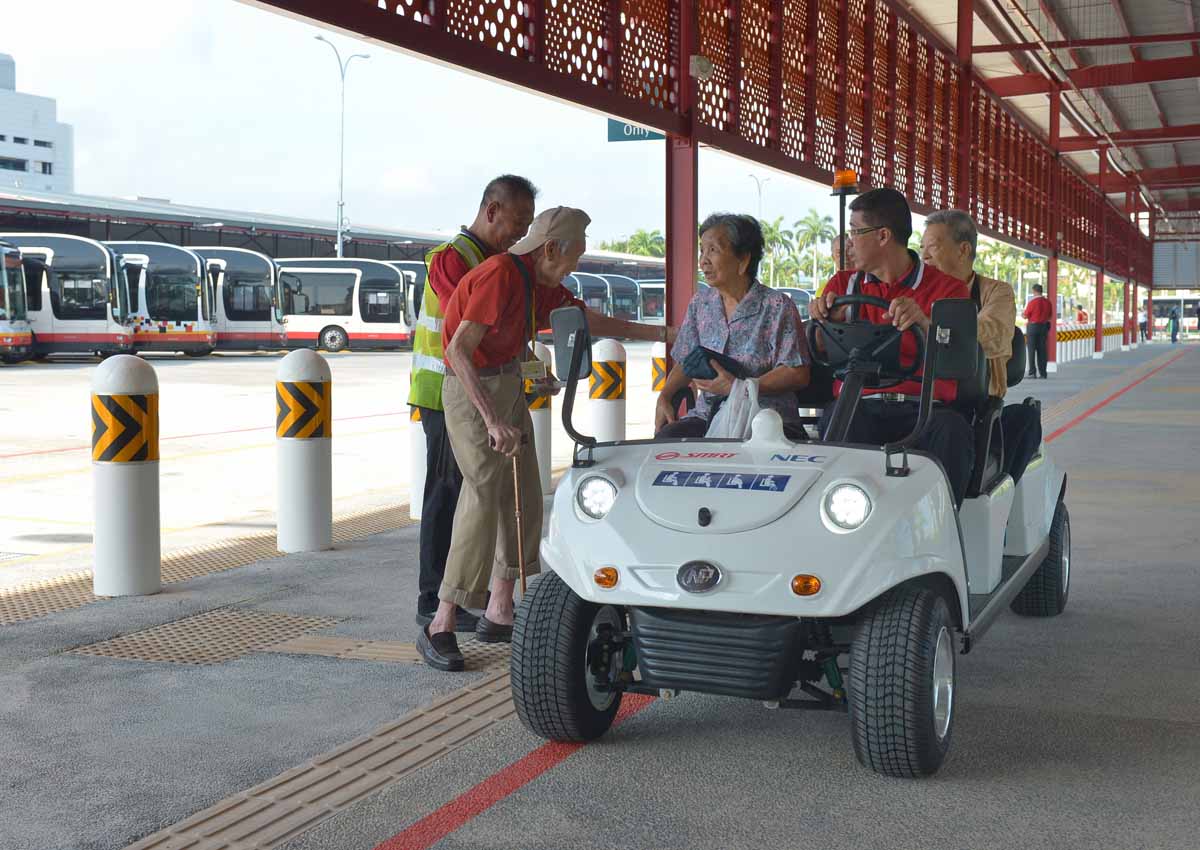
To help those who find it hard to walk long distances, the Woodlands Temporary Bus Interchange is offering free rides on electric buggies – becoming the first bus interchange here to provide such rides.

After all, it is one of the longest bus interchanges here, at 0.5km.

There will be two electric buggies, which can each seat four people including a driver, to ferry commuters around.

The rides were among the features unveiled at the temporary bus facility’s first day of operations yesterday.

It will be in service until 2019, while the Woodlands Regional Interchange undergoes upgrading and an underpass is built to link the upgraded interchange with the stations of two MRT lines.

It is a temporary bus interchange, it also boasts various features, including those that shorten bus waiting times or improve accessibility for those with disabilities.

Coordinating Minister for Infrastructure and Minister for Transport Khaw Boon Wan, who is also an MP for Sembawang GRC, toured the bus interchange yesterday with grassroots advisers from Sembawang and Marsiling-Yew Tee GRCs.

Mr Tan Kian Heong, vice-president of SMRT Buses, which runs the temporary bus interchange, said efforts have been taken to ensure a smooth transition for commuters from the permanent interchange to the temporary one.

“Although the relocation is temporary, we aim to provide our commuters and staff with the service standards found in a fully operational, permanent bus interchange,” he added.

Buses from the Woodlands Temporary Bus Interchange make about 400,000 passenger trips a day.

The bus interchange has display panels and sensors to help bus drivers find unoccupied parking bays and available alighting berths more easily. This will minimise the time spent looking for these spaces, saving time for the drivers.

To reduce passengers’ waiting time, cameras have also been installed so that interchange staff can monitor queues and ease the crowds by deploying more buses or those with more room, such as double-decker buses.

There are also features that will benefit people with disabilities.

These include pedestrian ramps that link the interchange to Woodlands MRT station, making it easier for people using wheelchairs to get around.

Handrails also have Braille guidance to help passengers with visual disabilities locate the waiting areas.

Mr Vikram Nair, MP for Sembawang GRC, said the features were introduced in response to feedback from residents.

“I’m optimistic about it,” he said. “The old Woodlands interchange was very stuffy but this new one is more open, and there is more space for commuters to queue for buses.”

Mr Tea Chap Chek, a 70-year-old Woodlands resident, said he would give the electric buggy a try.

“Such features are good. It is quite far to walk from one end of the interchange to another,” said the retiree.

FEATURES

– FREE BUGGY SERVICE

Two four-seater electric buggies to operate daily

from 7am to 11pm to help commuters who require assistance to get to bus berths at the extreme ends of the interchange

– BRAILLE GUIDANCE

Braille guides on handrails to help the visually disabled

– RAMPS

Wheelchair ramps to link the interchange to the MRT station

– PRIORITY QUEUES

Priority queues and reserved seating

– BUS GUIDANCE SYSTEM

System which includes sensors and display panels to provide information on available alighting berths and parking bays

– INTERACTIVE HELP

Interactive panel for passengers to check bus routes, updates on community events or even look for a job on a jobs portal

– STAFF LOUNGE

Air-conditioned staff lounge for bus captains and staff

– CAMERAS

Closed-circuit television cameras to help staff monitor bus queues


This article was first published on March 13, 2016.
Get a copy of The Straits Times or go to straitstimes.com for more stories.

Image: 
Publication Date: 
Sunday, March 13, 2016 – 09:36
Send to mobile app: 
Source: 


Story Type: 
Others

Source link

Cotton On $20 to $40 Off Storewide Women, Kids, Body, Typo, Rubi & More 24hr Promo 13 Mar 2016 |…

0

Cotton On up to 40% off storewide, today only. Valid for Women, Men, Body, Rubi, Typo, etc

Cotton On $20 to $40 Off Storewide Women, Kids, Body, Typo, Rubi & More 24hr Promo 13 Mar 2016 |…

Save up to $40 off sitewide (Women, Kids, Body, Typo, Rubi, etc) at Cotton On’s online store

Source

SG50 time capsule filled with items chosen, created by S’poreans

0

SINGAPORE – A collection of items representing Singapore’s identity and journey as a nation, has been identified to be placed into an SG50 time capsule at Gardens by the Bay. It will be opened in 2065.
The items which were chosen following a two-month…

Source link