Home Blog Page 441

Commentary: COVID-19 – time for businesses and workers to have the guts to embrace the new normal

0

SINGAPORE: Over a cup of coffee recently, a friend of mine, under pressure because of the beating his business is taking amid the COVID-19 outbreak, unleashed a torrent of worries and frustrations.

Given the fluidity of the situation, he and his team were struggling to cope with fresh uncertainties of how the business would operate.

It eventually dawned on him that, crisis or no crisis, surviving in a VUCA (volatile, uncertain, complex and ambiguous) world has been the norm for several years now. In fact, the term has been bandied about in business circles since the early 2000s.

READ: Commentary: SMEs welcomed support from Budget 2020. Of course they all would

LISTEN: Singapore Budget 2020: A report card, a Heart of the Matter podcast

CRISIS – THE BEST TIME TO ‘GET WITH THE PROGRAMME’

Still, a sense of short-termism perpetuates the measures many firms take to survive today. It’s akin to suffering from intermittent amnesia.

We only remember the pain when the next crisis arrives and forget it soon after it abates, leaving us unprepared for an increasingly unpredictable world.

Since COVID-19 emerged, members of the Government have been urging both businesses and workers to use the lull to improve their business models and skills to prepare for an eventual recovery.

Singapore “must expect to see significantly higher numbers” of new COVID-19 cases in time to come, Minister for Health Gan Kim Yong said in Parliament on Thursday (Mar 5).

“It is likely this disease will stay with us for a long time and we will have continuously adjust, fine-tune, our measures to deal with the disease so that life can go on while appropriate precautions are put in place,” he added.

Gan Kim Yong Mar 6

Health Minister Gan Kim Yong speaks at a press conference on Mar 6, 2020.

This indeed might be the best time for businesses to reflect and workers to reboot. While you put out fires, consider what it would take to build enduring structures and approaches so that life can go on.

BEYOND SALARY CUTS, FREEZES AND RETRENCHMENTS – A NUANCED HR AUDIT

A study by management consultancy, Bain, based on data from the global financial crisis showed that the top 10 per cent of companies saw their earnings climb steadily throughout the period and continue to rise afterward.

The differentiator was preparation. In addition to digital transformation, a key element of this was workforce management.

As a recruiter, I’m well aware that while many firms are cutting jobs, others believe a combination of salary cuts and freezes would serve them better.

This is understandable as retrenchments can be costly for companies. Ultimately, rehiring and training when the economy picks up could set you back a sizeable amount. The Society for Human Resource Management states that generally, it could cost up to 50 per cent of an employee’s annual salary to find a direct replacement.

READ: Commentary: The biggest work-from-home exercise may have just begun. How ready is Singapore?

READ: Commentary: Sometimes, a promotion isn’t all that great

But if you choose to keep employees and institute interim coping measures, you need to be discerning. This is the time to do a human resources audit.

Only keep those who are likely to be valuable to your success and longevity. Ask yourself, do they have a spirit of learning? Do they have a spirit of adaptability and experimentation needed to succeed in an uncertain business climate?

Strategic retrenchments should give you more latitude to engage in strategic hiring during a crisis.

As you consider the elements you need to survive and to recover sustainably, skills gaps within your organisation might become more apparent. Think about the types of people you’ll need to assist in your transformation and longevity.  

Women looking stressed in the office

(Photo: Pexels/Startup Stock Photos)

During the Asian financial crisis in the late 1990s, Fortune 500 firm, Emerson, an automation solutions provider took a contrarian approach and ramped up its investments in research and development and production in Thailand.

By the time the crisis ended, it had secured a strong position for itself in Asia. Among the vital steps Emerson took was to gradually add manpower across its business in Asia and elsewhere to prepare for and maintain growth.

Emerson succeeded partly because it had built contingency planning into its culture and was able to strengthen its core business by taking advantage of the fact that its competitors were in withdrawal mode during the recession.

What do you do if, at this point, you don’t have this advantage? Some of our clients are considering different hiring models, for example, contract jobs with the promise of a bonus upon recovery. The recovery threshold that would qualify an employee for a bonus is clearly stated in the contract.

Also, factor the Government’s jobs and salary support packages into your decision-making process.

READ: Commentary: Budget 2020 shows old medicine can soothe symptoms but won’t be enough for businesses

READ: Commentary: Career Mobility is the new Career Stability

DUMP TRADITIONAL HIRING METRICS

Although some firms have delayed or even halted hiring, many of our clients are pressing on, with an eye on their future business prospects.

Some fervently apply VUCA principles to their hiring process. For example, during job interviews, they ask questions designed to assess whether a candidate is able to spearhead experimentation that could help the company deal with “unknowns, unknowns”.

Unfortunately, others choose to stick to traditional hiring metrics such as the schools candidates attended and grades, even in the face of a growing body of research showing that grades are not an accurate predictor of success.

man writing office laptop pen paper

A man on his laptop. (Photo: Pixabay)

In fact, as early as 1971, a study by the Harvard Business School suggested that grades do not determine a person’s efficacy at the workplace. Research suggests that even a candidate’s years of experience can be a poor predictor since operating environments are volatile and past experience can easily become obsolete.

Instead, test for a candidate’s degree of self-motivation and ability to adapt and learn. A range of psychometric tools can help you do this.

DUMP AGEISM

Recent reports have again highlighted the issues facing candidates above 40 with many being stereotyped as unadaptable.

If you have a mindset that they “tend to be a certain way”, you’ll lose out on the many who are not “a certain way”.

Global HR Research analyst and founder of Bersin by Deloitte, Josh Bersin often cites research showing that “raw mental horsepower declines after the age of 30, but knowledge and expertise — the main predictors of job performance — continue increasing even beyond the age of 80”.

READ: Commentary: Commentary: Don’t waste Budget money. Here’s how to stretch your SkillsFuture dollars

He also cites growing evidence that drive and curiosity accelerate new skills acquisition, even during late adulthood, that “when it comes to learning new things, there is just no age limit”.

In our experience, the Government’s efforts to encourage upskilling and adaptability among older jobseekers have paid off. More than 50 per cent of our older candidates have a track record of keeping up with industry trends and acquiring the skills necessary.

But they have also reported that in spite of being willing to adjust their salary expectations, employers assume that they will leave as soon as they find a job that offers more money.

office colleagues

Two colleagues in a discussion. (Photo: Unsplash)

How can you objectively assess their intentions?

We recommend a closer look at their employment history and what motivated each move. Does it appear as if every move was motivated by a healthy pay bump? If not, give them the benefit of the doubt when they say they are willing to accept a pay cut.

Respectfully asking probing questions about their family background and financial commitments during the second or third-round interview would help as well, enabling you to assess if what you’re offering would be sufficient.

READ: Commentary: Better job matching? Employers should note these top 5 recruitment mistakes first

JOBSEEKERS NEED TO BE OPEN TO DIFFERENT MODELS OF WORK

On other fronts, jobseekers, both young and old, need to manage their expectations.

While a bad economy inevitably results in many companies freezing hiring, those that continue to hire may offer short-term contracts.

In our experience, many jobseekers turn away such contracts, choosing to hold out for something long-term that may or may not come.

But among the candidates we manage, up to 40 per cent on short-term contracts end up being offered contract extensions or permanent contracts, whether within the same company or other companies, within a month.

READ: Commentary: Do not fear retrenchment. Four tips for working professionals in a downturn

Our clients routinely say that when assessing CVs, short-term work experience beats a complete lull.

Upheaval and uncertainty instinctively lead many down a path of despondency. But let’s not succumb to this.

Let’s finally have the guts to accept this as the new normal and build robust mindsets and systems that will imbue us with a sense of comfort in an increasingly uncomfortable world.

Jaime Lim is Group Business Leader of PeopleSearch, an executive search firm with a presence in six cities including Singapore.
Source link

Coronavirus: 12 new cases in Singapore, including 9 from Safra Jurong cluster

0

[ad_1]

SINGAPORE – Twelve new coronavirus cases have been confirmed in Singapore, the Ministry of Health said on Sunday (March 8).

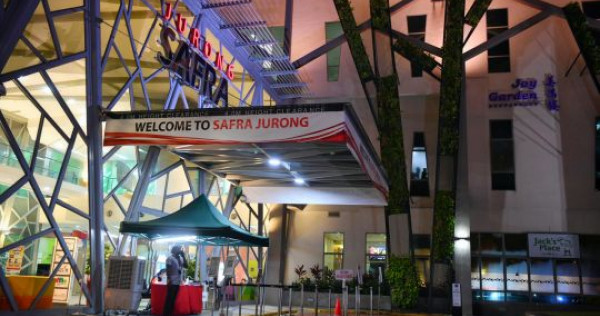
Nine of these are related to the private dinner function at Safra Jurong on Feb 15.

Of the three remaining cases, one is linked to a previous case and one is an imported case. The last is currently no linked to any case.

To date, there are 150 confirmed cases. A total of 90 patients have fully recovered and been discharged from hospital.

Of the 60 still in hospital, most are stable or improving. Nine are in critical condition in the intensive care unit.

This article was first published in The Straits Times. Permission required for reproduction.

[ad_2]

Source link

Six, including three children, sent to hospital after accident near Hougang 1 mall

0

SINGAPORE: Six people were taken to the hospital after an accident involving two vehicles near Hougang 1 shopping mall on Sunday (Mar 8).

The Singapore Civil Defence Force (SCDF) said it responded to the incident at the junction of Hougang Street 91 and Hougang Avenue 9 about 12.30pm.

Photos posted on social media and sent to CNA showed both cars mounted on the sidewalk. Both cars had damaged hoods.

Accident at Hougang Ave 91 on Mar 8, 2020 (4)

Two cars were involved in an accident near the junction of Hougang Street 91 and Hougang Avenue 9 on Mar 8, 2020. (Photo: Ilham Salleh)

Accident at Hougang Ave 91 on Mar 8, 2020 (3)

Two cars were involved in an accident near the junction of Hougang Street 91 and Hougang Avenue 9 on Mar 8, 2020. (Photo: Ilham Salleh)

Three children, aged eight to 10, were taken conscious to the National University Hospital along with two others, said the Singapore Police Force. The driver of one of the vehicles, a 26-year-old man, was taken to Tan Tock Seng Hospital.

Accident at Hougang Ave 91 on Mar 8, 2020 (2)

Two cars were involved in an accident near the junction of Hougang Street 91 and Hougang Avenue 9 on Mar 8, 2020. (Photo: CNA Reader)

Police investigations are ongoing.

Source link

Catching the invisible criminal, Covid-19: How the police work on contact tracing

0

[ad_1]

SINGAPORE – His brief was simple. Identify and find a passenger who had taken a taxi whose driver had Covid-19.

But all Senior Staff Sergeant Mohamad Shapie Saleh had to go on were that the passenger had alighted at Chai Chee Road and a blurred photo, obtained from a different police team, that gave him a rough idea of the man’s attire.

Senior Staff Sgt Shapie spent around four hours scouring footage from over 40 closed circuit television (CCTV) cameras at five blocks in the area to find out where the passenger had gone.

“We needed to exercise patience and concentration,” he said, adding that they had to scrutinise every single figure in the footage.

His work is but part of an extensive police operation that runs round the clock to assist the Ministry of Health (MOH) in contact tracing.

About 30 to 50 police officers are on contact-tracing duty on any given day, although police said numbers can be scaled quickly to 100 if the need arises

The work is first undertaken by Health Ministry staff, who conduct detailed interviews with confirmed cases and identify close contacts within 24 hours of confirming the case.

[ad_2]

Source link

‘Like an invisible criminal’: How police helped find missing link between COVID-19 church clusters in a day

0

SINGAPORE: As the novel coronavirus spreads in Singapore, a kind of puzzle began to emerge. Not on the frontline where doctors and scientists rush to find a vaccine, but behind the scenes where police officers race to find the cause of a “crime”.

On Feb 12, two employees of the Grace Assembly of God church were identified as confirmed cases of COVID-19. By the end of the month, the number of cases linked to this cluster had swelled to 17.

Authorities scrambled to determine how the cluster was infected. Knowing the source would mean greater assurance that the cluster was under control, and that the virus was no longer spreading in the community.

The Health Ministry (MOH) had started contact tracing as soon as the first case in the cluster was confirmed. But soon it became clear that more help was needed. This is where the Singapore Police Force’s Criminal Investigation Department (CID) comes in, as the department’s officers described their roles to reporters on Tuesday (Feb 3).

police church clusters discussion

The police holds a daily video conference with the Health Ministry to share updates. (Photo: Aqil Haziq Mahmud)

The CID has been roped in to help with contact tracing because of its investigative expertise: Using data analytics to sieve large amounts of information, the ability to trawl through closed circuit television camera (CCTV) footage, and even knowing the right questions to ask during interviews.

On any given day, an average of up to 50 police officers work on contact tracing. Police say this resource-intensive operation can be quickly scaled up to involve 100 officers, when more people need to be tracked down and interviewed.

READ: Chinese New Year gathering identified as missing link between COVID-19 church clusters

This is helpful when authorities try to crack particularly tricky COVID-19 cases, like those that involve close contacts whose identities are not known in the first instance.

After all, the CID had helped determine the source of the Life Church and Missions Singapore cluster – a couple from Wuhan who had the disease had attended a service there.

In the Grace Assembly of God cluster, the links were murkier. The CID branch helping with contact tracing – split into teams of interviewees and analysts – had focused on Case 48, the 34-year-old man identified as the first confirmed case linked to the cluster.

READ: ‘Painstaking’ contact tracing work by SPF led to discovery of possible cluster at Paya Lebar church: Shanmugam

After MOH comes up with an activity log – close contacts, places visited – of a confirmed case, the CID interview team follows up with the individual and his close contacts to fill in the gaps.

This involves speaking to them multiple times over the phone, and sometimes even while wearing protective gear in the wards of hospitals and the National Centre for Infectious Diseases (NCID).

New information is fed to the analysis team, which then uses analytics software like word clouds and location maps to sieve out trends from chunks of data and come up with hypotheses. It is then back to the interview team to verify these hypotheses.

READ: 3 new cases of COVID-19 in Singapore, including DBS employee, 2 church employees

For many days the back-and-forth with Case 48 yielded no definitive answer. “There was a lot of trial-and-error in the whole process,” said analysis team member He Minghui, 37, who also works as an intel analyst for the police.

But this turned out to be a red herring.

CHINESE NEW YEAR GATHERING

The CID switched gears and turned its attention to Case 66, another confirmed case in the cluster whose symptoms had developed earlier than the rest. The 28-year-old man’s activity log indicated that he had attended a Chinese New Year gathering at Mei Hwan Drive on Jan 25.

This quickly piqued the interest of interview team member Assistant Superintendent of Police (ASP) Johnny Lim, 44. For a start, these gatherings could have involved close contact and the sharing of food, raising the risk of infection. Details about the gathering were scarce too.

READ: 9 new COVID-19 cases in Singapore, including 6 linked to Grace Assembly of God cluster

This is the kind of “instinct” that police officers have honed from their years on the job, and has proved useful during contact tracing, said ASP Lim, who investigates organised crime at the CID.

“It’s like crime solving,” he added. “More or less, it’s similar kind of skills required – piecing information from different people and different places together.”

READ: Grace Assembly of God COVID-19 cluster: How it unfolded

ASP Lim reached out to Case 66 for a full list of attendees, carefully jogging his memory as the gathering took place some time ago. There were more than 30 names. He called up most of them, asking questions like what time they were there, how they got there and who they were with. Again, he kept the questions to a minimum so as not to stress them out.

At the same time, the analysis team ran the names of those who had attended the Chinese New Year gathering through its database. Two names stood out – a couple who had attended the same Life Church service as the couple from Wuhan, based on the church’s records. This was the eureka moment everyone had been waiting for.

“There is actually a lot of effort put into the backward tracing part,” Ms He said. “There were many hypotheses put out, but we found this was the most solid one that could possibly explain the link between the clusters.”

READ: 3 new COVID-19 cases in Singapore; 5 more discharged, including Chinese national who was first confirmed patient

ASP Lim reached out to the couple but found out that they were well. The woman was never hospitalised for COVID-19, and the man was only identified as a confirmed case on Feb 19 as Case 83, weeks after the gathering, and had been discharged.

However, ASP Lim was undeterred as this would still mean making progress by ruling out another hypothesis. “It’s not a dead end,” he said. “This information is crucial for us; it still leads somewhere.”

Still, records showed that the woman had gone to Sengkang General Hospital the day after the gathering with symptoms consistent with COVID-19. The man had also been unwell towards the end of January, and repeatedly sought treatment at a GP clinic.

MOH arranged for them to be tested at the NCID, and serological tests – which look for antibodies in blood samples to determine infection even after recovery – subsequently confirmed they had earlier been infected with COVID-19.

police church clusters johnny minghui

Assistant Superintendent of Police Johnny Lim (left) and Ms He Minghui. (Photo: Aqil Haziq Mahmud)

As a result, the woman was designated Case 91, the Chinese New Year gathering identified as the missing link between the two church clusters, and the CID’s work vindicated.

CID officers said this was one of their biggest contact tracing success stories to date, especially as the branch managed to make initial contact with Case 66 and eventually Case 91 all within a day.

“This infection is like an invisible criminal; we don’t know where and when it has happened,” Ms He said. “It is unlike an actual crime, when we know there’s a victim and culprit.”

DEALING WITH DOUBT AND LONG HOURS

It’s harder to find this “criminal” considering these officers do contact tracing on top of their normal duties. At least four days a week, ASP Lim works in rotating 12-hour shifts that usually end at 10pm, comprising many hours on the phone and “running” to different places for interviews.

“My regular work has to be on hold until this is done,” he said, calling it “national service”.

READ: Not ‘enough information’ to suspect a COVID-19 super spreader in Grace Assembly of God cluster: MOH

Of course there are challenges. ASP Lim said people have doubted if he was really from the police after he identified himself on the phone. This slows him down in a process where speed is critical to ringfence the virus spread.

Being wary of officials asking for personal information over the phone isn’t necessarily a bad thing, however, and police have urged the public to authenticate officers’ identities by calling their police station.

In ASP Lim’s case, one person who attended the Chinese New Year gathering had questioned his identity even after calling MOH’s hotline. In situations like these, ASP Lim would usually try to verify himself to family members and get them to convince the skeptic.

“We will try to convince them as to who we are and that we are really doing legit business here,” he said, adding that he would pass them the CID hotline so colleagues could officially transfer the call to him.

police church clusters daily conference

Officers say they are working harder and putting in longer hours to balance core duties with contact tracing, but acknowledge the importance of this work. (Photo: Aqil Haziq Mahmud)

The other difficulty is teasing the details out of people.

“Patients repeat the same story a few times to different people,” ASP Lim said. “So when my turn comes, they can get quite impatient as they have to repeat it.” But he said people are “generally very understanding” after he explains the purpose of his job.

Closer to home, ASP Lim said his wife is supportive of what he’s doing despite the long hours, adding that she helps to manage the household chores. His three children aged 12, 10 and seven are too young to understand, he said.

“They know this virus from the television, so I just tell them that papa is going to look for the virus,” he added with a laugh.

SEARCHING FOR TAXI PASSENGERS

Beyond looking back in time to find the source of infection, police officers deployed to what is called the field team are also tasked with forward contact tracing, like tracking down the people who had sat in the same taxi or cinema as someone with COVID-19.

This involves the gruelling task of reviewing hours of CCTV footage, conducting ground enquiries at different locations and identifying people simply based on how they walk or what they wear.

READ: 7 new coronavirus cases in Singapore, including taxi and private-hire drivers

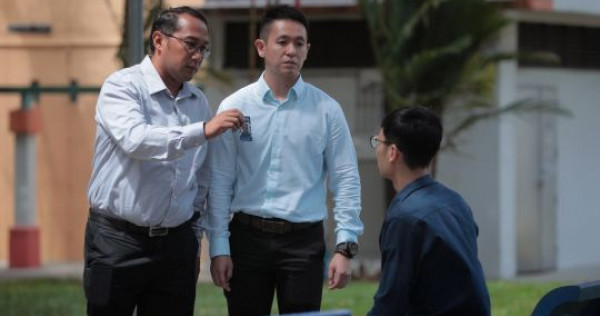
Senior Staff Sergeant (SSS) Mohamad Shapie Saleh, 38, was involved in tracking down passengers who took the taxi of Case 35, a 64-year-old man who worked as a taxi driver.

As many of the passengers paid in cash, there were no official personal details. SSS Shapie, who works in the Crime Strike Force at the Bedok South Neighbourhood Police Centre, recalls being activated for an entire evening for this case.

He was asked to find four passengers based only on their attire and a generic pick-up point, in a task akin to finding a needle in a haystack.

“Based on the attire, we try to trawl all the CCTVs within the area to see if there’s a person matching this attire,” SSS Shapie said, stressing that the smallest details matter.

police church clusters interview

The field team helps to trace close contacts whom MOH is unable to reach or locate for quarantine orders to be served. (Photo: Singapore Police Force)

SSS Shapie was told that a man wearing a white top and black pants had boarded Case 35’s specific cab on Chai Chee Road. The mission was to find out where the man lived and confirm that he had indeed taken the taxi.

Like a game of Where’s Wally, SSS Shapie took some three hours to sift through footage from 40 police cameras at five HDB blocks in the vicinity. If the man disappeared from the footage, he’d have to go back and possibly look through cameras at nearby shops.

SSS Shapie managed to trace the man to a lift lobby at an HDB block, and finally from the camera in the lift, got a clear view of his face. The officer noted the floor he got out at and knocked on the doors of every unit there, describing how he looked like and asking if he lived there.

He found the man, confirmed that he had taken the taxi, and said the MOH would be in touch. Again, some of these passengers had trouble recalling if they had taken the cab as it happened weeks ago. They also doubted that police officers were helping out with contact tracing.

“They’re quite surprised and would not believe that they were being traced,” he said. “At the same time, they are also worried that they might have the virus.”

FINDING MOVIE-GOERS

The process is a little different for Sergeant (SGT) Loh Seng Hong, 33, who was asked to track down two individuals who had sat near Case 48 in a shopping mall cinema in Orchard.

SGT Loh, who works in the Crime Strike Force at the Orchard Neighbourhood Police Centre, had already received from cinema staff CCTV footage showing their faces, based on ticket details and cameras at the booking counters.

police church clusters ground enquiries

Senior Staff Sergeant Mohamad Shapie Saleh (left) and Sergeant Loh Seng Hong (middle) conducting ground enquiries. (Photo: Singapore Police Force)

But SGT Loh did his homework and discovered that the footage displayed a time code that was faster by five minutes, and hence confirmed he had the wrong people. He looked through the footage again to get the right faces, then it was more of the same.

“Orchard is a shopping belt, so we trawled through mall CCTVs,” he said. “Some of them after the show, they don’t go back straight. So we needed to follow their movement when they went for dinner and stuff.”

It sounds easy because SGT Loh said he’s been in the Orchard strike force for five years. “We’ve looked through a lot of CCTVs,” he explained. “We have picked up the skills. Even by the walking patterns of individuals, we are able to identify them.”

BOOKMARK THIS: Our comprehensive coverage of the novel coronavirus and its developments

Download our app or subscribe to our Telegram channel for the latest updates on the coronavirus outbreak: https://cna.asia/telegram 

Source link

Singaporean doctor finds joy — and a new world view — helping Afghan refugees

0

SINGAPORE: He was in private practice as a general practitioner when a patient told him something that changed his life.

A non-governmental organisation was looking for a doctor to help Afghan refugees in Quetta, an area in Pakistan along the border with war-ravaged Afghanistan.

Up to that point, Wee Teck Young’s life in Singapore was, in his words, “very typical”. And he had been looking for such an opportunity. “I think everyone has the desire to help others,” he says.

What sealed the deal, however, was the photo his patient left with him: Of an Afghan refugee and his daughter. “She was beautiful,” he recalls. “It wasn’t too difficult for me to decide that I wanted to explore this.” 

The bachelor gave up his job and moved to Quetta in 2002, and then Afghanistan itself, where he has now lived for well over a decade. Since then, he acknowledges, his life has been far from typical.

Wee Teck Young graduated from the NUS in 1993. His life changed when he left Singapore in 2002.

He graduated from the National University of Singapore in 1993. His life changed when he left Singapore in 2002.

The 50-year-old, who prefers to be known as Hakim, or healer in the Afghan dialect Dari, has a finger in many pies.

While he is still licensed to practise medicine, his time is spent primarily on humanitarian work. He is an international coordinator of an NGO he started, called the Afghan Peace Volunteers, a group of young Afghans working together for non-violence.

The group’s work has been recognised internationally — and so has Hakim, who was awarded the International Pfeffer Peace Award in 2012 by the Fellowship for Reconciliation from the United States.

But his big move has changed not only his life and the lives of those he has worked with, it has also dramatically altered his perspectives on life and death, success and even world issues like climate change.

Hakim at an annual youth peace conference organised last year by the Afghan Peace Volunteers.

At an annual youth peace conference organised last year by the Afghan Peace Volunteers. (Photo: Wee Teck Young)

BEYOND HEALTHCARE

Hakim spent two years in Quetta before moving to Afghanistan’s Bamiyan province as a medical specialist with an international NGO.

But as he visited and lived in remote villages to help with public healthcare education, he realised that the needs of the people he met went far beyond healthcare.

“They needed education, community development, all the many basic human needs,” says the graduate of Anglo-Chinese School and Raffles Junior College.

A peace workshop he organised at Bamiyan University opened the door to him meeting more young Afghans who felt that “they didn’t have a voice” as war raged on and people were being killed every day.

Hakim in Afghanistan 1

Hakim with Bamiyan University undergraduates from five ethnic groups who took part in a three-month peace workshop in 2008. (Photo: Wee Teck Young)

“Then I said: ‘Oh, why don’t you come together?’” he recounts. So in 2009, the Afghan Peace Volunteers was formed, and in 2012, he moved to Kabul with some of the youths.

It is diverse work he does: The group focuses on initiatives loosely linked by the themes of “Green”, “Equal” and “Non-Violent”.

For example, there is a home solar energy project, a school for street children and Hakim’s passion project, “relational learning circles”, which are online focus groups encouraging members from round the world to connect and have conversations with each other.

“We can’t isolate these issues,” he says. “We need to solve these issues multi-dimensionally and see how they’re connected to one another.

“That’s how we are as human beings as well.”

At the Afghan Peace Volunteers' Borderfree Street Kids School, which has a total of 100 students.

At his NGO’s Borderfree Street Kids School, which has a total of 100 students. (Photo: Wee Teck Young)

HEAVEN AND HELL

When asked to describe the differences between Singapore and Afghanistan, he uses a stark analogy: Singapore is heaven, and Afghanistan is hell.

That is how it was put to him by an Afghan barber who asked him why he would come from “heaven to hell”.

“In all the humanitarian indexes, from healthcare to education, peace, security, environment … you name it, they’re near rock-bottom,” said Hakim.

Singapore is such a polar opposite that every time he flies home, he tells himself, “I’m leaving one world and going back to another.”

In the Afghan world, living with violence a real and everyday possibility has made him acutely aware of how fleeting life is.

On the way home from work in Kabul with his friend, Bismillah, accompanying Hakim for extra safety.

On the way home from work in Kabul with his friend, Bismillah, accompanying Hakim for extra safety. (Photo: Wee Teck Young)

“I could die anytime,” he says, recalling an incident when a bomb went off near the house he was living in at the time. “It was so loud the shock waves broke the glass pane, which was in smithereens across the room.”

By instinct, his Afghan roommate, Ali, flew across the room and was at the door before he realised that Hakim had not moved. “He just looked at me and said, ‘Move,’” he recounts.

“That’s the way it is for 32 million Afghans,” says Hakim, who has learnt not to take life, and Singapore, for granted.

“I don’t have to fret over the small little things,” he adds. “If I catch myself thinking about complaining about this or that (in Singapore), I really have to stop myself because that shows my ingratitude for how good this place has become.”

LEARNING FROM THE AFGHANS

Such near misses have “traumatised (him) in the same way they traumatise the Afghans”, which has motivated Hakim to look at trauma healing as another area of focus for the Afghan Peace Volunteers.

A psychological health seminar organised by Afghan Peace Volunteers at Kabul Education University.

A psychological health seminar organised by the Afghan Peace Volunteers at the Kabul Education University.

This was something that also made him realise that growing up in Singapore, he had been conditioned to repress his emotions, for which he needed healing.

“As a young child, I remember thinking that emotions are not trustable,” he said. “I thought that I needed to be strong (and) rational.”

He points out that Asian families tend to be less emotionally communicative, which he acknowledges he had to change in his own family.

“We do need more heart-to-heart conversations, and I want to encourage people to do that because I had to learn how to do that from the Afghans,” he says.

“The Afghans taught me to use touch, hug, sit next to the person … (and) be patient as the person cries or shouts or throws objects.”

Coping with his emotions was not the only thing he learnt from them.

“One of my presumptions was that these people are poor because they aren’t hardworking, they aren’t smart and they don’t have the abilities that I do,” he says. “When I began to work with them, I realised that wasn’t true.”

He cites the story of Najib, an Afghan boy he befriended while working with street children in Quetta.

“I asked him to write his name. He couldn’t, as he was illiterate,” he recalls. “In my misconceived world, I presumed that they didn’t go to school, so this is their lot and life then.”

But he found out later that Najib had run away from a bomb that had killed his parents, and was collecting trash to survive and feed his grandmother.

“He’s brilliant,” says Hakim, with tears forming in his eyes.

He cites another incident, when he asked Najib to smile for a picture. The boy’s grandmother, however, chided him for doing so, saying that her grandson had no reason to smile. “I realised I was the uneducated person,” he says.

Najib’s story is one that Hakim has told many times. It is clearly one that is close to his heart.

Hakim and Najib, an Afghan boy he befriended while working with street children in Quetta, in 2003.

Hakim and Najib in 2003. (Photo: Wee Teck Young)

‘PLEASE, GRETA, YOU KNOW IT’

Another thing close to his heart is climate change, something he started caring about only when he saw first-hand its effect on people he cared about, he admits.

“Eighteen years ago, I didn’t care about climate change,” he says bluntly. “I thought, ‘Well, the world may be warming, but I’m okay here.’

“But when I went to Afghanistan, all that became an everyday issue.”

The wells in two of the houses he rented, for example, dried up owing to drought. He has also worked with refugees fleeing their provinces for lack of water.

Everything he saw, he says, motivated him to read up on the topic voraciously, and he spoke at length to CNA Insider not only about what Afghanistan is facing, but also the global situation.

He estimates that there are as many as 20 million Afghans facing drought, and at least 300,000 climate refugees in the country. The numbers are only going to grow as temperatures continue to climb.

In Singapore, climate change may only be a “projection (for) the future”, but he is glad that Singaporeans, particularly the young, have started to take notice. “We should encourage it, get them to care more and more,” he says.

“Ask for 100 per cent renewable energy.”

A solar panel delivered as part of the Afghan Peace Volunteers' Home Solar Project.

A solar panel delivered as part of the Afghan Peace Volunteers’ Home Solar Project. (Photo: Wee Teck Young)

On the global front, Hakim has nothing but praise for climate change activist Greta Thunberg, calling her a “wonderful person” who has “put a face, a heart and a mind” to the cause.

But he wishes she could do one more thing: To call not only for 100 per cent renewable energy, but also for war to be abolished and for a fairer economic system “that meets everyone’s basic human needs”.

Because all these issues are interconnected. “Please, Greta, you know it,” he says passionately.

He knows there is pessimism about the possibility that world leaders will make effective change. Australian Prime Minister Scott Morrison’s reluctance to acknowledge climate change even in the face of bushfires and the Trump administration’s rollback of US climate change policies come to mind.

The pessimists are being realistic, he thinks, noting that those in power can “make things very difficult”. But he stresses that real change — throughout human history — “comes from the grassroots” and not the politicians.

“That pessimism or realism mustn’t dampen our spirits,” he said. “If all the Australians are out there putting out the bushfires, saying, ‘what, you don’t believe this is real?’ … the Prime Minister will have to seriously rethink his stance.”

THE IMPORTANCE OF RELATIONSHIPS

Just as he was motivated to read up on war and climate change, Hakim believes that Singaporeans — or all of humanity for that matter — would care more about such world issues, if they knew people who have been personally affected.

Volunteers wearing blue scarves symbolising the belief that all humans live under the same blue sky.

Afghan Peace Volunteers wearing blue scarves symbolising the belief that all humans live under the same blue sky. (Photo: Wee Teck Young)

“If Singaporeans had refugee friends, they’d open up their rooms and house them,” he says readily — a confidence perhaps sparked by his own experience. “I have faith in all of humanity,” he replies when pressed about it.

For this reason, he champions relationship-building as an important part of his work. This is where his relational learning circles come in.

“We have the technology to communicate with one another, and in a practical way, increase our care for one another,” he says. “We’re capable of violence, but we’re also caring people, so let’s focus on that instead.”

This same concept and faith in humanity underpins another important part of the Afghan Peace Volunteers’ work: Helping people to become mediators.

The military, says Hakim, represents a “conventional way” of maintaining security. But his unwavering belief is that all problems can be solved using non-violent methods like negotiations. “Even the most difficult conflict problems in Afghanistan can be solved that way.”

Hakim with a volunteer, Hamid, at the Border-free Nonviolence Community Centre.

Hakim with a volunteer, Hamid, at the Border-free Nonviolence Community Centre, where his NGO organises its activities. (Photo: Wee Teck Young)

When asked if global inequality can be solved in the same way, he again points to the need for important conversations.

He suggests scaling up the Afghan Peace Volunteers’ work in setting up worker cooperatives, where every worker has a share in the business, as an ideal solution to the issue.

“The very-rich-income owners need to decide, together with the low-income owners, that ‘I can do with less’,” he says. “Give me a lower salary. Cut it. Have a minimum and a maximum wage.”

Such details need to be specific to every community, society and country, he adds. “But we have the skill and technology to be able to do that.

“So let’s have those conversations and decide together.”

This means high-income earners would need to be content with less, while low-income earners cannot expect to earn as much as the top earners but only “what they need”.

But would people buy into this idea. “It’s possible,” he says optimistically. “Very possible.”

A DIFFERENT MEASURE OF SUCCESS

His belief in this, it seems, comes from personal experience. He is the first to admit that over the past 18 years, his perspective on life — and success — has changed dramatically.

Hakim at his GP clinic with a young patient, not very long before he left for Quetta.

Hakim at his GP clinic with a young patient, not very long before he left for Quetta. (Photo: Wee Teck Young) 

Today, his needs are simple: He estimates that he spends about S$80 to S$90 a month on food and about S$100 for rent. “I have food, water and shelter, so I don’t need any money for now,” he says.

He does not draw a salary, while the Afghan Peace Volunteers relies on funding from his friends from medical school, and other peace groups from round the world.

Twice a year, he returns home to visit his parents, aged 80 and 81, as well as his older brother, who is married with family. Home in Singapore is a three-room flat in the Holland area, which he shares with his parents when he visits.

His life is very different from what he had envisioned when he was a student and a doctor here. “I was made to believe that if I got a better grade or was smarter, I was successful,” he says.

“But why did I want to be academically successful? Because I wanted a stable and good income.”

Hakim receiving his graduation certificate in 1993.

Receiving his graduation certificate in 1993. (Photo: Wee Teck Young)

To him, material things are no longer a measure of success. If they were, he observes, the most successful Afghans today would be the crooks.

Now, he focuses on spending time with his loved ones, building relationships and caring for as many people as he can.

“I hope to encourage people across the world to know and understand one another, person to person,” he said. “Full relationships — and we have the technology for that.

“That’s my dream.”

Hakim is focused on spending time with loved ones, building relationships and caring for people.


Source link

Hawkers at Chinatown Complex Food Centre offer discounts to bring back the crowds

0

[ad_1]

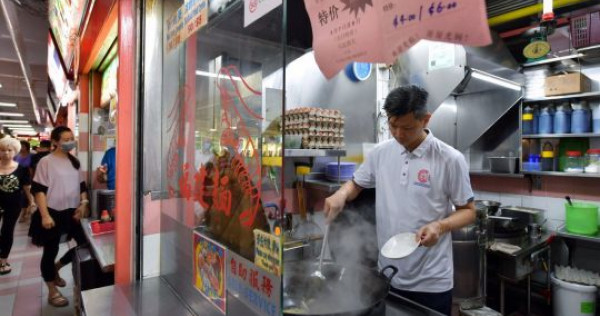
SINGAPORE – It’s been a lean few weeks for hawkers at the Chinatown Complex Food Centre but some tasty promotions this weekend have brought diners streaming in to get their fix of local fare.

It was a welcome sight for stall owners, who have seen business dip by up to 80 per cent as people stayed away from crowded places over fears of contracting Covid-19.

Many hawkers decided to take matters into their own hands, with around 130 of the 226 food stalls at the centre offering discounts.

Madam June Cheang is knocking 10 per cent off her herbal drinks while Mr Johnny Tng’s Super Mummy stall is selling Hokkien mee for $4 or $6 a plate – a dollar off the usual price.

Mr Tng, 48, noted: “Business was especially bad after the Chinese New Year period, and at one point the number of customers here fell by 80 per cent.”

He said the discounts have helped lift trade by 10 to 20 per cent but added that customer numbers are still only about half of a usual Saturday crowd.

[ad_2]

Source link

Coronavirus outbreak: Why still so dirty, Singapore?

0

[ad_1]

The perennial question of how clean Singapore is has once again come under the spotlight, with the Government last week emphasising the importance of public hygiene in combating the spread of the coronavirus.

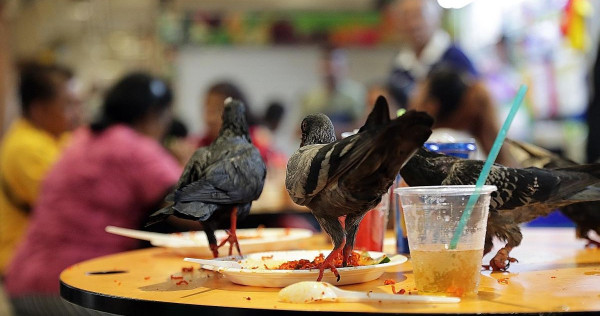
The Republic might have a reputation of being a clean city, but a Sunday Times check at five hawker centres islandwide found that the nation still has some way to go in maintaining it.

Many diners are still leaving their dirty dishes and leftovers on the table for workers to clean up after them.

This, even though a number of customers were observed wiping the tables with hand sanitisers and disposable wipes before sitting down for their meals.

Ms Connie Chan, 49, a hawker at the Chinatown Complex Food Centre, said: “Many customers expect a cleaner environment, but it doesn’t always mean they will change their habits.”

On Friday, the multi-ministry taskforce leading Singapore’s battle against the spread of the coronavirus announced the set-up of a new SG Clean Taskforce.

[ad_2]

Source link

Successful entrepreneur lost her child, went bankrupt and got divorced – and she's only 34

0

[ad_1]

For every inspiring Hercules figure in our lives, there are perhaps a dozen excuses we hold ourselves back by saying, “That can’t be me.”

Leza Klenk asked why that can’t be her.

Now, the 34-year-old Singaporean is the founder and CEO of million-dollar beauty tech company Spendless, an award-winning entrepreneur, a serial investor and a highly sought-after speaker.

At the core of it all, she’s also a loving mother of three.

And that’s where it all started, really.

When Leza married her first husband at the young age of 20, she had no lofty dreams or ideals. Running a business or being a CEO was probably one of the last things to ever cross her mind.

She only has an O-level certificate, having dropped out of school at 17 due to financial difficulties.

Swopping places with husband

When Leza started her first business, the then-housewife had only intended to earn some side income for her children.

[ad_2]

Source link

Commentary: How helping at home benefited my wife, our children and even me

0

SINGAPORE: My wife was about to return to work following the birth of our second child, and she was worried. How was she going to meet the demands of the job while supporting the needs of our young family?

Fully supportive of her career, I started to go into solution mode throwing out ideas around flexible work and a condensed work week, when she abruptly told me to stop talking.

She essentially said: “I don’t need your advice on how to structure my working hours. If you really want to be helpful, then give me the capacity to be successful.”

This absolutely stopped me in my tracks.

What she meant was that if I wanted to help with her career, I should help more with home life so she could then focus on being successful at work.

READ: Commentary: Women managers face double standards at work

LISTEN: Women earning less than men: Who bears the burden of change?

WORK-AS-USUAL FOR NEW DADS?

Another colleague recently joined HSBC Singapore from abroad just as his wife was about to have their second child. His wife has a very successful career in her own right.

But he remarked to me that when others heard about their story – starting over in a new country, in a new work environment and with a new child – most people would ask how she was going to manage, but rarely did they ask him the same. The inherent outside assumption was that his work-life would continue as normal.

These two examples raise a key challenge: If women are going to achieve gender equality at work, more focus is needed on achieving greater equality at home, through institutional and attitudinal changes.

woman boss

(Photo: Unsplash/Brooke Lark)

Of course, businesses need to continue to develop policies and programmes that address women’s career advancement, pay and representation in senior roles, because inherent bias still remain.

But these policies and programmes are only one side of the equation.

EQUALITY AT WORK STARTS WITH EQUALITY AT HOME

More than half of married couples in Singapore are dual-income, which means both parents are needed to be present at home – doing house admin, the school drop-offs, or being the one who sits down and helps with homework.

So companies need to support this by installing parental leave policies and flexible work arrangements that allow and encourage both men and women to take a more active role at home.

That’s not always the case at the moment. But it’s not fair to lump this solely and squarely at the feet of companies’ policies either.

I know many companies in Singapore that have highly supportive policies but these arrangements are still not being used by men. Why is this?

READ: Commentary: The myth of the superhero career woman is holding us back

READ: Commentary: The biggest work-from-home exercise may have just begun. How ready is Singapore?

THE PERCEPTION WE NEED TO ADDRESS

There could be a perception that work isn’t productive away from the office. Oddly, the COVID-19 outbreak is challenging this notion given that so many of us in Singapore are currently working from home.

So if the practical issues of working from home have been removed, then the remaining obstacle is a stigma that prioritising your family over work suggests you don’t take your career seriously.  

Postnatal depression - as a father

(Photo: Unsplash/picsea)

As men, there is absolutely nothing wrong with taking time or working flexibly to be with your family and there needs to be a greater shift in mindsets in this space.

Within companies, this requires a strong tone from the top that sets the standard. For example, our HSBC Singapore CEO will often work flexibly in order to attend school events or generally spend time with his kids.

A WAKE-UP CALL

As we approach International Women’s Day, it may seem ironic that I’m not actually talking about women. But the role of men is an essential and often overlooked part of achieving gender equality.

I got this wake-up call from my wife after the birth of our second child and it actually set me up for when our third child, Ella, arrived this time last year.

I made the decision to work three days a week from home, in the first eight months of her life, so that I could spend time with her, which also enabled my wife to return to work.

READ: Commentary: Who’s looking after the children and elderly if more women work?

READ: Commentary: Do men get away with not cleaning up?

I had to think hard about how I would make it feasible for my family and for work. It was really tough, but I found a path that worked for me.  

I couldn’t have done this without HSBC having the right policies and, more importantly, the right attitude – from both senior management and my own team and stakeholders. And of course, my wife Louise.

By the way, and as Louise would readily attest, I still have a long way to go in doing my share of the “home stuff”. I’ll keep trying. 

But what my experience has told me is that it can’t be done by individuals alone – there also needs to be a societal and institutional groundswell that provides the impetus too.

Ella turned one this week and she’s begun to walk and talk.

Guess what her first word was? “Dadda”.

Daniel Fitzpatrick is Head of Communications at HSBC, Singapore.

Source link