SINGAPORE – American oil giant ExxonMobil cut pump prices by three cents on Wednesday afternoon (March 11), its second reduction since Monday’s plunge in crude oil prices.
As at 2pm, petrol at Esso stations are $2.14 a litre for 92-octane, $2.18 for 95-octane and $2.58 for 98. Diesel is $1.83 per litre.
All the rates are before discounts, and are three cents lower than most prices posted by its rivals, which are likely to start matching Exxon’s cut later today.
With the latest adjustment, Esso’s 95-octane – the most popular grade here – is now 7.2 per cent lower than its price in mid-January. Since then, crude oil prices have fallen by more than 40 per cent.
ExxonMobil, the biggest fuel retailer here, said: “The price of crude is just one of the many factors.
“Besides wholesale prices, the retail prices of products are also influenced by other factors like marketing, storage, land prices, government taxes, currency exchange rates and competitive market forces.”
Training a pet is no mean feat. But these pet owners are drawing flak for hitting their cat when frustration got the better of them — and sharing it all on social media.
The Society for the Prevention of Cruelty to Animals (SPCA) confirmed on March 11 that it is investigating the case after a video of a man hitting a cat for urinating went viral.
In the clip, which was originally filmed and posted by a woman on her Instagram Story, a man could be seen holding a ginger cat by the scruff of its neck. He shouted at the cat and smacked it, saying in Mandarin: “If you urinate, I will hit you.”
The cat started urinating in the middle of his tirade, prompting the woman filming to laugh and zoom in on it.
The man then lifted the cat off the floor by the scruff of its neck before the clip was cut.
Getting a car in Singapore is a huge undertaking, not least because cars here are e-x-p-e-n-s-i-v-e.
A look around SgCarMart shows a new Honda City (1.5L) listed at $97,000 and a Kia Cerato (1.6L) at close to $94,000 — that’s more than half the price of a 3-room BTO in Woodlands.
But we get why zipping around in your own set of wheels can be enticing and exciting.
There’s the freedom of going wherever you want at the drop of a hat without having to squeeze with the crowds on buses and MRTs. Plus, there’s the option of going to ‘ulu’ and far-flung corners of Singapore without much consideration (Lim Chu Kang dairy farm, anyone?)
However, convenience comes at a cost.
Here are some cost considerations that you would probably have factored into your budgeting:
Ladies and gents, spring has arriveth. And as we come close to the end of the first quarter of (a very hectic) 2020, you might be thinking: where art thou, consumer electronic sales?
Alas, March’s expected big tech bonanza, IT Show, has been postponed in view of the coronavirus outbreak — a good thing really, considering the whole deadly viral infection thing.
But as always, the show must go on. In lieu of a packed bonanza at a convention hall, Lazada is offering a comfier shopping experience in the great indoors with deeply discounted electronics in its Online Tech Show.
Customers can expect up to 80 per cent of storewide discounts from over 1,000 brands on the e-commerce platform when the sale kicks off from March 12 to 16, with attractive deals from the likes of Apple, Samsung, Dyson and more to be snagged.
SINGAPORE: At 66, Mr Osman Omar has to climb two flights of stairs between his third-floor flat to get to the lift on the fourth floor. This requires some physical effort as he has asthma and a leg that aches.
His block at Jurong West is one of 150 blocks where the Lift Upgrading Programme – which was introduced in 2001 to provide residents with direct lift access on every floor – has not been implemented due to prohibitive costs or site constraints.
That direct access is essential for day-to-day living for residents like him, said Mr Osman.
“We have been waiting many, many years (for a lift). At our age, we have to go up and go down … Sometimes if you carry things (it’s also a) problem,” he told CNA.
But a new grant could help. On Mar 4, National Development Minister Lawrence Wong announced that the Government will offer a S$30,000 Lift Access Housing Grant, for those with mobility or medical issues, to buy a new or resale flat with direct lift access.
When CNA visited several flats with no direct lift access, residents were happy to hear of the grants, although they hesitated when asked if they would make use of it.
While Mr Osman said that he would like to use the grant to move into a flat with direct lift access, he was worried about the cost of buying another flat. This is given that he is retired and no longer earns an income.
Instead, “the best thing is if they do upgrading”, he said.
Mr Osman Omar has to walk up and down two flights of stairs to use the lift in his block. (Photo: Cindy Co)
Other residents CNA spoke to also said that they would wait and see.
Although 72-year-old Yeoh Cheng Sin was “happy” to hear about the grants, she said that she would wait to see if there would be an en-bloc for her flat before making a decision.
In any case, she and her 73-year-old husband would wait till they are at least 80 before thinking of moving, she said.
“Now we are still okay, but in a few years, I don’t know,” said the retiree, who lives in another Jurong West HDB block. She has been living in her current flat for 30 years.
Mr Yee, who lives on the 11th floor of the same block, said that while he was not opposed to moving, the problem was looking for a flat to move to. While he said that he was currently still fit, he probably would not be able to climb the stairs in a few years.
“The problem is – where do I move?” he said, adding that he did not want to move from his larger flat to a 1- or 2-room flat, as it would be too small.
“If we can stay in our old homes, it would be best.”
DIRECT LIFT ACCESS ESSENTIAL
Social workers and organisations working with seniors and persons with disabilities told CNA that having direct lift access is crucial.
“For seniors who are still fit and healthy, it may not be an issue. Many seniors are still fit in their 60s and 70s. However, in the 80s and 90s, there is definitely a further decline in strength and fitness for many,” said Mr Teo Tee Loon, executive director of Lakeside Family Services.
Lakeside Family Services provides services to underprivileged children, youths, families and elderly in the Jurong area.
“Direct lift access would therefore be very helpful to every person at some point in time, when they reach that stage of life,” he said.
Chief executive officer of SPD Abhimanyau Pal, said that direct lift access allows those with mobility challenges to be able to get to school, work and access services like medical care. It is also “essential” when quick evacuation is necessary.
SPD is a local charity supporting persons with disabilities.
“A barrier-free environment can help persons with disabilities regain a sense of mobility, empowerment and self-reliance,” said Mr Pal.
But while the S$30,000 grant can “relieve some of (the) financial burdens” involved in purchasing a new flat with lift access, more could be done, he added.
Some residents may need more help in purchasing and moving to a new flat, such as assessing the accessibility of the new location, or help with financial planning.
“This is necessary for persons who have limited resources and need help in understanding, navigating resources and decision-making,” he said.
Nevertheless, relocation is often “a last resort”, as it is a “drastic change” for residents.
“A holistic support system may therefore be required to help persons with disabilities to explore different options before deciding to move,” said Mr Pal.
ABERDEEN: Vitamin C is a common remedy that some people believe will cure the common cold and flu.
Although it helps us maintain good immune function, however, there’s little evidence that it can prevent or substantially reduce either of these diseases.
Yet, in the midst of the novel coronavirus outbreak, some “influencers” are claiming that taking mega-doses of vitamin C can cure COVID-19.
So let’s cut to the chase. Can vitamin C cure the coronavirus?
Considering that novel coronavirus belongs to the same family of viruses – coronaviruses – as the common cold and flu, it’s unlikely that taking vitamin C will prevent or cure you of a COVID-19 infection.
CAN VITAMIN C TREAT THE COMMON COLD?
Using vitamin C to treat the common cold was an idea popularised by double Nobel Prize-winning chemist, Linus Pauling, and further promoted by the dietary supplements industry. Unfortunately, ever since Pauling’s claim in the 1970s, there has been little evidence to back it up.
Vitamins or “vital-amines” were first discovered at the beginning of the 20th century as elements present in low amounts in our diets that were vital for health.
Certainly, people lacking certain vitamins will develop deficiency diseases. For example, people deficient in vitamin C will develop scurvy.
However, it wasn’t until the early 1930s that it was discovered that scurvy was caused by lack of vitamin C, and that taking the vitamin could cure the disease.
The science of nutrition was born with the discovery of vitamins, and has since become a competitive, unregulated industry, often with scientific fact competing against those spreading misinformation and looking to profit. The novel coronavirus outbreak is just the latest example.
These misleading articles have spread quickly, and are likely to be behind the shortage of vitamin C in Asia and a five-fold spike in demand for vitamin C and multivitamins in Singapore.
VITAMIN C CAN PROMOTE A GOOD IMMUNE SYSTEM
Vitamin C is important to maintain “redox” balance in the body’s tissues – these are types of reactions in cells that add or remove oxygen, and are essential for many processes such as generating energy in cells.
Shoppers browse for health products in an aisle stocked with vitamin supplements at a store in Sydney, Australia on Mar 9, 2017. (Photo: Reuters/Jason Reed)
These same reactions, though, can create products harmful to human cells – such as reactive oxygen species, which react with lipids (fat), proteins and nucleic acids. Vitamin C can lessen these harmful reactions. It also help enzymes build collagen, which is necessary for supporting our body’s tissues.
Although vitamin C doesn’t have miraculous disease-curing properties, some research has also shown it can help the immune system fight off bacteria and viruses.
Its role in protecting against viral infections was shown in a recent review which found that immune cells need vitamin C to produce proteins that activate the immune system throughout the body against virus attacks.
Having said that, we can easily obtain sufficient levels of vitamin C in our diet that will keep our immune system fully functional. Vitamin C is plentiful in many fruits and vegetables, including oranges, broccoli and potatoes.
And while it is relatively non-toxic, since its high water solubility makes it easy to excrete from the body, excessive doses can result in unpleasant symptoms such as diarrhoea, nausea and cramps.
BUT IT IS UNLIKELY TO BE A DRAMATIC CURE
Though I have said vitamin C is unlikely to be a dramatic cure for COVID-19, the fact that it can promote good immune function means it would be going too far to say there will be no effect.
And although a review found that vitamin C has no effect on reducing the frequency of colds, it did find that for the average person, there was a small decrease in the duration of common cold symptoms.
But for people that participate in brief periods of severe physical exercise (such as marathon runners and skiers), vitamin C halved the duration and severity of their common cold risk.
These slight effects of vitamin C on the coronavirus that causes the common cold have spurred a new clinical trial looking to cure COVID-19 infections using very high intravenous doses of vitamin C. These trials have just started and no results are yet posted.
Intravenous application of vitamin C will result in much higher and faster levels of the vitamin in the blood than any amount found in vitamin C supplements taken orally.
Though this approach could increase vitamin C’s mild protective effect, this is yet hypothetical and intravenous injection comes with its own risks, such as infection, blood vessel damage, air embolism or blood clots.
WHAT TO DO INSTEAD OF TAKING VITAMIN C
So although vitamin C does have some small effect on the common cold, it’s unlikely that taking large amounts of vitamin C supplements will cure a COVID-19 infection – or have a large effect at all.
(Photo: Unsplash/Kelly Sikkema)
Even if intravenous vitamin C works to shorten or cure COVID-19, it will likely only be a stop-gap before therapies directed at the virus, such as vaccinations, take over.
The most effective way to avoid the virus still remains washing hands, not touching the eyes, nose or mouth, and keeping your distance from anyone exhibiting symptoms.
SINGAPORE: At this year’s Budget, Deputy Prime Minister and Finance Minister Heng Swee Keat said Singapore will aim to phase out vehicles with internal combustion engines (ICE) over the next 20 years.
It is part of a bigger vision under the Land Transport Master Plan 2040 to make the country’s land transport sector more environmentally sustainable. At the core of this strategy are electric vehicles (EVs).
In fact, after 2030, Singapore should see no new purchases of ICE vehicles, according to Senior Minister of State for Transport Dr Janil Puthucheary at the Transport Ministry’s Committee of Supply Debate.
That will be no mean feat, given Singapore has more than 900,000 of such vehicles today.
To incentivise electric vehicle adoption, the Government is dangling several carrots like the EV Early Adoption Incentive (EEAI) – essentially a rebate on Additional Registration Fees (ARF) capped at S$20,000 starting next January.
If this gets the needle moving, then the gradual growth of the electric vehicle population should rise in tandem with the intended construction of up to 28,000 public charging points by 2030. It will be an incremental exercise from the current 1,600 chargers now publicly accessible.
Existing players in the industry say the 28,000 goal is realistic, but tell CNA that significant effort will have to go into readying Singapore’s infrastructure.
LAYING THE GROUNDWORK
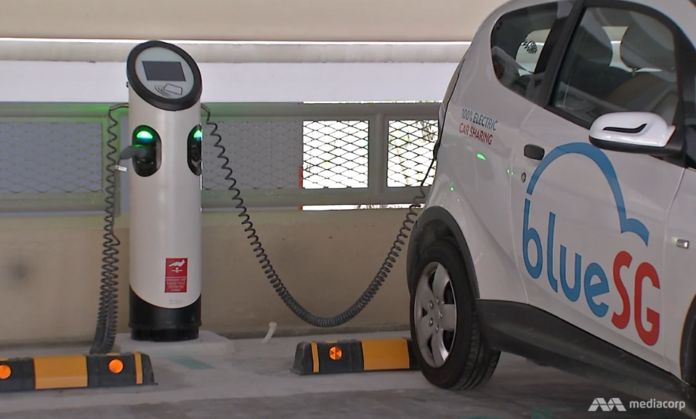
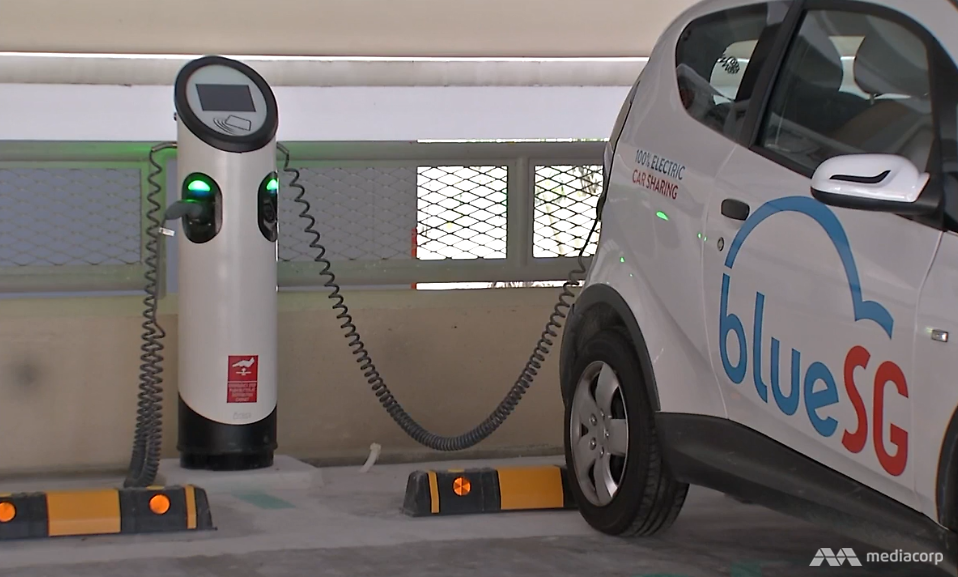
Over the past two years, BlueSG has built 1,291 charging points for its electric car-sharing service. A total of 239 of those charging points are accessible to third-party users – in other words, non-BlueSG vehicles can use them.
Commercial and Network Director Jenny Lim described the factors that affect whether a charging point can be built at an existing parking lot. “Other than the 4.8m by 2.4m size of the lot, there needs to be ample space around the lot so that we can install the equipment,” said Ms Lim.
Surrounding features like trees and underground cables also matter. For instance, trees cannot be cut down to make way for construction and installation work.
“It’s also important not to disrupt construction halfway,” said Ms Lim. “After you set about the construction process, if you realise there are underground cables, you will delay the whole construction process. And sometimes you may even have to abort it.”
It is also generally more expensive and time-consuming to build a charging point outdoors, because regulations dictate that trenching work has to be done to hide electrical cables underground.
Ms Lim said an outdoor project can cost 50 per cent more than one in a sheltered, multi-storey car park – and take twice as long.
“We need to do trenching, digging, and then we need to do casting – weather permitting,” said Ms Lim.
“From the moment we select a station to when the station is fully functional with all the approvals and applications in place, this will typically take four to six months.”
Access to power is another important factor. Commercial players like BlueSG have to tap available power sources to draw electricity to its charging points.
If the parking lot is outdoors, it has to be near an overground box, and there might only be one on an entire street. For multi-storey car parks, proximity to electrical rooms is key and these switch rooms are usually on the ground floor.
Simply put, the further the charging point from the power source, the more expensive the construction and installation.
NEW VERSUS OLD
It is generally more cost-effective to build charging lots from scratch by including them in new car park designs, according to Assistant Professor Raymond Ong, who researches transport infrastructure at the Department of Civil and Environmental Engineering at the National University of Singapore.
But it is more likely than not that the conversion of existing car park lots will have to factor into the numbers game.
BlueSG’s Ms Lim has a similar view that it would be easier to install charging points in newer developments like public build-to-order flats. She thinks getting to 28,000 charging points will not be a problem.
“For the landscape in Singapore, there are 4,000 public car parks – HDB, URA, various agencies’ car parks – altogether,” said Ms Lim.
“If you take away a good proportion that are older car parks, and you spread the rest across newer car parks, community areas near transport hubs, (with) easily between seven to 10 parking lots per car park, the Government should be able to fill up (and get to) the 28,000.”
However, Ms Lim also pointed out another challenge – that many car parks in Singapore are older and tend to only be equipped with just enough power for lights, elevators, and electronic gantries.
Property developers like City Development are already addressing this problem. Head of Sustainability Esther An said even older buildings like Republic Plaza can be made ready for electric charging, as long as they are properly maintained and upgraded to meet energy efficiency auditing standards.
“In every building, you have to maintain an upgrading schedule,” she said. “So, we don’t see it as a problem if you have continuous efforts to maintain building performance.”
Republic Plaza is more than two decades old and has six lots for BlueSG electric vehicles, two of which are for public use. The building will add two more public lots by the second quarter of 2020.
A BlueSG electric vehicle charging point.
CDL has also committed to installing electric vehicle charging infrastructure at its new residential developments moving forward.
In 2016, it provided isolators for 97 units at its landed property development in Serangoon Gardens giving owners the flexibility to plug-and-play EV chargers if and when they decide to get an electric car.
Charging facilities provider Greenlots – which is wholly owned by Shell – said more developers are showing interest in electric vehicle charging infrastructure.
“Condominiums and commercial buildings in Singapore have been quite slow to adopt EV charging stations, but the awareness is starting to grow amongst the building and facility management sectors,” said a Greenlots spokesperson, who added that charging locations are becoming more common because tenants, businesses and visitors are creating demand.
“The government may help to alleviate these concerns by implementing requirements for buildings to be EV-Ready,” the spokesperson said. “In Singapore, the Green Mark Award is a good example of how EV-readiness can be promoted.
“This building benchmarking scheme will encourage the construction of environmentally-friendly buildings and features that align with the long-term goals of sustainability and liveability. EV charging stations definitely fall within the category of a green feature.”
IMPACT ON THE GRID – GRIN OR GRIMACE?
Also very much a part of the debate are concerns about what impact 28,000 charging stations will have on the national power grid.
Greater electric vehicle adoption will inevitably lead to greater electricity demand, something the Transport Ministry has assured it can manage through the construction of new power generation capacity and the reinforcement of the grid network.
“We will also incorporate innovations such as smart charging and energy storage solutions that store energy from the grid during off-peak periods,” said Mr Puthucheary at the Committee of Supply debate.
Energy provider SP Group said it has progressively upgraded the grid infrastructure over the years to keep up with changing consumer demand. The company is also confident of handling the additional load.
“It’s likely going to be highly distributed across the whole of Singapore. Therefore, the impact on the grid, in our view, will be highly manageable,” said Goh Chee Kiong, CEO of New Energies at SP Group.
“That said, SP Group will undertake all measures to ensure there’s no adverse impact on the grid arising from EV charging.”
SP Group is also building and operating its own charging points and has a mix of fast- and slow-options available.
Right now, it has 166 chargers, with 86 of them accessible to the public.
By the end of this year, the company has committed to 1,000 charging points and will run Singapore’s largest public EV charging network, with a quarter of them fast-chargers.
Mr Goh said SP Group is working with property owners and managers to get these rolled out.
“There are three types of charging locations. The first being the workplace, the second would be residential areas, and the third being general public areas such as shopping malls,” said Mr Goh.
“A lot of the districts that will work with SP Group in the coming few months will be a combination of those three types of areas.”
LOCATION, LOCATION, LOCATION
So, where exactly will the 28,000 charging stations will be located? And how many will be fast- or slow- chargers?
These considerations will depend on demand projections, according to Dr Ong.
“Most of the time in transportation planning, we will estimate where the demand nodes are for drivers,” he said.
“In the case of electric vehicles, we would usually estimate the proportion of drivers who would switch from an internal combustion vehicle vehicle to an electric vehicle.
“Based on that, we have some numbers to estimate where around Singapore these drivers would be distributed, and based on that, we would estimate potential locations to plant the charging stations.”
The Transport Ministry is conducting studies to better understand the different factors that affect the demand for charging and is studying potential solutions to guide its roll-out.
For a start, it will prioritise public car parks and work with the private sector to improve the availability of electric vehicle charging.
“If you are considering an electric vehicle over an internal combustion engine vehicle you must be convinced that access to a charger will be as convenient as access to a petrol station,” said Mr Puthucheary at the Committee of Supply debate.
FILE PHOTO: Electric car charge points at the Holloway Road Shell station, where Shell launched its first fast electric vehicle charging station in London, Britain Oct 18, 2017. (Photo: REUTERS/Mary Turner/File Photo)
Dr Ong said location will also depend on charging technology. Under the national EV charging standard TR25, there are two standards – Type 2 (AC) for slow-charging and Combo 2 (DC) for fast-charging.
Slow-chargers can fully charge a car in six to eight hours and are more useful for overnight charging.
“It would make more sense to actually have these (slow) charging stations in, perhaps, HDB estates, where drivers are already parking their cars at HDB car parks overnight,” he said.
Fast-chargers, on the other hand, are more suited to those constantly on the move. For example, SP Group’s fast-chargers primarily serve drivers of fleet vehicles like electric taxi service HDT, Grab’s electric cars, and multi-national corporation Schneider Electric’s internal-use fleet.
These can get a car battery pumped up in 30 minutes and many are spread out in areas like office buildings, housing estates, business parks, JTC industrial estates and even on Sentosa.
On top of these two charging standards, the Land Transport Authority and Energy Market Authority have announced the addition of the Japanese fast-charging method CHAdeMO as an optional public charging standard.
This is compatible with electric vehicle models like the Nissan Leaf, Mitsubishi i-MiEV and the Honda Fit EV, which means buyers can choose from a wider range of options.
CHARGING AHEAD – WHAT’S NEXT?
As Mr Puthucheary put it, having all vehicles run on cleaner energy by 2040 is ambitious. It will require significant changes to commuting and consumer behaviour and the necessary supporting infrastructure.
Still, economist Associate Professor Walter Theseira who heads the Master of Management in Urban Transportation programme at the Singapore University of Social Sciences, is not quite sold on the target of 28,000 charging points.
“What does 28,000 mean? How many EVs can 28,000 support? If you have charging technology where you can charge within 15 minutes to half an hour, then 28,000 can support a lot of EVs,” he said.
“But if you are relying on overnight charging then I’m sorry, 28,000 actually supports fewer than 28,000 EVs, maybe 28,000 at most.”
Dr Theseira added that even if people do not expect to charge every night – in other words, for a charging point to support more than one car – it would require a system of subscription and payment which has yet to be worked out.
Others, though, see the battery as half full and Dr Ong believes 28,000 is just the beginning.
“Once this demand is created, and we see there’s a growth in EVs compared to EV-ICE mix, I believe strategies will be adjusted to potentially increase the locations and the charging points, iteratively, so we can achieve an electrification of vehicle future,” he added.
SINGAPORE – A total of 12 new Covid-19 cases have been confirmed in Singapore, including three Republic of Singapore Air Force (RSAF) servicemen who were in France on duty.
In an update on Wednesday (March 11), the Ministry of Health said that a case confirmed on Tuesday is also an RSAF serviceman who was in France. This means that at least four servicemen are now infected.
Of the latest 12 new coronavirus cases, eight, including the RSAF personnel, are imported, which means that they caught the disease overseas.
This is the largest number of imported cases Singapore has seen in a day and comes as countries around the world struggle to contain the virus.
One of the other new cases announced by MOH on Wednesday is linked to the private dinner function held at the Joy Garden restaurant at Safra Jurong on Feb 15, Singapore’s biggest coronavirus cluster, which now has 40 cases.
The latest update brings the total number of cases here to 178. Three more patients have been discharged, which means that 96 have so far recovered.
SINGAPORE: The room is buzzing with activity. Calls are being made and laptops are open as people cross-check dates, times and places with each other.
At the Integrated Quarantine Order Services (IQOS) Operation Centre, officers are hard at work conducting phone surveillance on those instructed to stay at home in a bid to curb the spread of COVID-19 and updating them on quarantine order agent visits.
Around 100 people work in shifts at the centre, which operates round the clock, and they perform their duties in co-operation with the Ministry of Health (MOH) and Singapore Police Force (SPF).
In a different part of the building, the Deployment Control Cell forms another part of the quarantine operations. Here, quarantine order agents receive their deployment orders. They then collect their personal protective equipment and head out for their assignments.
In a nearby lounge, personnel take a break in between shifts, tucking into snacks and playing console games. There are also bunks for those who wish to rest.
The Integrated Quarantine Order Services (IQOS) Operation Centre. (Photo: Matthew Mohan)
“We are very grateful for the opportunities to support the Government in this fight against COVID-19, as key partners to MOH,” said Assistant Superintendent (Auxiliary Police Force) Nigel Quek, Certis’ commanding officer of integrated quarantine ops services.
Speaking during a media visit to the Certis headquarters on Wednesday (Mar 11), Mr Quek added: “For me and my officers on the ground, we definitely feel there’s a sense of duty in support of this particular fight.
“There’s a sense of accomplishment, a sense of pride (in knowing) that everyone is going through this together to overcome this particular issue that is plaguing Singapore.”
IQOS operations consist of the serving of quarantine orders, supporting SPF with security services at Government Quarantine Facilities, escorting people under quarantine and monitoring of those under quarantine.
More than 400 quarantine order agents and members of the security staff have been deployed to perform these duties. A total of more than 700 Certis staff, including healthcare support staff, are deployed daily, added the company.
The work of a quarantine order agent is not without risk. Just last month, a Certis employee who served quarantine orders on two people from Wuhan contracted the COVID-19 virus.
But measures to safeguard staff are already in place, said Certis.
These include a centralised laundry service for agents’ uniforms as part of the disinfection process, compulsory decontamination procedures after duties such as a shower as well as temperature-taking when quarantine order agents return to the Certis headquarters.
Currently, quarantine order agents draw a specialised kit – containing items such as sanitary wipes, hand sanitisers, a surgical gown, gloves and masks – before heading out on assignments.
Before entering a home to serve a quarantine order, the agent will put on their gloves and mask. This posture is in line with MOH guidelines, said Certis.
Should the individual be identified by the MOH as a “high suspect case”, the quarantine order agent will also don a surgical gown.
Any individual who is found to have COVID-19 symptoms upon temperature-taking by an accompanying Health Promotion Board nurse will also be escorted to the hospital.
Beyond serving quarantine orders, these agents also assess the suitability of an individual’s home for quarantine. A room with an en suite bathroom is required.
If this condition is not met, the agent could be required to help transfer the person to a Government Quarantine Facility.
They are also required to perform regular home visits to ensure individuals do not defy the quarantine order.
ASP (APF) Quek assured that whenever agents are out for duty, Certis “always ensures that they have their personal protective equipment, mainly the gloves, mask as well as the gowns”.
“We also issue them vitamin C to keep their immune systems strong. We provide them with round-the-clock hot meals and beverages, and air-conditioned rest areas so that they can remain alert and vigilant for their next assignment.”
“In our daily briefs with our officers … the officers are happy and motivated to support the cause. The overall morale is relatively high,” ASP (APF) Quek added.
Hell hath no fury like a woman scorned, or a lady cheated out of a meal on her first date.
In an attempt to publicly shame a man who pulled a disappearing act on his partner after dinner, a Facebook user dug out his personal details and posted them online.
The information included his full name, workplace and social media usernames among others.
She had done so to warn others of this scammer, Euphemia Lee said on March 10, adding that she’s a friend of the victim.
PHOTO: Facebook screengrab
The man, surnamed Toh, was said to have offered to pay for the meal, but later pretended to take a phone call and left his date to foot the $130 bill at a sushi restaurant on March 9. He allegedly blocked her phone number too.
Worse still, he did not use his real name in the dating platform where he met Lee’s friend. Lee said she found out his name through PayLah!.