 SINGAPORE – Despite the Government’s huge investment to improve bus services, many commuters still feel they are not experiencing the benefits in terms of wait times and crowdedness, going by the results of a recent survey conducted by REACH.
Among other…
Source link
REACH survey shows mixed views on public transport
Air Asia 50% Off Malaysia, Indonesia & Thailand Fares 4 – 10 Apr 2016 | SINGPromos.com
AirAsia 50% off fares to Malaysia, Indonesia & Thailand

Air Asia 50% Off Malaysia, Indonesia & Thailand Fares 4 – 10 Apr 2016 | SINGPromos.com
Enjoy 50% Off Malaysia, Indonesia and Thailand fares with Air Asia’s latest promotion. How to enjoy this promotion. Pick your preferred destination. Select the dates stated within the promotion travel period (except peak period).
Parliament: Health Ministry reviewing security and contingency plans for hospitals, polyclinics
April 04, 2016 1:30 PM
SINGAPORE – The Ministry of Health (MOH) is working with public health care institutions here to review their security plans, in light of the growing terrorism threat, Minister of State for Health Lam Pin Min said in Parliament on Monday (April 4).


Hep C outbreak: Develop learning culture instead of blame culture, says Gan
 SINGAPORE – Amid calls for more details on the 16 Ministry of Health (MOH) and Singapore General Hospital (SGH) staff members who were disciplined for the fatal Hepatitis C outbreak in the hospital last year and their respective penalties, Health Minister Gan…
Source link
Parliament: Naming individuals rapped over hep C outbreak will not improve patient safety, says Gan Kim Yong
April 04, 2016 1:09 PM
SINGAPORE – Naming the individuals responsible for the hepatitis C outbreak at the Singapore General Hospital (SGH) last year will develop a “blame culture” that will not help patients in the long run, Health Minister Gan Kim Yong told Parliament on Monday.


Workers' rights group stops injured Bangladeshi worker from boarding plane
They were at the airport to escort their former employee onto a flight back to Bangladesh on March 4.
But they were stopped at the airport by a volunteer from a migrant workers group, Home, who wanted to take the worker to the Ministry of Manpower (MOM) for further investigations.
Bangladeshi worker Ashraful Mohamad, 25, claimed that his employer had failed to provide medical care for his injury.
He had earlier tried to claim for work injury compensation, but this was dismissed by MOM.
His situation – which was highlighted on the Facebook page of Mr Jolovan Wham, Home’s executive director, on March 6 – drew a sympathetic response from netizens, who slammed Mr Ashraful’s employer, Ribar Industries.
The company said it had been portrayed unfairly. It made a police report at the airport.
Mr Koh Boon Hock, manager at Ribar Industries, added that they were unhappy that Mr Ashraful had an old injury, but claimed he had got injured at work.
They paid his hospitalisation bills of $33,000, but refused to pay for spinal surgery that would have cost about $40,000.
On Dec 18, three weeks into his job, Mr Ashraful claimed that he was hit by a flying metal bar at work and became unconscious.
He was warded in the National University Hospital for two months after the alleged accident. On Jan 14, he filed a Work Injury Compensation claim for a neck injury, but it was dismissed.
PRE-EXISTING CONDITION
An MOM spokesman told The New Paper that its investigations showed that Mr Ashraful had a pre-existing neck injury that was sustained in a non-work accident two years ago.
She said: “As part of the investigation, we reviewed Ashraful’s medical records, interviewed him and two witnesses he identified to obtain an account of the incident.
“Ashraful’s witnesses denied that the alleged incident on Dec 18, 2015 took place; and there was no evidence of Ashraful being hit by a steel pole as claimed.”
The MOM spokesman said it stopped Ashraful from being sent home to assist with investigations into his second claim.
The spokesman said: “Our findings, however, established that contrary to Ashraful’s allegation, the employer did provide for Ashraful’s medical treatment before he was medically certified fit for travel.”
Mr Koh said they had done their best for their worker and should not be responsible for his pre-existing injury. (see story at right.)
This is Mr Ashraful’s third time in Singapore. He will be returning to Bangladesh tomorrow.
Before arriving here, he used his life savings to pay $4,000 for agent fees and a plane ticket. He was supposed to earn about $520 a month.
Home is now trying to raise funds for Mr Ashraful’s treatment.
Employer should pay for worker’s surgery: Home
Mr Jolovan Wham, executive director of Home, feels that the employer should pay for Mr Ashraful Mohammad’s surgery, even if his injury had not been work-related.
He said: “The doctor had deemed surgery to be necessary and to be performed as soon as possible…This is not cosmetic surgery.
“He needs the surgery for a normal life.”
Employers must buy and maintain medical insurance coverage of at least $15,000 per year for each Work Permit holder, which will provide cover for causes that may not be work-related.
In response, Mr Koh Boon Hock, manager at Ribar Industries, said it had ensured that Mr Ashraful’s condition was stabilised and that he was fit for travel.
Mr Ashraful was discharged from hospital on Feb 16.
He said: “After Ashraful was discharged, we made sure that the dormitory was suitable for his stay.”
Mr Koh, who hires about 50 workers, added that the company had initially offered to pay for Mr Ashraful’s surgery to be done in Bangladesh if he was honest about the alleged accident.
Mr A.K.M. Mohsin, editor of Singapore’s only Bengali newspaper, said he is aware of a few cases of false work injury claims and these workers spoil the market for workers with legitimate claims.
Ms Debbie Fordyce from the migrant workers group Transient Workers Count Too conducted a survey that found that a majority of workplace injuries were reported by workers who have worked for less than a year and these injuries resulted in 0 to 5 per cent permanent incapacity.
She emphasised that filing claims for minor injuries should not be seen as “gaming the system”. “When caught in a disadvantaged position (where workers have no control over their salary and the employer is able to send the man home at any time), filing a claim for a small injury may seem like the only recourse to a heavily indebted worker.”
But Mr Wham said filing for a false claim is “not possible” in Mr Ashraful’s case.
He said: “He did not ask for this accident to happen. Moreover, MOM’s investigations did not reveal that it is a false claim.
“It is not a situation of Ashraful trying to take advantage of his employer. He is not even asking for any compensation now, just for medical treatment.”
Nonetheless, Mr Mohsin said he understands the employer’s hesitance to pay for the surgery, considering the worker had worked with them for only three weeks.
Ms Fordyce added that she had previously advised a worker with leukaemia to seek treatment at home as soon as he was certified fit for travel.
“It would be a rare employer who would be willing to pay for a worker’s pre-existing condition.”
linheng@sph.com.sg

This article was first published on April 4, 2016.
Get The New Paper for more stories.
Image:

Publication Date:
Monday, April 4, 2016 – 14:00
Keywords:
Send to mobile app:
Source:
Story Type:
Others
Hougang resident kills over 200 mosquitoes in 5 days
Mr Chan is out for blood – mosquito blood to be specific.
His weapon of choice – a partially broken fly swatter.
The 41-year-old engineer has become somewhat of a mosquito’s worst nightmare after he started killing mosquitoes in his landed home in Keng Choo Bin Walk in Hougang about two weeks ago.
He told The New Paper last week: “Over the first five days, I’ve easily killed over 200 mosquitoes.
“I thought that there were many mosquitoes in this area, but I didn’t expect to actually kill so many.”
Mr Chan lives just one street from an active dengue cluster at Poh Huat Road West. More than a week ago, a 73-year-old woman living there died of dengue fever.
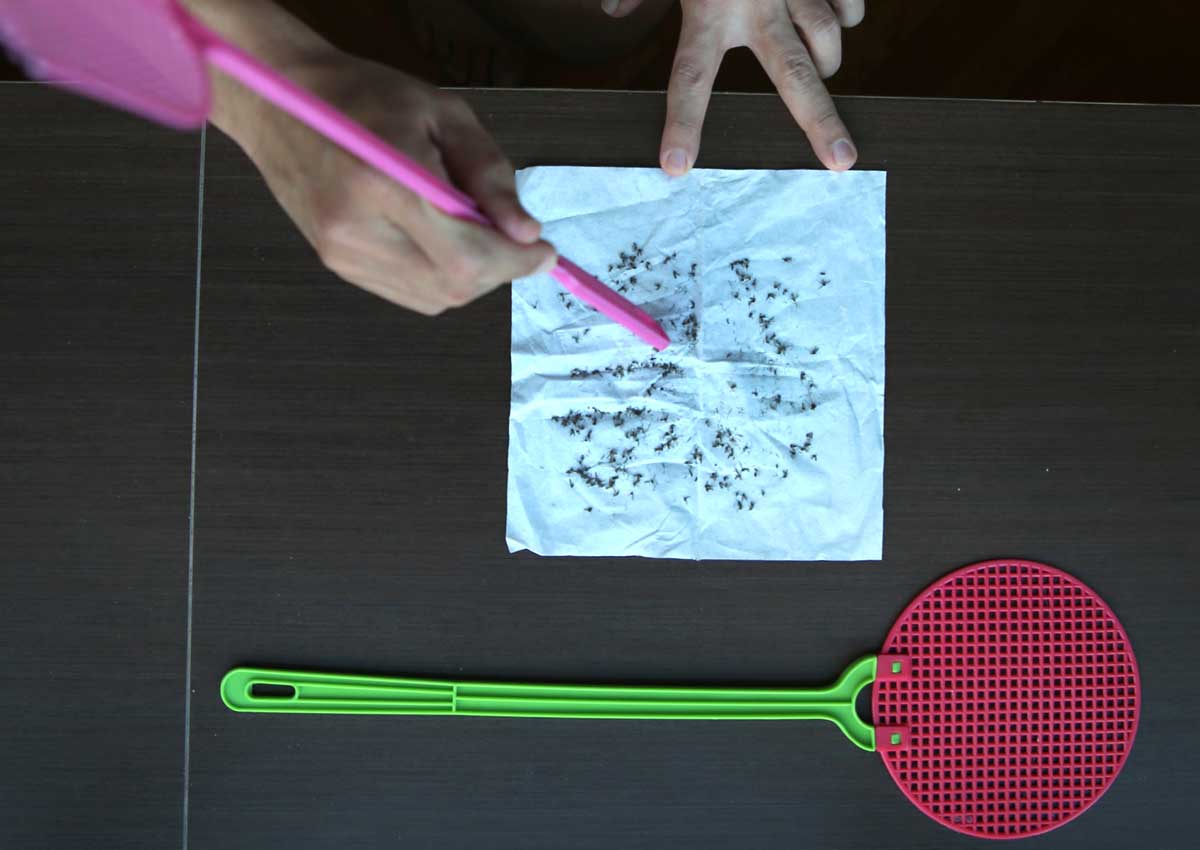
He said he keeps a mental count of the number of mosquitoes he kills daily and has even collected some of his “kills”.
“When you swat them so many times a day, you can keep track,” he said.
Mr Chan believes that the vacant school buildings behind his home might be contributing to the estate’s mosquito woes.
Other residents approached by TNP agreed that the mosquito problem seems to be getting worse. (See report on facing page.)
Mr Chan declined to give his full name as he is worried that neighbours might blame him if the National Environment Agency (NEA) finds mosquitoes in their homes.
He said he had contacted the agency twice, but was directed to the Singapore Land Authority the first time as the vacant school sits on state land.
After his second call, Mr Chan said NEA officers went to his home to check for mosquito larvae and took away his previous days’ “collection” of about 30 dead mosquitoes.
When TNP met Mr Chan at his home last week, he showed us his “kills”, which he kept neatly folded between squares of tissue paper.
BLACK-AND-WHITE STRIPES
Some of the dead mosquitoes had black-and-white stripes, which are distinctive of the Aedes mosquitoes that can carry the dengue virus, according to the NEA website.
Mr Chan said: “These are just the ones that are whole, sometimes they’re so badly squashed that you can’t pick them up. So I’m sure there were more.”
His household of six people has had to cope with the mozzie problem since moving there almost 10 years ago.
But a week before Chinese New Year, they noticed a sudden increase in the number of mosquitoes and bites.
Mr Chan also showed TNP his family’s extensive collection of mosquito repellent products and said they have tried all sorts of ways to ward off the insects, but to no avail.
He said his family always makes sure to get rid of stagnant water around the house to prevent the mosquitoes from breeding.
“Six months ago, we also installed ceiling fans in every room. It’s helped a bit because I think the breeze chases the mosquitoes away. Only the garang (Malay for fierce) mosquitoes will go against the wind,” he said.
Mr Chan started documenting the number of his “kills” when he was on leave about two weeks ago, as proof of his claims before he approached the NEA.
“I figured that I needed some kind of evidence. I can’t just give (NEA) a number off the top of my head,” he said.
Mr Chan added that he is worried most about the health of his two young children and elderly parents.
His family initially thought that his “collections” were disgusting, but once they understood the rationale behind them, they were supportive, he said.
During the 20-minute interview, Mr Chan’s eyes were constantly darting around the living room, to try to spot mosquitoes.
“Fortunately, none of us has contracted dengue, but we hope something can be done before it’s too late,” he said.
“As you can see, we’ve all become a little paranoid and we’re always on the lookout for mosquitoes.
“Once we feel something land on us, we’ll whack, even if it means hitting ourselves.”
NEA: ONE BREEDING HABITAT DESTROYED
The National Environment Agency (NEA) said it received three instances of feedback on the mosquito situation at Kang Choo Bin Walk in March.
Responding to queries from The New Paper, its spokesman said the mosquito specimens collected from Mr Chan were identified to be from the Culex species, which do not transmit dengue or chikungunya.
So far, one mosquito breeding habitat in the area has been found and destroyed and NEA will continue to work with stakeholders there to check for other breeding habitats, the spokesman added.
The NEA will also continue to conduct misting to kill adult mosquitoes in the area, when necessary.
In February, the agency warned that Singapore might see its worst dengue outbreak this year.
A perfect storm of factors, including warmer weather providing perfect mosquito breeding conditions, and a switch in the predominant dengue strain, could threaten to push numbers over the 30,000 mark, it said.
Four deaths from dengue have been reported in Singapore so far this year.
In response to TNP’s queries, a spokesman for the Singapore Land Authority (SLA) said that it does regular maintenance and vector works, such as sweeping of drains and clearing of leaves, to prevent and treat potential mosquito breeding habitats in vacant state properties, such as the school compound behind Kang Choo Bin Walk.
“In the case of the former Parry and Rosyth Schools at Kang Choo Bin Road, we have stepped up our vector control efforts, particularly since these state properties are located near dengue cluster areas,” the SLA spokesman said.
RESIDENT: 2 DENGUE CASES IN PAST YEARS
Neighbours living in Kang Choo Bin Walk said they have noticed more mosquitoes in the estate over the last few weeks.
Madam Julie Tan, 47, who works in sales, told The New Paper: “We’ve noticed that we’re getting more bites. At night, we sometimes hear them buzzing near our ears. Sometimes we even wear insect repellent at home.”
The mother of two children, aged 14 and 11, who has been living there for almost five years, said her husband fell sick with dengue in 2014.
A housewife living in the estate, who gave her name as Ms Winnie, 45, said that at least two residents had contracted dengue in past years.
She said her family has tried various ways to prevent mosquitoes from biting them, but none has been successful.
“Mosquito repellent sprays, mosquito coils, lemon grass diffusers, I’ve tried them all. We’ve just learnt to live with the problem,” she said.
“Of course, if something can be done to solve it, that would be best because there are a lot of children and elderly in this estate.”
Another resident, a retiree who wanted to be known only as Mr Chor, 70, said the NEA recently went to a vacant house next to his to check for mosquitoes and found larvae breeding in a pond.
“I think that was the main problem for my family, so I hope the problem gets resolved now that the habitat is destroyed,” he said.
tammei@sph.com.sg
This article was first published on April 4, 2016.
Get The New Paper for more stories.
Image:
Publication Date:
Monday, April 4, 2016 – 14:00
Keywords:
Send to mobile app:
Source:
Story Type:
Others
Selena Gomez to perform in Singapore on July 27

Singer-actress Selena Gomez will perform at the Singapore Indoor Stadium on July 27 at 8pm this year.
The former Disney star, who rose to fame as the lead character on Wizards of Waverly Place, a television show, segued into singing after the show’s conclusion.
Much like her fellow Disney alums, Gomez has embraced an increasingly mature public image with her post-Disney projects, not least with her current album, Revival.
The album, which debuted at number one in the US includes, ‘Same Old Love’ and ‘Hands to Myself’.
Ticketing details will be announced soon via Midas Promotions or their Facebook page.
prabukm@sph.com.sg
Image:

Publication Date:
Monday, April 4, 2016 – 12:57
Keywords:
Send to mobile app:
Source:
Story Type:
Rewritten Story
Flea trade zones
IF THE numerous photos posted on social media are anything to go by, Singaporeans love weekend markets. At the recent Express Art Market organised by The Local People, over 35,000 people turned up at the old Tanjong Pagar Railway Station for an afternoon of browsing through quirky finds from various vendors, while enjoying an outdoor concert or two.
The proliferation of markets is such that there is one nearly every weekend. And they are more Haji Lane than Sungei Road – gone are the second-hand clothes or dusty gadgets, with artisans and local craftsmen taking their place. In keeping with Sunday brunches at the latest hip eatery, visitors expect a carnival mix of fringe events ranging from DJ sets to gourmet food trucks.
The first to focus exclusively on indie artists and designers was MAAD by the Red Dot Design Museum, started in 2006. MAAD’s organiser Elvin Seah reports that they have since grown from 30 to 100 vendors, with monthly markets.
“Shoppers are paying more attention to different avenues, seeking products and services which are better customised to their needs,” says Mr Seah, who adds that flea markets are no longer associated with second hand items but better quality artisanal products.
These local and regional cult brands began making regular appearances at other weekend markets such as Public Garden, which started in 2011. More organisers then jumped on the bandwagon, such as Naiise from 2013, and The Local People from 2014.
The latter two in fact started life as online stores, but both saw the demand for offline retail concepts. Cheryl Yong, public relations and buying manager for Naiise, explains: “Consumers want to engage with designs and interact with products in person to understand them better. The temporary concept of a pop-up store also adds novelty.”
But with increasing competition, flea markets are fighting to stand out by curating their vendors and keeping things fresh. The Local People aims for 80 per cent new labels at each market, says co-founder Lu Yawen. “We give priority to new and local brands, especially those by art students, because we want to encourage the next generation of artists.”
Keeping up with trends is important too, says The Retro Factory’s Gary Tan: “There’s been a real resurgence of vinyl records among audiophiles recently, and at our first fair, we had a booth that sold vinyls and it made more than S$3,000.” That’s 10 times the sales of the least popular booth, he reveals.
While many organisers are focusing on homegrown brands, Megafash invites regional ones as well, so customers aren’t faced with the same few local vendors. Their catalogue comprises 300 brands with half from Singapore. Local artisans may “understand the taste and preferences of Singaporeans better”, says co-founder Ngeow Jiawen, but “it’s exciting to be able to shop for products that are otherwise only available at say, Chatuchak”.
Other factors such as “the music, the decor, the vibe, all play a part in helping to draw regular crowds”, she adds. This explains why Megafash chose Lepark for their Big N Breezy bazaar last year. Lepark is a tapas bar and events space located on the rooftop carpark of People’s Park Complex.
Lepark’s gritty underground appeal is not the only draw for market organisers. Co-founder Carmen Low explains that her other arts curation company, Getai Group, amps up events with electronic or live music, art jam sessions, live painting, or art installations. “We try to work with different spectrums of the local and regional creative industries, so our projects are always multi-dimensional,” says Ms Low.
But building an experience isn’t down to organisers alone; the onus is also on vendors to refresh their inventory every now and then – something that is naturally happening as the scene develops.
“I often see many makers here unable to commit full-time to perfecting their products or the customer experience, but this is changing as the younger generation is slightly less averse to risk,” observes Ms Low. Take Faridah Yusuf for instance. The 31-year-old founder of Freda D Parfum, who has been a regular vendor at MAAD for a year and a half, is a strong believer of constantly updating her collection. She grew from six to 12 fragrances after just two years of operations, and has since added products such as massage candles and body lotions. “All these products weren’t in the plan, but you can’t be monotonous; you grow with the consumers according to what they want,” says Ms Faridah.
Some new entrants also see the value in face-to-face interactions for product development. That was Fung Kwok Pan’s intention when his two-month-old business, Artless Goods, took part in its first market with Megafash earlier this year. “It is an avenue to experiment and get direct feedback from our customers. From there, we can adjust prices, streamline production processes and decide which products are worth the effort to streamline in the first place,” he says.
Given the anaemic retail sector due to high overheads and labour crunch, flea markets might be the way to go for emerging brands. New venues are also jumping on board this trend, some of whom are sympathetic to local makers and their struggles.
For instance, co-working space The Pavilion @ Far East Square has dedicated a 5,700 square foot space for pop-up events. Launched since January, they intend to host at least four flea markets a year, and offer 25 per cent discounts on rentals (up to S$3,800 for a full day) to events which support the creative industries or which are socially meaningful.
The space is managed by non-profit arts firm The Rice Company Limited, and promoting flea or art markets gels with their vision, says director of centre management Lynne Kok.
The non-profit outfit also promotes local works internationally through platforms such as Spotlight Singapore and Asia On The Edge, and plans to bring pop-ups overseas.
Live music venues such as 555 Villa Thai in Changi are also joining in. The beer garden boasts a 37,000 sq ft space suitable for weekend markets and workshops. “We intend to provide the space to local creatives at a very low cost, and in turn, vendors can provide our customers with diverse content,” says co-founder Joseph Zhang. He hopes that flea markets will appeal to families that tend to visit the Changi area for its tranquillity and proximity to the beach.
Some flea markets have become so popular that they are moving into semi-permanent spaces. For instance, Togetherly, in collaboration with Workshop Element (W.E.), will be taking over a 12,000 sq ft space at Isetan, Wisma Atria from April 20 to June 30.
It may seem counterintuitive that flea markets – first touted as edgy, alternative retail experiences – are now returning to the mainstream shopping mall. However, Togetherly’s Wendy Ng cites accessibility of location and exposure to the masses as key advantages. She adds: “Markets are also restrictive in terms of setup space; now, our vendors and labels get to showcase their wares in a boutique setting.”
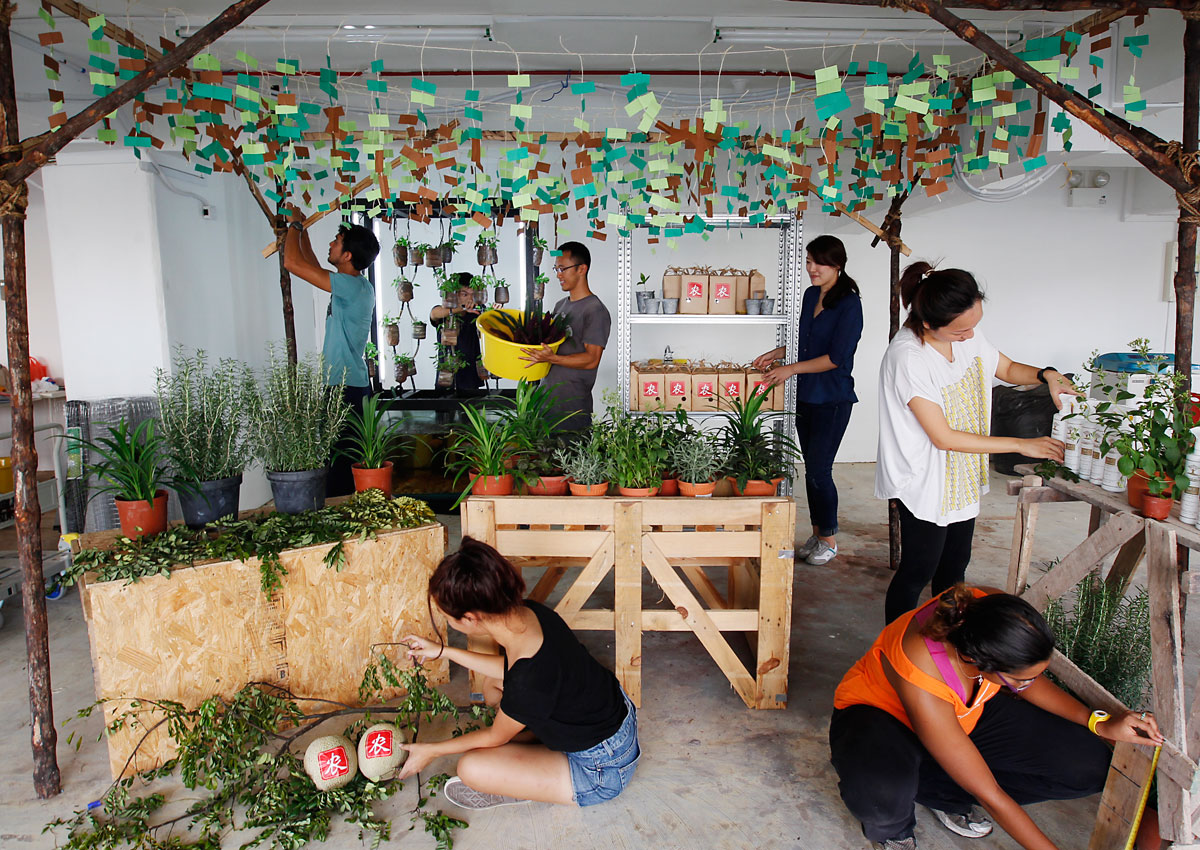
Flea markets can also draw foot traffic to more remote locations. Come mid-May, Edible Garden City hopes to add some buzz to Hort Park. The urban farming collective’s 8,600 sq ft space will host up to 30 micro-enterprises related to food and gardening.
“These booths are between a pop-up market stall and a brick-and-mortar shop,” says co-founder Rob Pearce. “We want to take away a bit of that burden from people who are trying to start interesting small businesses, so they don’t have to deal with the logistics, and we can provide the manpower to sell the products.”
He adds: “You get some really great collaborations in pop-ups because it’s usually cheaper or rent-free, so you haven’t got the usual commercial pressures. We want to capture that spirit of a pop-up market.”
Sparking ideas
Edible Garden City at Hort Park
LOVE the energy of pop-up markets, but don’t particularly enjoy the inconvenience of constantly setting up and tearing down booths? You’re not alone. Rob Pearce of the local urban farmers collective Edible Garden City is tired of it too.
He has organised a couple of pop-up markets over the last two years (such as Nong at People’s Park Complex, and The Growell Pop Up at Rowell Road), and while he enjoys the collaborative energy that comes from such temporary set-ups, the logistics can be a nightmare.
That’s why Edible Garden City is setting up a new 8,600 sq ft space at Hort Park, which can host up to 30 different vendors under a sheltered structure. These vendors are likely to be people who want a more permanent space than a pop-up market, but can’t afford to sign a two-year lease, says Mr Pearce. The space will soft-launch on May 15, with a few workshops and at least 10 vendors to begin with.
“We’re excited about the ideas and collaborations that will spark from having these vendors in one place. We want to be a kind of community hub for the gardening industry, where people can share knowledge and best practices, to grow the whole Singapore industry,” he says.
Naturally, the main focus will be food and gardening businesses, and some of the people who have already signed up include Aerospring Gardens – a local company selling vertical garden structures, a cold-brew coffee business, and a honey-making social enterprise from Rwanda.
“We’re looking for vendors who are ideally local, doing organic products, or are social enterprises. But equally we don’t want to be too strict and restrict people’s creativity, so if we see potential, we’re open to supporting them,” says Mr Pearce.
Eventually, the idea is to not only run one-off workshops, but also do in-depth courses under an arm called Open Farm School, as well as set up their own cafe selling simple fare such as coffee, cakes, and sandwiches, hopefully using produce from their own gardens.
Says Mr Pearce: “Edible Gardens also started in Hort Park, when the previous occupant introduced (my co-founder Bjorn Low) and me. A few years later, here we are, ready to take over the whole space. Small connections like that can grow into something so much bigger with some support, and we want to be able to return the favour.”
Vintage atmosphere
Retro Factory
retrofactory@outlook.com
WHEN Gary Tan started his Facebook group Retro Factory late last year, he didn’t expect to have more than 300 members in just a few months.
He says: “In places like the USA and Europe, people have a real appreciation for all things vintage. Unfortunately, in Singapore young people don’t really understand the importance of preserving old things. There’s a lack of a foundation there.”
The 47-year-old’s passion for vintage items was inspired by his father. “My father worked for the Eastman Kodak company for about 25 years, so he had all these vintage cameras. When I was six years old, I remember he started taking me for rides along what’s now the East Coast Parkway in his Triumph Spitfire or Sunbeam Alpine classic cars, and we’d just watch the fishermen for hours,” he says.
His own collection grew when he moved to Melbourne for his studies in 1990, and he found himself collecting old record players, neckties, and even bought and sold over 50 classic cars during the six years he spent in Australia.
Mr Tan says: “But when I returned to Singapore, the challenge was finding the space to store and display my collection, and I realised I couldn’t be the only one with that problem.”
When he saw the level of interest among other vintage collectors in his group, he decided they needed a place to display and sell their treasures. They held their first flea market on Jan 31 this year, which saw over 1,000 attendees and 22 vendors. The least-successful stall saw a profit of S$250 while the stall that sold vinyl records made around S$3,000 “because there’s been a resurgence in vinyl lately”.
The focus of the market isn’t just on the pieces for sale, of which vinyl records, gramophones, vintage cameras, and old typewriters are but a few – ranging in price from S$3 for a record to S$800 for a 100-year-old typewriter – but also features swing dancers, jazz music, and gourmet food.
The second market was held at the end of March this year, and saw about 300 attendees as it was held in a boutique location. Mr Tan hopes to hold these markets monthly, or at least, every two months.
He explains: “I’ve never wanted to just hang around at flea markets in Singapore. It’s more that I walk through them and then leave. That’s why I wanted to create a market with an authentic atmosphere, so people stay and enjoy a drink or two because they’re enjoying themselves. Not just because they want to buy something cheap.”
Upcoming pop-up events
The Naked Finn
Block 39 Malan Road, Gillman Barracks
April 2 (11am-5pm)
A year ago, seafood restaurant The Naked Finn moved from its little shack at 41 Malan Road (which now houses the bar Nekkid) to a full-fledged restaurant just down the street, and this Saturday, it celebrates its first anniversary with a mini farmers’ market.
Some of the products on sale will include locally-farmed barramundi from Kuhlbarra, line-caught coho salmon and lingcod from Alaska imported by The Naked Finn, coffee from Birdy’s Brew, honey from Cerana Honey, and sauces from Mekhala Living. They will also be handing out recipes created using raw ingredients from the market, such as a steamed barramundi using a filet from Kuhlbarra, and two sauces from Mekhala Living.
Open Farm Community Social
Market #4
130E Minden Road
April 2-3 (10am-4pm daily)
A trip to the market at Open Farm Community doesn’t necessarily just mean filling your bag with edibles for the week, it could easily involve a whole day’s activities. For instance, you could participate in one of their yoga classes, bring a picnic basket to lay out on the lawn, or grab a bite from the gourmet food truck – Kerbside Gourmet.
Some of the products on sale include live oysters from Sea Farmers at Ubin, cold-pressed juices with Chinese herbs from Flashjuice, handmade soy and beeswax candles from Candles Of Light, and organic skincare from FrankSkincare.
W.E. x Togetherly
435 Orchard Road
(Isetan, Level 1, Wisma Atria)
April 20 to June 30 (11am-9.30pm daily)
This semi-permanent pop-up by Workshop Element (W.E.) and Togetherly promises to add some indie flair to Orchard Road. The 12,000 sq ft space at Wisma Atria holds over 50 vendors and labels.
Expect quirky finds such as knitted accessories from It Takes Balls, leather pieces from Forest Child, and handmade accessories by Curious Creatures.
As with other Togetherly events, visitors are encouraged to participate in the book exchange, so bring a tome, wrap it at the booth and leave a note for the next reader.
Local musicians such as Jill-Marie Thomas and Victoria Ho will be performing on weekends, and watch out for air plant workshops by Crafted Identity among other programmes.
Retro Factory’s Vintage Flea Market
315 Tanjong Katong Road (Reservation at Vicki’s)
Early May
If you’re a fan of the older things in life, wander down to the Retro Factory’s vintage flea market on Tanjong Katong Road on the first weekend of May. Instead of the usual iPhone cases or handpainted canvases, you’ll find a little slice of history.
The market will feature around 20 vendors hawking vintage cameras, typewriters and gramophones. If shopping isn’t your thing, dance along to jazzy tunes played by guest DJs or sway along with local swing dancers from Dapper & Dames Vintage.
rachloi@sph.com.sg
thtan@sph.com.sg
avantin@sph.com.sg

This article was first published on April 2, 2016.
Get The Business Times for more stories.
Image:
Blurb:
Growing interest in local brands, art and culture is helping to give S'pore's flea market scene a boost as can be seen from their proliferation all over the island. -BT
Publication Date:
Monday, April 4, 2016 – 13:02
Keywords:
Send to mobile app:
Source:
Story Type:
Others
Public healthcare institutions' resilience against terror under review: Health Ministry
The review, expected to be completed in a few months, covers preventive security, contingency plans and the required competency of security personnel, according to Minister of State for Health Dr Lam Pin Min.
Source link


