Home Blog Page 4333

MOH working with public healthcare institutions to review security plans

0

The Ministry of Health (MOH) is working with public healthcare institutions in Singapore to review their security plans in light of the growing terrorism threat, Minister of State for Health Lam Pin Min said yesterday.
The review is being done with the Ministry of Home Affairs and is expected to be completed in a few months’ time. It will look into preventive security, contingency plans for different scenarios like terrorist incidents and recovery strategies.

The review will also examine the required competency of their security personnel, Dr Lam said in his reply to Dr Fatimah Lateef (Marine Parade GRC). But these healthcare institutions, which include public hospitals and polyclinics, already have in place “a baseline level of security”, he added.

This includes day-to-day security operations like closed-circuit television surveillance, patrols and immediate responses to security incidents by security personnel, and access controls against unauthorised entry to restricted and sensitive areas.

The institutions also work with police on developing standard operating procedures and conducting emergency drills to test their preparedness and vigilance, said Dr Lam.

Private healthcare institutions have similar security measures.

They are “part of the public, police-led security and safety workgroup, where they meet regularly to share good practices and to enhance preparedness for security threats”, he added.

yanliang@sph.com.sg


This article was first published on April 5, 2016.
Get a copy of The Straits Times or go to straitstimes.com for more stories.

Image: 
Category: 
Publication Date: 
Tuesday, April 5, 2016 – 11:18
Keywords: 
Send to mobile app: 
Source: 


Story Type: 
Others

Source link

Activists want dog festival taken off the menu

0

After being rescued from a truck carrying dogs illegally in July, a three-year-old greyhound received a new name, new owner and new family.

When the dog was found by volunteers from the Vshine Animal Protection Association in Dalian, Liaoning province, it had back injuries and was covered in blood.

It and many other dogs were trucked hundreds of kilometers-six or seven of them stuffed into a crate or small metal cage without food or water and bound for the dinner table.

To prevent further cases, animal rights activists are calling for an end to an annual dog meat festival in South China that has been blamed for tarnishing the country’s reputation overseas.

The festival in Yulin, Guangxi Zhuang autonomous region, is held in June, but has met increased opposition in recent years amid concerns over canine cruelty and unhygienic food handling practices.

Activists say they will continue to press for the festival to be banned and for legislation to be introduced outlawing the slaughter of dogs and cats for meat.

Qin Xiaona, founder and director of the Capital Animal Welfare Association, said, “The Yulin authorities need to adopt more proactive and decisive steps to crack down on an industry that kills dogs acquired illegally and sells their meat in breach of food safety regulations.”

According to Humane Society International, between 10 and 20 million dogs are killed annually in China for human consumption, predominantly in the south and northeast.

Qin claims that more than 80 per cent of these are stolen pets, according to research by her association.

Zhang Ying, a civil servant in Jiangsu province, said Tiantian, her 4-year-old Chihuahua, is more like a family member than a pet.

“I am worried that dog-eaters will force thieves to steal or poison our pets,” she said, adding that eating dogs has no place in tradition.

Peter Li, China policy specialist at Humane Society International, said the Yulin festival has been scaled back in recent years amid pressure from the authorities and from domestic and international protesters.

Image: 
Category: 
Publication Date: 
Tuesday, April 5, 2016 – 10:39
Send to mobile app: 
Source: 


Rotator Headline: 
Lucky greyhound gets new home after being rescued from China dog meat trade
Story Type: 
Others

Source link

Need for ecosystem that supports innovation: MPs

0

Onus on businesses to come up with fresh ideas, with Govt providing support system

A spirit of innovation and breaking new ground is crucial for Singapore’s survival, MPs said on the first day of the Budget debate.

While the MPs supported the Budget’s measures to boost such breakthroughs and welcomed help for companies, some said the Government may not always make the right business calls.

Ultimately, it is businesses that must come up with the next “killer” product or service that customers want, Mr Liang Eng Hwa (Holland-Bukit Timah GRC) said in his speech at the start of the debate.

For this to happen, Mr Liang said it is essential to have a vibrant start-up scene with low barriers to entry such as low rental costs and less red tape.

“We need an ecosystem with the necessary players, budding entrepreneurs, mentors, venture and private equity funds among others,” he said, adding that he supports the setting up of SG-Innovate, which Finance Minister Heng Swee Keat announced in his Budget speech to provide such an infrastructure.

Over the next five years, the Government has set aside a record $19 billion for research and development(R&D), of which $4 billion has been earmarked for industry-research collaboration. It will top up another $1.5 billion to the National Research Fund in Budget 2016.

Mr Alex Yam (Marsiling-Yew Tee GRC) said that while the Government could provide financial help, “the onus is on our businesses to innovate and be productive”.

He cited entrepreneur Kenny Yap, who heads tropical fish distributor Qian Hu. Mr Yap had said in an interview: “Any enterprise that does not embrace innovation, especially in Singapore, will not survive in the next three to five years.”

Several speakers touched on the need to support innovations by Singaporeans and ensure that the country gains from what it invests in.

Non-Constituency MP Daniel Goh said while there is heavy investment in deepening R&D capabilities, there should also be focus on making sure these are anchored by a Singaporean core in the sector.

Nominated MP Chia Yong Yong raised the issue of ownership of intellectual property (IP) through innovation, which she feels is important when research collaborations involve non-Singapore entities.

She hoped the Government would set clear guidelines for the retention of IP that was of strategic value to Singapore.

“We must not let Singapore pay money to be used as a test bed without retaining strategic IP arising from such research,” she said.

Mr Chong Kee Hiong (Bishan-Toa Payoh GRC) also said it was important for Singapore firms to own intellectual rights to reap the returns of the Government’s efforts in innovation.

Mr Lee Yi Shyan (East Coast GRC) noted that Singapore should not just consume smart solutions in areas like robotics, but also create applications and products that it can commercialise and export.

He noted that a 2013 survey showed economic spin-offs attributed to R&D were valued at $23.8 billion.”It is clear that allocating more R&D funding to industry-led research collaborations would greatly multiply the economic spin-offs to our economy,” he said.

joycel@sph.com.sg


This article was first published on April 5, 2016.
Get a copy of The Straits Times or go to straitstimes.com for more stories.

Image: 
Publication Date: 
Tuesday, April 5, 2016 – 10:57
Send to mobile app: 
Source: 


Story Type: 
Others

Source link

Rise in major breakdowns but MRT gets more reliable

0

Big disruptions jump by 40 per cent in 2015; but trains travelling longer between delays, which indicates greater reliability

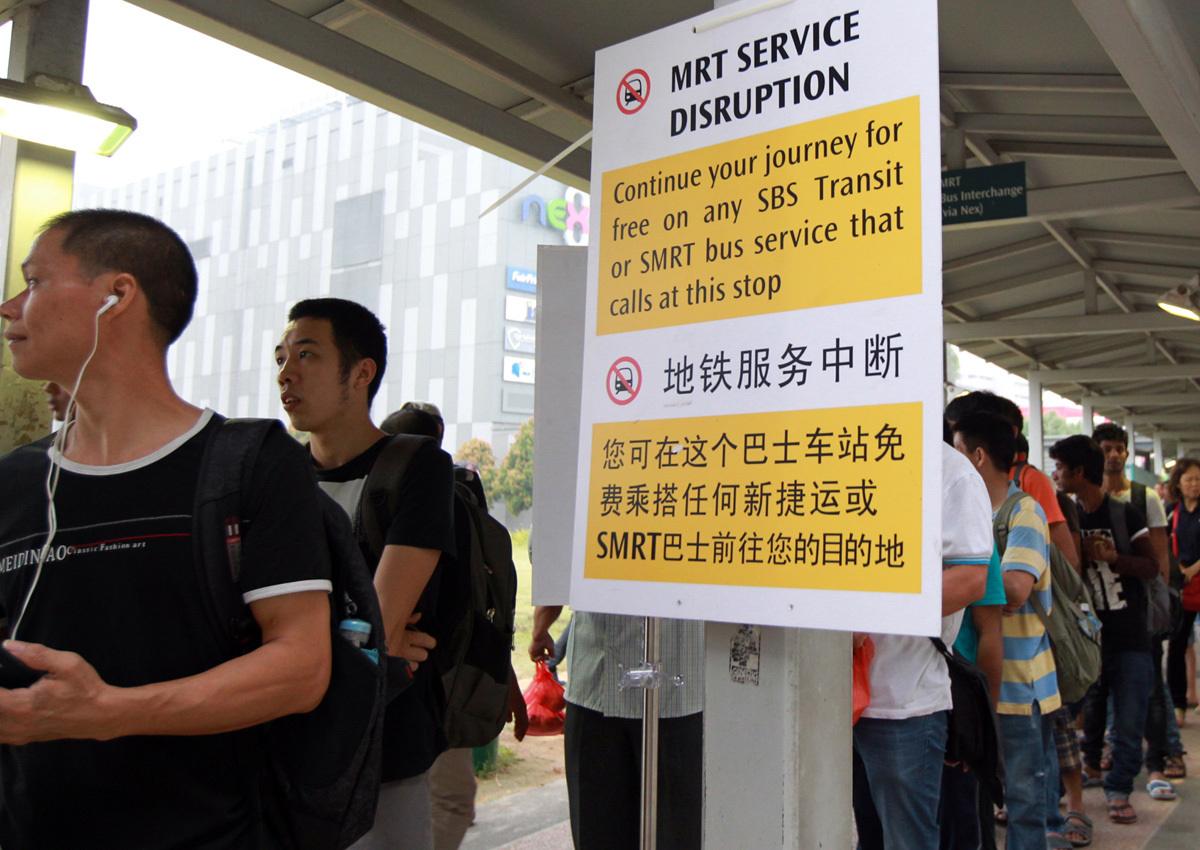
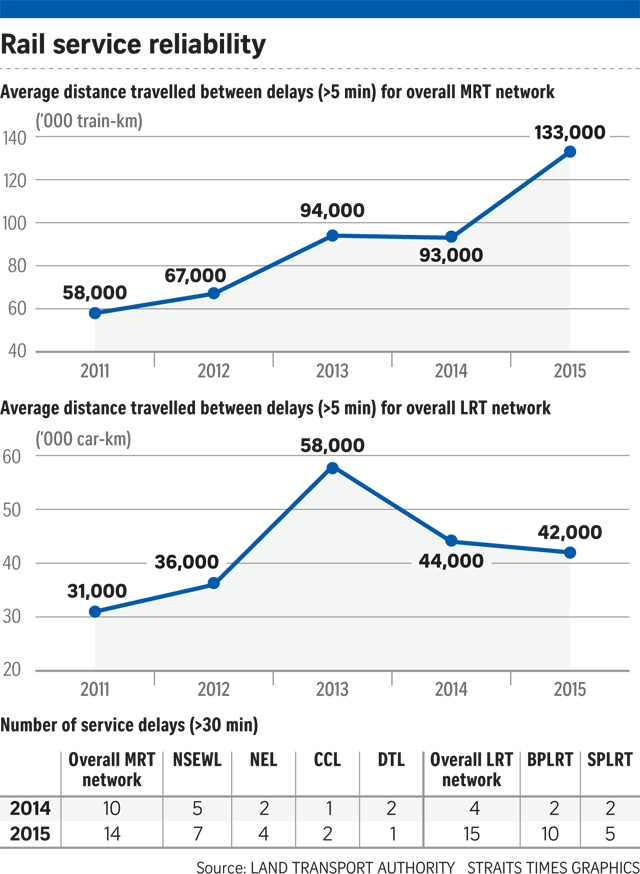
There were 14 major breakdowns on the MRT network last year – an increase of 40 per cent from the previous year, the Land Transport Authority announced on its website yesterday.

Meanwhile, the number of such breakdowns, each lasting more than 30 minutes, on the LRT system nearly quadrupled to 15.

For the MRT, only the newest line – the Downtown Line – posted a drop in the number of major disruptions. All others saw an increase, with the oldest – North-South and East-West lines – accounting for half the total of 14.

This figure is higher than that in 2011, when two massive breakdowns triggered a public inquiry and a multibillion-dollar asset renewal programme that will take at least two more years to complete.

There were nine major MRT breakdowns in 2011.

As for the LRT system, the problematic Bukit Panjang LRT, which has broken down repeatedly since day one in 1999, chalked up 10 major incidents – up from two in 2014.

Despite the big breakdowns, the rail system was more reliable than it has been since 2011.

Last year, a train clocked an average of 133,000km before a delay of more than five minutes occurred. This was up from 93,000km in 2014 and 58,000km in 2011.

Nevertheless, the 133,000km is still less than half the distance clocked by Hong Kong’s MTR trains between delays.

Of the various lines, the North-East Line was the most reliable, averaging 213,000km between delays.

The LRT network, however, posted an overall dip in reliability by averaging 42,000km between delays. This was down from 44,000km in 2014 but up from 31,000km in 2011.

Dr Walter Theseira, an economist at SIM University, said: “The overall picture is that rail reliability is steadily improving. However, it’s unfortunate that major breakdowns, which tend to inconvenience commuters to a much greater extent, have not improved in recent years.”

Dr Theseira said it is not economically feasible to achieve a state of zero defect.

“The question is whether we have put, or are putting in enough spending on maintenance to bring that probability of disruption down to an acceptably low level,” he said.

“I believe the public does understand this and will accept a low, but not zero, level of breakdowns in the system. However, I think what disturbs the public is the fact that some breakdowns could have been avoidable.”

National University of Singapore transport researcher Lee Der-Horng said the declining number of minor disruptions was “a positive sign”.

But he noted that the Circle Line was the only MRT line that showed a deterioration of overall reliability from 2013.

“This requires higher attention,” Dr Lee said, explaining that since this line is a connecting line for commuters from the other trunk lines, any disruption will have “a spillover effect” on service on the major lines.

christan@sph.com.sg


This article was first published on April 5, 2016.
Get a copy of The Straits Times or go to straitstimes.com for more stories.

Image: 
Publication Date: 
Tuesday, April 5, 2016 – 10:45
Keywords: 
Send to mobile app: 
Source: 


Rotator Headline: 
More major breakdowns last year, but MRT gets more reliable
Story Type: 
Others

Source link

Total of 7 long weekends for 2017

0

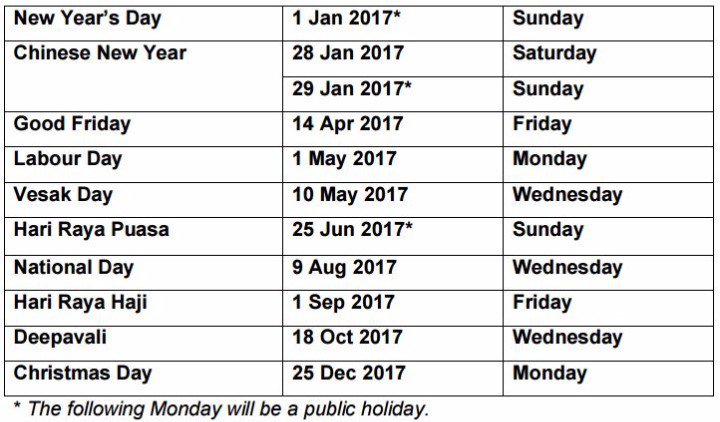
SINGAPORE – Mark your calendars for 2017’s public holidays, which was released by the Ministry of Manpower today (April 5).

There are 7 long weekends for 2017. They are:

New Year’s Day: Jan 1, 2017, Sunday. The next day, Jan 2, 2017 is a public holiday.

Chinese New Year: Jan 28, 29, 2017, Saturday and Sunday. The next day, Jan 30, 2017, is a public holiday.

Good Friday: April 14, 2017, Friday.

Labour Day: May 1, 2017, Monday.

Hari Raya Puasa: June 25, 2017, Sunday. The next day, June 26, 2017, is a public holiday.

Hari Raya Haji: Sept 1, 2017, Friday.

Christmas: Dec 25, 2017, Monday.

grongloh@sph.com.sg

Image: 
Category: 
Publication Date: 
Tuesday, April 5, 2016 – 10:37
Send to mobile app: 
Source: 


Story Type: 
Others

Source link

Growing number of Chinese teens flocking to US schools

0

Growing up on the Chinese mainland, Zhou Hailun always knew that she would finish her high school education in the United States, whatever the cost.

“That’s what everybody does,” said the 17-year-old from Sichuan province, who has spent the past two years studying in California and will graduate this spring.

“My father’s friends all sent their kids abroad, so that was the trend.”

Zhou is among a growing number of Chinese teens who are flocking to US high schools, looking for a Western education and a competitive edge in gaining admission to US universities and then finding a job back home.

But the pursuit of the American dream can quickly turn into a nightmare, experts warn, as many of these so-called parachute kid live in the US with little parental supervision and can end up in trouble – and even in prison.

“It’s a huge industry,” said Joaquin Lim, who runs a company that helps place Chinese students in US schools. “The last figure I read put it at $25 billion (S$33 billion).”

Of nearly 1 million international students enrolled in public and private institutions in the United States in 2014 and 2015, about 304,000 – or 31.2 per cent – were from China, according to the Washington-based Institute of International Education.

About 30,000 of those students attended secondary schools, compared with fewer than 1,000 a decade ago.

The majority of these “parachute kids” ages 14 to 19 end up in Southern California. For the most part, they attend Catholic or Christian schools because of restrictions by the US government on the number of foreign-exchange students enrolled in public schools.

In cities such as Murrieta, a rural community about 130 kilometers southeast of Los Angeles, the number of Chinese students has ballooned in recent years, bringing welcome cash to the school district as well as the host families who care for the teens.

“It costs about $50,000 a year for the parents, who are mostly middle class, to send their kids here, but they consider it an investment,” Lim said.

“Three years ago, we had about 40 Chinese students enrolled in high schools in Murrieta and today we have more than 300, and the number keeps growing.”

The town of about 105,000 residents is a far cry from China’s polluted mega-cities, but most of the teens adjust well to US life, said Renate Jefferson, who oversees the exchange programme for the public school district.

“What they notice first is the blue sky,” she said. “They just walk around in awe at the blue sky. They think it’s beautiful.”

The students are also baffled by the freedom they enjoy academically – a welcome change from the rigorous, rote-learning system in China.

“You have a lot of choices and much more freedom to study what you’re interested in,” said Li Junheng, 19, who is graduating this year from a Catholic school in Murrieta.

But many of the “parachute kids”, whose parents rely on intermediaries to help them through the bewildering application process, are in for a hard landing in the United States, ill-equipped to navigate the cultural transition and their newfound independence.

Last month, three Chinese teens enrolled at a private school in Rowland Heights, a neighborhood east of Los Angeles, were given prison sentences ranging from six to 13 years for attacking a classmate.

The incident attracted widespread attention in China and prompted soul-searching on the wisdom of sending teenagers to a foreign country with no close parental supervision.

“You don’t send your child 6,000 miles before verifying the school and who they are staying with,” Lim said. “Too often, these kids are thrown into a completely foreign environment and are not prepared to fend for themselves.”

Image: 
Category: 
Publication Date: 
Tuesday, April 5, 2016 – 09:49
Send to mobile app: 
Source: 


Story Type: 
Others

Source link

Activists renew calls to ban Yulin dog meat festival

0

Animal rights activists are calling for the end to an annual dog meat festival in South China blamed for tarnishing the country’s reputation internationally.

The Litchi and Dog Meat Festival in Yulin, Guangxi Zhuang autonomous region, is usually held in June, but has met increased opposition in recent years amid concerns over canine cruelty and unhygienic food handling practices.

Activists say that they will continue to press for the festival to be banned and for legislation outlawing the slaughtering of dogs and cats for meat in China to be outlawed.

“The Yulin authorities need to adopt more proactive and decisive steps to crack down on an industry that kills dogs acquired illegally and sells their meat in breach of the state’s food safety regulations,” said Qin Xiaona, founder and director of Capital Animal Welfare Association.

According to Humane Society International, around 10-20 million dogs are killed every year across China for human consumption, predominantly in the south and northeast.

Qin claims that more than 80 per cent of these are stolen pets, according to her association’s research.

Peter Li, China policy specialist of Humane Society International, said the Yulin festival has reduced in size in recent years as the authorities in Yulin are under pressure from both domestic and international protest.

“The peak of dog slaughter was in 2012 or 2013 when more than 10,000 dogs were killed in three days. The number dropped to 2,000 in 2015,” said Li.

In 2014, the Yulin authorities realised that endorsing the festival was a bad idea and in May 2014, they issued an internal warning to all government employees and families not to attend the dog meat restaurants.

“The Yulin authorities distanced themselves from the festival, saying it was a totally private business event, and shut down one live dog market and two dog slaughter operations in the city,” according to Li.

“This led to a drastic reduction in the number of dogs slaughtered in 2014,” he added.

Yu Hongmei, director of the VShine Animal Protection Association, said China needs to follow the example of other developed nations that have banned human consumption of dog and cat meat.

Image: 
Category: 
Publication Date: 
Tuesday, April 5, 2016 – 09:42
Keywords: 
Send to mobile app: 
Source: 


Story Type: 
Others

Source link

Convicted murderer Jabing Kho to hang after failing in bid to commute death sentence

0

April 05, 2016 9:46 AM

SINGAPORE – Convicted murderer Jabing Kho’s eleventh-hour bid to quash his death sentence, which he made last year less than 24 hours before he was due to be hanged, has failed.  


Source link

Public transport gets higher marks for quality, affordability

0

MORE commuters are giving Singapore’s public transport system the thumbs up.

Research released yesterday by government feedback unit Reach shows that commuters’ perceptions towards the quality and affordability of the public transport system have improved since last year.

In a telephone poll with 1,200 Singapore residents aged 15 and older, 80 per cent of respondents agreed that Singapore has a good public transport system, up from 74 per cent last year.

About 66 per cent agreed that it is generally affordable, up from 63 per cent in 2015.

Half of the respondents were also supportive of moving towards lower car ownership here.

The poll was conducted from Feb 29 to March 4, and respondents were randomly selected.

These findings come as the Government has pumped in billions to expand the bus fleet and ramped up a renewal plan for the North-South and East-West MRT lines, which are nearly 30 years old.

Some 760 new buses were put on the roads at the end of last year and another 240 are to come by 2017 as part of the Bus Service Enhancement Programme. It was launched in 2012 to meet the needs of a growing population.

Twelve new trains were added to the Circle Line at the end of last year to grow the fleet to 52. Four were added to the North-East Line’s fleet of 25.

The poll by Reach also showed that about six in 10 respondents were confident that the reliability of train services will improve.

Currently, services at some stations on the East-West Line end up to half an hour earlier so that engineering work, such as sleeper replacement, can be carried out. SMRT intends to complete the work by 2017.

About 1.26 million people took public transport to work last year, according to the latest General Household Survey released on March 9.

One of them is hairdresser Lawrence Yeo, who takes the train to his workplace at City Hall six days a week.

The 55-year-old Pasir Ris resident, who is a father of two, has never owned a car.

Mr Yeo said: “The public transport system is convenient. I don’t have to wait very long for the train – only around two minutes.

“Even if I take a cab occasionally, it is still cheaper than owning a car.

“It’s presently crowded but bearable. I do hope that, one day, it works 24 hours – so even if you stay out late, you still have a reliable and affordable option to come home.”

xueqiang@sph.com.sg


Get MyPaper for more stories.

Image: 
Publication Date: 
Tuesday, April 5, 2016 – 08:43
Keywords: 
Send to mobile app: 
Source: 


Story Type: 
Others

Source link

Bid to track down otter pup with hook in eye

0

SHE was following a family of otters, snapping photographs of them, when she realised that one of the pups had a fish hook in its eye.

Yane Kang, 40, is part of a group of about 10 otter watchers, who track the movements of wildlife including this particular family of two parents and eight pups, often spotted at Bishan-Ang Mo Kio Park.

Ms Kang told My Paper yesterday that she had been observing the otters on Saturday evening when she spotted the hook in one of the younger pups’ right eye.

The pup is believed to be four to five months’ old, part of a second litter born in December. The family is known affectionately to insiders as Bishan 10.

Asked if it was done deliberately, Ms Kang paused.

“We are not sure,” she said. “When I noticed, the otter already had a hook in its eye.”

My Paper reported about a similar case in October last year.

Otter lover Nick Soo, known by his moniker Fast Snail, had taken a video capturing an angler who seemed to be trying to hook an otter.

The otter squealed and was caught, before escaping with an injury that left it limping.

The video went viral and the angler turned himself in to the police later.

Mr Soo uploaded Ms Kang’s photos of the hooked pup to Facebook on Saturday.

He wrote that it was “related to illegal fishing again”.

Ms Kang, who has made a report to the Animal Concerns Research & Education Society (Acres), said the pup still has the hook in its eye and they are trying to locate it.

“We tried following them but they’re swimming too far away,” she added.

“We hope that members of the public will be more aware that we are sharing our environment with wildlife.

“Wildlife in Singapore is unique to our land and we believe that humans and animals can co-exist.”

Otters have become an increasingly common sight in Singapore, and can be spotted in waterways along Punggol Waterfront and Sungei Buloh, other than Bishan-Ang Mo Kio Park.

Anbarasi Boopal, director of Acres Wildlife Rescue Centre, said it is working with the otter watchers to help the pup.

“If any member of the public spots the injured pup, they can call the Acres 24-hour hotline at 9783-7782,” she said.

The otters are believed to have been last spotted at Kallang Basin on Sunday.

lydialam@sph.com.sg


Get MyPaper for more stories.

Image: 
Category: 
Publication Date: 
Tuesday, April 5, 2016 – 08:49
Keywords: 
Send to mobile app: 
Source: 


Rotator Headline: 
Acres appealing for help to track down otter pup with hook in eye
Story Type: 
Others

Source link