Tampines Rovers coach V Sundramoorthy goes On The Record to throw his hat into the ring, after previous coach Bernd Stange stepped down this month. “I’m born and bred here, and if the bigwigs in the FAS feel that I’m the right one, then good.”
Source link
I’m the man for the job: Sundram on Singapore football coach hot seat
Paul Walker's daughter gets $13.6m settlement in actor's death

The 17-year-old daughter of late actor Paul Walker has reached a $10.1 million (S$13.6 million) settlement with the estate of the man driving the car that crashed and killed them both in 2013, her attorney said on Friday.
Walker was a passenger in a 2005 Porsche Carrera GT driven by Roger Rodas when the car, traveling at speeds of 80 to 93 miles per hour (129 to 150 kilometers per hour), careened into trees and a utility pole in Santa Clarita, northwest of Los Angeles.
Meadow Walker’s attorney, Jeff Milam, said in a statement that the settlement would go into a trust for the teen.
The settlement, reached in November 2014, went unnoticed for nearly a year and half because it was filed under “Meadow W.”, according to celebrity news website TMZ, which first reported the story.
According to Milam’s statement, Rodas was only partially responsible for the crash, and the settlement covers a “fraction of what her father would have earned as an international movie star had his life not been tragically cut short.” Attorneys for Rodas’ estate could not immediately be reached for comment.
Fast And Furious star Paul Walker dies in car crash: Reports
Click on thumbnail to view photos. Source:
Reuters, , Shaw Organisation, Sony Pictures, UIP, YouTube screengrabs
































































Walker’s death at age 40 led to a lull in production of “Furious 7,” the latest movie in the mega-hit action series about illegal street racing that propelled his career.
The 2015 film grossed more than $1.5 billion worldwide, making it among the highest-earning films of all time.
Milam said the actor’s daughter was continuing her lawsuit against Porsche AG and that she “intends to hold the company responsible for producing a vehicle that was defective and caused Paul Walker’s death.”
Meadow Walker, the actor’s only child and sole heir, filed the complaint against the German automaker last September, accusing it of skimping on safety features that could have prevented the crash or at least kept him alive.
Porsche has maintained that the actor was responsible for his own death. After a four-month investigation, Los Angeles officials said the crash was caused by excessive speed, not mechanical failure.
Milam said Paul Walker survived the impact of the crash, but”burned to death because of Porsche’s defective design.”
A federal judge presiding over a similar lawsuit filed by Rodas’ estate against Porsche in Los Angeles ruled in favour of the car company on Monday, saying: “Plaintiff has provided no competent evidence that Rodas’ death occurred as a result of any wrongdoing on the part of Defendant.”
Image:

Publication Date:
Saturday, April 9, 2016 – 10:26
Keywords:
Send to mobile app:
Source:
Story Type:
Others
'Descendants of the Sun': More fantasy than reality

Lee Soo-yeon, a 27-year-old office worker in Seoul, can’t get enough of “Descendants of the Sun,” the ongoing Korean drama series that features a military romance between a solider and a surgeon.
“I think the series has many things that I can’t really see or achieve in my real life, such as the sense of justice, responsibility and altruism,” she told The Korea Herald. “And on top of all that, it is just very romantic.”
The 16-episode series takes place in a fictional war-torn Mediterranean country named Uruk, and features the story of special forces Capt. Yoo Si-jin, played by heartthrob Song Joong-ki.
He is in charge of mysterious and dangerous peacekeeping duties and falls for an army surgeon, Kang Mo-yeon, played by A-list actress Song Hye-kyo.
While the series garnered avid followers in Korea and abroad, even being cited as a tremendous economic and tourism booster, the enormous popularity of the military romance ironically reflects what today’s Korean society lacks, critics say.
“I think the character played by Song Joong-ki is great. He’s capable, courageous and has a sense of integrity,” said activist Lim Tae-hun, who heads the Military Human Rights Center — an advocacy group calling for human rights reforms in the Korean military.
“The only thing is that it’s almost impossible for a soldier like him to exist in South Korea’s military system.”
While the fictional character Yoo in the show enjoys special comradeship with his fellow soldiers, Lim said such military relationships were far from the reality, where suppressive military culture prevails and cases of abuse by soldiers are frequently reported.
“I’d say there is just no sense of dignity in the Korean military,” Lim said. “You don’t have any privacy. There is a strict hierarchy within the system. You don’t have the option of quitting while serving your military duty, unless you are willing to become an ex-convict.”
An able-bodied man refusing to perform his service leads to a jail term of one year in South Korea. Military duty is often therefore perceived as an inevitable obligation rather than a heroic deed.
These actors are scorching hot, thanks to Descendants of the Sun
Click on thumbnail to view photos. Source:
Viu, Instagram
































Other experts pointed out that the series promotes patriarchal values and nationalism. The series even won praise from President Park Geun-hye, who recently said the show could help “instill patriotism” among young Koreans. Patriotism is the Park administration’s most prioritized value, with such high-ranking officials as Prime Minister Hwang Kyo-ahn trumpeting all government-led policies as being based on the love for the country.
Acerbic critics of the series also note that the dialogues often reflect deeply embedded discrimination, which in another language would likely sound downright offensive.
In her column published last month, film critic Hwang Jin-mi pointed out that the character Yoo often makes sexist comments.
“He says, ‘it is my duty as a solider to protect children, the elderly and pretty women,'” she writes in the column published in a local daily. “Why does it have to be ‘pretty women,’ instead of just ‘women’?”
Hwang also addressed in the column that while the surgeon Kang is seemingly depicted as an independent, capable woman who offers medical relief to disaster victims in Uruk, she is always rescued by Yoo whenever she is in a life-threatening situation.
To Hwang’s comments, culture critic Lee Moon-won said the series in fact specifically targets female viewers, not the other way around.
“Most Korean men — especially those who have served their military duties — don’t want to watch TV drama series that feature men in military uniforms,” he said.
“Most of them don’t find any joy in watching fellow men being trained in the military. It’s the kind of experience that they’d rather not be reminded of. I argue that the series fulfills fantasies of female viewers, especially the one of physically strong men in uniforms who are also extremely caring and romantic at the same time.”
Critic Lee however said the show does reflect Korea’s situation of gender imbalance which makes women more vulnerable to financial insecurity and unemployment.
“I think patriarchal men can be seen as attractive to female viewers when they are exceptionally capable, physically strong and responsible,” he said.
“Given today’s sluggish economy and job market, it’s hard to find such (everyday supermen) who have those qualities whether they are patriarchal or not. I think the popularity of such strong, male military characters in the show reflects women’s collective insecurity and anxiety.”
Descendants Of The Sun heart-throb caused NG takes: Song Hye Kyo
Click on thumbnail to view photos. Source:
Viu, KBS World




























dyc@heraldcorp.com
Image:

Publication Date:
Saturday, April 9, 2016 – 10:25
Keywords:
Send to mobile app:
Source:
Rotator Headline:
'Descendants of the Sun' is more fantasy than reality
Rotator Image:

Story Type:
Others
Women in China ponder safety after hotel assault incident
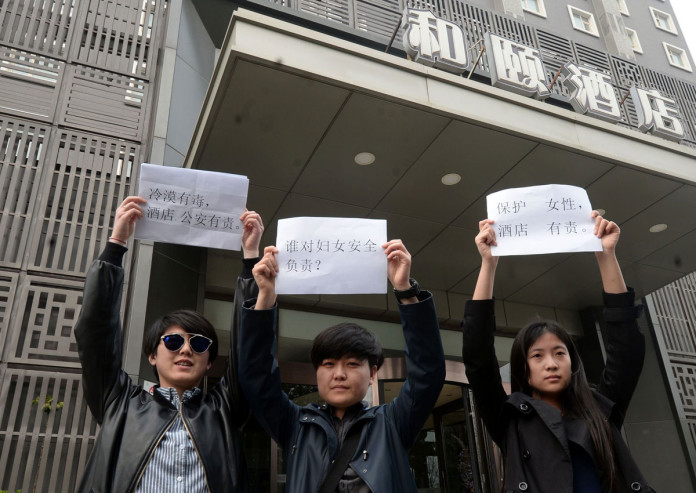
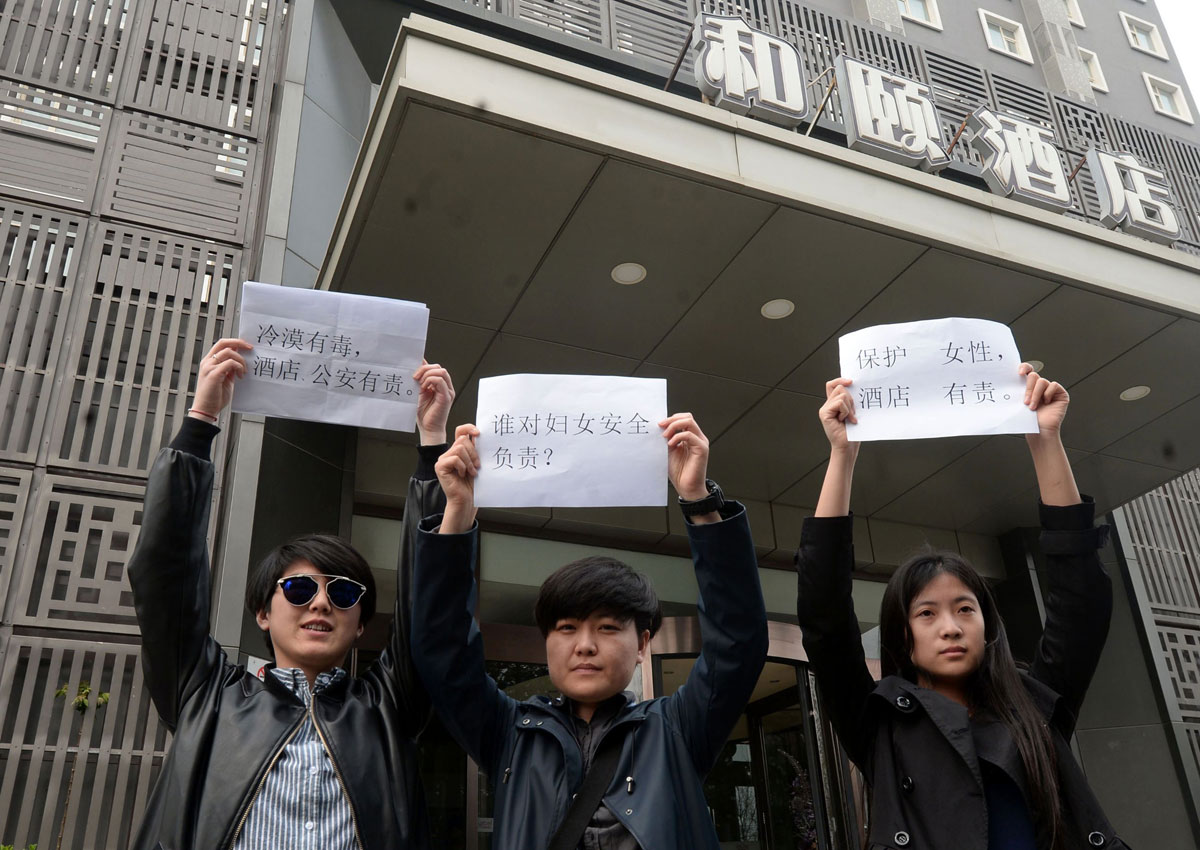
The arrest of a man in connection with the alleged assault of a woman at a four-star Beijing hotel has led many people to discuss the case, and the safety of women.
The news came on Friday when Beijing police posted a micro blog to say they had arrested a 24-year-old man surnamed Li on suspicion of involvement. They made the arrest at around 9 pm on Thursday in Xuchang city, Henan province.
“We established a special team to investigate the case after becoming aware of online video clips (of the incident) in which a man appeared to attack and drag a woman,” the posting said. Police are continuing their investigation, it added.
The alleged assault, which reportedly happened on Sunday, has garnered a great deal of attention in China, where many netizens have criticised the hotel’s security arrangements.
Sun Jian, CEO of the hotel’s parent company, Homeinns Hotel Group, a popular budget hotel chain in China, issued a statement on Friday apologising for any failings and vowing to thoroughly review security.
The alleged victim said she accepted the apology, and added that she wants to know the truth about what happened and is not seeking compensation.
She said in her micro blog that she was relieved to hear about the arrest of a suspect and welcomed the hotel chain’s review of its security.
“My two main requirements have been met,” she wrote. “I’m tired now and want to go back to my normal life.”
The woman, 27, was a tourist from Zhejiang province when the alleged incident happened. She wrote about it online on Tuesday night, saying she was followed and attacked by the suspect in the Yitel Hotel, in the Chaoyang district of the capital.
Video clips apparently recorded by hotel surveillance cameras show the man taking the same elevator as her and exiting on the same floor. He then appears to suddenly grab her, drag her and choke her, apparently covering her mouth to prevent her yelling.
Several people, including a hotel employee, are then seen passing by, but no one offers help until some guests finally realise what is happening and step in.
The incident caused many people to comment about the lack of willingness by many passers-by to get involved in situations. Others have commented online about the importance of women learning self-defence.
Ruan Chuansheng, a Shanghai criminal lawyer, said it was too soon to speculate on which charges the suspect might face.
“But it’s good to see the case has caught women’s attention and caused them to think about protecting themselves,” he said. “The topic of personal safety will, I think, remain a hot topic for some time.”
Xu Yun, 28, a Beijing resident, said she has bought pepper spray online to avoid being in a similar situation.
“It’s necessary for women to ask ourselves how much we know about self-protection.”
And Liu Xinrui, 27, a Beijing resident who works for a film company, said: “I will be concerned when I have a business trip alone or I come back home late. I’m searching for self-protection tips on social media and also looking for products used for self-defence.”
Image:
Blurb:
Many want to know more about self-defense as police announce arrest of a 24-year-old suspect. -China Daily
Publication Date:
Saturday, April 9, 2016 – 10:15
Keywords:
Send to mobile app:
Source:
Story Type:
Others
Re-employment age cap up from July 2017
From July 1 next year, workers will get to be re-employed up to the age of 67 years.
The announcement of the date for raising the re-employment age ceiling has been a long-awaited one, and comes 23 years after the Government first made clear that it wanted Singaporeans to be able to work until 67.
From the date, employers will be obliged to offer re-employment to eligible workers up to the age of 67. This is two years older than what is legally required today.
And those who want to be re-employed can also work with a different company if they agree to it.
Separately, a legal provision allowing companies to cut the wage of employees who turn 60 will be removed.
Minister of State for Manpower Sam Tan announced these changes yesterday during the debate on the Manpower Ministry’s budget.
He said that until the law is changed, the Government will continue to support companies which voluntarily re-employ workers older than 65. These companies get a subsidy equivalent to 3 per cent of the employee’s wages.
Since 2012, employers have been required to offer re-employment to eligible workers when they retire at 62, or give them one-off payments if they cannot be re-hired.
Mr Tan said that in future, older workers can be re-employed by a different company, provided the worker agrees to the transfer and the new employer fully embraces the re-employment obligations.
“We have received feedback that, sometimes, employers are unable to find suitable jobs in their own companies, but can help the worker secure re-employment in a related or subsidiary company,” he added.
On the removal of the legal provision to cut employees’ wages by up to 10 per cent when they turn 60, Mr Tan said it was “no longer relevant” as more than 98 per cent of companies here do not make such cuts.
The provision was needed in the early days when wages were more closely tied to seniority, to make older workers more attractive to companies, he added.
In recent years, more than 98 per cent of local employees who wanted to keep working beyond the age of 62 got their wish.
Said Mr Tan: “Going forward, pay should be reflective of workers’ job scope and value, regardless of age.”
During the debate, Ms Jessica Tan (East Coast GRC) noting how “MOM is committed to letting workers work longer and as long as they can and they’re willing to”, suggested raising or removing the retirement age.
But Manpower Minister Lim Swee Say said that doing so could result in less protection for workers as companies are then free to terminate their employment even earlier.
Labour MP Heng Chee How (Jalan Besar GRC) pointed out that some companies, such as ComfortDelGro, have set retirement ages that are higher than what is legally required.
Mr Heng, who is also Senior Minister of State in the Prime Minister’s Office, asked if MOM could work with the labour movement to encourage more firms to follow suit.
Mr Lim praised the “progressive” behaviour of such companies and suggested that the Tripartite Alliance for Fair and Progressive Employment Practices (Tafep) should spearhead these efforts.
oliviaho@sph.com.sg

This article was first published on April 9, 2016.
Get a copy of The Straits Times or go to straitstimes.com for more stories.
Image:

Blurb:
Workers can stay in job till age 67; law letting firms cut pay of 60-year-olds to be scrapped. -ST
Publication Date:
Saturday, April 9, 2016 – 10:09
Keywords:
Send to mobile app:
Source:
Story Type:
Others
More help for laid-off PMETs to get new jobs
Professionals, managers, executives and technicians (PMETs) will be given more support in securing new jobs, after making up the bulk of retrenched workers last year.
Manpower Minister Lim Swee Say yesterday announced enhancements to three programmes aimed at helping higher-skilled workers adapt to a more dynamic economy.
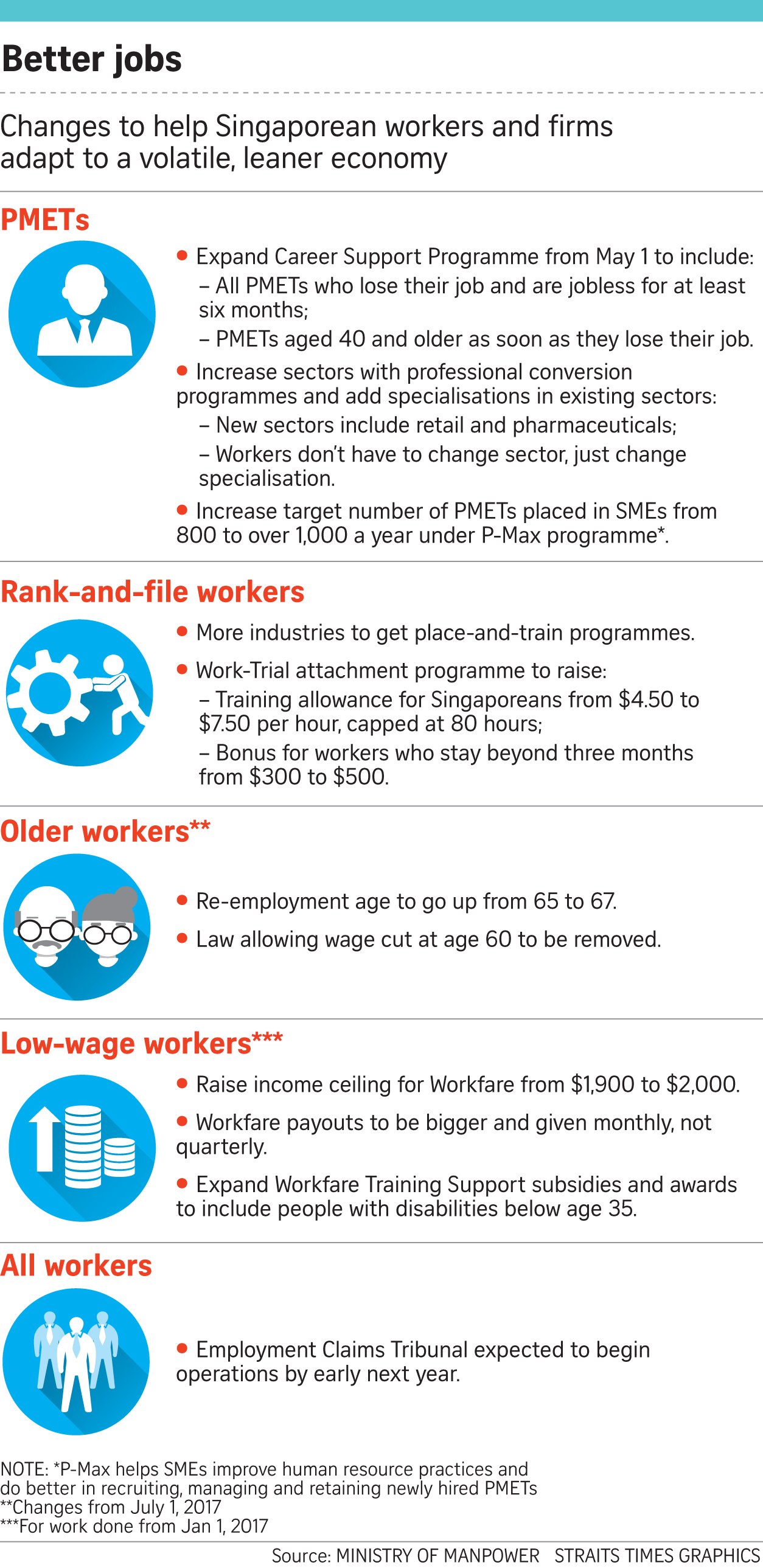
From next month, all Singaporean PMETs who lose their jobs and are unemployed for at least six months will be able to make use of the Career Support Programme, which previously only helped long-term unemployed Singaporeans aged 40 and above. It encourages employers to hire eligible job seekers for positions paying at least $4,000 and give them on-the-job training.
Currently, the Government foots 40 per cent of the wage bill for the first six months for those aged 50 and above, and 20 per cent for those aged 40 to 49, capped at $2,800 and $1,400 respectively. This funding is then halved for the next six months.
Older PMETs aged 40 and up will now also be eligible for the programme as soon as they are made redundant. Those who are jobless for at least six months will still qualify.
The new groups get 20 per cent of their wage covered for the first six months and half the funding for the next six.
Since the scheme was introduced last October, around half of the 200 older and long-term unemployed PMETs who participated in it have found new jobs, mostly in small and medium-sized enterprises (SMEs), Mr Lim said during the debate on his ministry’s budget.
Redundancies may go up as the pace of industry transformation picks up and Mr Lim said he was concerned that the longer workers are out of work after being made redundant, the harder it will be for them to get back into jobs.
“Our priority is to help them to get back to work quickly. We are unable to promise no pay cut, or guarantee job offers, but what we do promise is our best efforts to help with a variety of options and a diversity of opportunities,” he said. “We need them to do their best to help themselves, be prepared to adapt to different jobs – if necessary, in different sectors and even at different pay, so that they can grow again.”
To help workers switch jobs within and across sectors, a career conversion programme will be expanded to sectors like pharmaceuticals, logistics and retail.
Finally, under the P-Max programme, more partnerships with trade associations should also help find work for over 1,000 PMETs in SMEs each year, up from 800 who were placed over the first year.
The programme was started last year to help SMEs improve human resource practices and recruit, manage and retain newly hired PMETs.
Mr Lim also assured rank-and-file workers they will not be neglected.
More sectors will have Place and Train programmes, which provide salary support and course fee subsidies for employers, while their workers pick up new skills. Some 1,200 workers were placed last year. New roles will include guest services officers, and communication and network associates.
The Work-Trial attachment programme will also be enhanced, with higher training allowances for Singaporeans at $7.50 per hour capped at 80 hours, up from $4.50 per hour. The retention bonus for workers who stay beyond three months will be raised from $300 to $500.
As for workers with salary-related claims, all workers should be able to use the Employment Claims Tribunal from early next year.
joseow@sph.com.sg
This article was first published on April 9, 2016.
Get a copy of The Straits Times or go to straitstimes.com for more stories.
Image:

Publication Date:
Saturday, April 9, 2016 – 10:05
Keywords:
Send to mobile app:
Source:
Story Type:
Others
Stricter rules for Employment Pass approval
The Manpower Ministry is adopting a stick-and-carrot approach in dealing with the issue of hiring foreign professionals.
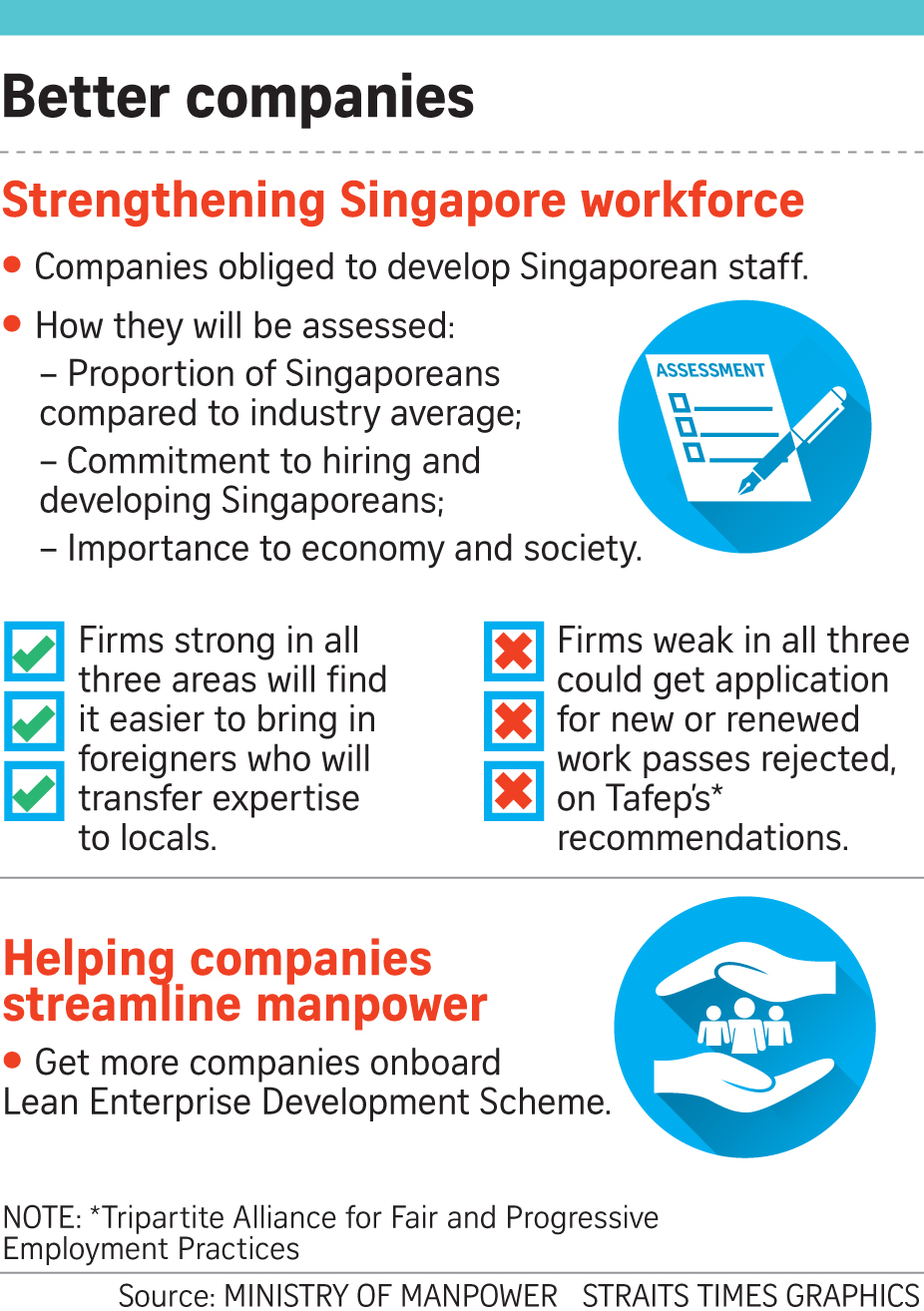
Employers who persist in hiring them for no good reason and fail to have concrete plans to nurture their Singaporean staff will find it harder to operate and expand in Singapore.
The ministry is going to be more demanding before giving the nod for an Employment Pass (EP).
The criteria for approval will be changed to include such factors as the proportion of foreigners in a company and whether it tried to recruit Singaporeans for the job.
Also, it will examine the extent of the company’s contribution to the economy and society.
Those deemed weak in all three areas will face difficulties in renewing the EPs of existing foreigners and getting new ones for fresh hires.
“The curtailment of work pass privilege will have serious consequences on (the companies’) continued operation and growth in Singapore,” Manpower Minister Lim Swee Say said in his strongest words yet on recurring complaints that foreigners are snatching professional jobs from Singaporeans.
He said: “(It is) not because we are anti-foreigner, but because (such companies’) behaviour has added to the deepening of ‘local-foreign’ divide in our Singapore workforce.”
On the other hand, companies that develop their Singaporean workforce will find it easier to bring in foreign experts who will transfer their expertise to local professionals, managers and executives, said Mr Lim. He was speaking during the debate on his ministry’s budget in Parliament yesterday.
His ministry considers only the foreigners’ background, such as qualifications, experience and salaries, when assessing EP applications.
The importance of preserving a Singaporean core in the workforce was highlighted during the debate by MPs like Mr Patrick Tay (West Coast GRC), Mr Lim Biow Chuan (Mountbatten) and Mr Chong Kee Hiong (Bishan-Toa Payoh GRC).
The minister assured them building a strong Singaporean core is one of his ministry’s three key priorities.
He also said employment watchdog Tripartite Alliance for Fair and Progressive Employment Practices (Tafep) will be given a bigger role to investigate and recommend to the ministry employers who should be put on a black-sheep watch list.
About 100 firms are now on it. Over half of their jobs that pay above $3,300 a month are filled by foreigners, the minister disclosed, without naming the firms or their sectors.
Mr Lim also produced numbers to correct the perception that foreigners outnumber Singaporeans in professional, managerial, executive and technical jobs. About 79 per cent of jobs with a monthly pay of more than $3,300 are held by Singaporeans, he said, revealing the proportion for the first time.
Even in the infocomm and food and beverage sectors, where the proportion of foreigners is higher, it is 37 per cent to 38 per cent, he added.
But he acknowledged there are “pockets” of businesses where foreign professionals outnumber Singaporeans. “This is highly undesirable,” he said.
He warned that these employers might already have broken the law by not making “reasonable efforts to provide fair employment opportunities” to Singapore citizens.
The tough move worries Nominated MP Randolph Tan, who asked: “Are we going too far in the opposite direction?”
Mr Lim replied: “I’m very mindful of this and I’ll always make sure that the interest of pro-business, pro- worker will always be harmonised and, hopefully, always strike the right balance.”
tohyc@sph.com.sg
This article was first published on April 9, 2016.
Get a copy of The Straits Times or go to straitstimes.com for more stories.
Image:

Blurb:
In stick-and-carrot approach, firms which hire foreign professionals for no good reason will have a hard time. -The Straits Times
Publication Date:
Saturday, April 9, 2016 – 10:00
Keywords:
Send to mobile app:
Source:
Story Type:
Others
OBS camp for all Sec 3 students from 2020
All Secondary 3 students will have to undergo a new, five-day Outward Bound Singapore (OBS) expedition-based camp from 2020 onwards.
This is being introduced as part of a new National Outdoor Adventure Education Masterplan, which provides students here with more opportunities to benefit from outdoor education. Under the masterplan, students will get to participate in three cohort camps during their school years.
“School camps are a way of immersing our students in authentic and often challenging situations, where they need to work in teams and learn to take responsibility for decisions they make,” Acting Education Minister (Schools) Ng Chee Meng said in Parliament yesterday.
Currently, students participate in at least two such camps – one in upper primary and another in secondary school – where they learn to prepare simple meals, set up shelters and assess risks in the outdoors.
To be held at the OBS campuses in Pualu Ubin and Coney Island, the new Secondary 3 cohort camp, unlike the other two, will bring together students from various schools.
This camp, which will be piloted with some schools next year, will be rolled out across all schools from 2020, when the Coney Island campus is expected to be ready.
The Ministry of Education (MOE) will work with OBS to design the camp programme to ensure it supports the school curriculum.
Under a physical education syllabus introduced in 2014, 10 to 20 per cent of curriculum time in primary and secondary schools is set aside for outdoor education.
Last year, the facilities at the four MOE Outdoor Adventure Learning Centres, such as the ones at Labrador and Jalan Bahtera, were rejuvenated to cut down waiting time for students to try various stations.
For instance, at the centre in Dairy Farm, a continuous belay system has been put in place to allow up to 30 students to attempt the rope course at any one time. Previously, only eight students could do so.
These centres, which have been used to conduct cohort camps for 60 per cent of primary and secondary schools here, will be further upgraded over the next few years to provide enough places for all upper primary and lower secondary school cohort camps.
Mr Ng stressed that the safety of students “remains paramount even as we enhance and expand outdoor education”. A panel has been set up to advise the ministry on the quality and safety of outdoor programmes, both locally and overseas.
Currently, some of the vendors who run such camps for schools rely on freelancers and temporary staff, who may not have the right skills.
The ministry has also put together a group of full-time outdoor adventure educators to conduct cohort camps for schools at the learning centres. These educators would have undergone three months of training and will design and facilitate activities for students..
Former allied educator Melvin Lee, 28, one of the 16 adventure educators selected under this pilot programme, said: “Through camping, students will not only have fun, but will also learn about themselves and their strengths.”
calyang@sph.com.sg
This article was first published on April 9, 2016.
Get a copy of The Straits Times or go to straitstimes.com for more stories.
Image:

Blurb:
Under new masterplan, students will take part in 3 cohort camps during their school years. -The Straits Times
Publication Date:
Saturday, April 9, 2016 – 09:54
Keywords:
Send to mobile app:
Source:
Story Type:
Others
Polys, unis to take more with talents and interests
Polytechnics and universities will admit more students based on their talents and interests as they widen the focus from academic grades alone.
All five polytechnics, as well as three of the autonomous universities – Nanyang Technological University (NTU), National University of Singapore (NUS) and Singapore Management University (SMU) – will expand their existing aptitude-based admissions. The changes will be implemented for students entering the polytechnics and universities next year.
These admission schemes cater to students with abilities and interests in a specific course, as well as those with talents in other areas, such as sports and community service.
“If we are learning something we are interested in, we are more likely to stay curious and engaged,” Acting Minister for Education (Higher Education and Skills) Ong Ye Kung said in Parliament yesterday. “And if we can stay curious, we are likely to make that subject a lifetime pursuit. If we make it a lifetime pursuit, we achieve mastery.”
The polytechnics already take in such students through the Direct Polytechnic Admissions exercise (DPA) and the Joint Polytechnic Special Admissions Exercise (JPSAE), which can admit up to 2.5 per cent and 5 per cent of the polytechnic intake respectively each year.
Now, a new Early Admissions Exercise (EAE) will replace the DPA. The JPSAE, which covers a small segment of students applying based on achievements like community work and sports, will also be wound down and folded into this new exercise.
The EAE, which will begin in the middle of this year, can admit up to 12.5 per cent of the intake. It will allow students to secure a place in a diploma course of their choice even before they sit the O-level exams.
The mode of assessment under the EAE may vary across courses, and can include interviews, portfolio submissions and aptitude tests.
From next year, a similar exercise will be put in place for students progressing from ITE to polytechnic.
At the course level, about one-third of polytechnic courses – such as those in health sciences, design and media – will raise their limits on students admitted via the aptitude-based admissions, from 30 per cent to 50 per cent.
The universities too are expanding their discretionary admissions intake. From next year, NTU, NUS and SMU can admit up to 15 per cent of their annual intake under the discretionary admissions scheme, up from the current 10 per cent.
Under this scheme, applicants who do not meet the cut-off point for the course of their choice but display aptitude and meet minimum academic requirements to cope with the rigours of the course may be considered.
Mr Eng De Sheng, 24, a third-year NUS computer engineering student, was admitted via the scheme for his interest in computers. He has been running his own business offering diagnostics and repairs for computers and smartphones since secondary school.
He said: “This scheme gives those who are already pursuing their interests (a chance) to learn more in the universities.”
But Mr Ong cautioned against “pushing the young to rush into declaring their interests prematurely”.
This article was first published on April 9, 2016.
Get a copy of The Straits Times or go to straitstimes.com for more stories.
Image:

Blurb:
They will expand their existing aptitude-based admissions for next year. -The Straits Times
Publication Date:
Saturday, April 9, 2016 – 09:51
Keywords:
Send to mobile app:
Source:
Story Type:
Others
North Korea says successfully tested missile engine

SEOUL – North Korea said on Saturday (April 9) it had successfully tested an engine designed for an inter-continental ballistic missile (ICBM) that would “guarantee” an eventual nuclear strike on the US mainland.
It was the latest in a series of claims by Pyongyang of significant breakthroughs in both its nuclear weapons and ballistic missile programmes.
Outside experts have treated a number of the claims with scepticism, suggesting the North Korean leadership is attempting to talk up its achievements ahead of a showcase ruling party congress next month.
According to the North’s official KCNA news agency, the ground engine test was ordered and personally monitored by leader Kim Jong Un.
As soon as Kim flagged off the test, “the engine spewed out huge flames with deafening boom”, KCNA said.
“The great success… provided a firm guarantee for mounting another form of nuclear attack upon the US imperialists and other hostile forces,” Kim was quoted as saying.
Now North Korea “can tip new type inter-continental ballistic rockets with more powerful nuclear warheads and keep any cesspool of evils in the earth including the US mainland within our striking range”, he added.
Military tensions on the divided Korean peninsula have been rising since the North conducted its fourth nuclear test in January, and a long-range rocket launch a month later that was seen as a disguised ballistic missile test.
The UN Security Council responded with its toughest sanctions to date over the North’s nuclear programme, and Pyongyang accused Seoul and Washington of spearheading the sanctions drive in New York.
In recent weeks, the state media has carried repeated threats of pre-emptive nuclear strikes against both the South and the US mainland.
The threats have been accompanied by claims of success in miniaturising a nuclear warhead to fit on a missile, developing a warhead that can withstand atmospheric re-entry, and building a solid-fuel missile engine.
North Korea has never tested an ICBM, although it has displayed such a missile, known as the KN-08, during recent mass military parades in Pyongyang.
While the North has clearly made progress in developing the KN-08, most experts still believe it is years from obtaining a credible ICBM strike capability.
Kim described the engine test as an “eye-catching event” which demonstrated the North’s national defence capability to the world.
He also noted that it represented “another great victory” to be presented at the upcoming Workers’ Party Congress, which is believed to be scheduled for May 7.
It is the first congress of its kind for 36 years and seen as a showcase for the leadership to hype its achievements and to cement national unity and loyalty around Kim.
Some analysts have suggested the North could even conduct a fifth nuclear test before the congress, and South Korean officials say they are fully prepared for such an eventuality.
The North said its January test was of a powerful hydrogen bomb, but experts said the detected yield was too low for a full-fledged thermo-nuclear device.
North Koreans across the country have been mobilised in a “70 day campaign” to prepare for the party gathering, with towns and cities across the country being spruced-up and prettified for the event.
Image:

Publication Date:
Saturday, April 9, 2016 – 09:24
Keywords:
Send to mobile app:
Source:
Story Type:
Others


