Home Blog Page 4280

TRS trial: Yang didn't want 'to implicate good friend'

0

Singaporean Yang Kaiheng founded socio-political website The Real Singapore (TRS) with his wife and a “good friend”, yet he told the police he did not know of his friend’s involvement.

Yesterday, he explained why he lied, saying he did not want to implicate his fellow undergraduate Damien Koh, a Web developer.

“I was sure he had nothing to do with sedition in the TRS site,” he told a district court.

Deputy Public Prosecutor G. Kannan told him he had no reason to fear implicating Mr Koh if he knew Mr Koh did not write or upload any articles for TRS.

Yang, 27, who is facing sedition charges, replied: “I didn’t want him to be called by the police and be implicated in the sedition case.”

Last year, Yang had told the police he had “no idea” if Mr Koh was connected to TRS.

But in the last three days, he had testified that Mr Koh was one of the website’s founders and handled its technical aspects.

DPP Kannan said he would address Yang’s inconsistent remarks when he makes his submissions to the judge at the end of the trial.

Both sides, however, were in agreement on one thing yesterday, and that is the person behind the Skype account “able_tree” must have owned and maintained TRS.

The Skype user had discussed TRS matters with Mr Koh from March 2013 to January 2014, indicating that the person who used the account was not doing it on an “ad hoc” basis, said DPP Kannan.

Yang had told the court earlier that he was involved in TRS for only one to two months after it went live in June 2012, and that any other help he gave his wife subsequently was “ad hoc”.

But who is behind the account has yet to be established.

The defence is arguing that only Ai Takagi, 23, who married Yang last October, used the account to discuss TRS matters. Yang had also testified that he used the account out of convenience and only for personal chats with friends.

Takagi had earlier pleaded guilty to sedition and was sentenced to 10 months’ jail.

But the prosecution said it will show later in the trial that Yang was, in fact, the person behind the discussions on the Skype account. The trial, which entered its ninth day yesterday, has been adjourned to June 22.

rachelay@sph.com.sg


This article was first published on April 9, 2016.
Get a copy of The Straits Times or go to straitstimes.com for more stories.

Image: 
Category: 
Publication Date: 
Saturday, April 9, 2016 – 14:00
Send to mobile app: 
Source: 


Story Type: 
Others

Source link

Cars overturn on ECP, Seletar West Link

0

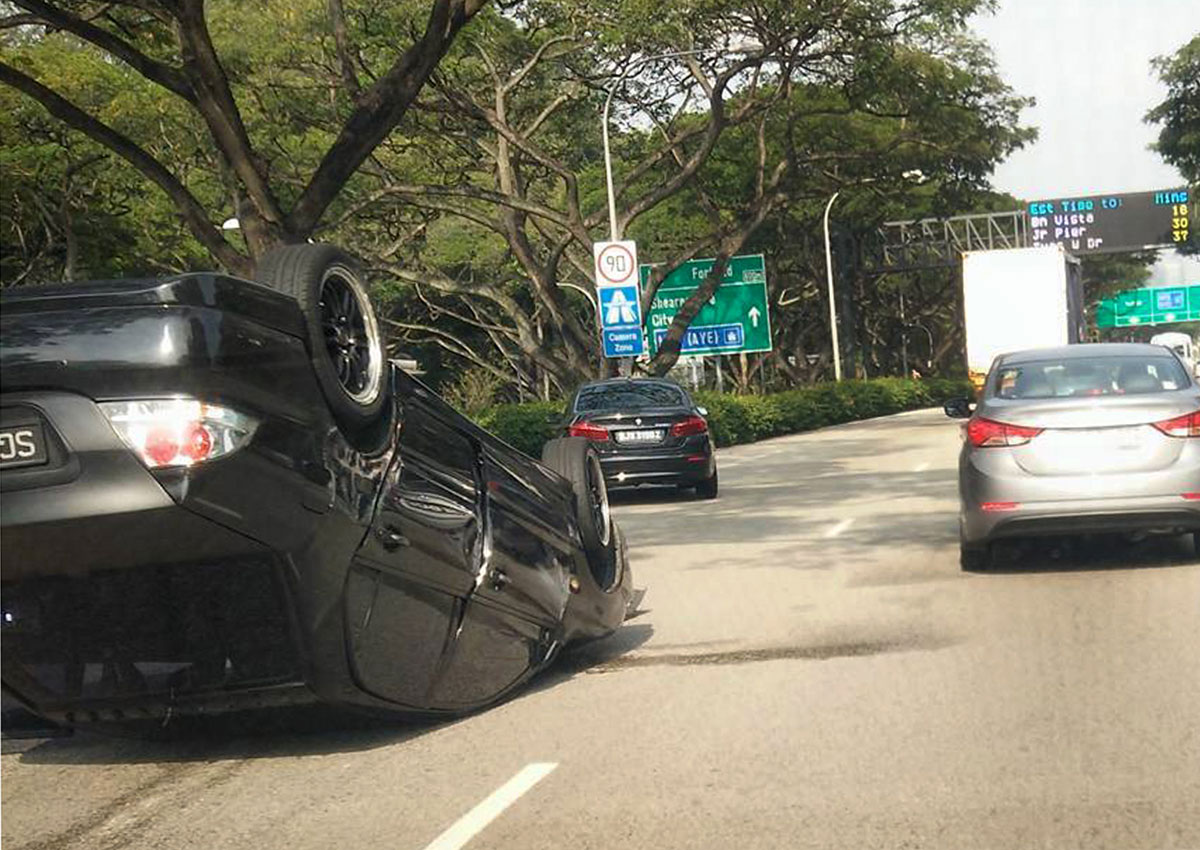
Two cars overturned in two separate accidents yesterday.

In the first, a black car turned turtle near Fort Road on the East Coast Parkway (ECP) in the direction of Ayer Rajah Expressway (AYE).

Two persons were injured, said the Singapore Civil Defence Force (SCDF). It dispatched an ambulance to the scene at around 9.30am.

Traffic was slow near the crash site.

Some motorists stopped to render aid to the injured persons and helped to guide traffic.

The pair were later taken to Raffles Hospital. In the second accident, a car flipped and eventually came to a stop against a lamp post on Seletar West Link (above) at about 4pm.

Madam Sulizah Sulaiman, who took a photograph of the scene while on her drive home from work, said several motorists stopped near the wrecked car.

The driver, a 34-year-old man, suffered minor injuries and refused to be taken to hospital, an SCDF spokesman told The New Paper.

zaihan@sph.com.sg


This article was first published on April 9, 2016.
Get The New Paper for more stories.

Image: 
Category: 
Publication Date: 
Saturday, April 9, 2016 – 21:00
Keywords: 
Send to mobile app: 
Source: 


Story Type: 
Others

Source link

Three more SG50 babies as triplets are granted citizenship

0

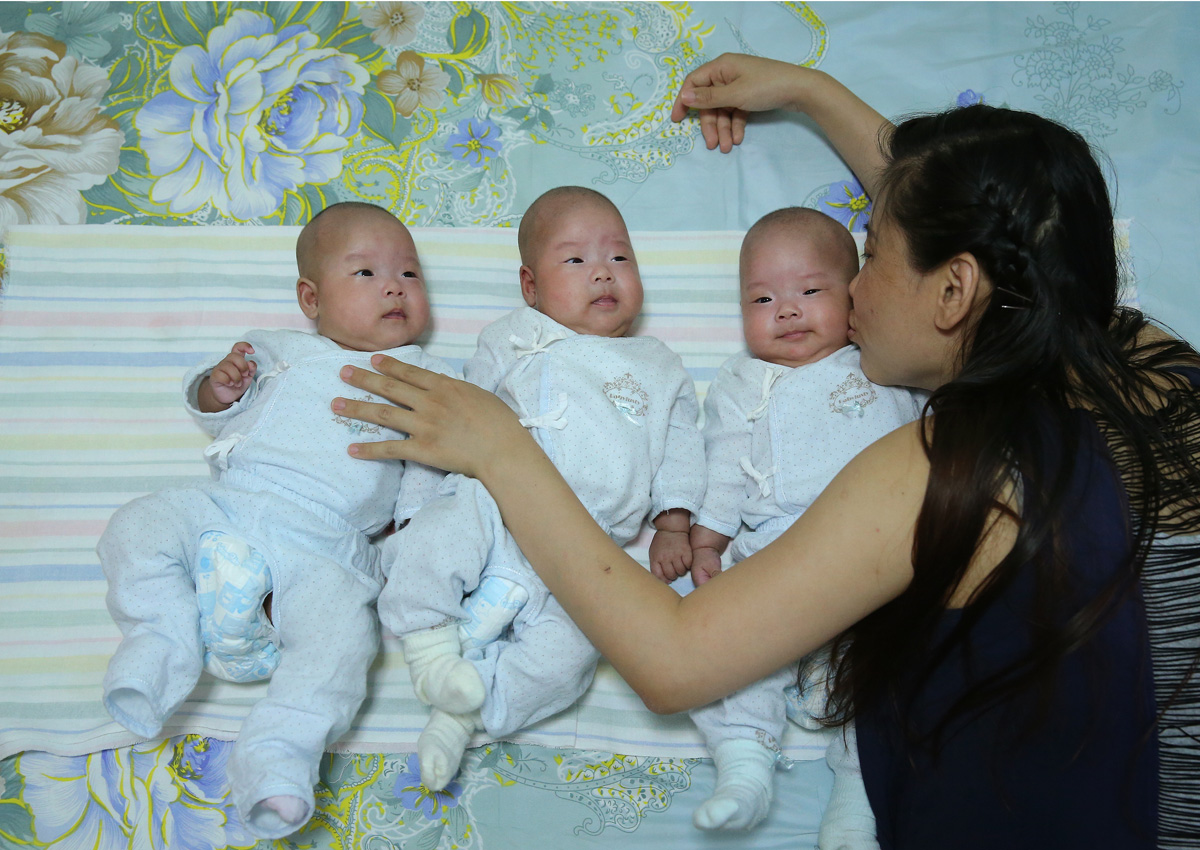
Singapore has three more Golden Jubilee babies, after three girls, who were stateless previously, were granted citizenship last month.

Madam Ning Lei, 35 – a Chinese national whose Singaporean husband ran away – could not register the triplets’ births at the KK Women’s and Children’s Hospital when they were born last July.

Their father’s identity card was needed for registration.

However, the Immigration and Checkpoints Authority (ICA) granted them citizenship last month.

Responding to queries about the development, ICA said it was “unable to comment on individual cases for reasons of confidentiality”.

Madam Ning had just finished feeding her daughters the day the ICA called to tell her that the girls’ birth papers were ready.

“My mind was a blank,” she said in Mandarin, adding that she has been busy changing, feeding and bathing her daughters since they were born.

Her mother is in Singapore to help take care of the girls.

Madam Ning said: “I am very grateful for all the help that ICA, the lawyers, the church and other charitable organisations have given me.”

Lawyer Dinesh Dhillon, a partner at Allen & Gledhill, made a case for the three girls to receive their Singaporean citizenship to ICA. He said: “The case caught my attention because I also have triplets.”

He remembered how his wife, helper and in-laws helped to raise his children. “We had a whole group of people helping… I was wondering how Madam Ning was coping.”

She qualified for help under the Law Society’s Pro Bono Services Office, so he offered his help and wrote a letter, arguing her case, to ICA late last year.

“We sent follow-ups and reminders… Four months later, the good news came,” he said.

For the next step, Madam Ning hopes to have her long-term visit pass approved, which will allow her to work in Singapore. She is now on month-long short stay passes.

“I would like to work in children’s art education,” she said, adding that she used to teach and choreograph dances for children in China.

Hopefully, a long-term visit pass will mean that she can seek help for housing, she added.

She is now living in a room in a condominium, owned by an acquaintance, for free.

“It is not a long-term solution,” she said.

Previously, the family was at a women’s shelter. “It was too noisy,” she said, adding that her family shared a room with two teenagers from China.

Madam Ning said that the last time she was in touch with her husband was on social messaging app WeChat, on the eve of Chinese New Year, when he transferred 5,000 yuan ($1,040) to her.

Her husband – Mr Gng Cher Kang, 35 – whom she believes is in China, also asked for the girls’ photos and videos.

Commenting on the granting of citizenship for her daughters, Madam Ning said she is glad that she no longer has to pay higher fees for her daughters and they can qualify for subsidies given to Singaporeans.

“The savings can help a lot, especially when they are so young and need immunisation jabs and regular check-ups,” she said.

awcw@sph.com.sg


This article was first published on April 9, 2016.
Get a copy of The Straits Times or go to straitstimes.com for more stories.

Image: 
Category: 
Publication Date: 
Saturday, April 9, 2016 – 14:00
Send to mobile app: 
Source: 


Rotator Headline: 
Triplets who were previously stateless now granted Singapore citizenship
Story Type: 
Others

Source link

S Koreans turn to dating apps and matchmakers to find partner

0

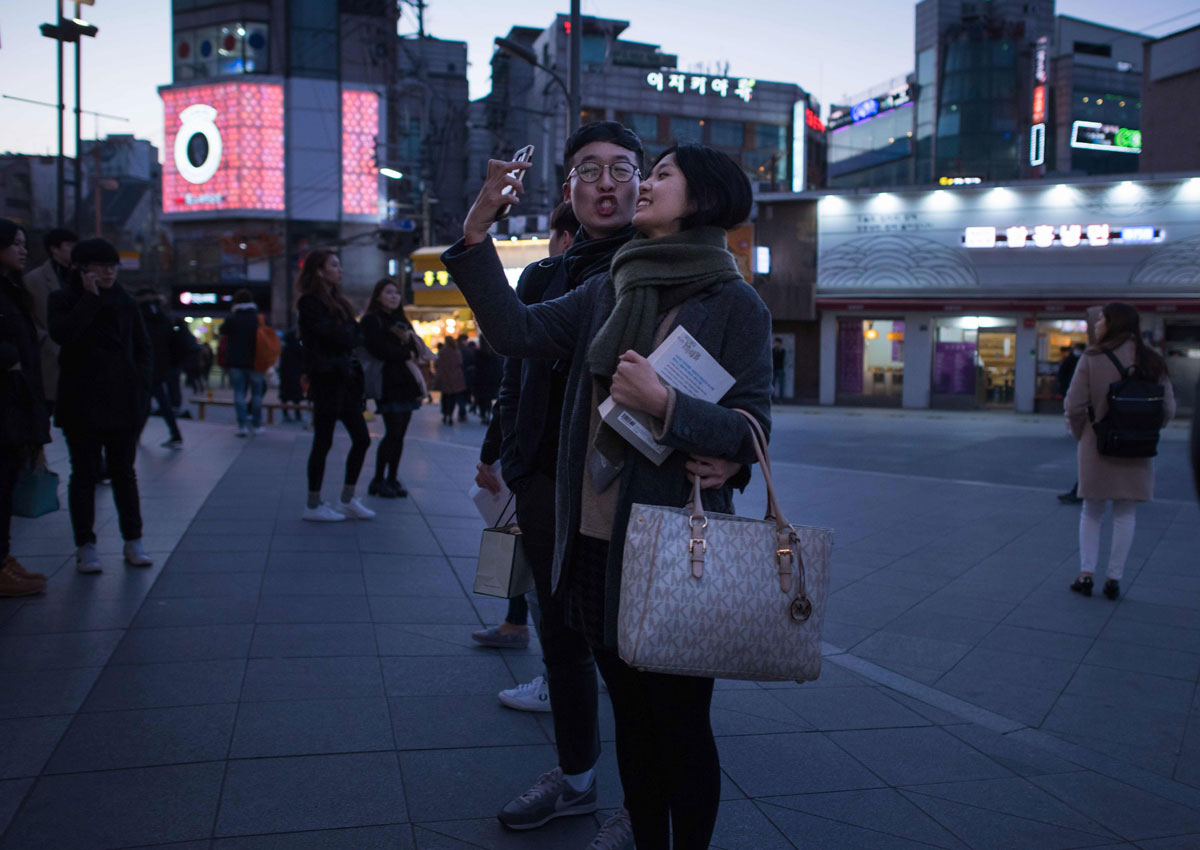
SEOUL – While browsing profiles on a dating app, Ms Jayine Chung was drawn to a man who described himself as someone who enjoys good food and throwing stones into the Han River.

“It was very quirky and amusing… Who does that any more? I needed to meet this guy,” recalled the 32-year-old freelance theatre producer with a laugh.

After several rounds of shortlisting from a list of potential dates through the free app Norang Narang (Korean for “you and me”) , they finally got to exchange contact details and arranged to meet the next day.

But Ms Chung was anything but impressed when her date, a freelance storyboard artist for TV commercials, showed up wearing a Burberry trench coat and driving a Range Rover, as if flaunting his wealth.

“Maybe he did it to get girls, but it sure didn’t impress me. Then we sat down to talk, and he realised I’m not the materialistic sort. I was more interested in his work, like he’s shot a short film, and his plans, and what’s he like as a person,” she recalled.

After he drove her home, she bought him a cup of coffee to thank him – a gesture that surprised him as most girls he had dated expected him to pay for everything.

That was the beginning of a relationship that culminated in their getting married in January last year, on the first anniversary of their first date.

Ms Chung and her husband, Mr Song Kyung Heub, 47, are part of a growing number of couples who met with professional help – be they matchmaking agencies or dating apps.

BOOMING BUSINESS

In the booming matchmaking industry worth an estimated 100 billion won (S$117 million), professional matchmakers are increasingly helping singles to find love – those for whom love is elusive because they are either too busy working or too shy to socialise on their own.

Even the South Korean government, eager to boost the country’s low fertility rate of 1.24, has announced plans to introduce matchmaking services at national and regional levels from this year, to create more opportunities for singles to meet and to encourage them to get married and start a family earlier.

The median age for marriage has risen in the past few decades to hit 32.8 for men and 30.7 for women last year, an increase of over five years – 27.8 for men and 24.8 for women – from two decades ago.

Singapore’s Senior Minister of State Josephine Teo, in Seoul last month to study the country’s marriage and parenthood policies, noted how youth in both South Korea and Singapore have delayed marriage in recent years. She also noted, however, that the Koreans were more proactive in looking for love and embracing commercial matchmaking agencies.

In a Facebook post titled “Dating – Gangnam Style”, she urged single Singaporeans to start early, like the Koreans, and be open to getting professional help.

There are some 1,600 dating agencies in South Korea, which is home to a population of 50 million.

Duo, which claims to be the largest dating agency in the country, has a membership of 31,000. It has made over 33,000 successful matches that led to marriages in the past two decades.

It uses a computerised system to crunch detailed information provided by members, including occupation, annual income, car and property owned, and residential zone, and conducts background checks to verify the information before pairing up members. It makes as many as 17,000 matches a month.

Duo chief executive officer Park Soo Kyung said the firm’s motto is to pair singles with the aim of making “happy marriages”. It has managers who talk to members to further define their ideal partner and dating coaches to advise them on how to carry themselves in order to win over their dream man or woman.

A typical male member is a 33-year-old university graduate who earns 40 million won a year, while a typical female member is a 30-year-old degree holder earning 30 million won a year.

RETURN OF A TRADITION

Matchmakers have traditionally played a key role in Korean society, said Ms Park. “Marriage partners were traditionally decided upon by parents because marriage was viewed as two families coming together as one. That’s why they relied on matchmakers to collect detailed information and recommend a suitable match,” she said.

Marriage in modern times has become a pursuit of free love and individual happiness, leading to the wane of the professional matchmaker.

However, with young people now becoming more pragmatic in their attitude towards marriage, they “would use information from matchmakers to find their ideal partners as they feel it is a rational thing to do”, said Ms Park.

She added that as getting married and starting a family require big sums of money, young people don’t want to risk going into it without knowing their partner’s socio-economic background and financial status – information which dating agencies can provide.

Said sociologist Kim Soo Kyung, a research professor at Korea University: “Marriage has become like a business or contract. People care more about economic status and what university one graduated from, and that could be the reason why they are turning to dating agencies that have a lot of that data.”

One concern, however, is that dating agencies rank members based on criteria that are “heavily weighted on materialistic indicators and aggravate gender discrimination”, Prof Kim said. For example, some occupations with looks as a prerequisite, like flight stewardess, are ranked higher.

Another reason for using dating agencies is that social circles have shrunk, with more people preferring to spend their free time alone, often glued to their smart devices. Young people are less able to rely on friends and family to fix them up with a date, unlike in the past.

Then, one could go for “sogaeting”, a one-on-one blind date with a friend’s friend, or “meeting”, a small gathering of six to eight singles who typically break the ice by playing some kind of drinking game.

Nightclubs would offer a so-called “booking” service, where a middleman would help men to approach women who they fancy and take them to their tables for a drink.

For financial consultant Choi Min Hee, 35, it was her mother’s colleague who introduced her to her husband, an office manager, a decade ago. Ms Choi said she was under family pressure to marry early and, as fate would have it, her date turned out to be her ideal man. “I liked him because of his positive attitude, and I knew I could trust him because we met through our parents,” she said.

They were married within a year of their first meeting, and they now have two children – a seven-year-old daughter and a three-year-old son.

LESS HUNG UP ABOUT MARRIAGE

South Koreans today are also less anxious about getting married, with marriage now viewed as an option and not a must. A 2014 survey by Statistics Korea showed that only 56.8 per cent of respondents think that marriage is necessary.

With high youth unemployment and a sluggish economy, many young people who are unable to find good jobs are choosing to remain single.

Some local governments have their own measures to encourage people to marry early and have children. Haenam county in South Jeolla province has been organising a two-day matchmaking camp for singles since 2014. The annual event successfully paired six couples last year, according to officials. The county holds the record for the highest birth rate in the country, with 2.4 births per woman.

The Seoul Metropolitan Government used to organise matchmaking events in the past, but has switched tactics to promoting small and affordable weddings instead in recent years, given that prohibitive costs are a deterrent to marriage.

However, some observers feel the state should not intervene as marriage is a private affair. Prof Kim, for instance, said the government should instead try to resolve issues that hinder marriage and childbirth, like high costs of housing and education, and create an environment that is conducive for families.

As society progresses, singles who are now better educated are more picky in choosing their lifelong partners.

Musical actress Song Hyo Jin, 28, has been single since her last eight-year relationship ended in 2012 . She has been dating casually, using apps to suss out prospective dates. “It’s easy to meet guys, but harder to develop a meaningful relationship because we need a lot of time to warm up to someone we just met,” she said.

She hopes to settle down by the age of 32 with a man who shares her Christian faith. “My parents want me to get married as soon as possible and they tried to matchmake me with their friend’s son. I met him once, but it was quite a short meeting and I need more time to find out what kind of a person he is,” she said.

Project manager Choi Jin Suk, 43, has tried dating apps but still prefers to go on blind dates set up by friends. His last girlfriend was introduced by a friend, but they parted ways last year.

He said it is harder to date now because his own expectations have gone up with age – the same applies to older women.

Some of his friends who tried dating agencies and found it useful have recommended it to him, but he is in no hurry to settle down yet. His ideal woman is someone who shares his beliefs and way of life.

“Right now I’m married to my job, but I do want to get married one day when I meet the right person,” he said.

changmc@sph.com.sg


This article was first published on April 9, 2016.
Get a copy of The Straits Times or go to straitstimes.com for more stories.


Image: 
Blurb: 
The young are turning to dating apps and matchmaking agencies in the S. Korean capital and beyond in search of partners. -ST
Publication Date: 
Sunday, April 10, 2016 – 03:00
Send to mobile app: 
Source: 


Story Type: 
Others

Source link

Thai police ban old Marie Claire magazine issue

0

Bangkok – Thai authorities have banned a five-month-old French edition of Marie Claire magazine because of an article which police said defamed the kingdom’s royal family.

Thailand’s royal defamation laws are among the world’s harshest and can land offenders decades behind bars.

An official order, published in the Royal Gazette late Friday and signed by national police chief Chaktip Chaijinda, outlawed importing or distributing the November 2015 issue of the magazine printed in France.

“Also, any magazines (of that edition) will be confiscated or destroyed,” it added.

A Thai police spokesman declined to comment on the order, which cited a 2007 publishing act that grants the national police chief power to ban any printed material that defames the monarchy or affects national security.

The reason for the delay in outlawing the edition was not immediately clear.

However the magzine would not have been widely on sale in the kingdom.

Prosecutions under royal defamation laws have surged since royalist generals seized power in a 2014 military coup, with many Thais facing jail time for social media postings on the monarchy.

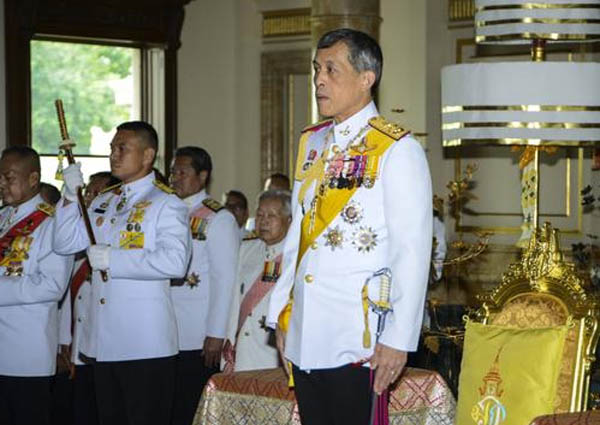
The outlawed Marie Claire magazine carried a French-language article critical of Thailand’s Crown Prince Maha Vajiralongkorn, who is next in line to the throne but does not enjoy the widespread adulation of his 88-year-old father, who is ailing.

The monarchy has become an increasingly sensitive topic as hospital-bound King Bhumibol Adulyadej, the world’s longest reigning monarch, enters his twilight years.

Media in Thailand routinely self-censor when reporting on palace affairs to avoid falling foul of kingdom’s lese majeste law, which carries a 15 year jail sentence per offence and is broadly-interpreted by authorities.

Last year a local Thai printer removed several New York Times articles that touched on the monarchy, forcing the paper to carry blank spaces.

The Economist has also seen editions of its magazine banned in Thailand for carrying sensitive stories on the royal family.

Image: 
Category: 
Publication Date: 
Saturday, April 9, 2016 – 13:11
Keywords: 
Send to mobile app: 
Source: 


Story Type: 
Others

Source link

Private art museum to close amid lawsuit

0

Less than a year after Singapore Pinacotheque de Paris opened in Fort Canning Arts Centre with a splash, the private museum said that it will shut its doors on Monday.

Art Heritage Singapore, which manages the museum, announced in a statement yesterday that it is “disappointed that this project did not succeed due to weaker-than-expected visitorship and other business and financial challenges faced”.

The closure comes as the company is being taken to court in Singapore by an Italian exhibition organiser over a sum of about €435,000 (S$667,500).

The amount was for work done by Arthemisia Group, which specialises in the organisation and holding of exhibitions in Italy, on the Myth Of Cleopatra exhibition – the Singapore Pinacotheque de Paris’ first exhibition, which ran from May 30 to Oct 4 last year.

In court papers, Art Heritage Singapore said Arthemisia Group had failed to fulfil all its obligations in organising the exhibition and that the exhibits were of poor quality, resulting in low ticket sales. The company is counter-claiming for damages and costs.

The Singapore museum’s closure comes after the closure of the flagship museum Pinacotheque de Paris in France on Feb 15, also due to poor visitor numbers in recent years.

The Paris museum opened in 2007 and is reported to attract over one million visitors annually.

Both museums are founded by French curator and art historian Marc Restellini, who is also the chairman of Art Heritage Singapore. The Singapore gallery is its only international offshoot.

Mr Restellini did not respond to queries by press time.

In the statement, Art Heritage Singapore said that Pinacotheque de Paris “remains keen to enhance the fine art scene in Singapore” and that it “will continue to evaluate more viable options in Singapore”, although it did not give more details.

The Singapore Pinacotheque de Paris housed 40 to 50 paintings by masters such as French impressionist artist Claude Monet and Dutch painter Rembrandt van Rijn in its permanent gallery.

Ticket prices for the museum range from $11 to $28 for adults, depending on the exhibitions.

Web designer Karen Ling, 45, a frequent museum-goer, said: “I visited the museum twice last year and was unimpressed.

“I did not think the exhibits were the best works of the old masters. It felt a bit of a letdown.”

The museum’s latest exhibition that traces the rise of graffiti as an art movement, Pressionism: Graffiti Masterpieces On Canvas, was meant to run till June 25.

Besides exhibitions, the museum had a free-admission heritage gallery dedicated to the history of Fort Canning and an art academy as well as food and beverage and retail tenants.

In a statement last night, the Singapore Tourism Board said it had facilitated the Pinacotheque project as part of efforts to grow Singapore’s leisure offerings and expressed disappointment at the closure of the museum.

asyiqins@sph.com.sg

nabilahs@sph.com.sg


This article was first published on April 9, 2016.
Get a copy of The Straits Times or go to straitstimes.com for more stories.

Image: 
Category: 
Blurb: 
Pinacotheque's manager cites poor visitorship, business and financial strains. -The Straits Times
Publication Date: 
Sunday, April 10, 2016 – 01:30
Send to mobile app: 
Source: 


Story Type: 
Others

Source link

Why Dr Lee's column was not published

0

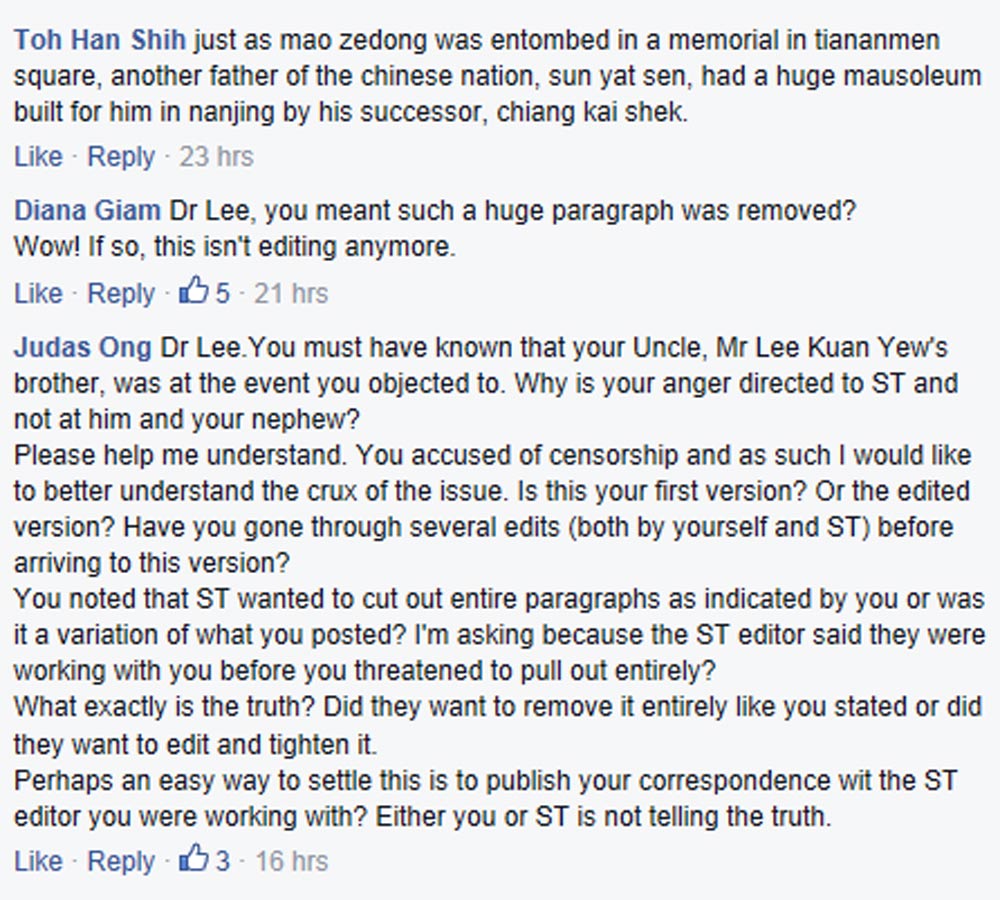
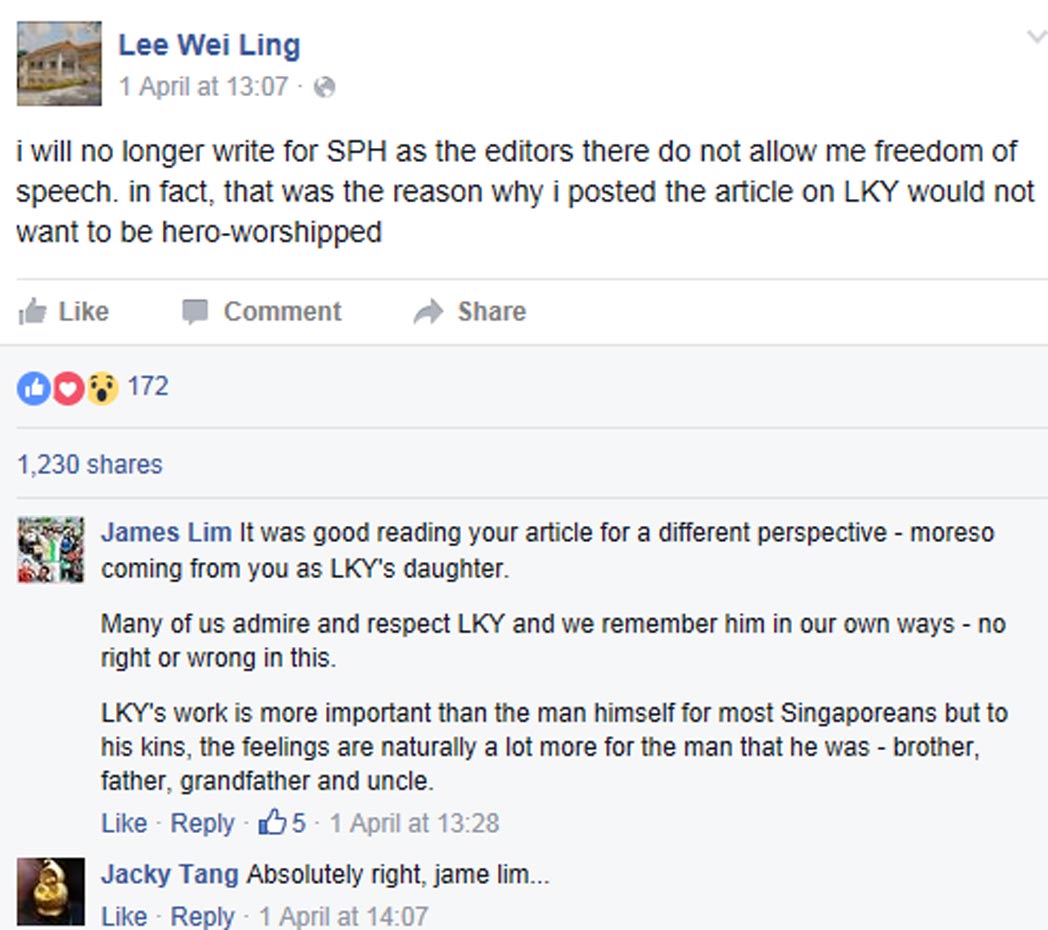
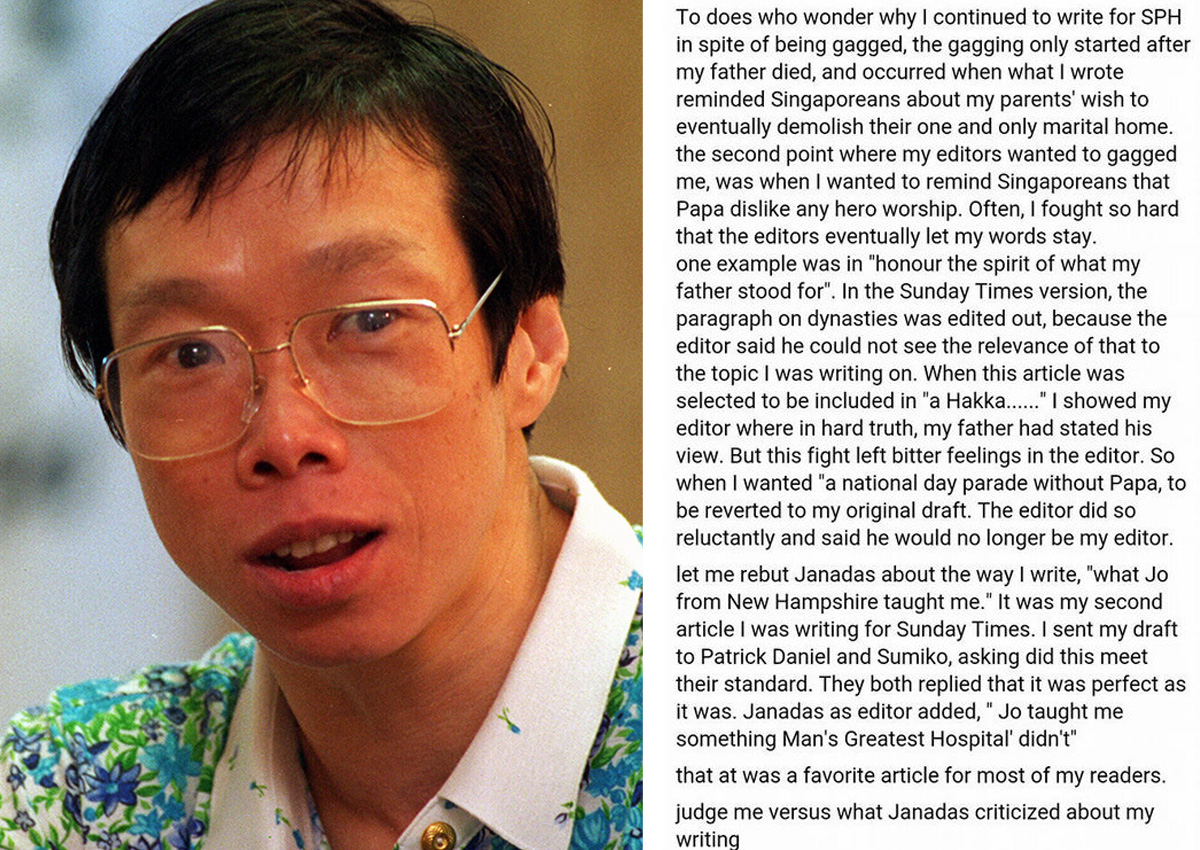
Several issues of serious journalistic concern arose from recent allegations by Dr Lee Wei Ling, a former columnist of The Sunday Times, after she blogged about events last month to commemorate the death of her father, Mr Lee Kuan Yew.

In a Facebook post on April 1, Dr Lee wrote: “i will no longer write for SPH as the editors there do not allow me freedom of speech. in fact, that was the reason why i posted the article on LKY would not want to be hero-worshipped.”

I had been editing Dr Lee’s columns since last November. So it pained me when she also alleged that those who edited her columns had been “commanded to edit certain issues out, and they are to (sic) timid to disobey, and too embarrassed by their timidness to tell me the truth”.

In another posting, Dr Lee alleged that her article, which had earlier been sent to me for publication in The Sunday Times, was rejected because I had deemed certain parts as “irrelevant”, while she thought them crucial.

I need to set the record straight on this. I did not say they were “irrelevant”, although I did have serious concerns about her latest draft, which I shall come to shortly.

I should first clarify an issue of wider interest to readers, namely, how commentaries are edited when submitted for publication.

In reviewing opinion pieces, an editor strives to stay true to the thrust and tone of the commentator, while bearing in mind professional standards relating to accuracy, fairness, the use of language, coherence, relevance, brevity, the law, and judgment on matters such as race and religion, among other things.

In the case of Dr Lee’s contributions, her ideas had to be honed and language tightened.

This editing process is necessarily a two-way affair, as with all commentaries in general.

Dr Lee sent me her article on what she considered “hero-worshipping” of her father on March 21. Over the course of that week, there were some 40 e-mails about the column, as we worked to get it ready for publication.

I sent her my edited version for her review on March 23, with the intended date of publication being Sunday, March 27.

She replied on March 23 (the day of Mr Lee’s death anniversary), saying: “Reads well. But I want to wait until the day unfolds completely.”

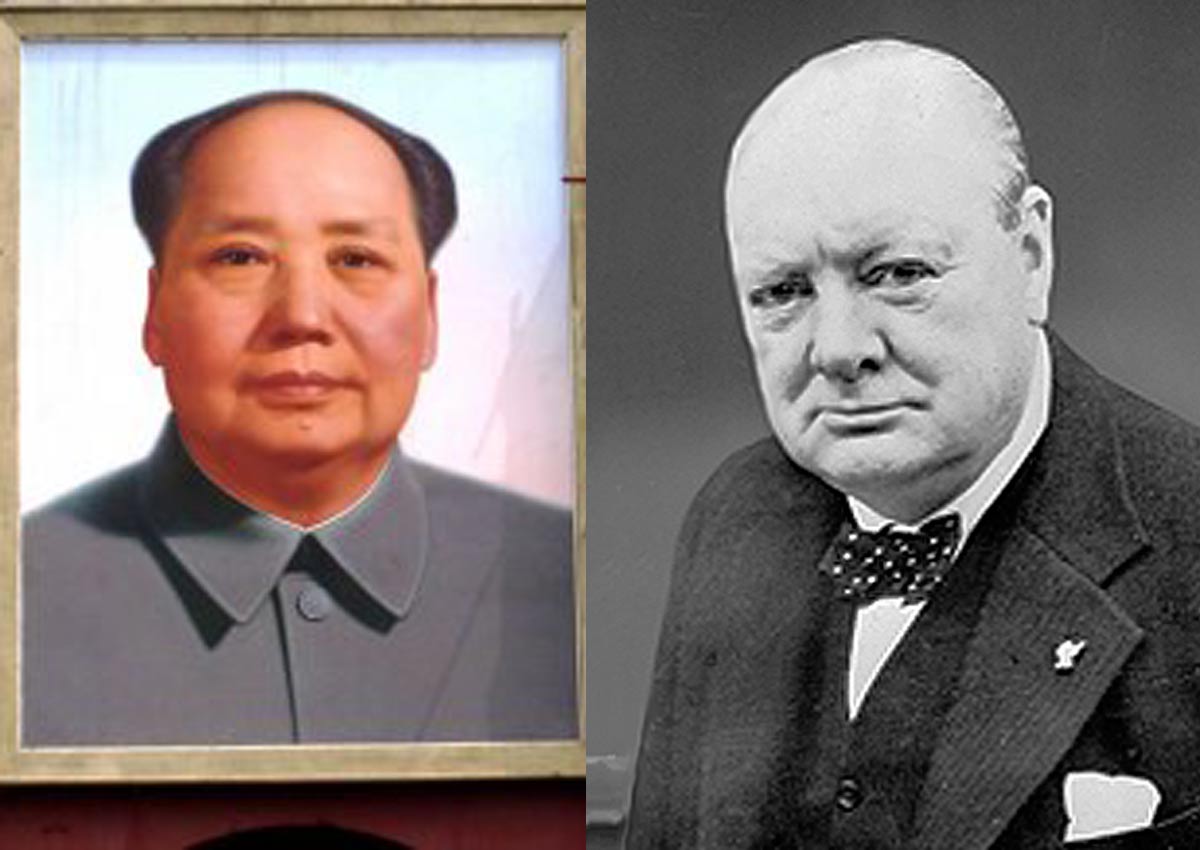
So all seemed well up to then. On March 25, I received another version of the column with substantial additions that I found distracting at first reading because of repeated references to China (Mao Zedong’s China had already been mentioned higher up in her piece).

But there was another issue as well. Upon checking the accuracy of a quote she cited from British Prime Minister David Cameron, and other further checks, I found that almost three quarters of the additions had been plagiarised.

I had learnt from experience with Dr Lee’s columns that her sources needed to be double-checked.

The additional paragraphs are shown below, with the plagiarised parts in italics: “Firstly when Chairman Mao died on 9 September 1976, the country was in shock. This was partly the result of the keenly felt loss of a semi-divine leader, but also caused by the enormous uncertainty about what the future held in stock for China and its people. The power struggle between Jiang Qing and the Gang of Four on the one hand, and Mao’s designated successor Hua Guofeng on the other, which had been smoldering for some time caused grave anxiety for many people in China. However, on 6 October 1976, within a month after Mao’s death, Hua had the Gang of Four arrested.

“Two days after the arrest of the Gang, the highest organs of the party and the state decided that a Memorial Hall would be built as a permanent tribute to the founder of the People’s Republic. On 24 November 1976, the foundation stone for the gigantic building, located to the south of the Monument to the People’s Heroes on Tiananmen Square was put in place. The construction went on day and night, and the building was finished on 29 August 1977. On that same day, Mao’s body, which had been embalmed and placed in a crystal sarcophagus, was moved to the Hall. On 9 September 1977, a ceremony was held to commemorate the anniversary of Mao’s death and the completion of the Hall.

“The anniversary of the funeral of Winston Churchill took place 50 years after the actual funeral on 30 January 1965, which brought the capital to a standstill and took place a week after his death aged 90 on 24 January, is being marked by scores of events, including a service and wreath laying at the Houses of Parliament, a memorial service at Westminster Abbey, and the rebroadcast by BBC Parliament of the original live coverage. In a tribute to his most famous predecessor, the prime minister, David Cameron, said: ‘Half a century after his death, Winston Churchill’s legacy continues to inspire not only the nation whose liberty he saved, but the entire world. His words and his actions reverberate through our national life today.’

“Compare the actual time from death to the first commemoration, and the different activities involved in the commemoration in the two leaders above. Which one would Papa wish commemoration to resemble. Also bear in mind, that unlike almost all leaders, Papa was dead set against a personality cult. If he was forced to choose one form of commemoration, Papa would have objected the least if the commemoration resembled that held for Winston Churchill. Do note that Churchill unlike Papa cherished glory and a place in the history of his county. Compare what Churchill’s commemoration which was conducted 50 years after his death with the activities that have been taking place in Singapore that lasted a week. I think Papa would have objected if he were able to convey his view.”

The first paragraph was from an obscure website (http://chineseposters.net/ themes/mao-after.php):

When Mao Zedong died on 9 September 1976, the country was in shock. This was partly the result of the keenly felt loss of a semi-divine leader, but also caused by the enormous uncertainty about what the future held in stock for China and its people.

The power struggle between Jiang Qing and the Gang of Four on the one hand, and Mao’s designated successor Hua Guofeng on the other, which had been smoldering for some time, was about to be fought out in public.

However, on 6 October 1976, within a month after Mao’s death, Hua had the Gang of Four arrested.

Two days after the arrest of the Gang, the highest organs of the party and the state decided that a Memorial Hall would be built as a permanent tribute to the founder of the People’s Republic.

On 24 November 1976, the foundation stone for the gigantic building, located to the south of the Monument to the People’s Heroes on Tiananmen Square, was put in place…

The construction went on day and night, and the building was finished on 29 August 1977. On that same day, Mao’s body, which had been embalmed and placed in a crystal sarcophagus, was moved to the Hall.

On 9 September 1977, a ceremony was held to commemorate the anniversary of Mao’s death and the completion of the Hall.

The second paragraph was from London’s The Guardian newspaper (http://www.theguardian.com/ uk-news/2015/jan/30/winston- churchill-50th-anniversary-of- funeral-commemorated):

The anniversary of the funeral on 30 January 1965, which brought the capital to a standstill and took place a week after his death aged 90 on 24 January, is being marked by scores of events, including a service and wreath laying at the Houses of Parliament, a memorial service at Westminster Abbey, and the rebroadcast by BBC Parliament of the original live coverage.

In a tribute to his most famous predecessor, the prime minister, David Cameron, said: “Half a century after his death, Winston Churchill’s legacy continues to inspire not only the nation whose liberty he saved, but the entire world. His words and his actions reverberate through our national life today.”

In Dr Lee’s e-mail on March 25, she said she was adamant that The Sunday Times run the latest version of her article unedited.

She added: “I am going to blog this version or a similar version of this. If there are copyright issues, then I won’t sell my copy right to SPH. I thought long and hard about it. I want the version I decide on. I hv my reason for my decision. It does not matter to me whether u agree with me or otherwise.”

Later that day, without any notice, she went ahead to post that version of the article online, thereby bringing an end to any further discussion on the editing of the column.

Given the plagiarism it contained, there was no question of our publishing her version of the article.

Further, as a matter of policy, we do not run a version of a column in our papers when another version of it has been published online.

The relationship between contributors, editors and publishers is one that is based on trust.

That is broken when ultimatums are issued; no newspaper editor would accept columns on that basis, however illustrious the writers.

But what matters more, of course, is the relationship between publications and their readers. For the sake of that, I have no choice but to make these disclosures about the pains taken to uphold professional standards.

ivanf@sph.com.sg


This article was first published on April 9, 2016.
Get a copy of The Straits Times or go to straitstimes.com for more stories.

Image: 
Category: 
Publication Date: 
Saturday, April 9, 2016 – 14:00
Keywords: 
Send to mobile app: 
Source: 


Rotator Headline: 
Why Dr Lee Wei Ling's column was not published
Rotator Image: 
Story Type: 
Others

Source link

Freed Italian hostage leaves Philippines hospital

0

Zamboanga, Philippines – A retired Italian priest held hostage for six months by suspected Islamic militants left a Philippines hospital Saturday a day after his release, looking frail though officials said he was in good health.

A thin Rolando Del Torchio waved to journalists as he walked to a waiting ambulance after spending the night in a military hospital in the southern port of Zamboanga, an AFP video journalist said.

“The victim is emaciated. He has lost a lot of weight compared to what we saw in his old pictures,” regional military spokesman Major Filemon Tan told reporters.

“He is okay otherwise.” The Italian was held captive by the Abu Sayyaf group after armed men snatched the then 56-year-old at gunpoint at his pizza restaurant in the southern city of Dipolog in October last year.

“The ASG was behind this kidnapping,” Tan said, referring to the group by its initials.

It was not clear where Del Torchio was headed, but the military spokesman said the Italian embassy had arranged for a chartered plane to fly him out of Zamboanga.

Calls by AFP to the Italian embassy in Manila went unanswered.

The authorities found Del Torchio late Friday aboard a ferry docked on the remote southern island of Jolo, the main Abu Sayyaf stronghold some 950 kilometres (590 miles) south of Manila.

The Abu Sayyaf is a small group of Islamic militants infamous for kidnapping foreigners and demanding huge ransoms, as well as for being behind deadly bombings in the mainly Catholic Asian nation.

Its leaders have in recent years pledged allegiance to the Islamic State group that controls vast swathes of Iraq and Syria.

Tan said he did not know if any ransom was paid to secure Del Torchio’s release.

Del Torchio had worked as a missionary for the international organisation PIME in the south from 1998 before retiring in 2000 to set up his restaurant, colleagues told AFP shortly after he was abducted.

The gunmen are holding nearly 20 other foreign hostages, all but one of them abducted since 2014.

The Abu Sayyaf last month posted a video of two Canadians, a Norwegian and a Filipina they kidnapped in September last year and set an April 8 deadline for ransom to be paid or the foreigners would be killed. The deadline passed Friday with no word on their fates.

The group beheaded a Malaysian tourist last year.

The latest groups of victims were 10 Indonesian and four Malaysian crew members snatched over the past two weeks from a tugboat and a cargo ship near the southern Philippines.

Image: 
Category: 
Publication Date: 
Saturday, April 9, 2016 – 12:49
Send to mobile app: 
Source: 


Rotator Headline: 
Italian hostage emaciated after release by Abu Sayyaf
Story Type: 
Others

Source link

Divorcee unable to divide assets due to gap between Syariah, civil law

0

A Singapore High Court judgment, involving a Muslim couple who divorced in a Johor Syariah Court, has pointed out a gap in the law here.

In the case, the 52-year-old man divorced the woman, 37, in 2012 – allegedly without telling her.

They are Singaporeans who have two young children and were living in Johor at the time, although they have a Housing Board flat in Singapore. Following the split, the woman applied to the courts here to divide their assets.

But she hit a snag: Both the Syariah Court and the High Court here ruled that they had no power under current laws to deal with the case.

“This case demonstrates an area deserving of a review for possible law reform,” said Judicial Commissioner Debbie Ong in judgment grounds released on Tuesday .

At issue is the division of the couple’s assets upon divorcing. Under the Women’s Charter, which was amended in 2011, litigants who divorce abroad can seek financial relief here. However, certain parts of the current charter are not applicable to those married under Muslim law, such as the division of matrimonial assets .

The judge said: “Parliament did not appear to have addressed its mind to a situation in which parties to a Muslim marriage could fall outside the jurisdiction of the Syariah Court and the Civil Court, leaving them with no recourse .”

The housewife in the case had applied initially to the Singapore Syariah Court to divide the assets, but it declined as it was not the court which dissolved the marriage.

The woman did not go to the Johor court as its division of their HDB flat would not have been enforceable in Singapore. This is based on a 2014 Singapore High Court decision. Her lawyer Mohamed Ibrahim Yakub from Achievers LLC applied to the Family Court for the division based on the foreign divorce provision in the Women’s Charter.

But District Judge Geraldine Kang ruled the court had no power and rejected the case last June.

The woman then appealed to the High Court. This is when the judicial commissioner pointed out that those married under Muslim law are specifically excluded from the key provision in the Women’s Charter that would have enabled the division of assets. The law has to be changed to include Muslim marriages in relation to the division of matrimonial assets.

The judicial commissioner said the present case showed up a “lacuna”, or gap, that arose from the separation of powers between the Syariah Court and the civil courts. “Whether the current lacuna in which the (ex-wife) is unable to obtain a division order in both courts ought to be plugged – and if so, ought to be addressed as a provision in the Administration of Muslim Law Act or the SCJA – is a matter for Parliament to decide,” she said.

In dismissing the appeal, she concluded: “I sympathise with the (ex-wife) who appears to have fallen into the lacuna described above.”

The woman’s lawyer said his client is considering further options to pursue the case.

vijayan@sph.com.sg


This article was first published on April 9, 2016.
Get a copy of The Straits Times or go to straitstimes.com for more stories.

Image: 
Category: 
Publication Date: 
Saturday, April 9, 2016 – 17:00
Send to mobile app: 
Source: 


Story Type: 
Others

Source link

Vegetable prices rise on heatwave

0

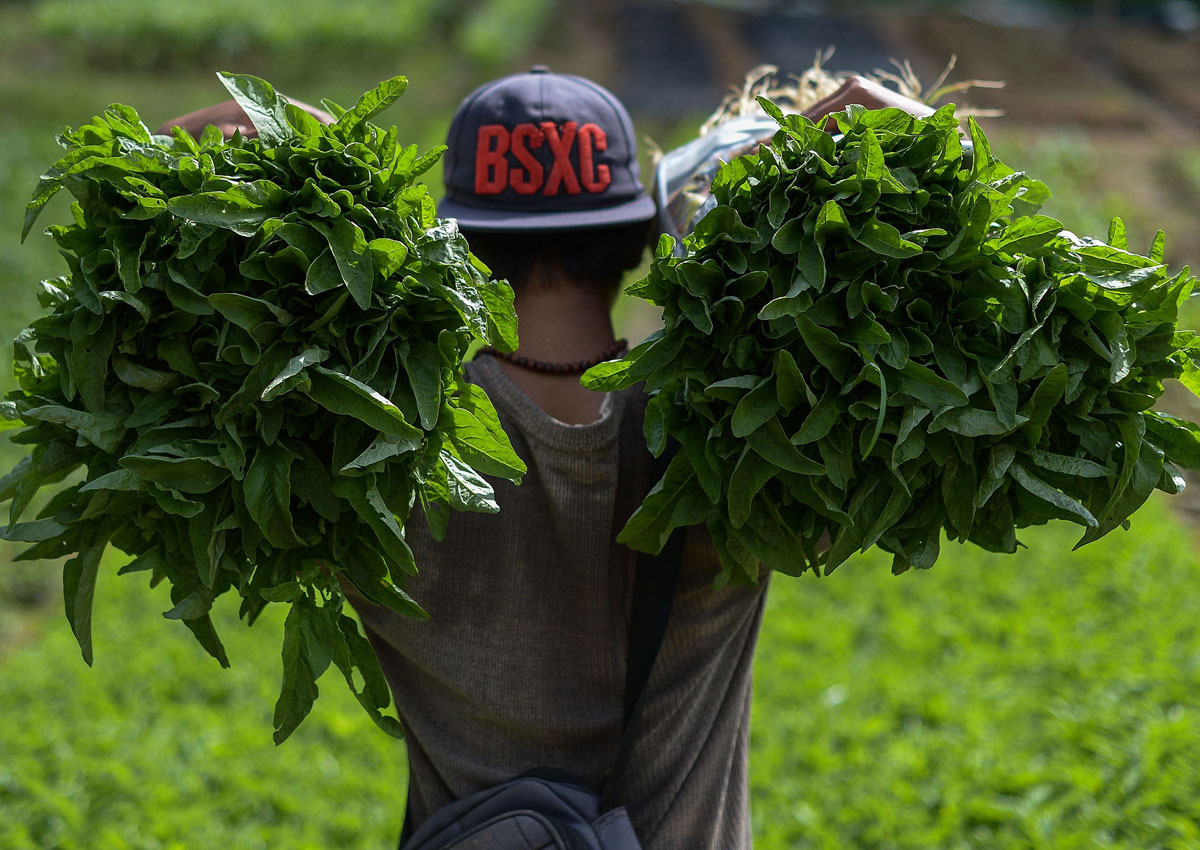
The heatwave in the region has led to more costly Malaysian greens at wet markets here.

Prices of cucumbers, long beans, bittergourds and brinjals have risen by 10 per cent to 20 per cent since last week, while French beans and tomatoes now cost 30 per cent to 40 per cent more, according to Mr Jerry Tan, assistant secretary of the Singapore Fruits and Vegetables Importers and Exporters Association.

At a wet market stall in Yishun, the price of Malaysian-grown chye sim has gone up from $2.80 per kg two weeks ago to $3.50 this week. Kangkung was selling at $3.30 per kg, up from $2.50.

While Malaysia has been suffering from a dry spell for the past month – with the heatwave causing schools to be closed for two days – farms there were initially able to cope by using water from reservoirs to grow their crops, according to the association.

However, the prolonged drought has dried up reservoirs, causing production of vegetables to fall.

The growth rate of vegetables slows significantly when the temperature rises above 35 deg C, according to Mr Tai Seng Yee, executive director of Zenxin Agri-Organic Food, which has farms in Johor and Cameron Highlands.

His farms now produce around four tonnes of vegetables a day, about a 20 per cent drop from before the heatwave. However, he has yet to raise the price of his produce which is sold at Cold Storage and Giant supermarkets here.

“We continue to maintain our prices since organic vegetables are already priced at a premium,” he said.

Supermarket chains, which tend to have more bargaining power because they buy in bulk, have yet to be affected. FairPrice, Sheng Siong and Cold Storage said prices and supply of their Malaysian greens remain stable for now.

Meanwhile, prices of kai lan and chye sim from China have almost doubled from a year ago, with importers blaming the cold snap that hit the country earlier this year.

The cold can freeze crops, while rain can cause plants to rot and wither faster than usual.

Prices of China-grown garlic have gone up by about 30 per cent to 50 per cent at supermarkets here, The Straits Times reported last week.

Despite the weather woes, consumers do not have to worry that there will not be enough vegetables to go round as importers can get supplies from other countries, said Mr Tan.

“Once our stock drops below a ‘safe’ level, we will activate supply from other countries like Thailand, Vietnam, Indonesia, Australia and India,” he said.

Prices of these vegetables, however, will be higher than those of Malaysian vegetables as it costs more to transport them to Singapore.

Housewife Tee You Na, 64, said: “If I like the vegetables, I will still buy, never mind if it is more expensive.”

mellinjm@sph.com.sg


This article was first published on April 9, 2016.
Get a copy of The Straits Times or go to straitstimes.com for more stories.

Image: 
Category: 
Blurb: 
Lower production at Malaysian farms due to drought pushes up market prices here. -The Straits Times

Publication Date: 
Saturday, April 9, 2016 – 17:00
Send to mobile app: 
Source: 


Story Type: 
Others

Source link