Home Blog Page 4242

Declassified – Secretive North Korea lifts veil on arms programme

0

SEOUL/WASHINGTON – Ahead of a rare ruling party Congress next month, secretive North Korea is revealing details of its weapons development programme for the first time, showcasing its push to develop long-range nuclear missiles despite international sanctions.

Until recently, information on the North’s weapons programme was hard to come by, with foreign governments and experts relying on satellite imagery, tiny samples of atomic particles collected after nuclear tests and mangled parts and materials recovered from long-range rocket launches.

No longer. In just over a month, the North has published articles with technicolour photographic detail on a range of tests and other activities that point to fast-paced efforts to build a nuclear-armed intercontinental ballistic missile (ICBM).

The reason for the revelations, many analysts say, is that Pyongyang believes convincing the world, and its own people, of its nuclear prowess is as important as the prowess itself. Nevertheless, isolated North Korea’s true capabilities and intentions remain unknown.

“Close-up pictures of ground test activities are almost unprecedented from the DPRK,” John Schilling, an aerospace engineer specialising in satellite and launch vehicle propulsion systems, told Reuters.

DPRK stands for Democratic People’s Republic of Korea, the North’s official name. The reclusive state has conducted four nuclear tests in the past 10 years, the last in January.

“The openness suggests that the underlying strategy is as much diplomatic as military: it is important to Pyongyang not only that they have these capabilities, but that we believe they have these capabilities,” Schilling said.

In its latest revelations, North Korean state media reported on Saturday that the country had carried out a successful test of a new ICBM engine. Pictures showed what experts said were the engines of two Soviet-designed R-27 missiles clustered together, ejecting two exhaust plumes.

The claims indicate the North has no intention of slowing down, despite last month’s United Nations sanctions and stern warnings from Washington and elsewhere, said Michael Elleman, a US-based rocket expert with the International Institute for Strategic Studies.

“The revelations, pronouncements and ‘tests’ appear to be part of a campaign to establish the narrative that Pyongyang has, or will soon have, a nuclear-armed, long-range missile that could threaten the US mainland,” he said.

“Each unveiling, if real, would be part of a structured programme aimed at developing the capability. The open question is: How real are these tests?”

The activities are likely to be watched closely by UN experts assigned to enforce sanctions prohibiting the North from engaging in work that involves ballistic missile technology.

CONVINCING THE DOUBTERS?

There is an increasing feeling among international arms experts that North Korea’s capability may be more advanced than previously thought. It could have a primitive but operable ICBM “later this decade,” said a US government source with intelligence on the North’s weapons programme.

Overcoming such scepticism, and fuelling alarm for its neighbours and the United States, may be the intended effect, with significant domestic propaganda value ahead of the May ruling party congress, said Yang Moo-jin of the University of North Korean Studies in Seoul.

“To a normal military, arms development is supposed to be classified,” he said. “But Kim Jong Un had years of the South and the US putting his military down, so now he wants to maximise the perceived threat of what he’s trying to develop.”

The recent ICBM engine test followed the March test of a solid-fuel rocket engine and a simulated test of atmospheric re-entry of a missile warhead.

Kim has vowed another nuclear warhead test soon, which would be the country’s fifth. Some analysts say it could be timed to take place just before the congress, at which Kim is likely to unveil an official policy of twinning economic development with nuclear capability.

Kim also claimed in March that his country has miniaturised a nuclear warhead to be mounted on a ballistic missile. Media reports displayed a spherical object and a jubilant Kim standing before a large rocket-shaped object similar to the KN-08 ICBM.

The choreographed manner in which the weapons tests appear to be taking place also points to political posturing rather than rigorous technical examination, some analysts have said.

Given the North’s secrecy, penchant for bombastic propaganda and history of manipulating photographic and video images, its claims are still met with plenty of scepticism.

“I am still not convinced that everything really is what they want us to believe it is,” said German aerospace engineer Markus Schiller, who has closely followed the North’s missile development programme.


Image: 
Category: 
Publication Date: 
Wednesday, April 13, 2016 – 09:30
Send to mobile app: 
Source: 


Story Type: 
Others

Source link

Couple's bad wedding photos post goes viral

0

THE photos were meant to bring back sweet memories of their big day but have instead made Jaclyn Ying and Kelvin Tang unhappy soon after their wedding.

In a cautionary tale that has become the talk of social media here, Ms Ying, 25, an education executive, recounted in a Facebook post on Sunday their shock at how badly their wedding photos had turned out.

The 21 wedding photos she put up with her post include those taken at odd angles and processed with odd colour filters. Her post has been shared more than 17,000 times.

Ms Ying said they had signed up for an all-in-one package with a “pretty reputable bridal shop”. While she was told that she could not choose her photographer, she was promised that the “standard of the talent pool was consistent”.

The couple, who had their wedding dinner at The Halia at the Singapore Botanic Gardens on March 26, were shocked after getting their wedding photos on Saturday.

“I was in disbelief. I cried too. A lot.” Ms Ying said.

For instance, one of the shots showed the groom posing in a bush, presented through a black-and-white filter while the background is filtered green.

Ms Ying and Mr Tang, 32, a court stenographer, paid more than $3,000 for the package, which included outfits, hair and make-up services and 10 hours of photography on their wedding day.

“I had expected that the photos would roughly fall within what we wanted – not blurred, well lit, reasonably well edited,” said Ms Ying.

While wedding photographers said photography is subjective, most agree the photos were not well taken.

Melvin Lau of Multifolds Photography said: “As much as the photographer attempts to be creative in his tilted shots and colour editing, it hasn’t been done tastefully.”

Benny Low of Colliding Luster added: “It is important to look at the work of the photographer to understand his eye for photography and his concept.”

Ms Ying said they met the photographer only on the morning of the wedding. “He is a really nice guy and we really don’t have anything bad to say about his attitude or demeanour.”

While she did not name him, Chung Siew Goh said yesterday on his Facebook page that he took the photos – though the post was removed.

Calling Ms Ying’s post unfair, he said he edited more than 900 photos for them but they chose 20 to express their dissatisfaction. He wrote: “Now (they) put (it) up in (the) media to show the whole world and spoil our reputation.”

nghuiwen@sph.com.sg


Get MyPaper for more stories.

Image: 
Publication Date: 
Wednesday, April 13, 2016 – 08:27
Send to mobile app: 
Source: 


Rotator Headline: 
Wedding photographer of says he edited 900 photos but couple picked 20 to show displeasure
Rotator Image: 
Story Type: 
Others

Source link

Bikes may be allowed on footpaths by year end

0

IT COULD be legal to ride a bicycle or electric scooter on footpaths by the end of this year, after the Government fully accepted an expert panel’s recommendations to boost the use of such devices here.
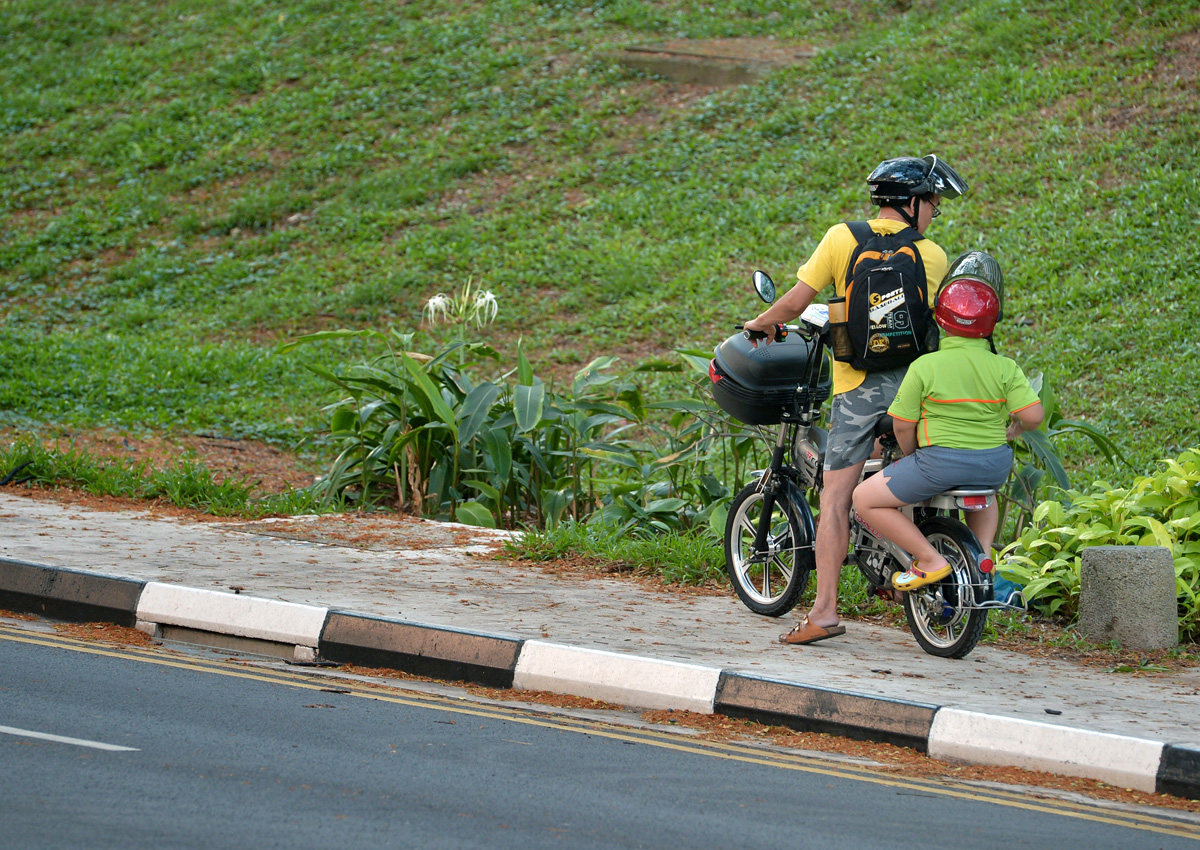
Senior Minister of State for Transport Josephine Teo said Singapore has to make a “quantum leap” in improving first- and last-mile connectivity for commuters, and close the gap with cycling cities like Amsterdam and Copenhagen.

The new rules and guidelines released by the Active Mobility Advisory Panel last month will “significantly improve” the mobility options for everyone, she said in Parliament yesterday during the debate on her ministry’s budget.

Besides recommending that personal mobility devices (PMDs) be allowed on the pavements, the panel also prescribed speed limits on foot and cycling paths, and registration for power-assisted bicycles (PABs) to curb the illegal modification of these devices.

PABs, or e-bikes, will also not be allowed on pavements, only on cycling or shared paths, because they pose a higher safety risk.

Mrs Teo said most of the panel’s recommendations would be implemented by the end of this year.

“Overall, the recommendations are fair and balanced, with sensible rules and guidelines to ensure the safety of pedestrians, cyclists and users of PMDs alike,” she said.

Mrs Teo also announced measures such as a Land Transport Authority (LTA) enforcement team, to address safety concerns and ensure PMD users follow the rules.

Several MPs had asked yesterday if enough was being done to safeguard the vulnerable on footpaths.

MP Cheng Li Hui (Tampines GRC) said pedestrians “should not be put at additional risk for the convenience of cyclists and users of PMDs”.

MPs Pritam Singh (Aljunied GRC), Ang Wei Neng (Jurong GRC) and non-constituency MP Dennis Tan all asked how proposed rules such as the speed limits of 15kmh and 25kmh on footpaths and cycling paths would be enforced.

Mrs Teo said the LTA will set up an enforcement team to work with the Traffic Police and National Parks Board to ensure reckless cyclists and PMD users are dealt with. There will also be stiffer fines for those who flout the rules.

“For a start, we will focus on hot spots such as crowded bus stops, and use speed guns to help us identify those that are speeding excessively,” she added.

As for the registration of e-bikes, her ministry is still working out the details, and hopes to release more details by the end of the year, she said.

There will be a grace period for e-bike owners to register their devices while the laws will be amended to stop the sale of non-compliant e-bikes.

Mrs Teo added that a nationwide Active Mobility campaign will be launched this month to raise awareness on the new policies.

This will be complemented with a new Cyclist Education Programme – to be rolled out in schools, community centres and foreign-worker dormitories from next month.

A network of volunteer “wardens” will also be set up. They will carry out patrols to encourage considerate behaviour.

MP Lim Biow Chuan (Mountbatten) asked if short-term bike-rental programmes could be rolled out in private estates to improve connectivity to MRT stations.

Mrs Teo replied that one would be piloted in the Jurong Lake District next year, and the Government would study how it can be expanded to other residential areas.

dansonc@sph.com.sg


Get MyPaper for more stories.

Image: 
Category: 
Publication Date: 
Wednesday, April 13, 2016 – 08:09
Send to mobile app: 
Source: 


Rotator Headline: 
Bikes, e-scooters may be allowed on footpaths by year end
Story Type: 
Others

Source link

Accident involving car and motorcycle causes massive traffic jam on Dunearn Road

0

April 13, 2016 8:08 AM

SINGAPORE – An accident between a car and a motorcycle on Dunearn Road in the direction towards city, caused a massive traffic jam during the morning rush hour on Wednesday (April 13).


Source link

Uber, Grab drivers will be screened

0

PRIVATE chauffeur drivers operating under apps such as Uber and Grab will be regulated in Singapore to safeguard commuters’ interest.

Like taxi drivers, they will be subject to medical tests and background screenings, have to attend a vocational licence course, and be put under a demerit point system.

Private-hire cars used for bookings under Uber and Grab will also have to be registered with the Land Transport Authority (LTA), and the vehicles must display a tamper-evident decal, so commuters and the authorities can easily identify them.

Announcing the measures in Parliament yesterday, Senior Minister of State for Transport Ng Chee Meng said: “With the growth of apps like Uber and GrabCar, some basic regulations are needed to ensure that the commuters’ interests, particularly safety, are taken care of.”

“Today, an estimated 8,000 to 10,000 drivers provide chauffeured services during peak hours. This has effectively increased the supply of point-to-point transport services by about a third during these hours,” he added during the debate on his ministry’s budget.

The new rules, which follow a six-month government review on the private-hire car industry, are expected to kick in by the first half of next year. Drivers can make applications in June.

This will give existing Uber and GrabCar drivers here time to take and pass the Private Hire Driver’s Vocational Licence (PDVL) course – a shorter, 10-hour programme, compared with what taxi drivers go through.

The course will cover topics such as road and passenger safety, and regulations for chauffeured services. There is no minimum age but applicants need to have held a Class 3/3A driving licence for at least two years.

Both permanent residents and work permit holders can apply, provided that they are employees of a chauffeur company. Singaporeans have the additional option of being a sole proprietor of their own limousine firm to qualify.

The current taxi drivers vocational licence (TDVL) system will also be tweaked, including cutting down the course time from the current 60 hours to 25 hours. There are also plans for part of the course to be done via e-learning.

Mr Ng said the course will no longer focus as much on memorising the street directory for route planning.

Drivers will instead be taught to use GPS and online navigational tools.

Cabbies who are active with no demerit points will be exempted from refresher courses while there are three- and five-hour programmes tailored for cabbies who need more training.

Currently, the courses are six or nine hours long, and taxi drivers must take them every six years. The new TDVL programme will take effect from next month.

Existing taxi drivers who want to become PDVL holders can easily do so by attending a two-hour course, without the $40 application charge.

adrianl@sph.com.sg


Get MyPaper for more stories.

Image: 
Publication Date: 
Wednesday, April 13, 2016 – 07:55
Keywords: 
Send to mobile app: 
Source: 


Rotator Headline: 
Uber, Grab drivers will be screened and put under demerit point system.
Rotator Image: 
Story Type: 
Others

Source link

ST Now, News As It Happens – April 13, 2016

0

April 13, 2016 7:04 AM

Welcome to ST Now, News As It Happens.  We will keep you updated on the latest happenings in Singapore and beyond. If there is something you want to share with us, please drop us a note via email at stshare@sph.com.sg or reach us on Facebook and Twitter @STcom.  Here’s a recap of what happened earlier.


Source link

Did Ho Ching really post that monkey photo unintentionally?

0

Despite her apology, some netizens continued to doubt Ms Ho Ching’s claim that the photo of a monkey appearing to…

Source link

Clarification

0

“KTPH: We Followed Medical Protocols” (The New Paper Mar 9)

We wish to clarify that the injured worker, as well as Mr Ko Ko Ye Chit, and the two other workers  are not employees of Lucky Joint Construction, as…

Source link

Other social media gaffes

0

British PM follows escort agency

In November 2013, it was found that British Prime Minister David Cameron was following a high-class escort agency on Twitter.

It was reported to be an accidental follow…

Source link