 JERUSALEM – Minister for the Environment and Water Resources Masagos Zulkifli has again vowed to crack down on companies responsible for transboundary haze using the “full extent” of Singapore’s laws, in his first response to recent comments by Indonesian…
Source link
S'pore laws will be 'taken to full extent' against companies responsible for transboundary haze, says Masagos
No quick fix in Israeli-Palestinian conflict, says PM Lee

TEL AVIV – There is no overnight solution to the Israeli-Palestinian conflict, and what is needed is for both sides to take small steps and build confidence towards a two-state solution, said Prime Minister Lee Hsien Loong.
Mr Lee, who was speaking to…
Source link
Alibaba's Ma pledges not to interfere in SCMP edit

SHANGHAI – The new boss of Hong Kong’s South China Morning Post, Jack Ma, has promised not to interfere in editorial decisions, in an apparent bid to assuage concerns about the paper’s independence under his e-commerce giant Alibaba Group Holding Ltd.
Critics have questioned Alibaba’s intentions for the paper, speculating it may be an attempt to buy influence or toe the Chinese government’s line in Hong Kong, a semi-autonomous former British colony that enjoys a high degree of press freedom.
In an interview with the SCMP posted on its website, the charismatic Ma said he felt there were “all sorts of misunderstandings” in the outside world’s perception of China, adding that the media did not paint a full picture. “The paper’s China coverage should be objective, reasonable and impartial,” he said.
“We should let our readers see China from more angles and perspectives.” Alibaba completed its $266 million purchase of the SCMP, which was announced in December, earlier this month.
“I have neither the experience nor desire to interfere with the newsroom operation. I will not take part in the editorial decision-making,” Ma said, nevertheless reserving the right to weigh in as a reader. “I believe the most important thing for the media is to be objective, fair and balanced. We should not report something with preconceptions or prejudice.”
Executive Vice Chairman Joe Tsai wrote in a letter to SCMP readers following the takeover announcement that China’s economic rise and importance to the world “is too important for there to be a singular thesis”.
A survey in March showed Hong Kong residents and journalists believe the state of press freedom deteriorated in the city for a second straight year in 2015, apparently a reflection of general unease in the city about mainland Chinese control.
Ma, speaking to the SCMP, said the newspaper should be”objective, reasonable and impartial” and should not report with preconceptions or prejudice.
Image:

Publication Date:
Thursday, April 21, 2016 – 11:55
Keywords:
Send to mobile app:
Source:
Story Type:
Others
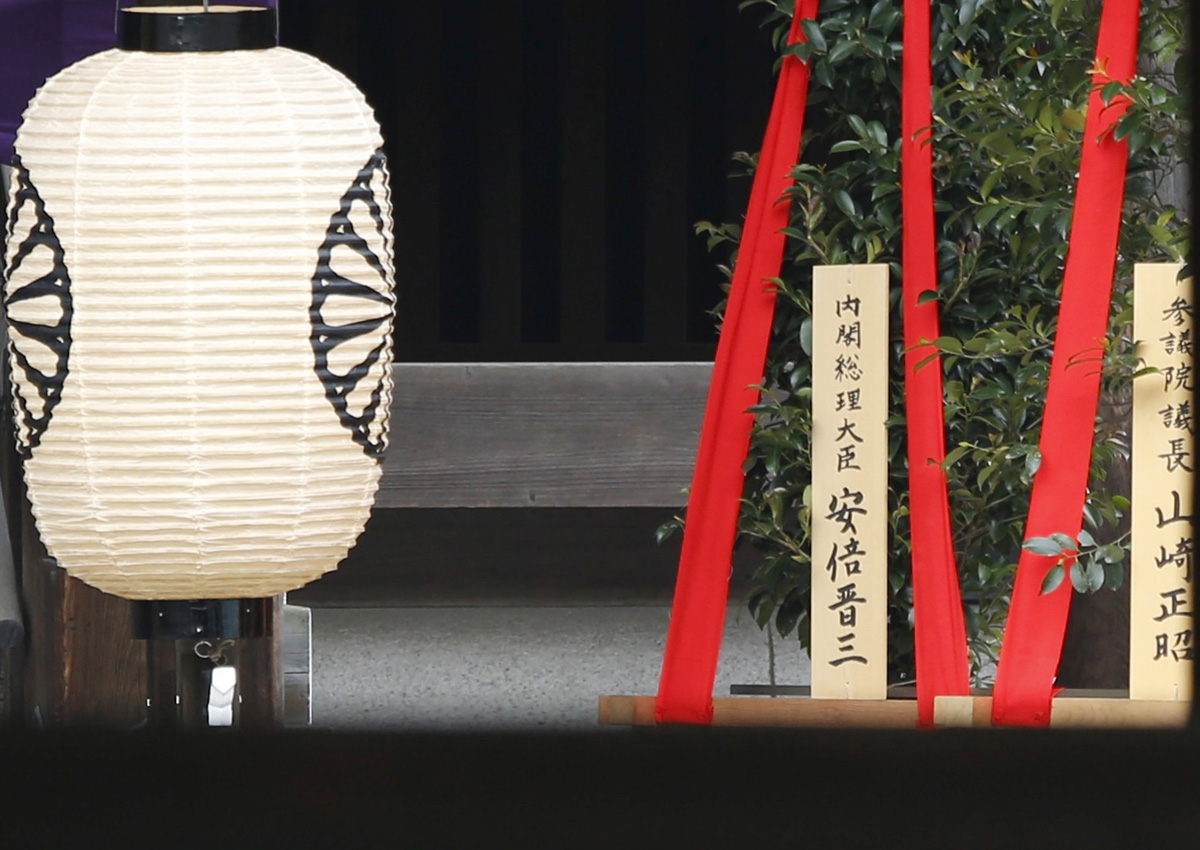
Japan's Abe makes ritual offering at Yasukuni shri

TOKYO – Japanese Prime Minister Shinzo Abe on Thursday sent a ritual offering to a controversial Tokyo shrine for war dead, a move that could anger China as the Asian neighbours prepare for a meeting to help smooth ties.
Abe’s spring festival offering at the Yasukuni shrine, which some see as a symbol of Japanese militarism in World War Two as it honours convicted war criminals among other war dead, comes as Foreign Minister Fumio Kishida prepares to visit Beijing.
Click on thumbnail to view photos. Source:
Reuters












An official in the shrine’s public relations department confirmed the offering, but declined to be identified, in line with its policy.
Kishida is likely to meet Chinese counterpart Wang Yi on April 30 in a bid to ease friction over issues such as sovereignty disputes over the South China Sea, Japanese media have said.
Abe is likely to avoid the more provocative step of attending the spring festival at the shrine, media said.
Abe’s visit to Yasukuni in December 2013 angered China and South Korea and provoked rare criticism from key ally the United States because the shrine honours 14 Japanese leaders convicted as war criminals by an Allied tribunal, along with war dead.
Since becoming premier in late 2012, Abe has sent ritual offerings to the annual spring and autumn festivals.
He sent a cash offering last August, at the time of the 70th anniversary of Japan’s World War Two defeat, but did not visit.
Image:
Publication Date:
Thursday, April 21, 2016 – 11:51
Keywords:
Send to mobile app:
Source:
Story Type:
Others
From The Straits Times Archives: Past 'mass hysteria' cases in Singapore
SINGAPORE – Several schools in the Malaysian state of Kelantan have been plagued by incidents of mass hysteria over the past week, with students claiming to have seen ghostly figures.
To date, eight ustaz, a bomoh and Islamic traditional experts have been sought for their expertise in chasing away the “spirits”, as the problem grew so serious that one school was forced to shut down temporarily .
The phenomenon of mass hysteria, while not new, has been rarely seen in recent times, although outbreaks were especially prevalent in schools and factories in Malaysia and Singapore throughout the 1970s.
Here’s a look at some of the reported cases in Singapore.
KORO “EPIDEMIC”, OCTOBER 1967
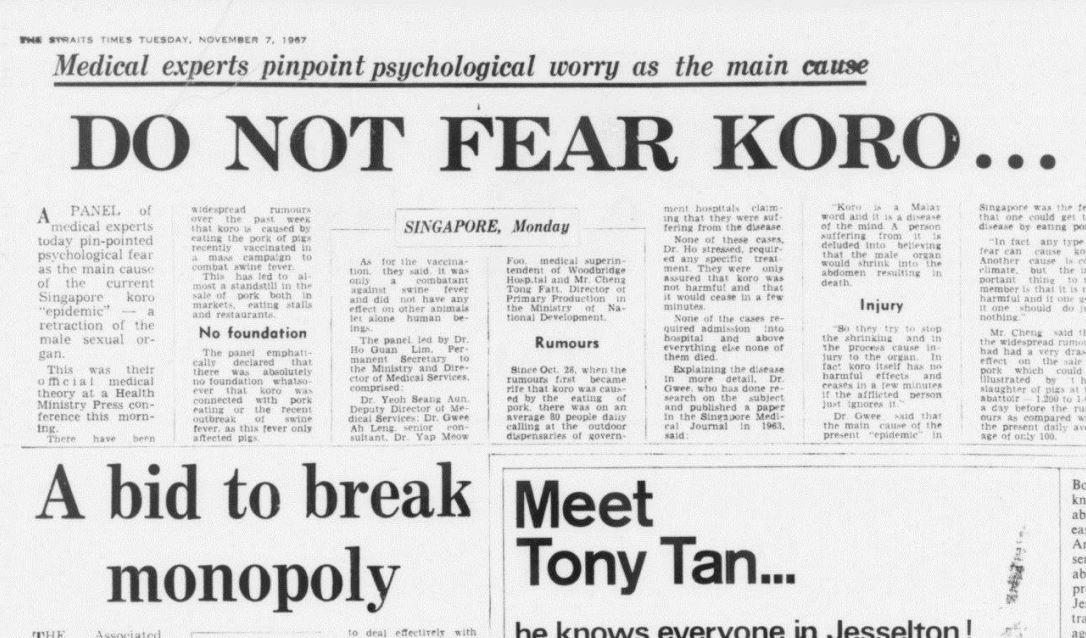
One of the earliest reported cases of mass hysteria was medical in nature. Rumours had first spread on Oct 28, 1967, that eating pork caused koro – a retraction of the male sexual organ.
Panic ensued as an average of 80 people called daily at the outdoor dispensaries of government hospitals claiming to be suffering from the disease, said a Straits Times report on Nov 7.
A Health Ministry press conference was subsequently called to dispel the rumours and clarify that koro was not connected to consuming pork. A panel of medical experts pinpointing psychological fear as the main cause of the epidemic.
The epidemic was apparently so severe it “led to almost a standstill in the sale of pork both in markets, eating stalls and restaurants”, the report said.
GENERAL ELECTRIC (USA) TELEVISION AND APPLIANCE, JANUARY 1973
On Jan 13, 1973, a case occured at the company’s flatted factory in Boon Keng Road when eight female employees became hysterical. There is no report of a second incident, but on Jan 17, a third incident was said to have happened with as many as 25 women on the factory’s U-Board assembly line affected.
Part of the factory was subsequently shut down that afternoon.
One woman said in a Straits Times report: “It was frightening. The women went into a trance and started screaming.”
Another said they had not taken the first incident seriously. “But it certainly gave cause for concern when another 12 became hysterical on Tuesday (Jan 16) and about 25 today (Jan 17),” she added.
Employees also claimed they saw visions of a teenage girl lurking in the washroom for several nights.
Bomohs and Buddhist monks held daily seances during the outbreak as incense was burnt and holy water sprinkled at two blocks of the factory.
PON PON FOOD MANUFACTURING, OCTOBER 1973
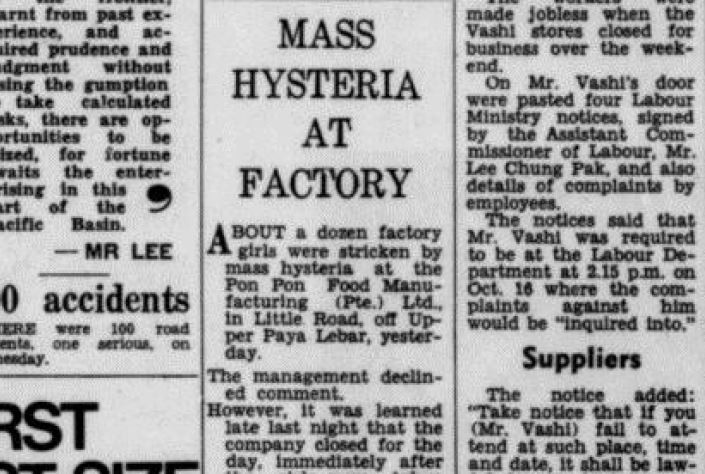
About a dozen female workers were stricken by mass hysteria at the food company’s factory in Litte Road, off Upper Paya Lebar, on Oct 4, 1973.
Pon Pon, which produced dried cuttlefish and employed 120 workers consisting mainly women, closed for the day immediately after its workers were taken ill at around noon.
TELECOMMUNICATIONS AUTHORITY OF SINGAPORE (TAS), OCTOBER 1977
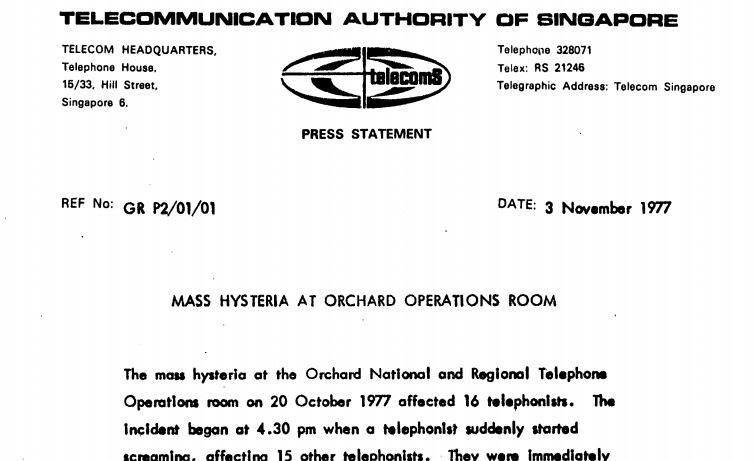
Mass hysteria hit the operations room of the TAS headquarters in Exeter Road on Oct 20, 1977, as a group of women began screaming and struggling with those who tried to calm them.
A report said the incident occurred at around 4.30pm, when most of the day shift staff were about to leave work.
According to a TAS official, some went into a trance while others vomited and frothed in the mouth. They later said a “jin” had entered their bodies.
In a press statement issue on Nov 3, TAS said the hysteria affected 16 telephonists when one of them started screaming. One telephonist was taken to hospital because of a minor injury and discharged later that day.
WOODSVILLE SECONDARY SCHOOL, APRIL 1979
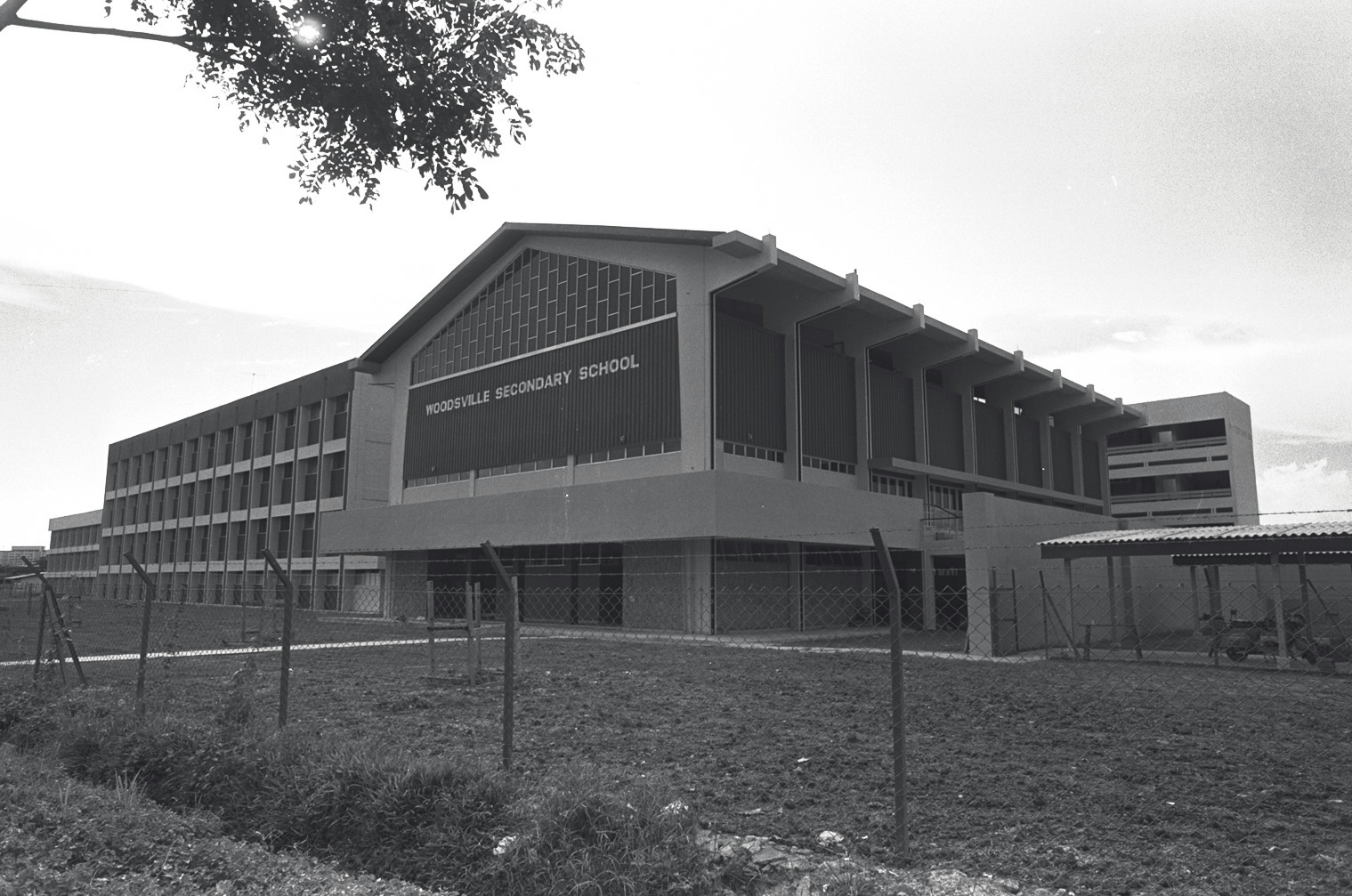
Up to 30 Secondary 1 and 2 students in the school in Aljunied Road were affected at about noon on April 24, 1979. They were sent to hospital for observation while their classmates were told to leave school early.
It was later revealed in a Straits Times report on July 2, 1980, that 48 students went hysterical during the outbreak.
The report said: “For three days, a frightening ‘epidemic’ sent one student after another into frenzied trance-like states.
“While some cried, shivered and started eating the grass and empty glasses, others stared into empty space with open eyes while performing a Tai Chi type of dance movement called the Kuda Kepang, an ancient Malay wedding dance.
“Some were restrained from their violent fits by the teachers. No one could communicate with them during their violent fits and trances.”
Twenty-eight students gave different accounts of legless apparitions which appeared before them.
GENERAL ELECTRIC (USA) TELEVISION AND APPLIANCE, JUNE 1979

Six years after the first wave of incidents, the company’s Boon Keng factory again suffered an outbreak on June 20, 1979. At least 20 women were overcome by mass hysteria, with some sent to hospital.
UNNAMED ELECTRONICS FIRM, JUNE 1979
Factory girls from the firm’s Bedok South facility were struck by mass hysteria over two consecutive days.
The firm’s doctor reportedly attended to the cases and sent those affected home after treatment.
LABOUR MINISTRY ARRANGES MEETING TO DISCUSS MASS HYSTERIA OUTBREAKS, APRIL 1980
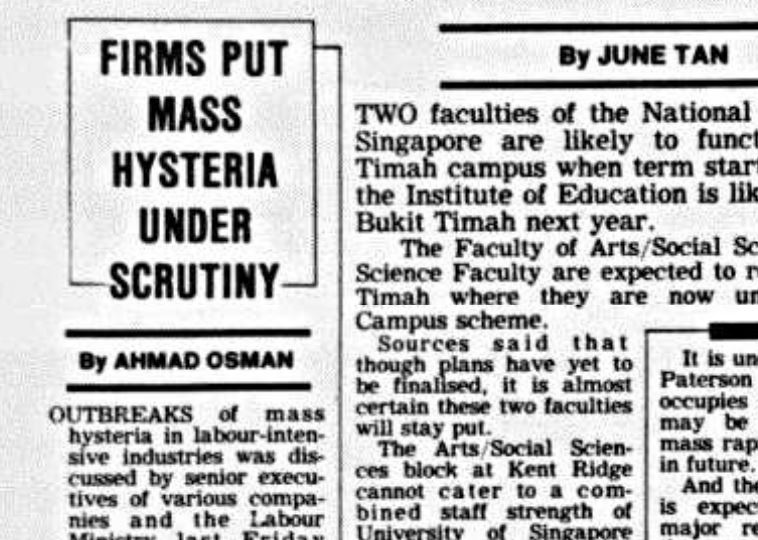
The problem, which had been specially prevalent in labour-intensive industries (mostly electronics and textiles firms), warranted a closed-door discussion between the senior executives of various companies and the ministry on April 26, 1980.
It is believed the meeting emphasised the physical aspects of the problem and how to cope with them, rather than any medical or psychical aspects.
The ministry’s industrial health division revealed in July the same year that it had investigated 13 mass hysteria cases, involving a few hundred factory workers, since the first outbreak in 1973. The other cases were not reported.

This article was first published on April 21, 2016.
Get a copy of The Straits Times or go to straitstimes.com for more stories.
Image:

Publication Date:
Thursday, April 21, 2016 – 11:29
Keywords:
Send to mobile app:
Source:
Rotator Headline:
From The Straits Times Archives: Past 'mass hysteria' cases in Singapore
Rotator Image:

Story Type:
Others
Joanne Peh wins Popular Artiste for 10th time

Actress Joanne Peh took home her 10th Top 10 Most Popular Female Artiste trophy at Mediacorp’s Star Awards ceremony on Sunday. This means the 32-year-old will collect the All-Time Favourite Artiste award next year, making her the youngest recipient of the accolade.
She said: “The happiest thing about winning this 10th award is that my fans need not spend money voting for me. They need not worry about the results and can find inner peace, just like me.”
Fans have to pay for each telephone call made to vote for their idols in the Top 10 Most Popular Female Artiste category.
The inner peace probably refers to the joy motherhood has brought her.
She spoke to the media backstage after the win, even though she said she could not wait to get home to her seven-month-old daughter with actor husband Qi Yuwu.
Incidentally, Qi, 39, received the All-Time Favourite honour on Sunday at the ceremony, which was held at Mediacorp’s new campus at one-north for the first time. He collected it with actress Rui En, 35.
In her acceptance speech, she asked for forgiveness over her controversial remarks after knocking a parked motorcycle on April 12.
The other Top 10 Most Popular Female Artistes are Quan Yi Fong, Rebecca Lim, Felicia Chin, Jesseca Liu, Julie Tan, Carrie Wong, Belinda Lee, Kym Ng and Jayley Woo.
Click on thumbnail to view photos. Source:
The Straits Times, The New Paper, Shin Min Daily News

























Quan, 42, shed tears of relief as she was the last to be called onstage to receive the popularity award – her 10th time too.
Winning the popularity award for the first time was even sweeter for actress Woo because she received the award from her idol, Korean actor Park Hae Jin of television series Cheese In The Trap.
“I’m so nervous, I just hugged oppa,” the 24-year-old said, using the Korean word for big brother. She added that she hopes one day to receive the award with her twin sister Hayley, who is also an actress.
Other awards handed out included the Best Evergreen Artiste Artiste Award, which went to veteran actor Chen Shucheng, and the Best Programme Host Award, which went to Lee Teng.
Meanwhile, getai singing competition Getai Challenge took home two awards, for Best Variety Programme and Best Variety Special.
Rising star Wong snagged the Social Media Award, while the Rocket Award, which is given to those who have shown the most improvement in the past year, was handed out to Tan.
Sunday’s event was the first half of the two-part awards show, which continues this Sunday when the top acting awards such as those for Best Actor and Best Actress will be given out.
This article was first published on April 19, 2016.
Get a copy of The Straits Times or go to straitstimes.com for more stories.
Image:

Blurb:
The actress' win will make her the youngest recipient of the All-Time Favourite Artiste award next year. -The Straits Times
Publication Date:
Thursday, April 21, 2016 – 11:56
Keywords:
Send to mobile app:
Source:
Story Type:
Others
3 hospitalised after multi-vehicle accident at Woodlands Ave 12
The accident involved two cars, two lorries and a bus, the Singapore Police Force said.
Source link
Former Mediacorp employee jailed 2 weeks for slapping, spitting at police officers
Zhao Xiaotian was granted bail of S$10,000. She is appealing her sentence.
Source link
What SkillsFuture is about
We know that it is not easy to understand what SkillsFuture is about.
We are used to names of funding schemes and organisations. So we have many people equating SkillsFuture with SkillsFuture Credit, the $500 granted to every Singaporean above 25 years old. But the Credit is only a small, though important, part of SkillsFuture.
In time to come, when we restructure WDA (Singapore Workforce Development Agency) into two statutory boards – SkillsFuture Singapore and Workforce Singapore – I am sure people will think SkillsFuture is the name of a government agency. But it is not.
What is SkillsFuture? Not a funding scheme, a training programme, or organisation. All of the above and none of the above.
I’d like to think of it as a national movement. SkillsFuture is everything we do to create a future that is different and better than today, in the way we look at work and careers, and the way we develop ourselves and our next generation.
SkillsFuture is three big ideas.
MASTERY
The first idea is mastery. It is a future where the focus is not on paper qualifications, but on the skills and destiny we create with these skills.
Paper qualifications will still serve an important purpose. Ask any worker and he will tell you how important it is to have some paper qualifications to show when looking for a job.
Paper qualifications are akin to currency – they hold value and can facilitate functioning of the market; they make exchange of distilled information more efficient.
But just as we do not, and should not, live for cash, qualifications are not the be all and end all. They are the means to an end – the end being to achieve mastery – to be really good at what we are doing. To attain a level of expertise so deep that we can innovate, venture into new territory, dream and invent.
William Hewlett and David Packard, Larry Page, Mark Zuckerberg – they were all tinkerers at the top of their game before they became inventors. Lionel Messi and Ronaldo were very skilful with the ball before they become creative players. Mastery begets creativity and invention.
So what needs to change is the kind of paper qualifications we want to have. Paper qualifications need to be more diverse and varied, and reflect not just academic qualifications but also qualifications for skills and other aptitudes.
The focus should also not just be on academic qualifications given at major milestones such as diplomas, bachelor’s degrees, master’s degrees or PhDs, but recognising what we learn throughout our whole life. Credentials can come in many forms – statements of attainment, credits, badges, advanced certificates.
Whatever we do, we need to focus on it, and continuously practise and upgrade, share our knowledge and learn from fellow practitioners. That is the most powerful function of the craft guilds in Europe. SkillsFuture challenges us to create a future where our people collectively do this and help Singapore stand out in terms of quality and competitiveness.
MERITOCRACY
The second big idea is meritocracy. If people are collectively pursuing and achieving mastery across various fields, surely our notion of success must also change in the future.
While in Switzerland and Germany recently, I saw how society respected not just those with academic achievements or who are managers and CEOs, but also artisans and craftsmen.
When our nation was young and our path straight and narrow, success and merit was seen as a pyramid – the cleverest and most able could climb to the apex, and be recognised for it.
As our nation becomes more established, the economy becomes more diversified, and we see many people flourishing in different fields. There are many paths, each ascending to a different, equally beautiful peak – a mountain range of successes. But that may not be fully descriptive of the future we envision, or even the present that is unfolding.
We assume people want to climb mountains. A friend who trekked in Nepal recently told me this story. He remarked to his Sherpa guide that Nepal is such a mountainous country that Nepalese must be a mountain people. The Sherpa replied: “You are mistaken, we are valley people.” Indeed, Nepalese do not live in the mountains. The air there is thin and altitude sickness can kill you.
We each have different destinations – the village, the city, the seaside, the oasis, the valley, the riverbank. It is a function of our gifts, our dreams, our resources. And we all find different paths to get there. That will be the evolution of meritocracy – inclusive, embracing, and celebrating the diversity of all our achievements.
YOU
Finally, SkillsFuture is about you.
As a macro strategy, it is still important to know what path our country will take and what sectors we are growing. This is the top down element – how we read the global environment, identify opportunities and seize them. It is a nation’s enterprise.
But there will also be many micro, individual decisions in society – students choosing what course to study, what careers or interests to pursue, who inspires them, what fields they want to attain mastery in. The top down macro-economic strategy and national imperatives may or may not be relevant to them.
SkillsFuture is a very personal enterprise. As Singapore flourishes and comes of age, as we become more mature, people feel free to pursue their interests, aspirations and passions.
It is a good thing that we can pursue our interests and follow our passions. If we discover our passions, we will have curiosity. If we have curiosity, we have the motivation to learn our whole life and achieve mastery.
And if a young person has yet to discover their specific area of interest or aspirations, the education system should give them more time for self-discovery.
Mastery, meritocracy and you – that is what SkillsFuture is about. The last, to me, is the most important.
Pursuing excellence is hard. Bone-deep difficult. Boredom, fatigue, self-doubt are constant bedfellows.
That is when we have to remind ourselves honestly, why we are doing this. It cannot be because my parents or Government tells me so. It must be because it is my choice, and deep down, this mastery is part of who I really am.
The writer is Acting Minister for Education (Higher Education and Skills).
stopinion@sph.com.sg
This article was first published on April 21, 2016.
Get a copy of The Straits Times or go to straitstimes.com for more stories.
Image:

Category:
Publication Date:
Thursday, April 21, 2016 – 11:24
Keywords:
Send to mobile app:
Source:
Story Type:
Others
Bukit Batok by-election: National concerns 'likely to outweigh municipal issues'
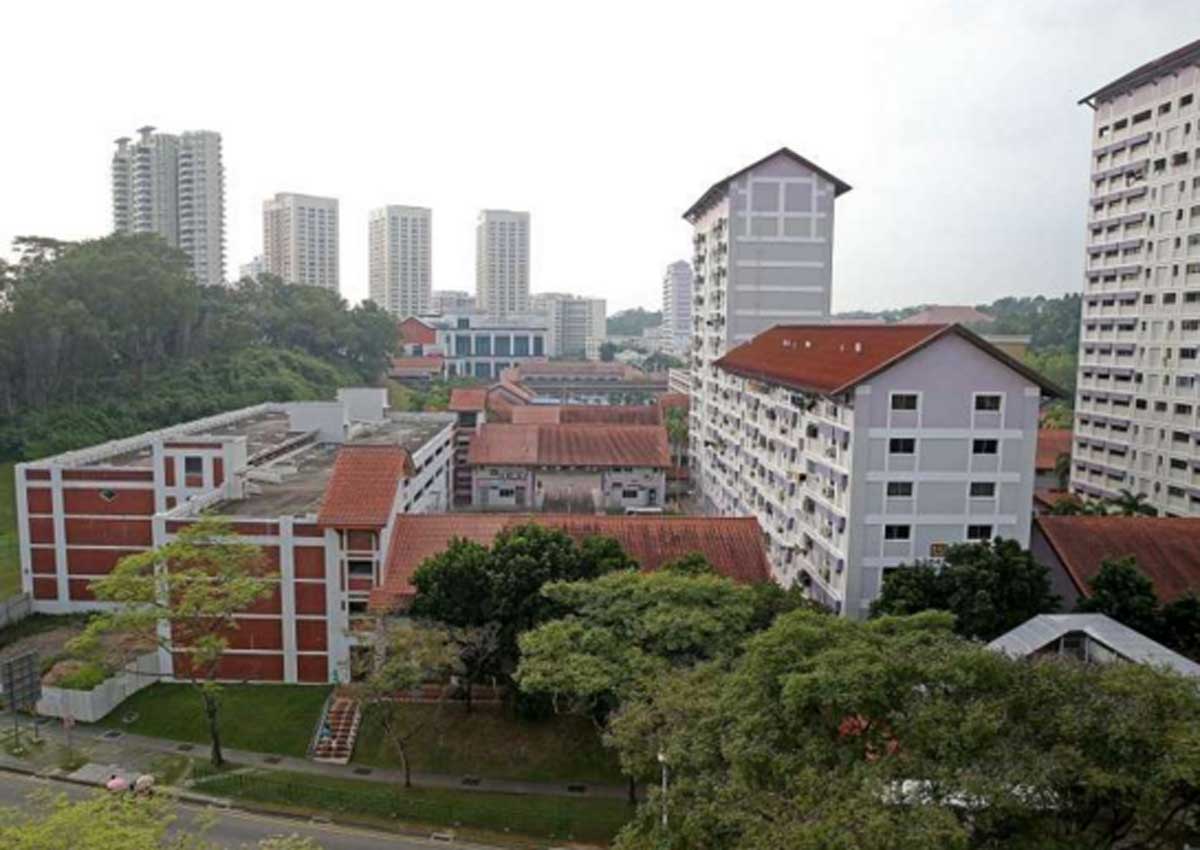
National concerns will likely outweigh municipal issues when Bukit Batok voters go to the polls on May 7, political watchers said yesterday.
The track record of the People’s Action Party (PAP) will also be a deciding factor for residents with such concerns as a slowing economy, and defence and national security issues, they added.
The polls come just eight months after the PAP won 69.9 per cent of the votes at last year’s general election, and weeks after the passing of a Budget that set the tone for Singapore in the years to come.
Former Nominated MP Eugene Tan, a law don at Singapore Management University (SMU), said: “Although there was no big hongbao, I think people responded quite positively to the Budget. So in terms of the voter mood, it’s actually quite different from the last by-election” in January 2013.
The by-election will likely be a straight fight between the Singapore Democratic Party’s (SDP) secretary-general Chee Soon Juan and lawyer Murali Pillai of the PAP.
And while the alleged affair by former MP David Ong may be a “dent in the PAP’s armour”, analysts doubt it would be a main issue.
Click on thumbnail to view photos. Source:
The Straits Times, Berita Harian, Shin Min Daily News















Dr Norshahril Saat of the Iseas-Yusof Ishak Institute said some Singaporeans may be disappointed such a scandal hit the PAP for a second time. But it is noteworthy that the party took “a strong stand” in the way it handled the matter, he said.
There are also several differences between this and the 2013 Punggol East by-election, which was called under similar circumstances and ended with the PAP ceding the seat to the Workers’ Party (WP).
First, the national mood then was still harsh against the PAP, which was “on the defensive in its politics and engagement”, said Associate Professor Tan.
That is no longer the case. The buoyant Golden Jubilee celebrations last year also remain “quite fresh in people’s minds”, added National University of Singapore sociologist Tan Ern Ser.
Second, the May 7 by-election comes on the back of Mr Ong’s 73.02 per cent victory in a three- way fight in GE2015, at which SDP candidate Sadasivam Veriyah garnered 26.38 per cent of the vote.
Dr Norshahril said it is highly unlikely the SDP will be able to engineer a swing of more than 20 percentage points, even with the purported “by-election effect” in which voters turn to the opposition knowing that the ruling PAP will remain in government.
By-election battle for Bukit Batok SMC
Click on thumbnail to view photos. Source:
The Straits Times, The New Paper, Lianhe Zaoabao, Berita Harian












This by-election also comes after the WP made headlines over audit lapses at its former Aljunied-Hougang-Punggol East Town Council.
Institute of Policy Studies deputy director for research Gillian Koh believes Dr Chee anticipated this could be a concern among voters. That is why he has formed a team to assist in the handover of town council matters should he win.
In all, the by-election is shaping up to be a fight between two veterans: Dr Chee, whose first election was 24 years ago, and Mr Murali, who began volunteering in Bukit Batok 16 years ago.
The PAP has been emphasising Mr Murali’s grassroots experience, and NUS political scientist Reuben Wong said this could work in his favour as he was also not “parachuted in”. The PAP was criticised in the past for fielding candidates with little experience and feel for the constituencies they were contesting in.
Still, Dr Chee will hope to capitalise on the by-election effect, said Associate Professor Tan Ern Ser, adding that the SDP chief will likely use the argument that “voting him into Parliament would mean having an opposition voice that would pressure the Government to give more”.
Prof Eugene Tan said Dr Chee will also likely tell voters “they can benefit from having two different opposition parties in Parliament”.
This article was first published on April 21, 2016.
Get a copy of The Straits Times or go to straitstimes.com for more stories.
Image:
Publication Date:
Thursday, April 21, 2016 – 14:00
Keywords:
Send to mobile app:
Source:
Story Type:
Others


