Trade and Industry (Trade) Minister Lim Hng Kiang said the ASEAN Competition Policy and Law Programme is the first of its kind in the region that aims to bring key stakeholders of competition policy together.
Source link
Singapore's Competition Commission leads effort to align competition policy and law in ASEAN
This AMK block is proof 'Yan Dao' cop stops thefts
She used to leave footwear in the common corridor outside her three-room flat, but someone would nick them. She lost three pairs of branded shoes over the past five years.
Madam Nur Hidayah and her neighbours on the third storey of Block 449, Ang Mo Kio Avenue 10, suffered in silence as even clothes hung outside to dry were not spared.
Putting up their own closed-circuit television (CCTV) cameras was too expensive.
But over the past year, thanks to an ingenious neighbour, it has become safer to leave footwear and clothes outside the house.
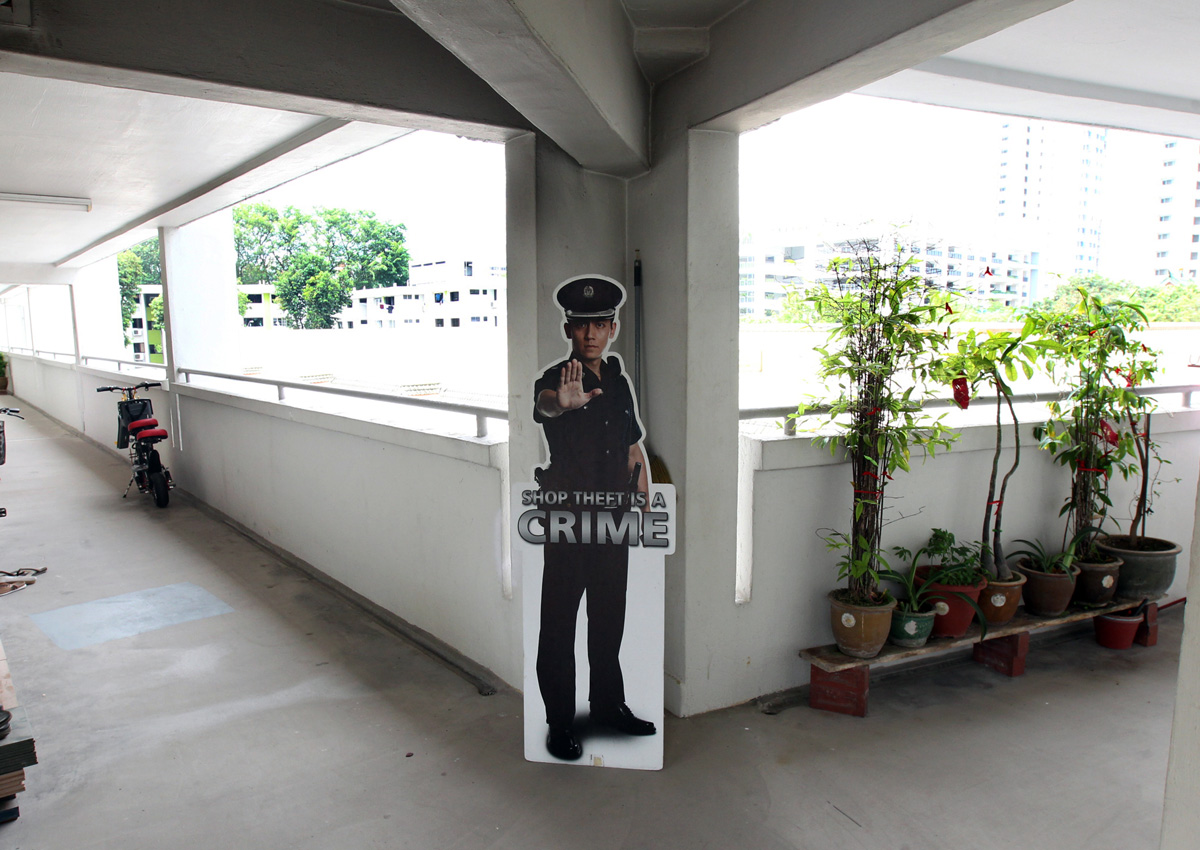
When plumber Sim Ngiap Phua, 72, who lives two doors away from Madam Hidayah, saw a cardboard standee of a policeman behind some fruit cartons near his block a year ago, an idea came to him – to take it home and position it facing the staircase.
He said he was told he could take it as the fruit shop did not know who it belonged to.
The standee he had picked up was the ubiquitous anti-shop theft “Yan Dao” (handsome in Hokkien) cop standee.
Click on thumbnail to view photos. Source:
Facebook video screengrabs






































































DETERRENCE
Surprisingly, it managed to deter the thieves from returning.
A 40-year-old polytechnic lecturer, who wanted to be known only as Mrs Lee, said: “It’s a good place for the standee to be because it’s facing the lift. So it acts as a warning to thieves.”
Mr Sim noted: “There was a big improvement after the standee was placed there.”
Said Madam Hidayah: “After the policeman (standee) was placed there, they’ve stopped taking the shoes. I purposely put branded shoes outside to see if they will be stolen. It’s been a year since.”
But on Monday, the police removed the standee from the corridor.
A police spokesman said these cardboard standees are allocated to shops to prevent shoplifting.
The shop it had been allocated to had placed it near the cartons. This led to Mr Sim mistakenly thinking it had been discarded.
So what do the residents think, now that their cardboard policeman is gone?
Mr Sim did not think that the thieves would strike again, but wished for an additional form of safety measure. Most flats in Singapore are equipped with CCTVs on the first staircase landings and inside lifts.
Said Mr Sim: “It would be safer if CCTVs could be installed to guard the corridors as well.”
Viral meme cop gets married
The life-size policeman standee was unveiled in November 2013 by the National Crime Prevention Council as part of the Festive Season Crime Prevention Campaign’s efforts to prevent shop thefts.
As reported by The New Paper in February last year, there are over 800 standees at storefronts across Singapore, turning the featured police officer, Assistant Superintendent (ASP) Ryan Koh, 34, into a viral meme.
Netizens have even given him the nickname “Yan Dao” (handsome in Hokkien) cop.
ASP Koh was also featured in an anti-crime campaign video by the Singapore Police Force in February 2015.
Despite the fact that the standees can be found in many shops across the island, many people do not recognise him in public.
He told The New Paper last year: “Maybe it’s because I don’t wear the peaked hat and put on that (stern) expression all the time.”
ASP Koh tied the knot with a colleague earlier this month. Their wedding photos have more than 2,500 likes and 1,500 shares on Facebook.
tnp@sph.com.sg

This article was first published on April 27, 2016.
Get The New Paper for more stories.
Image:
Publication Date:
Wednesday, April 27, 2016 – 21:00
Send to mobile app:
Source:
Story Type:
Others
Mouthpiece of drowned Singapore diver was missing
Seventeen hours after a Singaporean woman went missing while scuba diving in Indonesian waters, and after five hours of searching, a local diving guide spotted her body.
She was floating about 12 metres below the surface of the water.
When he got closer, he noticed that her diving regulator’s mouthpiece was missing.
Miss Vera Neo Qiu Ping, 27, was part of a group of Singaporeans who arrived at Gili Lawa in Komodo National Park, West Manggarai Regency, last Saturday for a five-day diving holiday.
At 5pm on Sunday, she failed to resurface with the other divers and the authorities were alerted.
Local diving guide Putu Sudiartana, who led the group, and other divers searched for Miss Neo until 10pm but there was no sign of her.
When daylight broke at 6am the next day, Mr Putu, another local guide, Mr Agustinus, and two of Miss Neo’s friends resumed the search.
It was about 11am when Mr Putu found Miss Neo’s body, he wrote in a Facebook post yesterday.
“Her body was floating about 12 metres underwater, without her regulator in her mouth. The regulator’s mouthpiece was also missing. It probably got stuck to something,” he wrote.
A diving regulator allows a diver to breathe air from a tank while underwater.
Mr Putu had given his account of what happened on Facebook after online speculation that Miss Neo, who worked in finance, could have drowned after being caught in a whirlpool.
He said the group had set out on Saturday morning on a cruise boat run by tour company Komodo Trails to Sebayur Island to check-dive to ensure everyone could dive with ease.
Afterwards, the group was divided into two between Mr Agustinus and him.
“We also dove that night on the island of Gili Lawa Barat and all seemed fine,” Mr Pulu wrote in Bahasa Indonesia.
On Sunday morning, they dove in Castle Rock, then spent the afternoon at Crystal Rock and reached The Shotgun, one of Komodo’s famous diving sites known for its rip currents, at about 4pm. All three are popular diving sites near Gili Lawa.
At the time, Miss Neo was in Mr Agustinus’ group.
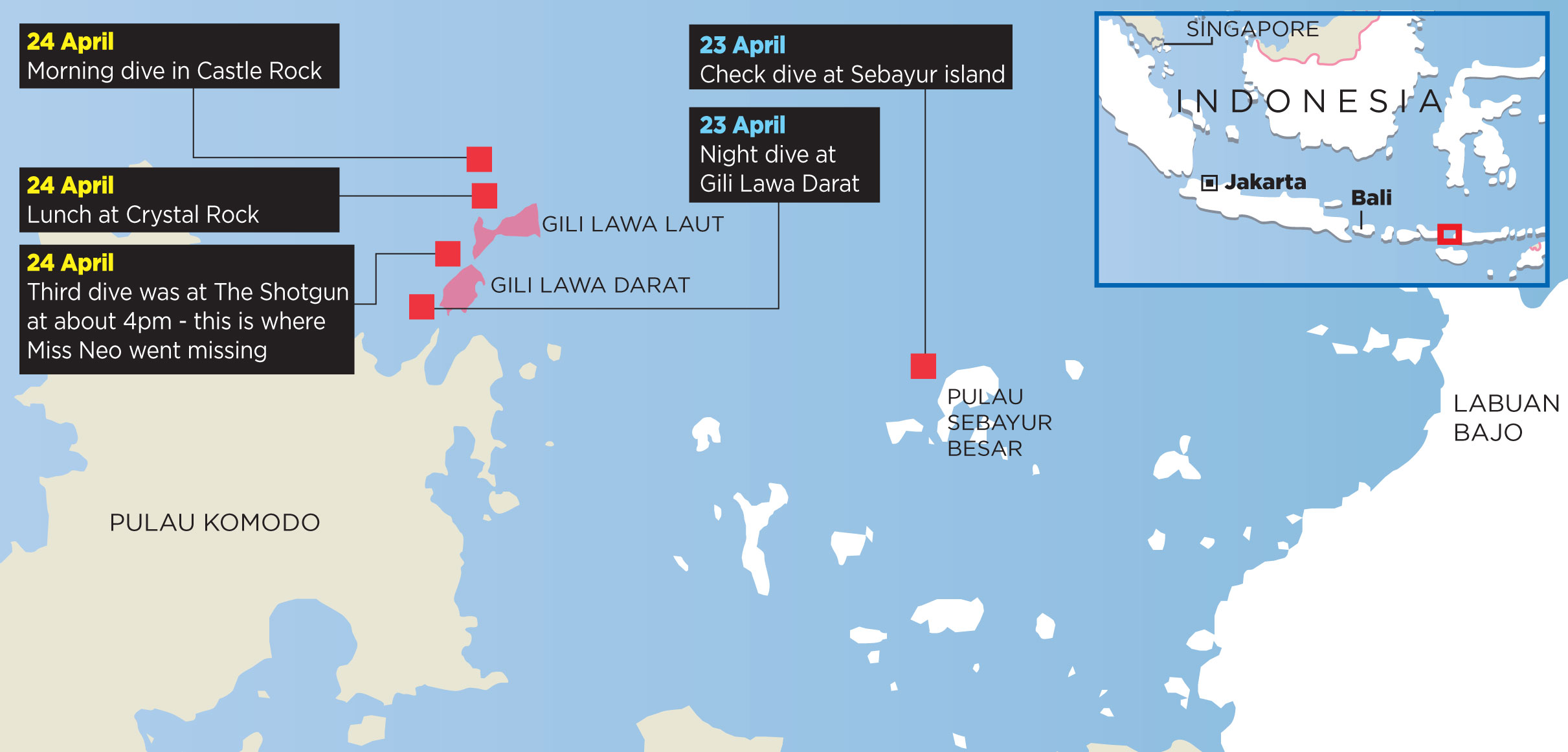 Photo: The New Paper
“When we got off the boat, everything looked fine but when we were about to start, the currents got stronger,” said Mr Putu.
He then led them to calmer waters. But they were in the water for only three minutes before they were called back to the boat.
“We were told that a diver was missing, so I dove again with the diver’s buddy and two dive masters from another boat in the area.
“At the same time, the boat captain called the authorities to report the missing passenger,” he said.
They gave up the search late at night.
“Two of the victim’s friends, Agustinus and I continued the search at about 6 the next morning but she was still nowhere to be found,” said Mr Putu.
About three hours later, the National Search and Rescue Agency (SAR) Republic of Indonesia started an eight-man search operation.
Mr Putu said: “I told the SAR team to snorkel around the water surface while the rest of us dove deeper.”
Nine minutes later, Mr Putu, who was accompanied by Miss Neo’s friend, found Miss Neo’s body. He slowly pushed the body to the surface of the water where it was retrieved by the SAR team.
Gear malfunction panic can be fatal
Although uncommon, a mouthpiece could dislodge from its tube if it is not secured properly, said freelance diving instructor Edmund Low
The 43-year-old, who has more than 12 years of instructional diving experience, said: “When the mouthpiece comes off, the diver will start drinking water and may panic.
“Although divers are trained to retrieve their alternative air source, panic may prevent them from doing so.”
An alternative air source is typically attached near the diver’s chest in case of an emergency.
Mr Low said: “There are many ‘maybes’ in this incident. If the alternative air source is not secured properly, it will be flailing behind the diver, making it difficult for the diver to retrieve it.
“The diver (Miss Neo) may also have knocked against something and passed out before the mouthpiece was dislodged.”
Despite media reports that Miss Neo was an experienced diver, Mr Low said she was nowhere near what would be considered an “experienced diver”.
Miss Neo was reported to have became a qualified autonomous diver with Scuba Schools International in October 2014 and earned her Advanced Adventurer certification in December that year after going on at least 18 dives.
Mr Low said: “The syllabus for recreational diving is adequate. But experience is key for divers to be able to execute the right processes in a state of panic and emergency.”
Another diving instructor, who has 22 years of instructional diving experience, said: “Even divers who have clocked 1,000 dives are only considered ‘mid-stream’.
“Her Advanced Adventurer certification merely indicates that she has completed a certain number of dives,” he said.
The instructor, who declined to be named, has dived at Gili Lawa and said that it is a popular diving site renowned for its beauty that is “like no other”, its variety of marine creatures and the chance to see a Komodo dragon.
Possible causes for fatal dives include panic and gear malfunction, he said.
“A diver might not think rationally when he panics. When visibility suddenly becomes poor, the diver might swim around in circles looking for other divers instead of resurfacing,” he added.
MINIMUM RATIO
Recommended diving safety protocols include having a buddy system and a minimum ratio of at least one dive guide to four divers, he said.
But he was quick to add that safety protocols vary across countries and dive operators.
He suggests that divers who want to dive overseas should book tours with reputable and licensed dive operators in Singapore, not just for safety concerns, but also to avoid complications when making insurance claims if an accident occurs.
He also recommends that divers should thoroughly research a dive site before attempting to dive there and have some “self-awareness”, which some divers lack, on whether they are suited to dive at particular sites.
tnp@sph.com.sg
This article was first published on April 27, 2016.
Get The New Paper for more stories.
Image:

Blurb:
Diving guide recounts how he found body of Singapore woman who died while scuba diving in Indonesia. -The New Paper
Publication Date:
Wednesday, April 27, 2016 – 14:41
Keywords:
Send to mobile app:
Source:
Story Type:
Others
Bukit Batok by-election: Rally sites at Bukit Batok Industrial Park, Bukit Gombak stadium
SINGAPORE – Candidates running in the Bukit Batok by-election will be able to apply to hold rallies at Bukit Gombak Stadium as well as a designated field along Bukit Batok Industrial Park A.
Rallies may be held between 7am and 10pm from April 28 to May 5 at these sites.
The list of election meetings scheduled for April 28 will be announced on April 27, after the close of permit applications.
As large crowds are expected at the election meetings, members of public are advised to take public transport.
Motorists travelling within the vicinity of the election rallies should be prepared for traffic diversions or lane closures, police added.
The status of the Speakers’ Corner as an “Unrestricted Area” under the Public Order Act will also be temporarily revoked from April 27 to May 7.
who wish to organise cause-related activities, such as public speaking, demonstrations, or public entertainment activities at the Speakers’ Corner during this period will need to apply for the relevant permits and licenses from the police.
ljessica@sph.com.sg
Image:

Publication Date:
Wednesday, April 27, 2016 – 14:08
Keywords:
Send to mobile app:
Source:
Story Type:
Others
New hotline is abused kids' lifeline
For over a year, Jack (not his real name) lived with his maternal aunt while his parents were in prison.
But the 10-year-old had to endure her verbal insults as she did not want to care for him.
There was no one else he could turn to as his paternal grandparents had abused him before, hitting him with a stool and hanging him upside down.
When a Family Service Centre (FSC) became aware of Jack’s plight, its staff reached out to Heart@Fei Yue, a Child Protection Specialist Centre set up by the Ministry of Social and Family Development (MSF) in April 2013 to handle child abuse cases considered of moderate risk.
Previously, it took on only abuse cases referred by the MSF but since April this year, it has opened its doors to the public with its hotline.
Social workers from Heart@Fei Yue have since met with Jack and his family members to make arrangements for him to stay in a children’s home near his school until his parents are released.
Moderate risk means children are victims of harsh physical punishment afflicted to areas other than the head, or whose welfare may be neglected by parents who are substance abusers or mentally ill, said Heart@Fei Yue centre director Ng Kwai Sim.
Members of the public can contact the centre directly to refer possible cases of child abuse or neglect, or to consult a social worker.
Severe cases, such as those involving sexual abuse, are referred to the MSF’s Childhood Protective Service while low-risk cases are handled by FSCs.
Since opening its services, Heart@Fei Yue, which serves the whole island, has had an average of a call a day through the hotline, but the numbers are expected to rise as people become more aware of it.
Principal social worker Ng Cher Meng said: “We hope to make Heart@Fei Yue more accessible to the public. The earlier (help is rendered) the better it is for the children.”
The public can reach Heart@Fei Yue via its hotline on 6819-9170 from Monday to Friday, 9.30am to 5.30pm.

This article was first published on April 27, 2016.
Get a copy of The Straits Times or go to straitstimes.com for more stories.
Image:

Publication Date:
Wednesday, April 27, 2016 – 17:05
Keywords:
Send to mobile app:
Source:
Story Type:
Others
Former SNSD member Jessica to open official fan club

Former SNSD member Jessica will officially open her own fan club, according to her agency, Coridel Entertainment.
The benefits of joining will include an official fan club card and the chance to preorder a fan meeting ticket.
Sign-ups will be followed by Jessica’s first solo debut with a new album release scheduled in May.
Fans can join online by purchasing tickets on Interpark (www.ticket.interpark.com) for 15,000 won (S$17.60). The tickets will be available from April 28 to May 22, and will last around a year until May 31, 2017.
5 things about Jessica and Girls’ Generation
Click on thumbnail to view photos. Source:
Lollipop, SM Town, Sina Weibo, Internet screengrabs, AFP























christinekim@heraldcorp.com
Image:

Publication Date:
Wednesday, April 27, 2016 – 14:06
Keywords:
Send to mobile app:
Source:
Story Type:
Others
'Minority-only contest would send wrong signal'
Any move to occasionally restrict presidential polls to minority candidates would send the wrong signal that Singaporeans of minority races cannot be elected on their own merit, said three people yesterday at a hearing on the elected presidency.
Society is already moving towards race blindness in voting at elections, and should be left to evolve on its own, they added.
Institute of Policy Studies (IPS) deputy director of research Gillian Koh said: “We are in the process of working towards the idea that we should select someone for this office regardless of race, language or religion… If we stop this process now that would be a great pity.”
Her view against having a legal provision to ensure a minority president is elected from time to time, was echoed by rights group Maruah and Singapore Management University law professor Jack Lee. They were speaking at the third hearing of the Constitutional Commission to review the elected presidency.
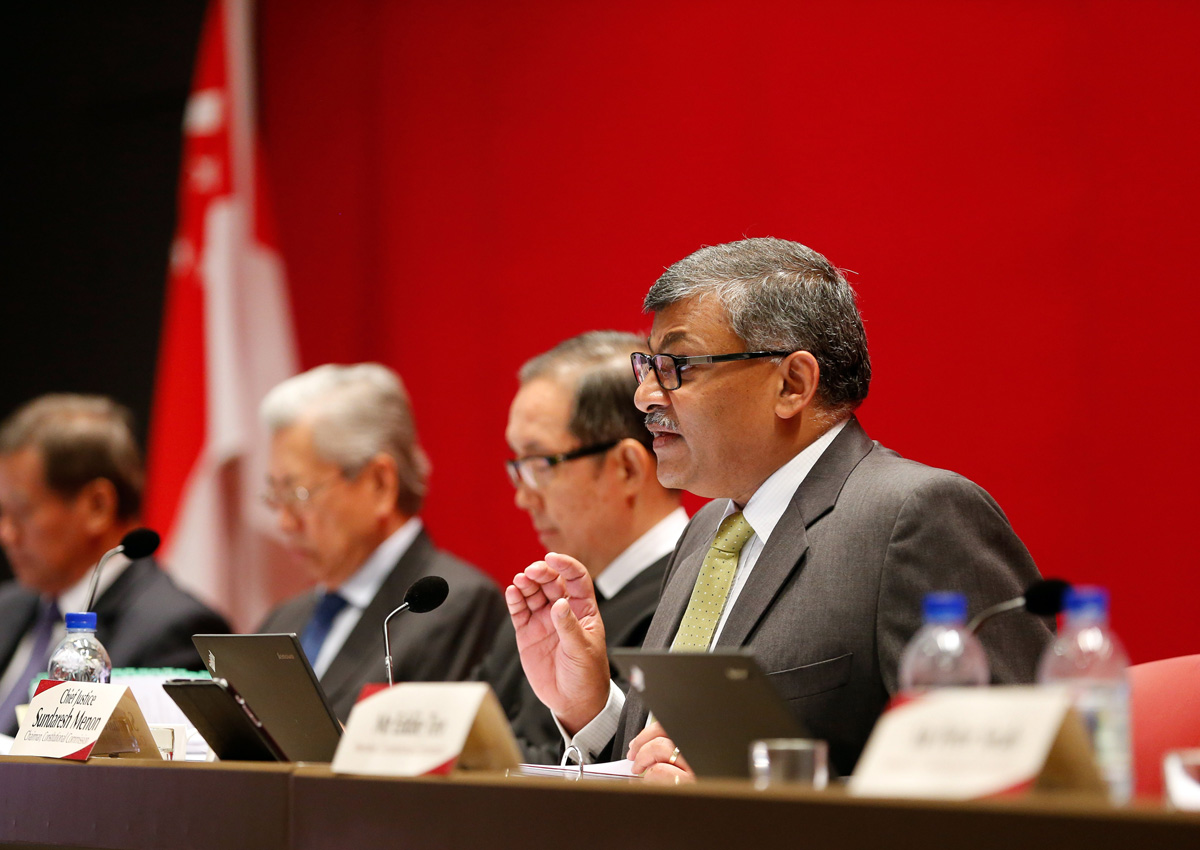
Chief Justice Sundaresh Menon, who chairs the commission, asked if it would be possible to achieve the twin aims of letting society evolve and yet nudging it along, by having a provision to reserve elections for particular ethnic groups when they have not been represented in the office of president for a prolonged period of time.
“The question is whether making any such a provision is going to hold us back or spur us on,” he said.
Dr Koh, who had earlier submitted her views jointly with IPS research assistant Tan Min-Wei, warned it could result in minority presidents lacking gravitas and political legitimacy.
Citing a publication by Malay self-help group Mendaki, she said some in the community did not believe in affirmative action even if they aspire to have a Malay president. The last Malay president was Mr Yusof Ishak, who died in office in 1970.
But Public Service Commission chairman Eddie Teo, a member of the commission, said minority candidates too would be subject to the same stringent eligibility criteria applied to all candidates, and would have qualified based on merit.
Dr Koh said there would still be a perception problem.
CJ Menon noted that those who win elections in majoritarian systems are the most electable but not necessarily always the most meritorious candidates.
But there is no data, Dr Koh said, to show Singaporeans vote along racial lines at presidential elections, as the two polls that were contested, in 1993 and 2011, had only Chinese candidates.
She added that an IPS survey of over 2,000 Singaporean voters in 2011 found most were sanguine about a minority president being elected under the current system.
Later, Maruah president Braema Mathi said there are enough Singaporeans from minority groups who are qualified to stand and they just needed to be convinced to do so.
Dr Lee proposed that a committee be appointed to identify suitable minority candidates with the help of organisations such as civil society groups and unions, similar to how Nominated Members of Parliament are selected.
Ms Mathi questioned if the Government-led discussion had brought the issue of a minority president to the fore unnecessarily. She also said the commission should “watch the scene” for two or three more elections before deciding on any changes.
Professor Chan Heng Chee pointed out that countries that have avoided discussions on ethnicity have had to “scramble to address it in their own way” as “the problem has come to hit them now”.
In Singapore, the issue has been discussed all along, she noted.
Prof Chan, a commission member and chairman of the Lee Kuan Yew Centre for Innovative Cities at the Singapore University of Technology and Design, also said having minority presidents is a way of demonstrating inclusiveness, which is important in a multiracial society.
National University of Singapore law professors Jaclyn Neo and Swati Jhaveri suggested having a three- member council of presidents – with at least two members from different ethnicities – to achieve this.
They also proposed the institutions related to the presidency, such as the Council of Presidential Advisers, be required to have minority members. Dr Jhaveri said this is “part of a holistic view of safeguarding minority representation”.
But CJ Menon asked if this would be “too interventionist”.
It is important to have a minority president from time to time because of the president’s special symbolic role, he said. But he questioned if there was a similar need in the institutions and cautioned against going down the path of entrenching group rights.
PRIVILEGED TO BE A SINGAPOREAN
“I’m not sure we haven’t done well. I think we’ve done extraordinarily well if we look at where we journeyed from in the last 50 years. I’m not sure I should be saying this, but as an individual and as a minority I feel greatly privileged to be a Singaporean. I can’t think of anywhere else I’d rather be because I feel there is such an open and equal-opportunity society. So I don’t think we should be harsh on ourselves, saying the vision of the first-generation founding leaders has not been realised. I don’t think the first-generation founding leaders necessarily thought it was going to happen in a decade or two. I think if we look at how we’ve progressed over the last several decades we’ve done incredibly well.”
– Chief Justice Sundaresh Menon, in response to National University of Singapore Assistant Professor of Law Jaclyn Neo who felt that there was still a long way to go in Singapore’s journey towards true multi-racialism.
PARAMOUNT CONSIDERATION
“There’s an intuitive sense on the part of many who have spoken that if you raise the criteria, that may reduce the pool of minorities… I just wonder whether we should separate the issues for a second and ask ourselves, first of all, whether the criteria we arrive at are adequate. Because that should be the paramount consideration… If the view is that the criteria should be updated, then surely we shouldn’t resist doing so for the sake of the minorities. Because that would actually mean that we are, in a sense, lowering the criteria from what they ought to be, in order to accommodate the minorities and that gives me quite a lot of discomfort.”
– CJ Menon, in an exchange with Singapore Management University law don Jack Lee about eligibility criteria’s effect on the number of qualifying minorities.
This article was first published on April 27, 2016.
Get a copy of The Straits Times or go to straitstimes.com for more stories.
Image:
Publication Date:
Wednesday, April 27, 2016 – 17:10
Send to mobile app:
Source:
Story Type:
Others
Song Joong-ki is more than good looks

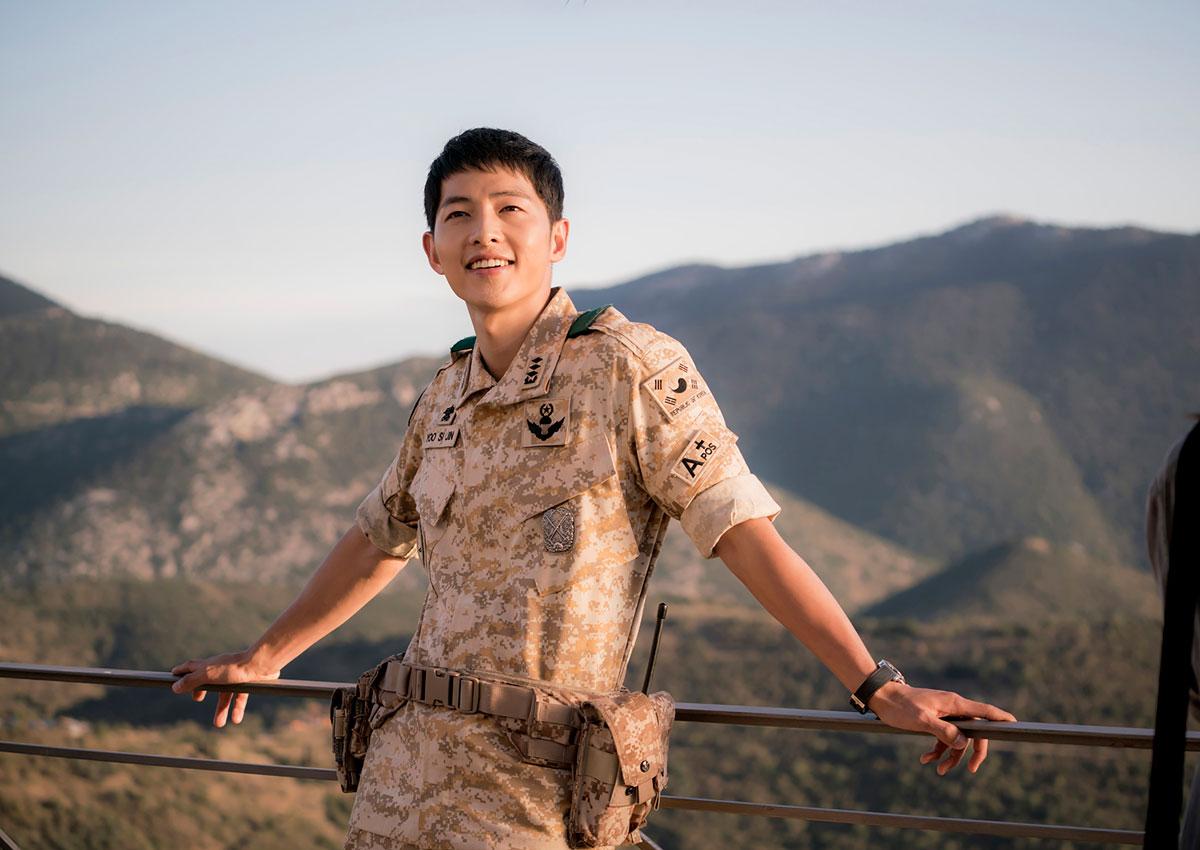
Though many have come to know him as the dashing Army Capt. Yoo Shi-jin in the recent hit series “Descendants of the Sun,” actor Song Joong-ki has actually tried his hand in diverse acting roles since his debut in 2008.
When it comes to his acting career, Song is not shy about his ambitions, he revealed in a group interview at the Grand Hyatt Seoul on April 15.
“There are so many characters I want to play,” the 30-year-old actor said. “I’m greedy about acting.”
Song has primarily been in the spotlight for his pretty-boy image, milky-white complexion and elite education background. He majored in business administration at the prestigious Sungkyunkwan University. However, his past works hint at an actor who is willing to take on substantial challenges in his craft.
In his first film, “A Frozen Flower,” he starred as a military commander’s bodyguard, a role that initially had no lines. Song was injured during the shoot when he fell off a horse, but continued filming through the pain. Director Yoo Ha, impressed by Song’s tenacity, decided to give him a short scene with dialogue, reports say.
In “A Werewolf Boy” (2012), Song played a half-man, half-wolf creature, raised among wolves, who becomes devoted to a girl who cares for him and teaches him the ways of human life. Song received positive reviews for his portrayal, which viewers said offered a skillful blend of wolfish habits, innocent boyhood and the unconditional devotion animals show toward humans.
These actors are scorching hot, thanks to Descendants of the Sun
Click on thumbnail to view photos. Source:
Viu, Instagram, AFP, StarHub













































The versatile actor also made his mark in television through his roles in the dramas “Sungkyunkwan Scandal” (2010) as cocky playboy Goo Yong-ha, and in “Deep Rooted Tree” (2011) as a young prince.
According to Jo Sung-hee, the director of “A Werewolf Boy,” Song was as fastidious in his acting technique as he was gregarious with the filming crew.
“Song prepares a lot and practices his scenes extensively,” Jo said at a press conference for his new film, “Detective Hong Gil-dong” on Monday. “He trains very hard. He’s also very talkative and energetic on the set.”
For his next project, Song has chosen the film “Battleship Island,” set in the period of the Japanese occupation of Korea. Song is to play Park Moo-young, an independence fighter who infiltrates a Japanese island to rescue a group of captured fellow Korean fighters. The role is a dream come true for him, Song said.
“I really wanted to do a period piece set in the Japanese occupation era,” he said. “With this film, I’ve cleared one longtime goal.”
Going forward, Song wants to steer away from the chivalrous boyfriend role that has earned him massive popularity.
“I want to play a character that is cold,” he said. “I think there are sides of me that are like that. I’m a fan of the actor Edward Norton, and if you see his early works, he plays a lot of those roles. A thriller could be fun, too.”
On his acting approach, Song said he likes to “go by the book” and prioritize the script over anything else.
“I read the script very carefully and I try to imagine, from the writer’s point of view, why a certain line of dialogue was placed in a certain scene.”
At the same time, he says it’s inevitable that his own personality comes through in the characters he plays.
“I’m not a fan of gushing emotions,” he said. “I think that probably shows in all of the characters I play. I try to reinterpret the characters in my style.”
Descendants Of The Sun heart-throb caused NG takes: Song Hye Kyo
Click on thumbnail to view photos. Source:
Viu, KBS World




























For his role as Yoo in “Descendants,” for example, Song was lauded for convincingly delivering romantic dialogue that could otherwise have been cringe-inducing, striking just the right balance between the cool and the emotional.
His time in the military was a significant turning point in his life, Song said.
“I was told I would never get another chance to rub shoulders with ordinary soldiers and live a normal life. I felt I would be able to learn a lot not only as an actor, but also as a young man.”
By meeting people who had come together for Korea’s mandatory military service, Song said he realised he shouldn’t complain about his own hardships.
“There were people from all different backgrounds. I thought to myself, ‘Things that I consider stressful aren’t anything to some people,'” he said. “I felt so many things in the military. I think that shows in my acting now.”
Now that his popularity has rocketed to superstardom — at least for the moment in Korea’s ever-churning celebrity scene — Song says he feels burdened with responsibility.
“I have to work hard at my job so that my company employees can take home their pay,” he said. “And I’ve gained international fans who are supporting me. I think I absolutely shouldn’t disappoint them.”
The best way to live up to these expectations, Song said, is to focus on his craft.
“I’m an actor, so the best thing I can do is to show myself through a good project.”
When asked if he wants to abandon his pretty-boy image, as most “serious” actors are wont to do, Song replied, unexpectedly, with a resolute “No.”
“Realistically, looks offer an advantage to an actor,” he said. “I’m going to work hard to maintain my skin. I’m going to prevent aging as much as possible. And I will keep trying to become a better person on the inside as much as I spruce up the outside.”
doo@heraldcorp.coma
Image:
Publication Date:
Wednesday, April 27, 2016 – 14:01
Keywords:
Send to mobile app:
Source:
Story Type:
Others
GIC scoops up buys amid global downturn
Image:

Publication Date:
Wednesday, April 27, 2016 – 17:15
External URL:
Send to mobile app:
Source:
Story Type:
Others
Jakarta gives Singapore a list of fugitives
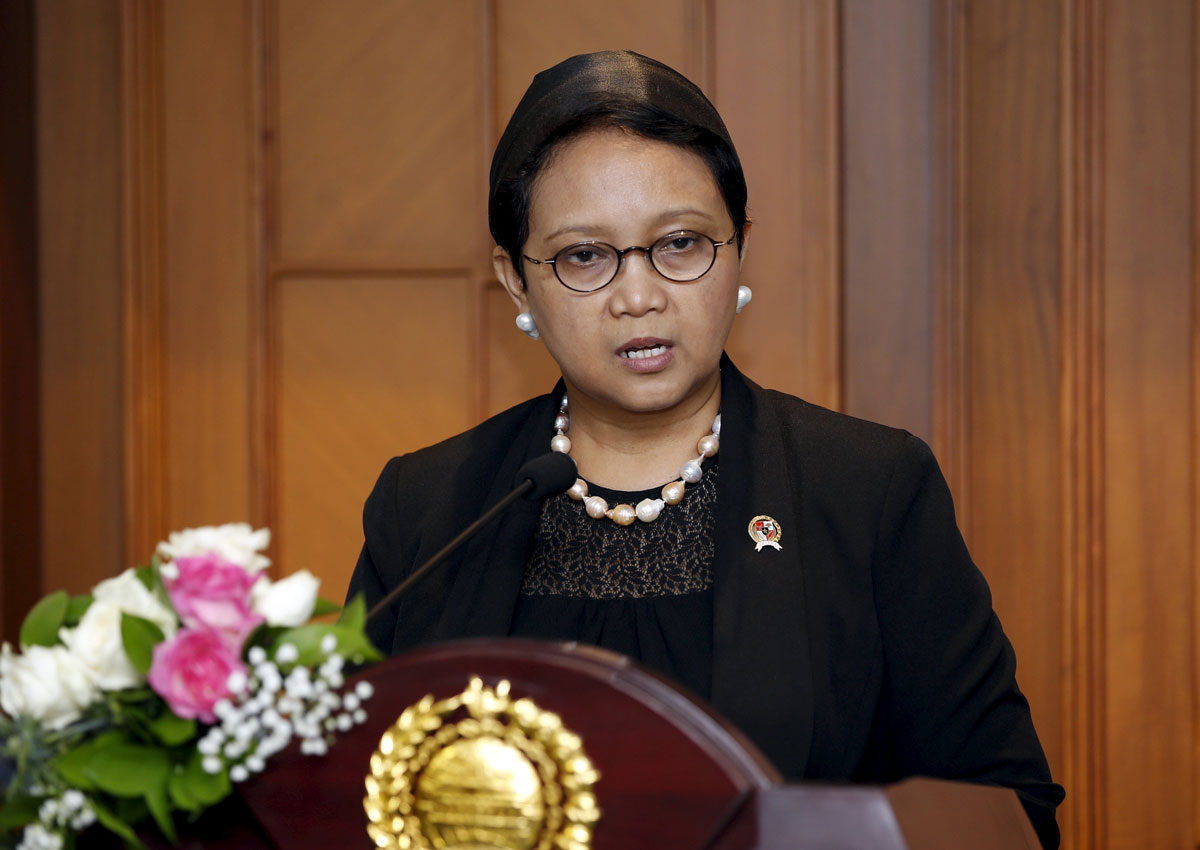
Indonesia has given Singapore a list of fugitives, part of back-channel efforts to nab those who had fled the country after being convicted of crimes.
Mr Atmadji Sumarkidjo, a senior official from the Coordinating Ministry of Political, Legal and Security Affairs, said Foreign Minister Retno Marsudi sent the list to the Singapore authorities recently, as both nations intensify co-operation in law enforcement. The co-operation is being conducted in lieu of an extradition treaty.
Indonesia and Singapore signed an extradition treaty as well as a defence co-operation agreement as a package in April 2007, but the pact has yet to be ratified by Indonesian lawmakers .
“We have not ratified the extradition treaty with Singapore, so we do this on the basis of the good relationship between our two countries,” Mr Atmadji told The Straits Times yesterday.
“We have sent to Singapore the data of all that we consider as fugitives, who have been convicted, and fled the country. So this is not extradition, it’s just good relations.”
Mr Atmadji also said leaders from both sides “can pick up the phone and talk” about such issues.
“Menkopolhukam and Menlu can just call Singapore’s Deputy Prime Minister (Teo Chee Hean), so it’s quick and bypasses bureaucracy,” he said, referring to Indonesia’s Coordinating Minister for Political, Legal and Security Affairs Luhut Pandjaitan and Ms Retno, respectively.
The latest development comes just days after Vice-President Jusuf Kalla erroneously implied that Singapore was unwilling to sign an extradition agreement with his country. Singapore’s Ministry of Foreign Affairs refuted Mr Kalla’s remarks a day later on Saturday.
Two days earlier, Singapore revoked Indonesian tycoon and long- time fugitive Hartawan Aluwi’s permanent residency and had him removed from the city-state. He is now in Indonesian custody.
Also last Thursday, China extradited Samadikun Hartono, the former head of the now-defunct Bank Modern, who had spent 13 years on the run since his conviction for corruption.
Hartawan had fled to Singapore in 2008 after he was suspected to have misused government funds amounting to 6.7 trillion rupiah (S$686 million) to bail out the now-defunct Bank Century during the 2008 global financial crisis.
Regarding such cases, Singa- pore’s Ministry of Home Affairs said previously that the country would “co-operate with and provide assistance to Indonesia within the ambit of our laws and our international obligations”.
Mr Atmadji declined to elaborate on the wanted list sent to Singapore, but The Straits Times understands that it comprises citizens who have been convicted of crimes and are believed to have left Indonesia before serving out their sentence. They include those suspected to be hiding in Singapore, as well as those on the run elsewhere.
Law enforcement, anti-corruption and counter-terrorism agencies in Indonesia maintain separate wanted lists and the database shared with Singapore is believed to contain those who are convicted of white-collar crimes.
On Interpol’s “Wanted Persons” list are 44 Indonesians sought by the government and they include Hartawan as well as 16 others wanted for fraud, as well as five each for money laundering and banking-related offences. The list also includes Dewi Tantular, who is linked to Hartawan and the Bank Century case.
Mr Luhut on Monday said President Joko Widodo has ordered the government to pursue the country’s fugitives. This includes “developing co-operation with the Singaporean Government”, he said.
In urging fugitives to return to Indonesia to face the legal process, Mr Luhut added: “The fugitives will not face undue punishment and will only be held responsible for what they have done.”
wahyudis@sph.com.sg
This article was first published on April 27, 2016.
Get a copy of The Straits Times or go to straitstimes.com for more stories.
Image:
Blurb:
Part of co-operation to nab those who fled Indonesia after being convicted of crimes. -The Straits Times
Publication Date:
Wednesday, April 27, 2016 – 14:00
Keywords:
Send to mobile app:
Source:
Story Type:
Others


