With the completion of the transfer, HSBC Bank (Singapore) will now oversee all retail banking and wealth management operations of the bank in Singapore, HSBC says.
Source link
HSBC completes transfer of business units to Singapore subsidiary
The worst singer in the world

As a new film starring Meryl Streep is released, Clemency Burton-Hill finds out what made Florence Foster Jenkins so popular – and inspirational.
Florence Foster Jenkins was a 20th-Century US socialite and music-lover who styled herself as an operatic coloratura soprano and became a sensation.
One of the most famous singers of her day, she was incredibly rich, a generous philanthropist, and garnered legions of fans including celebrities such as Noël Coward.
Florence’s fame, however, rested not on her musical talent, but rather its opposite.
Her astonishingly bad voice and abject inability – seemingly unbeknownst to her – to pitch correctly became the stuff of legend as she worked hard to lovingly massacre her way through gems by Mozart, Strauss and other leading composers.
Having previously only been seen in private at New York women’s clubs or in her own establishment, the Verdi Club, such was the demand for her performances that she went on to sell out Carnegie Hall in a 1944 concert that has entered the annals of music history.
While her public performances also raised millions of dollars (in today’s terms) for charity, the abiding image is that of polite society guffawing, jaws clenched, trying not to roll down the aisles with laughter as they showered her with thunderous applause.
Florence Foster Jenkins remains, it is widely agreed, ‘the worst opera singer in the world’.
But the most incredible thing of all is that she had no idea. The illusion that she was a truly great artist was maintained, thanks in no small part to her second husband St Clair Bayfield, throughout her life.
She loved what she did and she believed she was bringing great pleasure to her adoring audiences – which, in a way, she was.
Her extraordinary story has long held a fascination for writers, directors and musicians.
Read the full article here
Image:

Publication Date:
Wednesday, May 11, 2016 – 06:00
Send to mobile app:
Source:
Story Type:
Others
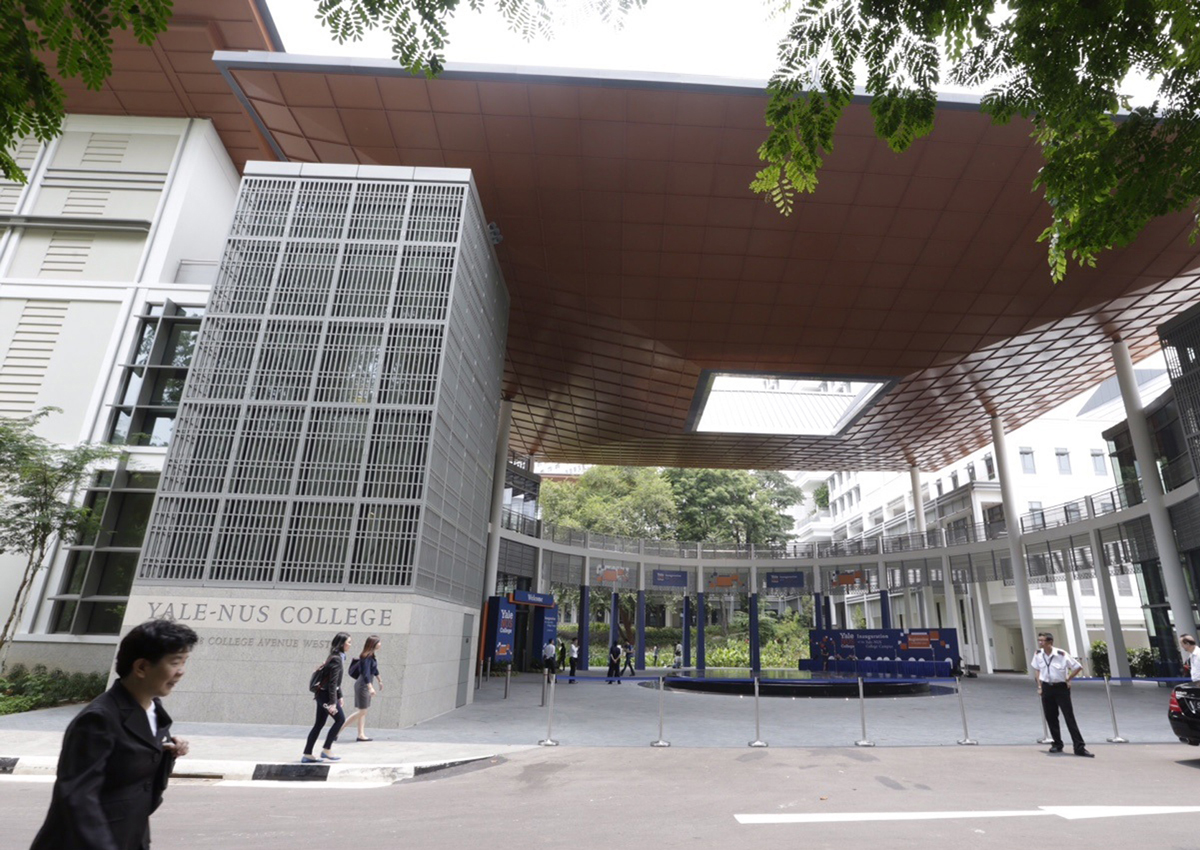
Yale-NUS adopts Latin honours system
The Yale-NUS College has become the second institution here to adopt the Latin honours system, a degree classification used by American universities such as Harvard and Yale.
The system, which indicates the level of distinction a graduate has earned, uses nomenclature such as summa cum laude and magna cum laude. The Singapore Management University (SMU) also uses the terms.
But, unlike SMU which does not limit the number of students who can earn Latin honours, Yale-NUS has imposed a 35 per cent cap.
The policy, which was made known to students through an official e-mail in March, has drawn mixed reactions from them.
Some students said it would be hard to know for sure how they are faring each semester as their final honours level would be made known to them only at the end of four years. This is because they are not marked on a bell curve throughout the four years, unlike their peers at the National University of Singapore (NUS).
The Latin honours is on top of the bachelor’s honours degree in arts or science that all students receive after completing the four-year undergraduate honours programme.
The top 5 per cent are awarded summa cum laude, while the magna cum laude goes to not more than the next 10 per cent, and cum laude to not more than the next 20 per cent.
There is also a cap within each major – no more than 60 per cent or six of the students (whichever is larger) will receive honours at the cum laude level or above.
Similarly, no more than 40 per cent or four of the students (whichever is larger) will receive honours at the magna cum laude level or above. There are 14 majors at Yale-NUS. Class sizes for the majors in the inaugural batch range from three to 16, with philosophy and physical sciences being the smallest, and politics, philosophy and economics drawing the most students.
In response to queries, Professor Tan Tai Yong, executive vice-president (academic affairs) at Yale-NUS College, said Latin honours may not be commonly used here. But it is well-known globally, and the classifications are similar to those used by liberal arts and sciences colleges and universities in the United States and other countries. The college uses a different method of determining the level of honours due to its unique curriculum, smaller cohort and grading practices, he said, adding that using Latin honours also allows it to distinguish its system of honours from that of NUS.
Prof Tan noted that the Latin honours may not “directly equate to the various classes of degree honours conferred by institutions that follow other systems, such as the British system”. Furthermore, the criteria for the levels of honours could differ across two institutions using the same honours terminology.
Other universities here, such as the Nanyang Technological University and SIM University, use the British honours system of first class, second-class upper, second-class lower and third class. Last year, NUS renamed its first-class honours as honours with highest distinction, second-class upper honours as honours with distinction, second-class lower honours as honours with merit and third-class honours as honours.
Prof Tan said the limits imposed on majors are meant to “recognise academic achievement within the major, in addition to the overall cumulative average point (CAP)”. It is also to “help control for potential differences in grading across majors, and shifts in the average CAP from one graduating class to another”.
About 170 Yale-NUS students signed a petition in March calling for the college to reconsider the honours system. One concern they had was that placing a cap within each major would lead to unhealthy competition, especially in courses with fewer than 10 students.
Some were also unhappy that the honours system was revealed only this year. Yale-NUS student Sherlyn Goh, 22, who belongs to its first batch which graduates next year, said: “Many of us had assumed that we would follow NUS’ fixed CAP system.”
The arts and humanities major also said having a bell curve system throughout the four years is better.
“It’s important that students know how we are doing academically so that we can take steps to improve our work or plan our modules more strategically.”
Global affairs major Dennis Chiang, 25, said some students think it might be unfair if they have the same CAP as an NUS student but do not make the 35 per cent cut for Latin honours. But he said that work experience would count more in his choice of career, either in policy work or journalism.
Prof Tan said Yale-NUS will recognise students’ academic and non-academic achievements through other ways such as prizes and awards. He said that the college is “very confident” that students who do well in their studies and co-curricular activities, and those who prepare for work through internships or engaging professional networks will be “strong contenders in the job market or for graduate programmes”.
Mr David Leong, managing director of recruitment firm PeopleWorldwide Consulting, said employers are increasingly looking at graduates’ work experience.
“They also look at the role and responsibility of the job position, and the salary package is based more on that than the qualification of the applicant,” he said. “Even master’s degrees have marginal difference in salary offers, compared to someone with relevant work experience.”

This article was first published on May 9, 2016.
Get a copy of The Straits Times or go to straitstimes.com for more stories.
Image:
Publication Date:
Monday, May 9, 2016 – 14:00
Keywords:
Send to mobile app:
Source:
Story Type:
Others
Can S-E Asia be haze-free by 2020?
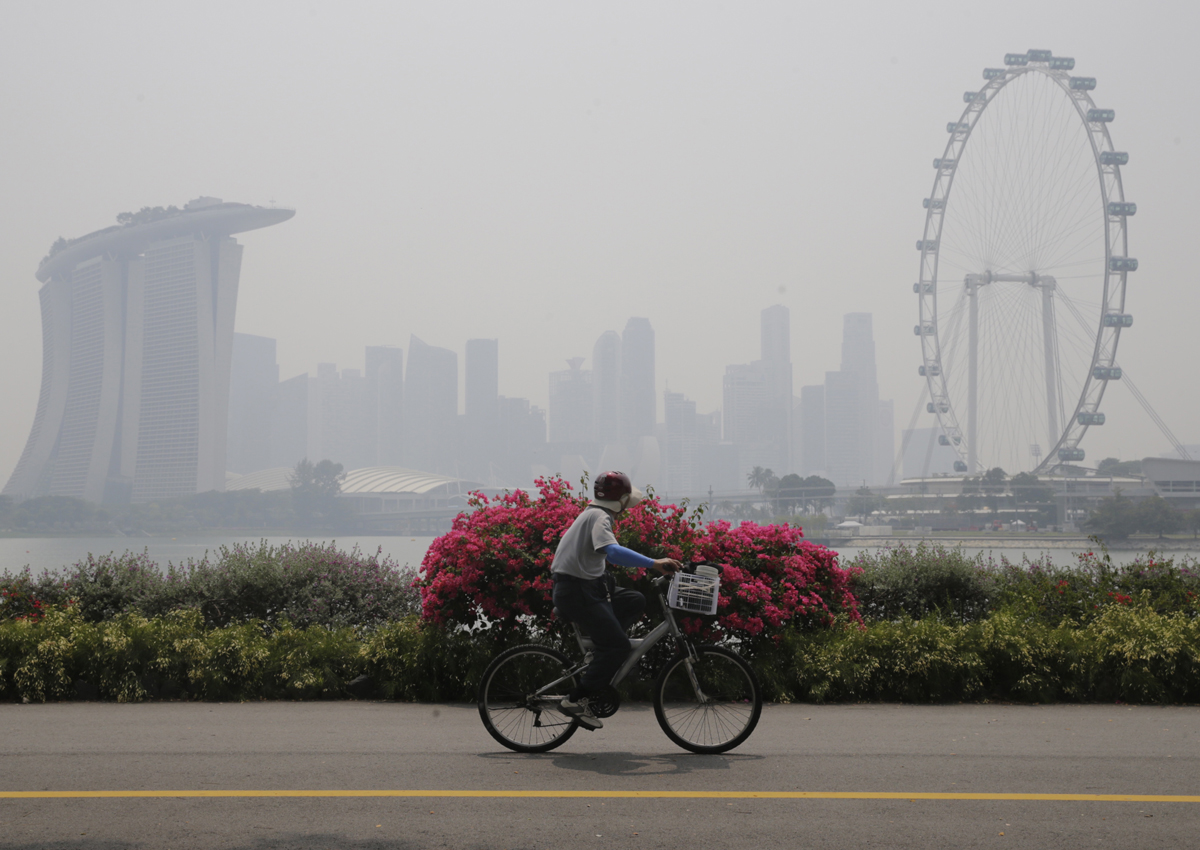
The start of the dry season in Indonesia is just around the corner and it will once again threaten the region with hazy skies.
Smoke-belching forest and peatland fires in Indonesia are the main cause of haze between June and October every year.
Normally, hot and dry weather conditions make the carbon-rich peatlands there highly flammable. The risk of fire rises when the peatlands are drained of water for oil palm and other plantations.
Last year, the fires burned harder and for longer, because of the El Nino weather phenomenon, which led to prolonged hot and dry weather in the region.
It resulted in an extended period of intense haze over parts of Indonesia and its neighbours – causing illness and death, grounding flights and closing schools. There was renewed determination to stop the haze-belching fires after that. Last October, ASEAN environment ministers set a target for the region to be haze-free by 2020. But how achievable is this?
WEATHER
It seems likely that, this year, the haze in Singapore will not be as bad as that last year. Climatologists said El Nino conditions are expected to subside in the middle of this year.
“With the El Nino conditions subsiding, the chance for anomalously hot and dry weather in Sumatra is smaller and forest fires are unlikely to be as rampant as last year,” said Associate Professor Koh Tieh Yong, a weather researcher from SIM University.
El Nino is likely to be followed by La Nina, which induces fire-dousing rain in this part of the world.
So the weather may be on our side this year, but what about next year, the year after that, and in 2020 and beyond?
Greenhouse gas emissions are contributing to climate change, which means extreme weather will become more frequent. Models have predicted that climate change could double the number of extreme El Ninos.
“The chance of a repeat of last year’s haze will be reduced if the factors that the Indonesian government can control – such as fire-fighting resources and adequate water supplies – are suitably prepared in the fire-risk regions,” said Assistant Professor Winston Chow of the National University of Singapore’s geography department.
INDONESIA’S POLICIES
An Indonesian official said last month that there will be “zero chance” that haze of last year’s magnitude will affect the region, as the Indonesian government and other stakeholders have “full determination” to tackle the issue.
Indeed, after last year’s crisis, Indonesia devised plans to tackle the issue. The Peatland Restoration Agency, set up in January to restore about 2 million ha of peatland in seven provinces by 2020, is just one of them.
Indonesian President Joko Widodo last month also proposed to stop allowing new land to be used for oil palm plantations, urging producers to concentrate on using better seeds to increase their yields.
But these moves were greeted with caution by observers who, like Singapore Management University (SMU) law don Eugene Tan, wondered if they are more form than substance.
Dr Erik Velasco, a researcher from the Singapore-MIT Alliance for Research and Technology, said policies should focus on providing alternative livelihoods for the people who rely heavily on the palm oil industry.
“Investments in different industries, including sustainable agro-industry, may help. I believe that strong investment in education would be a real solution to eradicate the problem.”
At the industry level, Asia Pulp and Paper as well as Asia Pacific Resources International Holdings- among the largest pulp and paper firms in Indonesia and which are implicated in causing the haze – have programmes to help villagers living near or within their concessions to find alternative livelihoods, such as growing fruit or vegetables or rearing livestock.
Taken individually, the various policies may sound promising. But for the haze to stop, the gears must mesh together nicely.
Mr Chris Cheng, strategic adviser to volunteer group People’s Movement to Stop Haze, recommended scaling up projects to enable livelihoods that do not contribute to the haze and strengthening law enforcement.
However, “policies may not deliver their full impact unless One Map is completed to show high fire-risk areas, as well as land ownership and operational status”, he said.
The One Map initiative aims to mark all forest boundaries and concessions clearly on one official map that can be referred to by all parties. This will improve transparency and accountability, and minimise land disputes.
WHAT SINGAPORE HAS DONE
Singapore has been hit badly by haze over the years and recognises that it has a part to play in fighting the problem.
It used the Transboundary Haze Pollution Act – passed in Parliament in 2014 – for the first time last year to punish those causing or condoning fires that result in unhealthy levels of haze in Singapore.
The Republic sent notices to six Indonesia-based firms, asking them to explain the steps being taken to put out and prevent fires on their land.
Last month, Minister for the Environment and Water Resources Masagos Zulkifli also said the Government will, from September, buy only printing paper products that bear the Singapore Green Label – which recognises suppliers that practise sustainable forestry management.
These are steps in the right direction. But SMU’s Associate Professor Tan said more can be done in the areas of consumer education, procurement policy in the private sector, and in ensuring that Singapore and Singapore- based financial institutions practise responsible financing diligently.
This, he said, will compel polluters to adopt responsible and sustainable agricultural practices, penalising errant firms that either clear land by fire, or do not take enough steps to douse fires when they occur.
Dr Velascosaid that to penalise errant firms, their finances must be dealt with. “The economy behind the haze is similar to that of drugs, for which the only effective sanctions are those affecting finances,” he said.
Mr Masagos noted at a recent press briefing that international consumer goods firm Unilever – which owns over 400 brands, including Dove – has dropped a leading Malaysian palm oil producer because of deforestation in its plantations in Indonesia.
He said: “If we do not get our act together, not only would we suffer from pollution and the greenhouse effect, (but) companies all over the world that are attuned to this problem will also stop buying from the region.”
MOVING FORWARD
Even as fingers are pointed at Indonesia and the palm oil, pulp and paper industries, it must not be forgotten that supply is driven by demand.
Prof Tan noted that the gravity of the challenge and the fact that the problem has improved little all these years suggest that all is not well and that ASEAN has its work cut out for it.
Plans at the governmental and industry levels are already in place.
Perhaps consumer action will be the fuel that powers the region to a haze-free 2020 and beyond.
This article was first published on May 9, 2016.
Get a copy of The Straits Times or go to straitstimes.com for more stories.
Image:
Publication Date:
Monday, May 9, 2016 – 14:00
Keywords:
Send to mobile app:
Source:
Story Type:
Others
Mother and son to graduate together
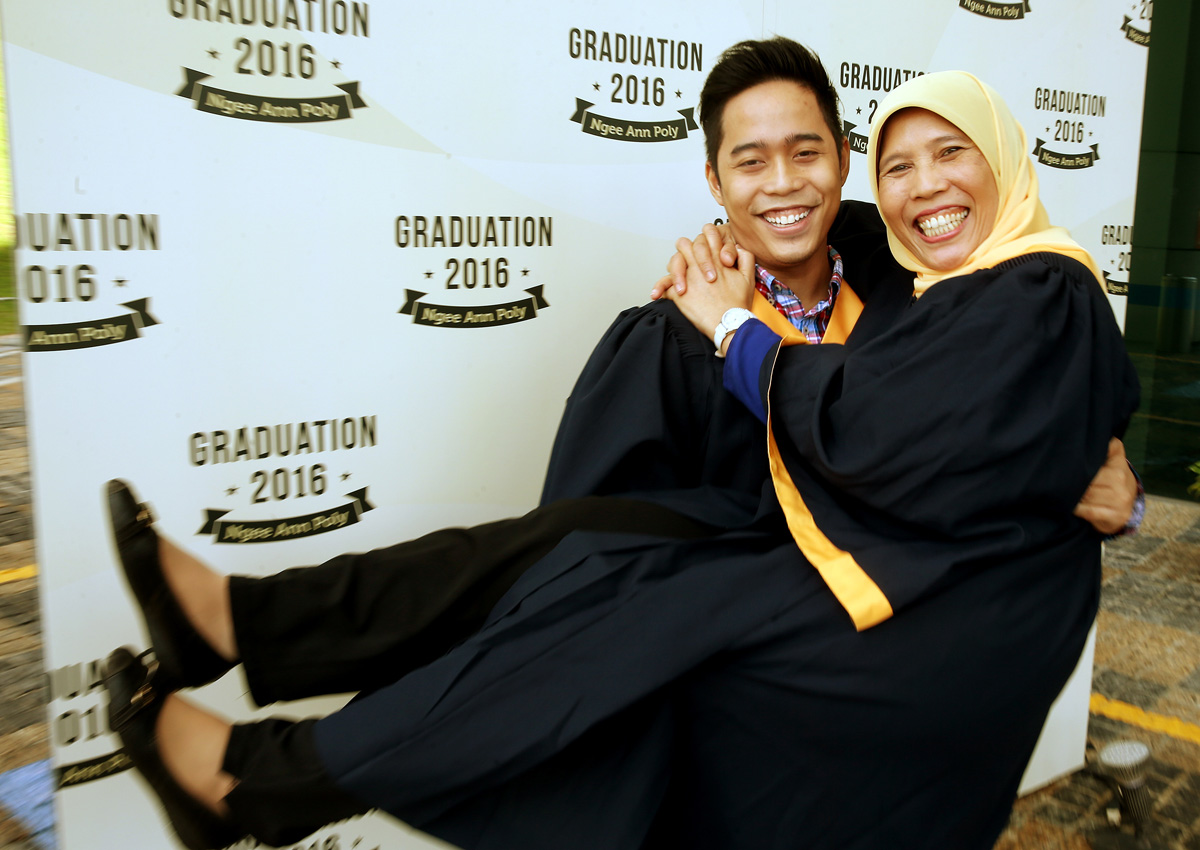
At Ngee Ann Polytechnic’s graduation this week, Madam Serimaryati Abdullah will not only be a proud mother seeing her son getting his diploma, but she will also be graduating with him.
The 51-year-old, who is the oldest NP student to graduate this year, will receive her Diploma in Health Sciences (Nursing) on Wednesday.
Her 22-year-old son, Mr Muhammad Nur Aniqq Ab Rahim, will get his Electronic and Computer Engineering diploma tomorrow.
“It’s a double blessing for my family this year,” said Madam Serimaryati, who was an enrolled nurse at Singapore General Hospital before she joined NP in 2013.
She holds a National ITE Certificate in Nursing, and had not gone to a polytechnic earlier as she did not meet the minimum grade point average of 3.5 required in 2008. The criterion was lowered later. “I’ve always wanted to go further (in my education), so I can do more as a nurse with better training.
“When I found out I could, I thought to myself, ‘It’s been so long since I’ve been to school’. I was initially worried about the generation and age gap. I was so afraid I wasn’t able to blend in with the other students.” But her son encouraged her and even helped her sign up.
Madam Serimaryati, who has four sons aged between 18 and 27, said: “My children motivate me a lot. They will ask me, ‘How’s school life? Anyone bullied you?’ or ‘Are the students rude? Do you understand what the lecturers are saying?’ “
She added: “When we see each other in school, Aniqq would call me ‘Ibu’ (mother in Malay), hug me and hold my hands.”
But she kept their relationship a secret to avoid unnecessary attention.
“People would ask me, ‘Who’s that?’ And I would say that he is my friend’s son. I didn’t want them to ask so many questions.”
Mr Aniqq, who is the third child in the family, said that even when he told his friends, they did not believe him.
As one of NP’s mature students, Madam Serimaryati said one concern was taking longer than her peers to understand concepts.
“Sometimes, for essay writing, other people can finish in one hour, but I would take about three hours. But my children would help me go through my grammar. And I got better.”
On her first week, she said: “Initially, I was very quiet. I would look and observe. In the classroom, I would sit in the second row. The students who came in would look at me, and ask, ‘Excuse me, are you in the right class?’
“When the lecturer came in, I would be the first person he would notice. He would ask for my name and check it against the list to make sure I was an enrolled student.
“I got these a lot. But later, the lecturers were firm, and there was no special treatment for me. I was just like the other students.”
On the decision to go back to school, Madam Serimaryati, who will start work at Ng Teng Fong General Hospital at the end of the month, said: “I’d tell others like me to just go ahead and do what you want. Age is not an excuse. Don’t worry what others might think. There will always be people who will help you. Learning is never ending.”
Mr Aniqq, who hopes to get a degree in computer engineering at Singapore Institute of Management, said: “I’m happy and proud that she decided to go back to school. She has always been my role model and I look up to her even more now.”
xueqiang@sph.com.sg
This article was first published on May 9, 2016.
Get a copy of The Straits Times or go to straitstimes.com for more stories.
Image:
Publication Date:
Monday, May 9, 2016 – 17:00
Keywords:
Send to mobile app:
Source:
Story Type:
Others
Worker accused of making false claim: MOM drops charges
In a rare turn of events, the Ministry of Manpower (MOM) last Friday withdrew charges against a foreign worker who it had accused of lying about his work injuries.
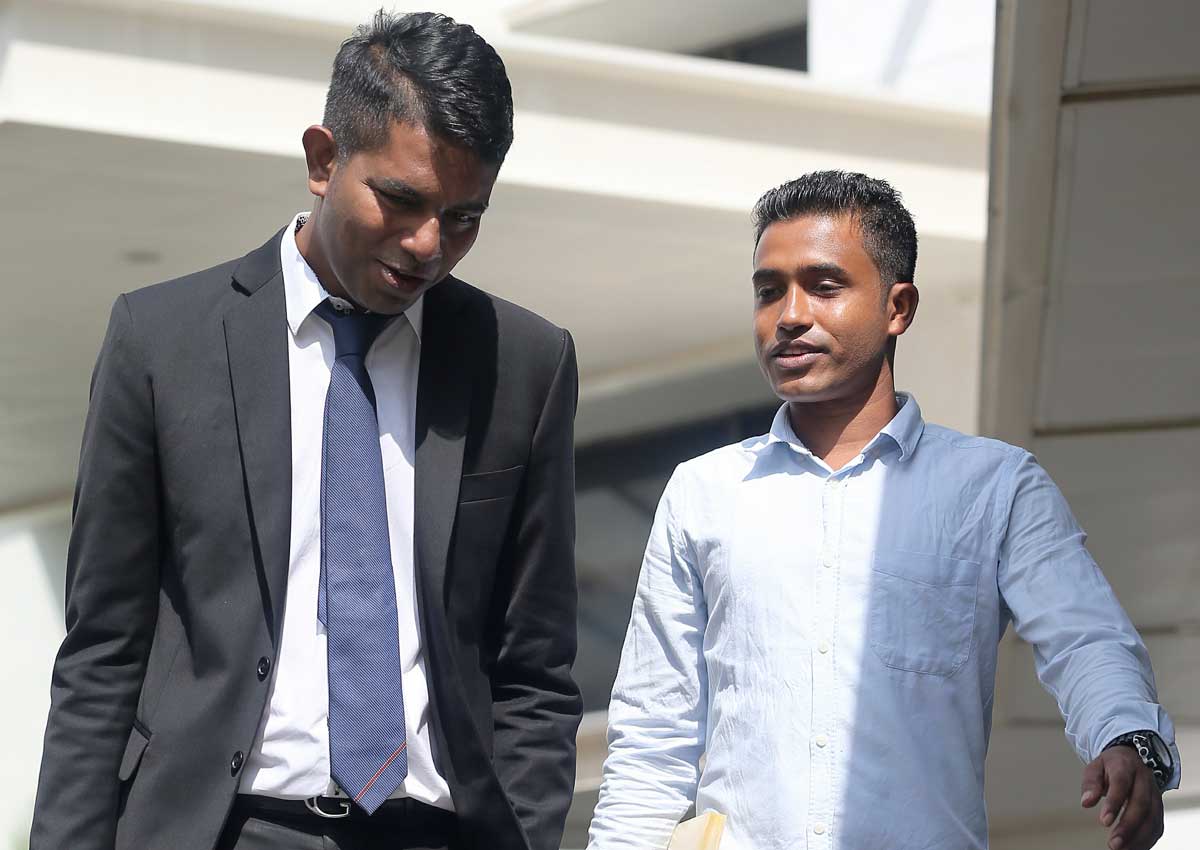
The withdrawal of the charges was a long-awaited relief for Bangladeshi safety supervisor Shahidulla Md Anser Ali. The 32-year-old has been stuck in Singapore, unable to work, for more than two years while his case was pending.
He told The Straits Times: “I am very happy. If I had done wrong, I would have gone to jail as this is the right thing to do, but I know I did no wrong.”
He had gone to MOM in 2014 to make a report about being beaten by his boss, but ended up being charged with making a fraudulent claim under the Work Injury Compensation Act (Wica). He was also charged with two counts of lying to an investigating officer.
Wica is a low-cost alternative to common law for workers to settle compensation claims for injuries suffered during work.
Court documents said Mr Shahidulla was charged with lying that his supervisor physically assaulted him and injured his back at 10am on March 1, 2014.
Had he been found guilty of making a fraudulent claim, he could have been fined up to $15,000, jailed up to a year, or both. Each offence of making false statements could have led to a fine of up to $5,000, or a jail term of up to six months, or both.
An MOM spokesman said: “The charges were withdrawn as a new witness, who could not be located during investigations, has come forth to support Shahidulla’s version of events.
“Making a fraudulent workplace injury compensation claim or providing false information is a serious act of deceit. MOM will not hesitate to take action against claimants who try to abuse the system.”
Mr Shahidulla’s pro bono lawyer, Mr Kalidass Murugaiyan, said: “I am glad the system panned out well for him in the end.”
Wica violation cases are not common, but the number of workers MOM has taken to court for such offences has edged up over the years.
Last year, MOM prosecuted and convicted five workers for Wica offences, up from four in 2014 and two in both 2013 and 2012.
Nine workers have been prosecuted this year, with three convicted so far. In February, a Bangladeshi marine worker was jailed eight weeks for making a false claim that his left little finger was severed while he was using a saw at work.
Transient Workers Count Too (TWC2) executive committee member Debbie Fordyce said that in the past eight years, she has dealt with about a hundred new foreign worker injury cases a month, but only seen six – including Mr Shahidulla – in which MOM prosecuted the worker for a Wica violation.
Of these, only one other worker had his charges withdrawn by MOM in 2013.
Mr Shahidulla, an only child, said he is looking forward to returning to Bangladesh to see his parents. “My mother and I will kiss each other and cry, and I don’t know who will cry more.”
Unable to work in the past two years, he could not send back money and has had to borrow $4,000 from friends and relatives for living expenses, while depending on TWC2 for food.
However, he hopes to return to Singapore to work, as his safety qualifications would earn him more here than back home.
“I want to keep other workers safe,” he said.
This article was first published on May 9, 2016.
Get a copy of The Straits Times or go to straitstimes.com for more stories.
Image:
Publication Date:
Monday, May 9, 2016 – 14:00
Keywords:
Send to mobile app:
Source:
Story Type:
Others
Best showing but should Dr Chee be going?
Singapore Democratic Party secretary-general Chee Soon Juan is adamant he will stay on in politics despite garnering only 38.79 per cent of the votes in the recent Bukit Batok by-election.
After his thank you parade yesterday, he told reporters he intends to continue his work in Bukit Batok SMC.
But is his string of five losses in close to 25 years an indication that he should leave instead?
Political analyst Mustafa Izzuddin told The New Paper: “As much as I believe the Bukit Batok by-election was Dr Chee’s swansong in his political career, I do not believe he will quit politics, because it has been in his DNA for more than 20 years.”
National University of Singapore sociologist Tan Ern Ser agreed, adding that there are many examples of opposition leaders elsewhere whose tenacity eventually paid off.
“Moreover, he has already invested much time and energy in politics and it’d seem like a waste to his cause (to exit politics),” he said.
Dr Chee’s performance in the recent polls is his best to date.
But Dr Mustafa, a fellow at the Iseas-Yusof Ishak Institute, remains sceptical about Dr Chee’s chances of being elected into Parliament.
“As much as one has to applaud the determination of Dr Chee to keep going despite losing every time he has contested, it is highly doubtful that he will strike parliamentary gold eventually.
“It will take an extraordinary turn of events, both politically and economically, for Dr Chee to make it into Parliament under the current circumstances of entrenched one-party dominance,” he explained.
Associate Professor Eugene Tan from the Singapore Management University, on the other hand, saw a possibility with a caveat: Dr Chee needs to make a “substantive change”.
But he quickly added: “I don’t think a leopard will ever change its spots.”
He said: “This is someone who’s trying to milk voters’ sympathy. He was trying essentially to reinforce that he has been persecuted – not only him, but his entire family has had to suffer, and so that’s why he’s deserving of people’s support.”
Singaporeans vote in Bukit Batok by-election
Click on thumbnail to view photos. Source:
The Straits Times, AsiaOne





















































































POWER HUNGER
The law don said he also saw Dr Chee’s hunger for power in the by-election.
When the People’s Action Party (PAP) incumbent MP David Ong resigned, Dr Chee was the one who decided he would contest in the by-election.
“He made the decision on his own accord. Unless he did a CEC (central executive committee) meeting over the phone,” he said.
Calling SDP Dr Chee’s alter ego, he said: “The election was not about the party, or even the voters. It was all about him.”
Political experts pointed to what they felt is a more pertinent question: Should Dr Chee continue to be the SDP’s main man?
Said Dr Mustafa: “The decision SDP has to make is whether they would want to remain a Chee-centric party or look beyond Dr Chee, with others fronting the party, going forward.
“While one can foresee SDP contesting Bukit Batok SMC again in future, it is less certain at this point whether it will be Dr Chee who will stand there again in the next election.”
Prof Tan said: “To put it bluntly, despite what is generally regarded as a good showing, Dr Chee should really examine if he’s the best person to lead the SDP.”
Law prof: Chee lacks staying power
His chances of winning would have been much higher if the media did not attack him, Dr Chee Soon Juan said on Saturday night after his concession speech.
The Bukit Batok by-election candidate told reporters in Mandarin: “We are not just competing with the PAP (People’s Action Party), we are also competing with media. It’s disappointing.”
But looking at the poll results, a political analyst told The New Paper that the Singapore Democratic Party (SDP) secretary-general would not have won anyway.
Discounting factors like the SG50 effect, the margin of the by-election ought to have been much closer, said political observer Eugene Tan.
On Saturday, Dr Chee had said that the results were encouraging and that it did not feel like a defeat.
But Associate Professor Tan thought otherwise, given that a by-election effect that was “as good as it can ever get”.
First, the PAP was on the defensive, after incumbent PAP MP David Ong vacated the seat due to a personal indiscretion, Prof Tan said.
Second, Dr Chee, who has been a politician since 1992, was up against Mr Muralidharan Pillai, who was contesting in just his second election in eight months.
Added the law don: “The fact that he (Dr Chee) couldn’t even touch 40 per cent shows that there are severe questions as to his electability.
SDP rally at Bukit Gombak Stadium on May 1
Click on thumbnail to view photos. Source:
AsiaOne, The Straits Times

























“Next year will be his 25th year, counting from his first election. By all accounts, it is actually a very dismal track record for such a high-profile (candidate).”
He mentioned Dr Chee’s lack of “staying power” as one of the reasons for his loss.
Compared with other opposition politicians like Mr Chiam See Tong, who contested and looked after Potong Pasir, Dr Chee moved to a different constituency with each election.
Prof Tan said: “To me, this reveals his political opportunism. There is no loyalty to a particular constituency. In the end, it’s all about expediency – which constituency, in his view, is his best chance…
“I have never seen him sitting down to help people work through their issues.
“He has never really held a Meet-the-People Session. He’s not interested in helping people. He’s interested in getting elected into office.”
He went further to suggest that SDP’s central executive committee member Paul Tambyah would have polled better than Dr Chee.
“Dr Chee is a polarising figure. Paul Tambyah is not. He will not bring into the campaign all the baggage… People would have been more prepared for a candidate like Dr Tambyah.”
The question now is whether Dr Chee will move on to a sixth constituency in the next general election, despite his promise to continue outreach work in Bukit Batok.
“He claims he understands what the heartlander issues are because he lives in a small flat.
“Let’s see what he does, whether he will go into deep hibernation or churn out policy papers which are out of touch with reality.”
fjieying@sph.com.sg

This article was first published on May 9, 2016.
Get The New Paper for more stories.
Image:

Publication Date:
Monday, May 9, 2016 – 14:00
Send to mobile app:
Source:
Rotator Headline:
Bukit Batok by-election: Best showing, but should Chee be going?
Rotator Image:

Story Type:
Others
More budget, lower owner contribution to support HDB shop revitalisation efforts
For instance, the Revitalisation of Shops upgrading budget for each HDB shop will be increased by 75 per cent, from S$20,000 to S$35,000, says HDB.
Source link
SBS Transit, SMRT awarded nearly S$1.9 million in total for improving bus waiting times

SINGAPORE – Bus operators SBS Transit and SMRT have been awarded S$1.34 million and S$504,000 respectively under the Bus Service Reliability Framework (BSRF) trial for improving wait times and reducing crowding between June and November last year, the Land…
Source link
Nations team up against terrorism at sea
ASEAN, Asian countries, Russia, Australia, NZ and the US in joint ops against maritime threats
The Singapore leg of a multinational military exercise kicked off yesterday as task forces intercepted and stormed a merchant vessel hijacked by “terrorists” at sea.
The action-packed operation was part of the ASEAN Defence Ministers’ Meeting (ADMM)-Plus Maritime Security and Counter-Terrorism Exercise, which started last Monday in Brunei. It will end on Thursday in Singapore.
The 11-day drill, which involves realistic sea- and land-based scenarios, aims to strengthen the capabilities of participating militaries in tackling terrorism and maritime threats.
About 3,500 personnel, 18 naval vessels, 25 aircraft and 40 special forces teams from 18 countries are taking part.
Participants include the 10 ASEAN nations, Australia, China, Japan, India, the Republic of Korea, New Zealand, Russia and the United States.
The inaugural ADMM-Plus convened in Vietnam in 2010, with the goal of boosting security and defence co-operation among ASEAN countries and their partners.
Working groups were set up in various areas of co-operation, which include maritime security and counter-terrorism.
This is the fifth ADMM-Plus field training exercise. The first was held in 2013 and focused on humanitarian assistance and disaster relief and military medicine.
This is the first time that the ADMM-Plus’ maritime security and counter-terrorism working groups are collaborating in an exercise.
Its joint operations director Brigadier-General (BG) Desmond Tan, 45, said such a collaboration is important as terrorism can occur out at sea.
“This has the added advantage of (adding) more relevance and realism to the exercise, (as) terrorism and maritime security are sometimes intertwined,” said BG Tan.
He added that collaboration allows for a wider scope of interaction among the troops.
Citing piracy issues, BG Tan also described the exercise as timely and relevant.
“I think we all recognise that these are transboundary challenges that no one country can tackle by itself,” he said.
In yesterday’s drill, the maritime security task force headquarters in Brunei’s Muara Naval Base and the counter-terrorism task force headquarters in Changi Naval Base were alerted to a hijacked vessel.
After tracking down the vessel, four teams from Brunei, the Republic of Korea, Singapore and Thailand stormed the vessel using rigid-hull inflatable boats, while two teams from Singapore rapelled onto the vessel from Super Puma helicopters.
The hijackers were eventually subdued and the hostages rescued.
BG Tan acknowledged that the multinational nature of the exercise has brought challenges arising from the participants’ different languages, cultures and tactics.
But he stressed: “This is exactly the purpose of this exercise – to bridge some of these challenges and to allow the various countries… to come together to exercise and to understand each other better and to build trust and confidence.”
The exercise continues today with land operations in the Lim Chu Kang training area.
yeosamjo@sph.com.sg
This article was first published on May 9, 2016.
Get a copy of The Straits Times or go to straitstimes.com for more stories.
Image:

Publication Date:
Monday, May 9, 2016 – 11:11
Keywords:
Send to mobile app:
Source:
Story Type:
Others


