The world’s first 24-hour Hello Kitty themed cafe will open on May 12 at the public area of Changi Airport Terminal 3’s Arrival Hall.
Source link
24-hour Hello Kitty cafe lands at Changi Airport
Pitch woes resurface at the National Stadium

As Tampines Rovers battled Selangor in the Asian Football Confederation Cup last night, the National Stadium’s turf came under scrutiny again.
Sandy patches were observed across the pitch as players were seen slipping and losing their their footing when they changed directions.
Stags winger Jermaine Pennant said: “When you grip into it and turn, it moves and slides. It’s very sandy.
“(It’s not ideal) for players like me. If we play on this pitch again, hopefully they can put out a better surface.”
While Tampines captain Fahrudin Mustafic called the 55,000-seater ground “a wonderful stadium”, there was no canvas for the ball artists to paint their masterpiece.
He said: “The pitch was slippery and bumpy, and we had to take an extra touch to bring the ball under control.
“It was my first time playing here. Despite the condition (of the pitch), the stadium was beautiful and the turnout was great.”
When the National Stadium reopened in 2014, its $800,000 Desso GrassMaster pitch was unable to grow properly because the stadium’s dome design did not allow sufficient sunlight in.
It was solved only after the Sports Hub invested more than $2 million in growth lights and a “lay-and-play” surface with warm weather grass, only for the problems to resurface.
For striker Billy Mehmet, who played for Malaysian states Kedah and Sarawak, the sandy pitch was not a big shock.
He said: “It was tough and sandy, but I was focused on the game, so the condition of the pitch didn’t matter for me.
“I’m used to playing on such surfaces in Malaysia, and the conditions were the same for both teams so it was fair. Playing here was a boost for the team, and we are hoping for more opportunities in the future.”
This article was first published on May 11, 2016.
Get a copy of The Straits Times or go to straitstimes.com for more stories.
Image:

Publication Date:
Wednesday, May 11, 2016 – 17:20
Keywords:
Send to mobile app:
Source:
Story Type:
Others
Song Joong-ki donates Chinese 'Running Man' proceeds

Actor Song Joong-ki, the star of hit drama “Descendants of the Sun” has donated all the proceeds from starring in a Chinese variety show, local news reported Tuesday.
Last month, Song participated as a special guest in “Hurry Up Brother” by Zhejiang Television, a Chinese variety show based on Korean popular variety show “Running Man.”
Song’s episode was filmed in Korea and the “Hurry Up Brother” crews filmed across Seoul. The Korean “Running Man” members also made special appearance in the Chinese version.
The special episode of “Hurry Up Brother” will hit the airwaves in China at 9 p.m. on Friday via Zhejiang Television.
Sexy actress Clara on her first kiss with Song Joong-ki
Click on thumbnail to view photos. Source:
Youtube, bntnews
















Descendants Of The Sun heart-throb caused NG takes: Song Hye Kyo
Click on thumbnail to view photos. Source:
Viu, KBS World




























Image:

Publication Date:
Wednesday, May 11, 2016 – 12:39
Keywords:
Send to mobile app:
Source:
Story Type:
Others
Balloting for NDP 2016 tickets opens on Friday
Singaporeans and permanent residents can apply for tickets to two previews and National Day Parade (NDP) starting from Friday (May 13).
This year’s celebrations marks the NDP’s return to the National Stadium after 10 years, as it was previously held at Marina Bay’s floating platform and at the Padang.
Highlights include as the use of unmanned technologies, aerial displays that involve props and performers, as well as indoor fireworks, the Ministry of Defence (MINDEF) said on Wednesday (May 11).
Applicants can choose to apply for two, four, or six tickets to Preview 1, which will take place on July 23, Preview 2 on July 30 or NDP on Aug 8 respectively. MINDEF added that those who apply for lower number of tickets will also have higher chances of obtaining them.
Here’s how to apply for tickets:
Through SMS
Create a SMS message, key in your personal details in the following format and send it to 8240 0050.
<NRIC No.> SPACE <No. of Tickets 2/4/6> SPACE <NDP/Preview1/Preview2> SPACE <SG/PR> SPACE <NAME>
Through Internet/SAM/AXS stations
Log on to the official NDP website at www.ndp.org.sg or visit any SAM and AXS stations. Fill in all the fields before submitting the application form.
Application for tickets closes on May 22.
Each NRIC holder is limited to one application regardless of application modes. Only the latest application will be entered in the electronic ballot if there are multiple entries.
MINDEF added that tickets are not allocated on a first-come-first-serve basis and they are strictly not for sale.
Ballot results are final and each ticket admits one spectator. Children, including infants, must hold a valid ticket to gain entrance to the parade.
Those who successfully balloted for NDP tickets last year will not qualify for this year’s balloting exercise.
Successful applicants will be notified by phone from June 2 to June 8, and may collect their tickets from June 10 to June 19 between 10am and 9pm daily at Kallang Wave Mall Atrium located at 1 Stadium Place, Singapore 397628.
For more information, visit the official NDP website at http://www.ndp.org.sg
minlee@sph.com.sg
Image:

Publication Date:
Wednesday, May 11, 2016 – 12:44
Send to mobile app:
Source:
Rotator Image:

Story Type:
Rewritten Story
Private apartment rents remain flat, HDB rents slip 0.6% in April: Index
Rental rates for private apartments stayed the same in April while rents for HDB flats fell by 0.6 per cent compared to the previous month, according to flash estimates by SRX Property.
Source link
More Malay families living in rental flats
The proportion of Malay families living in one and two-room rented flats has doubled in the last decade, government figures show.
Last year, there were 14,600 households headed by a Malay living in such flats.
This was 10.9 per cent of all Malay-headed households, up from 4.9 per cent – or 5,779 households – in 2005, according to the latest General Household Survey released in March.
While some may have been renting on the open market, most would be tenants under the Housing Board’s public rental scheme, which is meant to help the needy.
Academics, social workers and Members of Parliament warn against jumping to conclusions about the reasons for the increase.
National University of Singapore sociologist Tan Ern Ser said: “We should drill down further to find out whether, if we ‘control’ for age and class, the ethnic differences become statistically non-significant.”
About 57 per cent of the Association of Muslim Professionals’ (AMP’s) family services clients live in rental flats, up from about 30 per cent five years ago.
But this rise could simply be due to the higher supply of public rental flats, said AMP senior manager Hameet Khanee.
The HDB has ramped up the rental flat supply from 42,000 units in 2007 to 53,500, with an aim to boost this to 60,000 by next year.
The HDB said: “The increase in the proportion of Malay rental households is not just a housing issue, and we are working with MSF (Ministry of Social and Family Development) and other agencies to better understand the underlying causes of housing instability for rental households in general.”
Of the AMP clients living in rental flats, about one in 10 is waiting for a new flat, bought from the Housing Board, to be ready.
However, Malay households also form a growing proportion of one- and two-room rental households.
They account for almost a third of 45,500 such households, up from about one in six a decade ago.
Changing economic circumstances could have played a part, said NUS researcher Lai Ah Eng.
Low-income Malay workers could have been “displaced by cheap immigrant labour” in jobs such as cleaning, she said.
Among AMP’s family services clients, insufficient Central Provident Fund savings – due to unemployment or ad-hoc jobs – was the most common reason for living in a rental flat, accounting for 86 per cent.
Mr Zainal Sapari (Pasir Ris-Punggol GRC) said he has seen more Malay constituents appealing for rental flats at his Meet-the-People sessions. They include elderly couples who sold their flats to live with their children but have a rocky relationship, divorced families, and those who cannot afford a flat yet.
Calling it a “worrying trend”, he said: “Living in a rental flat environment may not be conducive to raise young children.”
There is a danger of families becoming entrenched over generations, said observers.
The AMP’s Madam Hameet said: “Considering that an HDB flat is an asset for most people, not owning a flat would prevent these families from leveraging on their flats as an asset to facilitate social mobility.”
The stigma and social issues associated with rental flats could also be detrimental to families, she added.
Dr Lai raised the possibility of “a permanent underclass of two to three generations with multiple family problems”.
The HDB encourages financially stable tenants to consider buying a flat when their tenancy renewal is being reviewed. Eligible first-timers can get up to $80,000 in grants.
“Special provisions should be made to help families undergoing divorce with their housing issues,” suggested Mr Zainal.
He is optimistic about the Fresh Start Housing Scheme to be rolled out later this year. It will help rental families with young children, who used to own an HDB flat, buy a home again.
Divorce, ill health are some reasons
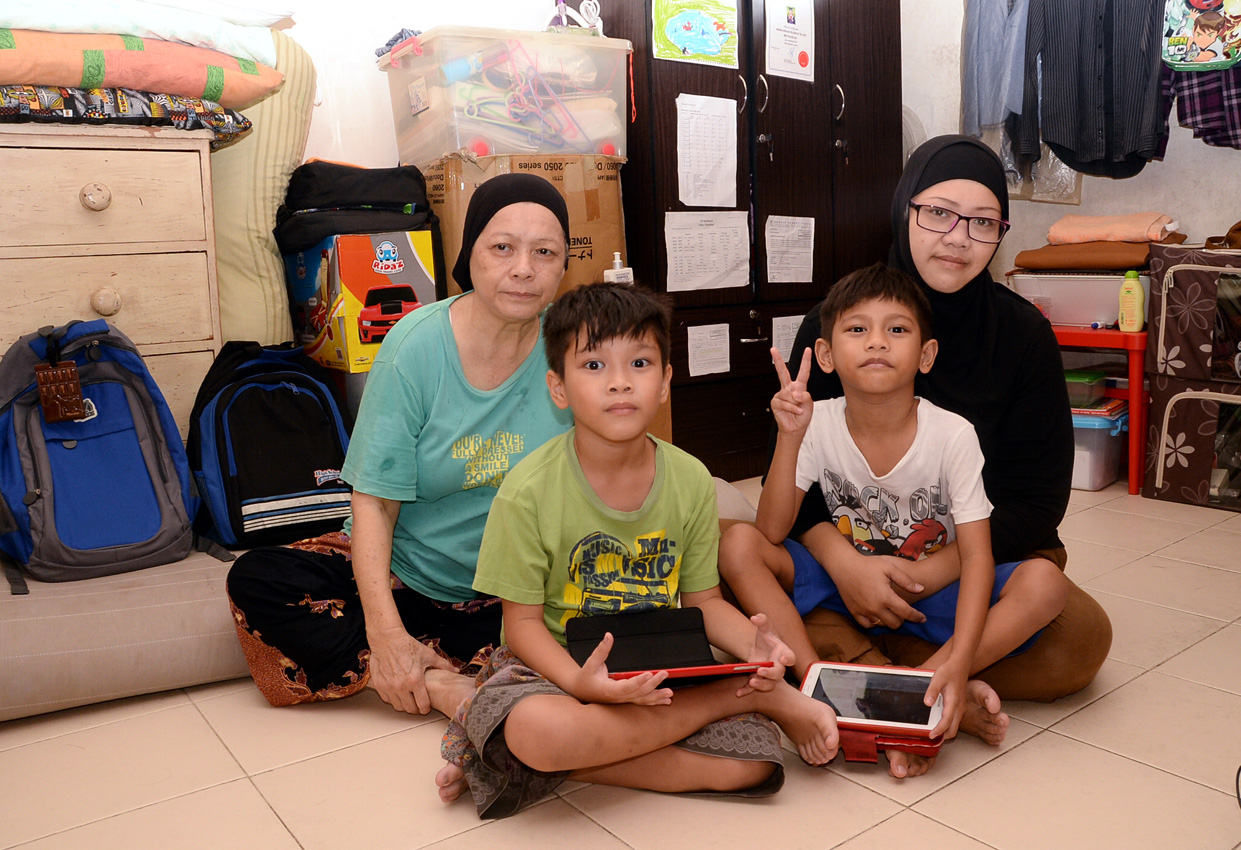
When Ms Renemarlina Osman got divorced, the 35-year-old had to sell the family’s three-room flat and move into her parents’ one-room rental flat with her two children.
For the past four years, they have shared the space with her parents and a nephew.
“The place is very cramped and my children don’t have space to study and play,” she said.
She is currently looking for a job and intends to buy a Housing Board flat once she can afford one, perhaps using government grants.
Divorce and health issues are among the reasons that families such as Ms Renemarlina’s go from owning a flat to renting one.
Just last year, Mr Safari Mohd Sidek was living in a four-room Pasir Ris flat and earning $7,000 a month in his shipping industry job.
But after he suffered a stroke and got divorced, the 54-year-old went to live in a rented two-room flat with his son and two daughters.
“If I get a job, it has to be one where I sit down. I don’t even have the strength to open a jam jar,” said Mr Safari, who has been unemployed since the stroke.
He hopes they will be able to buy a flat once his 18-year-old son finishes his National Service and starts work.
Other Malay families, however, decide to start married life in a rental flat and save up to own a home.
For Ms Sabrina Wati, 28, and her husband, owning a home requires a stable job that pays enough.
“Of course I want to upgrade. but I want us to be ready for it first,” said Ms Sabrina, a contract worker with Certis Cisco. Her husband does odd jobs with moving firms.
As both their parents live in two-room flats with other family members, the couple decided to move out, but could not afford to buy their own place.
Since 2007, they have lived in a two-room rental flat with their nine-year-old daughter.
“I would like us to be in jobs earning $1,500 each for us to be comfortable buying,” said Ms Sabrina.
Mrs Brenda Muhammad, 43, is looking for a flat with more privacy and space. Her family of four has slept in the sole bedroom of their two-room rental flat for eight years.
“The children are getting bigger and they need more space, but I can’t afford a flat,” she said of her children aged nine and 13. Her husband, the sole breadwinner, makes $60 a day as a cleaner.
She added: “When my children are older, I’ll go to work and save up for a flat.”
This article was first published on May 11, 2016.
Get a copy of The Straits Times or go to straitstimes.com for more stories.
Image:
Publication Date:
Wednesday, May 11, 2016 – 15:00
Keywords:
Send to mobile app:
Source:
Story Type:
Others
Train services along NSEWL to start later on Sundays from June 5

SINGAPORE – Train services at 13 stations on the East-West and North-South lines will begin nearly an hour later than usual every Sunday from June 5 to Dec 18, said SMRT in a press release on Wednesday (May 11).
The plan for a later start time on Sundays was…
Source link
Lin, Hirubalan and Chen call it a day
Sensing the need to make way for new blood, three of Singapore’s most-experienced netballers have decided to call time on their international careers.
National captain Micky Lin Qingyi, co-vice-captain Chen Huifen and Premila Hirubalan said the key reason for their decision to retire was to allow a new crop of players to step up.
The departure of the trio, who have 328 caps among them, was announced by Netball Singapore (NS) yesterday.
The move leaves a gaping hole in the national side. All three were inducted into Singapore’s Netball Hall of Fame in December after playing key roles, as the nation bagged three Asian Championships as well as a historic gold medal at the SEA Games on home soil last year.
Said Lin, 30, who joined the national squad in 2004, the same year as Chen: “I think I’ve done a lot and have been through the competitions that I wanted to already. It’s the younger girls’ turn to take part.”
Now a digital marketing assistant manager at Deloitte Singapore, Lin, with 102 caps, noted that she has been to one Commonwealth Games, three Asian Championships, and three World Cups, as well as two SEA Games.
Defender Hirubalan’s 117 caps make her the country’s most-capped player. The 33-year-old, first called up in 1999, agreed that while their departure leaves a big hole, it was necessary for the sake of the team’s growth.
The medical officer in the department of anaesthesiology at Singapore General Hospital said: “It’s difficult that three of us are leaving at the same time. But we have good players who are coming through.”
With the conclusion of the World Cup last August, it was the best time to step down before the new four-year cycle of tournaments starts with August’s Asian Championships, which serves as a qualifier for the World Cup.
Goal-attack Chen, 31, a physical education teacher at Northland Secondary who has 109 caps, said: “This is the most appropriate time (to leave). I’ve been through three cycles (from Asian Championships to the World Cup) already.
“I’ve fulfilled my netball dreams.”
NS’ chief executive officer Cyrus Medora lauded them for their contributions, saying: “They are stalwarts in the team. They are playmakers and they’ve been the fighting spirit of the team for so long.”
Head coach Ruth Aitken added: “They are great talents on the court, but their leadership within the group has also been a major factor in the team’s achievements.”
While it is not known who will inherit the captain’s armband from Lin, she has confidence that players such as Charmaine Soh and Pamelia Liew will step up.
“We’re aware that we’ve three huge shoes to fill,” she said. “They need to step up and I have great faith that they will do that.”
chiazya@sph.com.sg
This article was first published on May 11, 2016.
Get a copy of The Straits Times or go to straitstimes.com for more stories.
Image:

Publication Date:
Wednesday, May 11, 2016 – 17:00
Keywords:
Send to mobile app:
Source:
Story Type:
Others
Para-sport included in National Games
In another move signalling greater backing of disability sport, this year’s Singapore National Games (SNG) will feature para-sports for the first time.
Five sports (archery, boccia, tenpin bowling, swimming, table tennis) will be contested at the July 30 to Aug 7 SNG, with the possibility of more included in future.
This comes on the back of a successful ASEAN Para Games (APG), which Singapore hosted for the first time last December and finished with a historic haul of 63 medals.
Minister for Culture, Community and Youth Grace Fu, speaking yesterday before details of the GetActive! Singapore initiative were unveiled, said the APG showed sports can play an integral role in promoting an inclusive society.
She said: “After the APG, we realised that sport is a great way for people with special needs to be involved in society.
“It’s a great way for them to realise their potential. They don’t have disabilities, they just have abilities of different levels.
“We’re glad to have some sports we can incorporate, and we’d like to see even more in the future if we can get take-up.”
This also follows a conscious push by authorities to give people with disabilities greater access to sporting facilities.
It was announced last December that five ActiveSG sports centres, starting with one each in Jurong West and Toa Payoh, would become Centres of Expertise in disability sport.
Sport Singapore chief executive officer Lim Teck Yin said: “The big legacy from the APG was the disability sports masterplan, that aims to reach out to people with disabilities.
“To encourage them to use sport to enrich their lives, to build confidence and esteem, and enhance (the) quality of their lives.
“Sport is a great way to enable a social network of support so, as part of that support, we’ve introduced disability sport into GetActive! Singapore at different levels.”
Besides the SNG, activities catering to people with disabilities will also be offered at the Children and Families Festivals held across 15 sports centres islandwide.
Swimmer Theresa Goh, Singapore’s most bemedalled athlete at the APG, welcomed the move as another way for the public to get better acquainted with disability sport.
Said the 29-year-old, who is slated to compete at the Paralympics in September: “It’s a good chance to allow the public to see more para-sports, para-athletes and see what we do.
“Inclusion is what we aim for and this definitely bodes well for Singapore sport. I hope I’ll be in Singapore during the event, as I want to be there to show my support as a spectator, if not as a participant.”
maychen@sph.com.sg
This article was first published on May 11, 2016.
Get a copy of The Straits Times or go to straitstimes.com for more stories.
Image:

Blurb:
Move, which will see five sports contested at the SNG, aims to promote greater inclusion. -The Straits Times
Publication Date:
Wednesday, May 11, 2016 – 17:00
Keywords:
Send to mobile app:
Source:
Story Type:
Others
Johor's EduCity drawing Singaporean students
For decades, scores of Malaysian children have been boarding crowded buses daily at unearthly hours to come to Singapore to attend schools here.
In recent years, however, hundreds of Singaporeans, armed with their red passports, have been heading north to schools in Malaysia’s new education hub in Iskandar, Johor.
The Singaporeans are, to some extent, pursuing an overseas education at EduCity, about half an hour from Singapore via the Second Link.
These cross-border students cite lower fees – as much as 60 per cent lower for some programmes – due to the weaker Malaysian ringgit. Then, there are also a number of brand-name foreign institutions to choose from in EduCity.
According to EduCity managing director Joanne Oei, there has been a “steady increase” in the number of Singaporean students there. “With the strong Singapore dollar, quality international education becomes more affordable and accessible,” she said.
As of yesterday, the currency exchange rate between Singapore and its neighbour was $1 to RM2.96.
Ms Oei declined to reveal the number of Singaporeans in EduCity, but said they comprised less than 10 per cent of the student population there.
Over the past five years, the education enclave, with a collection of institutions from pre-schools to universities, has seen a jump in the total number of students, from 530 in 2012 to more than 4,000.
Malaysians make up the majority of students at EduCity, Ms Oei said. There are also students from countries such as Austria, France and India.
The increase can be attributed to the opening of new education institutions at EduCity, she added. “We are looking at growing the population to 16,000 by 2025.”
EduCity has become a popular destination for foreign institutions looking to gain a foothold in Asia.
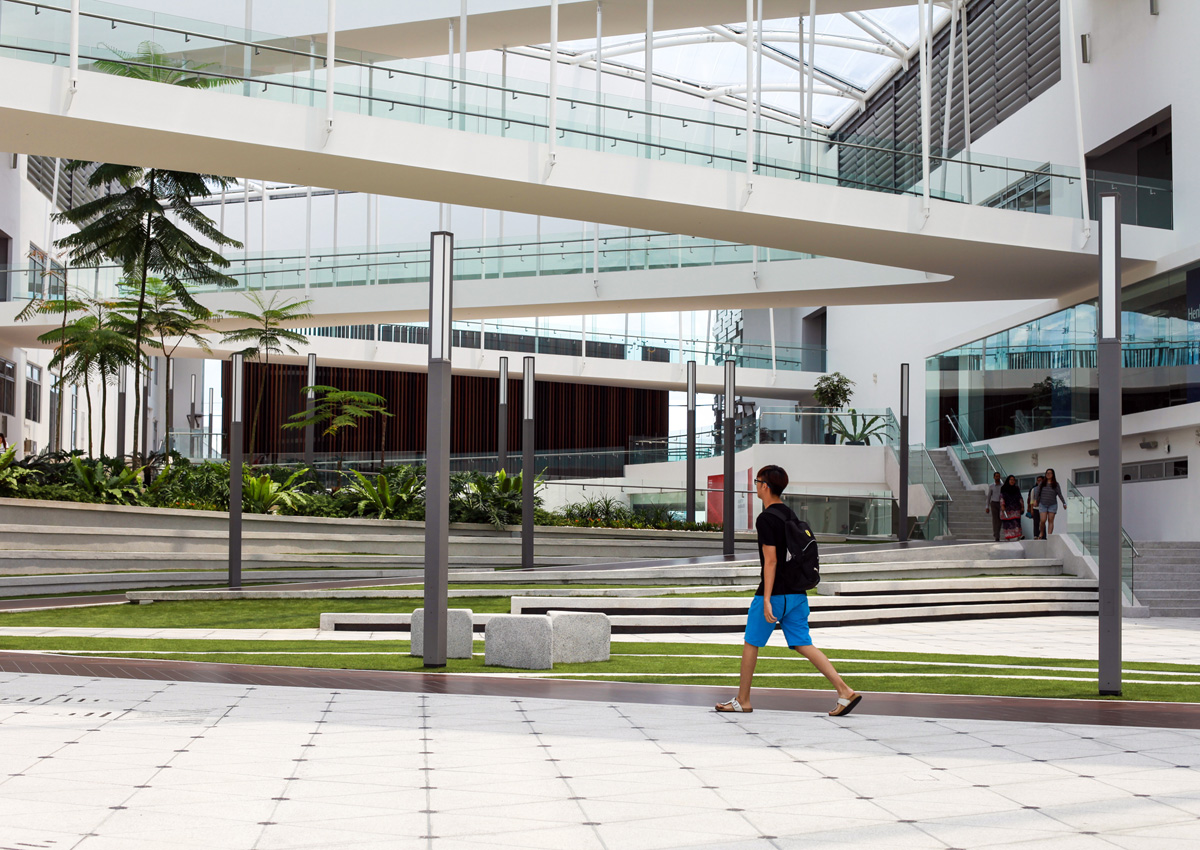
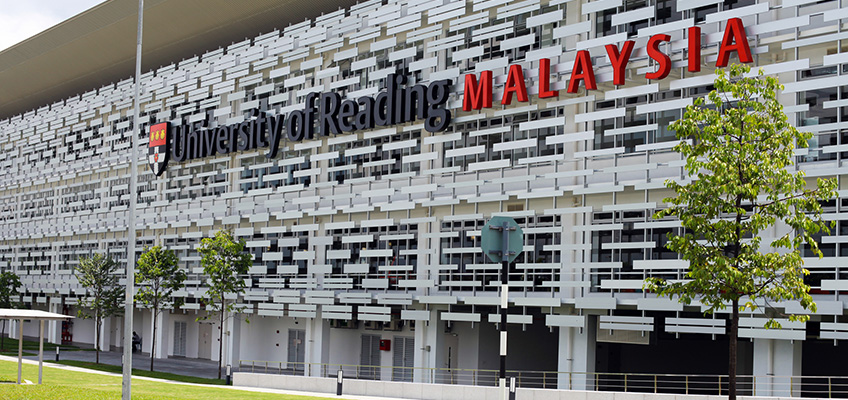
In the past few years, a cluster of education providers has set up shop at the 123ha education hub. These include the branch campuses of institutions such as the University of Southampton, noted for its engineering courses, and Newcastle University’s medical school, one of the top British medical schools.
Singaporean Chandralekha, 21, a first-year biomedical science student at Newcastle University Medicine Malaysia, pays 45 per cent of the $33,600 in yearly tuition fees that she would have been charged at the university’s British campus.
Ms Chandralekha, who goes by one name, said the attractive exchange rate has helped her to save a small fortune. She stays in an apartment near her university on weekdays, and returns to her Choa Chu Kang home in Singapore on weekends.
She said: “The fees are more affordable, and it is closer to home compared to other overseas universities. It’s also a prestigious degree.”
Two international schools, Marlborough College Malaysia and Raffles American School, are situated outside of the main EduCity area to accommodate their full facilities.
Singaporean Natanya Tan, 11, is one of about 100 Marlborough pupils who commute daily from various parts of Singapore via a fleet of nine buses. The journey takes about 50 minutes on a good day, and over an hour if there is heavy traffic.
Natanya, whose family lives in the western part of Singapore, wakes up at 6.20am to make the daily pick-up timing at 7.15am. Her school day begins at 8.30am and ends at 4.30pm.
The long commutes do not bother these students, it seems.
Natanya said: “I don’t find it too much of an inconvenience. Sometimes it can be fun even if we are stuck in a jam. I can spend time with my friends, or I can sleep on the bus or listen to music.”
Many have opted to stay in boarding facilities to save travelling time. Some schools have built their own accommodation facilities, while EduCity has a hostel known as the Student Village.
Singaporean Sean Koh, 18, is in his foundation year at the University of Southampton Malaysia Campus. He is staying at the Student Village, a five-minute walk from his school.
“Getting there is not a problem as I can wake up half an hour before classes, freshen up and reach there before they start,” he said.
EduCity will be adding more accommodation facilities to cater to the growing student community.
Ms Oei said EduCity is taking “very calculated steps” in its expansion plans. “We may look at early childhood development centres and certain vocational schools to complement the current ecosystem.”
calyang@sph.com.sg
This article was first published on May 11, 2016.
Get a copy of The Straits Times or go to straitstimes.com for more stories.
Image:
Publication Date:
Wednesday, May 11, 2016 – 14:00
Keywords:
Send to mobile app:
Source:
Rotator Image:
Story Type:
Others


