Who would have thought that Russell Crowe and Ryan Gosling would have such great comic chemistry?
Both are reputed for their dramatic prowess after all. To see them trading barbs while doling out pretty brutal stuff is…
Source link
Movie Review: The Man Who Knew Infinity (PG13)
This is a brilliant film, like A Beautiful Mind meets Slumdog Millionaire.
We get a glimpse into the mind of real-life Indian mathematical genius
Taiwan model, 25, dies while on underwater mermaid photoshoot

The death of a 25-year-old Taiwanese model who was on an underwater mermaid-themed shoot has left Taiwanese media baffled, with different eye-witnesses reporting different versions of events.
On Tuesday (May 17), Taiwan’s Apple Daily reported that Olivia Ku had travelled to Pingtung County’s Hengchun township for a mermaid-themed photoshoot.
The model was said to have been about six metres underwater when she removed her breathing apparatus and tried to change into a mermaid costume for a photo. However, she suffered an asthma attack while changing and had to be pulled back to shore.
Unfortunately, she could not be revived and was later declared dead in hospital.
YouTube screengrabs








After news of her death broke, Eelin Entertainment, one of Taiwan’s top modelling agencies, released a statement denying that Ku was on a work-related shoot. According to them, she was on a personal diving trip.
Furthermore, it is unclear if the 180cm-tall model had declared that she was asthmatic before the dive. Her family reportedly said that she had also been ill with a flu prior to the dive, but the other divers who were with her seemed to be unaware of this.
Taiwan’s EBC news reported that witnesses gave different accounts as to what happened that fateful day, including the depth which she was diving at. Some said she was only four metres underwater while others disputed that, claiming she was at least six metres deep.
The young model had been on diving trips before, and was a frequent volunteer with an organisation that helped to pick up trash from the seabed.
She leaves behind a 4-year-old daughter from a previous marriage.
ljessica@sph.com.sg

Maybank 1-for-1 Dining Deals & More from 1 May – 31 Jul 2016 | SINGPromos.com

1-FOR-1 dining deals & more (inc buffet) with Maybank cards
Not a Maybank cardmember? Share this & find someone who is!
Maybank 1-for-1 Dining Deals & More from 1 May – 31 Jul 2016 | SINGPromos.com
Savour irresistible offers. 1-for-1 dining deals and more with Maybank Cards. Aryaa, Bistro Kai, Charlie Brown Cafe, Holiday Inn Singapore Atrium, Oishii Japanese Restaurant, Song of India and more
Zouk delays relocation date to Clarke Quay
A spokesperson from Zouk says the night club is “looking to move at the end of the year as of now”.
Source link
Bride invites children from Pertapis to her wedding
After her first marriage ended, Madam Hairina Abu Bakar decided to take steps to change her life experience into something positive.
One of those steps was to volunteer at a local children’s home.
The bank executive…
Source link
Singapore, Myanmar exploring bilateral investment treaty
Areas of future cooperation include more investments in infrastructure development, agriculture and education, says Singapore Foreign Minister Vivian Balakrishnan.
Source link
Hong Kong protests as top China official visits
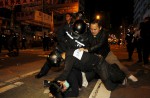
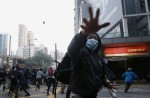
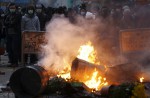
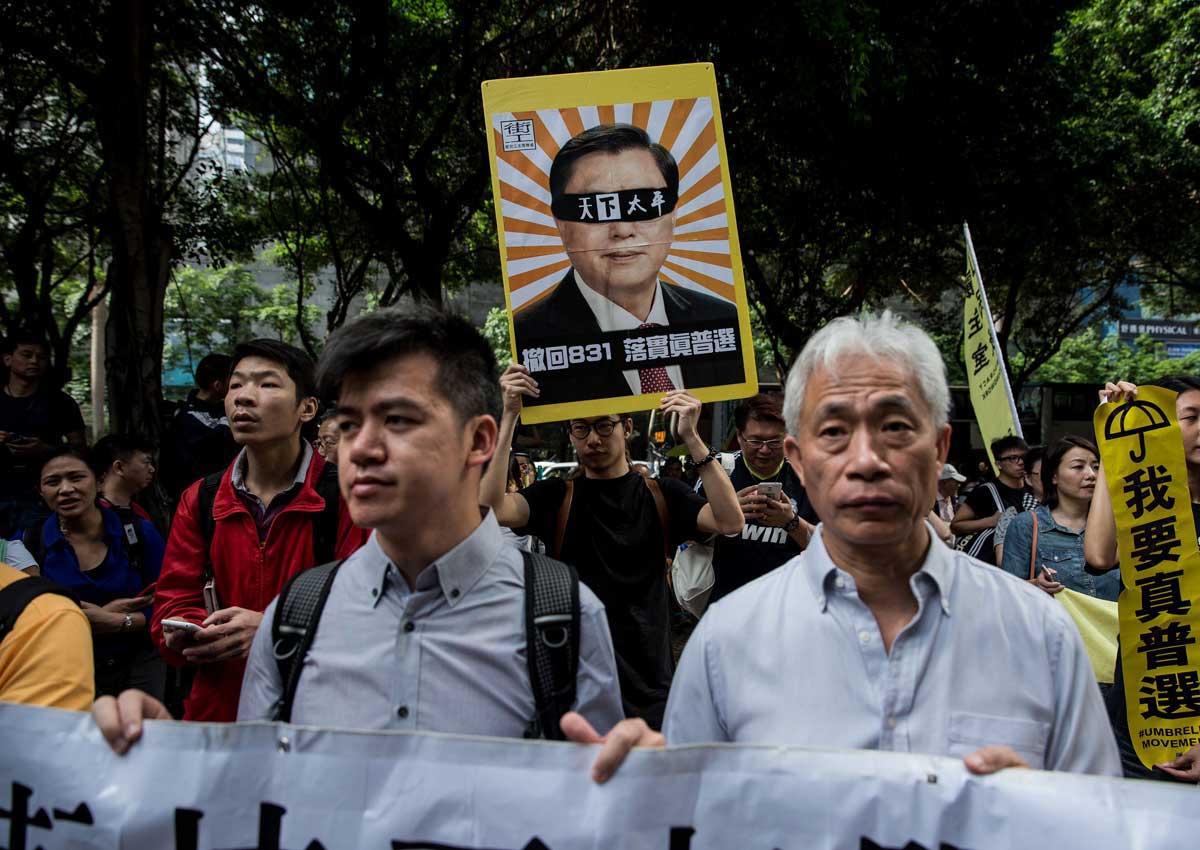
Hong Kong protesters angry at a visit by a top Beijing official shouted pro-democracy slogans and demanded free elections Wednesday but were kept away from talks seen as an attempt to bridge a growing political divide.
The three-day trip by Zhang Dejiang, who chairs China’s communist-controlled legislature, is the first by such a senior official in four years and comes as concerns grow that freedoms are under threat in semi-autonomous Hong Kong as Beijing tightens its grip.
Although Zhang’s trip is ostensibly for an economic conference, it is widely being seen as a conciliatory mission and a chance to gauge whether Beijing should back the city’s unpopular leader Leung Chun-ying to stand for a second term.
It comes as frustration over lack of reform has sparked a fledgling independence movement, condemned by authorities in Hong Kong and China.
Zhang will meet with pro-democracy lawmakers Wednesday evening in a rare move, after kicking off his visit Tuesday by promising to listen to political demands from across society.
But opponents have criticised Zhang for what they called “tokenistic” diplomacy and slammed Hong Kong authorities for putting parts of the city into a security lockdown for his visit.
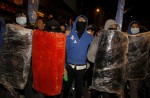
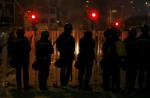
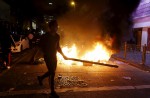
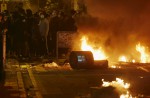
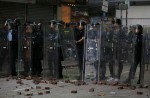
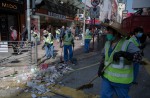
Roads around Zhang’s hotel and the convention centre hosting the economic conference have been cordoned off with water-filled barricades and protesters funnelled into designated areas, out of sight.
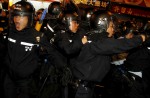
Around 100 protesters marched to one of the areas Wednesday morning before the conference started, vastly outnumbered by police — thousands of whom have been mobilised to protect Zhang.
They called for the “end of dictatorship”, fully free elections, and the release of Liu Xiaobo, a Chinese Nobel peace laureate jailed on the mainland, as well as the resignation of city leader Leung.
One woman was moved along by police as she waved a large Tibetan flag by one of the barricades.
“Our requests are very clear, we do not welcome Zhang,” said John Leung, 30, of the Hong Kong Confederation of Trade Unions.
Rival groups of pro-China demonstrators waved national flags and heated shouting matches ensued between the two sides.
Reuters, AFP, AFP PHOTO / SCMP / EDWARD WONG





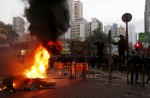
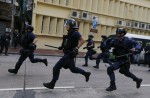
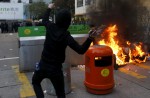



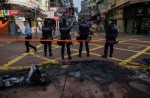




“Despite all, we are Chinese. Every policy and every government has its own imperfections,” said one pro-China protester who gave her name as Ms Yuan.
Demonstrators said they expected higher numbers for an evening rally.
Some said fear of a backlash had kept numbers away in the morning.
“I think more people are scared of the police,” said Alexandra Wong, 60, a retired accountant.
“They do what they want.”
Hong Kong police were criticised for heavy-handed treatment of protesters during massive pro-democracy rallies that brought parts of the city to a standstill in 2014.
Police arrested seven members of the pro-democracy League of Social Democrats party on Tuesday for unfurling protest banners on hills and flyovers.
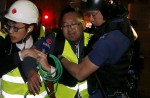
They also wrestled a leading pro-democracy activist to the ground near Zhang’s hotel as he tried to breach a barrier.
Human Rights Watch said Wednesday authorities had “sharply limited” the public’s opportunities to voice criticism of Zhang’s visit.
It also said Hong Kong officials should challenge Zhang “to make concrete commitments to respect Hong Kong’s autonomy on human rights and democratic rule”.
Hong Kong is semi-autonomous after being handed back to China by Britain in 1997 and enjoys freedoms unseen on the mainland, but there are concerns Beijing interference is growing.
Speaking at the economic forum Wednesday, Zhang said Hong Kong should participate more in China’s national development strategy.
“I hope that Hong Kong, with a broader mind and vision, will fully seize the major opportunities,” he said.
He emphasised the shared Cantonese culture of southern China and Hong Kong, an apparent bid to ease fears Beijing is trying to eradicate the city’s identity.
Hongkongers speak Cantonese, rather than the Mandarin dominant on the mainland, and there are concerns the language is being squeezed out.
Tokyo 2020 bid to be investigated after report of payment

TOKYO – A Japanese official who led the successful bid for the Tokyo 2020 Olympics said on Wednesday the Japanese Olympic Committee (JOC) plans to investigate the bidding after questions were raised about payments by the bid committee.
Media has reported the bid team made payments totalling more than $2 million (S$2.7 million) to a Singapore bank account linked to Papa Massata Diack, son of disgraced former international athletics chief Lamine Diack.
Japanese officials have said the payments were legitimate consultant’s fees.
Tsunekazu Takeda, president of the JOC and leader of the successful effort to win the Summer Games, said people involved with the bid would be questioned.
“We are setting up an investigative team that includes outside lawyers,” Takeda told a parliamentary committee.
“We will once again talk with people connected to the bid at the time to ascertain whether or not there was anything illegal in the suspicions that have been raised.”
Opposition lawmakers have seized on the issue, saying that a Singaporean company called Black Tidings, into whose account the Guardian newspaper said the payment was made, was a paper company.
The firm’s business address is in a government housing complex in a suburban part of Singapore. A Reuters cameraman saw shoes and umbrellas in front of the address this week, but the company has no registered phone number.
Takeda said on Monday he believed it was not a paper company.
The Singapore account into which the money was allegedly deposited was controlled by Ian Tan Tong Han, a friend of the younger Diack, the Guardian reported.
The elder Diack, a former International Olympic Committee (IOC) member, is under a French police investigation for corruption at the IAAF, athletics’ governing body. The IOC has said it has been in touch with French magistrates over the case.
Japan, which in 2013 beat Istanbul and Madrid to host the games, has been embarrassed by a number of woes since then, including scrapping the design for the centrepiece Olympic stadium, delaying construction.
Last month, it finally selected a new games logo after the previous one was withdrawn due to questions about plagiarism.

China worships mythical Yellow Emperor, founder of Chinese civilisation

Xinzheng, China – Scarves emblazoned with red dragons draped over their black business suits, Chinese officials lit incense and bowed solemnly at the feet of a mythical ancestor known as the Yellow Emperor.
The avowedly atheist Communist Party is promoting worship of the ancient figure as it seeks to bolster its legitimacy — and emphasise Chinese blood ties, including with Taiwan ahead of the inauguration of Beijing-sceptic president Tsai Ing-wen.
Thousands gathered in the heartland province of Henan, where the Yellow Emperor — described in archaic annals and present day schoolbooks as the founder of Chinese civilisation — is said to have been born 5,000 years ago.
Shots from gold-painted cannon began the annual ceremony, and the crowd, many in replica antique costume, listened to a booming announcer heralding the “ancestor of the Chinese nation”.
High-ranking cadres — including the province’s top official, and a former vice culture minister — processed up a red carpet, placed offerings in front of an altar and gazed into the statue’s chiselled visage, before bowing.
Lydia Zhou, an investment manager who flew from Shanghai to attend, told AFP: “I’m here to worship. He is our ancestor and this is his birthplace.”
The lauding of an individual comes as Communist chief Xi Jinping is increasingly lionised in China’s state-run media, and the announcer echoed his slogans: “Revive China, a one hundred year dream, ruling by law, moderate prosperity for all.”
Historians say there is little evidence the Yellow Emperor actually existed, but school textbooks widely describe him as the founder of Chinese culture and ancestor of all Chinese people — including its 55 official ethnic minorities, some of whom chafe against identifying as Chinese.
The same books assert China has existed for 5,000 years since his birth, though historians date the first Chinese dynasty — covering a tiny fraction of the present country — to around 1600 BC.
The Communist Party attempted to outlaw religion after taking power in 1949.
Under Mao Zedong, “Yellow Emperor worship was seen as feudal superstition,” Ren Dahuan, vice president of a state-run research association into the figure, told AFP.
But now the party says religion can be harnessed for social good ahead of it eventually melting away with economic progress.
Searching for tourist and investment income, officials in the emperor’s supposed birthplace of Xinzheng revived offerings in the 1990s. The ceremony was endorsed by the State Council, China’s cabinet, in 2008.
With economic growth slowing, the ruling party has turned to a grab-bag of traditions as it attempts to portray itself as a natural outgrowth of Chinese culture.
“These events are becoming bigger and bigger, because the state needs them to explain its legitimacy,” said Zhu Dake, a cultural critic at Shanghai’s Tongji University.
At the same time it is looking to forge a single identity for an ethnically diverse population.
“The state needs this bloodline,” Zhu added. “It’s a political strategy. China is a multi-ethnic country. Chinese people are a mixed-up thing, rather than descendants of a single ancestor.”
The message of unity applies to all ethnic Chinese, including the diaspora abroad and those in Taiwan, which split from the mainland in 1949 at the end of a civil war.
Its new president Tsai — from the traditionally pro-independence Democratic Progressive Party — will be inaugurated on Friday.
Among those lighting incense in Xinzheng last month was the head of Beijing’s Taiwan Affairs Office, which handles relations with Taipei.
Similarly, the former vice-chairman of Taiwan’s incumbent Kuomintang party Chun Chun-po attended another event at the reputed site of the emperor’s death in neigbouring Shaanxi province, telling local media: “As descendants of the Yellow Emperor, this is the happiest event in life.”
His remarks recalled those of Taiwan’s outgoing leader Ma Ying-jeou at last year’s first cross-strait summit since 1949, when he said that people on both sides of the Taiwan Strait were “of Chinese nationality” and “children of the Yellow Emperor”.
For his part President Xi offered: “We are brothers connected by flesh even if our bones are broken, we are a family whose blood is thicker than water.”
Both men’s declarations were disparaged by many in Taiwan, where Tsai’s message of Taiwanese identity resonated with voters and surveys show people feel increasingly separate from the mainland.
But in the People’s Republic, where the ruling party tightly controls presentations of history, there are few such concerns.
After the official ceremonies at the Shaanxi tomb complex — refurbished a decade ago at a cost of around 250 million yuan (US$38 million)– thousands of ordinary citizens poured in, many prostrating themselves before the emperor’s statue.
“He definitely existed, there are ancient books and bone carvings which prove it,” said student Shen Yuyan.
“He’s the ancestor of all Chinese ethnic groups and of Taiwanese people.”



