Home Blog Page 3899

Chinese tycoon Tony Xia buys Aston Villa for $120 million

London – Aston Villa have been sold to a Chinese group owned by Dr Tony Jiantong Xia, the Championship club announced on Wednesday, in a deal worth a reported US$87 million (S$120 million).

Villa crashed out of the Premier League after a miserable season that saw the Midlands team win just three of their 38 matches, but that hasn’t stopped Dr Xia making his move.

US-based owner Randy Lerner had been trying to sell Villa for two years and has finally found a buyer after significantly lowering his asking price to a reported £60 million ($86 million, 76 million euros).

“Aston Villa Football Club is pleased to announce that an agreement has been signed today for the sale of 100 per cent ownership by Randy Lerner to Recon Group owned by Dr Tony Jiantong Xia subject to the approval of the Premier League and the Football League,” a Villa statement read.

“Once those approvals have been granted and the new board members approved under the fit and proper rules of both leagues, Dr Xia will become Chairman of Aston Villa.”

Lerner, who bought Villa in 2006 for around £60 million, had hoped to sell the club for £200 million, but the team’s dismal form over the last two seasons put off potential investors until his price cut.

Villa chairman Steve Hollis flew to China to complete the deal as soon as their woeful top-flight campaign was completed last weekend.

Villa are currently managerless after sacking Remi Garde in March, but former Leicester boss Nigel Pearson and ex-Chelsea chief Roberto Di Matteo are reportedly the leading candidates to step in now a takeover has been agreed.

Dr Xia and the new manager will take charge with Villa condemned to second tier action for the first time since 1987-88 and with morale among supporters at an all-time low after months of protests against Lerner and the underperforming players.

“The Club will announce the appointment of a new manager shortly,” the Villa statement continued.

“Randy Lerner has sought the right new owner for Aston Villa who would take great care of the Club and restore its fortunes. He believes that Tony Xia is an excellent choice.

“Recon Group is Dr Xia’s privately owned holding company that owns the controlling interest in five publicly listed companies on the Hong Kong and Chinese stock exchanges and many other private companies employing 35,000 people in 75 countries.”

According to Villa’s website, Dr Xia decided to buy “an iconic football Club in England as the cornerstone of his Sports, Leisure and Tourism Division”.

The statement says he became “a fan of Aston Villa many years ago” and “played football as a striker until he finished at college”.

Dr Xia’s move for Villa comes after a glorious season for Thailand’s Srivaddhanaprabha family, who bought Leicester in 2010 and transformed the club into unlikely Premier League champions with the considerable help of manager Claudio Ranieri, in the process making them a huge hit in Asia.

Now Dr Xia has set his sights of taking Villa back into the Premier League’s top six and attracting the backing of Chinese sports fans.

“Dr Xia’s immediate objective is to return Aston Villa to the Premier League and then to have the Club finish in the top six, bringing European football back to Villa Park,” the Villa statement read.

“He plans to make Aston Villa the most famous football Club in China with a huge fan base.”

Lerner, in a long farewell message, said Dr Xia has the enthusiasm and experience needed to redevelop Villa Park in a bid to provide improved revenue streams.

“As we visited together, and had some unrushed time to discuss his plans, Tony’s excitement to develop Villa Park shone through,” Lerner said.

“I remain convinced that this is a crucial part of the Club’s future as it provides a critical, long-term second source of revenue and therefore sustainability for the Club from which squad-funding can potentially come.”

Questions over Xia

The new Chinese owner of English football club Aston Villa appears to be a highly educated, politically well-connected businessman – but questions have been raised over Tony Xia’s academic credentials and background.

Xia, whose Chinese name is Xia Jiantong, and his private conglomerate Recon Group were largely unknown to the outside world before buying the newly relegated Birmingham club for a reported $87 million on Wednesday.

A native of Zhejiang, known as the cradle of private companies in China, Xia’s biography shows him to rule a vast corporate empire with interests ranging from health and new energy to financial services and tourism. Recon has assets of more than 100 billion yuan (US$15 billion), according to its website.

Wealthy Chinese entrepreneurs have poured money into football, with President Xi Jinping hoping that the Asian giant will one day host and win the World Cup.

Recon says it has played host to Xi and other top officials. A picture on the company website is captioned as showing Xi, then the Communist Party chief of the eastern province of Zhejiang, visiting the company in 2005.

Another image is labelled as Chinese Premier Li Keqiang touring a subsidiary, and a third is said to show another top Chinese Communist, Zhang Dejiang, visiting the company and praising its “digital cities” efforts.

Xia is not identified in any of the pictures, despite being the company chairman, chief executive and owner.

Searches by AFP did not find Chinese news reports of any of the three visits.

Announcing the sale, Aston Villa said that Recon “owns the controlling interest in five publicly listed companies on the Hong Kong and Chinese stock exchanges”.

The Recon website says the same, but only names one of the subsidiaries, Lotus Health Group.

It claims to be the world’s second largest producer of food additive monosodium glutamate but lost $78 million last year, according to a statement to the Shanghai stock exchange, where it is listed.

“Life is a marathon and building a company is an endurance race as well,” Xia said in a posting on his microblog last year.

Xia’s love of football is said to stem from playing striker as a student, with one online post identifying his alma mater as Beijing Forestry University, where he studied landscape architecture.

He later studied at Harvard, MIT and Oxford University, according to a biography published by Aston Villa. He is a published author, with a book on urban planning selling on the Chinese website of Amazon, whose single customer reviewer gives it five stars.

But doubts have been raised about Xia’s credentials.

Fang Zhouzi, a prominent Chinese sceptic who operates a platform dedicated to exposing academic fraud such as plagiarism, questioned multiple Chinese reports that quoted Xia as claiming to be the youngest ever professor at Harvard.

In response, Xia said the media had exaggerated and he was only a professor’s assistant.

There is also confusion over his age. His verified Weibo microblog gives a birthday that would make him 39, but a listed unit’s annual report issued in April gave his age as 41.

Xia is the latest Chinese tycoon to heed Xi’s call to develop football in the world’s most populous country.

The Wanda Group of Chinese billionaire Wang Jianlin – who openly acknowledges that his footballing investments have political motivations – bought a 20 per cent stake in Spain’s Atletico Madrid last year, and in March it signed a sponsorship deal with FIFA, football’s troubled world body.

State-linked China Media Capital led a consortium to buy a stake of just over a 13 per cent in Premier League club Manchester City for $400 million in December. Xi himself included the club on a state visit to Britain before the deal, and posed for a memorable selfie with player Sergio Aguero.

Aston Villa crashed out of the Premier League in April after a miserable season that saw the team win just three of 38 matches. Xia’s dream is to return the club to the top flight and have them finish in the first six, according to a statement.

In an online posting discussing losing out on a business deal to a competitor, he said: “Do not lose courage after defeat, stage a comeback!”


Image: 
Category: 
Publication Date: 
Thursday, May 19, 2016 – 19:30
Keywords: 
Send to mobile app: 
Source: 


Rotator Headline: 
Tycoon Tony Xia, who bought Aston Villa for $120m, wants it to be the most famous club in China
Rotator Image: 
Story Type: 
Others

Source link

Chinese investor buys Aston Villa for reported $86 million

London – Aston Villa have been sold to a Chinese group owned by Dr Tony Jiantong Xia, the Championship club announced on Wednesday, in a deal worth a reported $86 million.

Villa crashed out of the Premier League after a miserable season that saw the Midlands team win just three of their 38 matches, but that hasn’t stopped Dr Xia making his move.

US-based owner Randy Lerner had been trying to sell Villa for two years and has finally found a buyer after significantly lowering his asking price to a reported £60 million ($86 million, 76 million euros).

“Aston Villa Football Club is pleased to announce that an agreement has been signed today for the sale of 100 per cent ownership by Randy Lerner to Recon Group owned by Dr Tony Jiantong Xia subject to the approval of the Premier League and the Football League,” a Villa statement read.

“Once those approvals have been granted and the new board members approved under the fit and proper rules of both leagues, Dr Xia will become Chairman of Aston Villa.”

Lerner, who bought Villa in 2006 for around £60 million, had hoped to sell the club for £200 million, but the team’s dismal form over the last two seasons put off potential investors until his price cut.

Villa chairman Steve Hollis flew to China to complete the deal as soon as their woeful top-flight campaign was completed last weekend.

Villa are currently managerless after sacking Remi Garde in March, but former Leicester boss Nigel Pearson and ex-Chelsea chief Roberto Di Matteo are reportedly the leading candidates to step in now a takeover has been agreed.

Dr Xia and the new manager will take charge with Villa condemned to second tier action for the first time since 1987-88 and with morale among supporters at an all-time low after months of protests against Lerner and the underperforming players.

“The Club will announce the appointment of a new manager shortly,” the Villa statement continued.

“Randy Lerner has sought the right new owner for Aston Villa who would take great care of the Club and restore its fortunes. He believes that Tony Xia is an excellent choice.

“Recon Group is Dr Xia’s privately owned holding company that owns the controlling interest in five publicly listed companies on the Hong Kong and Chinese stock exchanges and many other private companies employing 35,000 people in 75 countries.”

According to Villa’s website, Dr Xia decided to buy “an iconic football Club in England as the cornerstone of his Sports, Leisure and Tourism Division”.

The statement says he became “a fan of Aston Villa many years ago” and “played football as a striker until he finished at college”.

Dr Xia’s move for Villa comes after a glorious season for Thailand’s Srivaddhanaprabha family, who bought Leicester in 2010 and transformed the club into unlikely Premier League champions with the considerable help of manager Claudio Ranieri, in the process making them a huge hit in Asia.

Now Dr Xia has set his sights of taking Villa back into the Premier League’s top six and attracting the backing of Chinese sports fans.

“Dr Xia’s immediate objective is to return Aston Villa to the Premier League and then to have the Club finish in the top six, bringing European football back to Villa Park,” the Villa statement read.

“He plans to make Aston Villa the most famous football Club in China with a huge fan base.”

Lerner, in a long farewell message, said Dr Xia has the enthusiasm and experience needed to redevelop Villa Park in a bid to provide improved revenue streams.

“As we visited together, and had some unrushed time to discuss his plans, Tony’s excitement to develop Villa Park shone through,” Lerner said.

“I remain convinced that this is a crucial part of the Club’s future as it provides a critical, long-term second source of revenue and therefore sustainability for the Club from which squad-funding can potentially come.”

Image: 
Category: 
Publication Date: 
Thursday, May 19, 2016 – 15:05
Keywords: 
Send to mobile app: 
Source: 


Story Type: 
Others

Source link

Valencia says it is on right path despite upheaval

It has been a season to forget for Spanish football club Valencia as they finished 12th in the Spanish Primera Liga, after a topsy-turvy campaign marred by fan unrest and two managerial changes.

With the season ending last week, coach Pako Ayestaran was in a reflective mood as he arrived with some first-team players yesterday.

Speaking at the Singapore Sports Institute, the Spaniard said: “I always said that whatever happens, you have to analyse, even if you are successful. In this case when you have failed, probably many things haven’t (been) done the right way.”

“You have to be able to analyse, something the club is doing for the moment.”

Having finished fourth the season before and earning Champions League qualification, there was an air of optimism around Valencia, owned by Singaporean billionaire Peter Lim, at the start of the season.

But their fortunes quickly nosedived. Portuguese coach Nuno Espirito Santo resigned after 13 league games with the club languishing in ninth place and on the verge of elimination from the Champions League group stage.

Former Manchester United captain Gary Neville replaced him, only to leave after a run of three wins in 16 league matches. He left the club in 14th place and out of the Europa League before assistant coach Ayestaran stepped up.

Australian international goalkeeper Mathew Ryan echoed his coach’s sentiments. He also suggested the language barrier might have proved challenging for Neville.

“Obviously it’s difficult going to a foreign country, but it’s part of life you’ve to adapt to it as best you can. It takes more than a couple of months to be able to speak another language,” said Ryan, who took Spanish lessons with Neville.

“As a player, he pretty much achieved it all in the game but as a coach he’s beginning his career. Unfortunately, the way it’s happened, it didn’t quite work out for him. Hopefully in the future it can work out for him at another club.”

While some fans turned on the players and Lim, who bought the club in 2014, Valencia legend Gaizka Mendieta believes the Singaporean is the right man at the helm.

The midfielder, who reached the Champions League final twice with Valencia, said: “He seems to have (the right vision). The way they are working seems to be the right one. As long as the owner, chairman, fans and players are in the right direction, all want the same (things), (that’s most) important.”

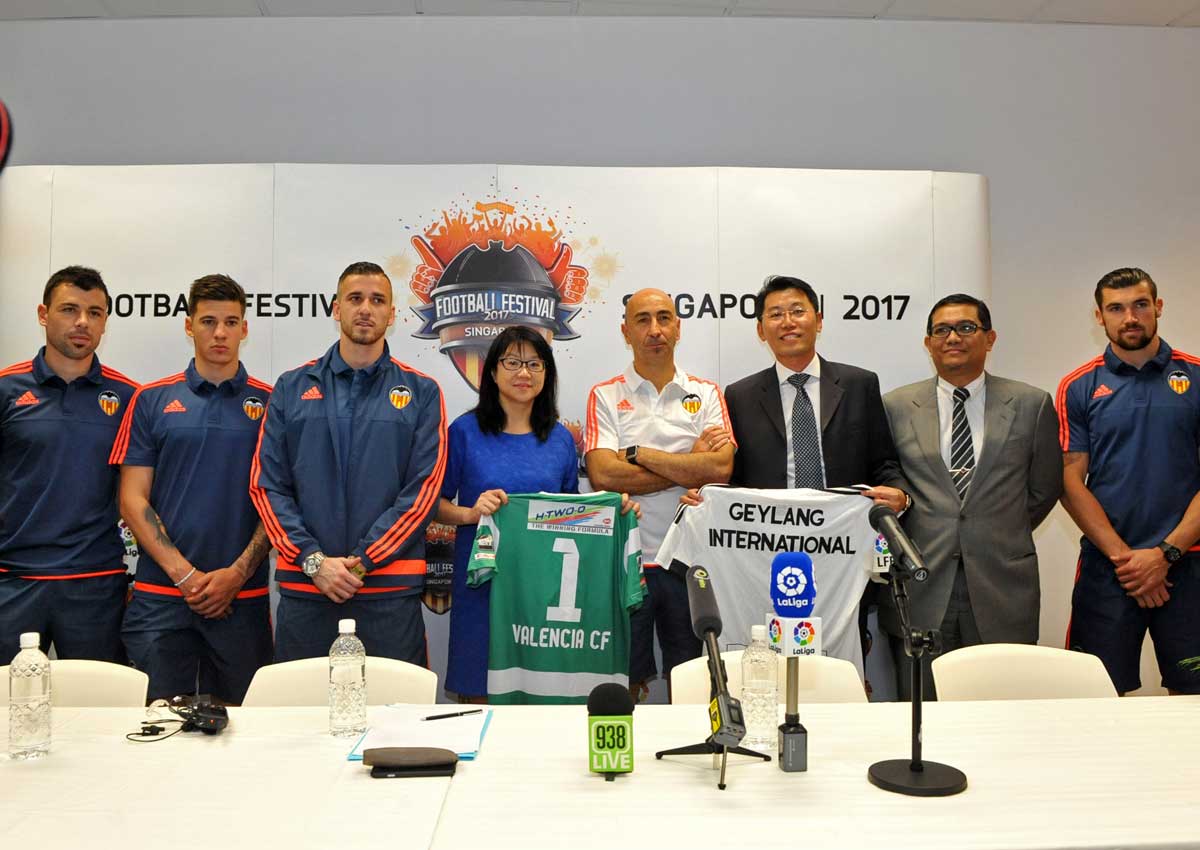
The Spanish contingent are in town to promote Valencia’s arrival next year, when the club will play at least one match at the National Stadium. More matches against local and foreign clubs are in the pipeline in the next few years.

Next year’s event will be part of a series of outreach activities the club has lined up. Dubbed the “Singapore Football Festival”, it is organised in partnership with La Liga and the Football Association of Singapore (FAS).

A three-year partnership with S-League club Geylang International was also announced. The deal will see both sides collaborating to hold football clinics in Bedok, led by a coach from the club’s academy.

Yesterday, Valencia gave a prelude of what to expect when they met children from Beyond Social Services at Beo Crescent.

The rain hardly quelled the participants’ enthusiasm as they enjoyed a kick-about with first-team players including Ryan, Santi Mina, Jaume Domenech and Javi Fuego.

Tomorrow, they will attend the Singapore Olympic Foundation – Peter Lim Scholarship Award Presentation at ITE College East.

On Saturday, the players will take part in the Football with a Heart event, a fund-raising initiative organised by Singapore Pools, iShine Staff Volunteers and the FAS.


This article was first published on May 19, 2016.
Get a copy of The Straits Times or go to straitstimes.com for more stories.

Image: 
Category: 
Publication Date: 
Thursday, May 19, 2016 – 16:00
Keywords: 
Send to mobile app: 
Source: 


Story Type: 
Others

Source link

Traffic Police to deploy new police speed laser cameras in 44 locations

The new cameras are able to capture images clearly during day and night, detect vehicle speeds from a farther distance than existing cameras, and can detect front and back number plates. 

Source link

Trafficking of Vietnamese women for sex and marriage expands across region – Expert

BANGKOK – The trafficking of women to China for sex work or forced marriage is expanding across Vietnam, an expert said, predicting that more Vietnamese women will be trafficked across Southeast Asia as the region moves towards freer trade.

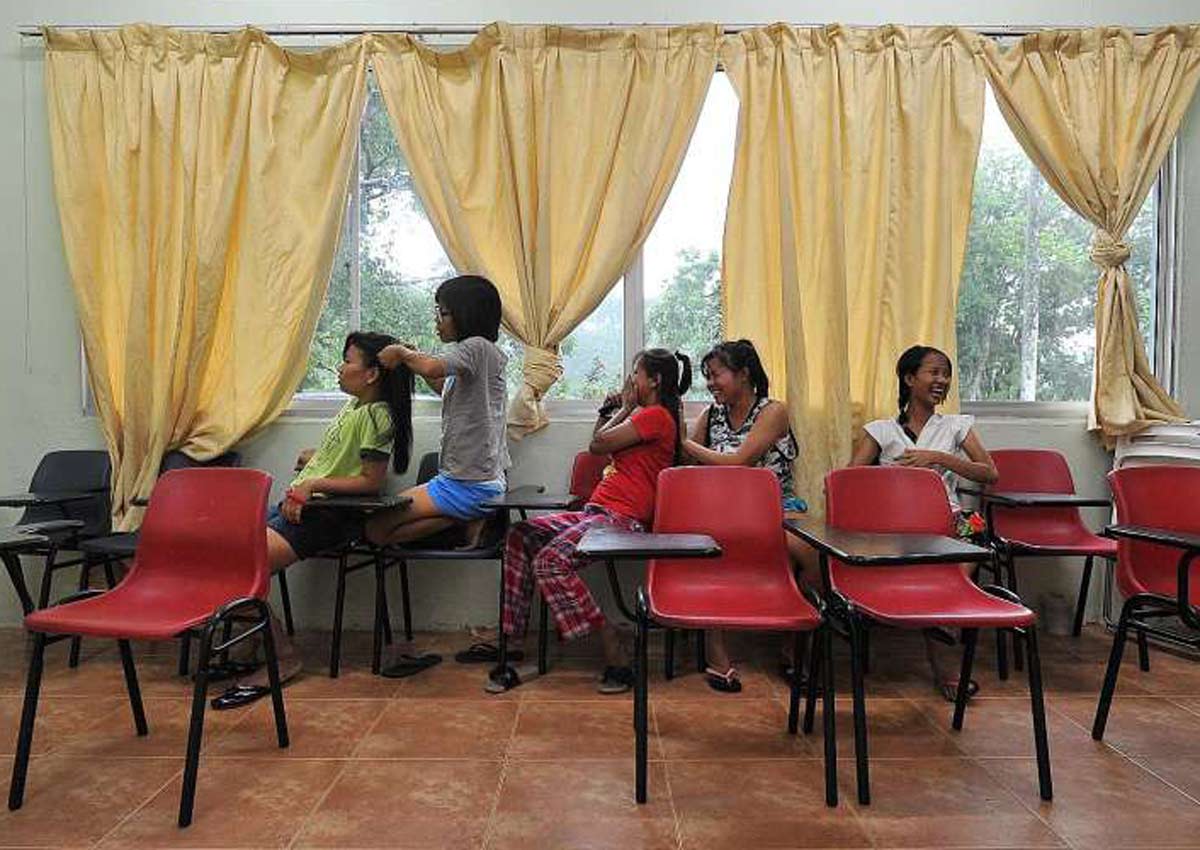
Seventy per cent of trafficking victims in Vietnam are women and girls, with the bulk sent to China as brides, sex workers or factory workers, while others are forced into sex work or marriage in Malaysia, or into brothels in Cambodia, said Mimi Vu of the Pacific Links Foundation.

In the past, most women trafficked into China were from northern Vietnam, near the Chinese border. Over the past year, the trade has expanded south, with officials finding more victims from the Mekong Delta region, said Vu, head of advocacy at Pacific Links, a California-based development organisation.

“Traffickers are willing to take the risk of trafficking victims all the way through Vietnam into China,” Vu said in a recent interview in Bangkok, adding that this means the “trade for brides is becoming more lucrative.”

China is a destination for trafficked brides because of its shortage of women as a result its strict one-child policy introduced in the late 1970s. The country last year eased restrictions to allow all couples to have two children.

Vu said economic growth in Vietnam and Southeast Asia has created more opportunities for criminals to dupe workers, including domestic migrants who leave rural areas for jobs in industrial zones, with little knowledge about human trafficking.

The 10-member Association of Southeast Asian Nations’ (ASEAN) shift towards a formal community with freer movement of trade and capital would increase trafficking risks, she said.

Already, an increasing number of factories in Malaysia are staffed by Vietnamese workers, and traffickers are “piggybacking” on that migration and tricking people with promises of jobs in electronics factories, she said.

“In reality, they get there, their passports are taken away, and they’re forced into prostitution or into being brides,” Vu said, noting that many women also end up re-sold into factories.

“You could be trafficked as a bride, give birth to a son, and then sold off to a brothel or a factory, or sold off to another family to give birth again… Her value as a commodity is almost limitless.”

CLEANING SUPPLY CHAINS

In 2013, Pacific Links developed a counter-trafficking programme for factory owners, managers and workers, with support from businesses complying with the California Transparency in Supply Chains Act.

The law, which came into effect in 2012, requires large retailers and manufacturers doing business in the US state to publicly disclose measures taken to eradicate forced labour and human trafficking from their supply chains.

Pacific Links’ Factory Awareness to Counter Trafficking (FACT) programme trains managers on international and local laws, as well as the traffickers’ tactics to trick workers on the factory floor and in the industrial zone. It teaches workers what human trafficking is, what to ask if they are approached, and how to report cases.

The FACT programme is now expanding after the passage last year of Britain’s Modern Slavery Act, which requires companies operating in the UK with a turnover of $51 million or more to disclose what they have done to ensure slave labour is not in their supply chains.

Pacific Links has trained 9,000 workers so far, and aims to at least double that number by the end of 2016.

Vu was a speaker for a panel at Trust Forum Asia, an event in Singapore last month on trafficking and slavery hosted by the

Image: 
Category: 
Publication Date: 
Thursday, May 19, 2016 – 14:31
Send to mobile app: 
Source: 


Story Type: 
Others

Source link

Rui En: Filled with gratefulness, not regret

The repentant stance that Rui En adopted at the recent Star Awards, where she apologised for an incident in which she drove and knocked over a parked motorcycle, continued at a press conference on Tuesday for a new Channel 8 drama.

The fantasy melodrama is titled If Only I Could… and its protagonists are given a second chance to go back in time to change their lives for the better.

Rui En, 35, says: “Who doesn’t want second chances? Who doesn’t want to go back in time, amend mistakes and do the right thing? Such sentiments are especially heartfelt for me now.”

The actress was flamed last month for her behaviour in the traffic incident, where she asked the motorbike owner, “Do you know who I am?”

She later clarified that she was telling him that she would not run away without taking responsibility for what she had done.

Asked how she would handle the situation differently if she were given a second chance, she says she does not know.

“Honestly, I’m in a dilemma. Be it mistakes or success, be it peak or hell, whatever we go through makes us who we are today,” she says.

“Initially I thought if I could go back in time, I would definitely do so – not just to half a year ago, but to the time I was a baby. I wanted to start anew. Then I realised that going through suffering may change a person for the better.”

She says she has learnt two lessons from the episode: to be grateful and to forgive herself.

“I never expected the unconditional concern, love and help given to me by my family, friends and colleagues. It has taught me not to take the people by my side for granted. I want to give back the love that they’ve showered on me during this period.”

A self-professed perfectionist, she says she has been heaping blame on herself since the incident and vomited at the Star Awards last month because stress triggered an existing gastric ailment.

“I’ve realised that I need to adjust (my mindset). I need to learn how to forgive myself and not put too much blame on myself. It has been tough,” she says.

Another problem she is facing – her inability to shed the extra weight she gained to play the dowdy character Zhen Hao in If Only I Could….

“I’m not young anymore. After I hit 30 years old, my metabolism rate slowed. Now I don’t lose weight as fast as before,” says Rui En, who gained about 7kg. She does not know how much of that extra weight she has lost because she is afraid of weighing herself.

“I’ve always felt that stepping on the weighing scale is very demoralising, especially when you find out you didn’t lose as much as you had expected to. I find it counterproductive.”

She is fighting back against talk about her chubbier face, though. “Women go through a lot. We get criticised for ageing or putting on weight. Why is society putting so much emphasis on physical appearance? This shouldn’t be the case.”


This article was first published on May 19, 2016.
Get a copy of The Straits Times or go to straitstimes.com for more stories.

Image: 
Category: 
Publication Date: 
Thursday, May 19, 2016 – 14:22
Keywords: 
Send to mobile app: 
Source: 


Story Type: 
Others

Source link

BMW tops list for customers' gripes about car defects

BMW has overtaken Volkswagen as the brand with the most customer complaints about product defects.

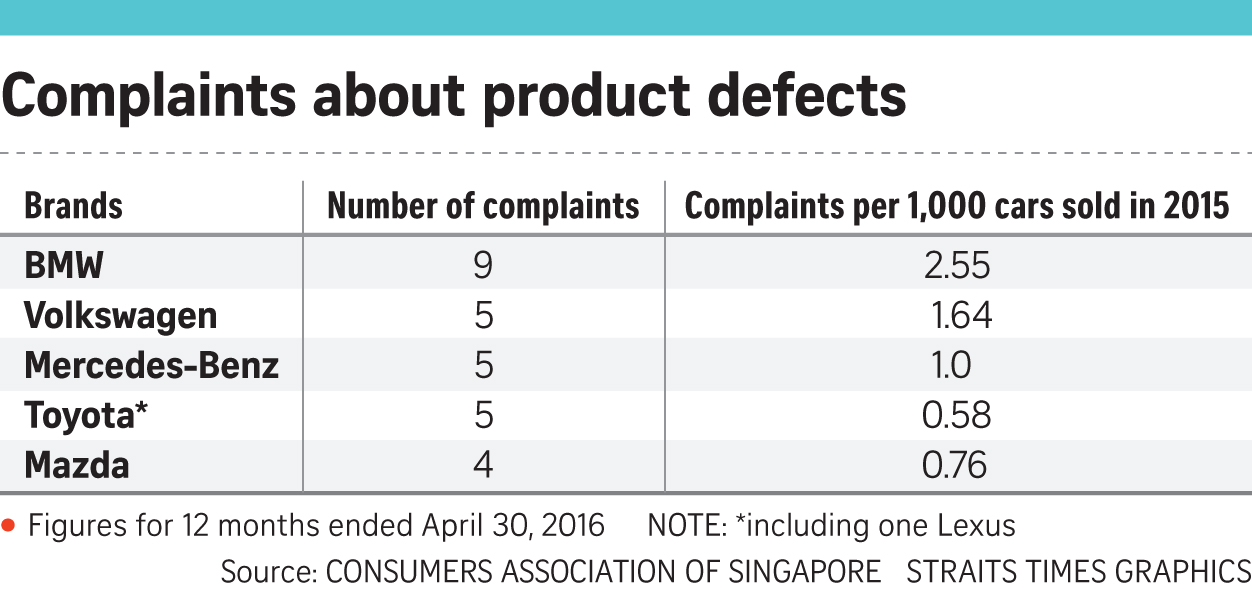
For the 12 months ended April 30, the Bavarian brand had the dubious honour of topping the list with nine complaints received by the Consumers Association of Singapore (Case).

Volkswagen, which hogged the top spot for the past two years, was next with five complaints, along with Mercedes-Benz and Toyota (including one about Lexus). The last one that made the top five list was Mazda, with four complaints.

edXAds by Rubicon Project Case said all the defect-related complaints were filed against authorised agents.

Comparing the ratio of complaints to the number of cars sold also saw BMW topping the list, with 2.55 complaints for every 1,000.

Volkswagen was next with 1.64, followed by Mercedes with 1.0. Among the three German brands, VW was the only one that improved in the complaints-to-sales ratio. Last year, its ratio was 3.41. Mazda had 0.76, while Toyota had 0.58 complaints per 1,000 cars sold.

In total, there were 42 defect-related complaints about new cars in the period, with European makes accounting for two-thirds of the tally.

A Case spokesman said: “We see a variety of defective motorcar complaints, such as faulty engine cooling system, defective gearbox, rattling noises while driving, problems with the braking system, et cetera.

“Some cars are reported to have multiple defects as well.”

Retiree Tan Chim Peng, 52, said he bought a BMW X3 in February last year. Just two months later, he detected a whistling sound when he travelled at more than 80kmh. The windows also rattled intermittently.

He said: “The workshop inserted a thin rubber strip above the window frames, but the noise persisted. They couldn’t fix it.”

He approached Case, and the car agent offered to buy back the X3. “I paid $224,800 for it, and six months later, they offered me $160,000,” he said. He decided to keep it until recently, when he traded it in for a Mercedes-Benz GLC.

He said: “The BMW has a good engine, but its insulation is poor. My previous car, a Hyundai Tucson, had better insulation, and it cost half the price.”

A spokesman for BMW agent Performance Motors (PML) said: “We take great pride in the products that we sell and we are confident that they have been tested by the manufacturer… to ensure that the products are of the highest quality.

“That said, each of the concerns raised with the Consumers Association of Singapore was on different issues. A few issues were raised regarding expired warranties and general wear and tear of the vehicles and component parts.

“PML addressed these issues closely with customers to ensure that they were resolved in a timely manner.”

Case said product defects accounted for the bulk of the 119 complaints it received about new cars.

The remaining 77 complaints were about a wide variety of issues, from poor service to failure to honour a sales agreement to misrepresentation, and were attributable to both authorised agents and parallel importers.

“For example, the consumer could have requested a car made in a certain country and the car dealer could have led the consumer to believe that it was so, when it was not true,” the Case spokesman said.


This article was first published on May 19, 2016.
Get a copy of The Straits Times or go to straitstimes.com for more stories.

Image: 
Category: 
Publication Date: 
Thursday, May 19, 2016 – 14:20
Keywords: 
Send to mobile app: 
Source: 


Story Type: 
Others

Source link

Mandai Birds Sanctuary gets lifeline

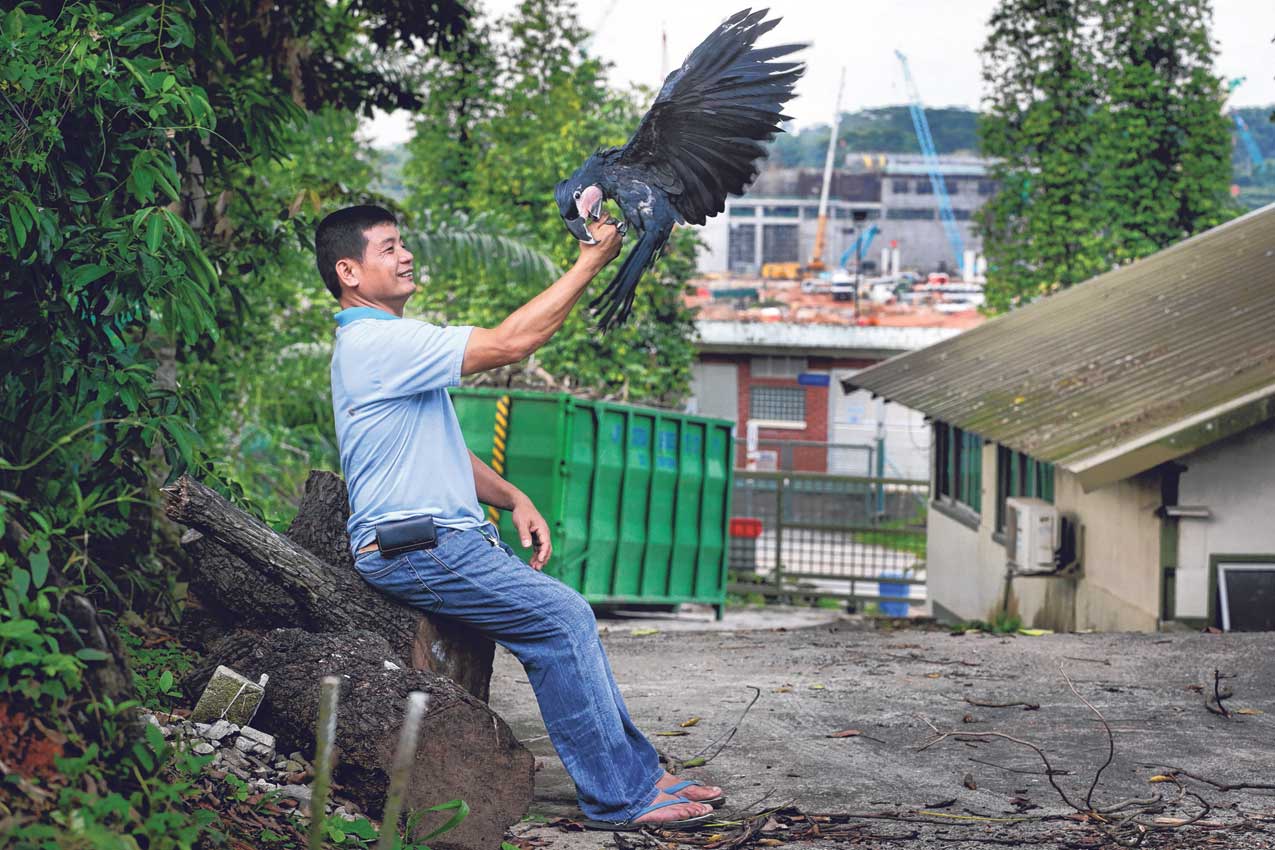
A quiet lane off Mandai Road stirs with activity at the crack of dawn every day as Mr Rosendo Jacildo, 45, and his co-workers get breakfast ready for about 3,000 mouths.

They dice fruits and vegetables or boil beans in a makeshift kitchen for over an hour before making their rounds to feed each feathered resident of the Mandai Birds Sanctuary.

“I’ve taken care of the birds since they were babies. When they mature and they’re healthy, I feel joy,” said Mr Jacildo.

The sanctuary curator, who is from the Philippine island of Luzon, has been living and working on the sprawling 2ha compound in Lorong Lada Hitam since 1996, two years after the facility opened.

Since then, it has grown to house more than 3,000 birds across 125 species, including some rare cockatoos, macaws and lories.

But last November, it was given a final notice to vacate the state land by May 31 this year.

Mr Jacildo, like the birds, had been waiting for a new home since then.

In February, the sanctuary’s founders were approached by a landscaping nursery, which offered them an available 1ha site at its Sungei Tengah premises.

But not optimistic that they would be able to relocate in time, they made several appeals to the Singapore Land Authority (SLA) to extend its tenancy.

After grappling with an uncertain fate for half a year, the sanctuary finally received a lifeline yesterday.

Co-founder Daniel Teo, 73, was told that the lease would be extended till February next year. The SLA confirmed this. Relieved, Mr Teo said that the extra time will allow them to plan how to turn at least five of the seven greenhouses at the new site into aviaries.

“It means a lot to us. We can now have a good sleep tonight,” echoed Mr Jacildo. “If the deadline is really the end of May, the birds will suffer because the new aviaries are not up yet. The birds may also be exposed to the threat of rodents.”

The Agri-Food and Veterinary Authority said that it would need to license the sanctuary for animal health and welfare as well.

The situation remains bittersweet for Mr Jacildo, who would have to part with at least half of the collection of birds. The new, smaller premises can take in fewer of them. The sanctuary is selling the birds in bulk to breeders abroad.

Many of the adult birds were personally bred by Mr Jacildo in his first few years at the sanctuary. This includes the black palm cockatoo, one of his favourite species.

Known for its majestic appearance and gentle nature, it often takes about 15 years to mature.

“They’re like my children. If I could, I wouldn’t sell them at all. But the only choice now is to let them go,” he said.

He is also worried that the birds may fall ill during the move. “It’s easy for me to adapt. I’m used to a hard life. For the birds, it depends.”

Mr Jacildo was a farmer in the Philippines before he got the job here. He picked up bird breeding by reading books.

At the sanctuary, he started with simple cleaning and feeding tasks, but now replies to client e-mails and arranges shipments after learning to use a computer eight years ago.

In the evenings, he enjoys making video calls to his three daughters – aged 10, 13 and 17 – in Luzon.

He takes them around the sanctuary via video to update them on a few of their favourite birds – Joyjoy, Sunshine and Rainbow – which they met during their last visit five years ago.

“My life has changed since I got onto the plane and left Philippines for the first time. I thought I would earn some money, then go back after five years to start my own business,” said Mr Jacildo.

“But now, it has been 20 years. As long as my body can take it, I want to stay here with the birds.”


This article was first published on May 19, 2016.
Get a copy of The Straits Times or go to straitstimes.com for more stories.

Image: 
Category: 
Blurb: 
Publication Date: 
Thursday, May 19, 2016 – 16:00
Keywords: 
Send to mobile app: 
Source: 


Story Type: 
Others

Source link

Employers say live-out maids 'will lead to more costs, issues'

Maid employers in Singapore have raised concerns about plans by Indonesia to stop sending new “live-in” maids overseas.

The change, meant to “better protect” its helpers from being exploited, could kick in as early as next year, an Indonesian Manpower Ministry official said on Sunday.

However, many employers here told The Straits Times that they fear it could lead to higher costs and cause other problems.

Madam Fong Choye Har, 52, who works in accounting, is “unwilling to cover the extra costs of food, lodging and transport”. She said: “We can already provide all this, so why would we spend (extra)?”

Bank executive Jazreen Tan, 32, said that both she and her husband, a real estate agent, have irregular schedules and that makes it difficult for her to be without a maid at night. The mother of a two-year-old said: “My clients might decide to meet me at the last minute. No one might be around to take care of our boy.”

Employers also fear that maids could fall into bad company or commit crimes if they live elsewhere.

Under the Employment of Foreign Manpower Act, foreign domestic workers must live with their employers at the addresses stated on their work permits. A spokesman for Singapore’s Ministry of Manpower (MOM) said “exceptions may be made on a case-by-case basis when the employer is temporarily not in Singapore”, but added that “such requests are rare”.

However, one employer here, a social worker who gave his name only as Mr Pang, admitted breaking the law to give his family’s helper some time off. The Filipino visits the family of six to cook and clean from 8am to 7pm from Monday to Saturday but lives elsewhere. She has been with them for seven years.

Mr Pang, 36, said: “Living in their workplaces can be stressful… They need a mental break, not just physical. Allowing her to stay out is how we can avoid taking advantage of her availability.”

Another employer, a 60-year-old marine company director who gave his name only as Mr Esmail, does not mind having live-out maids as long as “it remains less expensive to hire Indonesian helpers than to hire helpers from other countries like the Philippines and Myanmar”.

“I value my privacy, so I like the idea of hiring a helper who isn’t staying with me,” he said.

Employers are allowed to house their maids in a temporary dormitory when they go on holiday.

Mr Tay Khoon Beng, who owns Best Home Employment Agency, runs a 250-bed facility called Well Care Home in Woodlands for trainee maids, those who are being transferred, and those whose employers are on holiday. “The place is really meant for short stays,” he said, noting that the dormitory is always full.

He shares operating fees with four agencies. Agents must inform MOM when a maid moves in.

Besides wanting maids to live separately from their employers in dormitories and to work regular hours, Indonesia also plans to formalise maids’ training in areas such as cooking, childcare and eldercare.

This move is part of efforts by Indonesia to improve the welfare and status of its overseas workers after cases of abuse and non-payment of salaries arose.

It banned maids from working in Malaysia in 2009 but lifted the rule two years later after an agreement between the countries on better protection measures.

A ban on new Indonesian domestic workers to around 20 Middle East countries has been in place since last year.

Former Indonesian president Susilo Bambang Yudhoyono promised in 2012 to provide one million jobs by 2013 to encourage Indonesian women working overseas as maids to return home. The programme did not take off.

Indonesian maid Sarinah, 34, said: “It will be good working office hours, but if we have to rent a room and pay for our own supper, we will have to spend more.”

•Additional reporting by Cheryl Lin


This article was first published on May 19, 2016.
Get a copy of The Straits Times or go to straitstimes.com for more stories.

Image: 
Category: 
Publication Date: 
Thursday, May 19, 2016 – 14:08
Keywords: 
Send to mobile app: 
Source: 


Story Type: 
Others

Source link

Father and son behind Roads.sg hope clips deter bad road behaviour

With their propensity to shock, online clips of accidents – like that of a motorcyclist being mowed down by a bus, or of a car running into a pedestrian – can rack up tens of thousands of views.

But they are not meant to entertain, said the father-and-son team behind Roads.sg, a website that hosts such user-submitted videos.

Instead, they hope that motorists will be impacted by seeing how negligence or carelessness on the roads can have deadly consequences.

“A picture speaks a thousand words, they say. But to me, a video can say a million,” said Mr Aloysius Fong, 58, a businessman who founded and runs Roads.sg with his son Jeremy, 23. Roads is an acronym for Respect Others And Drive Safe.

Over the past few years, road safety interest groups such as Roads.sg, Singapore Reckless Drivers (SRD) and Beh Chia Lor have gained a large online following.

Mr Fong estimates there are “hundreds of thousands” of drivers who own an in-vehicle camera.

These record happenings on the roads, from major accidents to near-misses, and poor road etiquette, such as tailgating and abrupt lane changing.

These videos offer an insight into the dangers of bad road behaviour.

“Imagine: You stop at a red light and a family is crossing the road. A car just zooms pasts everyone and nearly takes a life. There are no Traffic Police there, just you and your camera recording,” Mr Fong said.

On Roads.sg, he and his son also make it a point to post – alongside the videos – the penalties for breaking traffic laws, as public education.

The three sites have each garnered a sizeable audience: SRD, which was reportedly started in 2012 by graphic designer Marc Lee after his own motorbike accident, has a Facebook following of more than 105,000.

This is followed by Roads.sg with over 55,000 people, and Beh Chia Lor with more than 45,000.

A spokesman for Beh Chia Lor (literally horse-cart road in Hokkien) said: “We hope to influence the motoring public to adopt good driving practices and road safety.”

Roads.sg’s Mr Fong is now revamping the website, which started in end-2014, so that the clips will be searchable via licence plate numbers of motorists who display poor road behaviour.

“I want to keep a whole library of all the numbers of vehicles in Singapore (whose drivers) are driving recklessly, be it purposefully or by mistake,” he said.

Users who submit their clips to Roads.sg are requested to include the licence plate number of the motorist involved, whenever feasible.

Mr Fong said such a library can have a variety of future applications, such as being referenced by insurance companies, for example, which can re-evaluate a motorist’s premiums if he is found to be driving recklessly all the time.

Taxi, bus and logistics firms can also tap the library to see if their drivers are behaving dangerously.

A police spokesman said videos shared on social media platforms help to “create more public awareness on road safety”.

He added: “These videos are also useful in providing insight and clarity in the form of video evidence of violations and accidents.”

In November, the police asked users of such road safety community sites to make reports via the Traffic Police’s online portal.

“TP will look into the matter and take follow-up actions if the violations come to TP’s attention,” a spokesman told The Straits Times.

Mr Fong, who has invested $60,000 of his own funds in Roads.sg, has no plans to monetise the site. For him, it is about making motorists more conscientious and safer road users.

He said many people drive recklessly because they think that there are too few policemen on the road and that they will not be caught.

“Bad habits and attitudes are hard for authorities to catch, and we hope to influence people’s driving behaviour,” he said.


This article was first published on May 19, 2016.
Get a copy of The Straits Times or go to straitstimes.com for more stories.

Image: 
Category: 
Publication Date: 
Thursday, May 19, 2016 – 16:00
Send to mobile app: 
Source: 


Story Type: 
Others

Source link