Singapore’s consumer prices fell 0.5 per cent last month, following a 1 per cent decline in March and a 0.8 per cent fall in February.
Source link
Consumer prices continue fall in April, but pace of decline slows
Singapore to contribute US$150,000 in aid to cyclone-hit Sri Lanka
This includes US$100,000 contributed by the Government, and communities affected by Cyclone Roanu will receive food and non-food relief items such as household and health kits as well as clothes.
Source link
ERP rates, VEP hours to be reduced during June school holidays

SINGAPORE – Electronic Road Pricing (ERP) rates will be lowered by between 50 cents and S$1 for the upcoming June school holidays, starting from this Saturday (May 28), said the Land Transport Authority on Monday.
This means that some motorists will…
Source link
Guilty As Charged: Chia Teck Leng led a double life and cheated banks of millions
This story was first published in July 2015 in an e-book titled Guilty As Charged: 25 Crimes That Have Shaken Singapore Since 1965. A collaboration between The Straits Times and the Singapore Police Force, the e-book appeared in The Straits Times Star E-books app. Read the other crime stories here. (Warning: Some content in these stories may be disturbing for some individuals.)
High-rolling hustler (2004)
“Unremarkable” family man, who led double life as the darling of offshore casinos, cheated banks of millions
Living in a Serangoon Road condominium with his wife and two teenage sons – Chia Teck Leng appeared to most as an unremarkable family man, with all the trappings of upper middle-class Singapore. But unbeknownst to his friends and family, Chia secretly led a double life as a high-rolling hustler, complete with flashy cars, luxury apartments and a girlfriend half his age.
He was the darling of offshore casinos – gambling operators would personally fly him in on private jets so he could have a flutter in their betting halls.
To feed and fund his gambling addiction, he swindled four foreign banks out of $117 million from 1999 to 2003, using his position as the financial manager of Asia Pacific Breweries (APB). The case at that time was Singapore’s biggest involving commercial fraud.
In 2004, the then 44-year-old was sentenced to 42 years in jail by High Court Judge Tay Yong Kwang – the longest for a case of commercial fraud.
“Bankers knocking on his door were there to meet the man… to forge a business relationship, but the man they met was unfortunately in the business of forgery,” said Judge Tay at the sentencing.
Chia had been a compulsive gambler since at least 1994, when he was a financial controller with Swire Pacific Offshore, a marine services company.
He had plunged deep into debt during 1995 to 1996 and owed several banks about $100,000 in the form of overdrafts and credit card dues. But fortune smiled on him the next year when he began visiting Star Cruise ships almost every fortnight, to try his luck at the gambling tables.
He won on several occasions and was offered a credit line of $75,000. In less than a year, his winnings grew to about $1 million.
However, the tides turned in August 1998. In a gambling spree that lasted a fortnight, he not only lost all his previous winnings, but racked up new debts as well.
By the time he joined APB in 1999, the debts had mounted sky-high, and he was a desperate man. He trained his sights on four foreign banks, one after the other – Skandinaviska Enskilda Banken (SEB), Sumitomo Mitsui Banking Corporation (SMBC), the Mizuho Corporate Bank and the Bayerische Hypo-und Vereinsbank Aktiengesellschaft (HVB).
Submitting forged documents, he was able to open accounts in APB’s name, with himself as the sole signatory. With SEB he had a credit facility for $500,000 – which he intended to use for himself.
Meanwhile, APB had no idea of what its finance manager was doing behind its back. Chia remained in sole control of all these accounts by forging director board resolutions that authorised him to receive the credit and loan facilities provided, sign all transactions and operate the bank accounts on behalf of APB.
To forge the signatures of the various directors of APB, he obtained specimens from annual reports and internal documents. He practised the signatures till he was sure they would pass muster.
Chia’s modus operandi was to draw money from SMBC, Mizuho and HVB, and transfer it to the SEB account. From there, the money was siphoned into his two personal accounts with DBS before it was remitted to casinos in Australia, Britain, Hong Kong, Malaysia and the Philippines.
He rolled over funds provided by the banks, making timely deposits to each account whenever repayments were due, thus creating the impression of a credit-worthy customer.
During a crunch situation in November 1999, he even withdrew $53 million from an APB account with OCBC. He managed to replace the entire amount by October 2002, escaping detection. As the amount of illegal money available increased, so did the stakes for which Chia gambled.
In 2002, he met his girlfriend, Chinese national Li Jin, 22, on one of his gambling trips onboard a cruise ship. Li was a croupier in the VVIP (Very Very Important Person) room.
He won $1 million from her and, from then on, she became his “good luck charm”. To make sure his luck continued rolling in, he spared no expense. Chia purchased a $530,000 apartment in Grange Road for her and bought her branded goods and jewellery.
He also bought a $10,000 forged passport so Li could enter Singapore easily. She used it twice – in 2002 and 2003 – and was jailed six months for the offence.
But as the adage goes, the casino always wins and the Commercial Affairs Department got wind of Chia’s activities. He was arrested on Sept 2, 2003. Before his four-year run ended, he had withdrawn $117.1 million. Of this, only $34.8 million was recovered. The authorities estimated that he lost $62 million feeding his gambling habit.
While he was in jail, Chia wrote a 13-page paper as a form of penance. Called “Taming the Casino Dragon”, he shared his experience as an insider to the world of high rollers.
Self-deprecating at times, and hoping others would not make the same mistakes he did, he wrote that “like an inexperienced teenager succumbing to the lure of a newly discovered vice, I was soon hooked”.
CHIA’S DOUBLE LIFE
Accountancy graduate Chia Teck Leng began his career at accounting firm Arthur Andersen before taking on a host of high-flying positions, including assistant vice-president at UOB, before becoming finance manager at Asia Pacific Breweries on Jan 20, 1999, with an annual salary of between $200,000 and $300,000.
To colleagues, his wife and two teenage children, he was a hard-working executive and an unassuming family man. But behind that veneer, was a high-rolling casino gambler with a mistress and a “hedonistic” lifestyle.
He had been gambling since 1994. Since July 2000, he had been flying in private chartered jets to Melbourne where he would gamble at the Crown Casino. He was given VIP treatment, staying in its most expensive room, complete with butler service. A night there cost A$25,000.
He was also a regular at London Ritz’s Club, where he could gamble even higher stakes.
From $200 bets during his Star Cruise days, he went up to single bets of A$20,000 and 25,000 in British ones. He even played for A$400,000 a hand at the Crown Casino.
He met his mistress, Chinese national Li Jin, in April 2002 at the casino on board a cruise ship. She was then a croupier.
He won $1 million from her that night. From then on, he would ask to gamble against her – his “good luck” charm.
Such were the losses suffered that she was eventually given a day off whenever he came on board. The Nanjing University graduate later left her job to be with Chia in Singapore.
He got her a forged passport for $10,000, under the name Chu Chiao-Ling, to enter and leave the country. He spent lavishly. He bought a $150,000 Mercedes-Benz, a $530,000 apartment in Grange Road, and gave gifts totalling $300,000 to various people, including his girlfriend.
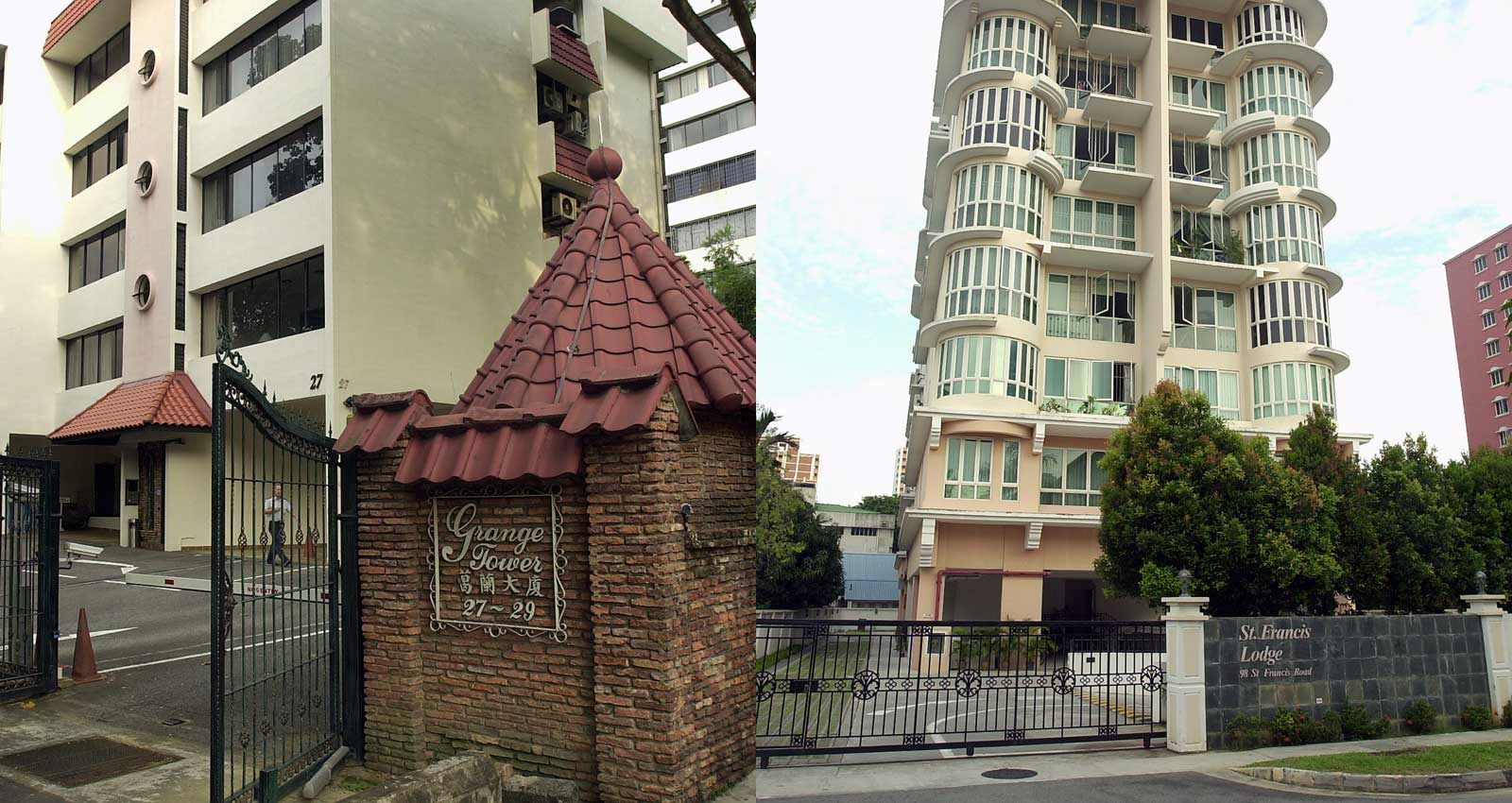
Chia owned two apartments at Grange Tower and St Francis Lodge. Photo: ST
BANK’S CLAIMS
Bayerische Hypo-und Vereinsbank (HVB), Skandinaviska Enskilda Banken (SEB), Sumitomo Mitsui Banking Corporation and Fuji Bank, now known as the Mizuho Bank, sued Asia Pacific Breweries seeking repayment for the fraud committed by its employee Chia Teck Leng.
First Mizuho withdrew its suit, then Sumitomo’s was dismissed. This was followed by HVB and SEB’s cases also being dismissed.
Justice Belinda Ang, in her judgment against HVB and SEB, said that the banks had made themselves “easy prey” by ignoring their own banking procedures and failing to notice discrepancies or irregularities in documents that were “staring bank officers in the face”.
The banks were so eager to do business with APB that they willingly gave out loans of millions of dollars without doing due diligence to verify that Chia was authorised to act for the company, she said.

This article was first published on May 16, 2016.
Get a copy of The Straits Times or go to straitstimes.com for more stories.
Image:

Publication Date:
Monday, May 23, 2016 – 12:20
Keywords:
Send to mobile app:
Source:
Story Type:
Others
ERP rates, VEP hours to be adjusted for June school holidays
ERP rates for selected roads and expressways will be reduced for the June school holidays, while the VEP operating hours will be shortened, announced the LTA.
Source link
Circle of Care to cover more children
A three-year-old programme to help children from disadvantaged backgrounds level up has reaped benefits, and is being expanded to include more children and families.
Piloted by Lien Foundation and Care Corner at two pre-schools in 2013, the Circle of Care programme has social workers and educational therapists working alongside pre-school teachers.
It led to higher rates of school attendance and gains in learning for the at-risk children at those two centres in Leng Kee and Admiralty.
The scheme is now being expanded to 15 pre-schools. Two primary schools – Lakeside and Gan Eng Seng – have also come under the programme to see how children can be helped with the transition to Primary 1.
Social workers will collaborate with the schools’ counsellors, teachers and allied educators to follow the child until Primary 3.
With the expansion, it is estimated that 30 per cent of the 1,700 pre-schoolers enrolled at the 15 pre-schools will need further help through the programme.
The programme uses an integrated approach that weaves a “circle of care” around the child. Teachers, social workers, education therapists and community partners – who typically work apart – come together to identify the root causes of a child’s difficulties and provide help on different fronts.
The model was shown to work for the 76 at-risk children at the two pilot centres, where 95 per cent of them came from families with household incomes of below $3,000 a month.
The Circle of Care team raised their average attendance from about 30 per cent to 70 per cent by working closely with their families.
Educational therapists working with pre-school teachers helped improve their literacy and numeracy skills.
Despite the encouraging results, Lien Foundation officials who went on a trip earlier this month to look at children’s centres in Adelaide and Melbourne said they and their partners are looking at how the programme can be improved further.
They said they were struck by the comprehensive and high-quality programmes and services offered to disadvantaged children and their families in the two Australian cities.
Besides providing kindergarten and childcare services, centres offered antenatal care for mothers- to-be, health checks and play sessions for babies and toddlers where mothers learn about the importance of play, talk and reading.
Lien Foundation chief executive officer Lee Poh Wah said one of the take-aways for him was how the programmes focused on not just helping the child, but the families too.
“Good parenting is key to helping these children. We must ensure that these kids have a strong family and good home environment.”
He also noted the emphasis placed on helping children develop traits such as grit and resilience.
Several of the children’s centres had mindfulness programmes to help children develop concentration and self-awareness.
Said Mr Lee: “We shouldn’t just focus on boosting their literacy and numeracy skills.
“Research shows that their socio-emotional skills such as impulse control and persistence and grit are as important for success.”
He was also impressed with the leaders in the early childhood education sector in Australia, and said it was crucial as overseas research has shown that school leadership is second only to teaching in affecting learning outcomes.
It was the reason that Lien Foundation launched a leadership programme called “Principal Matters” to help principals become more effective leaders.
Dr Khoo Kim Choo, consultant for Circle of Care, noted that some of the centres in Australia place much effort on helping the child transition to formal schooling.
Pre-school heads and teachers visit the primary schools and share the learning portfolios of the children heading there, while primary school teachers and heads also visit the pre-schools to see how they can align their curriculum and teaching to suit the children.
“It is important for pre-schools and primary schools to collaborate, if not some of the hard-won progress made by these children can be lost,” Dr Khoo said.
Mr Lee agreed, adding that the Education Ministry and Ministry of Social and Family Development should look into how pre-schools, primary schools and student-care centres located in schools can collaborate to better the outcomes for children who had lost out in the “lottery of life”.
sandra@sph.com.sg
This article was first published on May 23, 2016.
Get a copy of The Straits Times or go to straitstimes.com for more stories.
Image:

Publication Date:
Monday, May 23, 2016 – 17:00
Keywords:
Send to mobile app:
Source:
Story Type:
Others
Super tutors who earn at least $1m a year
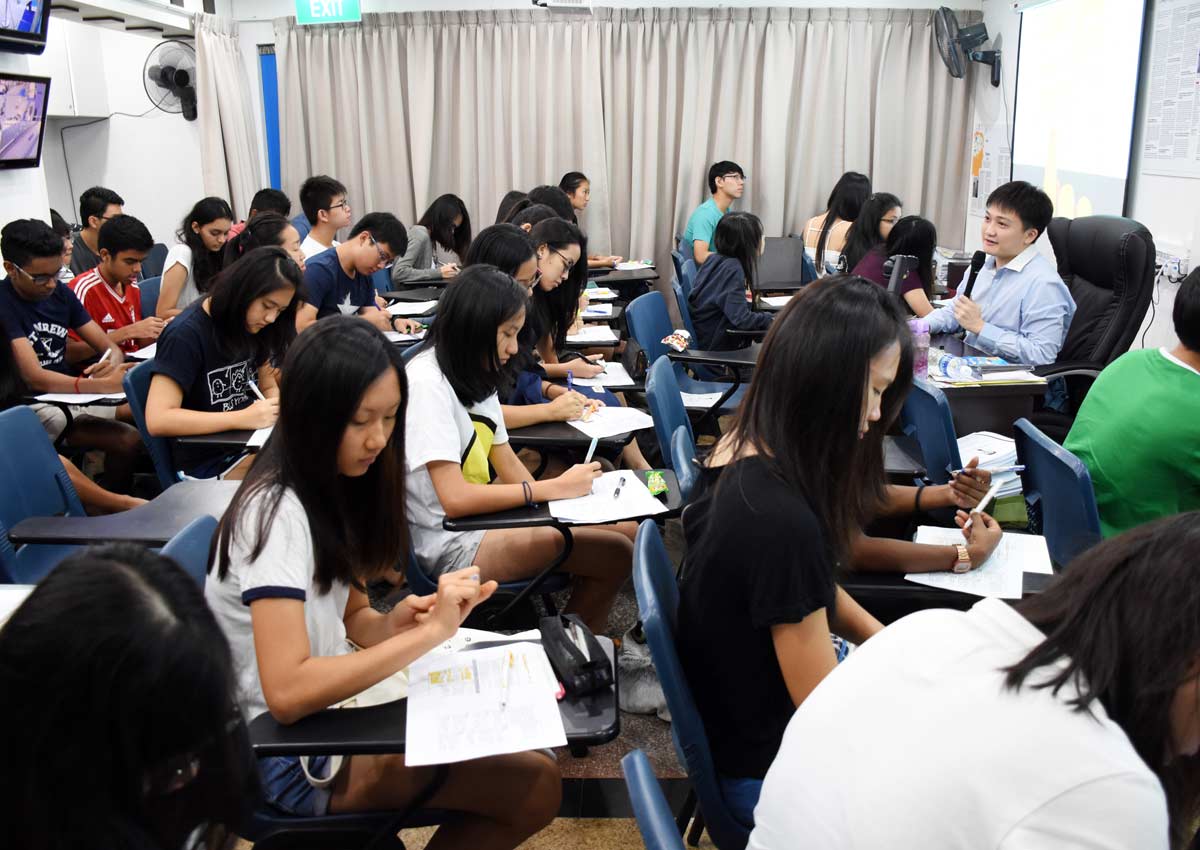
Persistent parents call him daily to ask for a place for their child in his A-level economics tuition class. Some try to reserve a spot three years ahead. A few well-heeled ones even offer two years’ fees of $8,000 up front.
Meet economics tutor Anthony Fok, one of a small but growing group of “super tutors” with earnings of at least $1 million a year in fees.
There are at least 10 such private tutors, according to educators in the growing tuition industry. Private tutors like Mr Fok have to register their centres for GST when their annual revenue crosses the $1 million mark.
They are part of a tuition industry worth more than a billion dollars annually, nearly double the $650 million households here spent on tuition in 2004.
“Students look for me because they want their A grade… even those who are already doing well in school,” said 32-year-old Mr Fok, who has about 200 students and 40 names on his waiting list. Some even come from Johor Baru.
According to him, two-thirds of his students have gone on to ace the A-level paper.
His fees range from $380 to $420 for four 1 ½ hour lessons a month. He takes home about $500,000 a year after deducting the rent of his two centres in Bukit Timah and Tampines and other expenses.
Already, the popular timeslots for his classes are fully booked. Each class comprises 30 to 40 students. However, Mr Fok does not intend to open more classes as “there is no way I can cope as a one-man show”.
Mr Fok, who used to teach at a secondary school for about four years, said his achievement is the result of dedication and hard work.
For instance, he gives his mobile number to his students so they can message him whenever they need help. He also assists his students in “spotting” topics likely to appear in exams by analysing past papers, and provides them with concise notes, complete with key pointers.
“The tuition industry is growing rapidly with many tutors entering the industry, lured by the attractive income,” he said. “Top tutors put in a lot of hard work to help students. It’s not an easy industry to be in, fuelled by demanding parents and many competitive tutors.”
Despite noting that good academic grades do not define success, Mr Fok said: “Tuition isn’t a bad thing. I believe that parents’ concerns with grades stem from the desire to give their children the best help they possibly can.”
Second-year Anglo Chinese Junior College student Janine Ang has attended Mr Fok’s classes since last year. She pays $420 per four lessons. From borderline passes, the tutoring has helped Janine, 18 – who will sit her A levels this year – to improve to As in her economics tests and exams.
“It’s worth the fees in exchange for the results,” she said.
Physics tutor Phang Yu Hon, a 49-year-old who collected $1.1 million in fees last year, said parents are willing to fork out for tutors known to deliver results. He has been hitting the million-dollar mark since 2011.
His fees for his O- and A-level classes range from $400 to as much as $700 for four two-hour lessons. Each of his classes averages about 25 students.
His students – he handles 200 a year – are mostly from the upper- middle income group, and include sons and daughters of business owners, medical professionals, senior civil servants and academics.
“Their parents are less concerned about cost and more focused on the tutor’s track record,” said the former research engineer, who has a first-class honours degree in electrical engineering.
Some of his students told The Straits Times that their results have seen marked improvement.
Former CHIJ St Nicholas Girls’ School student Ivana Ding, for instance, had been consistently doing poorly in physics before attending Mr Phang’s classes in March last year.
At the O levels last year, the 17-year-old, now a first-year biomedical sciences student at Ngee Ann Polytechnic, scored A2 for the subject with his help.
“Mr Phang makes the difficult concepts easier to digest through analogies as well as dances and songs he choreographed and composed. These all made physics not only fun but also easier to study,” she said.
But not every tutor makes it into the top league. Mr Phang believes such tutors possess a charisma that others do not.
In recent years, a crop of new tutors are slowly making a name for themselves in the business.
Former teacher Wynn Khoo, who taught physics and principles of accounts for the past five years, made the switch to full-time tutoring this January. Already, the 31-year-old, who charges $280 to $320 per four lessons, has around 100 students.
Top tutors also insist that top marks is not a guarantee, as students have to put in hard work too.
Maths tutor Gary Ang, 37, who draws a five-figure monthly salary, said: “Parents sometimes think tutors are magicians who can turn a failing student into an A student overnight. If the student is willing to work hard, then yes, there will be results.”
Another maths tutor, Ms Celine Loi, who is director of Joss Sticks Tuition Centre, said that students needed to take ownership of their studies, attend classes on time and work with the tutors.
The 40-year-old’s centre, which employs 20 tutors, runs about 55 classes a week, for about 400 students.
But education experts such as National University of Singapore lecturer Kelvin Seah believes that sending students to star tutors may be counterproductive.
Dr Seah said engaging the services of such star tutors may not guarantee better academic grades.
“When students are forced into tuition lessons, they could grow to dislike the subject instead of taking a greater interest in it,” he added.
calyang@sph.com.sg
This article was first published on May 23, 2016.
Get a copy of The Straits Times or go to straitstimes.com for more stories.
Image:
Publication Date:
Monday, May 23, 2016 – 14:00
Send to mobile app:
Source:
Story Type:
Others
Online alert helps autistic boy
Sengkang Neighbourhood Police Centre (NPC) is leading the way in reaching out to residents using social media.
Through memes and videos that the Sengkang team created, it managed to garner about 10,700 likes on its Facebook page – the highest among 35 NPCs islandwide.

Sengkang NPC’s Facebook page, which has about 10,700 likes, has improved communication with the police and the residents. Photo: Facebook screengrabs
The online outreach has enabled the NPC to reach out to people and resolve cases they otherwise would not have heard about.
One such case is that of a neighbourhood “terror” who was once loose on the streets of Sengkang.
The Sengkang NPC officers were first alerted by a private message on its Facebook page.
A concerned resident wrote that a teenage boy had been cycling recklessly on pavements and was going round the neighbourhood, harassing and staring at pedestrians as though challenging them to a fight.
It turned out the boy was autistic and his family was in financial need.
Officers from the NPC worked to help him and his family, hooking them up with agencies such the Ministry of Social and Family Development, the Institute of Mental Health and the Family Service Centre in Sengkang.
IMPROVED
Since the incident last year, the boy’s situation has improved and officers, who are still in touch with the family, no longer receive any complaints about him.
Inspector Kevin Lee, 42, is the deputy overall in-charge of Sengkang NPC’s Community Policing Unit (CPU), which monitors its social media and conducts activities such as roadshows and school assembly talks.
Commenting on the autistic boy’s case, he said: “While there was no ‘crime’ involved, we were afraid that things would get out of hand.
“So we immediately reached out to the community partners to confirm the case.
“We found out that a couple of other residents had faced similar situations before with this particular boy.”
Through its grassroots contacts, the team found the boy’s home address and it soon learnt that the neighbourhood “terror” was actually a 14-year-old boy with special needs.
CPU officer Peh Chi Siong, 26, said: “At first, his father wasn’t willing to listen to us when we told him that we had received feedback identifying his son as quite a character.
“He seemed shocked to hear the news and said that he had no time for us.”
The team did not give up and even approached the father, a security officer at his workplace.
The team’s continued and heartfelt attempts to reach out to the family paid off when the father started opening up.
Sgt Peh said: “He finally shared with us that his son had autism and that his condition was getting worse. The son would get violent and start throwing things around.”
Another CPU officer, Sgt Muhd Safuan Sahul Hameed, 30, said: “The family was going through some financial difficulties as well. When we heard their story, we knew they needed assistance.”
Through the team’s efforts, the family managed to receive financial aid and additional medical subsidies for the boy’s treatment as well as find employment for the boy’s mother, who was then looking for a job.
Six officers from the CPU, who were part of the case, were given the PS21 Star Service Team Award at the annual Excellence in Public Service Awards Ceremony last Wednesday.
CPU officer Rosminah Samsuri, 33, said: “We’re delighted to know that things have changed for the better for the boy’s family.
“In helping the community, we look for the long-term approach. We find out the root of the problem…”
Facebook posts help them nab criminals
Posting suspects’ images on the Sengkang Neighbourhood Police Centre’s (NPC) Facebook page has led to the arrests of several offenders.

Photo: Sengkang’s NPC/ Facebook
Some surrendered themselves while others were arrested after those who recognised them came forward to offer information.
The NPC’s commanding officer, Superintendent Chong Chung Meng, 39, attributed these successes to his team’s active presence on social media.
Out of 35 NPCs in Singapore, each with its own Facebook page, the Sengkang team gets the highest number of likes at around 10,700.
There are 23 officers in the NPC’s Community Policing Unit (CPU) and six of them are tasked to monitor the Facebook page throughout the day.
They also create items likes memes and videos to attract more eyeballs.
Supt Chong, who has led the NPC since June 2013, said that when the Facebook page was first set up in December 2012, it had only about 2,000 likes.
He attributed the five-fold increase to the entertaining but insightful material his CPU team creates, which often include pop-culture references.
Assistant Superintendent Iskandar Abdul Kadir, who is in charge of the CPU, said: “Our Facebook page is updated once every few days with different materials like videos, memes and advisories.”
INFORMATION
With the Facebook page, more people – mainly Sengkang residents – are coming forward to volunteer information, said Supt Chong.
He recalled how, in 2013, in a case of a man insulting a woman’s modesty, a concerned resident offered information to the NPC after the man’s photo was put up on Facebook.
Supt Chong said: “The suspect could have known that his picture was online, that’s why he decided to surrender two days later.”
The man was given a stern warning.
Another case that year involved a woman who illegally used someone else’s card to withdraw money from an ATM.
A closed-circuit television (CCTV) footage showed she was with another woman when she committed the crime.
They surrendered soon afterwards when one of them notified the other after spotting their photos on the NPC’s Facebook page.
Supt Chong added: “In 2014, there was a shop theft case where the suspect had stolen some groceries.
“We uploaded his photo, taken from a CCTV footage, onto our Facebook page.
“One of his neighbours reported to us after seeing it and we arrested the thief two days later.”
Online outreach ‘richly rewarding’
Media consumption patterns have shifted online and the Singapore Police Force (SPF) has adapted, said a spokesman.
The SPF has been using social media to engage the public since 2009.

With the Facebook page, more people – mainly Sengkang residents – are coming forward to volunteer information. Photo: Sengkang’s NPC/ Facebook
All 35 Neighbourhood Police Centres (NPCs) in Singapore have their own Facebook pages.
The spokesman added that the SPF’s outreach to the public via social media has been “richly rewarding”.
Social media has also allowed the police to reach out to members of public more consistently, particularly the younger population.
Top three NPC Facebook pages with the most number of likes
l Sengkang NPC: more than 10,700
l Punggol NPC: more than 7,980
l Ang Mo Kio NPC: more than 4,710

This article was first published on May 23, 2016.
Get The New Paper for more stories.
Image:

Publication Date:
Tuesday, May 24, 2016 – 06:30
Keywords:
Send to mobile app:
Source:
Story Type:
Others
Court denies buyer of $270k resale flat legal ownership
A man has been put in a quandary after his purchase of a resale flat for $270,000 from a dementia-ridden owner was not legally recognised.
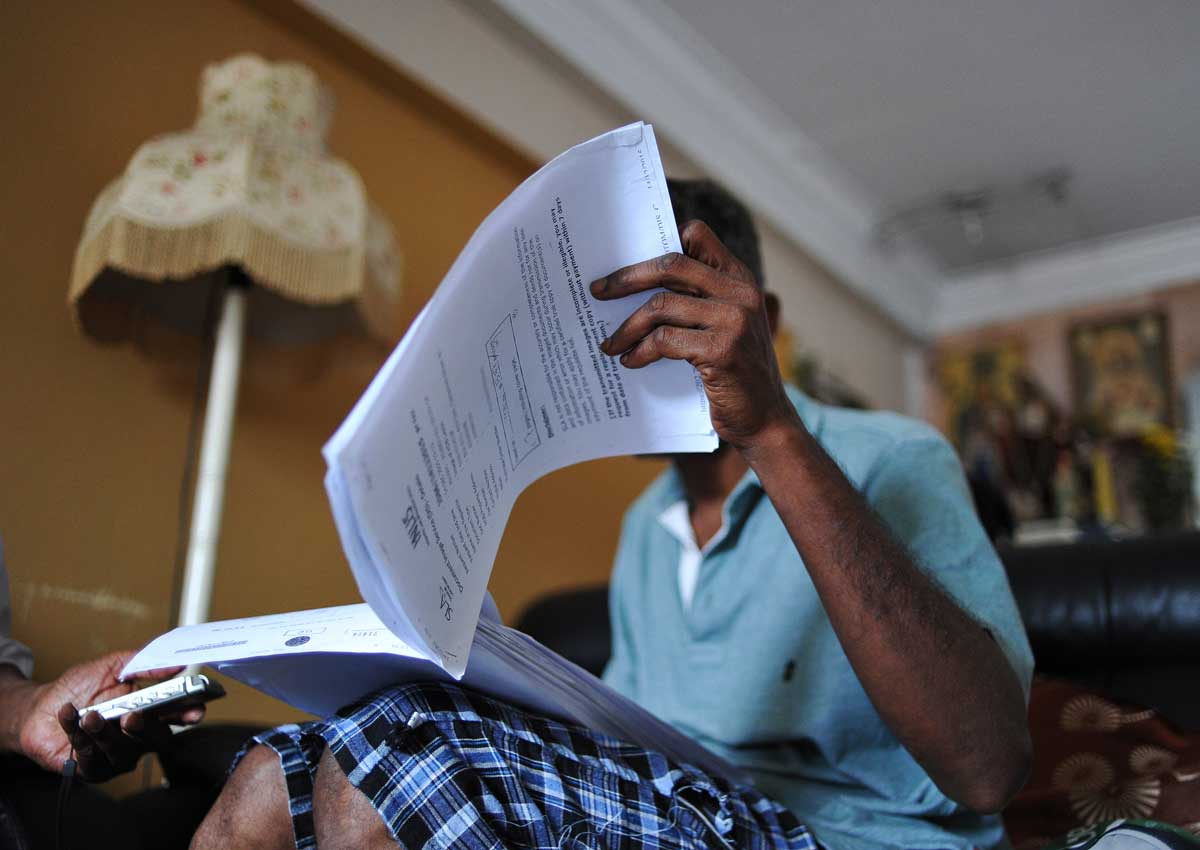
Mr Peter Nathan, 55, who failed to obtain legal ownership of the Tampines flat after the High Court turned down his application last month, told The Straits Times he had been paying the flat’s annual property tax since the sale in 2010. He has also been paying its monthly town council conservancy charges since 2012, he added.
In 2010, Mr Nathan, an oil surveyor, bought the flat from Mr Arthur De Silva Petiyaga, 75, whose late daughter Millicent had acted on his behalf. She had applied to the court to act on his behalf in 2010 but did not actually have the authority to sell the flat on her father’s behalf.
But Mr Nathan came to know of this only in 2014, after Ms De Silva died two years earlier and his relationship with her father soured. Mr Nathan’s father and Mr De Silva had been childhood friends.
Mr Nathan then applied to take possession of the flat and the Singapore Land Authority refused to register the transfer. The High Court also rejected his bid.
Judicial Commissioner Aedit Abdullah said in judgment grounds last month that the case had shown up problems that can arise when a person appointed to act for someone lacking mental capacity dies and is not automatically replaced.
Mr Nathan, who is now lodging at his sister’s Yishun flat, is appealing against the ruling.
A check with the Tampines Town Council showed that the council had billed the owner based on HDB-supplied records which had listed Mr Nathan as the owner of the three-room flat since 2010.
HDB told ST the transaction was completed by lawyers for the buyer and seller in September 2010.
“HDB had granted approval for the resale based on our assessment of the sellers’ and buyer’s eligibility, for instance, whether the sellers have fulfilled the Minimum Occupation Period and whether the buyer has met the requirements for purchase of the flat. As HDB did not act for both the sellers and buyer, we are unable to comment on their legal status,” said a spokesman.
Meanwhile, the family of Mr De Silva has made clear that he had not received any money from the sale of the flat in 2010.
In court papers filed by their lawyer Noor Mohamed Marican for the case heard by Justice Abdullah, Mr De Silva’s grandson Jordan Christopher said when his grandparents were divorced in the Syariah Court in 2008, it was decreed that their matrimonial flat in Tampines was to be sold on the open market.
The proceeds of the flat was to be used to settle the HDB loan and return the money used from the CPF account of his grandmother.
From the net proceeds after the above deductions, 60 per cent was to be given to his grandmother and 40 per cent to Mr De Silva.
Mr De Silva never received a cent of the proceeds after the purported sale, said his grandson in his testimony.
Since his daughter’s death, Mr De Silva has been living alone in the flat, and the flat was regarded by all parties as his property, he added.
He alleged that Mr Nathan’s application was done in bad faith to dispossess an elderly man without mental capacity of his own property. He added that family members are taking steps to apply for a court order to empower them to manage Mr De Silva’s affairs.
vijayan@sph.com.sg
chiaytr@sph.com.sg
This article was first published on May 23, 2016.
Get a copy of The Straits Times or go to straitstimes.com for more stories.
Image:
Publication Date:
Monday, May 23, 2016 – 17:00
Keywords:
Send to mobile app:
Source:
Story Type:
Others
Co-founder of Ku De Ta club goes to court in new twist
The former Ku De Ta club, which opened in 2010 at Marina Bay Sands to much fanfare, is at the centre of yet another legal dispute.
Mr Chris Au, a Singapore-based Hong Kong businessman who co-founded the club, since renamed Ce La Vi, has sued his former business partners for conspiring to steal his rightful share of the club.
On Jan 30, 2014, French luxury group LVMH Moet Hennessy Louis Vuitton reportedly paid $100 million for a 51 per cent stake in the swish club on the 57th floor of Marina Bay Sands’ SkyPark. The purchase was made through LVMH’s investment arm L Capital.
In court papers filed in the High Court last week, Mr Au said he should have received more than $33.7 million from the deal but was denied because of “a conspiracy… designed to deprive (him) of his shareholding and rights in Ku De Ta, a company that he founded and made successful”.
He named a staggering 10 defendants in his writ of summons, including four former business partners and L Capital.
The Singapore permanent resident said in court papers that he held 35.5 per cent of Kudeta BVI – which owned the Ku De Ta Singapore nightclub – and that there was an agreement to buy out his interest for $33.7 million using funds from L Capital’s acquisition.
But on Jan 29, 2014, a day before the acquisition, Mr Au said his former business partners got the Hong Kong court to freeze his assets without his knowledge.
The court order was served on him only a week later, said Mr Au, adding that he would not have proceeded with the acquisition had he known of the court order.
He said L Capital was aware of the court order to freeze his assets, but “intentionally and wilfully chose not (to) warn or inform” him.
As a result of the actions by his former business partners and L Capital, he said he “has not received a single cent that he is entitled to”.
The rift between Mr Au and the club’s new owners continued even after the club sale, the court papers showed. For example, he charged that he was wrongfully removed as a board director in July last year after he warned the board of mismanagement of the club. Examples included appointing a chief executive without relevant experience and failure to comply with “basic corporate governance requirements such as holding quarterly board meetings”.
He also accused his four business partners of unlawfully conspiring to break into his laptop and hacking into his e-mail account to steal personal and business information.
The lawsuit is the latest twist in a high-profile saga that started in 2014.
Barely after Ku De Ta was taken over by LVMH, shareholders began waging a legal battle in Hong Kong over the distribution of proceeds.
Shareholders Komal Patel – also known as Karl Patel – and Harilaos Apostolides claim in Hong Kong court papers that they each hold 24.17 per cent of Kudeta BVI. They also claim that Mr Au owns the same amount, a figure that Mr Au is challenging.
The Hong Kong trial is set for later this year. But even before the trial, Mr Au already had two run-ins with Justice Kevin Zervos.
In November last year, Mr Au asked that the judge recuse himself because of professional links with Mr Apostolides’ brother, but the judge declined.
In August 2014, the same judge said Mr Au had given false evidence in Singapore about his interest in Ku De Ta and it merited referral to the Attorney-General’s Chambers (AGC) in Singapore.
But when contacted last week, an AGC spokesman said: “There appears to be no record of a referral from the Hong Kong High Court.”
TIMELINE OF THE SAGA
SEPTEMBER 2010
Ku De Ta Singapore opens at the SkyPark on the 57th storey of Marina Bay Sands. The club, which is a play on the phrase “coup d’etat”, was named after a popular Bali beach club. Its $50 cover charge, including one drink, was the priciest in town.
DECEMBER 2010
The owners of the Bali Ku De Ta beach club sued the Singapore club for trademark violation, arguing that one of the partners did not have the right to license the name to the Singapore club.
NOVEMBER 2013
The High Court ruled that the Singapore club can keep its Ku De Ta name. The Bali club owners appealed.
JANUARY 2014
French luxury group LVMH Moet Hennessy Louis Vuitton reportedly paid $100 million for a 51 per cent stake in the Singapore club.
JANUARY 2014 TO NOVEMBER 2015
Multiple lawsuits in Hong Kong among the shareholders over the splitting of sales proceeds.
DECEMBER 2014
The Court of Appeal overturned the High Court decision and ruled that the Singapore licensor does not own the trademark. 2014 The club reportedly generated $43 million in revenues. MAY 2015 The Court of Appeal ruled that the local club cannot use the Ku De Ta name.
JUNE 2015
The club was renamed Ce La Vi.
MAY 2016
Mr Chris Au, co-founder of the club, sues his former business partners and the club’s majority owner L Capital in Singapore.
Who’s who in the lawsuit
PLAINTIFF
- Mr Chris Au, Hong Kong businessman who is a permanent resident in Singapore and co-founder of Ku De Ta
DEFENDANTS
- Mr Komal Patel, British national, one of the original shareholders of Ku De Ta
- Mr Jason Mark Cohen, Hong Kong resident, one of the original shareholders of Ku De Ta
- Mr Harilaos Apostolides, Australian national, a shareholder of Ku De Ta
- Mr Cheong Yew Kuan, Malaysia citizen, investor in Ku De Ta
- Rocky Cape International, a British Virgin Islands Registration company
- Essence Investments, a Marshall Islands Registration company
- L Capital KDT
- L Capital Asia
- Mr Shantanu Mukerji, managing director of L Capital Asia
- Mr Ravinder Singh Thakran, managing partner and chairman of L Capital Asia
tohyc@sph.com.sg
This article was first published on May 23, 2016.
Get a copy of The Straits Times or go to straitstimes.com for more stories.
Image:

Blurb:
HK businessman accuses former partners of stealing his share of $100m stake sold to LVMH. -ST
Publication Date:
Monday, May 23, 2016 – 14:00
Send to mobile app:
Source:
Story Type:
Others


