Home Blog Page 3851

Indonesian birds face extinction due to pet trade: study

JAKARTA – Thirteen species of Indonesian birds, including the country’s symbolic Javan Hawk-eagle, are at serious risk of extinction mainly due to the pet trade, a wildlife watchdog warned Wednesday.

The vast Indonesian archipelago is home to a dizzying array of birds and keeping them as pets has long been part of the national culture, with birdcages a common sight outside homes and shops across the country.

However increasing demand for some species as pets has led to dramatic population declines, wildlife trade monitoring network TRAFFIC warned in a new study.

“This is a multi-million-dollar industry, there’s a huge criminal element and many people are profiting illegally from this business,” Chris Shepherd, TRAFFIC’s director for Southeast Asia and a co-author of the study, told AFP.

Huge demand for songbirds in Indonesia has also put bird species in other countries such as Malaysia and Thailand in danger, Shepherd said.

The Javan Hawk-eagle is Indonesia’s national bird and the inspiration for the Garuda, the mythical winged creature that adorns the country’s coat of arms.

Other species at risk of extinction include the Silvery Woodpigeon, Yellow-crested Cockatoo, Scarlet-breasted Lorikeet, Javan Green Magpie, Black-winged Myna, Bali Myna, Straw-headed Bulbul, Javan White-eye, Rufous-fronted Laughingthrush, Sumatran Laughingthrush and Java Sparrow.

The Helmeted Hornbill is also at risk but unlike the others, is not kept as a pet. Thousands are being illegally killed and traded for their unique “casques” – a solid lump of fibrous protein that runs along the top of the bill and onto the skull.

It is used as a substitute for elephant ivory, to meet demand in China, according to TRAFFIC.

It is illegal to hunt birds in the wild in Indonesia and sell them as pets but critics say the law is often flouted, and major bird markets in cities still operate freely.

Shepherd said that government efforts to crack down on the illegal wildlife trade too often focused on endangered species such as orangutans, tigers and elephants, and did not do enough to protect birds.

The TRAFFIC report called for a range of solutions to tackle the problem, including better law enforcement and public awareness campaigns.

Image: 
Category: 
Publication Date: 
Wednesday, May 25, 2016 – 15:38
Keywords: 
Send to mobile app: 
Source: 


Hermes ID: 
2 317 601
Hermes ID String: 
VLINDOBIRD25
Hermes Author: 
GRONGLOH
Story Type: 
Others

Source link

Who decides what is 'embarrassing'?

Student Hazel Lim, 15, was stunned when she received WhatsApp messages from four of her friends last year, each containing photos of her nine-year-old self.

The photos showed her as a model wannabe, even posing with her hand on her head while flaunting the clothes she was wearing.

The pictures were so embarrassing that she declined to have them published for this article.

Her friends had gotten hold of the pictures by being Facebook friends with her mother, Madam May Liew, who has been posting photos of Hazel since the teenager was nine.

Hazel told The New Paper: “I was extremely embarrassed but laughed it off anyway. I obviously did not know exactly what Facebook was when I was nine.

“I asked my mother to delete the pictures, but she said that they were too cute to be deleted.”

For Madam Liew, 48, posting family pictures online is a way of documenting shared memories.

Madam Liew, who runs a stationery manufacturing company with her husband and also has a 21-year-old son, said: “Sometimes, Hazel would complain about the photos that were taken when she was younger, but I choose not to delete them for memories’ sake.

“It is also easier to store the photos on a single platform so I don’t have to worry about losing them when I change my mobile phone.”

Thankfully for Hazel, the surfacing of her old photos was a one-time occurrence as her “friends have gotten sick” of teasing her for it.

Today, Madam Liew, who has 63 friends on Facebook, continues to post pictures of Hazel, but mostly of two of them together on special occasions such as Mother’s Day.

‘RIDICULOUS’

But Mrs Lim could end up in jail for a year or be fined up to 45,000 euros (S$70,000) for posting pictures of her young daughter – if she was in France, that is.

French authorities recently warned parents against posting “embarrassing” photographs of their children online and “publicising intimate details of the private lives of others – including their children – without their consent”, reported The Telegraph.

Calling this law “ridiculous”, full-time Singapore blogger Wendy Cheng, also known as Xiaxue, told TNP: “If I dress my son up as a kitten during Halloween, is that considered embarrassing? Who decides what is considered embarrassing?”

With more than 614,000 followers on Instagram, the 32-year-old, who is married to an American, frequently posts pictures of her three-year-old son Dashiel on her social media accounts.

Dashiel has also appeared in videos that Ms Cheng hosts for online television network clicknetwork.

Ms Cheng said: “This law will only be logical if the pictures are sexual. But I think for newborns and little boys, topless shots are still acceptable.

“Besides, nothing can be more traumatic for a child than his parent going to jail.”

French police said the warning was in response to the “danger of paedophiles targeting children after seeing family photographs online”.

Some French parents were also forced to remove naked pictures of babies or young children from their social networks, reported The Telegraph.

While parents TNP spoke to agreed that stalkers and paedophiles are a real concern in Singapore, they have not received any disturbing comments online.

But parents, especially those whose social media accounts have a wide reach, should be mindful of certain boundaries, said Singapore blogger Ang Chiew Ting, better known as Bong QiuQiu.

Ms Ang, 28, who has more than 294,000 followers on Instagram, created another account dedicated to pictures of her daughter Meredith even before she was born.

Meredith, now one, has more than 65,000 followers.

Ms Ang said: “I know of bloggers who do not censor their child’s private parts, but I think that there should be a line to it.

“I don’t post any half-naked pictures of Meredith. My posts also don’t have any location tags. I’m especially careful as Meredith is a girl and she is growing older.”

Another parent, Mr Alvin Low, 33, said the law seems like an “overreaction”.

The owner a creative enrichment company posts pictures of his two-year-old son Koby on his Instagram account, which has more than 1,200 followers.

Mr Low, who holds classes in primary and secondary schools: “(Doing so) is a way for me to connect with my students. Many of my students, including primary school kids, follow me on social media because of my son.

“I then use social media to try to motivate my students and share certain values.”

While Mr Low said that whatever is considered “embarrassing” can be subjective, he added that parents should ensure their posts do not cause any discomfort.

“I guess a picture is generally embarrassing when it makes its viewers go ‘Oh my gosh’ instead of ‘Aww’,” he said.

EXPERTS SAY…

Social media and international communications expert Lars Voedisch of PRecious Communications told TNP that compared with the past – when parents would show off photos of their children in their wallet – the Web seems like a natural platform today because of its convenience.

But he added that parents should protect their children’s modesty and privacy.

Mr Voedisch said: “We should be very wary of what we share online, and this applies not just to photos of children but also general private information.”

While there has not been any research on children being psychologically affected by parents posting photos of them online, the Internet presence can affect one’s childhood experiences, given this day and age, said Dr Adrian Wang, a consultant psychiatrist at Gleneagles Medical Centre.

He said: “What looks cute when a child is two years old may look different when the child grows up to be a teenager. If someone uncovers an unflattering photo and makes fun of the child when he is older, it may hurt his self-esteem.”


This article was first published on May 25, 2016.
Get The New Paper for more stories.

Image: 
Category: 
Publication Date: 
Wednesday, May 25, 2016 – 21:00
Send to mobile app: 
Source: 


Story Type: 
Others

Source link

Football: France to deploy 60,000 police for Euro 2016

PARIS – France said Wednesday it will deploy more than 60,000 police to provide security for Euro 2016 as it vowed to do “everything possible to avoid a terrorist attack” during the tournament that starts next month.

The comments from Interior Minister Bernard Cazeneuve came after the Stade de France in Paris, which will host the event’s opening match and final, descended into chaos Saturday before the national cup final after smoke bombs were set off inside the stadium, sparking panic among crowds that clustered at the stadium’s exits.

Cazeneuve told the sports daily l’Equipe that the match between Paris Saint-Germain and Marseille “did not serve as a test” for Euro 2016.

“It was not the same public, not the same organiser, nor the same security deployment,” he said. “However, what happened will be taken into account” ahead of the month-long football tournament, which kicks of June 10.

“Our objective is that the Euro is a big festive gathering, but we owe the French the truth. Zero percent precaution means 100 percent risk, but 100 percent precaution does not mean a zero percent risk,” he said.

“We are doing everything to avoid a terrorist attack, and we are preparing to respond. More than 60,000 police will be on the ground.” The Stade de France was targeted by suicide bombers during the attacks by the Islamic State group on the French capital in November. The assailants tried unsuccessfully to get inside the security perimeter.

Cazeneuve said security inside the stadium is the responsibility of UEFA, while safety at the “fan zones” – which will accommodate seven million people in 10 host cities across the country – is the mandate of private security agents.

“Fan zones are secure spaces, I took the decision to impose security pat-downs at entrances, to use metal detectors and to ban bags inside. If there were no fan zones, fans would regroup in an ad-hoc setting and the risk (of an attack) would be greater,” he said.

Despite the beefed-up measures, he said there was no particular threat against the football tournament.

“At this time we do not have a specific threat to a specific team or a specific player, a specific match, or a specific fan zone,” he said.

He added that protests would not be banned but did not rule out possible disorder as the country is gripped by a major labour strike.

“It remains an open possibility… that security cannot be guaranteed by law and order forces.”

Image: 
Category: 
Publication Date: 
Wednesday, May 25, 2016 – 15:26
Keywords: 
Send to mobile app: 
Source: 


Hermes ID: 
2 317 565
Hermes ID String: 
VLEURO25
Hermes Author: 
GRONGLOH
Story Type: 
Others

Source link

Daughter of missing Hong Kong bookseller calls for US help

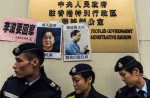
Hong Kong – The daughter of one of five Hong Kong booksellers who went missing late last year has called on US authorities to help end her father’s “unofficial and illegal” detention in China.

Four booksellers working for a Hong Kong publishing house which specialised in gossipy works about Chinese leaders went missing from various locations in October, with another disappearing at the end of December.

They all reappeared eventually in mainland China.

The disappearances fuelled growing unease in Hong Kong over the erosion of freedoms in the semi-autonomous city, which was handed back to China from Britain in 1997.

“It has now been eight months since my father and his colleagues were taken into custody. I still haven’t been told where he is, how he’s been treated, or what his legal status is,” Angela Gui said at a US congressional hearing Tuesday in Washington DC.

Her father Gui Minhai, a Swedish national and co-owner of the Mighty Current publishing company, failed to return from a holiday in Thailand in October.

His “unofficial and illegal” detention “is especially shocking in light of the fact that my father held Swedish and only Swedish citizenship”, she told the Congressional-Executive Commission on China.

Three other booksellers disappeared on the mainland and one went missing from Hong Kong itself.

Gui mysteriously re-emerged on state broadcaster CCTV in January, and said he had returned to China to “take legal responsibilities” for killing a college student in a car accident 11 years earlier.

In another televised confession in February, he said he tried to smuggle illegal books into China.

Angela Gui said she wanted “the US to take every opportunity to ask China for information on my father’s status as well as urge that he be freed immediately”.

Swedish authorities have said they were “quite concerned” about the incident and have called for more openness from Chinese authorities.

Three other booksellers – Cheung Chi-ping, Lui Por and Lam Wing-kee – have blamed the company’s illegal book trade on Gui.

All four are under criminal investigation on the mainland.

The fifth bookseller, Lee Bo, has said he travelled to China to assist with the investigation and returned to Hong Kong in March.

The disappearance of Lee Bo, who went missing from Hong Kong, raised fears that Chinese security authorities were operating in Hong Kong in violation of the city’s laws.

Britain and other nations have spoken out about Lee’s case. Britain said it believed he was “involuntarily removed to the mainland” in what it called a “serious breach” of the handover agreement.

The handover deal allows Hong Kong to keep its special rights and freedoms for 50 years, but there are fears that such freedoms are being eroded.

Image: 
Category: 
Publication Date: 
Wednesday, May 25, 2016 – 14:39
Send to mobile app: 
Source: 


Hermes ID: 
2 317 373
Hermes ID String: 
AS0525-BOOKSELLER
Hermes Author: 
SSANDREA
Story Type: 
Others

Source link

Cyclist who was hit by a truck last year: Why does this keep happening?

He shuddered when he read about a cyclist who died after she was hit by a cement truck on Monday.

“The hair on my arms stood,” Mr John Liang, 39, told The New Paper.

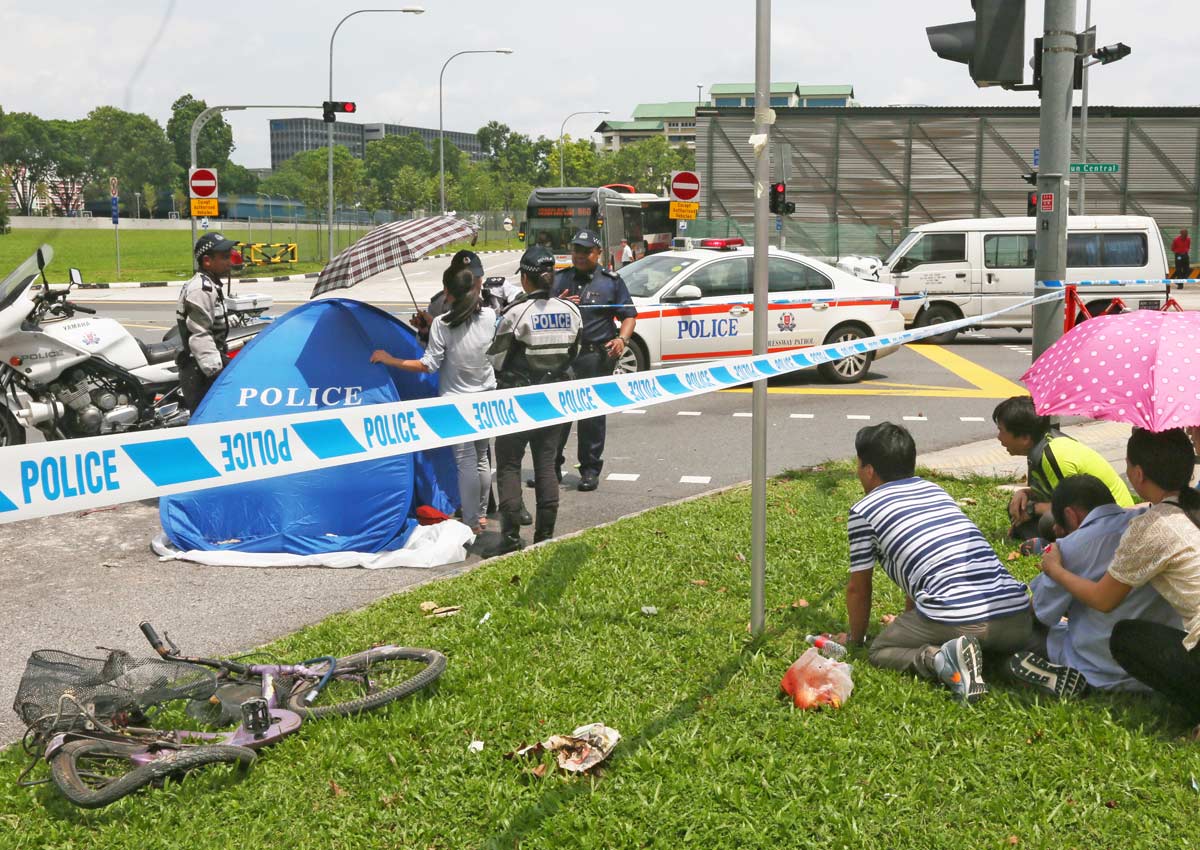
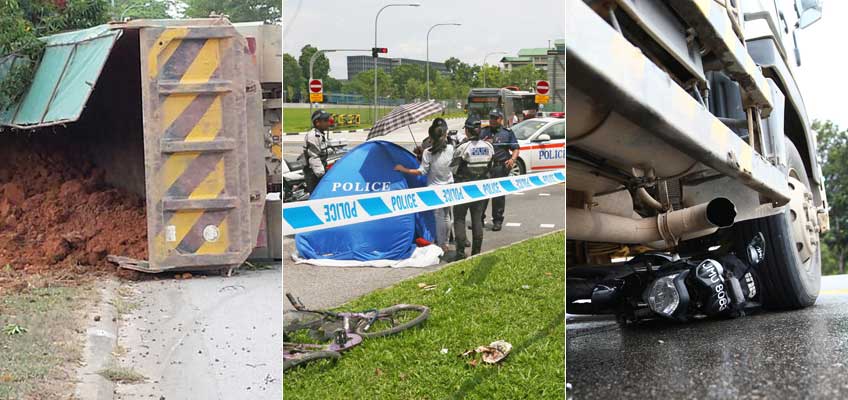
Madam Lin Shui Yu, 59, was hit while cycling on a pedestrian crossing in Yishun Central. She was cycling with two of her friends.

Why does this keep happening, wondered Mr Liang.

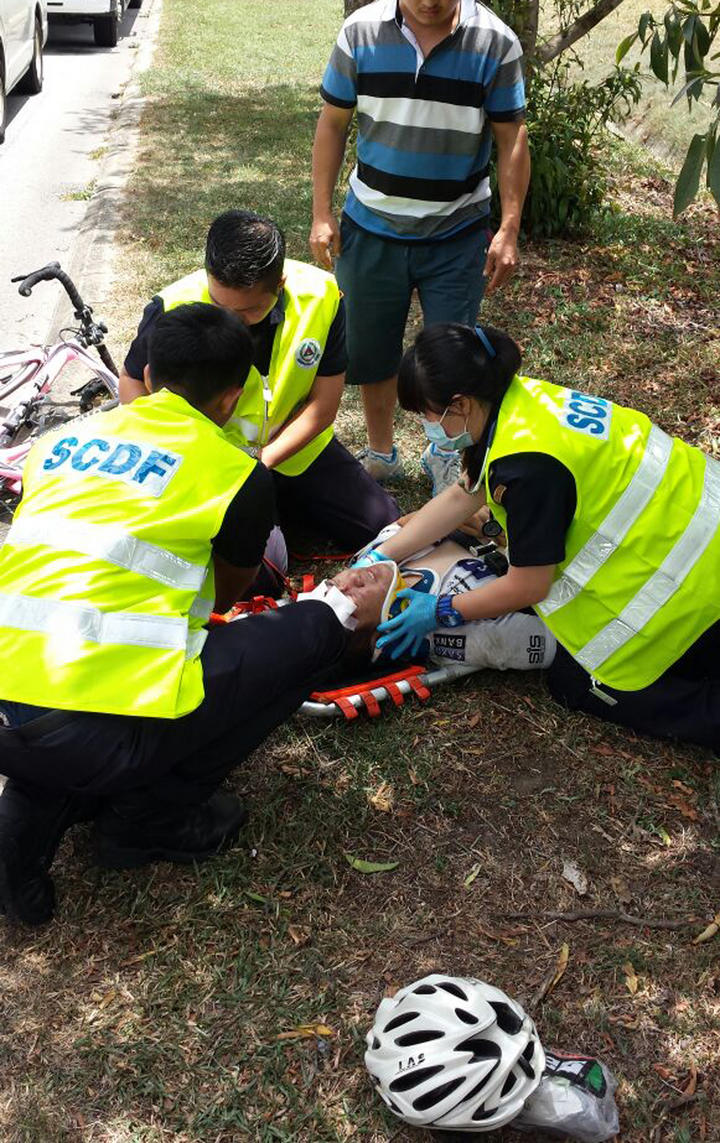
In March last year, he was cycling along Changi Coastal Road when a tipper truck hit him from behind.

Mr Liang was flung “several metres” and landed on the grass verge, head first.

“Thank God, I had my helmet tightly strapped to my head. Yet it came off and the inside split in two, like a watermelon,” said the cycling enthusiast.

“I suffered 10 broken ribs and a broken collarbone. There was also a blood clot in my brain.

“Can you imagine what would have happened if I wasn’t wearing a helmet?”

Mr Liang lost consciousness “for about 30 seconds after the landing” and when he came to, the first thing he saw was the tipper truck lying on its side.

He said: “The condition on the road that day was perfect – the sun was shining, the roads were dry and traffic was not heavy.

“There was no possibility of bad vision or the vehicle skidding. Then this happened.

“Witnesses who ran over to help me told me that after it hit me, the truck swerved and hit two trees before landing on its side.”
Mr Liang believes that the truck driver was a foreign national who had been on the job for only a month.

This could not be verified.

“The irony was he managed to escape unscathed,” Mr Liang said.

Despite being in excruciating pain, Mr Liang still had his wits about him.

“I was able to give my wife’s contact number to the passers-by and ask them to send photos of the accident scene to her,” he recalled.

SURGERY

Mr Liang was taken to Changi General Hospital and warded for three days.

“I underwent surgery to have tubes inserted into me to drain the blood, just in case the broken ribs stabbed and punctured my lungs,” he said.

“But I didn’t go through any operation to repair my ribs or collarbone. They healed on their own. I was also given morphine to manage the pain.”

Mr Liang was on medical leave for two months after he was discharged from the hospital and spent the next nine months trying to recover.

He was given painkillers.

“I couldn’t sleep well. I would be jolted awake by the pain if I were to turn in my sleep,” he said.

“I am still recovering. Every six months, I would have to return to the hospital for my check-up to make sure my collarbone is healing well.

“It hasn’t fully healed. I was told there is still 5mm more to grow before it becomes whole again.”

The clot in his brain has slowly dissipated.

Mr Liang has yet to get back in the saddle.

“It has been a year and I still feel the apprehension,” he said.

“The lack of exercise has piled on the weight. I need to get fit again. I need to conquer my fear and get back to riding soon.

“I hope by telling my story, I’ll be able to persuade the authorities to look into the industry which allows foreigners to drive big vehicles before they are familiar with our roads.

“They also have to look into the drivers’ long hours and their driving speed.”

Mr Liang does not know what became of the driver who hit him.

“Something needs to be done before more people are killed on the roads unnecessarily,” he added.

IT’S ALL ABOUT THE MONEY

The figures are grim.

The number of accidents involving heavy vehicles causing injury or death has been rising.

In 2013, there were 816 such accidents. It was 839 in 2014 and 877 last year.

Why?

Heavy vehicle drivers point the finger squarely at the way they are paid.

They declined to be identified for fear of losing their jobs.

“We make about $18 to $20 a trip, $12 to $13 if the trips are shorter,” one said.

They also blame foreign drivers, whom they say try to make as many trips as possible to maximise their short stay here.

Most of the drivers are foreign workers from India and China, he claimed.

“So to them, the amount of money matters because of the currency exchange. That’s why they piah (Hokkien for rush),” said the local driver of five years.

Eight months after the horrific accident in 2013 where a concrete truck killed two brothers aged 13 and seven, the Workplace Safety and Health Council proposed that commercial drivers be given a fixed salary to help reduce deaths on the road.

There has been no news since the proposal.
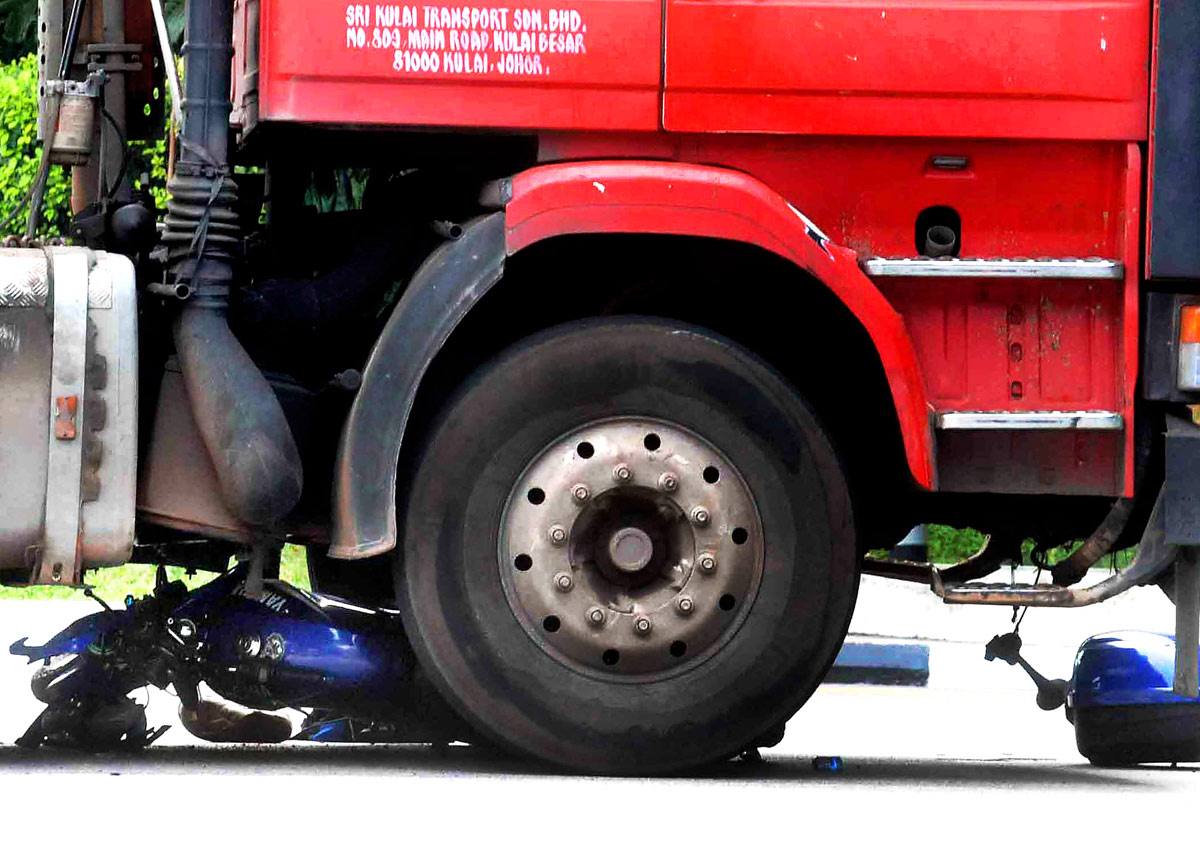
The number of accidents involving heavy vehicles causing injury or death has been rising. Photo: ShinMin

Bok Seng Logistics group chief executive officer Dave Ng said the pay-per-trip system is merely an incentive for drivers to complete the jobs assigned.

They are also paid a basic salary. He declined to be specific or give a range.

To ensure his company’s 90 heavy vehicle drivers are mindful of road safety for themselves and others, he installed a hi-tech road safety device in his fleet.

Called Mobileye, it is a driver-warning system that can sense road markings, pedestrians and other road users, alerting the driver if there is a potentially dangerous situation.

It also keeps a log of the mistakes made, which can be accessed by the company and shared with the authorities.

Is there a need for tougher laws?

In Singapore, drivers who kill others in a road accident can be charged with causing death by a negligent act. That carries a suspension and up to two years’ jail with the possibility of a fine.

RECKLESS

In the United States, causing death due to illegal driving of an automobile, including gross negligence, drink driving, reckless driving or speeding, is classified as vehicular manslaughter or vehicular homicide. The penalties range from three to 15 years’ jail and between five and 20 years for habitual violators.

After the Tampines accident in 2013, Member of Parliament for Tampines GRC Baey Yam Keng campaigned for heavy vehicles to be kept away from schools and residential areas.

He has had some success. (See report below.)

Mr Baey feels the law as it stands now is sufficient. He said the law already makes a distinction if the driver is negligent or reckless and provides for punishment according to the crime.

“Most importantly, when you get behind the wheel, top of mind must be the safety of those in your vehicle and of other road users.

Always pre-empt and anticipate,” he said.

The cement truck driver in the Tampines accident pleaded guilty to causing the death of the brothers. He was jailed two weeks in 2014 and banned from driving for five years.

MP’s fight to slow trucks down

On Jan 28, 2013, a cement truck killed two brothers who were riding a bicycle at a pedestrian crossing in Tampines.

Tampines MP Baey Yam Keng then called for heavy vehicles to be kept out of residential areas.
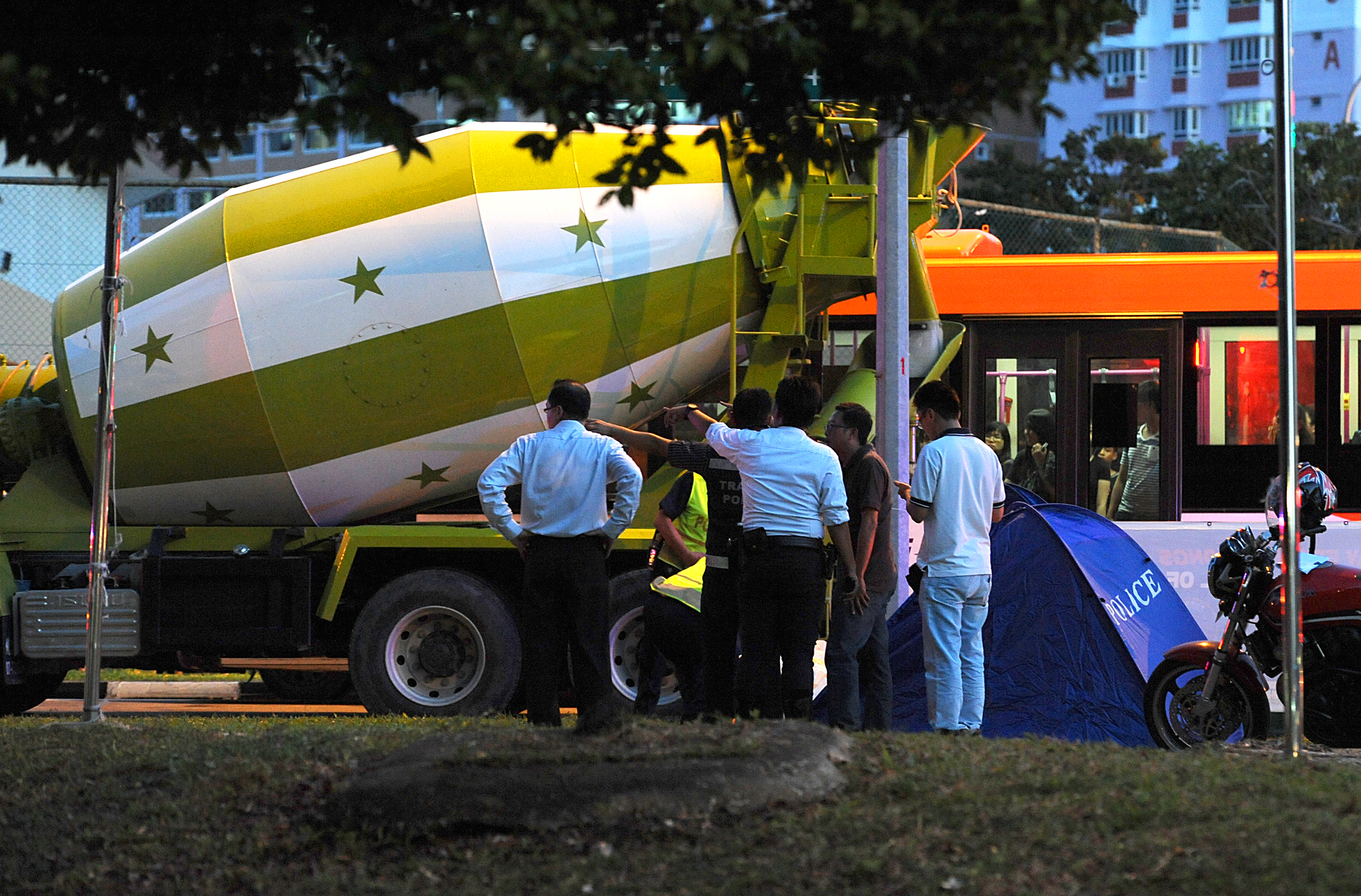
The driver of this cement truck hit two brothers, aged 13 and seven, who were crossing a traffic light junction in January 2013. Photo: The New Paper

He wanted the Housing Board and the Land Transport Authority (LTA) to find a safer route that heavy vehicles could take in his constituency, away from schools or pedestrian crossings. But that proved impractical as construction sites are often within residential areas.

Mr Baey, who is also Parliamentary Secretary, Ministry of Culture, Community and Youth, pressed for changes.

SLOW DOWN

“I’ve seen in Tampines narrower streets with wider dividers, to force drivers to slow down,” said Mr Baey.

“Roads that were once straight are now curvy. This is another tactic to slow drivers down in residential areas.

“I feel that such physical conditions make people behave differently on the roads. LTA is trying.”

These changes are part of what LTA terms Silver Zones to improve road safety for elderly pedestrians, a spokesman said.

LTA has completed seven Silver Zones (Bedok, Bukit Merah View, Jurong West Street 52, Lengkok Bahru, Tampines, Woodlands and Yishun). Eight more will be completed by next year.

LTA intends to implement 35 Silver Zones in residential estates by 2020.

Some moves by police and LTA

A police spokesman said drivers of heavy vehicles are put through training for further driving skills at the driving schools.

The authorities also conducted road safety sessions. As recent as April, the traffic police, together with the Singapore Road Safety Council, held a Road Sense seminar and dialogue session with them, to discuss how best road performance can be achieved, the spokesman said.

In March 2015, the mirrors for blind spots were implemented.

A spokesman for the Land Transport Authority said the mirrors of more than nine in 10 of 18,600 existing heavy goods vehicles, with maximum laden weight exceeding 12 tonnes, comply with European or Japanese mirror standards.

The spokesman added: “These vehicles are checked to ensure that blind-spot mirror requirements are met during mandatory periodic vehicle inspections from October 2015.

“Non-compliant vehicles will not be able to pass the inspections and are required to rectify the issue before proceeding for a re-inspection.”


This article was first published on May 25, 2016.
Get The New Paper for more stories.

Image: 
Category: 
Publication Date: 
Wednesday, May 25, 2016 – 21:00
Send to mobile app: 
Source: 


Rotator Image: 
Story Type: 
Others

Source link

Ex-BSI banker accused in 1MDB probe made implicit threats to Yak: Prosecutors

Image: 
Publication Date: 
Wednesday, May 25, 2016 – 14:01
Keywords: 
Send to mobile app: 
Source: 


Rotator Image: 
Story Type: 
Others

Source link

Road Safety Month returns with focus on safe cycling

This year’s Road Safety Month will see the launch of the “Stop, Look, Wave” Children Road Safety Programme – jointly organised by the Singapore Road Safety Council (SRSC) and Volvo Trucks – and the Safe Cycling Programme pilot by the Land Transport Authority (LTA).

Source link

NTUC Health's first nursing home uses technology to intensify rehabilitation

At the home’s official launch on Wednesday (May 25), NTUC Health said that the ultimate aim is for residents to regain independence and return to their families.

Source link

Gong Cha S$1 Classic Milk Tea with Pearl Jelly (worth S$3.00) for UOB Cardmembers at 14 Outlets…

DON’T MISS: $1 Classic Milk Tea with Pearl Jelly at 14 selected Gong Cha outlets when you pay with your mobile (25 – 29 May for UOB cardmembers)

Gong Cha S$1 Classic Milk Tea with Pearl Jelly (worth S$3.00) for UOB Cardmembers at 14 Outlets…

Pay only S$1 for a Classic Milk Tea with Pearl Jelly (worth S$3.00) from 25 to 29 May 2016 at 14 selected Gong Cha outlets when you pay with UOB Mighty App…

Source

Students show off bald heads for Hair for Hope 2016

SINGAPORE – Students from Edgefield Primary School took part in this year’s Hair for Hope campaign by shaving their heads on Wednesday (May 25). They will be joined by students from Montfort Junior School on Thursday.
The main two-day Hair for Hope 2016 event…

Source link