Among other changes, the central bank will be simplifying checks on investors and reducing financial requirements for platform operators, in an effort to improve companies’ access to securities-based crowdfunding while enhancing investor safeguards.
Source link
MAS simplifies regulations for securities-based crowdfunding platforms
Free Pap smear tests available at 170 clinics island-wide until Jul 31
As part of an awareness drive by the Singapore Cancer Society, Singapore women aged between 25 and 69 who have been sexually active at some point and have not had a Pap smear in the last three years can be screened at no charge at participating clinics.
Source link
Internet providers urged to tackle live-streaming of child sex in the Philippines

LONDON – Poor families in the Philippines are pushing their children into performing live sex online for paedophiles around the globe in what one senior Unicef official called a form of “child slavery”.
“There’s no limits to how cruel and gross this business is – and it’s a billion, billion-dollar business,” said Lotta Sylwander, head of the UN children’s agency Unicef in the Philippines.
She called for internet providers to “get on board” in tackling the crime and said money transfer centres should do far more to identify abusers by tracking suspicious payment patterns.
Unicef says the Philippines is the number one global source of child pornography and the “epicentre of the live-stream sexual abuse trade”.
Sylwander described how children as young as five or six are forced to perform several times a day in front of a webcam, for an hour at a time, as buyers in different time zones come online.
“It’s facilitated by mothers and fathers or close relatives. It may even happen in their home,” she added. “It’s definitely child slavery because the child has no choice.”
The paedophiles transfer money and then give instructions of what they want to see. In many cases the child is abused by someone outside the family but there have been cases of parents abusing their own children or children abusing each other.
Sylwander said the Philippines received 7,000 reports of cybercrime a month, half of which related to child sex abuse.
“Our biggest hurdle is not the government, not the police; it’s getting the internet providers to come along and say we will help you track (and) stop this,” she told the Thomson Reuters Foundation in an interview in London.
“My biggest concern is why don’t the Internet providers do more – how can the dark web continue to do what it does?”
FAMILY ABUSE
Sylwander said the live-streaming of child sex had boomed in the Philippines because of the high level of English, good Internet access and well-established money transfer systems that Filipinos working overseas use to send earnings home.
Poverty is a driver with many parents expecting their children to contribute financially. One group of young children rescued in Manila said they were paid 150 pesos (S$4.40) to take part in shows.
But Sylwander cited other darker forces at work. Researchers in the Philippines who are carrying out a major survey on violence against children, to be published later this year, have found shockingly high levels of sexual abuse within families, she said.
There is also a legacy left over from the huge prostitution industry which grew up around the American military bases until they closed in the 1990s.
Sylwander said this had led to a tolerance of prostitution and when the Americans departed the industry had to find other ways of operating.
Unicef, which works with centres that have rescued children, says they were often left severely disturbed.
Sylwander described how one very young boy living in a safe house started undressing and making sexual movements when he saw a staff member pick up a mobile phone because the boy automatically thought he wanted to film him.
“Their minds have been so traumatised and so destroyed and so focused on anything sexual that they can’t play or communicate like kids any more. It’s a very difficult rescue process,” Sylwander added.
Despite the rising number of cases coming to light there have been very few convictions.
One problem is that the age of sexual consent in the Philippines is 12, another is the mass of contradictions between laws. There is also no law yet around online crimes, Sylwander said.
Unicef is calling for the age of consent to be raised to 16 and for other legislation to be made watertight.
Sylwander said Unicef was working closely with police from Britain, Australia and the Netherlands to tackle the crime.
It is also hoping to develop training programmes for lawyers, prosecutors, police and judges to help bring abusers to justice.
Image:

Publication Date:
Wednesday, June 8, 2016 – 12:15
Keywords:
Send to mobile app:
Source:
Story Type:
Others
Katong mall may soon go on sale en bloc
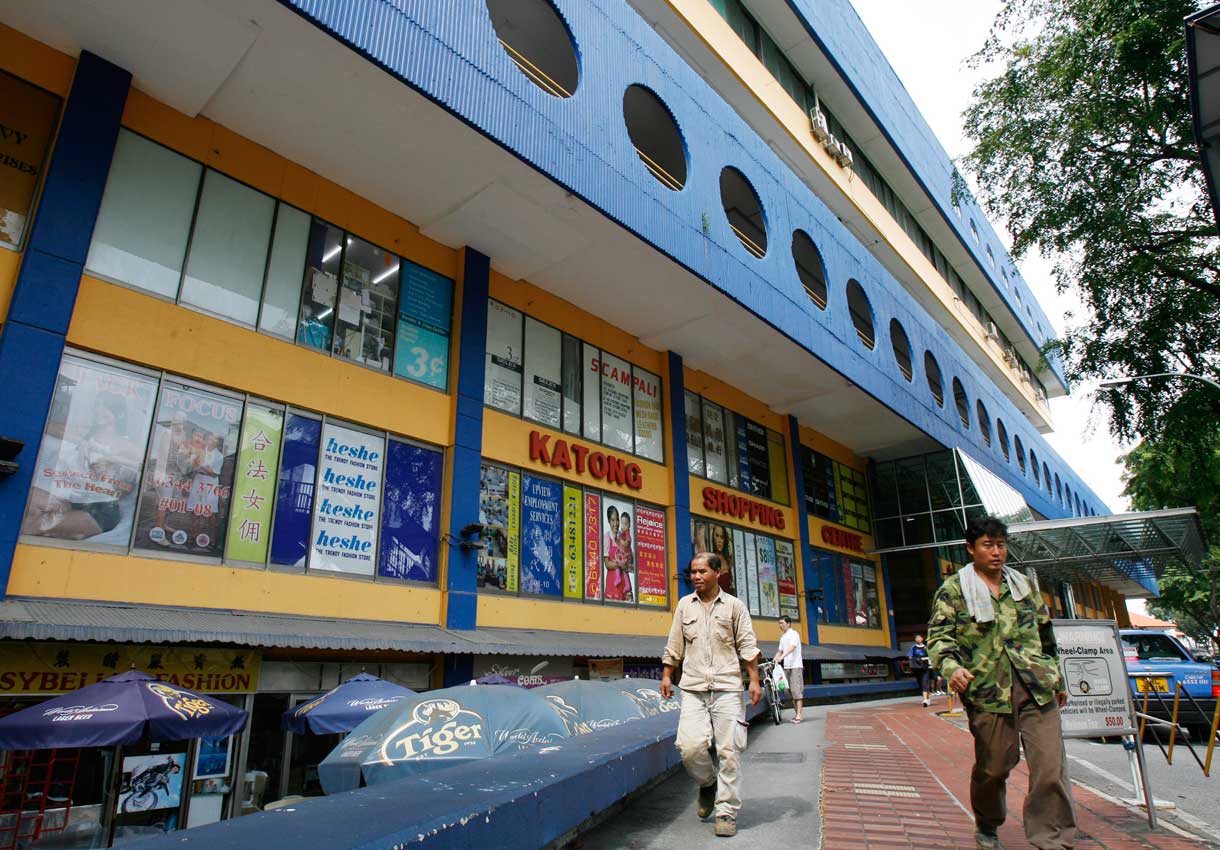
The landmark Katong Shopping Centre could soon be making a third attempt at a collective sale, this time with an asking price of about $630 million. More than 80 per cent of the owners by share value and total area of the 425-unit mall agreed to the proposed sale.
City Developments (CDL) owns 60 units and 323 carpark spaces at the mall, which is one of the oldest in Singapore.
The complex with a striking blue exterior, which cost a CDL subsidiary $20 million to build, was the most modern and largest mall in the east when it opened in 1973. Today, it mainly caters to maid agencies, printing shops and textile and clothes outlets, with offices on the upper floors. The 90,000 sq ft site with a plot ratio of 3.0 is zoned for commercial and residential use.
However, Cushman & Wakefield, which is handling the sale, has applied for outline planning permission for full commercial use, which would be in keeping with its current use. It is also proposing additional gross floor area for medical suites.
Many units at the freehold mall are leased out. Some tenants told The Straits Times yesterday that a potential sale would not affect them as they would just move, but others lamented the hassle.
“It’s not so easy to find an affordable place,” said aquarium shop owner Chan Kheng Siang.
Mr Chan, who has been a tenant for 31/2 years, pays $1,000 a month for a basement space of just over 200 sq ft.
Mr Daniel Lee, who pays about $4,000 a month for 360 sq ft on the first floor where he runs a watch shop, shared similar sentiments.
“Rents at new shopping centres are pretty high. But this is an old building and it needs upgrading. (A sale en bloc) will eventually have to happen,” he said.
The owner of a tailoring business on the basement level said he had mixed feelings about a sale. “I had been hoping to leave it to my child, but am also happy to completely retire from the business,” said Mr Sam Ho, 83.
Mr Ho bought his 230 sq ft unit for about $43,500 when the building was first built. He now stands to get about $900,000.
Experts noted that a sale could be challenging, assuming a land price of over $2,000 per sq ft per plot ratio. “The market is very price-sensitive… The best scheme for the site would be retail with perhaps offices as well,” said Chestertons managing director Donald Han.
The challenge would be the big-ticket nature of over $500 million, although there could be foreign interest based on recent transactions, including the Shunfu Ville and Cuscaden Road sites, he added.
Potential interest could also depend on what sites are made available via the Government Land Sales programme for the second half of the year. These are expected to be revealed later this week.
Still, “the days of buying sites to develop, strata title and sell at lofty prices are over”, said Mr Han. Commercial strata sales have slumped with the imposition of the Total Debt Servicing Ratio. “The best approach would be to build, operate and keep on a longer-term basis.”
A retiree and Katong resident who wanted to be known as Madam Gan said a collective sale is a good idea. She used to take her children to the mall and now takes her grandchildren there at least once a week for enrichment classes.
“I’ve shopped here from the time it was built. There were very few malls in the area and the clothes were very fashionable. A redevelopment would give this place a new lease of life.”
Separately, Jalan Besar Plaza was yesterday launched for collective sale with a minimum asking price of $380 million.

This article was first published on Jun 08, 2016.
Get a copy of The Straits Times or go to straitstimes.com for more stories.
Image:
Publication Date:
Wednesday, June 8, 2016 – 14:00
Keywords:
External URL:
Send to mobile app:
Source:
Story Type:
Others
Surgeon accused of baiting rare birds to get good photo
An orthopaedic surgeon was yesterday charged with littering and feeding endangered birds with live fish injected with air.
Lee Soon Tai, 62, who runs a clinic at the Mount Elizabeth Medical Centre, allegedly committed both acts on two occasions last year in Bukit Batok Town Park.
Lee, who faces a total of four charges, is accused of feeding an endangered grey-headed fish eagle with live fish injected with air, together with two other people – Sathiananthen Rasalingam and Tran Thuong Chung Linh – some time between 2pm and 5pm on July 19 last year.
The trio are also accused of littering by throwing three dying fish into a pond at the park, which is managed by the National Parks Board (NParks), on the same day.
About one month later, on Aug 16, Lee allegedly repeated both acts between 2pm and 5pm.
This time, he allegedly did so with three other people – Sathiananthen, Tran and V.V. Shanmuga Sundaram.
Feeding an animal and littering in a public park are offences under the Parks and Trees Act.
Those found guilty of littering or feeding an animal in a public park can be fined up to $5,000 for each offence.
No plea was taken by the accused and the case will be mentioned again on July 19.
In October last year, a video of three photographers allegedly baiting grey-headed fish eagles in Bukit Batok by using live fish injected with air made its rounds on social media.
They apparently did this so that the fish would remain afloat and attract the attention of the bird.
This would help the photographers snap an “action” shot of an eagle swooping down on its prey at the water surface.
NParks said at the time that it was investigating the case.
In 2014, a photographer was found guilty of animal cruelty and fined $500 for tethering the legs of a tern chick to a bush in order to take a picture of the bird.
audreyt@sph.com.sg
This article was first published on June 08, 2016.
Get a copy of The Straits Times or go to straitstimes.com for more stories.
Image:

Publication Date:
Wednesday, June 8, 2016 – 17:00
Send to mobile app:
Source:
Story Type:
Others
'True friend' of the court dies suddenly
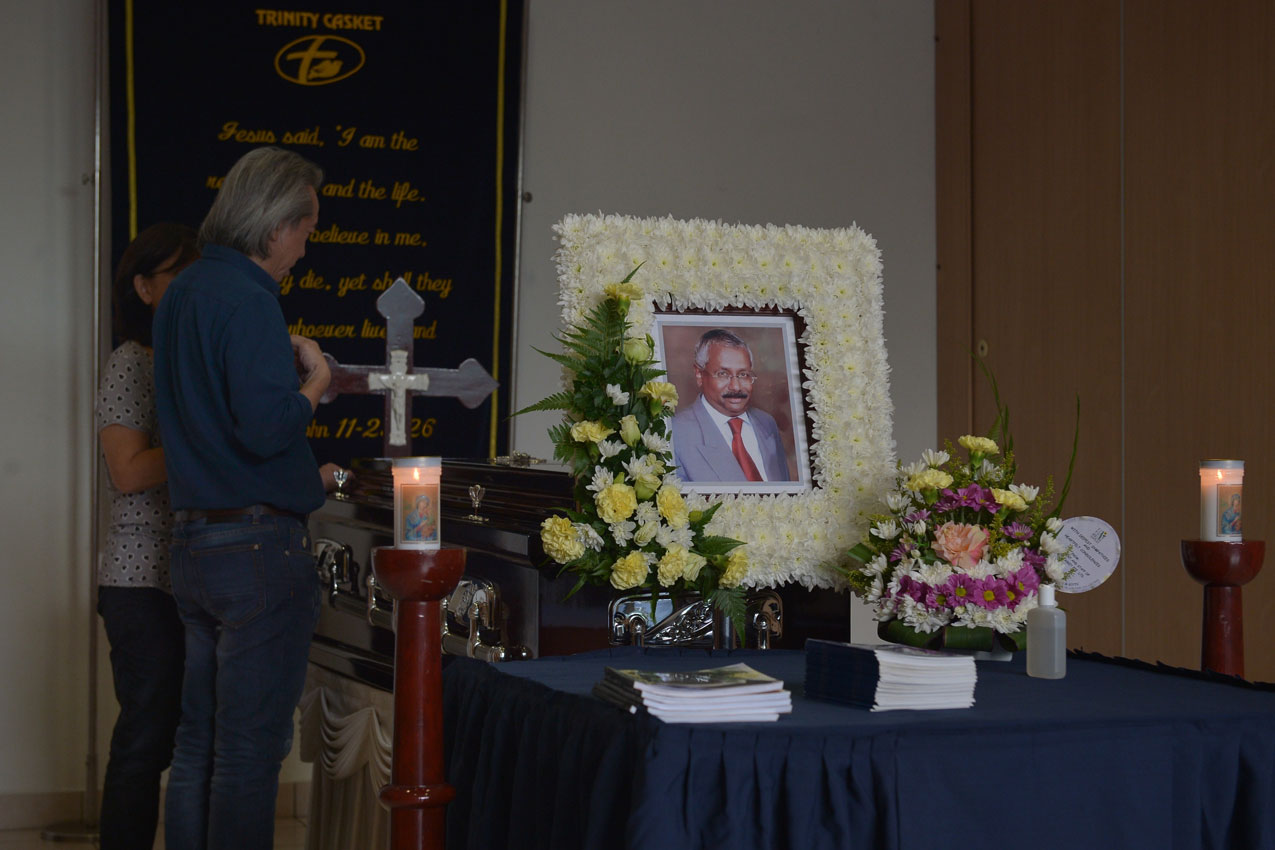
Colleagues said he was “fit as a fiddle”, and planning a trip to Kuala Lumpur for his father’s memorial service. The sudden death yesterday of criminal lawyer Louis Joseph, 61, a familiar face in the State Courts, shocked them.
His wife said he became unwell close to midnight after he had gone to bed and was taken to hospital, where it was said he suffered a heart attack.
Ms Sylvia Khoo, 62, said her husband had been taking medication for diabetes, cholesterol and high blood pressure.
Mr Joseph’s colleague, Mr Mathew Kurian, managing partner of Regent Law, informed the court of his death yesterday as he applied for a sentencing matter handled by Mr Joseph to be adjourned.
District Judge Mathew Joseph said that he was deeply shocked and saddened.
“Louis Joseph has been a good friend of the court. He has displayed exemplary professionalism in the conduct of his cases before this court, and I have nothing but the highest regard for him,” he said.
He said the court had lost a “true friend” who was fearless in promoting the interests of his clients, while also according due respect to the court and the prosecution. “We will miss him dearly,” said the judge.
Mr Joseph had appeared often in court, in particular the community court, acting for young offenders.
The Malaysian lawyer was called to the Singapore Bar in 1990. He held several jobs after that, teaching at Ngee Ann Polytechnic, working as in-house counsel in London, and for Senior Counsel Harry Elias before joining Regent Law four years ago as an associate.
At Regent Law, he handled most of its criminal matters, the most recent being the conviction of a man for unlawful stalking under the Protection from Harassment Act.
“We have lost a good friend and his departure has left a vacuum in our lives,” said Mr Kurian.
Lawyers expressed shock at his unexpected death and described him as a gentleman who was always willing to help someone.
Mr Ramesh Tiwary, a sole proprietor, said Mr Joseph “always had a smile for people” while Mr Kalidass Murugaiyan of Trident Law recalled how his friend would oblige by mentioning cases on his behalf when he was engaged in other court matters.
Aside from his wife, Mr Joseph leaves behind a daughter, Maria.
Ms Joseph, 28, a museum professional, said he was an excellent father who was always around.
“My dad wanted me to do what I like and I was interested in art, history and heritage,” she said.
Ms Khoo said he was a devoted husband who loved to cook. She said they had been looking forward to the break in Malaysia because he had been working quite hard.
A wake is being held for Mr Joseph at St Teresa’s Church in Kampong Bahru. His funeral is on Friday.
This article was first published on Jun 08, 2016.
Get a copy of The Straits Times or go to straitstimes.com for more stories.
Image:
Publication Date:
Wednesday, June 8, 2016 – 14:00
Keywords:
Send to mobile app:
Source:
Story Type:
Others
Seletar bus package up for tender
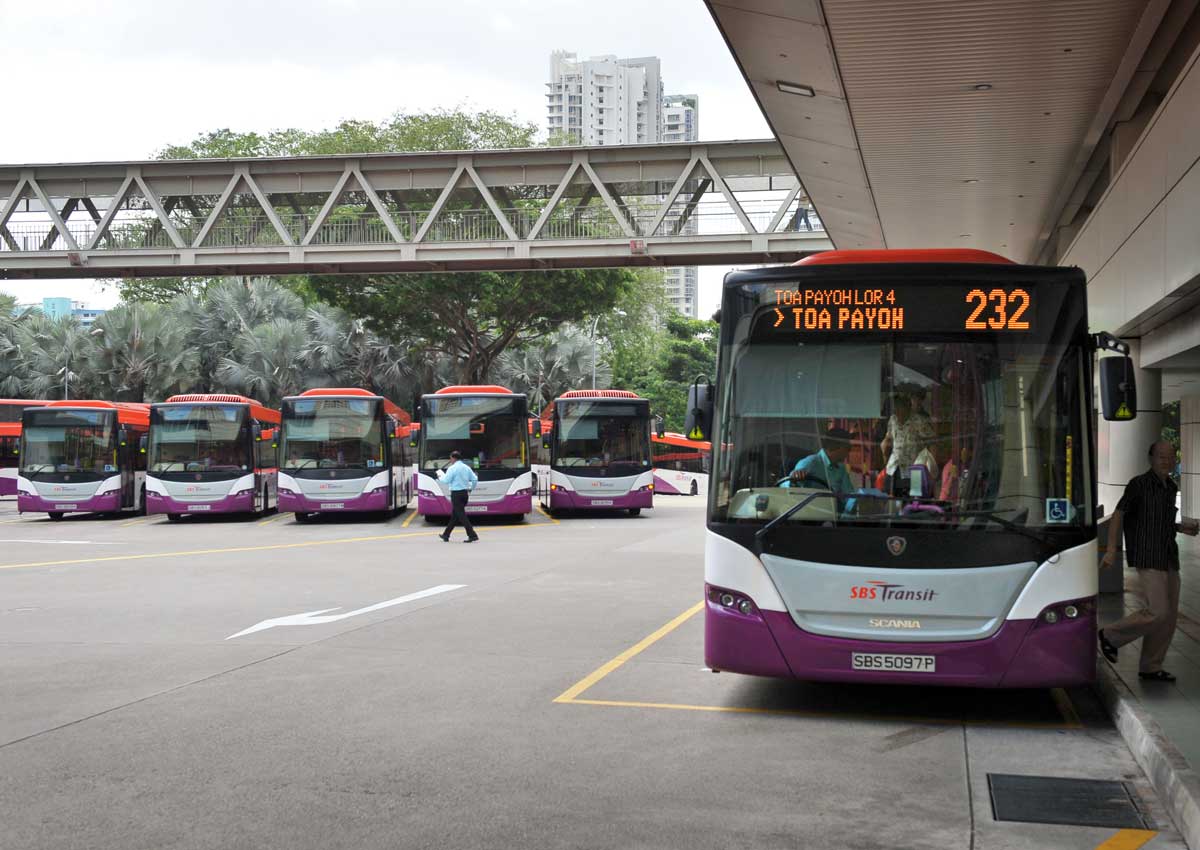
The tender for the third government bus contract – named the Seletar package – was called yesterday, attracting interest from several companies and consortiums.
The package, named after a new depot being built off Yio Chu Kang Road, comprises 26 bus services – 24 routes currently run by SBS Transit and SMRT, along with two new ones that will be announced later.
The successful bidder will start operating the services in two batches from the first half of 2018, the Land Transport Authority (LTA) said yesterday. It will be given a fleet of 420 buses initially, expanding to about 500 in 2023.
The services will operate from Ang Mo Kio, Yio Chu Kang and Yishun bus interchanges, and the bus fleet will be based at the Seletar Bus Depot, which is due for completion by the third quarter of next year.
At least five potential bidders have expressed interest in the tender, which closes on Oct 6. They include Anglo-Australian firm Tower Transit, which won the inaugural contract in May last year to operate 26 bus services in the western part of the island for five years. It put in a bid of $556 million.
Mr Andrew Bujtor, managing director of Tower Transit Singapore, said the firm has its sights set on the latest package. “There are significant economies and efficiencies that we can unlock by operating on a larger scale,” he said.
British firm Go-Ahead, which clinched the second contract last November with a $497.7 million bid for the rights to 25 bus services in Pasir Ris and Punggol, said it will read the new tender “with interest”. Two consortiums which participated previously are also keen. Local firm Travel GSH said it will team up with Chinese company Jiaoyun Group Corp again. A Travel GSH spokesman said: “We have engaged a group of consultants to put together a better proposal.”
Tian San Shipping will look to put in a joint bid with South Korea’s Kumho Construction & Engineering again. SMRT, which runs 11 of the 24 existing routes, also expressed interest. SBS Transit, which runs the other 13 routes, only said it will assess the tender.
A total of 380 bus captains and 10 bus workers from both companies will be affected by the new contract. Under tripartite guidelines, they have to be offered contracts by the new operator at terms that are no worse off. They may also choose to stay with their own companies and be redeployed, where feasible.
National Transport Workers’ Union executive secretary Melvin Yong said the union, together with SBS, SMRT and LTA, has conducted more than 10 engagement sessions with the affected staff.
“Through these sessions, we addressed their concerns, clarified their queries, and sought their feedback regarding the latest changes,” said Mr Yong, who is also an MP for Tanjong Pagar GRC.
adrianl@sph.com.sg
This article was first published on June 08, 2016.
Get a copy of The Straits Times or go to straitstimes.com for more stories.
Image:
Publication Date:
Wednesday, June 8, 2016 – 17:00
Keywords:
Send to mobile app:
Source:
Story Type:
Others
Sea of visitors at Underwater World before its closure
Large crowds thronged the submarine tunnels of Underwater World Singapore (UWS) yesterday as the iconic oceanarium began the countdown to its closure on June 26, after 25 years and more than 30 million visitors.
With the school holidays in full swing and admission fees slashed to 1991 prices, it was difficult to negotiate one’s way through the massive crowd of tourists and local families with children when The Straits Times visited yesterday.
Around 4,100 visitors admired the marine life there yesterday, nearly triple the average daily visitorship, said Haw Par Corporation, which runs UWS.
The slashed admission prices – from $29.90 to $9 for adults and from $20.60 to $5 for children – attracted businessman Harry Yeo, 43, who was visiting UWS for the first time with his wife and two sons.
Mr Yeo said: “I didn’t visit last time because I thought it was too expensive.”
Over the years, UWS has bred pink dolphins and about 15 species of fish and sharks.
It has also released critically endangered Hawksbill turtles and collaborated in a study of their migratory behaviour.
In recent years, though, UWS has been facing competition from the Marine Life Park and Universal Studios theme park, also on Sentosa.
On Monday, it announced it will close, as its lease expires in less than two years.
When Mr Ivan Goh, 45, heard the announcement of UWS’ imminent closure, he knew he had to pay a visit to the aquarium.
“Twenty years ago, I came here … and made a lot of good memories, so I wanted to bring my children here to make memories as well,” said the salesman, who took his mother and three children along. “I’m sad that it’s going to close.”
His sentiments were shared by many Singaporean visitors.
Educator Soh Meng Le, 36, who was there with his wife and two young children, remembers UWS as a popular attraction of the past.
“Besides the bird park and the zoo, at that time, this (UWS) was the next biggest thing,” he said.
Ms Tan Li Ying prefers UWS for its “child-friendliness”.
“I feel that the fish seem closer and the viewing panels are the right height for my young children,” said the 38-year-old mother, who thinks it is a pity the place has to close.
She also has childhood memories of the aquarium. “My dad would bring me (to UWS), and we would watch the pink dolphins.”
Five pink dolphins, three fur seals and five otters have already been transferred to the Chimelong Ocean Kingdom in Zhuhai, China.
Haw Par said the transportation plan was co-developed by experts at UWS and the Zhuhai attraction, and that the animals have settled into their new homes.
Suitable destinations are being sought for the rest of the marine inhabitants.
UWS said it is holding a outplacement programme for its 70 staff to prepare them for future careers.
Mr Philip Chan, 62, who has been with UWS since the beginning and supervises the team of divers who care for the fish, feels sad that UWS is closing.
“Diving in the UWS tunnel is a special experience,” he said.
“The animals have also grown familiar with us. The sharks, I think, can actually sense the presence of different divers.
“Every diver has a different breathing pattern and a different style of feeding.”
He added: “Many ex-staff also told me that they’ll want to visit and see the fishes one last time.”
linyc@sph.com.sg
racheloh@sph.com.sg
This article was first published on June 08, 2016.
Get a copy of The Straits Times or go to straitstimes.com for more stories.
Image:

Publication Date:
Wednesday, June 8, 2016 – 17:00
Keywords:
Send to mobile app:
Source:
Story Type:
Others
Competition commission seeks feedback on changes to guidelines
The Competition Commission of Singapore is considering further proposed changes to its guidelines on financial penalties and enforcement following the feedback received in a round of public consultations last year.
Source link
ACS boys won't fall for DHL phone scams, claims blogger
A recent spate of telephone scams in Singapore where callers masquerade as staff of courier company DHL has seen more Singaporeans coming forward online to warn the public about providing personal information to the scammers.
On Tuesday (June 7), one netizen took to his blog, crazyrandomchatter, to explain why his friend claims that Anglo-Chinese School (ACS) alumni would not never fall for these scams which seem to originate from China.
In a nutshell, his rant was hinged on the fact that callers of these scams typically speak Mandarin.
The blogger, who goes by the moniker RENCHoo, said: “ACS boys. Mandarin. The two don’t go well together. My friend didn’t understand a single word that the scammer was saying.”
He continued: “I’ve been told that the ‘-‘ in ‘Anglo-Chinese School’ is not a dash symbol. It’s actually the symbol for subtraction. So ‘Anglo-Chinese School’ means ‘Anglo Chinese School’.”
The post also highlighted two other scam cases.
In one of the cases which was first highlighted on Facebook, a netizen said that the scammers targeted his “lowly-educated, retired” mother, whose savings were “painstakingly accumulated over a lifetime of work as a nightshift operator and convenience store cashier to support our family”.
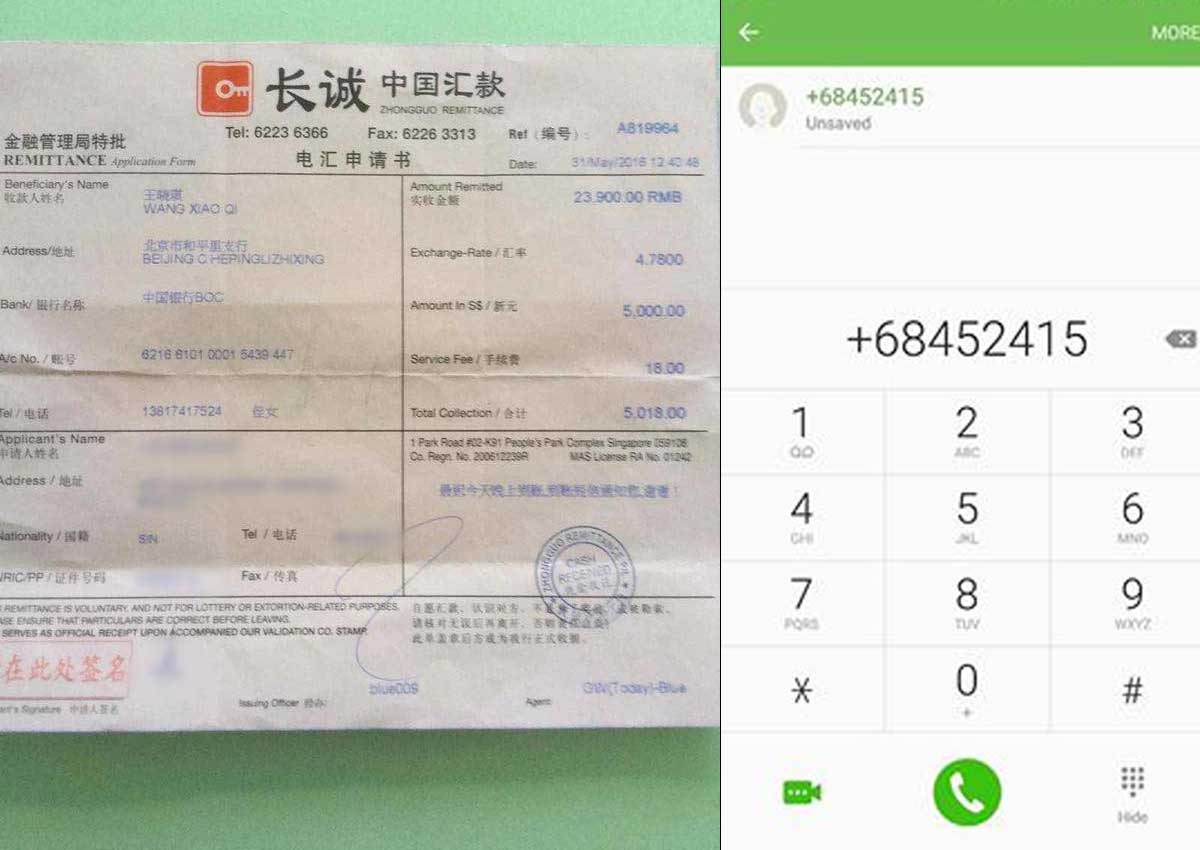
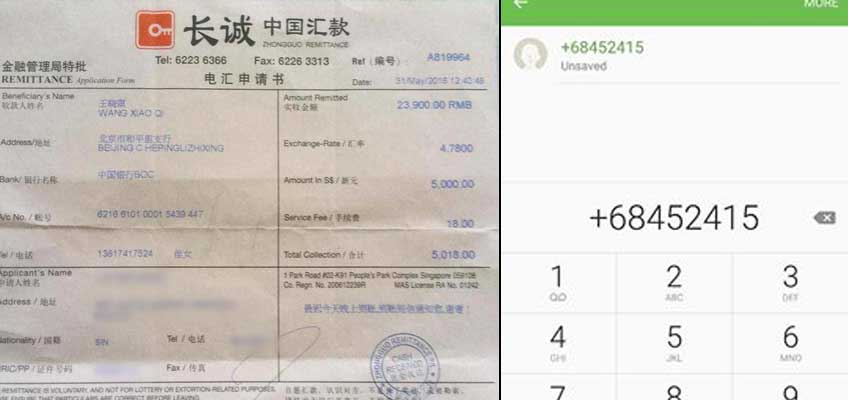
The netizen said the scammer who identified himself as Wang Xiaoqi told his mother that she was being investigated by the Chinese police for trafficking fake credit cards and money laundering.
The post also released details of the bank account number and mobile number of the scammer.
In the second case, Ms Cynthia Tay-Lek did not fall prey to the similar scam but also posted on Facebook an account of her phone conversation with the scammer.
Ms Tay-Lek decided to play along with the scammer and provided him with a fictitious NRIC number, which translated in Mandarin is “Daddy is going to the bar”.
The scammer then told her that their system showed that she had a package from the United States to Singapore and that it contained $200,000 and two fake passports.
After telling the scammer that he could keep the passports but to return her the cash, the scammer told Ms Tay-Lek that he could not release the parcel until she paid a fine.
At this point, she said: “I’m sorry I can’t do it now cos I’m halfway killing someone.”
Scam victims from China who allegedly lost $1.6b look for clues in Singapore
Click on thumbnail to view photos. Source:
The Straits Times







The conversation ended when the scammer could not get Ms Tay-Lek to remit money to him online.
On the National Crime Prevention Council’s Scam Alert website, the stories of 40 people who encountered such scams were posted for the month of June this year. Of these cases, 37 involved parcels and Chinese scammers.
stephluo@sph.com.sg
Top 7 scams in Singapore and more
Click on thumbnail to view photos. Source:
www.scamalert.sg
















Image:
Publication Date:
Wednesday, June 8, 2016 – 15:56
Keywords:
Send to mobile app:
Source:
Rotator Headline:
ACS boys won't fall for DHL phone scams because Mandarin and them 'don't go well together', claims blogger
Rotator Image:
Story Type:
Rewritten Story


