Hiring: data analysts, IT specialists and infrastructure managers.
While layoffs and pay cuts are becoming more common as the Covid-19 pandemic continues, some companies are bucking the trend and looking to hire.
Property search portal 99.co chief executive officer Darius Cheung, for one, is preparing for when the real estate market picks up and is looking to fill positions for both fresh graduates as well as senior managers.
Said Mr Cheung, 39: “Everyone is taking a hit in revenue and everyone is cautious, including us. But we take a long-term view of this situation, and I see hiring as an investment.”
One upside of doing so now is that a greater hunger for job security could mean that new hires would come in ready to “buckle down” and take work seriously. “We hope to bring in fighters,” he said.
He is not alone, and this cautious optimism is reflected in a number of firms that have placed job advertisements online and with recruiters, looking to fill roles in areas such as infrastructure management, legal, finance and technology.
Kenneth Lai Yong Hui is accused of posting a message that claimed he “got intel” that Singapore would “proceed with more measures” from “this Saturday”.
The message, which was posted on a Facebook page named Taxiuncle, added that food courts and coffee shops would purportedly close and that supermarkets would open only two days a week.
“Better go stock up your stuff for the next month or so. Govt officials in meeting yesterday and will finalize measures tomorrow,” he wrote.
The false message posted on Facebook about purported COVID-19 measures. (Photo: Singapore Police Force)
Lai posted this message sometime before Apr 20, the charge sheet stated, just before Singapore extended its “circuit breaker” period.
Singapore implemented a circuit breaker period to curb the spread of COVID-19 in the country on Apr 7. It was originally scheduled to end on May 4, but was extended last week to Jun 1.
Food courts, coffee shops, supermarkets and wet markets remain open, although entry restrictions have been imposed on four popular wet markets.
The police had said in a statement on Monday morning that they will not hesitate to take action against anyone who transmits or communicates falsehoods.
“Members of the public should refer to official sources for information and avoid spreading unsubstantiated information or false rumours, as these may cause fear and public alarm,” said the police.
Lai will return to court to plead guilty on May 27.
For transmitting a message he knew to be false, he can be jailed for up to three years, fined a maximum S$10,000, or both.
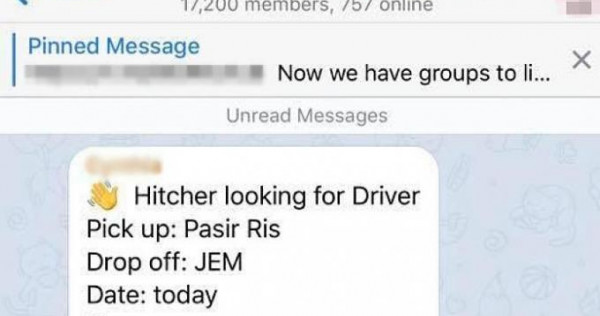
Despite two drivers having their cars seized for allegedly providing illegal carpooling services and facing fines of up to $10,000 and/or jail of up to six months, the largest carpooling platform here has remained active.
When The New Paper checked the Telegram chat group SGHitch yesterday, it was still operating, albeit with fewer postings by drivers.
A user told TNP that when he requested a ride at around 9pm last night, he received seven offers from drivers in 20 minutes.
Medical experts are now calling for the chat group, which has been renamed Covid-19 Lockdown SG Hitch, to be shut down as its enabling of carpooling and private arrangements undermines safe distancing measures.
Infectious disease physician Asok Kurup said: “The people behind the group should be penalised to send a warning to other like-minded individuals.”
Dr Asok said riders should stick to booking through ride-hailing platforms as there is “simply no reason” to resort to private arrangements.
SINGAPORE: Mr Peh Thian Hock may be 75 and retired, but he prides himself in the strength that he amassed as a foot masseuse for more than 10 years.
But there is one thing that gets him huffing and puffing – changing diapers for his partner of 20 years. Mdm Tiah Ah Chiang suffered a stroke seven years ago and has been bedridden ever since.
“She looks frail and skinny but it takes me a lot of strength to do it because she has no control over her legs,” he said. On top of that, diapers leave a hole in his wallet too.
Mdm Tiah needs three to four diapers a day, which add up to about 12 packs of 10 diapers a month. The S$200 spent on the diapers has been a financial burden.
“It doesn’t seem like a lot of money when you buy one pack at a time. But when it’s accumulated over the month, it’s actually really expensive,” he said.
But things got better when Mr Lawrence Ng visited Mr Peh’s flat while doing volunteer work at their rental block last November. Little did Mr Peh know, Mr Wong was the owner of a local diaper company, Audela.
The 44-year-old ex-civil servant started the company last year with the mission to provide adult diapers at affordable prices to people like Mr Peh. He noticed that it was “not uncommon” for the lower-income to scrimp and save on diapers.
“There was one time I saw an old lady walking really fast in my estate – I was curious and wondered if she needed help with something, so I went up to her,” he recalled. To his shock, he found her relieving herself at a corner.
Feeling awkward, he plucked up his courage to approach her when she was done with the deed. “I asked her, why don’t you go to the toilet? She told me she really had no choice, she can’t control her bladder.”
“And diapers are really too costly, so she has to make do – if she can’t find a toilet in time, she would just pee in public,” Mr Ng recalled.
Mr Lawrence Ng. (Photo: Lawrence Ng)
Unfortunately, she was not the first, nor the last person Mr Ng had encountered who had to urinate in public due to incontinence, or even stay home so that they did not soil themselves outside. Often, it was the cost of diapers that rendered them helpless.
“I feel that diapers actually represent a person’s dignity. If a person wants to go out like you and me, then we should give him or her the confidence to do so,” he said.
PERFECTING DIAPERS
Before developing his own prototype, Mr Ng spent about six months studying various brands of diapers from other countries such as Taiwan and Thailand. “I extracted portions that I found to be comfortable in each diaper, mixed and matched them to form the present product.”
When Mr Ng had his first prototype, he lived in them for five days to put himself in his users’ shoes – or rather, diapers. “I also got my whole family to try it – by knowing how it feels, we can design diapers that are really comfortable for users,” he said.
“We tried it in all positions – sitting, normal walking, lying down – to make sure it’s comfortable from all angles. I also monitored the amount of water I drank to know what’s the maximum capacity of the diapers and how it feels when it overflows.”
The experience made him empathise with individuals who resort to changing diapers less regularly due to the strain on finances. “By right, you should change the diapers after you pass motion once or twice, but I’ve seen people who use one diaper the entire day to save cost.”
“I don’t know how they do it. The stench would be so strong and it is definitely uncomfortable. I could already feel the load after the first pee,” he added. Wearing soaked diapers for too long would also cause rashes and bedsores.
The absorbance of his diapers was also an important aspect that Mr Wong took time to get right. “I realised that if the absorption is not fast enough, liquid can leak from the sides of the diaper when I move.”
However, producing thicker diapers for greater absorbance was not ideal due to Singapore’s already warm and humid weather. “The thicker it is, the more absorbent it will be but the comfort would not be there,” he said.
“I spoke to suppliers from Japan, the US and Germany to source for a material that can provide quick absorbency and still be breathable for our weather.”
He also improved the cutting of the diapers due to “Singaporeans’ body type”. “We actually have wider bottoms and are more curvy compared to other Southeast Asian countries.”
“Compared to other brands manufactured in Thailand, Philippines or Indonesia, our cutting is bigger and customers have told us that it’s more comfortable.”
KEEPING DIAPERS AFFORDABLE AMID RISING COSTS
Recognising that that the cost of diapers may be a burden to some individuals and families, Mr Ng takes a personal approach in getting to know his customers. He personally delivers diapers to new customers to find out more about their needs.
“I will identify needy families or individuals and help them by selling at cost price or supply them diapers for free.”
Audela provides 500 to 800 packs of diapers to “at least seven households and two nursing homes” for free on a monthly basis. Part of the cost is covered by private and corporate donors, who reached out to Mr Ng through word of mouth.
Some of Audela’s beneficiaries. (Photo: Audela website)
What keeps the business afloat is Audela’s presence in retail outlets such as Prime supermarkets, HAO Marts and online platforms like q100, Lazada and Shopee. Mr Wong said his diapers are cheaper than other household brands in the market by about “10 to 20 per cent”.
CNA found that most household brands retail at about S$1.20 per piece, while Audela’s cost about S$1.
The company keeps prices low by sourcing for materials directly from raw material suppliers in Japan, the US and Germany, rather than going through a third-party supplier, said Mr Wong. He then ships the materials to Hong Kong for production.
“We are a small enterprise with low overhead, so we pass savings on to consumers.” Mr Ng also runs a transport business at the side that helps to “cover costs” and allows him to continue giving diapers to needy families.
Mr Ng delivering diapers to his recipient. (Photo: Lawrence Ng)
“I just make sure we can still get the minimal profits to keep the business sustainable,” he said.
However, that has been difficult ever since the COVID-19 pandemic, due to the rising costs of raw materials.
“The outer and the inner layer of surgical masks are made with non-woven fabric, which is used in the production of diapers as well.” Even with an estimated 50 per cent increase in shipping rates and 30 per cent increase in raw materials cost, Mr Ng has yet to increase the price of his diapers.
“We still want to be able to provide affordable diapers to those in need. Ever since the “circuit breaker” measures, we had to outsource most of the delivery to protect our staff, but we cover the cost of that as well.”
Mr Ng also reported a drop of monthly donations in this period and hopes more companies “can come forward to contribute”.
“With everything that’s going on right now, there are even more seniors who will need diapers – especially when they are encouraged to stay at home.”
As for Mr Peh, he has been receiving free diapers from Audela ever since his chance encounter with Mr Ng. Even though the diapers are just left at the door these days, he is grateful.
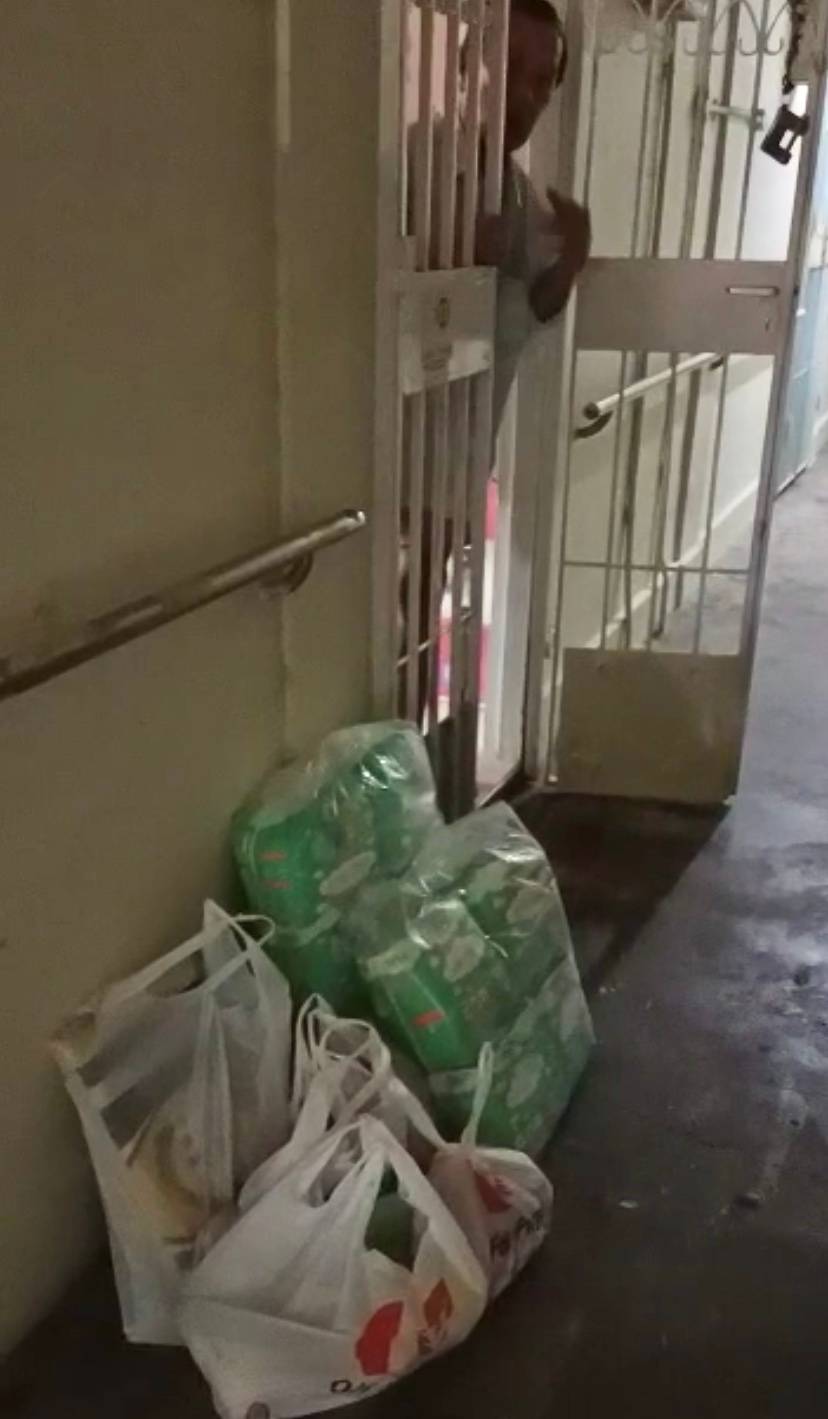
Mr Ng leaving diapers and groceries at Mr Peh’s door. (Photo: Lawrence Ng)
“Without him, I would have to head out to buy a pack every three days – it’s very ‘heart pain’ to spend that money,” he said.
SINGAPORE – Couples may have their marriages solemnised virtually from next month amid the coronavirus outbreak, if a coming Bill gets passed by Parliament.
Minister for Social and Family Development Desmond Lee wrote on Facebook that a Bill will be introduced at the next Parliament sitting on May 4 to enable civil and Muslim marriages to be solemnised remotely.
This means that the couple would not have to be present at the Registry of Marriages or the Registry of Muslim Marriages, nor need to be in the physical presence of a marriage solemniser and witnesses.
During the circuit breaker period, marriage solemnisations have had to be postponed.
Mr Lee wrote: “Even during a crisis, we should try to enable important life events such as marriages to go on. We should not let Covid-19 hold back those who are ready to start a new life together.”
If the Bill is passed, couples – where at least one party is a Singapore citizen or permanent resident – will be able to have their marriages solemnised virtually.
SINGAPORE – The police will be charging a man on Monday (April 27) for spreading false information about the Covid-19 circuit breaker measures.
In a statement on Monday, the police said that the 40-year-old will be charged in court for communicating a false message, which carries jail of up to three years, a maximum fine of $10,000, or both.
Between April 15 and 16, the man allegedly posted a false message on Facebook group “Taxiuncle” saying that he had “intel” on extended measures Singapore would take on April 18.
He wrote: “Food courts, coffee shop all to close. Supermarkets will only open two days a week. Better go stock up your stuff for the next month or so. Government officials (were) in meeting yesterday and will finalise measures tomorrow.”
The police said they will not hesitate to take action against those who transmit or communicate falsehoods.
Members of the public should refer to official sources for information and avoid spreading unsubstantiated information or false rumours, as these may cause fear and public alarm, police added.
SINGAPORE: Guess what Singaporeans are sharing on WhatsApp these days?
If you guessed some type of coronavirus-related information, you’re spot on.
But can you guess how many of these were real?
Since late January, after Singapore recorded its first few COVID-19 cases, our research team at the Wee Kim Wee School of Communication and Information at Nanyang Technological University has been keeping track of messages being forwarded on WhatsApp about the COVID-19 outbreak.
This matters because WhatsApp is the most used messaging app in Singapore. About 84 per cent of the population use it.
Some forwarded messages we collected were forwarded to us by others, while many came from a WhatsApp group that students created where members can seek verification on posts they were unsure about.
The WhatsApp group now has more than 200 members and has received more than 300 posts.
Our analysis involved 153 forwarded messages about COVID-19. Through fact-checking, we found that 35 per cent of these forwarded messages were outrightly false.
An example is a forwarded message that claimed drinking or gargling warm water with salt or vinegar can wash down the coronavirus. The Ministry of Health had specifically debunked this.
A forwarded message that claimed drinking or gargling warm water with salt or vinegar can wash down the coronavirus. The Ministry of Health had specifically debunked this. (Graphic: Edson C. Tandoc Jr)
Since we were interested in posts that were repeatedly shared, we only analysed messages that carried WhatsApp’s forwarded tag.
WhatsApp installed a forwarded message tag in 2018 to curb the spread of viral falsehoods on its platform. Forwarded messages carry either a single or double arrow to indicate that a message has been forwarded. A double arrow means a message has been forwarded more than five times.
Some 28 per cent of the posts we analysed were accurate, such as screenshots of emails or announcements from malls that informed their tenants they had a suspected case.
Some 20 per cent of the posts mixed true and false information. One post that included a video of a Malaysian student in London recording a message for his parents claimed the student contracted the virus at a party and had died of COVID-19. The video is real, but the student had to clarify in a Facebook post that he is very much alive.
The remaining 17 per cent of the posts were difficult to verify.
MISREPRESENTATIONS
We saw other examples of mixing truths and falsehoods. Some used real photos and videos but misrepresented them.
An example is a screenshot of a list of stringent measures supposedly announced by Prime Minister Lee Hsien Loong. Some users mistook it as a list of restrictions slapped on Singapore, but this turned out to be Australia’s.
A screenshot of a list of stringent measures supposedly announced by Prime Minister Lee Hsien Loong. Some users mistook it as a list of restrictions slapped on Singapore, but turned out to be Australia’s. (Photo: Edson C. Tandoc Jr)
While some 37 per cent of the posts we analysed contained explicit references to Singapore, showing the national focus of these forwarded posts, some 25 per cent did not contain any information about geographic location.
The absence of geographic location has facilitated the spread of misinformation across countries. Just think of all the videos you’ve seen of accidents purportedly happening in Singapore that turned out to be events elsewhere.
But this can also be one signal we can use in assessing whether a forwarded post is true or false: We should ask ourselves, where did the event supposedly happen?
Similarly, some 73 per cent of the forwarded posts we examined did not contain any reference to a specific timeframe. A piece of advice, an event, or an announcement is shared with the assumption it was recent but the post is silent on when this happened.
The absence of an explicit timeframe is also facilitating the spread of misinformation across time; this is why we see the same piece of misinformation recur after a few months.
Some 33 per cent of the posts we analysed also did not mention the source of the information. While misinformation typically refers to a made-up expert or misappropriated names of real people, many of the forwarded posts we came across contained no source.
This raises another question we should ask ourselves when receiving such messages. Should we believe a piece of information whose source we cannot trace or verify?
File photo of a mobile phone user. (Photo: Xabryna Kek)
WHY PEOPLE FORWARD POSTS
Sharing posts has become a form of social exchange: The more we receive posts from others, the more we share, and the cycle continues.
This form of social exchange, using viral posts as currency, has become much easier with messaging apps, such as WhatsApp, which make forwarding posts easy.
This forwarding function, however, has also facilitated the spread of falsehoods, triggering, for example, a series of mob killings in India after angry residents ganged up on some men wrongly accused by viral WhatsApp messages of plotting to kidnap children.
In response, WhatsApp has limited the number of times a message can be forwarded by a user. Earlier this month, WhatsApp rolled out a stricter limit to forwarding by allowing a user to forward a message to only one chat at a time, in a bid to slow down the spread of misinformation about COVID-19.
WhatsApp also instituted forwarded tags that accompany forwarded messages. These are supposed to alert message recipients that a particular message had been shared many times and most likely was not personally created or verified by the friend who forwarded it.
However, interviews and focus group discussions we have conducted indicate that WhatsApp users understand the forwarded tag in different ways.
For some, a message with a forwarded tag elicits caution and users become more sceptical of the message’s veracity. For others, receiving a message with a forwarded tag means the information is a point of a popular conversation. Others do not remember or do not pay attention to the forwarded tags at all.
The WhatsApp app logo is seen on a smartphone in this picture illustration taken September 15, 2017. (Photo: REUTERS/Dado Ruvic)
TACKLING MISINFORMATION IS LIKE TACKLING A VIRUS
Sharing a post is easy but undoing the effects of misinformation is not.
News outlets, fact-checking sites, and government agencies can issue corrections to debunk a piece of misinformation, but studies have found that corrections are not always effective in correcting misperceptions.
Just like fighting COVID-19’s public health threat, everyone of us must do our part.
In an earlier study, we found most Singaporeans would ignore a piece of misinformation if they come across one, instead of taking proactive measures, such as reporting the post to have it removed or telling the one who posted that the information is false.
But by not doing anything, we allow the spread of falsehoods.
We should also exercise caution when we share posts on social media or forward on messaging apps.
We should scrutinise a message before forwarding it. We can also search for related information online: Have legitimate information sources, such as news organisations, reported about it?
Online falsehoods work like viruses. They infect one vulnerable host who can then spread them to other hosts.
One user wrongly believing in a falsehood and then sharing it with others, instead of taking steps to verify the information first, is all it takes to start the spread of misinformation.
We share posts for various reasons, from something as simple as wanting to amuse ourselves to something more altruistic such as showing others that we care.
Whatever the reason is, sharing should not be at the expense of misinforming other people, especially at a time like this, when people need accurate information more than ever.
Download our app or subscribe to our Telegram channel for the latest updates on the coronavirus outbreak: https://cna.asia/telegram
Edson C Tandoc Jr is an Associate Professor at the Wee Kim Wee School of Communication and Information at NTU. This work is part of his Information Integrity Initiative project that focuses on studying information quality during a period of misinformation.
Mak Weng Wai is a final-year student at the School of Humanities at NTU, majoring in History.
SINGAPORE: These past few weeks, Singapore’s largest Work from Home (WFH) experiment kick starts in earnest, as circuit breaker efforts to contain the COVID-19 outbreak have been imposed.
Businesses are shutting down en-masse, and arranging, where possible, for employees to work from home for the six weeks or so.
Similar scenarios are also playing out across the region and the world, as governments and businesses the world over are also asking their citizens and employees to work from home.
This is a seismic shift in the way we are working and living for the foreseeable future.
As much as work has to adjust to a new reality, our homes must also adapt to work and the need to stay productive to keep businesses running and workers employed.
This is already creating a bit of a confusing dichotomy for workers who now need to balance the needs of employment against the challenges that come with working from home, and an ongoing economic crisis that has just gotten worse.
Overall, this change will generate interesting insights into how employees and employers will reshape the workplace, and for many, what the work-from-home perk will look like in the future.
MOBILITY NON-OPTIONAL
Our work norms have changed in several ways. To start, work has become increasingly mobile, with remote working likely the baseline option for many, as more and more employers deploy laptops and smartphones to their workers, in lieu of desktop computers and desk phones.
COVID-19 developments have accelerated this shift significantly, making mobile work no longer an option, but a requirement.
This has presented governments and businesses with the need for formidable and immediate adaptation, taking into account the many necessary limitations and mandates imposed to help flatten the curve.
Workers wearing face masks fumigate a construction site to prevent the spread of dengue fever in Singapore on Apr 17, 2020. (Photo: AFP/Roslan Rahman)
As a result, for a great many roles and functions, we’re beginning to discover that employees can contribute effectively despite being geographically dispersed, especially in the more critical parts of both the public and private sectors. This is despite initial teething issues, and other issues that need to be properly ironed out especially in areas of security best practices.
As this work arrangement continues, businesses and organisations will finally realise business in this new normal can still continue, even if parts of their workforce are remote.
Mobility will go from being a perk of the job, into something built into the function or role being hired for.
CREATING NEW WORKPLACE CONCEPTS
Second, as mobility becomes the norm, I also see the nature of the workplace changing significantly. To start, employers will look to make telecommuting a more permanent arrangement.
A recent Gartner survey is showing that 74 per cent of CFOs are planning to move previously on-site employees to remote work arrangements post-COVID-19.
After all, not needing your workforce to be in the same place all at once also means savings on office rental, renovations, and ongoing maintenance.
That said, the reality is effective interaction over time is what improves both collaboration and innovation. So the distance between colleagues and teams must be bridged.
Perhaps this new and less-crowded workplace emphasises a new paradigm for the office, where ideas, interactions and our work relationships can thrive. Instead of creating a bunch of cubes where people work in solitude, office spaces should be designed in to encourage collaboration while accommodating different employee work styles and preferences.
While part of the workforce can be encouraged to work remotely if they feel the need to, those who opt to work from the office should have spaces that encourage and enable collaboration.
Instead of swathes of open working spaces, employers might consider building huddle rooms that are video first.
An empty executive boardroom. (File photo: Work Central Offices)
Office designers could replace the conference phones in these small meeting spaces with video conferencing gear by default, to better enable collaboration in small groups, whether with colleagues in other time zones or those working from home.
ENHANCING PRODUCTIVITY AT HOME AND A HIGHER DEGREE OF TRUST
The debate over COVID-19’s impact on productivity has been a heated one.
The challenge is compounded when the widespread use of laptops and mobile devices have in the past encouraged an always-on, always-connected mentality, which some employers have taken advantage of, often blurring the boundaries between work and life.
In fact, as remote work results in a lack of performance visibility, employees end up feeling the need to self-manage more. This constant reminder that productivity is the default measure of accomplishment leads them to work longer hours from home than in the office.
As businesses’ and governments’ work-from-home policies are accelerated and put to the test in short order, both employers and employees will have to start having a higher degree of trust in the workplace.
It might not come naturally but employers must trust their employees will get work done, while considering that some adjustments are inevitable, especially for those with family responsibilities to manage while also working from home.
For employees, this flexibility and trust can lead to improved productivity while working from home.
A study conducted by Stanford University, in fact, revealed that performance among call centre employees who worked from home for nine months saw an increase by 13 per cent.
(Photo: Unsplash/Tran Mau Tri Tam)
It also helps that technologies that enable productivity and collaboration has become affordable and ubiquitous for many, such as high-speed internet connectivity, high-performance laptops in thin-and-light form factors, as well as the emergence of numerous cloud-based platforms for financial services, e-commerce and more.
NEW SOCIAL NORMS ESTABLISHED
Many businesses were afraid to implement flexible work practices before the pandemic but are now diving into this work-from-home world with urgency.
The past few weeks have shown that we have become more comfortable utilising technology like video to collaborate, and to build strong and lasting relationships (whether professional or personal) over long distances if required, taking the place of tedious and expensive business travel.
The extended time at home for many will go a long way in establishing better work-life balance, whether practising better self-discipline to be optimally productive during working hours, or getting better at setting a clear end to the workday in order to spend more time with family, and post-COVID-19, perhaps to have more frequent catch-ups with friends in and outside of work, or to attend a concert.
But while WFH is (quite literally) a lifesaver, it cannot completely replace the human connection and friendships that we build at work, by physically coming into an office and engaging face to face with colleagues.
THE REAL REVOLUTION HAS JUST BEGUN
As the Fourth Industrial Revolution kicked off, great emphasis was placed on the role of digital transformation in defining how businesses would remain relevant in the future.
Up until two months ago, the actual transformation has been rather slow for many.
(Photo: Unsplash/Martin Castro)
Today, it turns out COVID-19 has been the greatest catalyst for digital transformation the world has seen, with companies now accelerating adoption of these future work practices that have been discussed for years. Digital readiness is no longer optional.
These are extraordinary times for all. Companies must deliberately rethink how we approach our relationships with work, technology, and more importantly, the people in our lives, so as to ensure that we can come out all the better and stronger when this crisis ends.