The customs official at the Eurostar station raised a quizzical eyebrow at my passport.
“Singapore?” He sniffed. “Singapore isn’t in Europe.”
“That’s true,” I replied. “But nor is Britain anymore.”
He smiled…
Source link
Taiwan commemorates first anniversary of deadly water park fire

TAIPEI – Taiwan on Sunday (June 26) marked the first anniversary of an explosion which killed 15 and injured hundreds, including a Singaporean, at a water park as victims and their relatives demanded justice for those responsible.
Just one organiser of the party at the park which ended in disaster has been sentenced so far.
Nineteen-year-old Singaporean Megan Loy was one of those injured in the fire. She suffered serious burns to around 80 per cent of her body, and is still recovering from her injuries.
See also: Singapore teen on the mend after nine skin grafts
Hundreds of survivors and relatives gathered for a memorial concert in Taipei to remember the dead and express their gratitude to medical, social and charity workers. Singaporean singer JJ Lin was among those who performed.
AFP, Reuters, Instagram










































Almost 500 were injured in the blast at Formosa Fun Coast outside Taipei, when clouds of multi-coloured corn starch sprayed on revellers at a “colour party” ignited due to heat from stage lights.
The park had rented out its premises to an events company for the party.
Horrific video footage showed partygoers – mostly aged between 18 and 25 – screaming as they tried to escape the raging flames.
Prosecutors last year indicted only the party organiser Lu Chung-chi, who was among nine people – including the chairman and president of the park – being probed in the case.
Outraged victims and their families appealed for a new investigation, which was formally opened last month.
In April, Lu was sentenced to four years and ten months in prison for negligence leading to death, as the court cited the “excruciating pain” of the bereaved.
But victims said the sentence was too light and the park’s executives should also be held accountable.
“It is unacceptable that 15 people were killed but only the party organiser got a four-plus-year jail term. That’s not justice. We bought tickets from the water park and it should be held responsible,” said 26-year-old accountant Huang Ching-chun, who has been on sick leave from her job since the accident.
More than 200 of the partygoers were seriously injured, some with more than 90 percent burns – leading to amputations in some cases. Although all have now been released from hospital, many are still enduring painful rehabilitation or surgery.
Chen Wei-han, a 25-year-old former swim coach, said she just wants to “return to my normal life and be able to look after myself” after she was hospitalised for seven months with burns to nearly 70 percent of her face and body.
“The water park and New Taipei City government were both responsible for this huge public safety disaster. The victims and their families deserve justice,” Chen’s father added.
See also:
Bravery, loss and hope: Life after the Taiwan water park tragedy


Police arrest 75 in raids of massage parlours, public entertainment outlets
The 66 women and nine men are suspected of committing various criminal and employment-related offences.
Source link
Prince guitar, Bowie's hair sold for more than $200k

LOS ANGELES – Bidders paid a combined total of more than US$150,000 (S$202,970) for a lock of David Bowie’s hair and Prince’s iconic “Yellow Cloud” guitar on Saturday (June 25) at a Beverly Hills auction.
Heritage Auctions, which prompted legal action by offering Whitney Houston’s Emmy Award as part of a separate sale, said the snippet of Bowie’s pale blond hair went for US$18,750.
It came from a former employee of the Madame Tussauds Wax Museum in London who was tasked with recreating the music icon’s 1983-era hairdo for his wax figure.
Reuters, AFP





























Prince’s instrument of choice during the late 1980s attracted a winning bid of US$137,500, with unconfirmed reports saying it had gone to Indianapolis Colts owner Jim Irsay.
The auctioneer was forced to abandon plans to sell Houston’s Emmy as part of a separate auction of her dresses and other belongings after the US Television Academy argued it owned the rights to the statuette.
US District Judge Percy Anderson issued a temporary restraining order on Friday forbidding the auction house from selling the trophy, won in 1986 for Houston’s performance of “Saving All My Love for You” at the Grammys.
AFP, Reuters, Sony Music Singapore, Sony Entertainment, Instagram





















































“We fought the good fight, but we respect the court’s decision,” Heritage spokesman Eric Bradley said.
The 48-year-old diva was found drowned in a bathtub at the Beverly Hilton in 2012.
Bowie and Prince, two of the most influential artists in pop history, died within months earlier this year – the so-called “Thin White Duke” after a battle with cancer and the reclusive “Purple Rain” singer of an opioid overdose.











He was rarely photographed during the late 1980s without his bright yellow maple wood instrument, complete with a distinctive elongated upper horn.
“As celebrity stage-used instruments go, this piece is as unique as Beethoven’s piano or John Coltrane’s saxophone,” Garry Shrum, Heritage’s director of music memorabilia said when it was put up for sale.
The Yellow Cloud was used in the studio, in videos and at gigs until the neck broke on a French TV show in 1994.
Reuters















It was repaired, but confined to the recording studio and eventually made way for the “Symbol” guitar identified with Prince’s later work.

'Silver tsunami' threatens to wipe out S. Korean rural communities
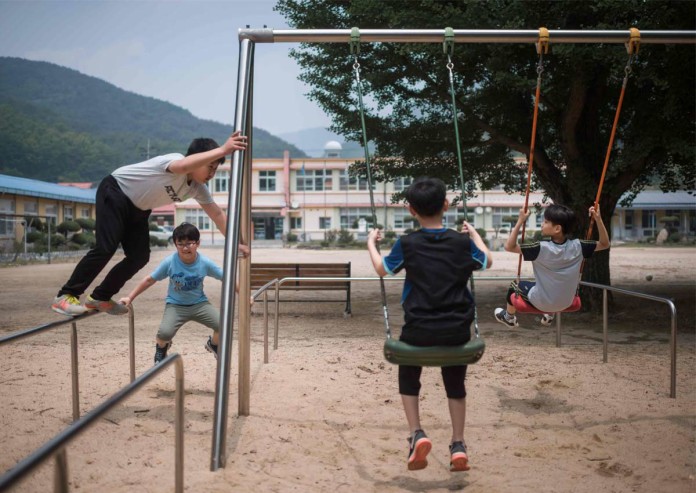
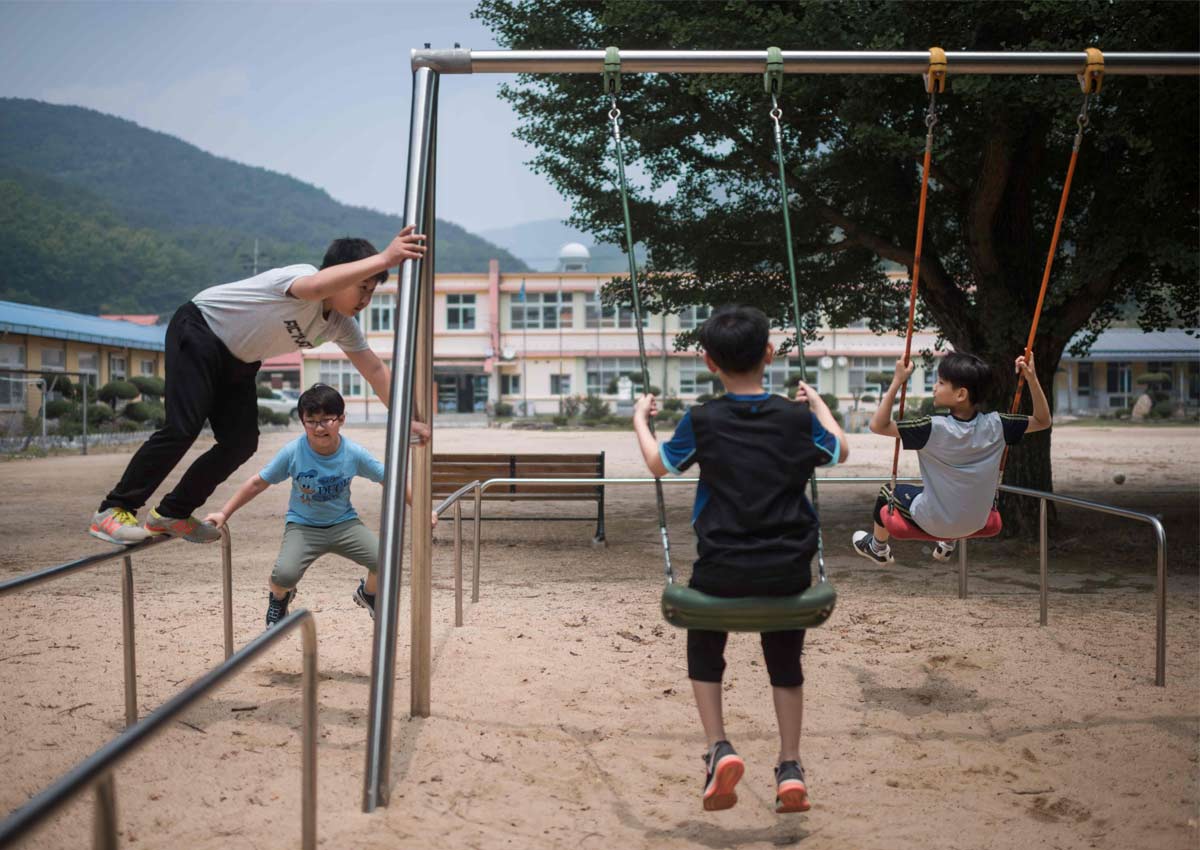
It’s lunch break at Seoksan Elementary School and the entire student body has taken to the vast playground for a game of football – with just three players on each side.
“We don’t really have enough people and there’s no goalkeeper, but it’s still fun,” said Lee Jung-Bin, playing on the same side as his sole fourth grade classmate, Kim Dong-Won.
Lee is one of only six students – all boys aged seven to 11 – attending the school in the southern South Korean rural county of Gunwi, which once boasted 700 pupils.
Many classrooms are padlocked and rusty goalposts and a basketball hoop stand forlornly at the corners of the playground, while an old banner welcoming queries “for admissions and transfers” flutters on a nearby fence.
Seoksan is one of many “mini-schools” struggling to stay open in rural communities that have been decimated by a dramatic demographic shift in South Korea which now has one of the world’s lowest birth rates.
By 2030, a quarter of all South Koreans will be over 65 years old, and the overall population is expected to peak at around 52 million the same year before entering a period of steady decline.
This so-called “silver tsunami” poses a major challenge for Asia’s fourth-largest economy as the young, working-age population declines and the cost of caring for the elderly escalates.
And in remote, rural communities like Gunwi, which lies some 200 kilometers southeast of Seoul, the trend is exacerbated by a youth exodus to the cities for work.
Nestled among mountains and known for its mushrooms and apples, Gunwi county boasted a population of more than 70,000 in the 1980s.
That number now stands at 24,000 with nearly 40 per cent over 65 years old – one of the highest ratios in South Korea.
“I’m worried this county might disappear from the map once we die,” said Lee Jong-Rak, a local official of 38 years standing.
Childbirth has become so rare that there isn’t a single obstetrician or maternity ward in the entire county, and more than 20 elementary, middle and high schools have closed since the 1990s.
At the other end of the demographic spectrum, elderly care facilities have mushroomed and the number of their permanent residents has tripled in the past decade.
Outside one Gunwi community centre where they had been attending a health class, a group of elderly men and women climbed onto a rusty town bus whose driver – in his 60s – was the youngest on board.
South Korea has a fertility rate of 1.19 births per woman – the lowest among OECD member nations.
More than 3,700 schools nationwide have closed since the 1990s and thousands more are set to be shut down or merged in coming years, according to the education ministry.
And this year, more than 20 per cent of 6,218 elementary schools across the country had a first grade intake of less than 10 students.
Lee Sang-Ho, a researcher at Korea Employment Information Service, said Gunwi was one of many rural communities facing a “high risk of extinction” in the next 30 years.
And he warned that a collapse in production and consumer demand triggered by a rapidly ageing society wasn’t a threat limited to the countryside.
“The same forces behind the plight of the rural communities will eventually reach urban areas, pushing the entire national economy into a long-term downturn cycle,” Lee said.
In Gunwi’s county seat, also called Gunwi, small businesses are struggling to cope with an ageing consumer base that has little or no consumerist intent.
“Look around here. How many people in their 20s do you see?” said the owner of a small electronics shop near the town hall.
“These days, I can’t even put rice on the table,” said the owner, who declined to be identified.
Her 40-year-old store showed its age in its product line, with dusty shelves stacked with cathode-tube TVs, cassette tapes of 80s’ pop hits and corded phones featuring extra-large keypads.
Gunwi officials have done what they can to rejuvenate the county, offering free school lunches and cash incentives for couples having a third child.
The central government has launched similar schemes across the country, pumping more than 80 trillion won ($68.3 billion) since 2006 into programmes aimed at encouraging people to marry young and have larger families, according to health ministry data.
But critics say such schemes ignore the root causes of the problem, including a lack of quality jobs, childcare facilities and support for working mothers.
At Seoksan elementary, the school’s three remaining teachers were downbeat on their future employment prospects.
“Realistically speaking, it’s hard to see the school remaining open for another 10 years,” Kang Min-Sung said after finishing her reading class with three students in a classroom big enough for 30.
Kang, 28, grew up in Gunwi. After high school she left for for college in the nearest major city Daegu where she opted to stay after graduation.
Teaching at the school requires an hour-long daily commute by car and a strong sense of commitment.
“Schools like this, however small, are necessary for the education of the children who live here,” she said.
“I just don’t know how many will be left for us to teach in the future.”
Bus fire kills 30 in central China

BEIJING – At least 30 people were killed when a large bus burst into flames after crashing into the side of a road in central China on Sunday (June 26), state media said.
A total of 56 people were on board the bus which crashed in Hunan province, the official Xinhua news agency reported, suggesting casualties could rise.
It said that 21 injured passengers have been sent to hospitals, adding that the driver of the bus had been detained.
Thick black smoke billowed from the vehicle, as passengers appeared to stand nearby, reported state broadcaster CCTV.
Local officials believe that an oil leak caused by the bus crashing into a roadside guard rail may have caused the fire, Xinhua said.
Traffic accidents are common in China, with more than 250,000 people dying each year on the country’s roads, according to the World Health Organisation.
Long-distance buses are popular as a cheap way of travelling between cities and competition between bus firms can be fierce.
China has seen repeated bus fires in recent years which have caused multiple fatalities.
At least 38 people were killed in 2014 when a van carrying inflammable liquid hit a bus on a highway in Hunan province, state media reported.
In 2010, a shuttle bus carrying steel factory workers in eastern China burst into flames, killing 24 passengers.
Several such incidents were deliberate arson attacks, according to officials.
An arsonist who injured more than 30 people by setting fire to a bus in the Chinese city of Hangzhou was executed last year, authorities said.
In 2013, a suicidal man started a fire on a vehicle in Xiamen in the eastern province of Fujian that killed 47 people, including himself.
There were no indications that the fire on Sunday was deliberate. Xinhua said rescuers were searching the charred frame of the bus.


53A: The fresh faces behind this year's NDP song
Less than three days after this year’s National Day Parade (NDP) theme song was released, the band behind it have already gotten requests to perform the tune at their usual Tuesday night gig at Timbre @ The Substation.
The song, Tomorrow’s Here Today, was written by composer Don Richmond and performed by a six-member cover band called 53A.
The youthful pop tune features a catchy whistling refrain and the upbeat, forward-looking lyrics speak of hopes and dreams .
The NDP song is the band’s most high-profile gig yet. Formed 14 years ago, they are familiar faces on the live music circuit, known for doing covers of anything from soft rock to top 40 hits at either The Substation or Hive by Wala Wala three times a week.
The band comprise vocalist Sara Wee, 30, lead guitarist Alvin Khoo, 37, bassist and vocalist Bani Hidir, 29, drummer Helman Kamal, 29, keyboardist Nazaruddin Mashruddin, 27, and percussionist Serena Chen, 34.
The music video has garnered 294,000 views on Facebook and 85,000 views on YouTube since it was released last Sunday.
“It’s really cool that they’re giving the underdogs a go,” says lead singer Wee, speaking to The Sunday Times in between sets at Hive by Wala Wala. “This also opens up the opportunity for younger artists who are up-and- coming to be part of NDP the next time.”
Wee, who often works with composer Richmond, 39, did the female vocals for his demo for Tomorrow’s Here Today.
He, in turn, recommended the band to the NDP committee. “The brief given to me at the beginning was that we needed some fresh faces because they didn’t want to use the usual suspects,” he says.
While he had been involved in the production work of last year’s NDP theme song, Our Singapore, by JJ Lin and Dick Lee, this is his first time composing the music and writing the lyrics for one.
The feedback for the new song has been mostly positive, though some people have criticised it for being more of a radio-friendly pop song than a National Day song.
In response, Richmond says: “Singaporeans don’t need to be told, this is the part where you take out your flag and wave it, or this is the part where you turn to your friend of the other race and look at him and smile. Singaporeans have grown up and matured as a listening audience, we don’t need things force-fed to us.”
Singer-composer Dick Lee – who wrote 1998’s Home, the gold standard of National Day songs – acknowledges that it is “extremely tricky” to write a theme song that works across the board.
“This is why I tend to approach the song by targeting emotions, as I’ve found that an emotional pull in a song can unite a diverse audience.”
Jeremy Monteiro, who composed 1990’s One People, One Nation, One Singapore, says he has always wondered what would work as an alternative to “rah rah, heart- thumping national songs”.
Describing Tomorrow’s Here Today as a nice departure, he says: “Among all the attempts to do a catchy National Day song, this is the one I like the best. It’s not tacky, it’s a really nice pop tune.”
At the National Day Parade, where there will be a potential crowd of 55,000, the band will perform the new song along with all the classics.
Wee says: “We’re going to bring in the old and the new and I think that’s what the concept of the next 50 years is about.”

This article was first published on June 26, 2016.
Get a copy of The Straits Times or go to straitstimes.com for more stories.

Car-free Sunday extended; restarts in October

SINGAPORE – The Car-Free Sunday pilot has been a “tremendous success” and it will be extended after a two-month hiatus, said Minister for National Development Lawrence Wong on Sunday (June 26).
The pilot initiative to close off some roads in the CBD area on…
Source link
Uncertainty growing in Singapore countryside as farmers are told to move
Moving may be troublesome for many, but for farmers with bulky equipment and thousands of animals or crops in tow, the process can be downright painful.
Yet, farmers in Singapore tell The Sunday Times that if they have to move, they will, as long as they have the assurance that it will benefit them and the agriculture industry as a whole.
“We need to know that there is a plan, a direction. Are we moving blindly or would the move improve infrastructure and boost the industry?” says Mr Kenny Eng, president of the Kranji Countryside Association (KCA) that represents about 40 farms, many of which are family businesses.
Fourteen of its members, including goat farm Hay Dairies and Jurong Frog Farm, are among the 62 farms in an area in Lim Chu Kang which will be redeveloped to make way for the Defence Ministry’s new training grounds. They were told earlier this month that they have to move out by the end of 2019.
The deadline had initially been June next year, but the Agri-Food and Veterinary Authority (AVA) pushed it back 2½ years to give farms more time.
Affected farmers will have the option of bidding for new farm land early next year, but the exact details of the location and size of the new plots available have yet to be announced.
With many questions going unanswered, uncertainty is looming large over Singapore’s idyllic countryside, where farmers feel they are ploughing a lonely furrow at keeping their businesses and passions afloat.
One of those affected, 50-year- old quail farmer William Ho, is already considering a change. He says: “It may be too expensive to be a farmer after the move, but I can be a nature guide – children always enjoy hearing about my quails.”
UNSUITABLE LAND
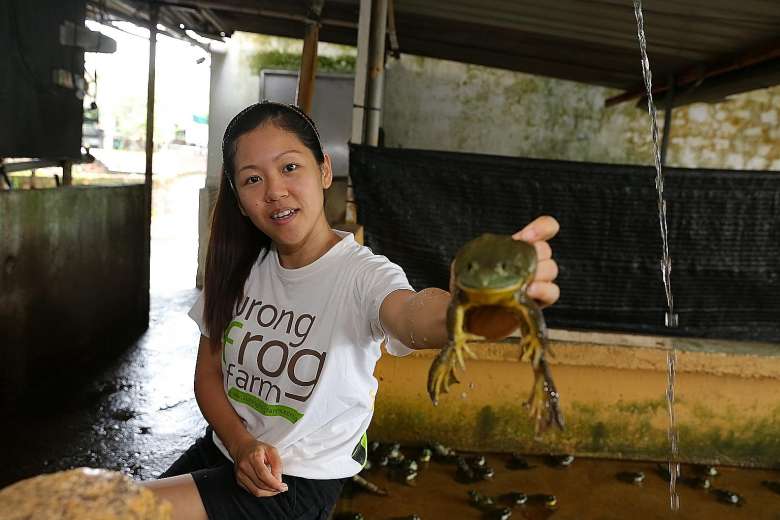
The Jurong Frog Farm, contrary to what many expect, smells surprisingly fresh. Its director Ms Chelsea Wan, 32, says the constant supply of running water from a well and reservoir within the farm helps.
But such amenities may not be available at the new site.
In fact, Ms Wan says the move might entail her farm moving into a factory, where frogs will be reared “without ever feeling sunshine or rain”.
This is a no-no for the true-blue farmer, or the frog princess, as she is known in farming circles.
“We could work with our suppliers and establish farms overseas; we may just end up focusing on the factory packaging frog products.
“But we have family here in Singapore and it is less than ideal to have a farm overseas,” says Ms Wan, who has an eight-month-old son.
For vegetable farmers, the quality of soil at the new site matters too.
As vegetable farmer from Farm 85, Mr Tan Koon Hua, 48, puts it: “The quality of soil is essential to how crops turn out – it can’t be contaminated with waste or contain many stones. We also have to cope with the extreme changes in weather patterns of late.”
COSTS
Mr Ho, who is co-owner of Lian Wah Hang Quail and Poultry Farm, says the possible move could cost him about $10 million, including spending on infrastructure at the new site, such as power supply and a new slaughterhouse and processing plant that will allow him to scale up his enterprise and stay commercially viable.
Over at Hay Dairies, business director Leon Hay, 38, says that building double-storeyed barns to house his 1,000 goats would alone cost about $6 million. The layers are necessary because the new plot could be at least 50 per cent smaller than its current 2ha, he adds.
It could take between three and five years for the structure to be built, and another 10 years before investment costs can be recuperated, excluding any interests on loans, he says.
With the 20-year lease period announced by the AVA earlier this month, that leaves the firm about seven years to start making a profit, and only after at least 13 years of effort.
Mr Eng says: “If farms are given more flexibility to diversify revenue sources, they have a better chance to thrive in a challenging environment and, in turn, invest more in their core business of food production.
“Also, while production is important, creating the market and demand is just as important. Agri-tourism and agritainment contribute immeasurably to that.”
LEASES
Earlier this month, AVA decided to go back to the original lease period of 20 years after getting feedback from farmers that the 10-year tenure, with a possible 10-year extension announced in 2014, was too short for investing in automation.
AVA chief executive Tan Poh Hong had said then that the longer 20-year lease tenure would provide more certainty to farms and allow them to invest in intensive, highly productive technologies that operate on minimal manpower.
The news was welcomed by farmers but, even then, they said the prospect of repeating the cycle of bidding for a new plot and building new structures every 20 years was a daunting one.
Farmers say an increase in productivity could be achieved in other ways besides automation. They are trying to innovate by coming up with new concepts and products.
At the frog farm, for instance, one new product is bottled hashima, the oviducts of mature female frogs that has the same “beautifying properties” as bird’s nest, says Ms Wan.
They are also trying to attract young people into the sector, to avoid becoming a sunset industry.
This is done by coming up with fresh concepts that combine both agriculture and entertainment, such as farm visits and tours.
They also launched the Farmers’ Market, the seventh edition of which will continue today between noon and 5pm at the Nyee Phoe Flower Garden.
Ensuring the longevity of the farms beyond their leases could benefit more than just the farmers.
As Hay Dairies visitor and financing manager, Madam Priscilla Chong, 41, told The Sunday Times last week: “It is good to keep the farms. Without them, children may have to go to farms in Malaysia or Australia, or even the wet market, to learn about animals.”
Young farmers keen, but there are doubts
They are young, without a tan and business savvy: Meet the second-generation farmers of today who are redefining what it means to be farmers by looking beyond simply raising livestock.
But despite their passion and innovation, farmers like Jurong Frog Farm’s “frog princess” Chelsea Wan may eventually have to trade their wellingtons for more office-appropriate footwear.
The Jurong Frog Farm is one of the 62 farms in Lim Chu Kang which will have to clear out by 2019.
Although the farm’s 32-year-old director hopes to continue her father’s legacy, she says there is still too much uncertainty about the future of the agricultural sector.
“Even if we manage to secure another plot of land then, what will happen 20 years later? By that time, I will be 56 and structurally unemployed. Who would hire me then? ” asked the National University of Singapore graduate.
This is not for the lack of trying, though. Young farmers like Ms Wan are often on the lookout for ways to boost productivity, such as through automation, for example.
They are also injecting a breath of fresh air into the sector by trying out new products and concepts, such as farm tours, to draw the crowds to Singapore’s rustic countryside in the north-west.
Ms Wan, for instance, considered how the entire frog – instead of just the legs, a la frog leg porridge – could be consumed. Her answer: hashima, essentially the oviducts of adult female frogs. Some people are willing to pay up to $105 per tael (50g) for it.
At the neighbouring Hay Dairies, business director Leon Hay, 38, sells not only goat’s milk, but also the chance to see live goats by taking groups on farm tours. Hay Dairies, Singapore’s only goat farm, is also affected by the 2019 deadline.
Still, all the young farmers’ efforts at diversification and innovation may come to naught if farms are forced to move every 20 years – a costly affair.
On whether he would bid for the new farm plots come 2019, Mr Hay told The Sunday Times: “I am willing to use my retirement savings for the move, if there is a future for the industry.”
Farmer and son hope to develop business further
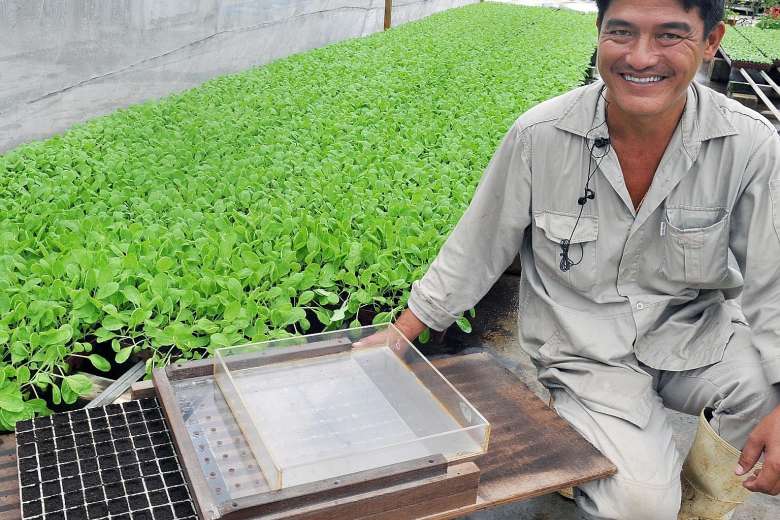
Mr Tan Koon Hua, 48, director of Farm 85 Trading, takes quiet pride in growing leafy crops such as bok choy and kang kong on his vegetable farms.
His son Liang Zhong, 21, is as old as he was when he first started out in farming more than 20 years ago, and eager to learn the trade. But Mr Tan is reluctant to hand over the reins. Out of his five farms, three totalling 10ha in Lim Chu Kang have been affected by redevelopment plans, and he feels the outlook for the industry remains uncertain.
“My son is very interested in farming, but I am worried that he may end up suffering,” he said in Mandarin. “I can train him so the trade can flourish. But the policy direction for the local farming industry is still unclear. If he joins me, he might be spending time learning something that will be wasted.”
Mr Tan has been trying to improve business efficiency and quality, and said farmers are not just concerned about the relocation, but also the longer- term outlook. Every day, his farms produce seven to 10 tonnes of leafy vegetables, which are distributed to supermarkets and wholesalers. He has developed a tool that allows seeds to be sown with sufficient distance between each plant, which eases harvesting and ensures scarce land is utilised well. Since 2012, the farms have also reduced the use of chemical fertiliser by scaling up the production of their own organic fertiliser made out of compost.
Mr Tan hopes there will be more dialogue between farmers and the authorities so that the needs of the industry can be better communicated.
Besides soil quality and availability of water at the relocated farms, there are also rising manpower costs and changes in weather patterns in the light of climate change to contend with.
“We want to coordinate well with the authorities so that the journey ahead for the industry will be a smooth one, and ensure that there will be Singaporeans who can produce food for the country,” he said.
Mr Liang Zhong, who has just completed national service and is helping his father out at the farm, said: “I will try my best to continue his work, but we need the assurance from the Government that this industry is here to stay so that we can further develop and invest in the business. “
This article was first published on June 26, 2016.
Get a copy of The Straits Times or go to straitstimes.com for more stories.

Oh rats! Rodent scourge on the rise, say experts
They live around us, thriving on the scraps of food left lying around in homes and shopping malls, typically in the dark of the night.
But in recent times, incidents of rats seen scurrying about in the day have gained widespread media attention. Pest control experts said this is an indication that the rodent scourge in Singapore is on the rise.
“If rats are seen during daytime, you can be sure that there is a high infestation of rats,” said PestBusters chairman and chief executive Thomas Fernandez.
PestBusters is one of five pest control firms to report increases of between 20 per cent and 60 per cent in rat-related inquiries.
The firm, which has been in the business for 25 years, received 1,563 inquiries involving rats last year – a 55 per cent rise from the 1,006 inquiries the year before.
In the first quarter of this year alone, it received more than 400 calls involving rats.
At Innovative Pest Management, three out of five calls made to its hotline are about rats. Its technical director Hadi Hanafi said: “We started seeing an increase in calls after the Bukit Batok incident two years ago.”
These days, rats can be seen lurking around construction sites, restaurants, common areas of shopping malls and in homes, pest controllers said.
Last week, it was reported that Marina Bay Link Mall, part of the Marina Bay Financial Centre, was the latest mall to have rat issues. Dried droppings were found in the false ceilings of a food outlet and a common area of the mall during an inspection. Shortly before that, a Facebook user uploaded photos and a video of a rat in the bread section of the FairPrice outlet in Kang Kar Mall next to Hougang Mall.
Keeping the premises clean is crucial in the battle against rodents but the urbanisation of Singapore’s landscape has contributed to the recurring rat problem, said Dr Chan Hiang Hao, a medical entomologist at Rentokil Singapore. He has received an average of 55 rat-related inquiries a month since January.
“Urbanisation provides greater availability of resources for the rats, causing them to have a generally higher growth rate,” said Dr Chan.
See also: Rats! Problem is still plaguing Singapore
For instance, the common Norway rat or brown rat can mature in 10 to 12 weeks in an urban environment , after which it is capable of giving birth to six litters – each consisting of about eight pups – every year.
Another reason for the spike in the rodent population could be the trend of mixed-use developments, said Ms Audrey Ong, who is the business development manager at Origin Exterminators.
“There are now more food places distributed throughout buildings, and where there are people and food, there will be rodents,” she said.
Ms Ong added that false ceilings, especially those used in commercial buildings, are often “ideal habitats” for rodents. She said: “These are hidden areas of a building that pest controllers may not check frequently because access can be limited.”
To target these problem spots, the firm has started using infrared sensors that can gather real-time data on rat activity.
Some experts also believe that current rodent control methods have not evolved to deal with the rats.
“The rats are very intelligent and they can recognise the baits that are used over time,” Mr Hadi said.
“If they bring the bait home and one of them dies from feeding on it, they will not touch the rest of it.”
Rats have also learnt to avoid the metal cages and glue boards typically used to catch them, experts said. That is why empty traps cannot be a sure sign that the problem is at bay, they added.
“It’s not reasonable to expect that there will be zero rats,” said Ms Ong. “But if the population is low, you won’t usually see them in the day because rats are biologically nocturnal. If the colony is growing fast, the weaker ones will be out to forage during the day, due to competition for food.”
Many experts said pest control measures, such as inspections and maintenance of traps, should be an ongoing effort.
Said Mr Hadi: “It is not just about getting the cheapest quote because the people you get may not be well- trained to target the rat colonies and eliminate them.”

No return of menace at Marina Square
When a dead rat was found in a vegetable dish at Chinese restaurant Hotpot Culture in Marina Square, it crippled business at other eateries in the mall.
Now, almost 18 months on from when pictures of the rodent’s carcass circulated online, the restaurant has reopened and others that survived the downturn in customers there have put the incident behind them. Many told The Sunday Times that they have regular pest-control measures in place and have not seen a return of the rat menace.
The Hotpot Culture incident triggered thorough inspections by the National Environment Agency (NEA), which later found signs of rodents in the false ceilings of 14 food outlets at Marina Square, and at one of the mall’s bin centres. At least five eateries at the mall closed down in the aftermath of the incident, owing to a lack of customers.
The Sunday Times visited the mall during lunch time last Friday and found business to be slow in several eateries. However, Chic-a- Boo Fried Chicken manager Alex Yong said this was because customers mainly visit in the evenings and on weekends. He added that the mall may be quieter than usual lately because of renovations.
Monthly checks are conducted at the food outlet and it is required to submit pest-control reports for monitoring to the mall management.
Similarly, Chinese eatery Yechun Xiao Jiang Nan’s manager, Mr Daniel Choo, said: “The pest-control workers inspect our kitchen and storage areas twice a month.”
Cleaner Mohd Zubir, 58, who has worked at the mall for about two years, said traps are placed in different parts of the mall and checked twice daily.
“I don’t see rats any more,” he said. “When there are food stains on the floor, we always clean it up quickly.”
These efforts have not gone unnoticed by visitors to the mall.
Mr Benson Sun, 44, who works in sales, said: “I’ll be happy to eat anywhere in the mall. I don’t see the rats anywhere so I’m not worried.”
Rodent control efforts make a difference at temple
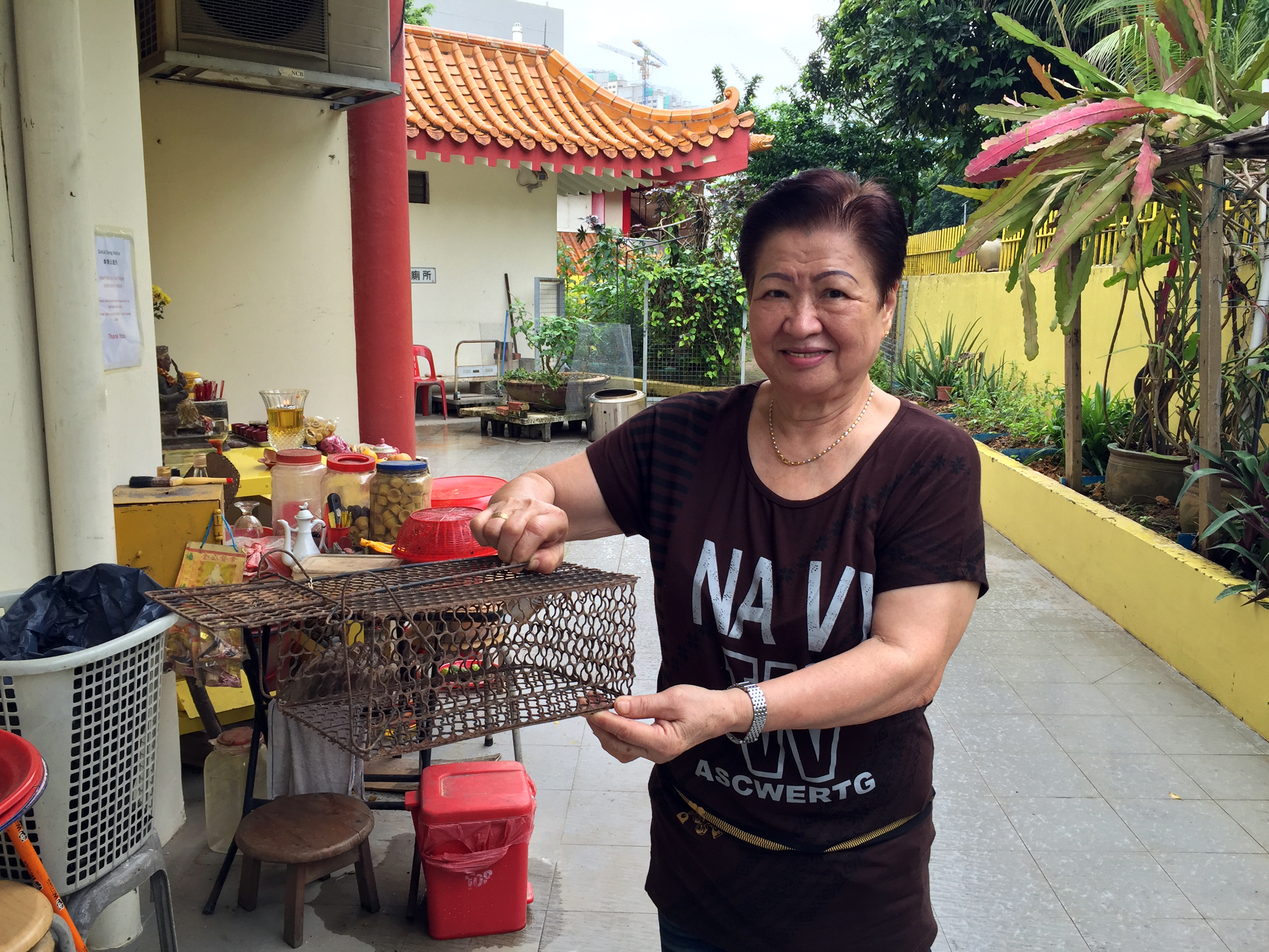
Three months ago, it was common to see an average of four giant rats a day at the See Thian Foh Combined Temple in Bukit Batok.
Since the authorities carried out an extensive rodent-busting operation at the site, the situation has improved, though staff and volunteers at the temple still see “one or two small rats occasionally”.
The temple’s administrative clerk, a Ms Ang, 33, said: “Previously, we would see about four or five big rats in the day, hiding among the plants in the temple grounds.”
She added that some could even be up to 15cm long.
One 72-year-old volunteer, who gave her name only as Ms Sim, said: “A few rats will still be around, so we continue to put out traps and rat poison. But the situation is much better now than before.”
In April, the National Environment Agency (NEA) and Housing Board intensified pest-control efforts after rat activity was reported on vacant state land behind the temple.
The agencies uncovered 20 burrows along a nearby footpath and found food sources to be the primary cause of the infestation. They said the situation was brought under control within five days.
The incident came about a year after more than 230 rats were killed in a hilly area next to Bukit Batok MRT station.
The NEA said that unattended offerings were found on two unauthorised altars behind the temple. The HDB worked with the temple operator to move the altars inside.
People would frequently leave food to feed the stray dogs in the open, which added to the rat problem, Ms Sim said.
However, the practice stopped soon after the authorities were called. A surveillance camera was installed on the vacant land, which is now inspected about twice a month.
When The Sunday Times visited the temple last Friday afternoon, three metal cages with cuttlefish bait were seen at the back of the temple. Ms Sim said that a rat was trapped last Monday, but she was not concerned about the rodent infestation returning.
“We all chip in to keep the temple premises clean and we also throw out the trash every day,” she said. “The rats won’t have a chance.”
This article was first published on June 26, 2016.
Get a copy of The Straits Times or go to straitstimes.com for more stories.
See also: