 SINGAPORE – Local carrier Singapore Airlines (SIA) remains the best airline in Asia, but has slipped one spot to third-best in the world, according to the latest passenger survey by international air transport rating organisation Skytrax.
Skytrax announced…
Source link
Singapore Airlines slips one spot to third-best in the world in Skytrax ranking
In the works: Chatbots to answer queries on govt websites
The Infocomm Development Authority (IDA) is exploring the use of chatbots, programs that simulate human behaviour, to help users navigate online government services, and will partner Microsoft to develop the technology.
Called Conversations As A Platform, the project was announced yesterday at the World Cities Summit by Dr Vivian Balakrishnan, Foreign Minister and Minister-In-Charge of the Smart Nation Initiative.
During a discussion at the event, he said: “If you ask most people today, most of their interactions with their friends and peers are through mediums such as instant messaging. Now, the question is, why shouldn’t the same capability be available for the Government?”
Interacting with a chatbot is similar to chatting with a human. Users type a question into a chat window, and the bot will answer.
Mr Satya Nadella, CEO of Microsoft, said in a statement: “Conversations As A Platform is a new shift that applies the understanding of human language to computers and computing, which can transform every industry.”
While no timeline for the project was given, it will be conducted in three phases.
In Phase One, chatbots will draw on a database to answer questions from users about public services.
In Phase Two, they will be able to help users complete simple tasks on government websites.
In the final phase, chatbots will be able to respond to personalised queries from users.
The Government is already using virtual assistants on some of its websites. Ask Jamie, a joint project between IDA and the Ministry of Finance, was launched in 2014. Users can type questions into a chat window, and the assistant will direct them to the appropriate resource.
Mr Thomas Husson, vice-president and principal analyst at infotech research firm Forrester, said chatbots are an interesting way of providing services.
But he warned: “The risk is that it can create some frustration if citizens do not get what they want, or if there isn’t a good balance with human-type interactions.”
Educational therapist Christabel Hong, 55, thinks chatbots are a good idea. “It’s better than trying to reach an officer via phone. Sometimes, there are many menu options and a long waiting time.”

This article was first published on Jul 13, 2016.
Get a copy of The Straits Times or go to straitstimes.com for more stories.
Image:

Publication Date:
Wednesday, July 13, 2016 – 14:00
Send to mobile app:
Source:
Story Type:
Others
Standard Chartered robbery: Thai police chief to question suspect
A Thai media outlet has identified the suspect as 26-year-old David James Roach, a Canadian, and he is currently being detained in Bangkok’s Suan Plu Immigration Detention Centre.
Source link
Liferacer: Warehouse Sale – Price fr $1 Onwards from 15 – 17 Jul 2016

Liferacer swimwear warehouse sale this Fri – Sun. Prices start fr $1 (15 – 17 July)
Liferacer: Warehouse Sale – Price fr $1 Onwards from 15 – 17 Jul 2016
Liferacer is a Singapore Branded swim wear established since 2002 producing mainly swimwear for adults & children including swim caps, swim goggles, beach shorts, sarong wraps, skirts, dresses and hats
Bumboat fire: SCDF calls off underwater search for missing boatman
SINGAPORE – The Singapore Civil Defence Force (SCDF) has called off the underwater search for the missing boatman who jumped off his river taxi when it caught fire on Tuesday evening (July 12).
Local media reported a SCDF spokesman saying that the underwater search was called off at midnight but a surface search resumed on Wednesday morning (July 13).
The search for the missing boatman, who was said to be in his 30s and was the only person on board at the time of the fire, commenced after the fire was put out.
In a post on Facebook at about 10pm on July 12, SCDF said it deployed DART rescuers, who faced the challenge of poor visibility at night and having to submerge and search through the deep silt of the river bed.
Search methods at the time included point diving at the depth of about 4 metres, employing a circular search pattern from the point where the man was last seen, with the search team moving in a grid formation.
It is unclear what happened but according to one Stomp contributor, Jeffrey, he heard a loud bang before he saw the flames.
He said: “The boat was a passenger boat, the kind that tourists take to go down the Singapore River.
“I think the fire was caused by the the boat hitting a wall”, he added.
Boat catches fire near Esplanade
Click on thumbnail to view photos. Source:
Stomp, SCDF Facebook













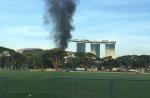


Photos sent by readers to Stomp show thick black smoke billowing from the burning boat. The smoke was also reportedly visible from Clarke Quay.
No other missing people or injuries have been reported from this incident, according to SCDF.
maryanns@sph.com.sg
Image:

Publication Date:
Wednesday, July 13, 2016 – 11:20
Keywords:
Send to mobile app:
Source:
Rotator Image:

Story Type:
Rewritten Story
Young parents lost about S$70,000 in phone scam

SINGAPORE – Armed with nearly 10 years’ worth of hard-earned savings, first-time parents Joanne and Mark (not their real names) were ready to move to an executive condominium with their three-month-old son, when they fell prey to a phone scam and lost almost…
Source link
Mandarin Airlines staff threatens 'collective vacation'

TAIPEI – The workers’ union for Mandarin Airlines (華信航空) on Tuesday threatened to take a “collective vacation” during the busy Mid-Autumn Festival, after talks between management and employees of the domestic carrier broke down.
“There was a (management-labour) schism. They rejected our very first demand of equal pay for equal work,” union spokesman Wu Yan-hsien (吳彥賢) said.
The union said it was planning a”collective vacation”during the busy Mid-Autumn Festival and that it did not rule out formal strike action on Jan. 1, 2017.
Flight attendants of China Airlines (中華航空), the parent company of Mandarin Airlines, went on strike late June, winning key concessions from management.
Employees of Mandarin Airlines said that those concessions should also apply to them, and complained that they earned 60 per cent of wages earned by their counterparts at China Airlines.
Mandarin Airlines, based in Taipei, primarily operates domestic and regional flights including destinations in mainland China, Japan, the Philippines and Vietnam.
Wang said Mandarin Airlines management wanted to work around the “equal pay for equal work” impasse by discussing lower-priority issues – a suggestion that the union rejected. Labor-management talks ended two hours after they began.
Other Demands
The union wanted management to harmonize their working hours with national labour laws and to provide guarantees for annual days off and public holidays.
Employees also demanded a guaranteed minimum of eight days off per month and 30 days off per season.
Worker representatives also claimed that top managerial positions at Mandarin Airlines had been appointed by China Airlines, leading to policies that were not necessarily in the best interests of the former’s employees.
It also found wanting collective employee insurance with its parent company, which increased operating costs.
Representatives of management said that work-related parameters differed between domestic and international carriers and that further review of employee benefits, adjustment in wages and off days needed to take into account the practices of Taiwan’s other domestic carriers including those of Uni Air (立榮航空) and TransAsia Airways (復興航空).
Company officials also said they were negotiating “proactively” with employees, adding that it was pushing for collective bargaining, doubling wages for employees working on public holidays and providing subsidies for the cleaning of employee uniforms as well as certain increases in benefits.
It added that while it was open to future negotiations with “greatest sincerity,” it was also preparing to protect consumer interests.
Image:

Publication Date:
Wednesday, July 13, 2016 – 10:51
Send to mobile app:
Source:
Story Type:
Others
New Pokemon game goes virtually ballistic in China

Pokemon Go, a mobile game that allows players to capture imaginary characters in real-life locations, has become a massive hit in China-even before it is officially released in the country.
The augmented reality game, which is available in Australia, New Zealand and the United States, went temporarily live for some hours in China on Monday and has since gone crazy with lucky hunters posting on their social networks all kinds of cute-looking Pokemons they find and capture in their bedrooms and in offices.
The wildly popular game has added $7.5 billion (S$10.1 billion) to the market value of its developer, Nintendo Co Ltd, since it debuted on July 6. But there is no official information about the game’s international rollout, so creating opportunities for those who want to make some quick bucks on the Pokemon fever in China.
A Pokemon Go clone has quietly climbed on to the top free game list on China’s iOS App Store. The game, named City Spirit Go, features a creature in the app icon that looks similar to a Pikachu. Though it isn’t equipped with augmented reality technology, it is location-based, requiring players to move around in order to discover and capture the imaginary creatures-just like Pokemon Go.
The game is free to download, but to improve gamers’ performances, there are many in-app purchases with the most expensive virtual diamond package costing $97. Most of the reviews are good with one commenting, “the game cannot be missed”.
Pokemon Go fever
Click on thumbnail to view photos. Source:
Reuters, AFP


















Apart from the knockoff game, on China’s most popular online marketplace Taobao of Alibaba Group Holding Ltd, about 100 retailers have set up businesses to provide US- or Australian- or New Zealand-based Apple store accounts to help Chinese players download the game.
The fee for using such an account is between 0.3 yuan (S$0.06) to 20 yuan and the best-selling store on Taobao has sold to more than 7,000 buyers.
However, downloading the game is merely the first step. The location-based game is not available in China, so it is not compatible with gamers who used a Chinese location.
“I’ve been using an app which can alter my location. So from the point of view of the server, I am playing it in the US,” said Dong Meng, a postgraduate student who has been playing the game since it debuted on July 6.
Image:

Publication Date:
Wednesday, July 13, 2016 – 11:06
Keywords:
Send to mobile app:
Source:
Story Type:
Others
Taiwan surgeons to feature in TV series

Taiwanese surgeons’ life-saving efforts, both locally and internationally, are being highlighted in a new TV documentary series that will soon premiere across Asia to showcase the nation’s medical achievements, the Ministry of Foreign Affairs (MOFA) announced Tuesday.
Speaking at a press event to unveil the series, “Taiwan Revealed: Medical Elite,” Vice President Chen Chien-jen (陳建仁), himself a renowned epidemiologist, praised Taiwan’s world-class medical care and technology as well as its national health insurance system that covers 99.9 per cent of its population.
Taiwan used to suffer from epidemics, poor sanitation and low medical standards, Chen said.
Over the past five decades, however, the country has managed to eradicate or bring under control more than a dozen communicable diseases, such as malaria, black-foot disease and polio.
“In the past the international community helped Taiwan eradicate several communicable diseases. Today as a nation with advanced medicine and health care, Taiwan is returning the favour,” he said.
“Our country has been transformed from a recipient to a provider of international assistance, enabling Taiwan to further realise the universal human right to medical care.”
Through the documentary, the Discovery Channel’s professional team introduces to audiences in Asia the “dedicated endeavours” of Taiwan’s medical practitioners, he added.
Among those featured in the series are Chen’s mentor, Lien Jih-ching (連日清), also known as Dr. Mosquitos, Chen said.
Lien is one of the medical professionals who helped eradicate malaria in Taiwan decades ago and who has also offered his expertise to fight the epidemic in Taiwan’s African ally Sao Tome and Principe.
Long-term Cooperation
During the same event, Foreign Minister David Lee (李大維) said the latest series is another collaboration between MOFA and the Discovery Channel, which started in 2003 to produce films that document some of the remarkable people and most interesting aspects of Taiwan.
The production crew captured footage of Taiwanese medical teams treating children with cleft lips and fighting malaria in Cambodia and Sao Tome and Principe.
The two new episodes of the series will debut on July 20 and July 27 at 10 p.m. on the channel across the Asia-Pacific region, airing in 36 countries and markets to more than 200 million households, according to the Discovery Channel.
Image:

Publication Date:
Wednesday, July 13, 2016 – 10:59
Keywords:
Send to mobile app:
Source:
Story Type:
Others
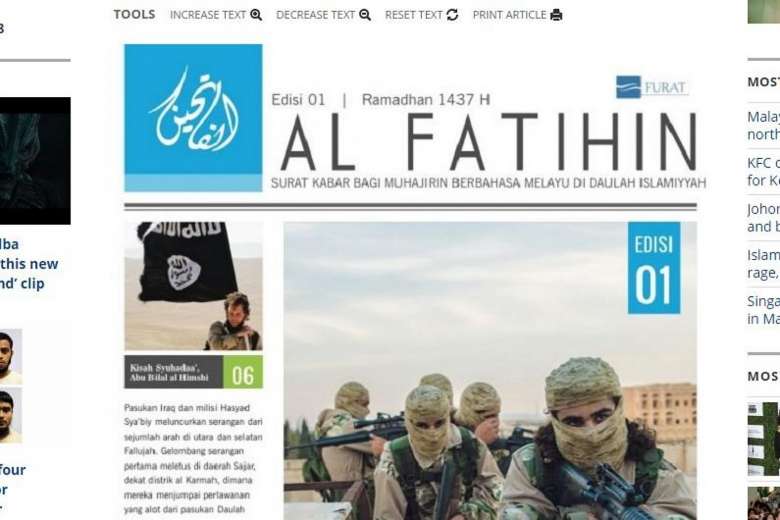
ISIS launches first Malay language newspaper in South-east Asia; distribution includes Singapore: Report
The Islamic State in Iraq and Syria (ISIS) has launched its first Malay language newspaper for its supporters in South-east Asia, as the terrorist group seeks to expand its reach in the region.
Malay daily Berita Harian reported on Monday (July 11) that the publication, called Al Fatihin, was launched in southern Philippines on June 20.
Al Fatihin means “The Conqueror” in Arabic.
It is also being distributed in Singapore, Malaysia, Brunei, southern Thailand, Indonesia and the Philippines.
According to the Malay Mail Online, which translated the Berita Harian report, an unnamed security expert was quoted as saying that the publication could signal that Malaysia was in ISIS’ sights.
“This psychological campaign means that the terrorists have a big objective, which is to expand their influence among people who understand the Malay language,” the expert said.
“Based on the way the language is used, we believe the writer or editor of the paper may be from this country.”
A paper published on June 23 by Singapore’s S. Rajaratnam School of International Studies, which is based within Nanyang Technological University, also confirmed the existence of the publication.
The paper’s authors, senior analyst Jasminder Singh and research analyst Muhammad Haziq Jani, noted that Al Fatihin’s tagline indicated that it would serve the existing South-east Asian “foreign fighters”, who mostly hail from Indonesia and Malaysia.
“Al-Fatihin’s tagline drives the point that, no matter the differences and nuances in language, identity and origins, South-east Asian jihadists have a common logos and as such, all Malay-speaking jihadists should act as one,” the paper added.
The 20-page inaugural edition was also “well-timed” for the holy month of Ramadan, and focused heavily on its significance, as well as the rituals of fasting. There were also reports on the caliphate and features on religion.

This article was first published on July 12, 2016.
Get a copy of The Straits Times or go to straitstimes.com for more stories.
Image:
Publication Date:
Wednesday, July 13, 2016 – 12:14
Send to mobile app:
Source:
Story Type:
Others


