
The team – including 13 children – were on their way to the Gothia Cup, a youth tournament in Sweden,…
Source link
13 children from Singapore youth football team stranded in Turkey
Singaporean children's football team stranded in Turkey
The team from the F-17 football academy which includes 13 children, have been stranded at the Antalya Airport, after their flight to Denmark was diverted due to the attempted military coup, says the football academy.
Source link
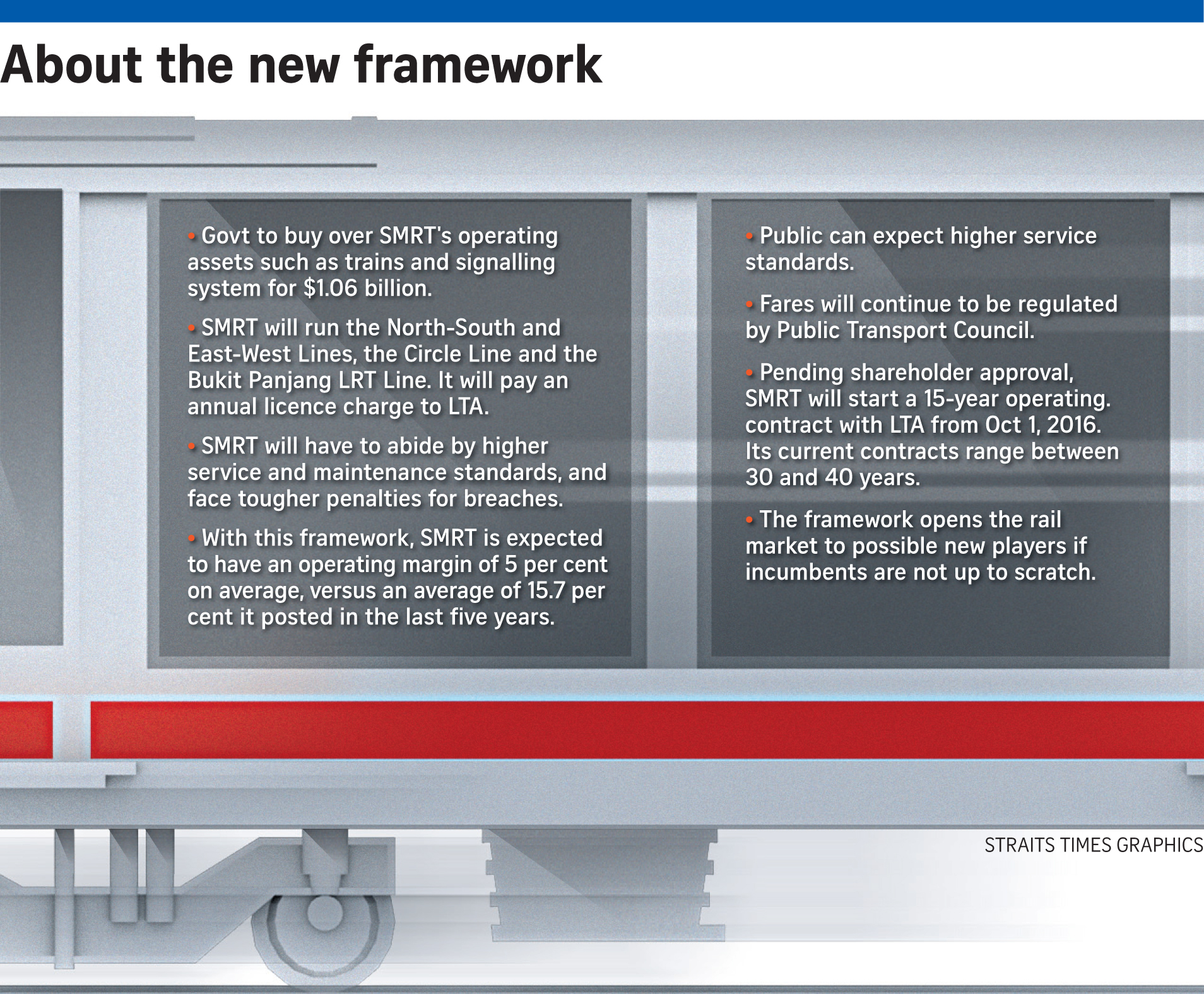
Transport minister Khaw Boon Wan lists benefits of LTA's $1b take over of SMRT's rail assets
Transport Minister Khaw Boon Wan believes the new rail financing framework will benefit commuters.
“It will allow the Land Transport Authority (LTA) to add trains to respond more quickly to demand, and to replace and upgrade existing rail assets in a more timely manner,” he said.
“This should achieve the twin objectives of raising rail reliability and reducing crowdedness.”
Mr Khaw noted that the new framework was first implemented for SBS Transit’s Downtown Line.
“We now look forward to its extension to all the SMRT train lines,” he said, adding: “The new rail financing framework will benefit commuters.”
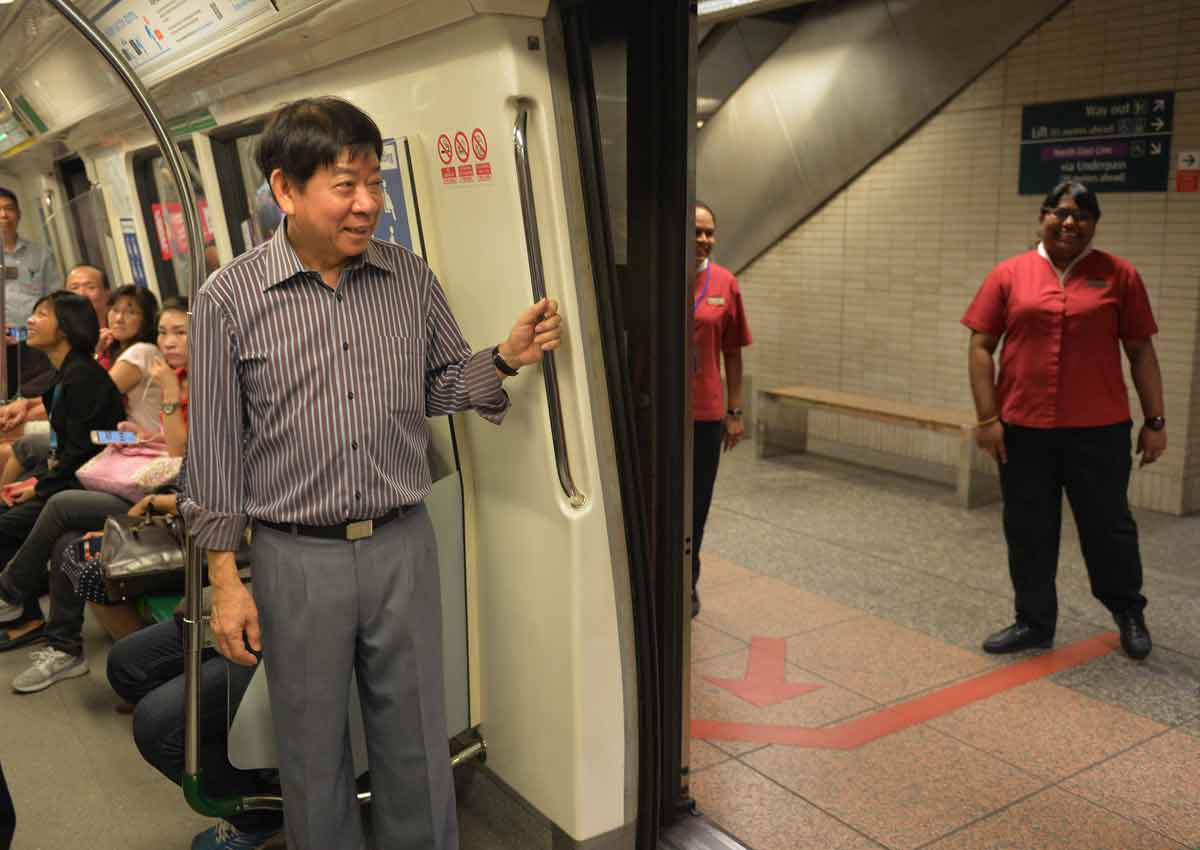
Mr Sitoh Yih Pin, chairman of the Government Parliamentary Committee for Transport, concurs. He said the operator will be able to focus on service to commuters and maintenance of the rail system.
“There will be no more large capital expenditures for the operator,” he said.
Mr Sitoh added that the new format also paves the way for “greater contestability”.
“The reduction of the licence period to 15 years will hopefully translate to more competition, improved service levels and cost-efficiency,” he said.
In a Facebook post, National Transport Workers’ Union executive secretary Melvin Yong said the union will study the new arrangement “in greater detail to assess its implications on our rail workers”.
“We will continue to work closely with LTA and SMRT to ensure that our workers’ interests and welfare are taken care of,” he added.
SIM University senior lecturer Park Byung Joon said the new framework translates to “more public funding and accountability”.
“The responsibility to invest in assets to improve the system now lies with the Government,” he said.
“Although there is no guarantee that this will lead to better service, there is no reason to doubt that it won’t,” he added.
National University of Singapore transport researcher Lee Der- Horng said: “I think commuters will benefit if it all goes as planned.
Hopefully, the operator can focus more on operations, and the Government can make the right judgment on the upgrade and renewal of the system.
“In a way, it is like getting the best of both worlds.”
Professor Lee, however, said he was surprised that SMRT was willing to settle for a substantially thinner profit margin in the new framework.
SMRT is expected to get an Ebit (earnings before interest and taxes) margin of 5 per cent on average, compared with the more than 15 per cent it has been getting on average in the last five years.
DBS Equity Research senior vice-president Andy Sim said that may not necessarily be a bad thing.
He said that as “compensation”, SMRT is “released from capital expenditure, which is a positive”.
“This will lead to more stable financials going forward,” he said. “But we will have to examine the details more closely to have a better idea of the exact impact.”
The analyst also said SMRT’s statement on not distributing the proceeds of the asset sale – more than $1 billion – to shareholders in the form of a special dividend is “somewhat of a disappointment”.
Mr Sim’s last recommendation for the stock, put out in April, was “hold”, with a target price of $1.53. Yesterday, SMRT hit $1.54 before trading was suspended at noon.
christan@sph.com.sg

This article was first published on July 16, 2016.
Get a copy of The Straits Times or go to straitstimes.com for more stories.
Image:
Publication Date:
Saturday, July 16, 2016 – 14:00
Send to mobile app:
Source:
Story Type:
Others
Five interesting playgrounds for the kids to romp in
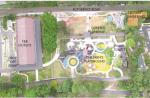
Earlier this month, families flocked to Marine Cove at East Coast Park in droves while children thronged its newly opened playground.
Outfitted with an array of inclusive play elements, the nautical- themed play area caters to children of different ages and diverse abilities, making it a draw for many kids. The result was lines of tots queuing for play equipment and jams along rope bridges.
Marine Cove reopens end-June: 5 things about the recreational enclave at East Coast Park
Click on thumbnail to view photos. Source:
National Parks Board, The Straits Times



If you fancy a less crowded playground for your young ones, here are five of the more interesting public ones across the island, that have more than just simple swings and slides.
The Straits Times speaks to local playground specialists – who supply, install and sometimes design play equipment – about the design considerations behind these neighbourhood landmarks. They are engaged by bodies such as the National Park Boards (NParks), the Urban Redevelopment Authority and town councils.
These specialists import a majority of their equipment from the United States and Europe, often mixing and matching equipment to fit their clients’ budgets and concepts. They also sometimes custom-build play equipment for more creative projects.
NParks was unable to respond to queries about the cost of playgrounds by press time.
All playgrounds here must comply with local safety guidelines laid down in SS 457, the Singapore safety standard for outdoor playground equipment.
The equipment should be weather-proof and strong enough to withstand heavy usage by children and the weight of parents who may accompany their children.
All playground designers aim to stimulate children’s development, says Mr Kenneth Kutska, executive director of the International Playground Safety Institute in the US and an expert in playground safety.
Says Mr Kutska, who has worked with playground specialist company CT-Art Creation here: “All the elements of a well-designed play area work together to provide settings for social exchange, problem-solving scenarios and physiological growth. And, best of all, they’re cleverly disguised as fun.”
West Coast Park
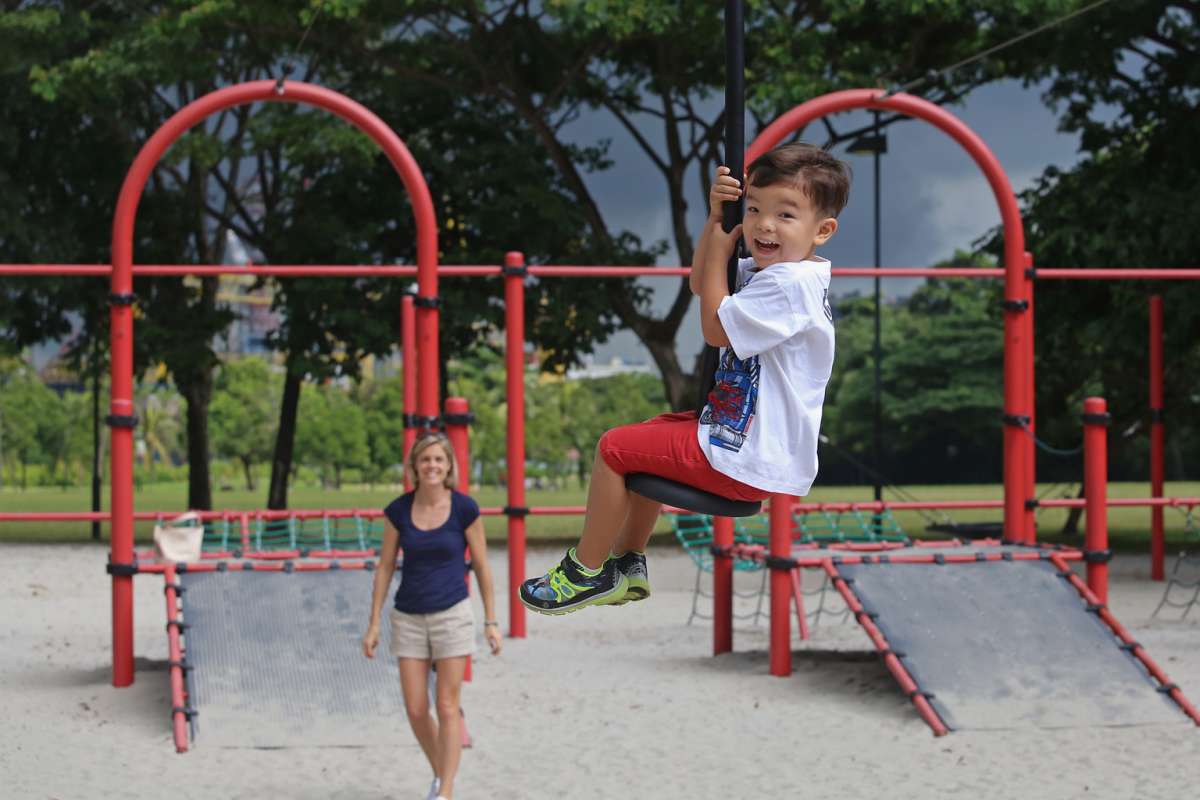
West Coast Park has been the stalwart playground of the west since opening in 1999.
However, it can still hold its own against newer playgrounds, thanks to its arsenal of adventurous play equipment that even teenagers find fun.
The 600 sq m playground houses a host of obstacle courses, such as a flying fox, balancing beams and a giant rope pyramid which, at 9.3m tall, is one of the largest in Singapore.
Student Sabrina Faisal, 19, says: “It’s not just a playground for kids. I can see its appeal to everyone because some of the equipment is quite challenging, but also very fun.”
There is an entire section for toddlers, including a mini fire engine and a Viking ship.
A few companies have worked on the playground over the years, adding new sections via renovation works.
Mr Patrick Lee, 52, director of CT-Art Creation, the agency that first developed the playground, says it caters to children of different ages.
Children aged two to five have lower centres of gravity and are shorter, so equipment with lower heights are more suitable for them. Handrails which are within their reach are installed on these play elements and steps are less steep.
As toddlers prefer imaginative play, equipment with designs that resemble real-life vehicles, such as the fire engine, also appeal to them.
Those aged five to 12 prefer more physically challenging and problem- solving tasks, hence the giant rope pyramid and balancing beams.
But safety always comes first.
Mr Lee says: “One must understand children’s behaviour. When they play, they will take risks. The most important thing is to ensure there are no hazards such as entanglement, entrapment, falls and sharp edges.”
Tiong Bahru Park
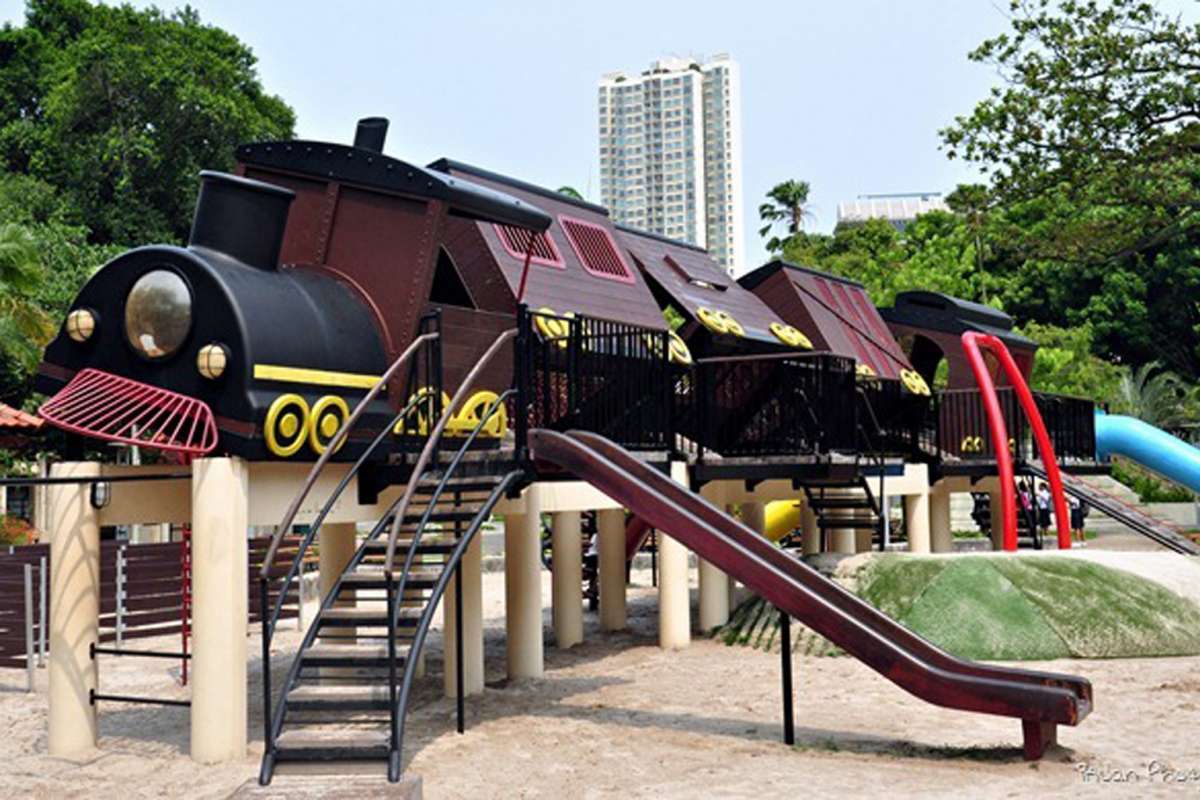
Visitors to this playground get to go on a train ride with a difference. The locomotive here features five cabins tilting at different angles, along with rope elements, climbing equipment and slides within the train.
Mr Kenny Chua, 51, director of playground specialist Swan-Li, which developed the park’s 900 sq m playground, says: “The angles give a disorientating effect and make it exciting and challenging for kids.”
First opened in 1967, Tiong Bahru Park was redeveloped in 2000 with the theme of “Old Frame, New Images”. The train was then built in line with a concept by a landscape consultant engaged by the National Parks Board (NParks).
During the design stage, Swan-Li sought advice from teaching staff at Nanyang Polytechnic School of Design and School of Engineering.
Mr Chua says: “Its team of experts worked with our in-house designers to come up with the final design. We then developed it using 3-D modelling software, made a scale model and presented it to NParks.”
The final train design was also checked for playground safety compliance before being built.
“It’s one of the few customised themed playgrounds in Singapore and children like these. My hope is that we can have more customised and adventurous playgrounds for them to explore,” adds Mr Chua.
Other themed playgrounds in Singapore include the rainforest treehouse playground at Gardens by the Bay; a dinosaur-themed playground at Block 827 Woodlands Street 82; and an animal kingdom playground at Block 686 Woodlands Drive 73.
Yishun River Green
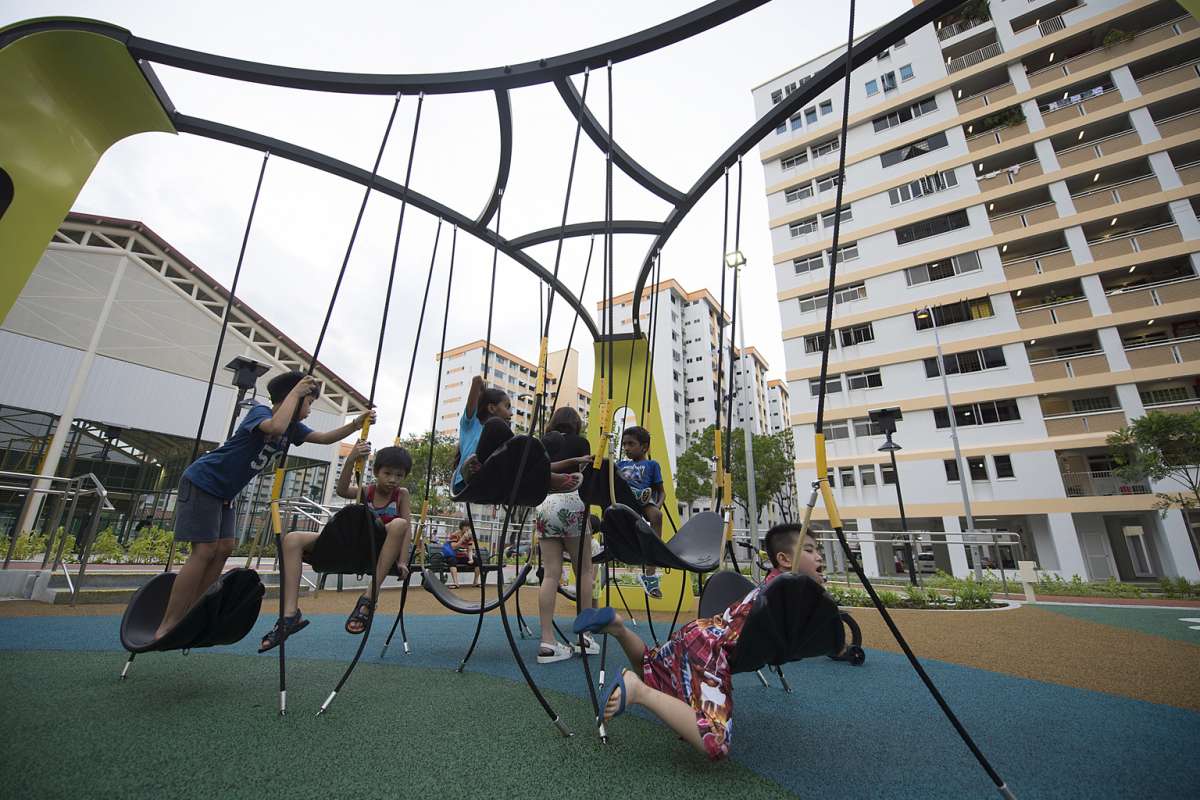
Yishun residents have an art installation of a playground to let their children run around in.
The Yishun River Green playground, located at Block 330 Yishun Ring Road, features the Mini Pool, an art installation involving 16 pads on the ground that light up and change colour when they are stepped on.
The work is by Jen Lewin, a light sculptor based in the United States whose work was displayed at the 2014 edition of i Light Marina Bay, a light art festival that emphasises sustainability and energy-saving measures.
Her art caught the eye of Playpoint, the playground specialist which developed the play area commissioned by the Nee Soon Town Council.
Mr Jason Sim, 40, Playpoint’s managing director, says: “We felt her concept was innovative and the future of play should go in that direction.”
Complementing the 480 sq m playground’s whimsical theme are three crooked houses that seem to have been plucked straight out of a children’s book by, say, Dr Seuss. They were designed by Monstrum, a Danish playground design company.
There is also a kinetics hammock trellis – a swingset with nine seats installed at different heights.
The playground, which opened in December last year, was developed with an estimated budget of $413,000, according to Playpoint.
Mr Sim says most playground equipment use the same principles, with similar spinning, swinging or moving motions.
“It’s how you incorporate these into design elements with a different wow factor to attract people.
“The ideal playground should be a mixture of architecture, aesthetics and play value – something that both the commissioning parties and designers can be proud of.”
Sembawang Park
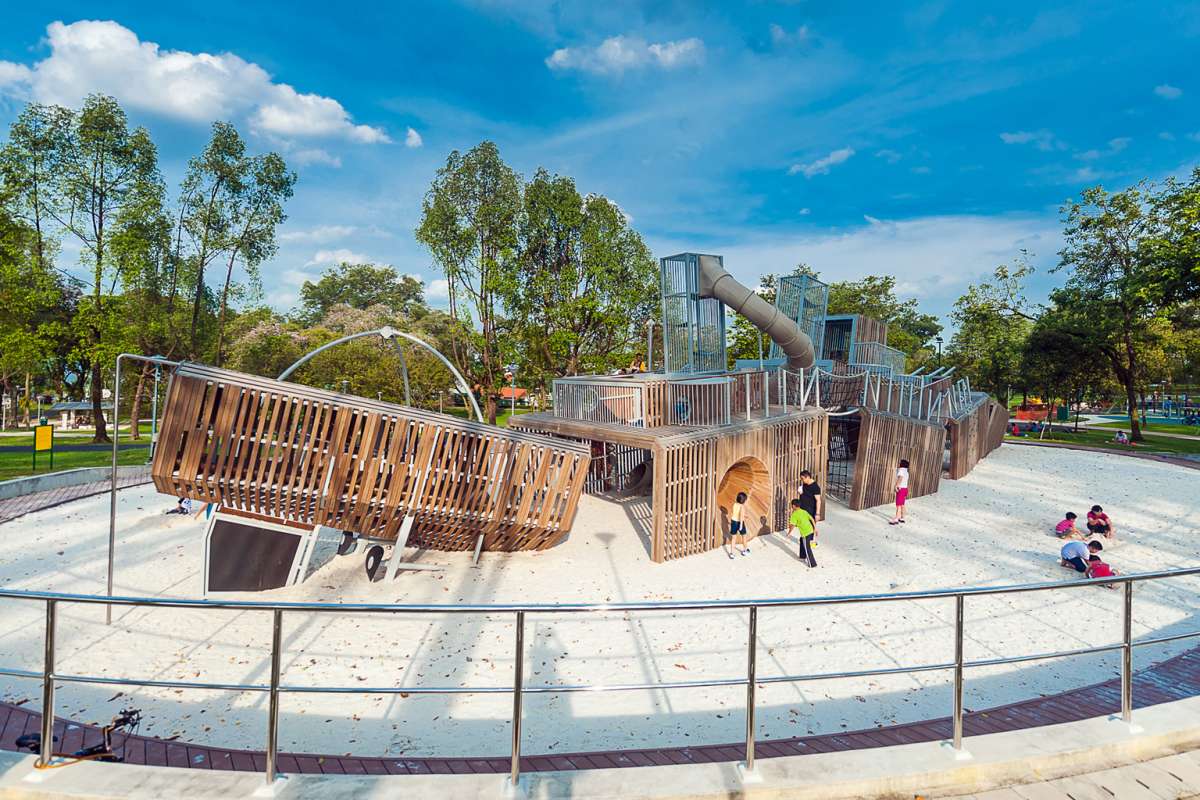
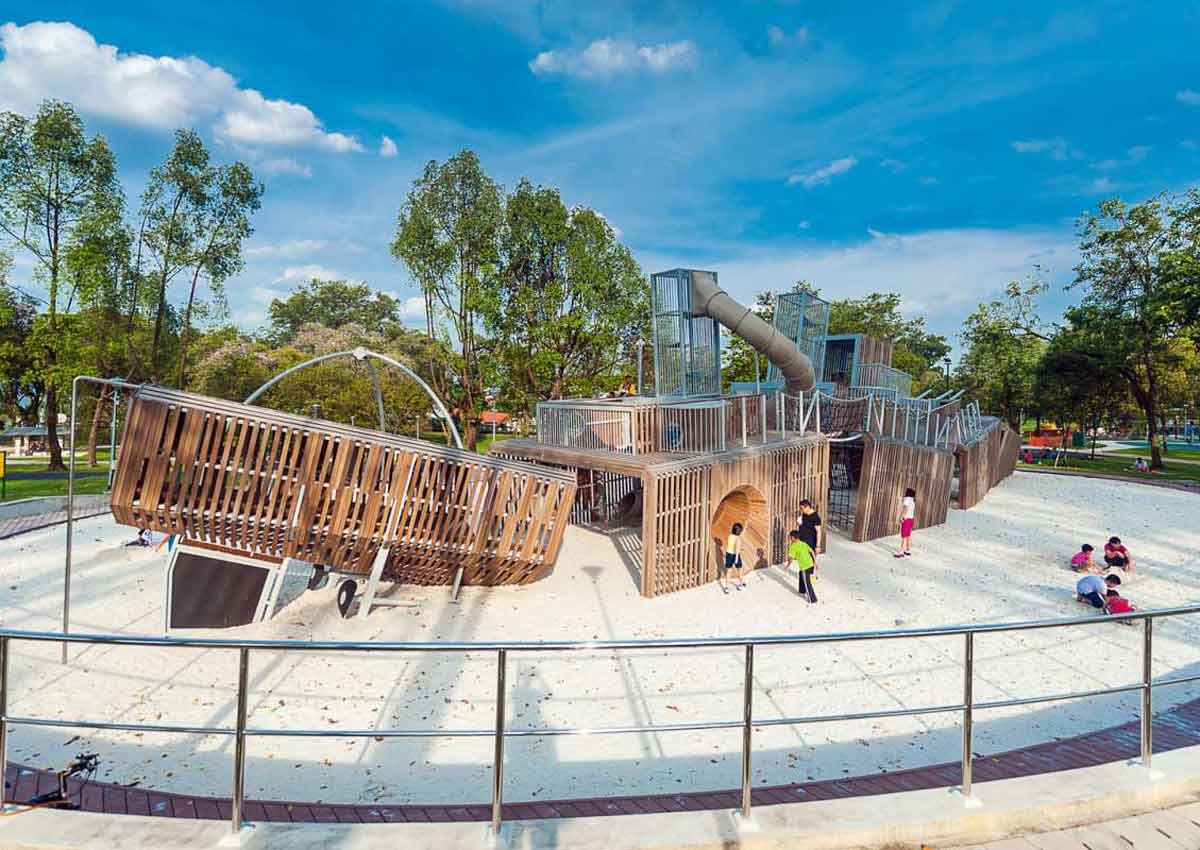
Nestled within the coastal Sembawang Park is a life-sized shipwreck of wooden planks and galvanised steel, separated into five fractured pieces.
The massive “wreck” is the centrepiece of the 900 sq m Sembawang Park playground, commissioned to be maritime-themed “because of the area’s links to the naval history of Singapore”, says Ms Kartini Omar, group director of the Parks Development Division at the National Parks Board (NParks).
The “wreck” was built in memory of two British battleships that sank north of Singapore after being attacked by the Japanese during World War II. Complete with gun turrets, propellers, smoke stacks and even a rudder, the ship was crafted with an emphasis on detail. It opened in July 2013.
Mr Jason Sim, 40, managing director of Playpoint, the Singapore playground specialist company that built the structure, says: “There is even a hole on the hull of the ship marking where the torpedo entered it.”
Playpoint has also designed playgrounds at Gardens by the Bay, Jem mall and Singapore Sports Hub.
In line with the naval theme, the playground in Sembawang Park uses sand as a base instead of a “unitary surface”, which is the rubber flooring seen at some other playgrounds.
Sand has long been a staple feature of playgrounds – and for good reason. According to child development experts, playing with sand brings many benefits to children, such as enhancing sensory experiences and creativity.
However, according to consultants, it is also sometimes considered more difficult to maintain as it may harden or get displaced.
Pasir Ris Park

Families are drawn to the Pasir Ris Park playground near Elias Road for its coastal view, sea breeze and welcoming 750 sq m of space.
Thanks to its expanse – afforded to only a handful of playgrounds in Singapore – the playground has a collection of well-spaced-out play equipment.
Ms Laura Connelly, 31, a part-time English teacher and mother of two daughters aged three and one, says: “The play area is huge and my girls can easily spend an hour exploring the variety of play structures there, as well as walk along the coast and spot chickens and often a family of otters in Sungei Api Api.”
The highlights of the playground include a 10m-long slide stemming from a rope pyramid perched atop a hill, several rock-climbing walls and a rope bridge.
The playground has been built and upgraded by different companies over the years.
Despite being built to withstand heavy usage, the playground requires regular inspection and maintenance for safety.
Mr Patrick Lee, 52, director of playground specialist CT-Art Creation and a certified playground safety inspector, says the maintenance schedule depends on the playground owners and typically occurs once every few months.
But there is one problem frequent checks cannot prevent: vandalism.
Mr Patrick Yeo, 45, director of Mexplay, another playground specialist company, says: “The biggest challenge of the upkeep of equipment comes not from the children’s heavy use of them, but rather, from vandals.”
Unfortunately, playground specialists say there is little playground caretakers can do, except remove markings and spraypaint with thinner or paint over the vandalised sections.

This article was first published on July 16, 2016.
Get a copy of The Straits Times or go to straitstimes.com for more stories.
Image:
Category:
Publication Date:
Saturday, July 16, 2016 – 17:00
Keywords:
Send to mobile app:
Source:
Story Type:
Others
SMRT will still shoulder significant risks, says its CEO
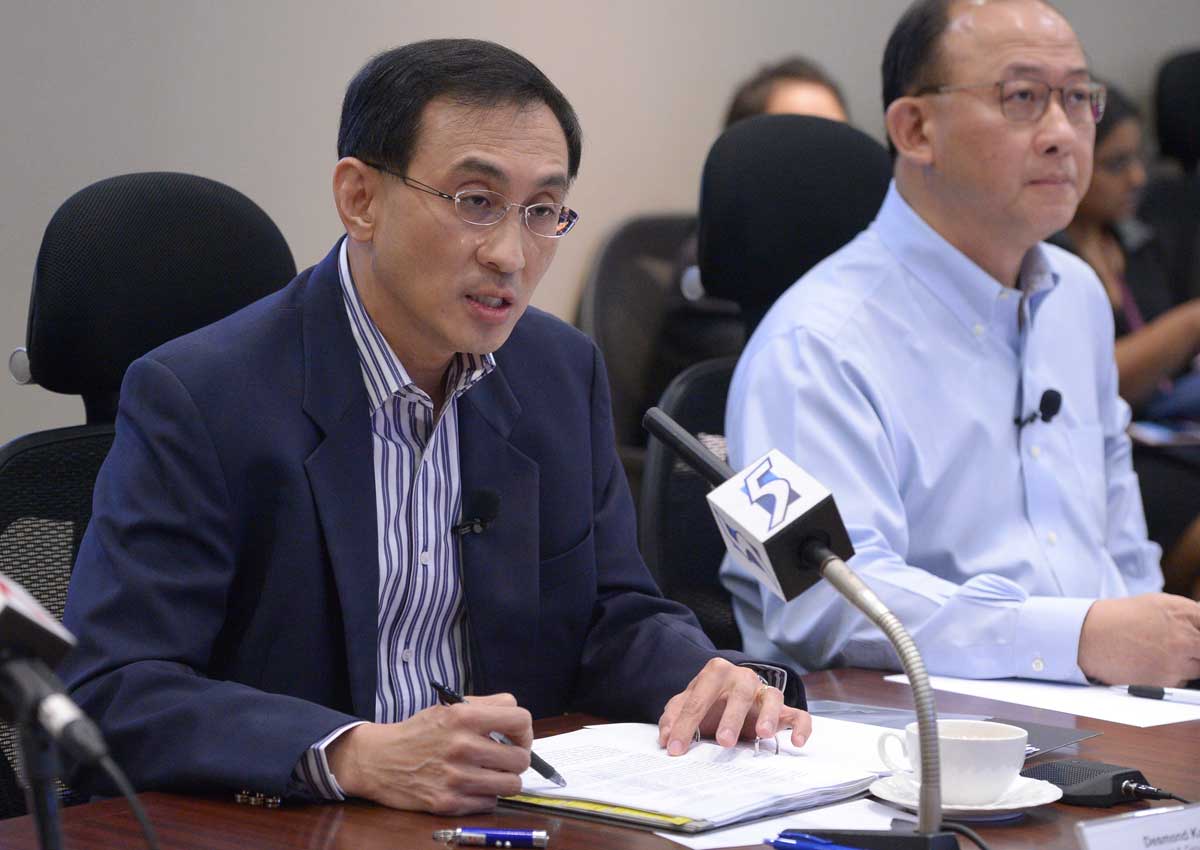
While the new rail financing framework means that SMRT gets some protection in terms of fare revenue and profitability, the company will still be shouldering “significant risks”, said the operator’s president and group chief executive officer, Mr Desmond Kuek.
“We are still not in control of fares and we don’t have all the visibility over ridership going forward or the impact that new lines will have on our existing lines in terms of ridership and the total revenue that might be collectible under our existing lines…
“There continues to be significant risks for us which we have very little control over,” he said.
For investors, the news will likely come as a relief from the growing uncertainty of SMRT’s finances. SMRT itself admitted yesterday that the current model is an “unsustainable” one.
Noted DBS Equity Research senior vice-president Andy Sim yesterday: “(With SMRT) released from capital expenditure, which is a positive… this will lead to more stable financials going forward.”
UOB Kay Hian Research’s Andrew Chow said that “overall”, it is a positive move, adding that it will free SMRT from a heavy capital expenditure commitment.
Speaking to reporters and analysts at a briefing last evening after the Land Transport Authority announced that it will take over all of SMRT’s operating assets to free the operator to focus on service levels, Mr Kuek said the upside is the risk-sharing element built into the new framework. This “was never there before”, he said.
With the new deal, LTA will shoulder some of the financial burden if earnings (before taxes and interest) fall below a certain level.
However, there is less upside for SMRT because once earnings are higher than a stipulated level, as much as 95 per cent of the excess will go back to the LTA.
Mr Kuek noted that SMRT’s rail business has faced declining profitability since 2012 and it would not have been possible for the firm to sustain its financial obligations and the heavy capital expenditures required by an expanded and ageing network.
For example, maintenance-related expenses increased to reach 45 per cent of rail fare revenue in the 2016 financial year.
The cost of meeting “heightened regulatory standards” has also increased, he said. On the other hand, fares have gone up by just 1 per cent year-on-year in the last five years.
The new framework will not impact fares, which continue to be regulated by the Public Transport Council, the LTA said. This will be based on the current fare adjustment formula, which expires next year.
With SMRT set to receive $1.06 billion (with GST) for the transfer of assets, shareholders may be disappointed to learn that they will not be getting any special dividends.
Instead, SMRT intends to use the money mainly to boost service levels and reliability, including hiring more maintenance staff, Mr Kuek said.
At least 700 will be hired over the next three years. This is on top of the 30 per cent increase in technical workforce that SMRT has made in the last three years, he added.
SMRT also plans to pare some of its total debt as well.
SMRT had called for a trading halt before the announcement was made, and its shares last traded at $1.545. Although investors will not get a special dividend, they may still welcome the news when trading resumes on Monday.
Rival SBS Transit saw its shares close 8.9 per cent higher yesterday, possibly because of news that it is in talks with LTA regarding a similar transfer of its lines.
karam@sph.com.sg
marilee@sph.com.sg
This article was first published on July 16, 2016.
Get a copy of The Straits Times or go to straitstimes.com for more stories.
Image:
Publication Date:
Saturday, July 16, 2016 – 14:00
Keywords:
Send to mobile app:
Source:
Story Type:
Others
Singaporeans advised to avoid non-essential travel to Turkey

SINGAPORE – The Ministry of Foreign Affairs (MFA) has advised Singaporeans to avoid non-essential travel to Turkey for the time being, after an attempted Turkish military coup early on Saturday (July 16) morning.
“Singaporeans who are in Turkey should stay…
Source link
3 Singapore-based scientists linked to research fraud
Their research was hailed as a breakthrough in the fight against killers such as obesity and diabetes.
But now, at least three scientists working in top Singapore institutions and funded by major government organisations have been linked to scientific fraud in what could emerge as one of the biggest such cases here.
So far, two of the researchers have left their posts and another has had his PhD revoked, and six of their papers have been retracted.
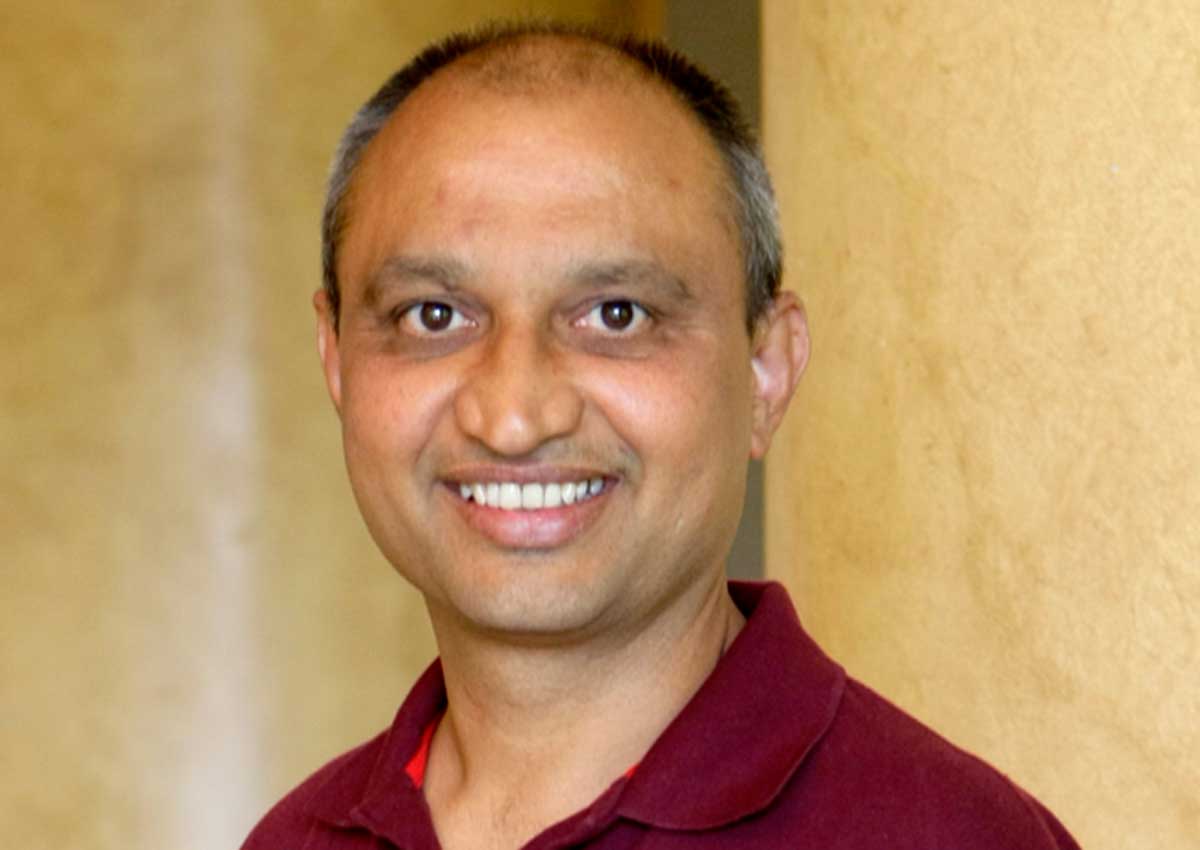
The trio at the centre of the scandal are Professor Ravi Kambadur, 54, who was with the Nanyang Technological University (NTU); Dr Mridula Sharma, who was associate professor at the National University of Singapore’s (NUS) Yong Loo Lin School of Medicine; and former NTU researcher Sudarsanareddy Lokireddy.
Their work focused on myostatin – a protein that regulates muscle growth in humans and animals, whose suppression the researchers claimed could keep people in “fat-burning mode” and let them shed kilos.
It was led by Prof Kambadur, whose joint appointments at NTU’s School of Biological Sciences and the Singapore Institute for Clinical Sciences – which comes under the Agency for Science, Technology and Research (A*Star) – have been “terminated”, according to NTU.
Dr Sharma is no longer at NUS and Dr Lokireddy has had his PhD from NTU revoked.
NTU, which did not elaborate on how the falsifications were uncovered, said its investigations in December last year led to three myostatin papers published in 2011 and 2012 being retracted.
Two other papers were corrected and another withdrawn prior to publication.
Three more papers published from 2012 to 2014, based on research funded by A*Star and the National Research Foundation (NRF), are now being retracted from the journals Molecular Endocrinology and Journal of Biological Chemistry.
Both funding bodies could not confirm how much money had been pumped into the research.
Said NRF chief executive Low Teck Seng: “NRF holds a very high expectation with regard to the research that we fund. We do not condone any fraud or flouting of ethics. In my view, the organisations involved acted swiftly and appropriately.”
Scientific misconduct is taken very seriously as false information can have a knock-on effect. In the current case, the retracted papers have already been cited by other researchers in their studies.
NTU said it was obliged to urgently correct the literature as part of its responsibility to the community.
An NUS spokesman confirmed that Dr Sharma is no longer with the university, but declined to comment further.
Retraction Watch, a website that monitors retractions of scientific publications, reported that the falsifications also happened in Dr Lokireddy’s NTU doctoral thesis. He got his PhD four years ago.
Since then, he has been a post-doctoral fellow at Harvard Medical School, in the United States, where he published at least one paper as first author, in the prestigious US journal Proceedings Of The National Academy Of Sciences (PNAS) late last year.
A Harvard University spokesman did not respond to questions about Dr Lokireddy’s employment status or the integrity of the PNAS paper, but said: “We are fully committed to upholding the highest standards of ethics and to rigorously maintaining the integrity of our research. Any concerns brought to our attention are thoroughly reviewed.”
NTU said that “disciplinary proceedings” are being taken against other researchers, and that Prof Kambadur’s research students will be re-assigned to appropriate supervisors.
When contacted by The Straits Times, Prof Kambadur declined to comment, saying that he would leave it to NTU to investigate.
Dr Sharma and Dr Lokireddy could not be reached for comment.
linyc@sph.com.sg
This article was first published on July 16, 2016.
Get a copy of The Straits Times or go to straitstimes.com for more stories.
Image:
Publication Date:
Saturday, July 16, 2016 – 14:00
Keywords:
Send to mobile app:
Source:
Story Type:
Others
Uma Uma Ramen: 1-for-1 Ramen 4th Anniversary Special on Monday, 25 July 2016

Uma Uma Ramen: 1-for-1 Ramen & $3 side dishes at Forum on Monday, 25 July
Uma Uma Ramen: 1-for-1 Ramen 4th Anniversary Special on Monday, 25 July 2016
Uma Uma Ramen serves true Hakata Style ramen with thin delicious noodles, made according to a family recipe, and a robust and aromatic tonkotsu stock.
Singapore's MFA advises against travel to Turkey
Singaporeans who are in Turkey should stay indoors, monitor the news closely and e-register with the Ministry of Foreign Affairs it says.
Source link
Taiwan train blast suspect confesses to acting alone

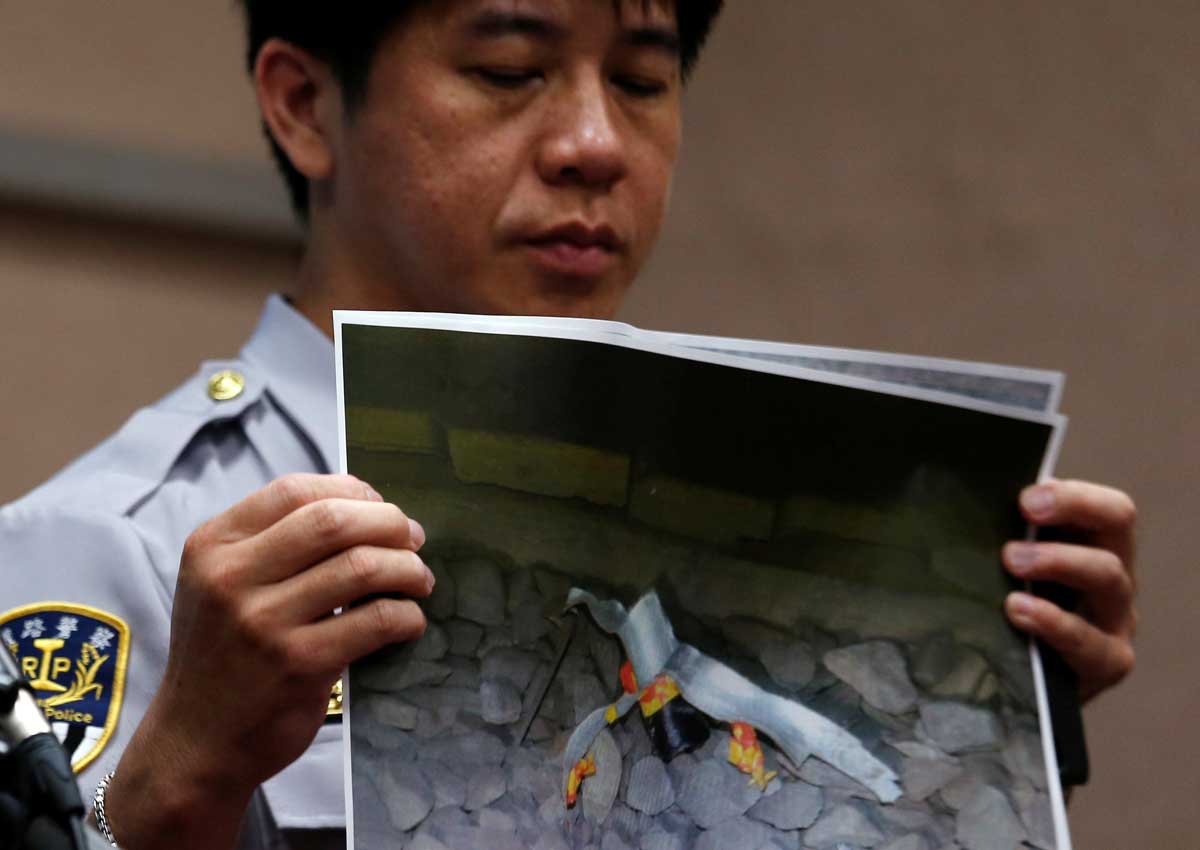
TAIPEI, Taiwan – The suspect involved in the commuter train blast that injured 25 people on the night of Thursday, July 7 confessed on Friday afternoon that he was responsible for the explosion and did not have any accomplices, according to police sources.
Ling Ying-chang (林英昌), the 55-year-old male suspect who was among the 25 victims wounded during the blast, reportedly made the confession when indirectly questioned by the police.
Lin also confirmed evidence that he detonated an explosive device on commuter train 1258’s sixth carriage on Thursday, July 7, two minutes before it was due to arrive at Taipei Songshan Railway Station.
Lin also told the police that his real motive was to achieve “fame.”
Suspected pipe bomb explodes on Taiwan train
Click on thumbnail to view photos. Source:
Reuters, The China Post/ANN, AFP








Details Still Remain
As Lin, who was seriously injured in the blast, has yet to recover, the police very slowly carried out questioning, with many details remaining to be cleared.
The police started to interrogate Lin at around 3 p.m., Friday, in the presence of prosecutors, but with the entire questioning process recorded and videoed. The suspect was very cooperative in the process, the police said.
According to doctors, Lin is still unable to be discharged from the hospital.
The police will therefore continue to safeguard Lin at the hospital, and will hand the results of the interrogations to prosecutors.
Lin was identified as a key suspect within hours of the explosion, because he was seen nearest to the explosive device at the time of the explosion and his fingerprints were found on the device.
Further evidence later emerged showing that he was responsible for the incident.
Consumer Terrorism
Lin was suspected by investigators to have been planning an earlier act of “consumer terrorism.”
Lin purchased a bottle of Paraquat, a highly toxic weed killer, before heading north to Taipei from central Taoyuan county.
Investigators surmised that he planned to inject the poison into consumer drinks to trigger a public panic.
He also prepared a sharp tool that could easily pierce through a container and inject liquid into the container. The tool helped investigators rule out the possibility that Lin intended to commit suicide by drinking the herbicide.
Image:
Publication Date:
Saturday, July 16, 2016 – 11:13
Keywords:
Send to mobile app:
Source:
Story Type:
Others


