Image:
Publication Date:
Wednesday, July 27, 2016 – 14:00
Keywords:
Send to mobile app:
Source:
Story Type:
Others
PM Lee Hsien Loong and the Prime Minister’s Office is holding a contest for members of the public to win tickets to this year’s National Day Rally.
Source link
The latest team, that will serve from 2016-2018, will be led by it new Chairman Mr Lock Wai Han.
Source link


Singer Justin Timberlake got slapped in the face and he doesn’t know why.
The incident, which took place at a golf tournament at Lake Tahoe in the US, came out of the blue.
Video footage released by paparazzi website TMZ shows a heavily-escorted Timberlake being slapped by a hand.
Taken aback, Timberlake stopped and asked his unidentified assailant: “Bro, why would you do that?”
According to Billboard, the man who slapped Timberlake wanted to “touch” the singer and had simply been overly enthusiastic in his encounter with the singer.
The man refused to leave the premises after being told by the police to do so. He was subsquently arrested for disorderly conduct.
Timberlake will not pressing charges against the man, said reports.
prabukm@sph.com.sg

As the National University of Singapore (NUS) began its crackdown on sexualised activities during orientation games yesterday, Members of Parliament (MPs) expressed surprise and concern that such activities are still happening.
Several orientation camp organisers in NUS were called up for questioning by the school administration, following The New Paper’s report on sexualised games at some of the camps.
Some female participants said they were pressured into taking part in these games despite their discomfort. The games included a simulated rape between siblings, embarrassing questions about sluttiness and bodily fluids, and inappropriate body contact.
TNP understands that the NUS Students’ Union, in particular, is under intense scrutiny, but has so far denied allegations of indecency.
Many people were outraged by the report and MPs called on the school to take a closer look at such activities.
In a statement yesterday, an NUS spokesman said that inappropriate activities and behaviours are not condoned by the school and “strong disciplinary action” will be taken.
“NUS takes an extremely serious view of the recent media report and feedback on instances of offensive and completely inappropriate orientation activities,” she said.
“We are very disappointed that… instances of offensive and completely inappropriate orientation activities that were not submitted nor endorsed have surfaced.”
About 40 orientation camps were organised by the different faculties, halls, student union, and school societies in NUS this year.
The spokesman said that all students involved in organising and leading the camps were briefed by the Office of Student Affairs (OSA) before the activities were carried out.
They were also given a list of dos and don’ts.
She said: “Students were also made aware that strong disciplinary actions will be taken against offenders.
“In addition, all proposed orientation programmes and activities had to be endorsed and cleared by the relevant supervisors, such as hall masters and vice-deans, as well as OSA, before they could proceed. Students were asked to remove inappropriate activities.”
An e-mail was sent to all NUS students yesterday to assure them that the school is “committed to providing students with a safe and secure environment”.
Mr Seah Kian Peng, who is on the Government Parliamentary Committee (GPC) for Education, was surprised that sexually suggestive activities were still going on despite complaints over the past decade.
After finding out details of some of the activities, he described them as “unnecessary and humiliating”.
He urged the universities to take a hard look at these activities and examine the purpose of such camps.
“If the purpose of an orientation camp is team bonding or a rite of passage, such behaviour cannot be justified in any way. They have definitely crossed the line,” he said.
“During the planning process, the leaders should just ask themselves: Is this something they would want their younger siblings to go through?
“If they had a daughter, would they want her to experience this?”
Ms Denise Phua, GPC chairman for education, urged the organisers to reflect on the purpose of orientation camps. She said: “They should consider other activities that are less controversial and still fun and memorable.”
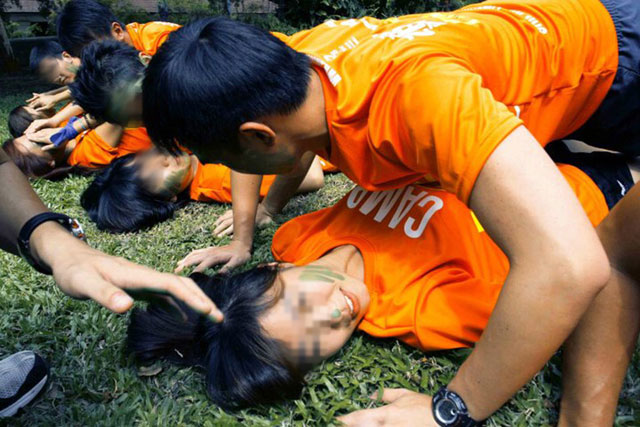
Photo taken at Singapore Institute of Management-University of London’s (SIM-UOL) orientation games in 2011. PHOTO: Wanbao reader.
PARENTS REACT
Many parents were shocked to read about the sexualised activities at NUS and some went on TNP’s Facebook page to register their disapproval.
Netizen Yoshimura Isaac wrote: “Frankly, if my daughter goes for such a orientation, then I will make sure I change her to another school. It’s supposed to be teaching things that are useful to their future, not teaching them to do or act (in) such a manner.”
Another netizen, Alvin Teow, wrote: “If NUS doesn’t deal with this in the right way, then all parents should think thrice about letting their daughters enrol in NUS.”
TNP reader Josephine Ng, 46, a housewife, called the activities ridiculous and embarrassing.
“When I read the article, I could not believe it. I’ve read past reports and this is not excusable,” said the mother of two girls aged 12 and 14.
“If the school cannot handle it, then I think it’s time the Government steps in,” she said.
“Such activities have a long-term impact, not just on the students but on Singapore’s image as well.”
Ms Phua said that parents are understandably concerned.
“But their children are no longer kids, and they must let them decide if they wish to take part in such activities,” she said.
In previous years, it was reported that the Social Development Unit (SDU), which was formed in 1984 to promote marriages among graduate singles, had sponsored many of the orientation camps in universities.
In 2008, a letter to The Straits Times forum page complained about risque activities at orientation camps and called for SDU and the universities to monitor the activities.
An SDU spokesman said at the time that it had informed students who sought its support to keep physical contact to a minimum.
The unit was renamed the Social Development Network (SDN) in 2009.
An SDN spokesman told TNP yesterday: “Since January 2016, SDN has ceased its funding for university camps and events.”
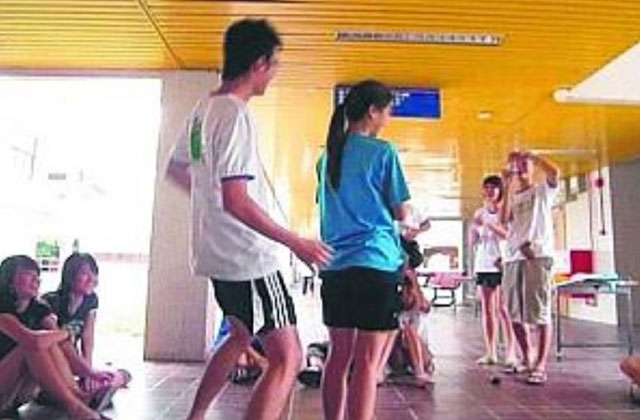
A forfeit previously done at camps in NTU and NUS in 2008, where one person pretends to be a pole while the other pole-dances. PHOTO: Stomp.
Clear guidelines for NUS orientation
An NUS spokesman told The New Paper that clear guidelines on dos and don’ts were set for orientation activities.
DOS:
DON’TS:
Unfair to generalise: Orientation leader
Sexualised activities are not the norm at NUS orientation camps, an orientation group leader (OGL) said yesterday.
Speaking in his personal capacity, Mr Siew Jowen, 22, told The New Paper: “I felt that it was unfair to the other orientation groups in this camp, and other orientation camps, because such incidents are isolated.”
He said the re-enactment of the incestuous rape scene did not take place in his group. “I did not even know this rape game existed,” he said.
The NUS Students’ Union camp has 20 orientation groups this year, each led by a different OGL. Before and during the games, OGLs will ask the participants if they feel comfortable with the activities, Mr Siew said.
“Anyone is free to pull out. We respect people’s choice and we will not make them feel bad for quitting,” he said.
And some participants did sit out for some of the games. “We tend to see the same few participants sitting out. All the games planned by the camp committee are non-sexualised,” he said.
Asked about how games become sexualised, Mr Liew said: “We are all adults so there might be sexual innuendo that slipped (in). However, none of them is intentional.”
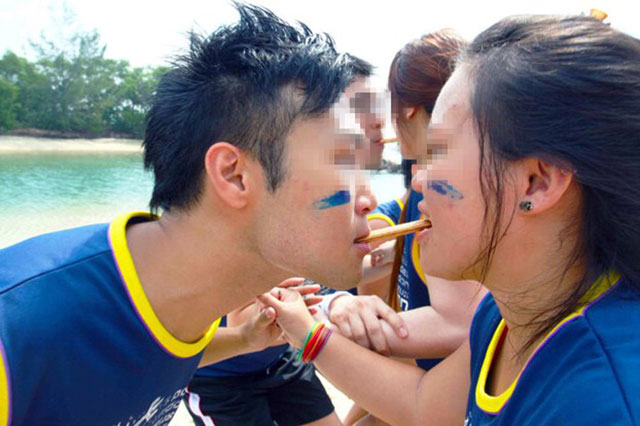
Photo taken at Singapore Institute of Management-University of London’s (SIM-UOL) orientation games in 2011. PHOTO: Wanbao reader.
SMU bans improper themes, NTU stays alert
The Singapore Management University (SMU) has guidelines for its freshmen orientation camp (FOC) activities to ensure that close physical contact between the sexes is kept to a minimum.
Activities with improper themes are prohibited, a SMU spokesman told The New Paper yesterday.
There are other rules to ensure the safety and well-being of camp participants.
For example, rules on separate sleeping arrangements for men and women are strictly enforced and alcohol consumption is prohibited.
The SMU FOC, which is funded by the university, is organised by the SMU Students’ Association and the Office of Student Life.
All student organisers and student facilitators involved in the FOC undergo training via workshops on risk assessment and management, games leadership, facilitation and CPR-AED certification.
Nanyang Technological University (NTU) has similar guidelines for its orientation activities. This year, NTU “redefined” these activities to focus on values including inclusiveness and mutual respect.
NTU Associate Professor Kwok Kian Woon, Associate Provost (student life), said: “… Organisers of orientation activities have been advised not to pair or group participants together based on gender or any other factor.
“Unwanted or unwelcome physical contact and other activities that are not in keeping with the orientation objectives and student code of conduct are strictly prohibited, and the university will not hesitate to take disciplinary action in such cases.”
Associate Prof Kwok said that professors and staff in the schools and halls have also become more involved and proactively supporting the student leaders’ and orientation organisers’ efforts.
He said: “… No student should take advantage of any freshman.
“We are aware of the issues and have been working closely with NTU student leaders to encourage greater safety and responsible behaviour during orientation, dedicating significant university resources to their activities.”

This article was first published on July 27, 2016.
Get The New Paper for more stories.

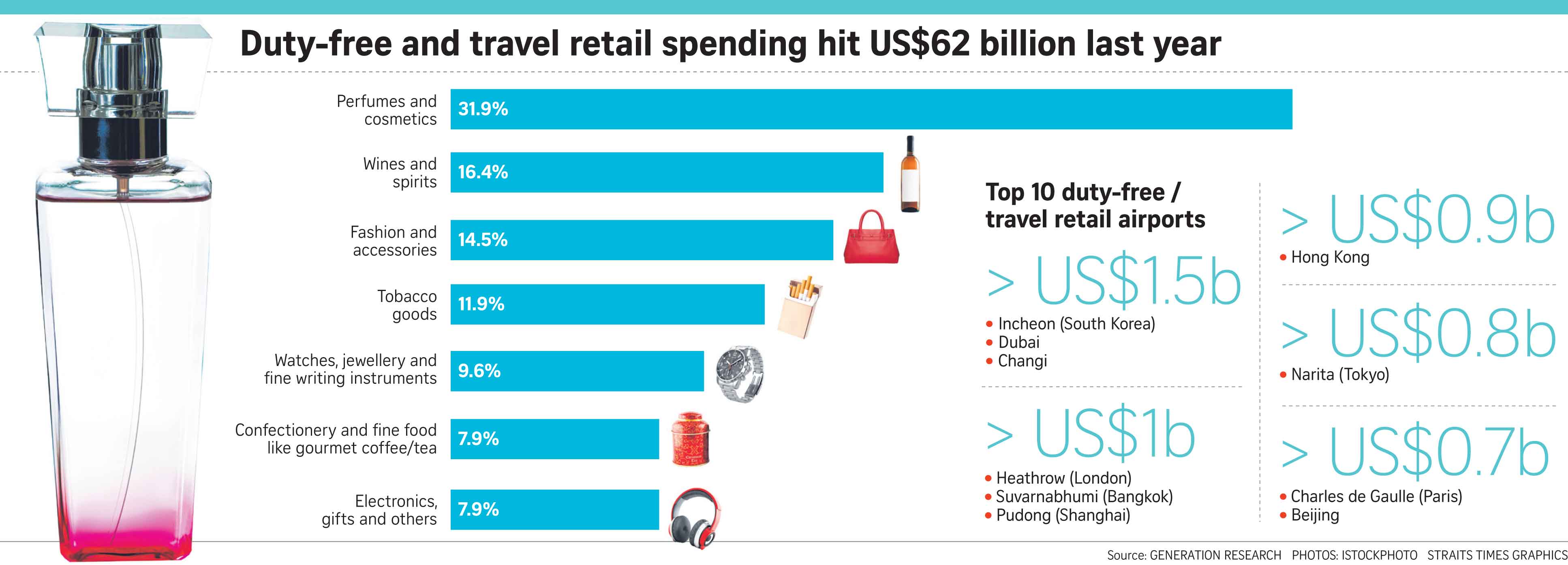
Changi is one of only three airports that raked in more than US$1.5 billion (S$2 billion) in spending by travellers last year.
Actual amounts were not stated but Changi was ranked third, behind South Korea’s Incheon and Dubai, in a recent study by Swedish duty-free and travel retail consultancy, Generation Research.
Globally, travellers spent a total of US$62 billion at duty-free and airport shops last year, about 3 per cent less than the US$63.8 billion in 2014.
Asia was the only region where spending increased.
Perfumes and cosmetics made up about a third of the total sales, followed by wines and spirits, and fashion and accessories.
With demand for travel in the Asia-Pacific expected to grow in tandem with a burgeoning middle class, airports in the region can expect takings to increase further, said experts.
For Changi, increasing commercial revenue is key to keeping the airport competitive, as part of the takings are used to subsidise aircraft parking and landing, as well as other aeronautical charges.
When Jewel Changi Airport opens in early 2019, travellers will have more reasons to shop at Changi, said lecturer Raine Anastasia Chin from Singapore Polytechnic’s business school.
The multi-storey complex being built in front of Terminal 1 will offer mainly retail and dining options.
Ms Chin said: “We expect the retail scene at Changi to pick up significantly when Jewel is done. The idea is to get travellers, especially those in transit, to spend time and, hopefully, money there.”
Expanding retail and dining options to boost revenue and earnings is a growing trend among airports worldwide, she said.
“An airport is no longer just a place people go to, to take a flight,” Ms Chin added.
To entice even more travellers and visitors to shop, Changi Airport Group reviews and refreshes its offerings regularly, said its executive vice-president (commercial) Lim Peck Hoon.
New brands recently introduced include Spanish clothing and accessories label Zara’s first duplex store in an airport, Saint Laurent Paris boutique, Samsung Experience Store, and Garrett Popcorn.
With the demand for chocolates and sweets growing by 20 per cent year on year, in the first five months of the year, Changi is looking to expand product offerings in this range, Ms Lim said.
Another category becoming popular with shoppers is mid-priced fashion, as carried by brands like Charles & Keith, Uniqlo, Giordano and Pandora.
To catch those who may not have much time to shop, the airport’s online shopping portal, iShopChangi, which was launched in 2013, now offers more than 6,000 items.
Earlier this month, two new product categories – books and Lego – were introduced.
With the service, travellers can confirm their orders 18 hours to two weeks before their departure flights and pick up the items at any of the designated collection points.
Ms Lim said: “With passengers becoming more well-travelled and retail trends constantly evolving, Changi needs to ensure that our retail strategy and value propositions remain relevant to our shoppers.”
Housewife Jane Lim, 36, a Singaporean, said: “It’s not just the shopping; there are so many other things to see and do at Changi Airport while waiting for a flight. Some airports are really lame but many of the major hubs do offer a decent range of shopping and dining options.”

This article was first published on July 27, 2016.
Get a copy of The Straits Times or go to straitstimes.com for more stories.

A motorcyclist was critically injured when he was struck by a falling tree while riding to work.
Mr Lee Kar Choon, 23, a Malaysian, was on his way to his job in the production line at a food-manufacturing factory in Senoko, when the accident happened.
“He was just five minutes away from his workplace,” his brother-in-law, Mr Jonathan Poh, 27, told The Straits Times over the phone.
The retail associate said the accident happened between 6.30am and 7am a week ago in Admiralty Road West, during heavy rain.
His family still does not know what actually happened and is appealing for anyone with videos or photos of the accident to come forward.
The Straits Times understands the tree which fell was a casuarina and the authorities are investigating the matter.
“He was taken to Khoo Teck Puat Hospital, where the staff contacted his workplace, which then contacted me,” said Mr Poh.
He said Mr Lee was taken to the hospital in a coma, and had to be operated on to remove a blood clot in his brain.
“The doctor told us that his condition is now quite stable, but still critical,” Mr Poh said.
As he also suffered a shattered chin bone and cracked cheek bone in the accident, he has to undergo more operations, with the next tomorrow for his chin.
Mr Poh understands that his brother-in-law, who is currently in the intensive care unit (ICU), was found lying on the road, with the tree “right beside his head”.
His motorbike, which is black in colour with orange designs, lay some distance away.
“The tree had fallen from the opposite side of the road, so it blocked off two lanes,” he said.
Mr Lee has been working here for close to five years. “Up until three years back, he had rented a flat here. But then he had a daughter, so the three of them moved back to Johor Baru,” said Mr Poh.
Since then, Mr Lee’s routine had been to travel across the Causeway every day, except on Sundays, returning between 5.30and 6 in the evenings.
“The road where the accident took place is on the route Malaysian workers commonly take to get to the factory areas,” said Mr Poh.
When they received word of the accident, Mr Poh and his wife drove across the Causeway with Mr Lee’s wife and daughter.
Mr Lee is the younger brother of Mr Poh’s wife.
Mr Poh said the accident would place a financial burden on his brother-in-law’s family.
“His wife is especially worried because, while the medical expenses now are borne by his company, the road to recovery is quite long,” he explained.,
“While recovering, he can’t work, so they are trying to figure out their finances now.”
This article was first published on July 27, 2016.
Get a copy of The Straits Times or go to straitstimes.com for more stories.

TODAY ONLY: Guardian 1-Day super sale up to 80% off & more at 60 outlets (27 July)

Guardian: 1-Day Super Sale Up To 80% Off at 60 Stores on 27 Jul 2016
Enjoy up to 80% off at Guardian’s 1-Day Super Sale on 27 Jul 2016 at 60 participating stores from 11am to 10pm. Up to 80% off, More than 500 deals, Get up to $40 vouchers with purchase, PAssion cardmember specials and more
The Ministry of Education’s long delay in completing a review to make sure student loans are repaid promptly drew scrutiny from the Auditor-General’s Office (AGO) in its annual report out yesterday.
Loans due for recovery from former National University of Singapore (NUS) and Nanyang Technological University (NTU) students stood at $228.04 million last June.
This is part of over half a billion dollars in tuition fee and study loans given to students of institutes of higher learning that are outstanding, the AGO said in getting across the magnitude of the issue.
The public sector watchdog highlighted these sums in questioning the Ministry of Education (MOE) over its drawn-out review of a formula used to calculate fees payable to banks for administering the loans.
The AGO had, six years ago, flagged this formula, pointing out that it “discourages” banks from putting in their best efforts to recover outstanding loans.
The MOE gives NUS and NTU the loan principal and absorbs any defaults. Universities outsource administration of the loans to two banks, which are paid fees.
But the AGO found the formula wanting, as the fees are a percentage of total outstanding loan balances.
As of June 30 last year, the outstanding balance of such loans totalled $511.49 million.
“Any recovery or write-off of loans would therefore reduce the outstanding balance and correspondingly the amount of agency fees payable to the banks,” it said.
The MOE said then that it would review the formula, and gave targets for completing the review each time the AGO followed up since 2010.
But the AGO noted yesterday that these dates “had been postponed several times”, and the review had not been completed as of March.
NUS and NTU also did not put in place adequate controls to ensure loans due were promptly recovered, relying on banks to monitor and recover them, said the AGO.
It checked 116 such loans, and found 27 cases where work to recover them was delayed by one to 31/2 years. It also checked on another 58 loans in default for at least two years and, in 33 cases, the banks could not produce documents showing recovery action “for prolonged periods” of up to 31/2 years.
Even when the banks did flag cases of long-overdue loans, MOE “was not prompt in following up”.
The AGO’s test-check of 32 loans that the banks said were pending MOE action found that MOE had waited for between two and 61/2 years to follow up on 23 of them.
MOE did not act in the remaining nine cases.
Education Ministry’s response
MOE said the majority of tertiary students who take loans are Singaporeans, and the tuition fee and study loan schemes “ensure they do not miss out on tertiary education because of financial constraints”.
It is working closely with universities and banks on prompt follow-up of loans in arrears.
“Where the delay in loan repayments is due to instances such as the borrower facing financial difficulty, MOE may allow the borrower to defer the monthly loan instalment repayment or reduce the monthly instalment payable temporarily,” it said.
It also said the review of agency fees, part of a larger review of service-level agreements with the banks, has taken longer than desirable, and is “expediting the review”.
MOE told The Straits Times the default rate for these loans has “remained low”, at about 1.4 per cent of the total outstanding loan amounts. In 2014, about 30 per cent of undergraduates and 4 per cent of diploma students from publicly funded institutions tapped government study loans, it said.
MOE added that banks have an established process to follow up with borrowers who are late in repayments. If a borrower consistently misses his repayment, legal action may be taken by the banks, and the borrower and guarantor “are liable to pay all legal costs and expenses on an indemnity basis”.
Both NUS and NTU said they are working together with MOE and the banks to review and tighten the existing loans recovery process.
OCBC Bank and DBS Bank, which administer the loans, said they will work closely to help former students in financial difficulties reach a suitable financial arrangement.
OCBC Bank added that the challenges of each recovery case are unique. “Where necessary, we will work with the institutions to facilitate the recovery,” it said.
This article was first published on July 27, 2016.
Get a copy of The Straits Times or go to straitstimes.com for more stories.