Channel NewsAsia looks back at the 21-year-old Olympic champion’s trajectory leading up to his crowning moment at Rio 2016.
Source link
The coming of Joseph Schooling
Singapore rejoices over first Olympics gold
Singapore exploded in celebration Saturday after homegrown swimming hero Joseph Schooling beat US legend Michael Phelps in the 100m butterfly in Rio to win the tiny republic’s first ever Olympics gold.
Source link
Singapore’s Joseph Schooling: ‘I hope this shows people from small countries can do extraordinary things’
The newly-crowned Olympic champion talks about what his historic win could mean for Singapore sports, at the post-race press conference.
Source link
Resale flat buyer aghast at 14 holes in ceiling
Housewife Emmiellia Arip and her family were looking forward to moving from a rental unit in Changi into a flat of their own.
Ms Arip, 44, and her husband bought the four-room resale flat in Bukit Batok because they felt it was good value for money at $320,000.
But their happiness has been marred by the discovery of not one or two – but 14 – gaping holes in the ceiling board of their living room.
Ms Arip and her husband, a food and beverage manager, bought the unit at Block 509 in Bukit Batok Street 52 on June 28.
Renovation began two weeks later. On July 20, as contractors were removing the false ceiling installed by the previous owner, they found holes in the ceiling board above it.
“They immediately contacted me. I came down, I saw, and I got the shock of my life,” said Ms Arip.
She said she and her husband are the flat’s third owners.
She contacted the Housing Board and was told that, as the new owner, she had to take responsibility for the defects and pay for any repair works.
HDB told The Straits Times that, because the flat is a resale unit, the buyer, having bought it on a caveat emptor basis, “will be responsible for any irregularity carried out by the seller in the flat”.
But Ms Arip hopes HDB can fix the holes for free. “My new house’s renovation is almost complete, except for the ceiling. I told my contractors not to do anything. It’s not my doing. Why should I pay for it?”
She said she had inspected the flat before buying it, but the holes had been covered, so she did not know about them.
HDB told ST that, when the block in question “was completed some 30 years ago in 1985, there were no holes in the ‘original’ ceiling”.
An investigation found that the holes were probably created during the installation of the false ceiling by the past owner, said HDB.
“We have explained to the flat owner that these openings do not affect the structural stability or safety of the flat or the building,” it said.
Mr Rajan Supramaniam, a lawyer at Hilborne Law LLC, said that before buying a resale flat, valuation and inspection of the unit have to be done, and it is the buyer’s responsibility to do them properly. But he noted that, in this case, the ceiling was covered and the owner might not have seen it.
“If she had known about the defect during the valuation and inspection stage, then she could have asked the previous owner to absorb the costs,” he said, adding that HDB does not have to pay for repair of the holes, unless they make the building structurally unsound.
“If it’s a new flat such as a Build-To-Order one, and the problem concerns the workmanship, then HDB will bear responsibility,” he noted. “But if it’s a resale flat, and the defect is cosmetic and within the confines of the unit, then it would just become part of the buyer’s renovation costs.”
The “lemon law”, which protects consumers against defective goods, does not apply here, said Consumers Association of Singapore executive director Seah Seng Choon, as it does not apply to property.

This article was first published on Aug 13, 2016.
Get a copy of The Straits Times or go to straitstimes.com for more stories.
Image:

Publication Date:
Saturday, August 13, 2016 – 16:00
Keywords:
Send to mobile app:
Source:
Story Type:
Others
Ray of hope for monkey species near extinction
A rare, reclusive monkey native to Singapore is on the brink of extinction, but a new strategy is in place to ensure its kind can live on.
The Raffles’ banded langur, also known here as the banded leaf monkey, once thrived across the island. But urbanisation has whittled down its population to a paltry 60 at most, according to 2010 data.
However, help has arrived for the black-and-white leaf eaters. A strategy to conserve them was yesterday launched by Ambassador-at-Large Tommy Koh.
A collaborative effort between several organisations in Singapore and Malaysia – such as the Wildlife Reserves Singapore (WRS), the National Parks Board (NParks) and universities from both sides of the Causeway – will involve enhancing the forest habitat for the monkeys.
This will be done through reforestation and the provision of more forested habitats, such as new nature parks, which will allow the monkeys to move between forest fragments. These “green corridors” will give the monkeys a larger area to forage for food, thus expanding their living area from the Central Catchment Nature Reserve, where they can now be found, to nearby forest patches.
More research into the creatures, as well as the development of education material to raise awareness of the monkeys, is also on the cards.
Compared to its cheeky cousin, the long-tailed macaque, the Raffles’ banded langur is less known, perhaps due to its shyness and preference for staying high up in forest canopies.
While its reclusiveness ensures it does not come into conflict with humans, it has also made it hard to study them. But the new initiative will put more eyes and ears on the ground to observe them.
Scientists and naturalists from Malaysia, such as those from the Malaysian Nature Society and the National University of Malaysia, will collaborate with Singapore organisations such as WRS, NParks and the Jane Goodall Institute (Singapore) to conduct surveys and research, for instance.
The Raffles’ banded langur, which can be found only in Singapore and Johor in Malaysia, is one of three recognised sub-species of the banded langur, commonly known as the banded leaf monkey.
Each of the three sub-species is found in different parts of South-east Asia, and little is known about them. Singaporean researcher Andie Ang, 31, who has been studying the Raffles’ banded langur since 2008 under National University of Singapore Professor Rudolf Meier, believes the strategy will allow more data to be collected.
“Plans to conserve the langur must be backed by data collected across its range to include the different populations in Singapore and Malaysia, and not just in specific geographical areas,” she said.
Ms Ang chairs the Raffles’ banded langur working group – a committee of experts formed under the new strategy – tasked with forming an action plan to guide and implement the conservation work, which will receive $250,000 in funding over the next two years from the WRS Conservation Fund.
Dr Sonja Luz, WRS director of conservation and research, said: “Together with NParks, we are fully committed to be a part of the pioneering approach to manage the species over the long term, so Singapore does not have a primate going extinct on our watch.”
While the newly launched conservation strategy targets the Raffles’ banded langur, Ms Ang believes information gleaned from it could inform future conservation strategies for the other two sub-species.
Chairman of the Johor branch of the Malaysian Nature Society Vincent Chow told The Straits Times: “Johor is very rich in biodiversity but we don’t have enough specialised researchers.
“Any scientific research will go a long way towards unravelling the secrets of Johor’s flora and fauna and (help in making) the first step towards preserving our natural heritage.
“(The society) will assist in any way we can in the species action plan for the Raffles’ banded langur, and welcomes more cross-border collaborative projects.”
Two species native to Singapore
RAFFLES’ BANDED LANGUR

The banded leaf monkey (above) and the long-tailed macaque, both native to Singapore.PHOTO: COURTESY OF NICK BAKER
Although it is known in Singapore as the banded leaf monkey, the Raffles’ banded langur is actually a sub-species of the banded leaf monkey. There are three recognised sub-species, which are found in different parts of South-east Asia.
The other two are the Robinson’s banded langur, which can be found in the north of Malaysia, Thailand, and Myanmar; and the East Sumatran banded langur, found in East Sumatra in Indonesia.
The Raffles’ banded langur can grow up to 84cm in length, including its tail. It is about twice the size of the long-tailed macaque, the only other monkey species in Singapore.
Although the Raffles’ banded langurs were once widespread here, there are now at most only about 60 of them in Singapore, according to 2010 research findings. These monkeys can now be found only in the Central Catchment Nature Reserve.
The last one in Bukit Timah Nature Reserve was mauled to death by dogs in 1987 when it ventured to the ground.
LONG-TAILED MACAQUE
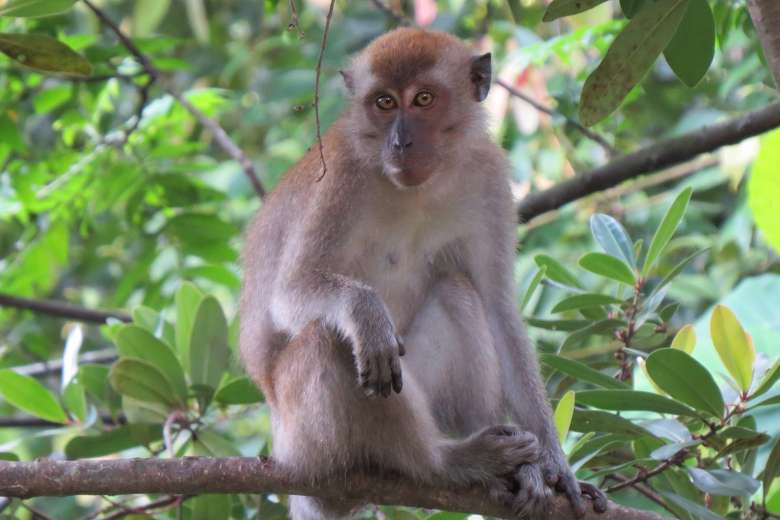
The banded leaf monkey and the long-tailed macaque (above), both native to Singapore.PHOTO: COURTESY OF PREMA
Including its tail, this monkey can grow up to 56cm in length.
It is native to countries such as Singapore, Bangladesh, Brunei, Cambodia, India, Indonesia, Laos, Malaysia, the Philippines, Thailand and Vietnam.
In Singapore, there are now more than 1,000 of them.
Their original habitat includes secondary forests and mangroves, but they can now also be encountered in parks and urban areas such as Bukit Batok Nature Park and Sentosa.
They often come into conflict with humans when they venture into residential areas in search of food.
This article was first published on Aug 13, 2016.
Get a copy of The Straits Times or go to straitstimes.com for more stories.
Image:

Publication Date:
Saturday, August 13, 2016 – 16:00
Send to mobile app:
Source:
Story Type:
Others
'Joseph swam the perfect race’: National assistant coach

How did Joseph Schooling win Singapore’s first-ever Olympic gold medal in any sport? According to national swimming assistant coach Gary Tan, a former butterfly specialist himself who competed at two Olympics, the 21-year-old effectively won it from start to…
Source link
NMPs seek changes to Bill that spells out contempt of court
Three Nominated MPs (NMPs) have made the unusual move of proposing changes to a Bill on laws of contempt of court, as they believe it will make the legislation clearer.
NMP Mahdev Mohan, an assistant professor of law at Singapore Management University, told The Straits Times yesterday that the amendments would bring the Administration of Justice (Protection) Bill more in line with existing common law, which is built on judgments of previous cases.
The proposed changes, listed in a notice of amendments issued by Parliament yesterday, will be tabled at a Parliament sitting on Monday, when NMP Kok Heng Leun will also present a parliamentary petition on behalf of a group seeking to delay the passage of the Bill.
The 249 Singaporeans who signed the petition contend that it may restrict legitimate discussion of issues that are of public interest.
One clause in the Bill says contempt by scandalising the court is committed if a publication “poses a risk that public confidence in the administration of justice would be undermined”.
The NMPs want the phrase “real risk” to be used instead of just the word “risk”.
The term “real risk” is from a 2010 judgment by High Court judge Quentin Loh, who ruled that for a statement to be in contempt, it had to have a “real risk” of scandalising the judiciary.
“If the Ministry of Law prefers a test which departs from the current legal position, (we would like) for it to formally offer an explanation,” Mr Mohan said.
Another change that the NMPs are seeking relates to a clause in the Bill that states that a statement by the Government on an issue in a pending court proceeding is not contempt of court “if the Government believes that such a statement is necessary in the public interest”.
The NMPs want the words “the Government believes that” to be removed.
The 14 proposed changes were submitted by Mr Mohan, Mr Kok, who is a theatre group artistic director, as well as NMP Kuik Shiao-Yin, a social entrepreneur.
Mr Mohan said they had worked together on the changes after they found, while discussing the Bill, that their concerns were similar.
The Bill was introduced in Parliament on July 11, and is scheduled for debate next week.
It covers three main areas of the law of contempt: prejudicing court matters, disobeying court orders and scandalising the courts.
Currently, there are no statutes on contempt of court, and existing laws are built on common law.
A spokesman for the Clerk of Parliament’s office said the proposed amendments will be considered after the Bill is debated during its second reading.
It takes place when Parliament forms a committee of the whole House to scrutinise the Bill.
If the House agrees to the changes, they will be made before the Bill’s third reading, which is the final step when the House decides whether to give it the nod.
This article was first published on Aug 13, 2016.
Get a copy of The Straits Times or go to straitstimes.com for more stories.
Image:

Publication Date:
Saturday, August 13, 2016 – 15:00
Keywords:
Send to mobile app:
Source:
Story Type:
Others
Hospital a no-go zone for Pokemon Go, NUH tells staff
Chasing pocket monsters down hospital corridors is a “no-no” for staff at the National University Hospital (NUH).
At a meeting yesterday, staff were told not to play the popular Pokemon Go mobile game while on duty, in the first reported case of a public institution advising its staff not to play the game at the workplace.
One nurse, who declined to be named, told The Straits Times: “We are supposed to focus on and take care of our patients.” Another nurse said this was to maintain professionalism and ensure safety, as some people have reportedly fallen down and hurt themselves while playing the game.
Gotta catch ’em all: Pokemon Go now in Singapore
Click on thumbnail to view photos. Source:
The Straits Times, Facebook / RSAF, Facebook/SPF, AsiaOne, Capitaland



















































When contacted, an NUH spokesman said: “Staff have been reminded not to play the game, or any other game, while they are on duty, and to remain professional while caring for patients.”
She added that the hospital also discourages members of the public from playing in areas that could affect the normal operations of the hospital or infringe on patients’ privacy.
In response to queries, a Ministry of Health (MOH) spokesman said NUH’s move was not part of any Pokemon “ban” by the ministry. Still, it said, hospital staff are expected to focus on their work.
“Patient care and safety are our hospitals’ top priority,” the spokesman said. “To ensure that attention to patients is not compromised, our public hospitals periodically advise their staff to refrain from engaging in non-work-related activities during working hours and within the institution’s premises.”
Since the launch of Pokemon Go in Singapore on Saturday last week, players of the game have gathered at parks and public housing estates to catch the game’s virtual pocket monsters, which seemingly pop up in real locations.
Players are able to spot them through their smartphone cameras.
The game makes use of popular landmarks and points of interests to serve as “PokeStops”, where players can obtain free items, or “Gyms”, where players battle one another. These places can be located all over the island, such as at MRT stations, parks and even hospitals.
Human resource experts said NUH is doing the right thing, noting that playing games at work affects productivity.
Ms Linda Teo, country manager at recruitment firm ManpowerGroup Singapore, said “it will not reflect well on the company if frontline employees are caught playing the game by customers”.
Shipyard and factory workers operating heavy machinery could also jeopardise their safety if they are allowed to play the game, she added.
This article was first published on Aug 13, 2016.
Get a copy of The Straits Times or go to straitstimes.com for more stories.
Image:

Publication Date:
Saturday, August 13, 2016 – 14:00
Keywords:
Send to mobile app:
Source:
Story Type:
Others
Olympics: Ask Joseph some questions, Phelps says after rare silver

RIO DE JANEIRO – When your name is Michael Phelps, it’s hard to play second fiddle.
Appearing before journalists after dead-heating for the silver medal in the 100 metres butterfly on Friday, the last individual race of his long career, the most successful Olympian of all time was peppered with questions as gold medallist Joseph Schooling of Singapore sat alongside him.
Gracefully, the American tried to ease out of the spotlight.
“Joe should be getting most of the questions,” he eventually told reporters, laughing. “This kid just won a gold medal, guys. Let’s ask him some more questions.”
When a journalist obliged by asking Schooling how it felt to become “the go-to butterflier in the world right now”, the 21-year-old hesitated and glanced to his left at Phelps.
“That’s for you bro, don’t look at me,” Phelps told him.
It was a surreal moment for Schooling, who had just beaten three of the greatest butterfly exponents in Phelps, South Africa’s Chad Le Clos and Hungary’s Laszlo Cseh, all of whom tied for second.
“That sounds like a lot of pressure. I don’t think I’m anywhere close to these three guys next to me,” he said modestly in reply to the question.
“Today just happened to be a good day for me. I think Chad, Michael and Laszlo should still be the face for butterfly. This is like my first gold medal it’s not like I’ve won 22 or 23.”
Phelps shot back: “It’s a pretty good one to win, though.”
Click on thumbnail to view photos. Source:
The Straits Times, Reuters, AFP








































Schooling paid tribute to Phelps as the idol whose inspiration set him on course to become Singapore’s first gold medallist in any sport.
“If it wasn’t for Michael, I don’t think I could have gotten to this point. I wanted to be like him as a kid. I wanted to win. And I think a lot of this is because of Michael, he’s the reason I wanted to be a better swimmer.”

After the medal ceremony, the pair were deep in conversation on the pool deck, and Schooling said he told Phelps the feeling was ‘out of this world’.
“He smiled and said, like, I know,” Schooling said. “He’s been through it all, and just being beside him, walking beside him and celebrating, I’ll really cherish that for the rest of my life.”
Click on thumbnail to view photos. Source:
Twitter screengrabs, Facebook screengrabs, Facebook/SGAG










Image:

Publication Date:
Saturday, August 13, 2016 – 13:22
Send to mobile app:
Source:
Hermes ID:
2 518 575
Hermes ID String:
SY_PHELPSSCHOOLING_0813
Story Type:
Others
$20.8m owed to California Fitness members
The firm that owns California Fitness was already $21.7 million in the red in January last year, but that did not stop the gym chain from signing new members and getting them to pay their fees up front.
That is how owner JV Fitness kept the chain going despite money troubles, until the chain’s closure last month.
Around 27,000 members are now owed $20.8 million in unused gym access and unredeemed personal training sessions, it was revealed in a liquidation report presented to court yesterday. The debt forms most of the $30.8 million which the chain’s owner is liable for. JV’s total assets on record are worth $5 million and include rental deposits paid to its landlords.
Read also: California Fitness shuts all branches in Singapore
Financial statements also show that for years, JV has been accumulating losses, which stood at $25.6 million by the end of June this year.
Liquidator Tim Reid, describing the losses as “staggering”, said: “The members who paid in advance… have every reason to be annoyed.” He added that there is “no prospect” of getting back their money through any asset sale. After the chain closed its Orchard branch in February, the gym equipment was sold for just $20,000, he explained.
Members were shocked to hear that the gym had been losing money since 2013, and asked why it was allowed to continue selling packages.
Consumer watchdog head Seah Seng Choon called for the authorities to look into what he called a questionable practice. Said the executive director of the Consumers Association of Singapore: “Case will discuss with the ministry and the relevant stakeholders to look into protection for consumers’ pre-payment.”
In the liquidators’ report, Mr Reid and his colleague Theresa Ng said the way the firm obtained payments in advance when it was clearly insolvent “warrants further close review”.
Lawyer Lionel Tay, who acts for the liquidators, added that they will also be investigating all potential breaches of the Companies Act or any other law.
When California Fitness shut its Orchard branch six month ago, leaving it with three other outlets at Raffles Place, Bugis and Novena, it said it was a strategical business decision. Last month, after all 12 California Fitness gyms in Hong Kong were shut due to debt, a spokesman here would only say that the Singapore chain operated separately.
But on July 16, California Fitness announced that it had closed the Raffles Place branch and directed its members to the Novena and Bugis outlets. Shortly after midnight on July 20, the liquidators, who were appointed just hours earlier, announced all outlets were closed.
Read also: California Fitness liquidators looking to sell off gyms, members urged to be patient
Property valuer Lai Kin Hoow, 32, who used only two years of his seven- year package worth over $5,000, said there were no signs that the gym had been facing mounting debts.
Another member who paid $1,700 for a 26-month package just nine days before it closed has given up hope of getting her money back. “Going forward, I hope more can be done to protect consumers,” said the 38-year-old woman who works in a logistics firm and wanted to be known only as Ms See.
Lawyer Amolat Singh said it would have been up to JV’s directors to make the call to stop taking in members. “If the directors continued to trade and operate when the dark clouds had clearly gathered on the horizon, that could potentially make the directors personally liable. Then again, that would be cold comfort to the members as the directors may not have the financial muscle to satisfy all the debts.”
Last month, it was reported that two senior California Fitness executives in Hong Kong had been arrested by the authorities there. They are suspected of infringing Hong Kong’s Trade Descriptions Ordinance, which takes to task traders who promise goods or services when knowing they cannot deliver.
Meanwhile, when asked about news that it is opening a new gym at Bugis Junction, Fitness First made it clear it is taking over the space vacated by the Shaw Theatres cinema, and not California Fitness.
Members
$20.8 million Amount owed to 27,000 members
$5.5 million in unredeemed personal training sessions
$15.3 million in unused gym access
1,468 members have filed proof of debt forms to make claims
At least 500 have yet to collect their belongings from gym lockers
Landlords
$1.8 million Amount owed in rent
• Novena outlet: $565,000
• Bugis outlet: $680,600
• Raffles Place outlet: $550,500
Employees
249 employees’ services terminated, foreigners repatriated
$548,000 Amount owed
• $145,000 in CPF contributions for June
• $403,000 in salaries for July
Financial position
$200,000 Paid-up capital
$25.6 million Accumulated losses (as of June 30)
$30.8 million Total liabilities
$5 million Total assets
This article was first published on Aug 13, 2016.
Get a copy of The Straits Times or go to straitstimes.com for more stories.
Image:

Publication Date:
Saturday, August 13, 2016 – 14:00
Keywords:
Send to mobile app:
Source:
Story Type:
Others


