28.3 C
Singapore, SG
Thursday, September 10, 2026
Home Blog Page 3020

Pregnant woman: Zika in Singapore is what I've always feared

0

The first case of locally transmitted Zika virus was reported yesterday at Block 102, Aljunied Crescent. HARIZ BAHARUDIN (harizbah@sph.com.sg) visited the block to find out how residents feel

When she found out she was pregnant five months ago, Aljunied Crescent resident Mastika Yacoob, 42, told herself she would take no chances with the dangers of dengue.

For the first three months, the designer made sure she had a mosquito patch on her at all times.

Her concerns abated in her fourth month, and she stopped wearing them.

But now, five months into her pregnancy, she is worried again.

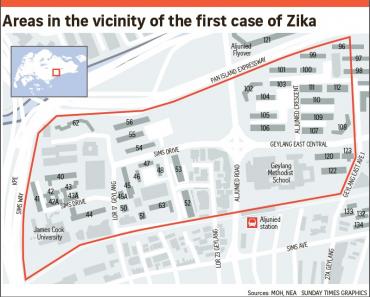
Yesterday, news emerged of Singapore’s first case of locally transmitted Zika virus. And it was traced to her place at Block 102, Aljunied Crescent.

Speaking to The New Paper on Sunday at her home last night, Ms Mastika was visibly stunned by the news.
With one hand on her stomach, she said: “Here? In our block? That is scary. It’s something I’ve always been fearful of.”

Zika poses a serious threat to pregnant women as it can lead to their children having birth defects.

She and her husband, 36-year-old software engineer Kohodai Dada, are not taking any chances and said they would purchase more mosquito patches right away at the nearby 24-hour supermarket.

Mr Dada said: “We always hear it on the television, but now this is a different thing altogether.

“To know that someone was infected in the very block we live in, it makes the problem that much closer to home.”

According to a joint statement by the Ministry of Health (MOH) and National Environment Agency (NEA), the patient, a 47-year-old Malaysian woman, tested positive for the virus yesterday at the Communicable Diseases Centre (CDC) at Tan Tock Seng Hospital.

The unnamed woman had not travelled to Zika-affected areas recently and developed symptoms on Thursday.

The patient was referred to the CDC by a general practitioner (GP) on Friday. She is now hospitalised and is recovering.

The two agencies said with the “volume of travel by Singaporeans as well as tourists, it is inevitable that there will be imported cases of Zika into Singapore”.

There is also the “risk of subsequent local transmission”, due to the presence of the Aedes mosquito here.

FURTHER CASES

The statement said: “While MOH and NEA have stepped up precautionary measures, we expect that there may be further cases, as most infected persons may display mild or no symptoms.”

The patient’s close contacts, including household members, are being screened.

MOH is also testing others in the area who have fever and a rash. There are three other suspected cases in the area pending confirmation tests.

As an added precaution, all suspect cases of Zika virus infection will be isolated while awaiting confirmation of the blood test results.

All GPs around the 12-storey Block 102 and the patient’s workplace have been alerted to be “extra vigilant”.

Health Minister Gan Kim Yong said: “MOH and NEA are working together to carry out vector control and testing of residents in that area with fever and rashes so as to reduce the risk of further spread.

“I encourage those who are unwell and with these symptoms to visit their doctors for medical attention.

“We have also alerted our clinics in the area to look out for suspect cases and refer them to the CDC for testing.”

When TNPS visited the block last night, many residents had no idea their estate was home to Singapore’s first locally transmitted case of Zika.

Housewife Premavathi R, who is three months pregnant, was not even aware of the dangers Zika posed.

But her husband, 33-year-old IT engineer Vasanthan N, knew about it and said he was “concerned”.

After he explained the virus to her and informed her one of their neighbours was infected, she gasped.

Ms Premavathi, 28, said: “We’ve always kept the house clean, but I will consider buying insect repellent for my family and for my unborn child.”

But to Ms Mastika, there is no time to lose.

Besides the patches, her family will also be getting insect repellent which they will start using as soon as they return from the supermarket.

“I’ve lived here since I was five. This area isn’t the cleanest and people litter a lot,” she said.

Clutching her husband’s arm, she added: “There are so many breeding grounds for mosquitoes and what if they spread Zika?

“I am paranoid now.”

What is Zika?

Zika is a disease caused by a virus transmitted by the Aedes mosquito. It was first detected in Zika Forest in Uganda in 1947 in a rhesus monkey, and in the Aedes africanus mosquito in 1948.

Its incubation period is likely to be a few days and the symptoms are similar to those of other mosquito-borne diseases such as dengue and chikungunya: fever – rashes, conjunctivitis, muscle and joint pain, malaise and headache.

Zika has been linked to instances of Guillain-Barre syndrome – a rare disorder that causes muscle weakness and temporary paralysis.

It has also been linked to microcephaly, a rare condition in which babies are born with abnormally small heads.

There are currently no vaccines or drugs for Zika, as the disease was rare and mild until last year.

Those infected are usually advised by doctors to get plenty of rest and drink lots of fluids, while pain and fever are treated with available medicines.

Sources: World Health Organisation, Centres for Disease Control and Prevention

OLYMPICS TEAM

Yesterday, the Singapore National Olympic Council sent out a statement saying that the 25-member team of athletes and officials who represented Singapore at the recent Rio Olympics were not affected by the Zika virus.

“The athletes and officials of the Rio 2016 Olympic Games Team Singapore contingent have returned to Singapore safe and symptom-free from Zika,” said Mr Low Teo Ping, chef de mission for Team Singapore.

“We are keeping a close tab on the athletes and officials, monitoring them for symptoms such as fever, skin rash, headache, fatigue, muscle pain, and joint pain for three weeks upon their return.

“We have also advised them to continue to apply insect repellent and wear long-sleeved clothing where possible and to avoid travel to multiple places in a day.

“Any occurrence and non-occurrence of symptoms are updated to the team doctor daily.”


This article was first published on Aug 28, 2016.
Get The New Paper for more stories.
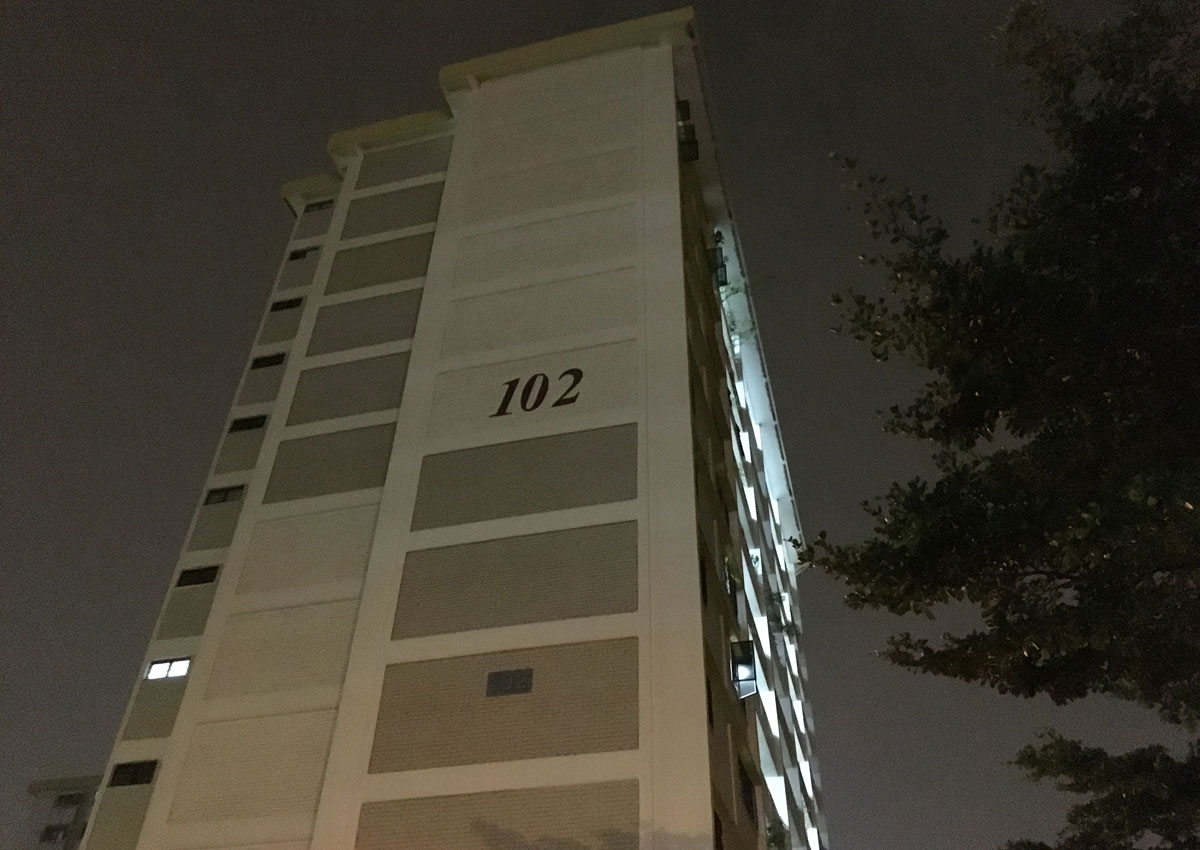
Image: 
Publication Date: 
Sunday, August 28, 2016 – 14:00
Keywords: 
Send to mobile app: 
Source: 


Rotator Headline: 
Pregnant woman at 102 Aljunied Crescent: Zika is what I've always feared
Rotator Image: 
Story Type: 
Others

Source link

Royal Sporting House: Mega Warehouse Preview Sale For SAFRA Members on 7 Sep 2016

0

RSH: Warehouse Preview Sale on 7 Sep for SAFRA members.

Not a SAFRA member? Share this and find someone who is as each member can bring two guests!

Royal Sporting House: Mega Warehouse Preview Sale For SAFRA Members on 7 Sep 2016

Enjoy up to 80% off at Royal Sporting House Mega Warehouse Preview Sale for SAFRA members on Wednesday, 7 Sep 2016, 12pm – 6pm.

Source

1974 Laju ferry hijack: The magnificent 13

0

After the passing of former president S R Nathan, there has been much talk about the 1974 Laju hijack and the bravery of the 13 men who traded places with the hostages. Who are these men?

In 2011, before he retired from the highest office, the late president S R Nathan hosted a small tea reception attended by seven of 12 Singaporean men.

It was a private function and some of the men were recognisable faces to Istana staff.

“It was our first and only reunion, and we recounted some of the things that happened in 1974. We were at ease with the results (of the crisis),” says Mr Tee Tua Ba, 74, the former commissioner of police.

Mr S. Rajagopal, 76, a retired counter terrorism officer with the Internal Security Department, was also there, as were several commando officers. He took pictures of the gathering.

He tells The New Paper on Sunday: “I met the President at an earlier event and told him we should have a gathering for the men.

“We had not seen each other as a group since.”

That was the day 13 men traded places with hostages of the Laju ferry to guarantee safe passage out of Singapore for four hijackers.

The details were never shared publicly and none of the men believed in self-glorification.

As a result, for more than 30 years, few outside the group knew of the men’s readiness to make the ultimate sacrifice.

Then before retiring, Mr Nathan revealed to The New Paper what took place on the Feb 8, 1974, Japan Airlines flight to Kuwait with the four Laju hijackers.

And he gave even more details in his book, An Unexpected Journey: Path To The Presidency.

Among the 13 were commandos, including LTC (Retired) Clarence Tan Kim Peng, Singapore’s first US-trained special forces soldier.

And ISD officers including director Yoong Siew Wah who, like the others, was ready to lay down his life.

INTERPRETERS

But there were also two non-security men who had acted as interpreters during the crisis.

One was a former official of the Syariah Court while the other had worked at the then-Singapore Broadcasting Corporation.

Both had died before the Istana reunion.

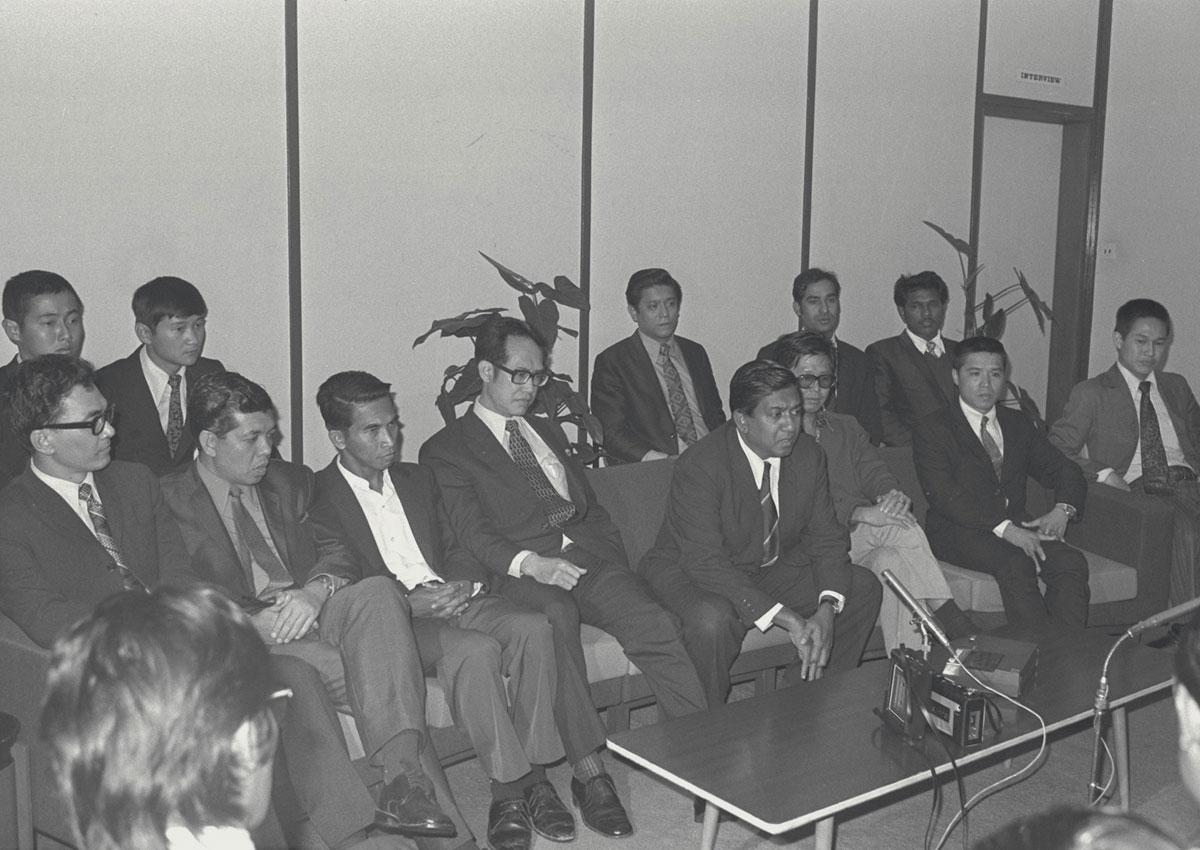
There has only been one publicly seen picture of the 13 men, taken at a press conference after the men had safely returned to Singapore on Feb 9.

They never again assembled as a group for more than 35 years.

The 13 men

DEFENCE MINISTRY

Mr S R Nathan
Director, Security and Intelligence Division, whom Prime Minister Lee Kuan Yew and Defence Minister Goh Keng Swee told to lead the 13-men exchange.

Captain Clarence Tan Kim Peng
Commanding officer of the Singapore Armed Forces Regular Battalion, the precursor of the 1st Commando Battalion. He was one of the first local officers to attend the ranger and airborne courses conducted by the US Army. He was involved with the elite soldiers until 1988, then he became a defence attache in Australia before retiring in 1992.

Captain Gwee Peng Hong
Commando officer who was the commanding officer of the first batch of NS commandos.

Mr Teo Ah Bah
Commando officer.

Mr Tan Lye Kwee
Commando officer.

HOME AFFAIRS MINISTRY

Mr Yoong Siew Wah
Director of Singapore’s Internal Security Department (ISD), 1971 to 1974. He was previously the Director Of The Corrupt Practices Investigation bureau and an officer in the Singapore special branch in the 1950s.

Mr Tee Tua Ba
Officer-in-charge of Marine Police, 1974 to 1976. He became Commissioner of Police before retiring in 1997. He is now serving as non-resident ambassador to Switzerland.

Mr Seah Wai Toh
Superintendent of police. He later became deputy director of ISD after 1974 and was involved in negotiating the surrender of four Vietnamese hijackers of an Air Vietnam flight in 1977.

Mr S. Rajagopal
Assistant Superintendent, counter terrorism unit, ISD. His career was packed with dangerous assignments. He was involved in the Air Vietnam operations. Masquerading as a doctor, he boarded and got the injured out of the plane. Now 76, he serves as the honorary treasurer of the Singapore Police Retirees’ Association.

Mr Andrew Tan
Assistant Superintendent, counter terrorism unit, ISD.

Mr Saraj Din
Assistant Superintendent, ISD.

TRANSLATORS

Haji Abu Bakar
Religious teacher who was approached by the Ministry of Defence because of his fluency in Arabic. A civilian, he volunteered to join the men on the flight to Kuwait. He went on to become ustaz abu bakar and remained involved in the rehabilitation of terrorists. He died on jan 25, 2005.

Haji Abdul Rahman
Broadcaster with the Singapore Broadcasting Corporation and fluent in Arabic.

Last days of the Laju hijack

The Laju hijack unfolded over nine days. Melvin Singh and Hariz Baharudin zoom in on the last two days as the hijackers negotiated for safe passage out of S’pore

FEB 7, 1974

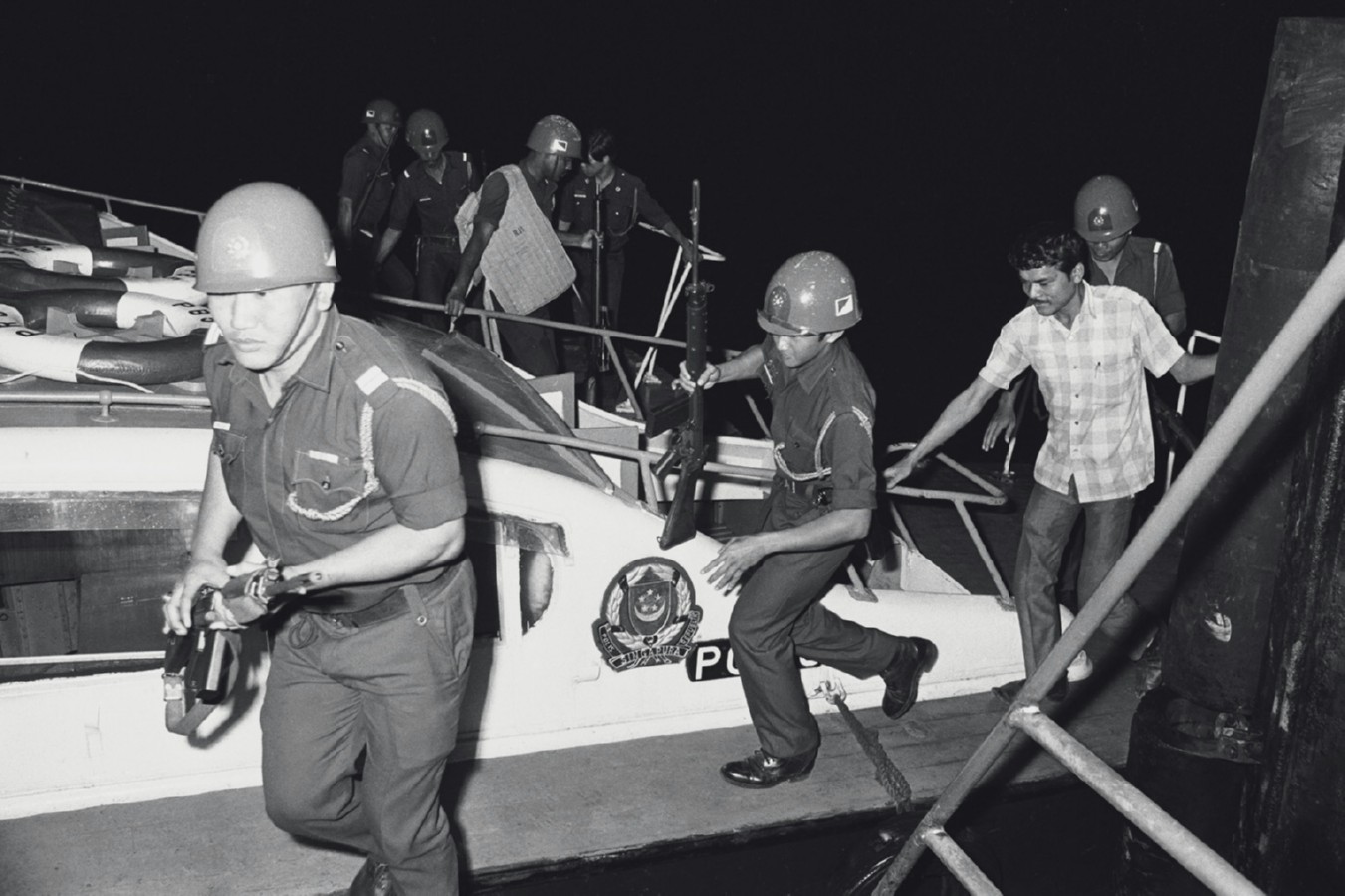
Police perform a series of practice runs on the route they are to take from the Marine Police jetty at Kallang to Paya Lebar Airport, where the Japan Airlines plane will be waiting.

Everyone is ready.

As the hijackers direct the Laju ferry to the jetty – a 30-minute journey – they keep their guns pointed at the heads of the three hostages.

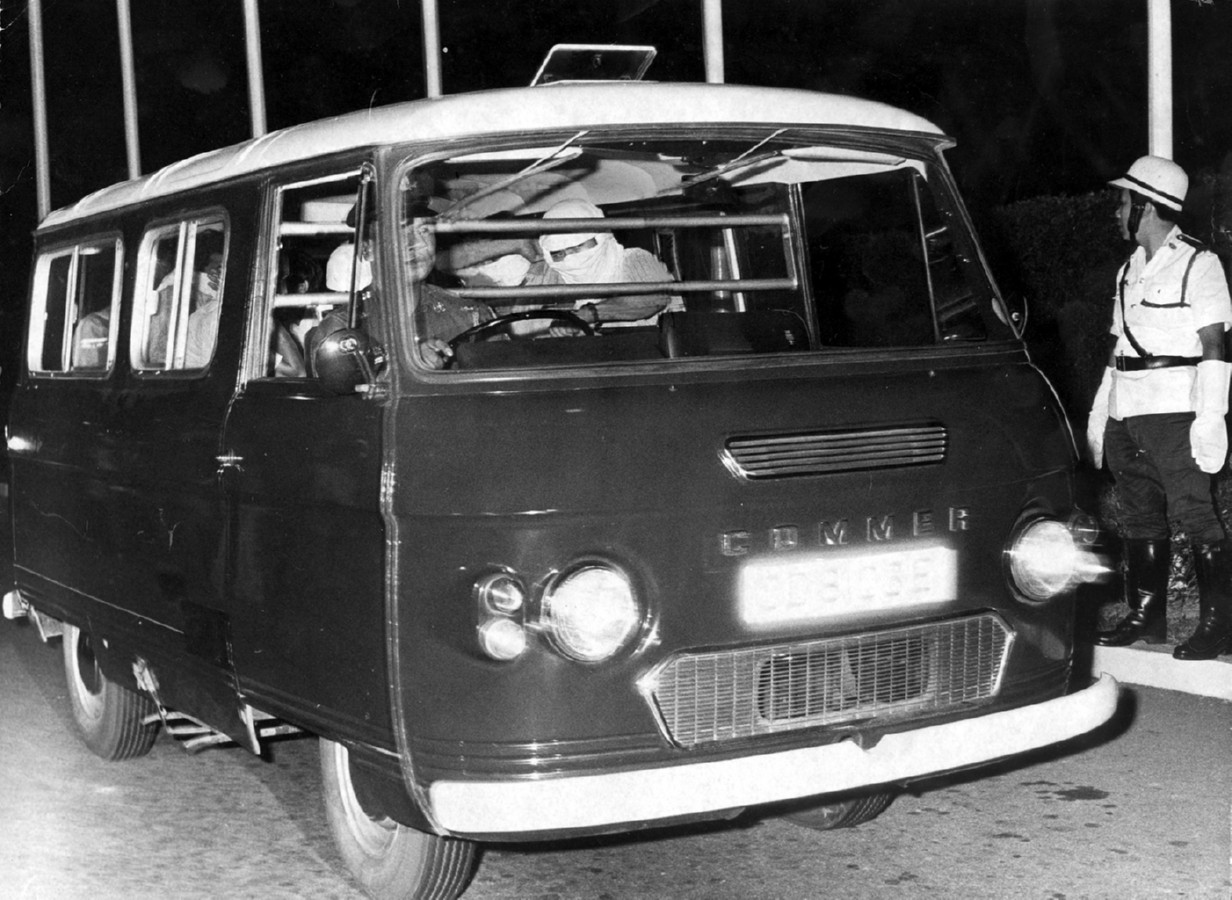
Then they board a police van and are taken to the Paya Lebar Airport VIP lounge.

Mr Nathan relates in his book: “At the airport, Haji Abu Bakar, an Arabic-speaking official of Singapore’s Syariah Court, who had been helping in the exchanges with the Arab hijackers, was asked to come with us, making the team 13 in number.

“Because of the last-minute nature of the arrangements, he did not have a passport and boarded the plane without having spoken to his family.

“This was courageous – not having a passport could have created difficulties both on landing in Kuwait and on his departure.”

It is now time to surrender the weapons.

Mr Tee is with his translator in the VIP lounge and the four hijackers. He again reminds them to give up their weapons.

Mr Nathan relates what happens next: “Tee Tua Ba, seeing suspicion, fear and anger in their eyes, reminded them of the guarantee.

“He suggested if need be, they can keep one of the bullets in the leader’s Browning automatic, which would be held against his temple.

“While Tee was guiding the hand holding the gun to his own head, the hijacker said that would not be necessary. Then they all surrendered their arms.”

Mr Tee says he knew the airport was surrounded by armed police officers and soldiers.

“If they heard a shot fired, they would know I was dead or seriously injured and would have moved in,” he tells The New Paper on Sunday.

“I told them to surrender their arms and explosives. They had trusted me so far, and we had operated in good faith.

“The plane wouldn’t take off unless they did so and that was when I took his hand and guided the gun to my head.

“The Arab leader stopped me and said, ‘Brother, I trust you.'”

FEB 8, 1.25AM

Just before he boards the plane, Mr Tee gets a call.

“I received a sudden call from Mr Tay Seow Wah, Permanent Secretary of Home Affairs.

“I thought something had gone wrong. To my surprise, it was not.”

Mr Tay has a message from Mr Lee Kuan Yew.

“It was, ‘Job well done’,” adds Mr Tee.

No blood has been spilled so far.

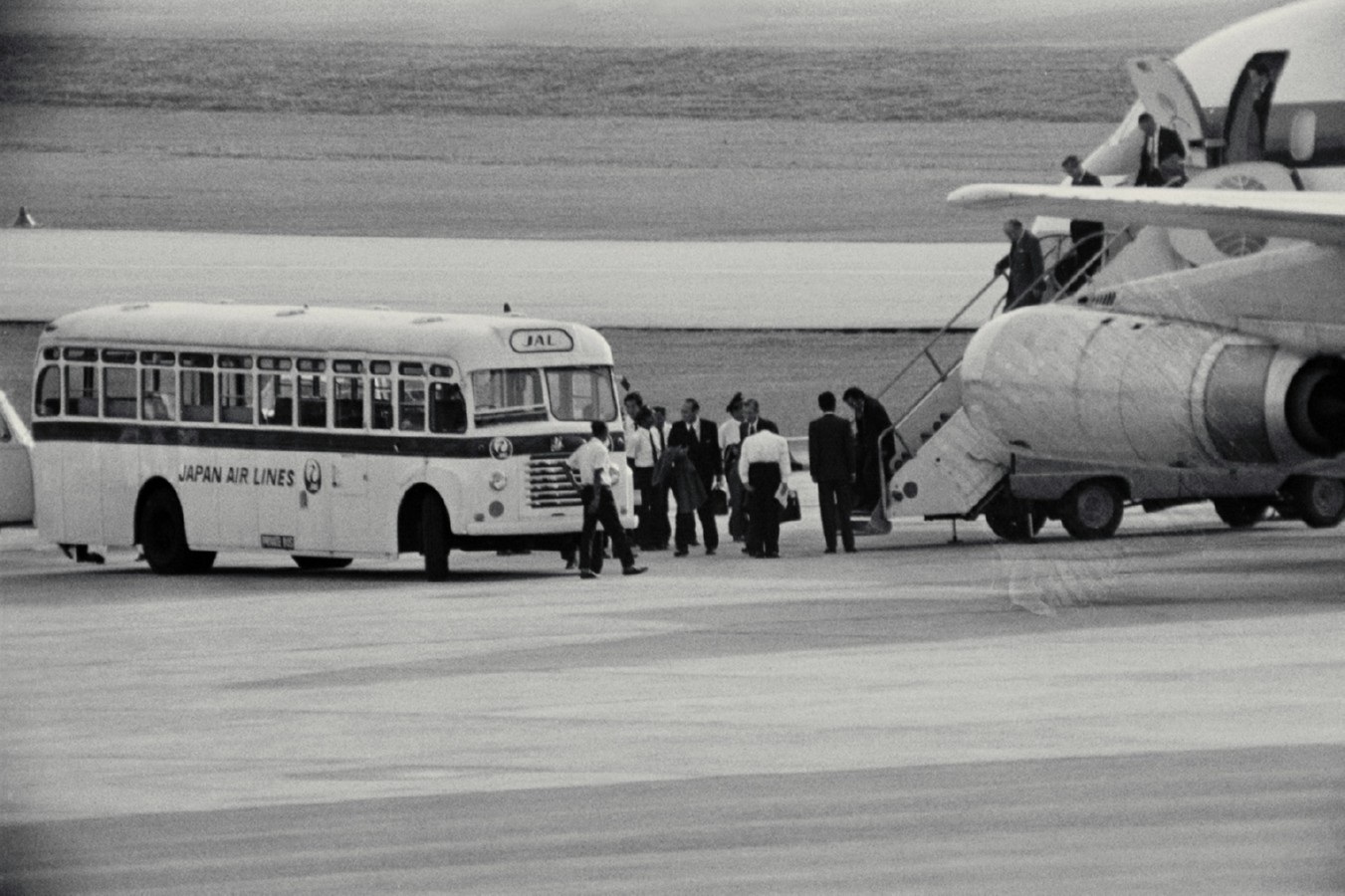
AIRPORT RUNWAY: Japanese government and Japan Airlines officials trooping down the gangway of the plane after its arrival from Tokyo on Feb 7, 1974.

The four men, the 13 Singapore officials and other Japanese officials and crew of the Japan Airlines plane, which had flown in from Bangkok, are ready for take-off.

To Mr Tee, the four men are no longer hijackers. “I already totally disarmed and strip-searched all the hijackers and recovered all the weapons, which included revolvers and knives, before boarding the plane.

“The hijackers were at our mercy and in honour of our agreement, we were there to ensure their safe passage,” says Mr Tee.

But the four men eye the Japanese crew and officials with some suspicion. So they are separated from one another.

The hijackers sit at the front of the plane, the Singaporeans in the middle and the Japanese at the back.

Two Singaporeans, using the surrendered guns, keep guard.

During the flight, Mr Tee continues to talk to the four men.

He says it is extraordinary that while they are adversaries, the two Japanese men and the officials are polite with one another.

Mr Nathan tells him to continue engaging the Arabs.

“They asked me why I called them terrorists.

“The Arabs said there are bigger terrorists out there and they don’t know when they return home if they will disappear,” says Mr Tee.

Mr Nathan joins in the conversation and tells the Japanese to take the message home to their compatriots – the Singapore Government has guaranteed their safety, and now it is their turn to return the favour for the Singapore officials.

As the flight approaches Kuwait, the control tower refuses permission for the plane to land.

Then they say it can land but nobody is to leave the plane.

Instead, the men involved in the Japanese embassy siege are to board the plane, and the flight is to leave Kuwait – destination unknown.

In his book, Mr Nathan says: “Interpreting the true facts somewhat loosely, I said I was a special envoy of the prime minister of Singapore and had a special message for the prime minister of Kuwait.

“He asked me what the message was and asked me to read it out to him over the air. I refused.

“I told him my instructions were specific and that the message had to be delivered in person directly to his prime minister.”

The plane lands and is immediately surrounded by police and military vehicles.

Mr Tee describes the scene: “My god, the number of tanks and armoured personnel that surrounded us was astonishing.

“For about two hours, there was just silence.”

Then the Kuwaiti defence minister walks to the door of the plane.

Mr Yoong Siew Wah bravely goes forward with Mr Nathan and Haji Abu Bakar.

Mr Nathan tells them they are guarantees to ensure the safety of the four men. It is now the job of the Kuwaiti government to protect the officials.

He tells them if anything happens to them, their prime minister has to answer for it.

The Kuwaiti officials are in deep discussion with the Japanese officials but Mr Nathan budges in repeatedly.

“Mr Nathan kept reminding them of their obligations and finally the Kuwaiti official told him, ‘If you talk some more, I will arrest you,'” Mr Tee says.

The Singapore officials are told to get lost, and they do.

They decide to lie low and disperse so there is no way the Kuwaiti authorities can round all of them up and put them back on the same plane.

“We had to get lost for awhile. I gave each of our people US$100 from the funds that I had brought. We went shopping,” says Mr Nathan in his book.

When asked what he bought with the money, Mr Tee laughs.

“By that time I was so tired, having had little sleep for more than a week. But this was the burden we had to endure.”

FEB 8: THE RETURN

The men return home and assemble for a press conference at Paya Lebar Airport.

Their families are to wait a little longer for the reunion.

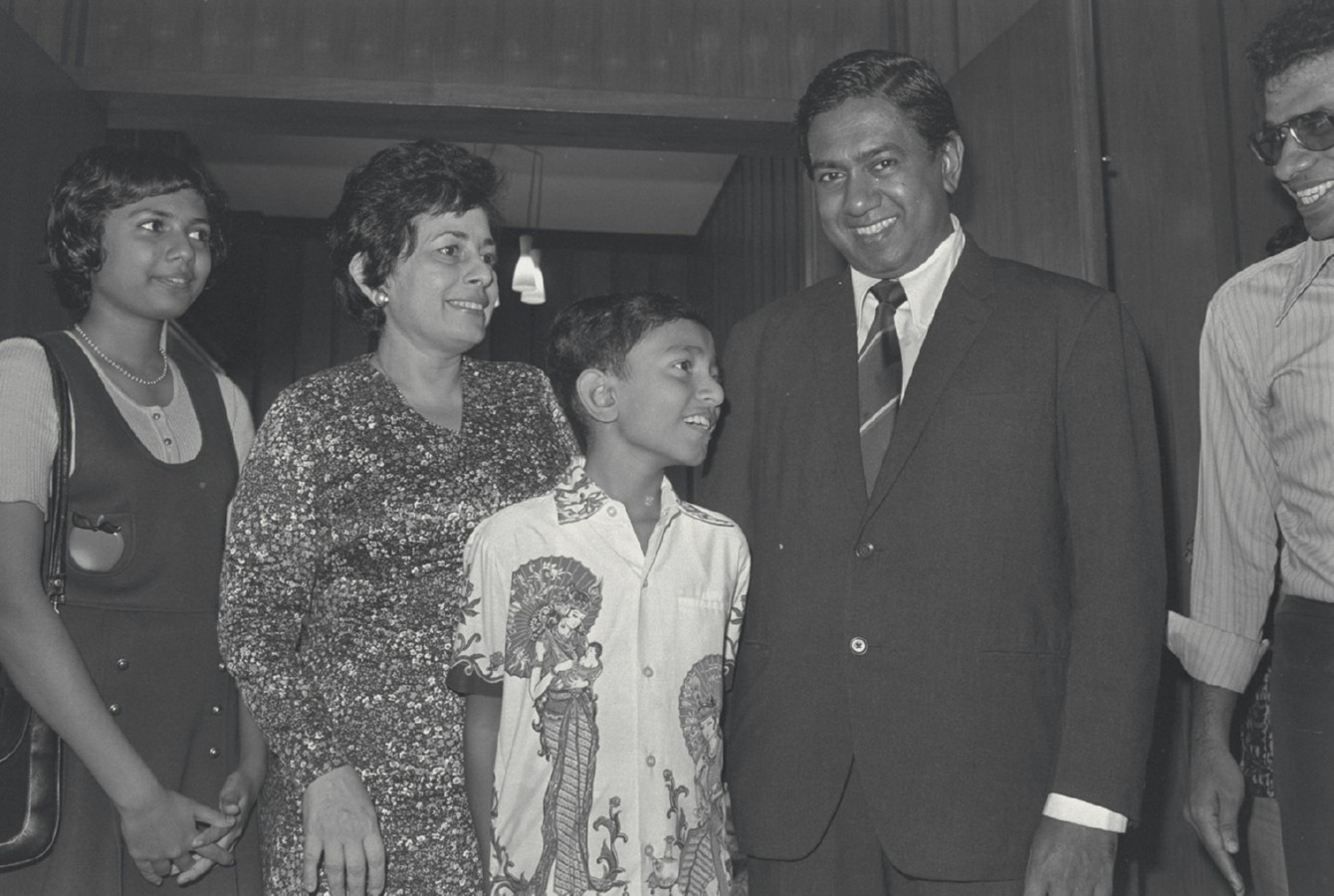
REUNITED: Mr S R Nathan was greeted by his wife and children on arrival at the Singapore airport.

Did they think they were going to make it back alive?

Mr Tee ponders, then says: “My sons were one and two then. I thought they might not see their father again, and my wife would not see her husband.

“But we had to lead by example, and there was a job to be done. We did our job.”

He says it was less dangerous on the plane than before boarding it.

But this is also the same man who directed a gun to his own temple.

The need for operation secrecy meant there was to be no great fanfare, no welcoming party.

The brave 13 were just doing their job.

Excerpts taken from Mr S R Nathan’s book – An Unexpected Journey: Path To The Presidency published by Editions Didier Miller


This article was first published on Aug 28, 2016.
Get The New Paper for more stories.
Image: 
Category: 
Publication Date: 
Sunday, August 28, 2016 – 21:00
Send to mobile app: 
Source: 


Rotator Headline: 
Who are the 'magnificent 13' in 1974 Laju ferry hijack?
Story Type: 
Others

Source link

Benjamin Lim case: He took pride in NPCC and was an obedient son

0

Most people remember Benjamin Lim as a schoolboy whose death prompted a relook at how young people are treated in police investigations. But to his loved ones, he will always be the obedient son who willingly took up part-time work to supplement the family’s income, and a young man who took great pride in his uniformed group.

The 14-year-old was found motionless at the foot of his Yishun block on Jan 26, hours after being questioned by the police for a case of alleged molestation. His death led to an ongoing review of police and school protocols.

It has been seven months since the incident, but it still brings tears to his mother’s eyes. Said her husband, 47, who is self-employed: “Things will never be the same.” The family declined to be identified.

Benjamin, his younger son, was close to his mother and sister, and took pride in his uniformed group, Mr Lim told The Sunday Times during an interview in his home, a three-room flat in Yishun.

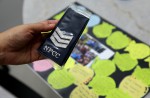
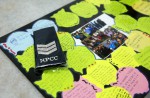
Tributes from Benjamin’s friends, along with family photographs, are arranged neatly in a small cabinet below the altar in their home.

When he was not at school, Benjamin worked part-time as a fast-food chain crew member – a job he found on his own initiative.

“He felt his pocket money was not enough for him to fill his tummy,” said Mr Lim. “He asked for our permission, we granted it, and he went for his own interview… he was very happy (to be accepted).”

He later introduced his mother, a housewife, to the same job as a crew member, and the pair would work shifts together. Half of Benjamin’s $200 to $300 monthly salary went to the household, said Mr Lim. The rest supplemented the $2.50 his parents gave him every day and went into his savings for items like a personal laptop. It also paid for his gear for his Secondary 3 cohort camp.

“He was looking forward to it; he worked for it,” said Mr Lim.”One month before, he already started buying things… it was all for the camp. He had a list. Every night, he would count how many items he was short of.” Most of these items were buried with the schoolboy.

Benjamin had also been very proud of his co-curricular activity, the National Police Cadet Corps, said his father. He might have been introverted, but he liked the outdoors and got excited if there were school activities. “He supervised his mother when she ironed his uniform, and polished his own shoes,” said Mr Lim, who received messages from Benjamin’s NPCC friends after the incident. “They said he was a pillar of the NPCC, that they turned to him for advice and support.”

Benjamin had also been keen to march at this year’s National Day Parade, and was due to receive the rank of sergeant.

While the family was vocal in questioning the circumstances surrounding Benjamin’s death, the past seven months have not been easy. As he had allegedly molested a girl, members of the public wrote to Mr Lim, saying things like: “What makes you think that he shouldn’t die?” Others said he must have died due to guilt.

Mr Lim said such comments were very hurtful.

During the inquiry, school staff and a police officer said Benjamin showed signs of anxiety only after speaking to his mother on the phone, before leaving for the police station. This left Mrs Lim visibly upset during court proceedings.

Penning down her thoughts in a letter in Chinese in May, she wrote: “Benjamin was obedient and quiet, and usually did not talk much or share his deepest thoughts… From what I know of him, he could not have been frightened by my volume of speech (over the phone).”

While he did not expect the incident to receive this much attention, Mr Lim said it might have been good, in hindsight: “It does make people stop and think if procedures can be improved.” But of his son’s death, he said: “I don’t think the family can ever get over it… A lot of questions are running through our minds.”


This article was first published on AUG 28, 2016.
Get a copy of The Straits Times or go to straitstimes.com for more stories.

Image: 
Category: 
Publication Date: 
Sunday, August 28, 2016 – 12:23
Keywords: 
Send to mobile app: 
Source: 


Story Type: 
Others

Source link

Benjamin Lim case: Family hopes for fast review of procedures

0

The family of Benjamin Lim is hoping that the authorities’ review of how schools and police deal with young suspects will be quickly concluded so that any tweaks to procedures will come sooner rather than later.

In his first comments since a coroner’s inquiry ruled Benjamin’s death a suicide on Aug 18, his father also admitted he was mistaken when he had earlier claimed that the five police officers, while in civilian attire, were sporting ID cards when they went to look for his son in school.

But while the inquiry has also assured the family that Benjamin was not ill-treated at the police station, where he was interviewed for allegedly molesting an 11-year-old girl, he said the family still has questions.

Why, for instance, was there a need to send that number of officers to Benjamin’s school, North View Secondary, when fewer officers could have done the job?

The 14-year-old had jumped to his death on Jan 26, hours after he was taken alone to Ang Mo Kio Police Division for questioning.

The day before, the girl had lodged a police report about being allegedly molested in a lift. The boy’s physical education uniform was recognisable from closed- circuit television footage, and officers contacted North View Secondary for help in identifying the boy.

Police went down the next day.

Benjamin was identified and brought to the principal’s office, where he was spoken to by a single police officer in the presence of school staff.

In his latest comments in a letter to The Sunday Times, Mr Lim clarified a point he made in his first open letter in the wake of Benjamin’s death: “We were told that five police officers went to North View Secondary School… and officers were in civilian clothes.

“We mistakenly assumed that police have their ID cards displayed when they were in the school.”

School principal Chen Fook Pang had negotiated with the police that only one of them speak to the boy.

The police agreed. State Coroner Marvin Bay had, in giving his findings, said police and the school had treated Benjamin properly when he was being investigated for alleged molestation. They “took active steps to handle (him) and the investigations sensitively, given his age and status as a student”, he said.

In the principal’s office, Benjamin was allowed to call his mother.

According to school counsellor Karry Lung, Benjamin had been calm when the police officer was speaking to him, but seemed nervous when talking to his mother, who was heard using a loud voice.

Mr Lim said the family found it “very difficult to believe that Benjamin was normal until he was speaking to his own mother”. He also questioned the counsellor’s assessment that Benjamin was “stable enough to be escorted… to the police station all alone”.

After giving his statement at the police station, Benjamin was brought home by his mother. He fell to his death around 4.20pm. Minutes earlier, his mother had told him he would not be attending a Secondary 3 cohort camp the next day.

This was after a phone call from the school counsellor.

Benjamin’s mother says the counsellor told her that her son would not be attending the camp.

But Madam Lung, who had drafted an e-mail detailing the conversation right after the call, said she had expressed her concerns and only suggested that it would be better for Benjamin to stay at home with his family and do e-learning – which the coroner accepted. However, the coroner suggested it would have been better for the counsellor to have spoken directly with Benjamin.

In his latest comments, Benjamin’s father said the call log on Mrs Lim’s mobile phone showed her conversation with Madam Lung lasted a minute. He wondered if that was enough time for the counsellor to explain that Benjamin might be under stress, and why the school felt it would be better for him to skip the camp, and also ask for the mother’s opinion.

Mr Lim said the court’s findings have done little to bring closure to the family. The police and the Ministry of Education are conducting a review of protocol, taking into consideration Coroner Bay’s suggestions, such as having a school counsellor present at the police station.

“As parents, we look forward to the speedy review of the current proceedings,” said Mr Lim, whose family declined to be identified.

He added: “Definitely, we will see an improvement.

“I just hope it will be soon.”

byseow@sph.com.sg 


This article was first published on AUG 28, 2016.
Get a copy of The Straits Times or go to straitstimes.com for more stories.

Image: 
Category: 
Publication Date: 
Sunday, August 28, 2016 – 12:07
Keywords: 
Send to mobile app: 
Source: 


Rotator Image: 
Story Type: 
Others

Source link

NEA to test novel way of cutting mosquito numbers

0

Study using bacteria-infected male mozzies to render females sterile to be held in three areas From October, some residents might notice more mosquitoes buzzing in their neighbourhoods.

But don’t worry, they won’t bite. In fact, these male Aedes mosquitoes do not transmit disease, but are Singapore’s latest allies in the fight against dengue.

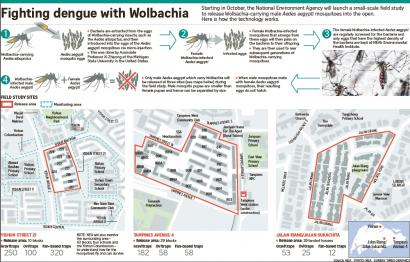
What the male mosquitoes will be armed with is Wolbachia, a naturally occurring bacterium. When these males mate with female mosquitoes, the bacterium causes the females to lay eggs that do not hatch.

Over time, this could lead to a fall in the population of Aedes aegypti mosquitoes, which transmit the viruses that cause dengue fever.

These mosquitoes also carry the chikungunya and Zika viruses. Yesterday, Environment and Water Resources Minister Masagos Zulkifli announced that the National Environment Agency (NEA) will release the bacteria-carrying mosquitoes at three sites as part of a field study.

The areas, Yishun Street 21, Tampines Avenue 4 and Jalan Riang/Jalan Sukachita in Braddell Heights, previously had dengue outbreaks and represent a cross-section of typical housing estates here – both high-rise and landed.

The Environmental Health Institute, a public health laboratory at the NEA, has been studying this novel method since 2012 and carrying out risk assessment and research to confirm that it is safe.

Mr Masagos told reporters that while efforts to reduce the mosquito population have been “fairly successful”, Singapore is still susceptible to dengue outbreaks as it is in a region where dengue is endemic.

He said the new method “works together with source eradication”.

“Whatever we’re doing today to ensure that mosquitoes don’t have opportunity to breed must continue.”

The NEA estimated that an average of one to three male mosquitoes per person will be released at regular intervals at each of the three sites.

The six-month field study aims to understand the behaviour of Wolbachia-carrying Aedes aegypti male mosquitoes in the urban environment, such as how far and high they fly, and how well they compete with counterparts without Wolbachia to mate with females.

To collect data, NEA will set up traps at locations including public spaces and the homes of resident volunteers.

The data will support the planning for a suppression trial, which may start next year.

Experts said that similar trials abroad have had a positive impact.

For instance, a release of Wolbachia-infected mosquitoes led to a more than 90 per cent drop in the mosquito population on an island in Guangzhou, China, under a pilot project starting in March last year.

Professor Ary Hoffmann from the University of Melbourne, who sits on the Dengue Expert Advisory Panel appointed by NEA in 2014, said: “Sterile release has been used against disease vectors and agricultural pests very successfully for many years around the world.

“The only difference here is that sterility is being generated through Wolbachia rather than radiation, but Wolbachia bacteria are already present in many insects…and do not pose any risk to humans.”

He added that Wolbachia, which can be found in over 60 per cent of insect species including butterflies and dragonflies, cannot be transmitted to mammals, including humans, as the bacteria cannot survive outside insect cells. Mr Derek Ho, director-general of NEA’s Environmental Public Health Division, said residents should continue mosquito-control procedures, such as clearing stagnant water.

Associate Professor Vernon Lee, of the National University of Singapore’s Saw Swee Hock School of Public Health, said: “Any gains through the Wolbachia method could be negated if residents provide mosquitoes with an abundance of breeding sites.”

Housewife Winnie Lim, 49, who lives at one of the Tampines blocks where the field study will be conducted, said the Wolbachia technology sounds like a “good idea”.

“Instead of fumigating all the time, this is a long-term effort to wipe out the mosquitoes.”

ateng@sph.com.sg

Image: 
Category: 
Publication Date: 
Sunday, August 28, 2016 – 14:04
Send to mobile app: 
Source: 


Story Type: 
Others

Source link

Rashford nets late winner for United

0

HULL 0

MANCHESTER UNITED 1

(Marcus Rashford 90+2)

Marcus Rashford struck a stoppage-time winner to sink battling Hull as Manchester United maintained their 100 per cent start in the Premier League under Jose…

Source link

Residents step up anti-mozzie efforts

0

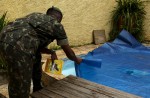
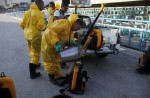
While details of Singapore’s first local case of Zika infection are only beginning to emerge, the National Environment Agency (NEA) has already taken steps to monitor the situation at Aljunied Crescent and prepare residents for battle.

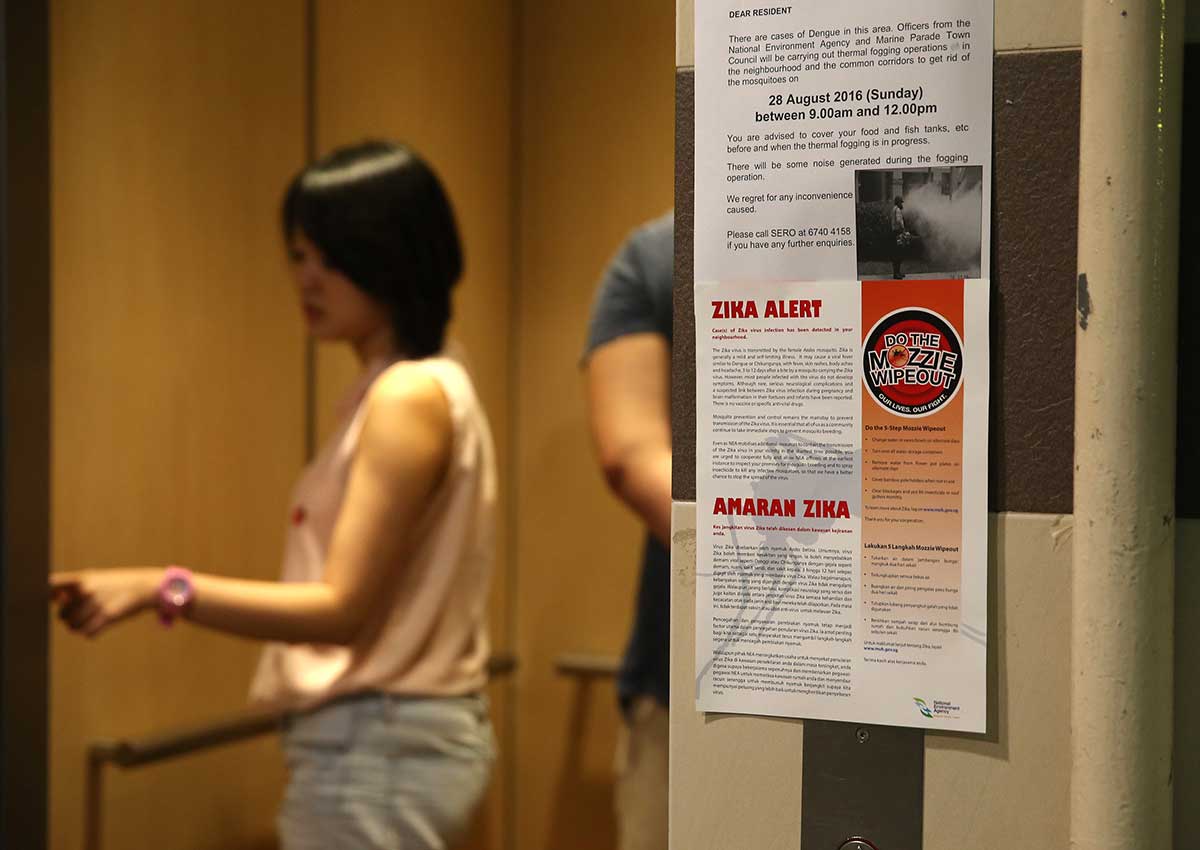
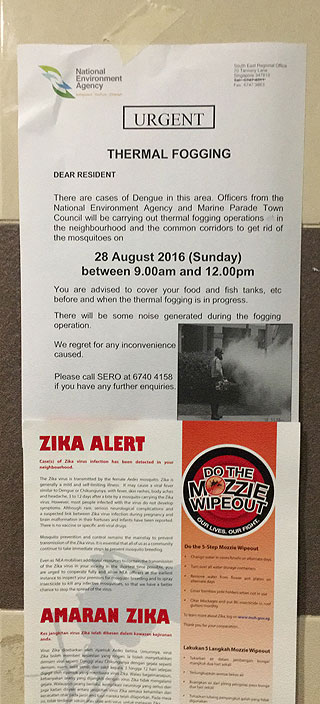
When The Sunday Times visited last night, posters had been put up at the lift landings of Block 102, providing background information on Zika.

Another poster informed residents that fogging of the area would take place this morning.

Five NEA officers were seen in the area last night distributing leaflets and bottles of insect repellent spray.

A 47-year-old Malaysian woman who lives in the block was yesterday confirmed to have the Zika virus. It is the first locally transmitted case in Singapore.

MacPherson MP Tin Pei Ling said she is in touch with the Ministry of Health for regular updates.

“I urge pregnant ladies to monitor your health especially carefully, as Zika can affect the development of an unborn child. As a mother, I am deeply concerned about this and had in fact raised this issue in Parliament earlier this year,” she said.

She noted on Facebook last night that Block 102 is not an active dengue cluster, but added that NEA will be thermal fogging the area today as a precautionary measure.

Mr Aloysius Yeo, 33, an oil and gas project engineer living on the 12th floor of the block with his family, said two NEA officers came to his flat in the afternoon to do chemical-spraying, and others later came around to give him a leaflet and a bottle of repellent.

He said there have been many mosquitoes in the area in the past year and, after learning about the latest Zika case, he now puts repellent on his three children and has stopped them from going to the playground downstairs.

Ms Vidya Viswanathan, 25, who came to Singapore five months ago to pursue a master’s degree in accounting at James Cook University Singapore, said: “I’m worried my exams and assignments and everything will suffer if I get it.”

Her mother Jeyashri Krishnamurthy, 54, a chartered accountant who is visiting her from India, said : “I’m really getting worried about this Zika thing. We take every precaution – no plants, no water anywhere. I hope it (Zika) stops here.”

Polyclinic maintenance worker Myo Min Soe, 40, and his colleague Kyaw Soe Thet, 34, had not heard the news when The Sunday Times visited them on the third floor of Block 102.

They said they had taken the stairs and had not seen the posters at the lift landing.

Mr Myo Min Soe, who had been living there for about eight months, said: “We are going to start protecting ourselves with insect repellent.”

But he and Mr Kyaw Soe Thet are not that worried.

“It’s not just this place, we need to be careful everywhere,” he said.

Although the latest Zika patient has not been to Zika-affected countries recently, Mr Myo Min Soe suggested she may have caught it from someone who has.

Meanwhile, also remaining vigilant are members of Team Singapore who competed at the recently concluded Rio Olympics. Mr Low Teo Ping, Chef de Mission for Team Singapore, said its members had returned to Singapore symptom-free and are being monitored closely.

linyc@sph.com.sg


This article was first published on AUG 28, 2016.
Get a copy of The Straits Times or go to straitstimes.com for more stories.

Image: 
Category: 
Publication Date: 
Sunday, August 28, 2016 – 14:00
Send to mobile app: 
Source: 


Story Type: 
Others

Source link

Air quality improves, returns to 'Moderate' range

0

Air quality in Singapore has improved with the 24-hour PSI returning to the Moderate range at 70-100  on Sunday (Aug 28) at 9am.

Source link

Last days of the Laju hijack

0

FEB 7, 1974

Police perform a series of practice runs on the route they are to take from the Marine Police jetty at Kallang to

Source link