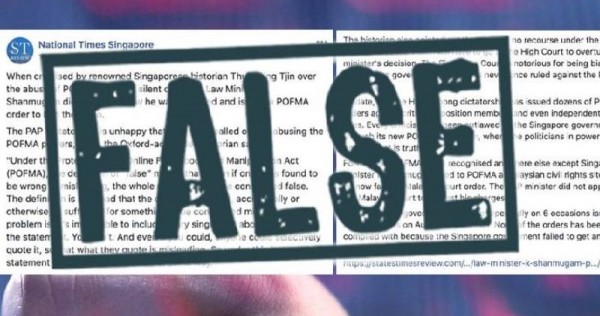
SINGAPORE – The National Times Singapore Facebook page has been asked to put up corrections to a post in which multiple false and misleading statements were made about the scope and application of the Protection from Online Falsehoods and Manipulation Act (Pofma).
Home Affairs and Law Minister K. Shanmugam instructed the Pofma Office on Wednesday (May 27) to issue a correction direction to the Facebook page, run by Mr Alex Tan, and a targeted correction direction issued to Facebook.
The Ministry of Law said in a separate statement on Wednesday this was the seventh occasion in which correction directions under Pofma have been issued against a Facebook page run by Mr Tan, “who has repeatedly and deliberately conveyed falsehoods affecting the public interest”.
The Pofma directives would require the Facebook page to publish a correction notice. Facebook would also be required to communicate the correction notice to all users in Singapore who access the falsehood through its platform.
When local photographer Jeryl Tan saw his jobs dry up during the circuit breaker period, he decided that he wanted to do more than binge on Netflix at home.
So he got down to business, helping 17 F&B establishments (and counting) beef up their online presence with professional photos of their offerings — all for free.
Speaking to CNA about his pro bono project, which will continue until the end of the circuit breaker (June 2), the 28-year-old explained that he had wanted to help F&B businesses which did not have access to proper food photography.
F&B businesses have had to rely on takeaways and food delivery services since dining in was disallowed on April 7 as part of circuit breaker measures.
Polytechnic graduate Dian Afiqah Salaihuddin had planned to get a full-time job after graduation so she could save up for university.
The Covid-19 pandemic not only dashed her hopes of a full-time job, she also could not extend her internship.
Then her mother lost her job in March, and her father stopped working at a gym because of the circuit breaker measures.
Miss Dian, who has a Singapore Polytechnic diploma in creative writing for TV and new media, managed to get a part-time job as a cashier at FairPrice Finest in April.
She became her family’s sole breadwinner for about six weeks until her mother found a part-time job recently.
“It was worrying because my internship company could not afford to let me stay on, and no one else was hiring,” she told The New Paper yesterday.
“I felt guilty because I have five younger siblings who are still schooling. My priority was to earn money and I had no time to keep job-hunting.”
Like Miss Dian, other fresh graduates are not optimistic about their job prospects amid the coronavirus crisis.
SINGAPORE: It could be more expensive to take the bus or train in future if telecommuting becomes the norm in the long term, even after the COVID-19 pandemic dies down.
Lower ridership means a drop in fare revenues for operators. They may eventually have to adjust fares or rely on more government subsidies to ensure that public transport continues running, said experts.
The issue of costs and funding would also “depend critically” on how long safe distancing measures would be implemented on buses and trains, said Associate Professor Theseira, who heads the Singapore University of Social Science’s master of urban transport management programme.
“What is affecting financing is safe distancing, because it forces us to operate a full schedule of services but with very low ridership per service run,” he said. “There is no way for any public transport system to break even with low ridership on board each vehicle.”
Transport Minister Khaw Boon Wan had said earlier in May that fare revenues have dropped by about 80 per cent during the COVID-19 pandemic, putting transport operators under “significant financial stress”.
He noted that even as ridership has fallen, public transport operators have had to spend on additional cleaning and on deploying people to ensure safe distancing.
Additional costs incurred by operators are not “adequately covered” by current fares and will “eventually have to be borne by operators and taxpayers”, Mr Khaw added.
Public transport operators will have to cover some of the shortfall on their own and depend on more subsidies from the Government for the time being, said transport engineering consultant Gopinath Menon.
“Fares may need to eventually rise so that the commuters also contribute their share instead of just the public transport operators and the Government,” he added.
File photo of an MRT train against a backdrop of HDB blocks. (Photo: Jeremy Long)
In the longer term, however, changes may have to be made to the pricing policy.
“We have to look at a combination of pricing policy – not so much fare increases, but perhaps trying to spread out travel more – and perhaps other means of cost recovery such as earmarked taxes or charges,” said Assoc Prof Theseira.
“For example, public transport in many cities is financed specifically from local taxes from businesses that benefit the most from public transport connectivity, such as those within some distance of train stations,” he pointed out.
PREVENTING TRANSMISSION ON PUBLIC TRANSPORT
For commuters returning to work or school, they will have to be mindful of safe distancing rules.
Experts note that measures to prevent crowding on buses and trains may be challenging to enforce after the circuit breaker period ends on Jun 1.
That is why it is compulsory for commuters to wear masks.
They should also avoid talking on the phone or to one another, noted Professor Teo Yik Ying, dean of the National University of Singapore’s Saw Swee Hock School of Public Health.
“These measures are aimed to minimise people from producing aerosolised droplets that go on to infect others or settle on surfaces,” said Prof Teo.
“If there is very little contact between people and no conversation, then the chance of droplets being expelled will be significantly reduced, and this in turn reduces the risk of infection to fellow commuters.”
Commuters wear face masks on an MRT train in Singapore on Mar 18, 2020. (Photo: Roslan RAHMAN / AFP)
Other ways to prevent the spread of COVID-19 on public transport could include the regular testing of frontline workers such as drivers, as well as increasing the frequency of buses and trains, although Prof Teo noted that this would increase operating costs substantially.
RETHINKING TRANSPORT
As an alternative to crowded mass transit, some countries, including Italy and Colombia, are turning to cycling as a mode of transport.
France is investing 20 million euros (S$31 million) in subsidising bicycle travel, while Britain has announced an ambitious £2 billion plan to promote “active travel” modes such as cycling and walking.
While Singapore has its own initiative to encourage cycling – the Government plans to invest more than S$1 billion on cycling paths over the next decade – Assoc Prof Theseira believes cycling is not yet a “realistic alternative” for most commuters because of the long distances between population centres and workplaces, as well as the lack of dedicated cycling paths connecting the two.
Singapore should continue to invest in public transport infrastructure, even if ridership were to decline in the longer term, said Assoc Prof Theseira.
“Extensiveness of the network is different from intensity of services. We need an extensive network so that you don’t need private transport and to provide redundancy,” he explained. “However, service frequency and intensity could be adjusted to save costs.”
Commuters wearing protective face masks wait for the bus, amid the coronavirus disease (COVID-19) outbreak in Singapore May 15, 2020. REUTERS/Edgar Su
Transport consultant Mr Menon believes the coronavirus outbreak is an “opportune time” to review Singapore’s overall transport policies.
Such a review should consider the provision of additional bus lanes and cycling lanes, and taking away lanes for motor vehicles, he added.
“Otherwise, we go back to the old system where the cars still dominate, with nothing having been changed, and the pollution levels return.”
In the longer term, Mr Menon hopes concerns over COVID-19 will also lead to greater decentralisation in urban planning – so people will be able to travel shorter distances for work and leisure – in addition to telecommuting and more flexible work arrangements.
The long term increase in adoption of telecommuting in response to COVID-19 would be a “great thing for everyone”, said Assoc Prof Theseira.
“Travel is actually economically inefficient. What we gain from economic activities around travel – such as supply of transport services, fuel and so on – is far outstripped by the value destruction from congestion, consumption of fossil fuels, environmental harm, time wasted,” he said.
There would however be adjustment costs, he noted, pointing to the impact of reduced demand on the taxi and private-hire car sectors.
“But while these costs may be painful to pay, a sustained reduction in local travel demand will eventually be better for the economy, because doing business without a need to physically travel is much more efficient,” he said.
SINGAPORE: After long lockdowns all over the world, countries are looking to ease them.
But the lifting of lockdowns means we are looking to resuming our daily activities with the fear of COVID-19 still hanging over us.
This means that governments and possibly employers will have to integrate various contact tracing measures into our routine.
The idea behind contact tracing is to take stock of where and when we come into contact with others for a significant period of time, so that we can track and curb the virus’ transmission.
That said, how much information can employers collect from employees in the name of contact tracing?
After all, giving our name, mobile phone number, location data, and movement record risks invasion of privacy.
It pays to know what can be considered legitimate contact tracing as opposed to unwarranted surveillance.
GOVERNMENT-SANCTIONED CONTACT TRACING
The Government has two digital tools – SafeEntry and TraceTogether – for contact tracing.
It is interesting to note however that the Personal Data Protection Act 2012 (PDPA) does not impose the data protection obligations on “any public agency”, which includes the government, including any ministry department, agency, or organ of State.
In other words, the Government does not need to obtain individuals’ consent to disclose personal data to another public agency.
Further, under the Criminal Procedure Code, the police has the power to obtain data for any investigation or trial.
However, considering that both SafeEntry and TraceTogether websites express that the data collected will be used for the specific purpose of contact tracing only, public agencies will be slow to use the data for any other purposes, at the risk of losing public trust.
WHY PRIVATE CONTACT TRACING
In addition to SafeEntry and TraceTogether, employers have to implement their own forms of contact tracing at their premises – not only to comply with the Ministry of Manpower’s (MOM) Safe Management Measures advisory, but also for business continuity.
Singapore Government Technology Agency staff demonstrate a new contact-tracing smartphone app designed to help stop the spread of coronavirus AFP/Catherine LAI
If there is an inspection, employers must be able to produce records of inspections and checks conducted and corrective actions taken.
For the manufacturing sector specifically, the Government has also advised tracking all interactions between individuals or groups who are in close contact or proximity for 30 minutes or more, inclusive of the location whenever relevant.
In terms of business costs, data to show where an individual has been for prolonged periods within the workplace could make the difference between having to close down a whole floor versus closing only a small section of the workspace with minimal business disruption.
MOM’s advisory states that if someone at the workplace is a confirmed case, employers should immediately vacate and cordon-off, clean and disinfect “the immediate section” of the premises where the confirmed case worked.
There is no need to vacate the building or the whole floor if there had been no sustained and close contact with the confirmed case.
Internal contact tracing data can help in better defining the area to be vacated, especially where employees do not have a fixed station or have to leave their stations often.
METHODS OF PRIVATE CONTACT TRACING
Depending on the nature of workplace – whether indoors, outdoors, in the office or a retail shop – the number of employees, and the budget available, employers may choose different options for contact tracing.
If there are CCTVs in place, employers may decide that it is convenient and cost-effective to use them to collect video footages of the employees within the workplaces.
Businesses could engage app developers for a bespoke solution, or build on the TraceTogether model to record “close contacts” – the exchanges of Bluetooth signals with nearby phones.
In the latter case, only the phone number and an ID assigned to the phone will be collected, and no location data will be collected.
Employers could also introduce wearable technology – a watch, lanyard or pen-shaped trackers that employees can carry with them during working hours. Imagine a fitness tracker, except for contact tracing.
Some of these use the exchanges of Bluetooth signals to track interactions between employees or even map out where in the workplace the infected employee has been and for how long, using Bluetooth beacons installed in the workplace.
This may be the best option that ensures the privacy of employees among the options considered here.
As a dedicated hardware for the specific purpose of contact tracing, it can simply be taken off outside of working hours unlike apps installed on phones.
Also, unlike CCTV footages where individuals are identified by their images, wearables can capture close contacts in the form of exchange of anonymous IDs, which will require an additional step of decryption to associate back to specific individuals.
Lastly, despite the risk of incomplete and inaccurate records, small businesses may decide to keep manual records – of when employees enter the workplace, where they are stationed, a list of their meetings, who the contacts are that they meet and for how long.
WHAT ARE MY PRIVACY RIGHTS?
Employees may feel that all of these measures are a little intrusive – and they are, to varying degrees – and feel a little helpless.
FILE PHOTO: Contact tracing app TraceTogether, released by the Singapore government to curb the spread of the coronavirus disease (COVID-19) is seen on a mobile phone, in Singapore March 25, 2020. REUTERS/Edgar Su/File Photo
On one hand, employees would be required to accept the employers’ contact tracing measures as long as they comply with the government’s requirements for Safe Management Measures.
On the other hand, however, the PDPA does limit how far the contact tracing measures can go, in three aspects in particular.
First, there’s the purpose limitation obligation. Personal data collected for the purpose of internal contact tracing should not be used or disclosed for any other purposes, unless consent is obtained or it is authorised under the law.
For example, an in-house app deployed for the sole purpose of contact tracing cannot then be used to check how employees spend their break time for the purpose of monitoring productivity.
Your employers shouldn’t be using the app to count how long you were away from your desk during your appraisal.
By the same logic, employers should be conducting contract tracing during working hours, at the workplace only.
So, if you head down to your nearest coffeeshop in the middle of the night to grab a cup of coffee or a snack, your boss doesn’t need to know.
Second, organisations must protect personal data in its possession or under its control by making reasonable security arrangements to prevent unauthorised access, collection, use, disclosure, copying, modification, disposal or similar risks.
In the case of the digital tools mentioned above, the personal data involved would be the CCTV footages where the employees are identifiable, or any data collected by the app or the wearables from which the individual employees can be identified – for example, mobile phone number or the location data.
The data should be accessed only by the designated personnel and adequately protected with strong passwords and encrypted storage.
Third, under the PDPA’s retention limitation obligation, companies must not keep the collected data once its original purpose is no longer being served.
The Government’s guidelines for the manufacturing sector, for instance, requires contact tracing records to be kept for at least one month.
The Personal Data Protection Commission’s (PDPC) advisory on this topic recommends companies to implement appropriate policies on their contact tracing measures, which should include explanation on how they comply with the above obligations.
In case of breach of PDPA obligations, including the failure to have appropriate policies in place, the PDPC has the power to give directions for companies to take corrective actions as well as to require payment of a financial penalty not exceeding S$1 million.
To protect their personal data, employees should be aware of and give their input on the policies to their employers or, if necessary, consider applying to the PDPC for a review of the suspected breach of the PDPA.
THE FUTURE
Contact tracing tools are currently pitched as something with a clear sunset horizon, that will last until the end of this pandemic.
However, if left unchecked, employers may take this opportunity to establish workplace monitoring as a new norm and continue with it even after the pandemic.
Worse, employers may even try to use it to monitor their staff’s movements outside of work for reasons other than contact tracing.
We may especially see this happen if work places transit to a remote working model on a more permanent basis, where employers may be tempted to use such apps to keep track of their staff.
Either of these possibilities will not only be taking a step backwards in terms of building a relationship of trust between employer and employee, but also with how we treat the privacy of personal data as a society.
Employees can help in preventing that from happening. The law empowers them to.
SINGAPORE: Singapore’s financial position will be “a lot weaker in the coming years”, but the Government will continue to find ways to manage this “difficult financial situation”, said Deputy Prime Minister Heng Swee Keat in an interview with CNA on Wednesday (May 27).
A total of S$52 billion will be drawn from past reserves this financial year to help Singapore as it battles the economic fallout from the COVID-19 pandemic.
“I will address the issue of how we are going to ensure that we continue to have the fiscal power to keep Singapore safe, not just in this one year, two years, but for the long term and I will address Parliament on this issue later,” said Mr Heng.
“But for now, let me say that we have a huge work ahead of us, which is to make the very best use of every dollar and cent that we have taken from the past reserves and make sure that we use it wisely and make sure that it counts. And if we can do that, that will allow us to bounce back better and allow us to protect Singaporeans better.”
The financial crisis was the only other time that Singapore had dipped into its reserves, when the Government drew S$4.9 billion to help workers stay employed and companies get credit.
The money was returned to the reserves in 2011 after the economy recovered.
“KEEP OUR PEOPLE SAFE”
The Deputy Prime Minister said the Government will need to continue to find ways in which it can “manage this difficult financial situation”.
“But for now, I think the most important thing is, first, keep our people safe and second, let’s get the economy going again, as much as possible,” Mr Heng added.
“It will not be easy … if we put our minds to it, we can emerge stronger, and with that, I think we can begin to rebuild our resources over time.”
Singapore has been “very fortunate”, because it has sufficient reserves to tide it through a even “more prolonged difficult period”.
“But we have to be very careful in how we spend this and make sure that we use it wisely and use it well,” the Deputy Prime Minister said.
When asked if Singapore could see a fifth supplementary budget, Mr Heng said: “After presenting four Budgets within such a short period of time, I will say that ‘never say never’.”
The Fortitude Budget has been sized in such a way that it allows Singapore to respond should the situation deteriorate, he added.
Medical personnel walk past migrant workers at a dormitory during the coronavirus (COVID-19) outbreak in Singapore Apr 27, 2020. (Photo: REUTERS/Edgar Su)
He explained that Singapore has set aside a contingent sum of S$13 billion, up from the usual S$3 billion annually.
“That is why in this Budget I have a bigger contingent sum,” Mr Heng said. “So I hope that we do not need to have another Budget in order to respond because if the situation deteriorates, it is going to be very very fast.”
CREATING JOBS
A key part of the Fortitude Budget is the SGUnited Jobs and Skills Package that will create close to 100,000 opportunities for workers, including jobs, as well as 25,000 traineeships and 30,000 skills training placements.
“It’s very important for us to provide a very focused support for our people who are seeking jobs – both those who have been retrenched as well as those new students, graduating students, from our ITEs, polytechnics and universities,” said Mr Heng.
“This SGUnited Jobs and Skills package has a very clear component to create jobs, as well as traineeships and company-level traineeships in order to ensure that everyone who wants to learn something, who wants to do something, is able to do so.”
When asked if the 100,000 figure was a reflection of the expected job losses that could arise from the COVID-19 pandemic, Mr Heng explained that it was based on a range of projected job losses and the number of new entrants into the labour market every year.
“This is how we’ve sized it. I believe that for now, that will be sufficient. But if there is need for us to do even more, we have the resources to do that.”
The Government is also taking more steps to put “a focused effort” on revamping the built environment sector to create better jobs for Singaporeans and to reduce “the manual portion” of the work.
“With the digitalisation trend, if we can be far more efficient, we would have to worry less about machines taking over man in the job market.
“For us, a combination of man and machines will be a very powerful one and therefore we must make the best use of how digitalisation can enable us to be more productive and more efficient,” said Mr Heng.
“But in other sectors, like for instance the built environment, people associate the built environment with just construction work and hard labour,” he added.
“But actually, the built environment is a pretty sophisticated one. You have many Singaporeans who are employed as architects, engineers, draftsmen, quantity surveyors and project managers. These are good high paying jobs.”
Mr Heng said he has discussed this with National Development Minister Lawrence Wong and Minister for Social and Family Development Desmond Lee.
“I must caution that there is a limit to how far we can go,” Mr Heng added.
“We will still need to rely on a significant proportion of foreign workers to do very difficult jobs for which many Singaporeans would not want to do.”
SINGAPORE – Singapore’s economy faces significant long-term challenges that need to be dealt with over the next five to 10 years, Deputy Prime Minister Heng Swee Keat said on Wednesday (May 27). And the sooner the general election is held, he said, “the earlier we can rally everybody together to deal with these very significant challenges ahead, and also to deal with these very significant uncertainties in the months and years ahead”.
Singapore’s next election must take place by April 14, 2021, and Mr Heng’s remarks, in an interview with TV station CNA, are the strongest hint by a minister to date that the polls are likely to be called soon.
Asked whether Singaporeans will have to wait until Phase 3 of resuming economic activity before the election, Mr Heng said: “The sooner that we can deal with the longer term challenges, the better Singaporeans will emerge out of this, and Singapore will emerge stronger. So I would say that, yes, elections are coming nearer by the day, and you have to be prepared for it.
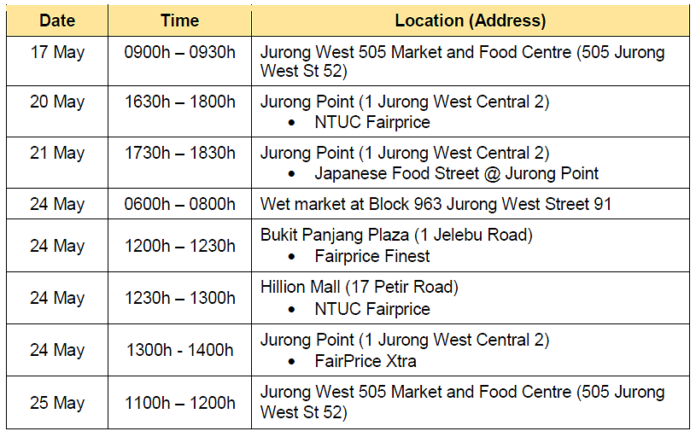
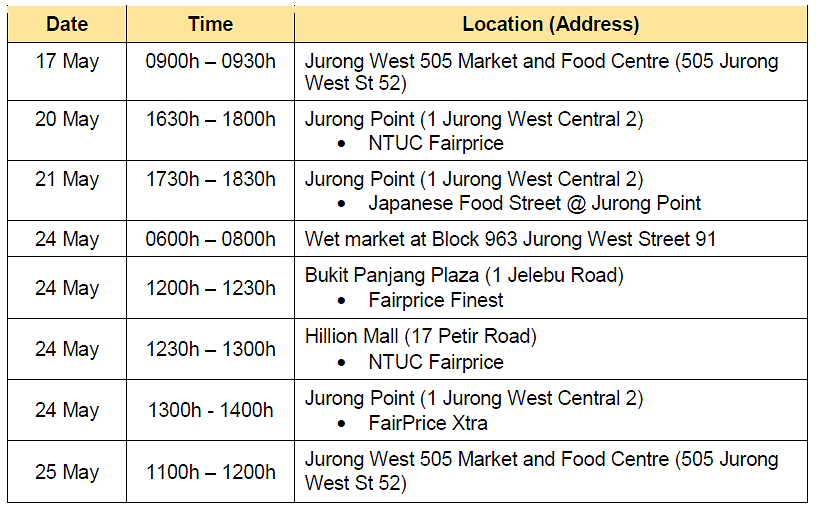
SINGAPORE: FairPrice supermakets at Bukit Panjang Plaza and Hillion Mall have been added to a list of public places visited by COVID-19 cases during their infectious period.
The new places identified on Wednesday (May 27) by the Ministry of Health (MOH) are the Jurong West 505 Market and Food Centre at 505 Jurong West Street 52, an NTUC FairPrice store at Hillion Mall and a FairPrice Finest store at Bukit Panjang Plaza.
The health ministry said on Monday the list includes public places COVID-19 cases had visited for more than 30 minutes.
“As a precautionary measure, persons who had been at these locations during the specified timings should monitor their health closely for 14 days from their date of visit,” said MOH.
“They should see a doctor promptly if they develop symptoms of acute respiratory infection (such as cough, sore throat and runny nose), as well as fever and loss of taste or smell, and inform the doctor of their exposure history.”
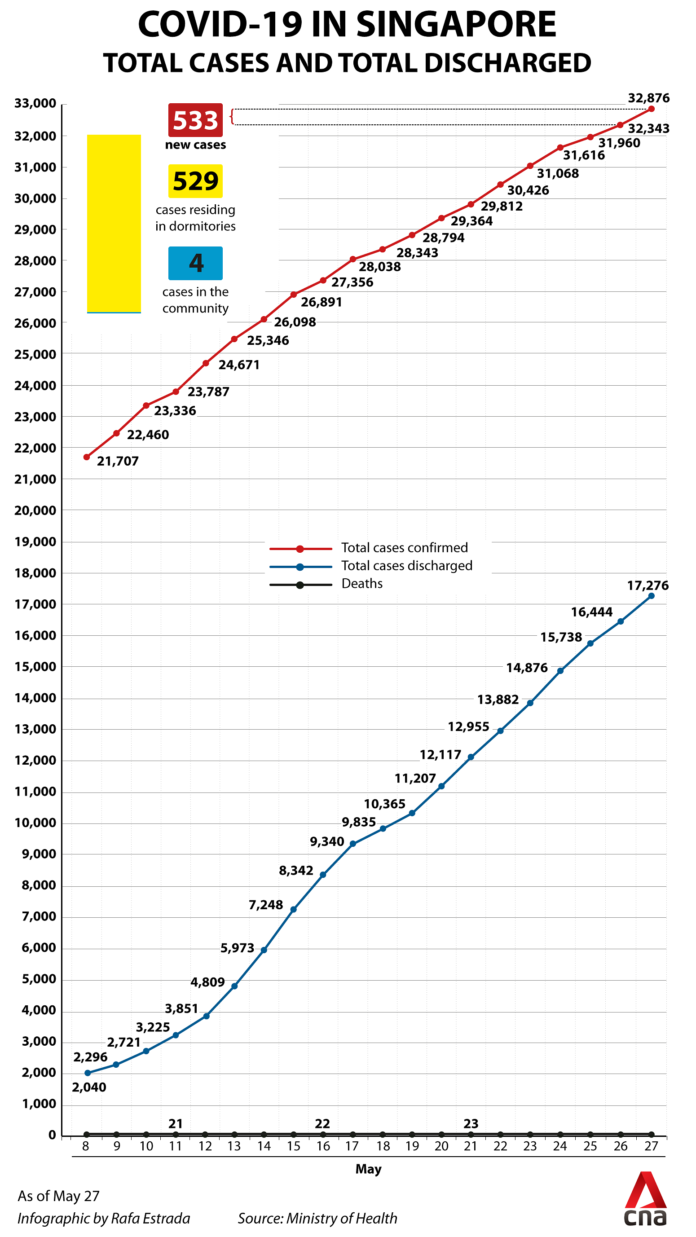
SINGAPORE: Singapore reported 533 new COVID-19 cases as of noon on Wednesday (May 27), taking its total number of infections to 32,876.
A total of 529 of the new infections involve foreign workers residing in dormitories, the Ministry of Health (MOH) said in its daily update.
The ministry said it continues to pick up many cases among work permit holders residing in dormitories, including in factory-converted dormitories, because of extensive testing in these premises.
Of the four cases in the community, three are Singaporeans and one is a Chinese national work pass holder.
Two of the community cases are Singaporean women aged 65 and 37 and are contacts of Cases 29563 and 31089. The were both asymptomatic and are part of the Jurong Penjuru Dormitory cluster, which currently has a total of 1,188 confirmed cases.
Case 29563, a 68-year-old Singaporean man who worked at Jurong Penjuru dormitory, had tested positive for COVID-19 on May 20. Case 31089, a Bangladeshi national, tested positive for the coronavirus on May 23.
The remaining Singaporean case, a 56-year-old woman, first experienced onset of symptoms on May 19.
The 33-year-old Chinese man reported an onset of symptoms on May 21. He had gone to work at 19 Pandan Road, Tuas Terminal Phase 1 and Jurong Port and tested positive for COVID-19 on Tuesday.
“The number of new cases in the community has increased, from an average of five cases per day in the week before, to an average of six per day in the past week.
“The number of unlinked cases in the community has also increased, from an average of one case per day in the week before, to an average of two per day in the past week,” said the ministry.
MOH added this is partly due to its active surveillance and screening of nursing home residents and pre-school staff, which have picked up more cases in the past week.
One new cluster was identified. It is a dormitory at 38 Tuas View Square and is currently linked to five cases.
The ministry said 99 per cent of the new cases are linked to known clusters while the rest are pending contact tracing. Further details can be found in MOH’s daily situation report.
A total of 832 more COVID-19 patients have been discharged. In all, 17,276 have fully recovered from the infection and have been discharged from hospitals or community care facilities.
There are currently 525 confirmed cases who are still in hospital. Of these, most are stable or improving while seven are in a critical condition in the intensive care unit.
A further 15,052 are isolated and cared for at community facilities. These are people who have mild symptoms, or are clinically well but still test positive for COVID-19. To date, 23 have died from complications due to COVID-19 infection.
COMMUNITY CASES VISITED FAIRPRICE OUTLETS
MOH said cases in the community recently visited the FairPrice Finest outlet at Bukit Panjang Plaza and NTUC FairPrice at Hillion Mall on Sunday while they were infectious. The cases also visited the Jurong West 505 Market and Food Centre on May 17 and May 25.
Four public spots in Jurong were also previously identified by the ministry as places visited by COVID-19 cases.
They include a wet market at Jurong West Street 91 and the FairPrice Xtra supermarket at Jurong Point shopping centre, announced on Tuesday.
The other two were the NTUC FairPrice grocery store and a Japanese “food street”, also at Jurong Point. These were listed on Monday, the first time MOH released such a list.
People who had visited them during timings specified in the list are advised to monitor their health closely for 14 days from the their date of visit.
Called the Fortitude Budget, the package aims to help businesses and workers adapt, transform and seize new opportunities in order to emerge stronger from the COVID-19 crisis, said Deputy Prime Minister Heng Swee Keat in Parliament.
When Ms Valerie Liu was in her early 20s, she thought she was a deity with superpowers that allowed her to talk to the radio and her television set.
The voices in her head kept telling her that her neighbours were watching her and conspiring with her mother against her.
This went on for a long time, until she was diagnosed with schizophrenia in 2007.
Today, the 38-year-old rarely hears these voices, thanks to the right medication and plenty of counselling and support from health professionals as well as her mother, who is her main caregiver.
World Schizophrenia Day was observed on May 24, as it is every year, to raise awareness for patients like Ms Liu, for whom more help is now available.
“Compared with a decade ago, things have gotten so much better. In my work, I talk to others, as someone who has lived through the experience of having schizophrenia”, said Ms Liu, who is now an executive and peer support specialist at the Singapore Association for Mental Health (SAMH).
She coordinates talks and workshops to help others dealing with mental health issues.