SINGAPORE: “And as we share this new, frightening reality,” Dr Anuradha Rao wrote in her CNA commentary, “there is no better time to introspect about our relationship with social media”.
As the winds of coronavirus sweep through our lives, nothing has been left unexamined, not even social media, where usage has seen an unprecedented surge.
Among those most engaged on social media are youth – individuals like myself. If anyone should introspect about their relationship with social media, it is us digital natives who grew up with them.
And so I have been reflecting. While I see the benefits of social media in these troubling times, a nagging concern has become impossible to ignore: For all the good social media can do, I fear that life amid coronavirus risks becoming a social media popularity contest.
Don’t get me wrong – in this time of social isolation, social media has been a good thing in many ways.
With our social lives disrupted, social media has been a key platform for us to more fully connect with loved ones and social networks.
Like a treatment against loneliness, social media has made being stuck at home that much more bearable.
But while greater exposure to social media carries greater exposure to its benefits, it also involves greater exposure to its risks.
A man holds a smart phone with the icons for the social networking apps Facebook, Instagram and Twitter on the screen. (Photo: AFP/Kirill Kudryavtsev)
In some sense, its use is inherently risky. Consider what one social media pioneer, Sean Parker, the founding president of Facebook, said in a 2017 interview:
The thought process that went into building these applications, Facebook being the first of them … was all about: ‘How do we consume as much of your time and conscious attention as possible?’ And that means that we need to sort of give you a little dopamine hit every once in a while, because someone liked or commented on a photo or a post or whatever. And that’s going to get you to contribute more content.
Parker then went on to admit that his team was in fact “exploiting a vulnerability in human psychology”.
Granted, people are not robots mindlessly letting engineers hack their minds. But we cannot deny the risk of going from using social media to maintain social connections, to using it to mine social validation.
It is a fine line we can cross without even realising it. Some might even say many already have.
As Professor Jung Younbo wrote in a CNA commentary last year: “People want to show off the most enjoyable moments of their lives” and are incentivised to keep posting these moments when they are rewarded with “likes”, those dopamine hits of social validation.
To be clear, there is nothing problematic with putting up life updates to stay connected with friends, or the harmless screenshots of Zoom calls for memory’s sake. But if we are not sufficiently self-aware, these activities risk becoming addictions.
We may end up posting screenshots of video calls less because we want to remember what happened, and more because we want others to know it happened.
We may end up posting about the food deliveries we received, less because we want to show our care, but more because we want to show off that we are cared for.
We may end up posting text messages, workout recordings, photos of family dinners, less because they made us feel good, but because posting makes us feel good.
(Photo: Unsplash/Eaters Collective)
To top it all off, watching all our friends’ stories, we would inadvertently compare ourselves to them, the fear of missing out present even amid a pandemic.
Collectively, beneath the veneer of “positive vibes” our posts give off, we run the risk of turning life amid pandemic into a corrosive popularity contest, as we compare our lives to others and want to present ourselves as not being worse-off, our every post carefully captured and captioned.
SO WHAT?
Some may ask, so what? For one, we would be giving in to those who are – in Sean Parker’s words – “exploiting a vulnerability in human psychology”. More importantly, we run the risk of hits to our mental health and those of our friends, already more vulnerable in a time of coronavirus disruption.
Consider an analysis formally published this year, reviewing 121 studies on the effects of social media. The review, led by Alyssa Saiphoo from Ryerson University in Toronto, found a “small, negative, and significant relationship” between what was termed “social networking sites use” and self-esteem. The bottom line is that there is an association between higher social media usage and lower self-esteem.
While research and statistical significance should always be interpreted carefully, we need only look around us to know that the problems are real. A Big Read story from last July reported that youth counselling centres and clinics in Singapore said they were seeing more cases of youths struggling with self-esteem issues due to social media exposure.
With the United Nations warning of a major mental health crisis induced by the pandemic, the additional impact of detrimental social media use is the last thing we need.
SOCIAL MEDIA, LIKE A DRUG
In a time of pandemic when uncertainties and anxieties are already high, we should not risk straining our mental health further with detrimental social media habits.
(Photo: Unsplash/Leon Seibert)
Social media can be a treatment for loneliness, but like all drugs, an overdose, or a mishandling, could risk unforeseen consequences.
Managing this risk, in my view, begins with being more self-aware. Before posting, ask yourself, “why am I posting this?”. Then ask yourself, “why am I really posting this?” If you are satisfied with both answers, then go ahead.
We also need to understand that there’s no need to put something on social media just to show it happened; our memories, our relationships and our lives are not any less real just because we did not do so.
Conversely, what we see on social media are just the bits of reality others want us to see.
It is human to want to show the best of ourselves on social media, but excessively doing so risks us forgoing the most human realities of all – living lives which are authentic, being mentally healthy and being in control.
Something else we can do is to more deeply embrace these realities now, and continue to even after this period of social isolation.
We can choose to live life more authentically through our own eyes, and less through the lens of our phone cameras. We can revel in the here-and-now of being with friends and family, rather than try to colour them with filters and captions.
To quote Dr Rao again, we do share a “new, frightening reality”. However, we can try to make this reality one that is more free, more human and more real.
The alternative, as far as social media is concerned, would be to risk a popularity contest – one which would be anything but real.
Download our app or subscribe to our Telegram channel for the latest updates on the coronavirus outbreak: https://cna.asia/telegram
Ng Chia Wee is a second-year student at the National University of Singapore’s Faculty of Arts and Social Sciences. He is also part of Access, a social mobility non-profit organisation.
SINGAPORE: Dr Siew Tuck Wah had waited five years for that moment.
In September 2018, the president of dog rescue charity Save Our Street Dogs (SOSD) had moved to a bigger house and this meant he could finally bring home Momo, a mixed breed that had lived in his shelter since 2013.
Momo is not any dog. As a puppy, it had started showing signs of aggression, like nipping at people. The problem got worse as it got bigger.
“When he grew up, his owners didn’t correct his bad behaviour,” Dr Siew, an aesthetic doctor, told CNA. “After that, they wanted to put him down.”
Dr Siew was having none of that. He took Momo into his shelter, hoping it could one day find a new home. Chances were slim, however, and Dr Siew acknowledged that a lifetime in a shelter was not much of a life at all.
Now about seven years old, Momo stands at around 160cm on its hind legs, about as tall as its owner. It has food aggression, leaps at people and bites them. It needs a big space to run around.
While Dr Siew said he is “lucky” that Momo trusts him enough not to bite him that often, he still has to put in considerable time and effort to care for an aggressive adult dog. “You must be very careful,” he said.
Save Our Street Dogs president Siew Tuck Wah with Momo. (Photo: Siew Tuck Wah)
Dr Siew dog proofs the house, separates Momo from other members of the household – including his three other dogs – and ensures Momo eats by itself.
“When he first came, I had blood in the house for three months,” he said. “Every day there would be a bite – (of a) human or another dog.”
When he brings Momo out, he keeps it on a literal tight leash. “Just the other day, he fought with another dog. They really pull and try to run away,” he added. “It’s very difficult to care for this kind of animal.”
THE BIG DEBATE
But not every dog is as lucky as Momo.
Veterinarians CNA interviewed said they’ve put down pets, including dogs, for aggression to protect public safety, although they said this makes up a tiny minority of euthanasia cases: The vast majority are for health reasons.
When owners ask to put down healthy pets for aggression, the vets said they conduct a thorough process to verify that behaviour and ensure owners have exhausted all other options, including training and rehoming.
Vets also said they quiz owners on these efforts, the family’s and the pet’s circumstances, and might recommend medicine to suppress the aggression. They could also observe the pet’s behaviour at the clinic and at home, and recommend trainers and shelters.
A dog at a Save Our Street Dogs exhibition in 2018. (Photo: Facebook/Save Our Street Dogs)
But animal welfare groups are less convinced.
Dog rescue groups that CNA interviewed said while vets are the best judges of an animal’s physical state, they might be less in tune with its character or temperament.
Some groups argued that vets, as human beings themselves, might pander to an owner’s emotions. This is especially if, for instance, the owner comes in with a snarling dog and tells a story about how it had bitten a child.
That said, vets and animal groups agreed that owners are ultimately responsible for their pets, aggressive or not, with the groups saying it boils down to the amount of time, effort and money owners are willing to put in to save pets’ lives.
THE CASE OF LOKI
The euthanasia of healthy pets has again been thrust into the spotlight, after a volunteer at a dog welfare group for Singapore Specials revealed on May 6 that one of its animals had been put down for apparent aggression.
In a Facebook post that has since been taken down, the volunteer at Exclusively Mongrels said Loki was adopted as a puppy and would have turned three soon. He alleged that Loki’s owners did not seek help from the group before putting it down.
The case sparked outrage among some netizens who felt the euthanasia was not justified. Some have identified and exposed the alleged owners, and criticised the Mount Pleasant Veterinary Group that conducted the euthanasia.
“Veterinarians do not participate nor have influence in prior agreements made between a rehomer and an adopter, which is a private matter,” the vet said in a statement on May 13.
Politicians including Member of Parliament (MP) and animal activist Louis Ng have weighed in, with Mr Ng calling for new regulations on euthanasia. The Animal and Veterinary Service (AVS), formerly known as the Agri-Food and Veterinary Authority (AVA), has said it is investigating.
Exclusively Mongrels announced in a Facebook post on Thursday that it had on May 18 commenced legal proceedings against Loki’s owner for what it said was a breach of the adoption agreement.
WHAT THE GUIDELINES SAY
The Code of Ethics for Veterinarians states that vets must consider euthanising animals to prevent unnnecessary suffering, but must first consider appropriate treatment options.
As far as possible, vets must get informed consent for euthanasia in writing, and may turn down euthanasia that isn’t deemed necessary. The code, however, does not address the issue of putting down healthy animals.
A Save Our Street Dogs booth at an exhibition in 2018. (Photo: Facebook/Save Our Street Dogs)
But the Singapore Veterinary Association (SVA), which developed the code with regulators like the former AVA, said the euthanasia guidelines also cover public safety.
“This necessitates professional judgment by veterinarians to effectively apply the standards, laws and ethics that govern veterinary practice, factoring in animal health, animal welfare, public safety and safety of the pet owners,” it said in a statement on May 12.
EXHAUSTING ALL OPTIONS
Regardless of the code, Animal and Avian Veterinary Clinic founder Dr Kenneth Tong said his team adopts a thorough approach when an owner comes in requesting to put down his dog for aggression.
The dog, he said, will be muzzled while its temperament is observed in the clinic and consultation room with zero or minimal restraint. Staff will also see how it behaves in public with other animals and people. These episodes will be recorded.
Dr Tong, who has more than a decade of veterinary experience, said he will ask for documented proof of injuries or hospitalisation due to injuries caused by the dog.
Besides that, owners should provide a “complete history” of the dog to the point of aggression, including potential triggers. This depends on how thorough the owner can be.
(Photo: Unsplash/Kenny Luo)
The owner must say how he has tried to correct the aggressive behaviour, including whether he has personally tried to train it or engage professional trainers, the number of trainers contacted, and the number and intensity of lessons.
With the owner’s consent, Dr Tong could refer the dog to a behaviourist or trainer for further assessment. If not, he will offer some contacts.
The owner will also be asked if he has attempted to rehome the dog, including which adoptors and shelters he’s contacted.
“The owner will then look into these alternatives, along with any medication, dietary changes and therapies, and take a period to decide the options,” Dr Tong said. “That can be days to weeks to months of trying the different or combination of options.”
VETS LIABLE FOR PET INFLICTED INJURIES?
Dr Frederic Chua, a vet at Allpets and Aqualife Clinic with 33 years of experience, said staff could also drop by the owner’s home to observe the pet in its usual environment.
The clinic puts down three to four animals – mostly dogs – each year for aggression, a figure he said is already considered high.
“In a sense, you could say we try to do everything and find any excuse in order to save a pet’s life,” he said.
“But we also have to consider the other side of things. For example, what if the pet, having gone through all these checks, retraining and treatment, continues to be a menace to the family and other other families?
“Then it becomes an ethical reason – public health, public safety. Then we have to be responsible in that sense.”
(Photo: Unsplash/Samuel Toh)
Dr Tong said vets must make a professional judgment on whether there is “imminent danger of injury and safety towards the family and public, including legal liability of the decisions made”.
“If a dangerous dog were to cause life threatening injuries, or even death, to a child, their owner or a member of the public, the vet who had refused to euthanise the animal would be considered partly responsible for these consequences,” said Dr Gemma Hepner, a senior veterinary surgeon at the Animal Practice Veterinary Clinic and Surgery.
Ultimately, Dr Tong said his final decision would consider this public health and safety risk in relation to the pet’s subsequent welfare.
“Confining an animal with limited movement area, chaining it continuously without the ability to bathe or groom it, or attend to its injuries for fear of being attacked, is in itself infringing on animal welfare,” he added.
ANIMAL WELFARE GROUPS RESPOND
However, SOSD’s Dr Siew said vets might not be the best people to assess an aggressive dog’s behaviour. “Vets are good at assessing health, but not behaviour all the time,” he said.
This, he said, is further complicated by the “difficult ethical question” that vets face: What happens to the pet if they don’t agree to the owner’s request, especially as many shelters face capacity issues?
When it comes to taking in aggressive dogs not originally from their shelters, SOSD, ASD and VFA will generally advise owners to look for trainers and alternative shelters or adoptors.
“If the vets say no, then the owner might go to another vet,” Dr Siew said. “Vets have taken in dogs that owners have given up, and are themselves under a lot of stress and emotional burden as well.”
Voices for Animals founder Derrick Tan at one his adoption drives in 2015. (Photo: Facebook/Voices for Animals)
Voices for Animals (VFA) founder Derrick Tan believes an owner could still “manipulate” a vet to put down a healthy pet for aggression despite not exhausting alternative options.
“It could be how owners had communicated with the vets, and how they had shared information with the vets,” he said. “How much and how far the owner has gone, no one knows. It’s all words.”
A Voices for Animals adoption drive in May 2015. (Photo: Facebook/Voices for Animals)
Echoing this, Action for Singapore Dogs (ASD) president Ricky Yeo said vets are also human beings who will react emotionally to a “snarling, growling dog” in the clinic.
“And the owner just rams it into the vet’s mind that this is aggressive,” he said. “Then it fortifies that notion, and so the vet, maybe in a moment of emotional stress, may then take on that fateful decision to euthanise.”
Dr Chua acknowledged that as with any industry, there will be “rotten apples”. “That’s what the code of ethics is for,” he said. “To investigate and penalise vets, even to the extent of suspending vets.”
OWNERS ULTIMATELY RESPONSIBLE
Nevertheless, vets and animal groups agree that owners are ultimately responsible for their pets.
Dr Chua said he’s had owners who come in wanting to euthanise a dog that has evidently been cared for mainly by a maid. He turned down these requests.
On the other hand, he said he’s seen families where every member of the household has been bitten by their dog, but they still love it and send it for training, despite it clearly not working.
“We also tried to use certain drugs as support for the training to help reduce the dog’s anxiety or sedate it,” he added. “In spite of all that, the animal is still aggressive and cannot be handled.”
Mr Yeo, a certified dog trainer who’s been in the industry for 20 years, admitted that a small handful of aggressive dogs cannot be helped as they are genetically imbalanced, and so he wouldn’t object to their euthanasia.
But he said most can see an 80 per cent improvement in behaviour with suitable and sufficient training.
An Action for Singapore Dogs adoption drive last November. (Photo: Facebook/Action for Singapore Dogs)
Still, rescue groups said owners opt for euthanasia as the cheapest and quickest option. A quick Google search showed euthanasia costs about S$200, compared to up to S$650 for 10 training sessions.
“Shelters can be full, but boarding places are always available,” Mr Yeo said. “It’s down to cost, at the end of the day. If the family’s mind has been swayed, they don’t want the dog anymore. They’ll be looking for all sorts of excuses.”
A girl with one of the dogs at an Action for Singapore Dogs adoption drive last November. (Photo: Facebook/Action for Singapore Dogs)
Then again, SOSD’s Dr Siew accepts that owners might choose not to get in touch with animal welfare groups for fear of being scolded or harshly judged.
“Those worries are not unfounded,” he said, noting that animal lovers will get angry with owners who want to give their dogs away for frivolous reasons. “There are some groups that are more outspoken, they tend to go online and say a lot of things.”
ONLINE VITRIOL
Loki’s case is no exception.
After the rescue group went public with it, some netizens blasted the Mount Pleasant vet on Facebook, with scathing comments like Loki’s blood is on their hands, or that they’re just doing it for the money.
One commentor wished grave harm upon their children.
In a Facebook post on May 13, Law and Home Affairs Minister K Shanmugam waded into the issue, saying it is unfortunate that some were coming to conclusions and questioning the vet’s professionalism without all the facts.
“I think many who expressed their views, were genuinely upset, and may not have considered the effect their cyber comments may have on the targets,” wrote the minister, known to be an animal lover.
The vets and rescue groups agreed that these types of comments are uncalled for.
Animal and Avian Veterinary Clinic’s Dr Tong said vets are already devastated about putting down an animal, but are not able to show these emotions to appear strong for owners.
“A proportion of mental stress arises from what veterinarians think will be the public perception of them carrying out and suggesting such acts, without complete knowledge of the reasons behind it,” he added.
“Having no avenue to clarify due to client-patient confidentiality, and the privacy or sensitivity offered to the grieving family, leaves veterinarians in an empty void all alone.”
File photo of a pet dog.
Over the years, numerous studies across the globe show higher rates of mental illness and suicide among veterinarians, sometimes up to four times that of the general population.
Dr Kevin Polglaze, chief veterinary surgeon at the Animal Practice Veterinary Clinic and Surgery, said vets like and respect animals, work long hours with disrupted rest, and earn less far less than doctors and dentists.
“Public abuse is all it takes to trip a vet to leave the profession, and in some cases take their life,” he said.
BAD FOR EVERYONE
SOSD’s Dr Siew said this “lynching of vets” will only be bad for animal welfare as vets become “very scared” of working with animal groups.
While ASD’s Mr Yeo said social media can be used to apply the “right kind of pressure”, he agreed that personal attacks mean no good will come out of the episode.
“Personal hateful comments just encourage more people to become a mob, and then in the end, the parties involved become very defensive,” he added.
Instead, the rescue groups believe such matters should be settled calmly and maturely, with the end result being a push for change. In this case, it’s a revised euthanasia protocol.
(Photo: Unsplash/Berkay Gumustekin)
Mr Yeo would know. He said he had tried to train a seven-month-old adopted puppy, Tammy, that was eventually put down in 2013 due to aggression, sparking similar public outcry after a rescuer had offered to take it back.
The then-AVA, laying out its investigations, clarified that the vet had followed protocol and that the decision was ultimately the responsibility and right of the pet owner.
The five-month saga was only resolved after lawyers for the owner and rescuer met and issued a joint statement saying their clients agreed that rehoming Tammy would have been the better option.
While the rescuer remembered telling the owner she was finding Tammy a suitable boarding place with the intention of finding it a new home, the owner said she remembered the likely outcome for Tammy was a long-term boarding place – something she did not consider humane.
NEW RULES ON EUTHANASIA?
Following the incident, Mr Yeo said he and other animal welfare groups submitted a revised euthanasia protocol to the SVA for discussion with the then-AVA. While nothing has materialised until now, he is hopeful the Loki incident will put it back on the agenda.
The Nee Soon MP Louis Ng had also taken to Facebook on May 7 to renew calls for clearer rules on euthanasia.
He suggested that owners must show proof that an aggressive pet cannot be trained or rehomed, and vets go through a mandatory seven-day “cooling off period” for owners to reconsider their decision or rehome the animal.
File photo of a pet dog. (Photo: Gaya Chandramohan)
The vets said they are wary of new regulations, pointing out these could be too prescriptive and rigid for a complex issue with many factors, and nuanced cases that need to be assessed individually.
Dr Tong, however, welcomed a revision of the ethics code to include guidelines that “empower the veterinarian to confidently carry out his or her decision in declining, offering alternatives or reaffirming euthanasia based on sound judgement without fear, pressure or ambiguity”.
VFA’s Mr Tan said he wouldn’t question vets’ professionalism, stating that they “go to school not to learn about euthanasia, but to help animals”.
“There are no bad dogs, only bad owners,” he added.
SINGAPORE: Recently, “normal” has become a rather special word. Seemingly overnight, all the blandness, boredom and tedium previously associated with it had evaporated.
Today, “normal” conjures up images of freely given hugs, freshly brewed hot kopi, boisterous catch-ups, and the soft evening breeze on our unmasked cheeks. Suffused with nostalgia, it has come to represent all the little things we had largely taken for granted before, but are now completely out of reach.
With the circuit breaker ending on Jun 2, one of the questions lurking at the back of everyone’s mind has been: When will things really go back to normal?
While no one really knows the answer to that, one thing is for sure – the end of the circuit breaker will certainly not be the decisive curtain-raising event that some might have hoped for.
Singapore will slowly ease restrictions over three slow phases, only completely lifting them when an effective COVID-19 vaccine or treatment has been found.
Some businesses will open, restricted visits to parents and grandparents will be allowed, and specialist outpatient and allied health services as well as the hairdresser will be available during Phase 1.
On Thursday (May 28), Minister for National Development Lawrence Wong acknowledged that the Government could review ending Phase 1 by mid-June.
This gradual reopening is no reason to pop the champagne and throw caution to the wind. Warnings of a possible second wave in China and Europe show just how fragile any victory over COVID-19 might be.
That said, the media has reported Chinese “revenge shopping” – an over-indulgence in shopping to make up for their missed shopping opportunities – Italians flocking to hair salons and Americans crowding the beaches.
In fact, even during the circuit breaker, Singaporeans queued for McDonald’s when it re-opened after a brief shutdown and haircuts. Quarantine fatigue is real.
But perhaps, rather than trying to reclaim some semblance of normalcy at the bottom of a box of McNuggets, this might be a good time to pause and take stock of the important ways the world, and our own lives have changed.
And rather than rushing headlong towards life as we knew it before, a more calibrated approach may help us make the most of the lessons we have learnt over the past two months.
FINDING BALANCE IN A HARRIED WORLD
There is a widely shared joke on the Internet that 2020 has been cancelled. Indeed, it has been a year when time seems to be standing still.
With many plans cancelled, our weeks are no longer punctuated with calendar alerts. No longer do we breathlessly rush from place to place, voluntarily or involuntarily.
An empty food hall at Orchard ION during the circuit breaker period. (Photo: Marcus Mark Ramos)
There has been a silver lining to this. In a world spinning at a breakneck pace, this moment of pause has forced us to do something many of us have never truly done before – to learn to live in the moment.
With time no longer tagged to the next big event – your big weekend brunch, so-and-so’s big day, the next great getaway – we are now forced to live one day at a time, one meal at a time, and one conversation at a time.
Suddenly, some of the most impatient people I know are experiencing slow living for the first time – cooking their own meals, getting to know their immediate families better, and taking short nature walks.
Speaking of which, sheltering at home has also given us a new respect for nature.
A lot of research shows nature to be an effective stress antidote.
A study in Frontiers in Psychologysuggests that spending as little as 20 minutes connecting with nature can help lower stress hormone levels. In COVID-19 times, this has become one of our few lifelines from “cabin fever”.
At the Bishan-Ang Mo Kio Park, near where I live, I now see people not just in the evening but sometimes under the blazing midday sun – probably to avoid the crowd or just to get out of their houses for a bit.
Thrice, when we spotted wild otters and a blue macaw flitting noisily from tree to tree, the delight of my fellow park-goers was palpable.
It was as if for a brief moment, they were free from the oppressive anxiety of living amidst a deadly virus.
Even photos and videos of such animal sighting are so widely shared that they quickly go viral – a recent one being the otters that “flouted circuit breaker rules” and visited KK Hospital as a family.
This is happening everywhere around the world, not just Singapore – a fox den near Lake Ontario, Toronto, a deer in the underpass of Nara, Japan.
A red fox runs around a parking lot in the southern Israeli city of Ashkelon, where predatory animals now roam amidrestrictions that have closed beaches and emptied sidewalks on Apr 20, 2020. (Photo: REUTERS/ Amir Cohen)
These images have lit up our screens and momentarily broken our prosaic homebound existence.
Along with this new affinity for wildlife, many are celebrating the restoration of nature in the absence of human interference.
Yale University and George Mason University researchers recently found that despite the epidemic and recession, “public engagement in the issue of climate change remains at or near historic high levels”.
Six in 10 Americans understand that global warming is mostly human caused, two in three say they are at least “somewhat worried” about it, and one in four are “very worried”.
This sentiment may drive more environmental and sustainability initiatives on a global, national and personal level.
In Singapore, I already see more people bringing their own reusable takeout containers, supporting local produce and shopping more consciously. This may indeed help us build a better world at the other side of COVID-19.
A GREATER SENSE OF GRATITUDE
Hunkering down has enabled us to bond more meaningfully with family. Now that we spend so much time with them, many of us have newfound appreciation for just how important family is, especially in difficult times.
On a wider level, isolation also had the strange effect of reminding us of our shared humanity and common suffering. And this, in turn, has made us more aware of social inequality.
FILE PHOTO: People exercise along a reservoir during the COVID-19 outbreak in Singapore on Apr 27, 2020. (Photo: REUTERS/Edgar Su)
For the first time, we find the accounts of GrabFood drivers more compelling that an out-of-touch and out-of-tune star-studded rendition of John Lennon’s Imagine.
Since we cannot really go “outside”, the only place to go is “inside”. For many, it has been a unique time of introspection, away from the noise and distractions of city living.
Looking inwards has changed our relationship with ourselves as well. No longer having to commute to work, some are finding more time for walks, online workouts, meditation or journaling.
If given time to develop into lifestyle habits, this will have a positive effect on our health and well-being for decades to come.
Working from home has also redefined our definition of beauty, and loosened the largely unspoken social etiquette that is tied to corporate wear and makeup in some industries.
Over the last two months, some of my friends have enjoyed cutting makeup from their daily routines.
Others, who profess an undying love for personal grooming are beginning to redefine it more as a personal pursuit than a “polite” social obligation.
All these little things add up.
If COVID-19 has been a great life detox, one positive outcome is that it has given us new gratitude for things we had previously taken for granted – visiting our aged parents, savouring chicken rice sent by a friend, exploring a new corner of the park. Who knew these things could elicit so much joy?
If we could just hold on to this newfound sense of wonder, we may forget to miss the malls, retail outlets and travel destinations that are yet slow to open.
And more importantly, if we could glean lessons from this difficult period, perhaps they will help us better navigate this brave new world, in so many ways strange and unrecognisable from the one we had left behind.
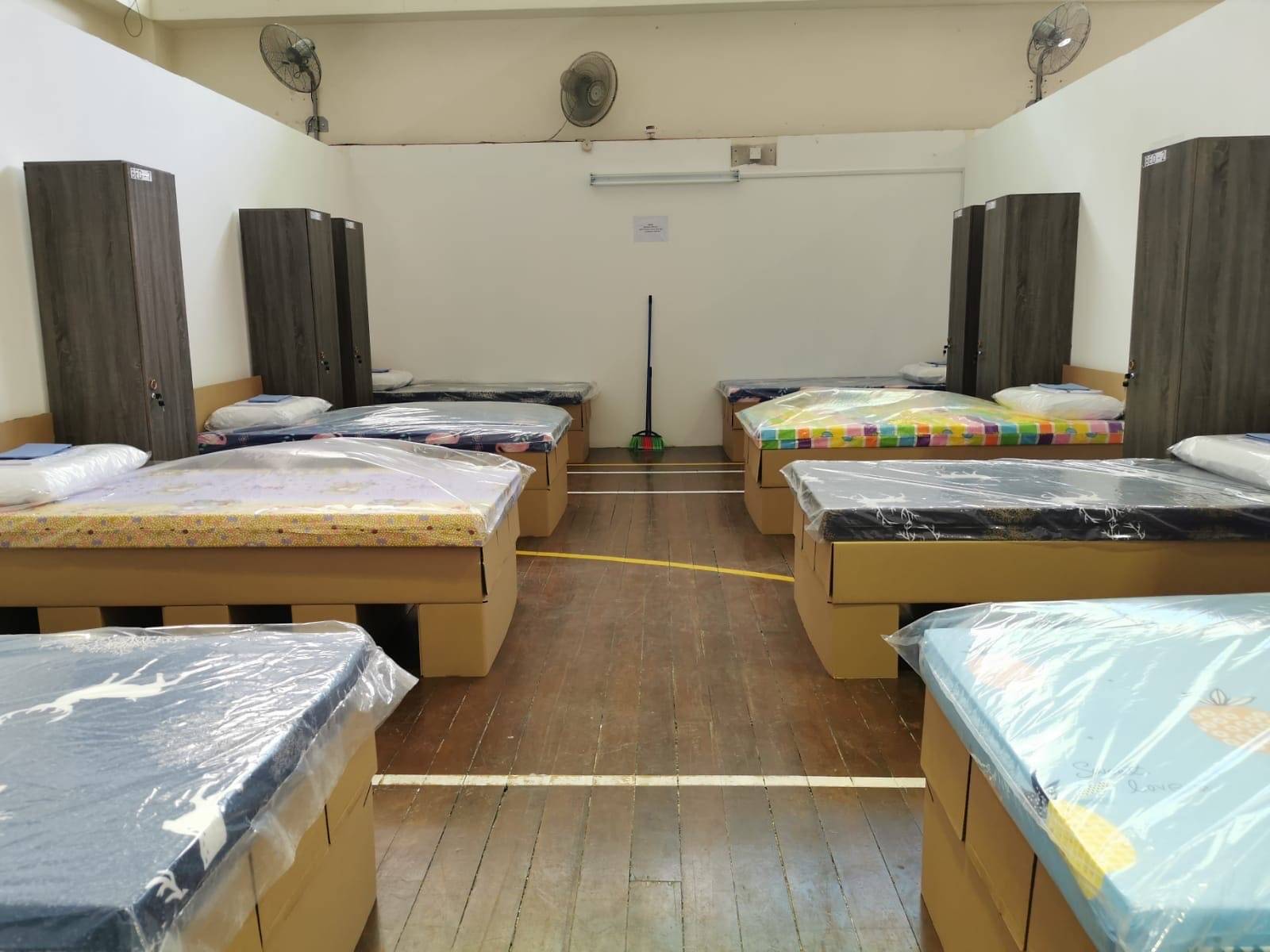
SINGAPORE: The former Qiaonan Primary School site has been refurbished to house foreign workers in essential services, the Singapore Land Authority (SLA) said on Friday (May 29).
The site at 15 Tampines Street 11 can accommodate about 500 people and has recently started to receive workers, a SLA spokesperson said.
Moving healthy foreign workers to temporary facilities has been part of the Government’s strategy to curb the spread of COVID-19.
Inside the former Qiaonan Primary School, which has been used to house healthy foreign workers in essential services. (Photo: Singapore Land Authority).
In April, Minister for National Development Lawrence Wong said that migrant workers who were not sick and were working in essential services would be housed separately from those in dormitories.
Military camps, Changi Exhibition Centre, vacant HDB flats and offshore floating lodging were among the sites selected as potential living quarters.
Some vacant state properties – based on their existing infrastructure and size – have been identified as suitable options as well, according to the SLA spokesperson.
The spokesperson said that “all necessary measures” have been put in place for the safety of the workers moving into the Tampines sites and for the community.
“The site is gated, with controlled access and security patrol,” the authority’s spokesperson said.
“On-site amenities including a minimart for workers to purchase necessities and meals will be provided for the well-being of the workers.”
The workers will have to observe safe distancing measures when staying within the former school site at all times and only leave the facility for work using transport arranged by their employers, the spokesperson added.
Inside the temporary facility. SLA said that there is a minimart on-site for workers to purchase necessities, while meals will be provided to the workers. (Photo: Singapore Land Authority).
In 2014, Qiaonan Primary School closed and merged with Griffiths Primary School to form Angsana Primary School the following year.
Other former school sites used to house healthy foreign workers include the former Hong Kah Secondary School and Bedok North Secondary School, according to a Ministry of Education response to CNA last week.
SLA had also announced earlier in May that the former Ngee Ann Polytechnic staff apartments at 90, 92 and 94 Kismis Avenue and the former Nexus International School at 201 Ulu Pandan Road would take in healthy migrant workers in essential services.
The two sites have a capacity of up to 1,000 beds each.
Google Street View of the former Nexus International School.
The former Chancery Court condominium at 36 Dunearn Road is another place where healthy foreign workers in essential services are currently staying. It can hold up to 1,200 workers.
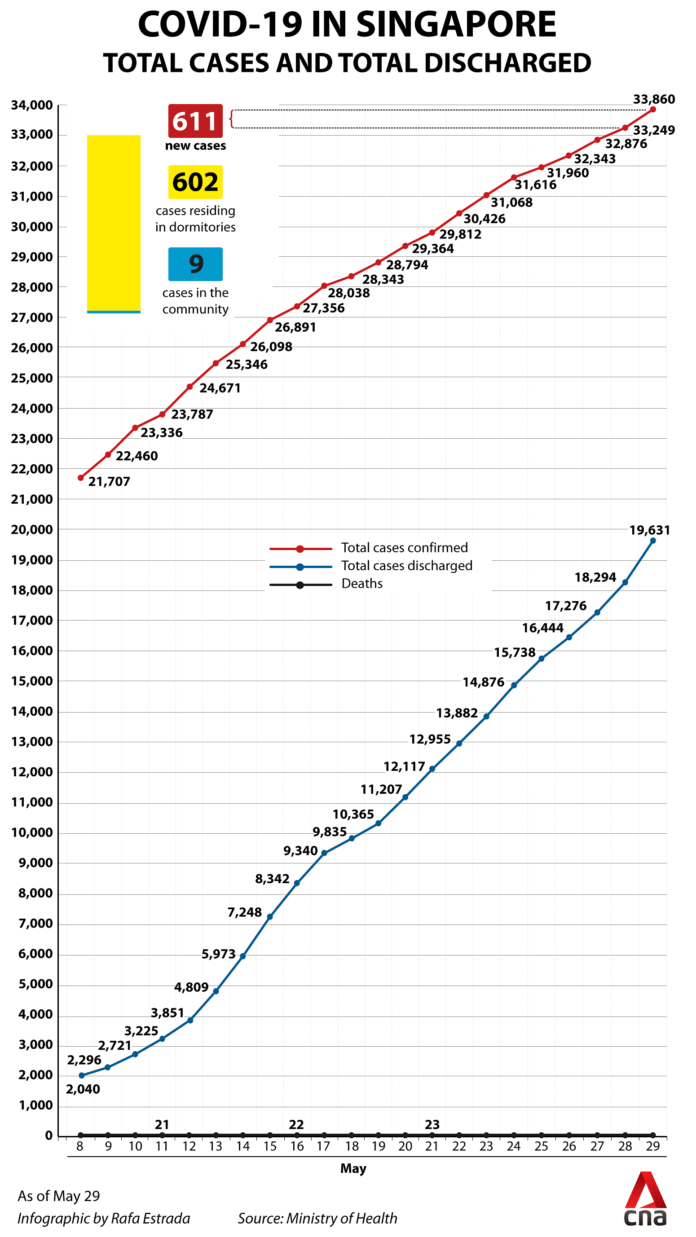
On Friday, Singapore reported 611 new COVID-19 cases, taking the country’s total number of infections to 33,860. Most of the infections are linked to foreign workers living in dormitories.
Getting cooped up at home for months on end is understandably exhausting for a number of reasons — the main one being the misery from feeling isolated and physically cut off from the rest of the world.
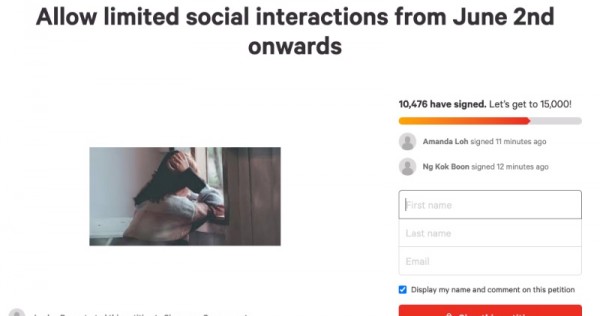
Though some will actually miss the circuit breaker (we see you, introverts), many others want it to end as soon as humanly and legally possible. Over 10,000 Singapore residents, if we’re judging from an online petition, are urging the government to let people meet up with their friends and do the things that friends do together after June 2.
SINGAPORE:The NTUC FairPrice supermarket at Taman Jurong Shopping Centre was on Friday (May 29) added to a list of public places visited by COVID-19 cases during their infectious period.
As part of its daily update, the Ministry of Health (MOH) has been providing information on the places COVID-19 cases visited while infectious.
According to MOH, the infected cases visited the supermarket at Taman Jurong Shopping Centre on May 20 from 7pm to 8pm and May 22 from 8.30pm to 9pm.
These places are defined as those visited by the infectious cases for more than 30 minutes.
The list will be updated on a rolling 14-day basis, which covers one incubation period and as epidemiological investigations progress, said MOH.
The cases’ residences, workplaces, healthcare facilities visited and public transport activities are excluded from the list.
Those identified as close contacts of confirmed cases would already have been notified by MOH.
“As a precautionary measure, persons who had been at these locations during the specified timings should monitor their health closely for 14 days from their date of visit,” MOH said.
“They should see a doctor promptly if they develop symptoms of acute respiratory infection (such as cough, sore throat and runny nose), as well as fever and loss of taste or smell, and inform the doctor of their exposure history.”
Singapore reported 611 COVID-19 cases as of noon on Friday, bringing the total number of cases in the country to 33,860.
In a later update, MOH reported that there were nine cases in the community – three are Singaporeans or permanent residents, two are work pass holders and four are work permit holders.
SINGAPORE: Singapore reported 611 new COVID-19 cases as of noon on Friday (May 29), taking the country’s total number of infections to 33,860.
Three cases were Singaporeans or permanent residents, the Ministry of Health (MOH) said in its daily update.
The country had on Thursday announced no new Singaporean or permanent resident COVID-19 cases for the first time since Feb 23.
A record 1,337 more COVID-19 patients were also discharged. In all, 19,631 have fully recovered from the infection and have been discharged from hospitals or community care facilities.
NINE COMMUNITY CASES
Of the nine cases in the community, two are Singaporeans, including a 44-year-old woman linked to the cluster at 1020 Tai Seng Avenue, which now has a total of 159 confirmed cases.
She is also a household contact of Case 28077, a 50-year-old Singaporean man who had gone to work at the dormitory and had tested positive for COVID-19 on May 17.
The other Singaporean case on Friday was a 25-year-old woman who was employed as a physiotherapist at Changi General Hospital (CGH) and is currently unlinked.
The woman, known as Case 33864, has no recent travel history to affected countries or regions and was confirmed to have the coronavirus on Thursday.
She is currently warded at CGH and had not gone to work since the onset of symptoms.
Another community case, 53-year-old permanent resident who was asymptomatic, is linked to the SCM Tuas Lodge cluster, which has 396 confirmed cases.
NUMBER OF UNLINKED CASES IN THE COMMUNITY REMAINS STABLE
The remaining community cases comprise two work pass holders and four work permit holders. All six cases were asymptomatic.
MOH said among the six work pass and work permit holders, five were picked up as a result of its proactive screening and surveillance.
Two cases were tested before they were due to start work on plumbing and electrical projects at schools, as a precautionary measure to prepare for the safe re-opening of schools, the ministry added.
Three were tested as part of the ministry’s screening of migrant workers residing at shophouses located at Balestier Road, due to their proximity to another cluster in the same area.
“The remaining case is a contact of earlier cases, and had already been placed on quarantine earlier,” the ministry added.
Overall, the number of new cases in the community has decreased, from an average of six cases per day in the week before to an average of five per day in the past week.
“The number of unlinked cases in the community has remained stable at an average of two per day in the past two weeks,” MOH said.
“We will continue to closely monitor these numbers, as well as the cases detected through our surveillance programme.”
A total of 602 of Friday’s new cases were work permit holders residing in foreign worker dormitories.
“We continue to pick up many cases among work permit holders residing in dormitories, including in factory-converted dormitories, because of extensive testing in these premises, as part of our process to verify and test the status of all workers,” the health ministry said.
Two new clusters were also identified. They are both dormitories and are located at 35 Kaki Bukit Place and 40 Kaki Bukit Industrial Terrace.
MOH said 99 per cent of the new cases on Friday are linked to known clusters, while the rest are pending contact tracing.
As there have been no more cases linked to Keppel Shipyard (51 Pioneer Sector 1) and 2 Tuas Avenue 1 for 28 days, the clusters have now been closed. Further details can be found in the ministry’s daily situation report.
There are currently 461 patients still in hospital. Of these, most are stable or improving while eight are in critical condition in the intensive care unit.
A further 13,745 are isolated and cared for at community facilities. These are people who have mild symptoms, or are clinically well but still test positive for COVID-19.
To date, 23 have died from complications due to COVID-19 infection.
MOH said some of the confirmed community cases had visited Taman Jurong Shopping Centre during their infectious period.
Among the other locations in MOH’s list of public places visited by community cases while infectious include FairPrice supermarkets at Bukit Panjang Plaza, Hillion Mall and Jurong Point.
People who visited these places during timings specified in the list are advised to monitor their health closely for 14 days from their date of visit.
In an update on pre-school staff members who tested positive for COVID-19, MOH said 11 of the 13 cases were likely to be past infections, based on epidemiological investigations, including their positive serological test results.
“One more serological test has come back positive today. We have assessed that the individual was unlikely to be infectious by the time of the recent screening. The final serological test (Case 33092) has come back negative, which is indicative of a recent infection,” said MOH.
The ministry added that the case is a non-teaching staff member and had been asymptomatic. Her close contacts have been placed under quarantine.
In all, more than 39,000 pre-school staff members have been tested so far, and only one case is likely to be a current infection.
SINGAPORE TO EXIT CIRCUIT BREAKER NEXT WEEK
“Circuit breaker” restrictions will be gradually eased in three phases starting with Phase 1 on Jun 2.
Phase 2 could start before the end of next month, provided “infection rates remain low and stable” in the first two weeks of June, said Minister for National Development Lawrence Wong on Thursday.
The Ministry of Health (MOH) has confirmed 611 new coronavirus cases in Singapore today (May 29).
Out of these, there are nine community cases while the remaining cases come from Work Permit holders living in dormitories.
Of the nine community cases, three are Singaporeans/Permanent Residents while four are Work Permit holders, and two are Work Pass holders.
Among the new community cases is a 23-year-old Singaporean, employed as a physiotherapist at Changi General Hospital, but had not gone to work since onset of symptoms.
MOH has also provided a list of public places that confirmed cases in the community had visited for more than 30 minutes.
Two confirmed cases had visited Taman Jurong Shopping Centre’s NTUC Fairprice (339 Yung Sheng Road) on May 20 from 7pm to 10pm, another on May 22 from 830pm to 9pm.
As a precautionary measure, people who had been at these locations during the specified timings should monitor their health closely for 14 days from their date of visit and see a doctor if they develop symptoms, said MOH.
SINGAPORE – When the circuit breaker ends, all companies – including those resuming operations in the first two phases of the economy’s re-opening – should adopt working from home as a default option.
This means that employees who have been working from home must continue to do so, and should go to the office only where there is no alternative.
Checks will be conducted to ensure that this is being done, said the Ministry of Manpower (MOM) in a press release on Friday (May 29), and businesses that do not ensure that employees work from home where possible, or whose workers do not adhere to safe management measures, may have to close their workplaces.
To reduce the risk of Covid-19 transmission in the community, all workplace personnel, including employees and visitors, should minimise socialising in the first two phases of the economy’s re-opening, said MOM, which gave more updates on safe management measures that companies should take in its press release.
All social gatherings, such as birthday celebrations and team-bonding activities at the workplace, must be cancelled or deferred.
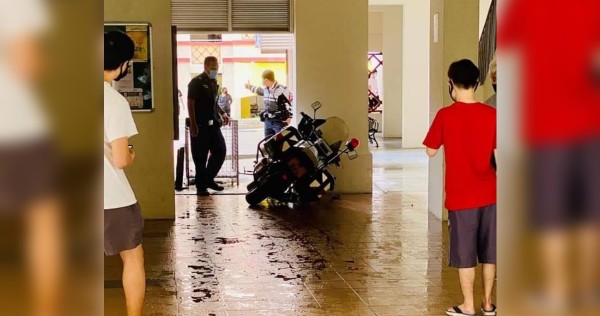
In a bid to evade the Traffic Police after failing to comply with instructions to pull over, a 21-year-old motorcyclist and his 18-year-old pillion rider rode against the flow of traffic, disregarding red light signals and committing several other traffic violations, the police said in a news release yesterday (May 28).
The two were later arrested.
The chase on Wednesday (May 27), which started along Tampines Expressway (TPE), spanned over 5km with the motorcyclist eventually leading the Traffic Police officer into weaving dangerously between the pillars of an HDB block void deck in Ang Mo Kio Avenue 5.
The pursuing officer lost sight of the duo after he was believed to have crashed into a pillar.