Home Blog Page 2914

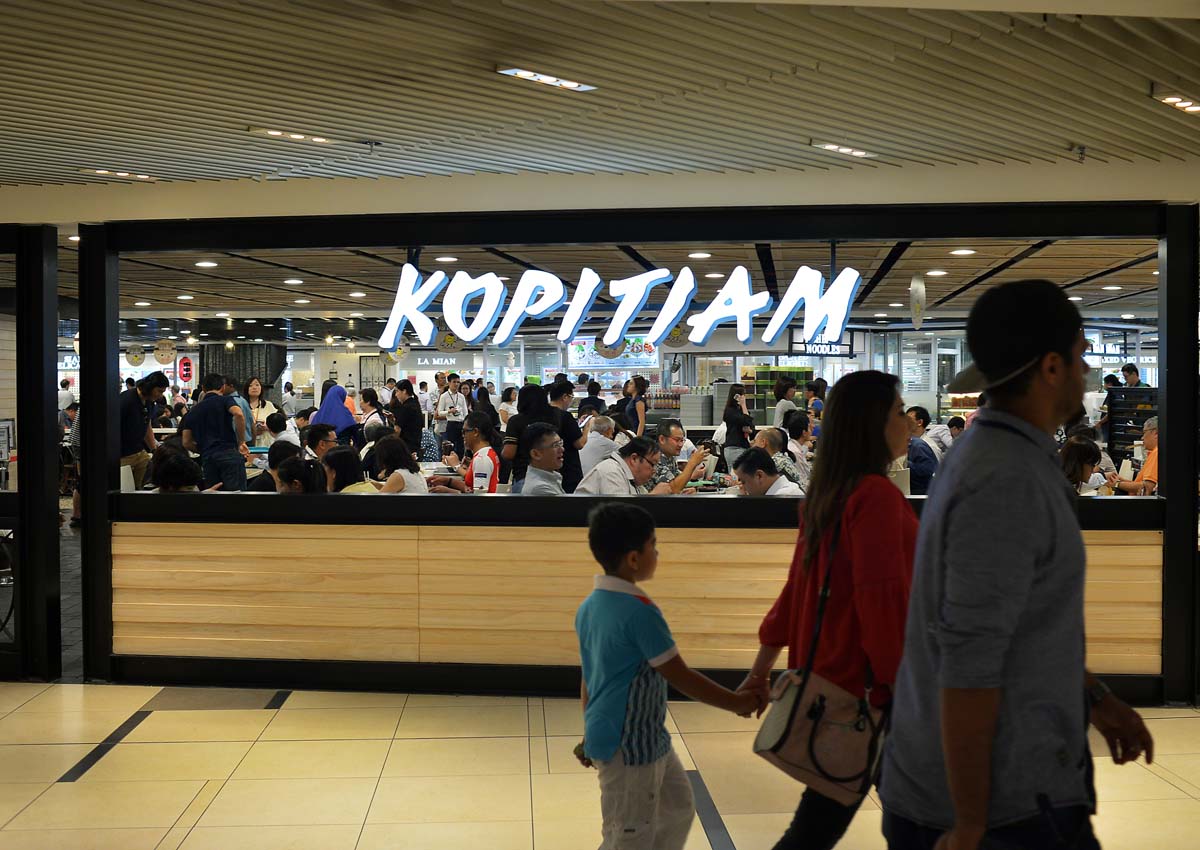
Wanted: Innovative kopitiams in Tampines and Choa Chu Kang

0

A futuristic new breed of coffee shops – at the vanguard of a $4.5 billion nation-wide IT transformation – could include features such as ordering via mobile apps or digital kiosks, and cashless payments.

Shopkeepers keen to meet the challenge of bringing in this type of innovation can bid in a tender for shops at two sites in Tampines and Choa Chu Kang later this month.

This is just the first step in the plan to transform the food industry – and 22 other key industries.

The Food Services Industry Transformation Map (ITM) was launched yesterday by Deputy Prime Minister Tharman Shanmugaratnam, also Coordinating Minister for Economic and Social Policies.

It is part of the Industry Transformation Programme announced in this year’s Budget.

The ITMs “lay out the growth and transformation strategies for the 23 key industries over the next five years… bringing together our initiatives for productivity, innovation, SkillsFuture and enterprise internationalisation for each industry,” he said.

These industries are divided into six clusters.

Food services falls under the lifestyle cluster whose oversight team will be jointly chaired by Senior Minister of State Sim Ann and Select Group managing director Vincent Tan. Spring Singapore will be lead agency for the cluster.

A pillar of the food services ITM – covering new-look coffee shops – is adopting innovative food formats.

By 2025, three out of eight dining experiences here will involve new formats like grab-and-go and vending machines, Spring estimates.

wrennie@sph.com.sg


Get MyPaper for more stories.

Image: 
Publication Date: 
Friday, September 9, 2016 – 09:03
Keywords: 
Send to mobile app: 
Source: 


Story Type: 
Others

Source link

Apple pre-order books are open

0

Customers who cannot wait to get their hands on the latest Apple products can start pre-ordering soon, even though the gadgets are not yet in town.

Singtel opened online pre-registration for the iPhone 7 and iPhone 7 Plus at noon yesterday, even though it will be selling the smartphones only next Friday.

Meanwhile, the Apple Watch Nike+ wearable fitness device – part of the new Apple Watch series – can be pre-ordered on the Apple website from Friday.


Get MyPaper for more stories.

Image: 
Publication Date: 
Friday, September 9, 2016 – 08:55
Keywords: 
Send to mobile app: 
Source: 


Story Type: 
Others

Source link

Most Southeast Asians working abroad want to come home and here’s why

0

GOVERNMENTS in Southeast Asia looking for ways to plug the talent leak in their respective countries can rest assured that the so-called skilled labor shortage pandemic in the region is not the result of a permanent refusal of graduates to return home.

Quite the contrary, as this recent Robert Walters whitepaper found, the majority of those earning a living abroad would actually prefer finding employment back in their home countries.

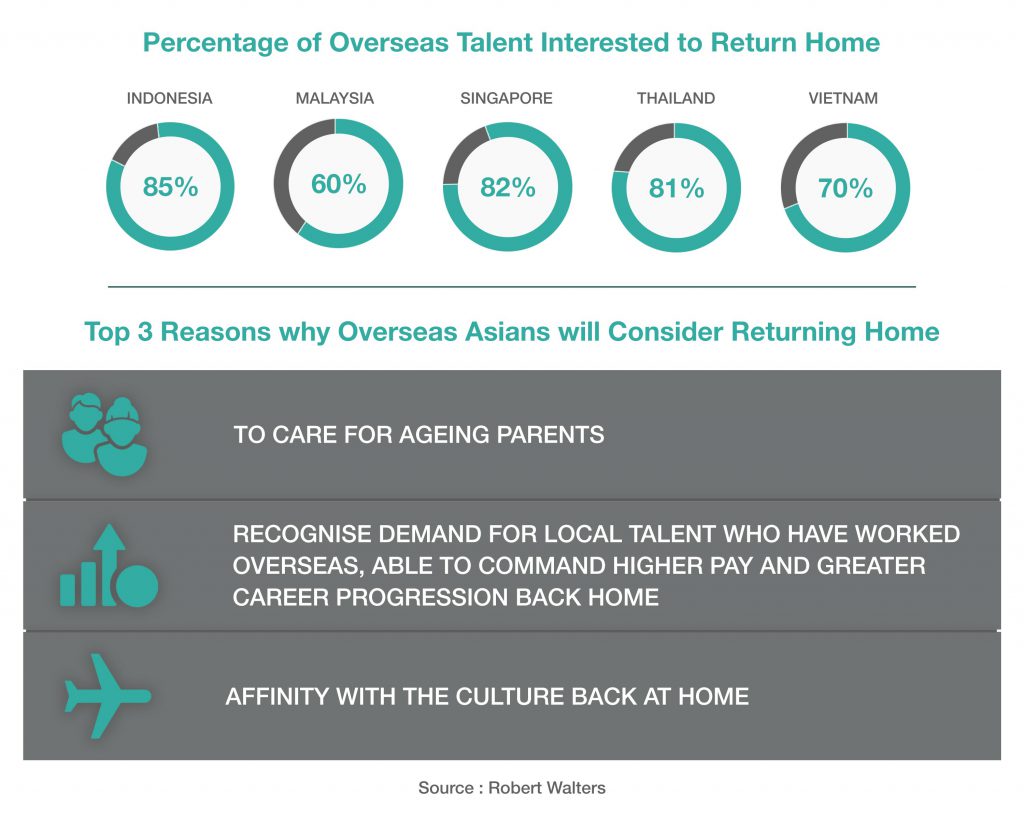
The whitepaper titled, “Return of the Asian talent” that focuses on overseas workers from Indonesia, Malaysia, Singapore, Thailand and Vietnam said the top three reasons for this are: To care for ageing parents; because workers recognize the demand for local talent with overseas experience and understand they are able to command higher pay; and their affinity with the culture back home.

According to the recruitment consultancy’s findings, there was approximately 4 million Vietnamese working abroad as of September 2015, 1.4 million Malaysians as of 2009, 429,872 Indonesians as of 2014, 212,500 Singaporeans as of June 2015 and 148,240 Thais according to numbers from June 2015.

Of these, an average of 75.6 percent of professionals want to return home. The breakdown in the survey says this is true for 85 percent Indonesians, 82 percent Singaporeans, 81 percent Thais, 70 percent Vietnamese and 60 percent Malaysians.
robert walters whitpaper_1

SEE ALSO: Global Talent Competitiveness Index highlights ASEAN’s disparity

In its foreward, Robert Walters labelled this an “exciting time for Southeast Asia”.

The firm noted that the region has seen rapid economic progression in recent years and as such, is facing a growing shortage of white-collared professionals, especially in emerging markets like Indonesia, Thailand and Vietnam.

“As multinational companies expand into these countries, there is a strong demand for business-savvy talent with bilingual abilities and global mindsets,” it said.

But though the numbers suggest that luring local talent back home would be like shooting fish in a barrel – especially since most want to come home anyway – the whitepaper said 88 percent of hiring managers polled in Southeast Asia are having trouble with recruitment.

To get from brain drain to brain gain, Robert Walters said it is important for employers to understand the key concerns of these prospective “returning Asians” and what to do to get them to accept employment back home.

SEE ALSO: Malaysia’s brain drain

“Returning Asians have an edge, one that comprises a global mindset and an in-depth understanding of the local culture.

“How hiring managers can effectively attract them home will depend on their understanding of what these returning Asians want,” the firm said.

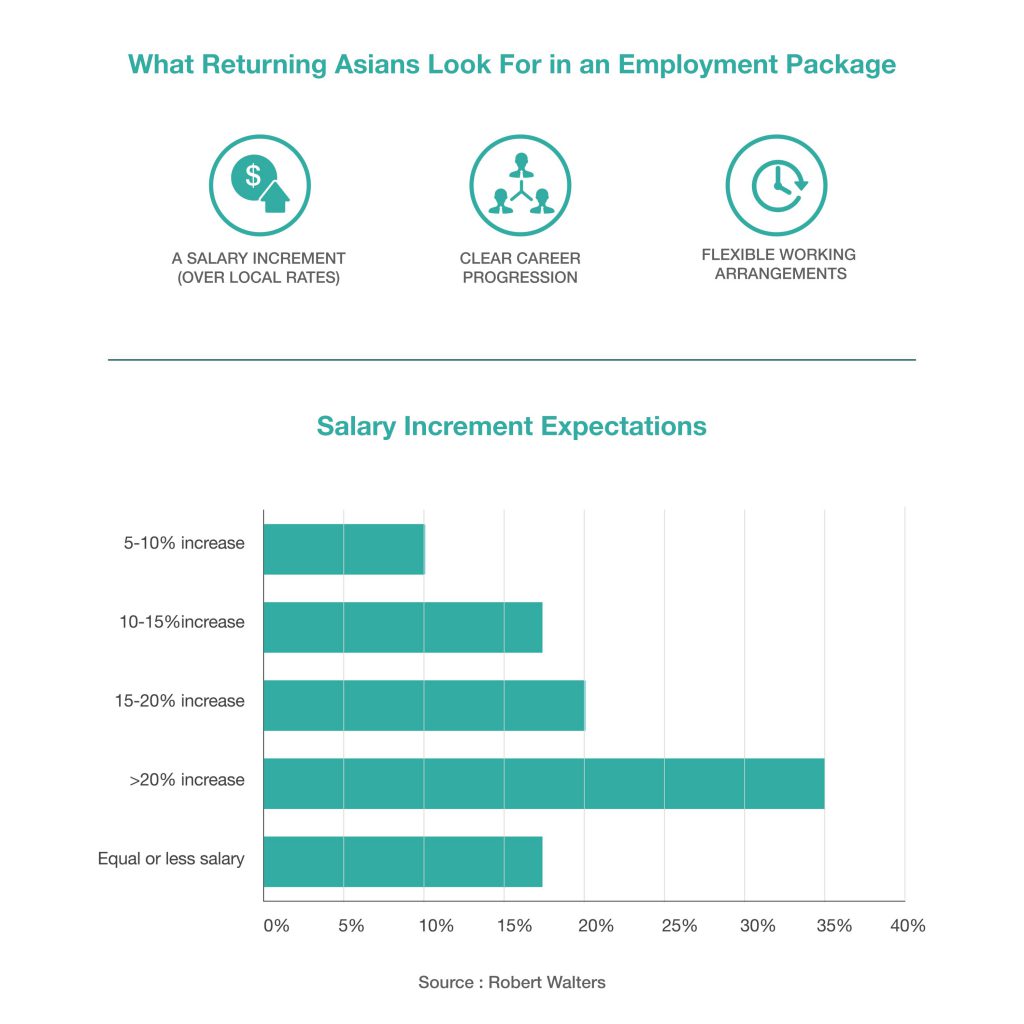
From its findings, Robert Walters said “returning Asians” are looking for salary increments, clear career progression and flexible working arrangements, among others.

The expectations wary, the firm said, but at least 35 percent feel they their salaries should be bumped by more than 20 percent. About 17.5 percent, on the other hand, are willing to accept employment back home for the same salary or even take a pay cut.

“Hiring managers will need to strike a balance between budgetary constraints and hiring the right candidates.

“It will be useful to weigh the cost of hiring versus not hiring; not hiring the right candidate due to initial cost savings may prove to have a greater adverse impact on the business in the long run,” said Toby Fowlston, managing director of Robert Walters Southeast Asia.

SEE ALSO: Singapore companies risk brain drain

The whitepaper said the top three concerns of overseas Asians thinking of returning home are: fears of less work-life balance or poorer quality of life; their ability (or inability) to assimilate back into the culture due to the length of time away; and underdeveloped infrastructure and public transportation.

To temper these concerns, however, the overseas Asians surveyed said there are things their prospective employers could do, such as: offer an attractive salary increment (32 percent); offer holistic employment packages and benefits (30 percent); and map out a clear career progression path (12 percent).
robert walters whitpaper_2

“The little things go a long way in showing returning Asians that they are working for a company that values its employees beyond the bottom line,” said Gerrit Bouckaert, country manager of Robert Walters Thailand and Vietnam.

According to this 2014 report on “reverse migration” by the Asia Pacific Foundation of Canada, in recent years, many Asian countries like India and China have committed significant financial resources to lure back some of their best talent from abroad to fill the employment gaps back home.

Among others, returning talents are offered incentives like better paid jobs, high socioeconomic statuses and talent growth.

In Malaysia, for example, the Economic Transformation Programme launched in 2010 expressly addressed the shortage of professionals and technical experts in the country, and trotted out initiatives aimed at luring talents home to fuel the local workforce.

“Vietnam, for instance, is estimating to have spent over $7 million. The various policy changes include tax incentives, financial compensation, increasing the number of international schools, and reforms to visa and permanent residency requirements.

“The trend of reverse migration will likely assist Asia’s efforts to recruit and retain talent,” the Asia Pacific Foundation’s report said.

The post Most Southeast Asians working abroad want to come home and here’s why appeared first on Asian Correspondent.

Source link

Enough qualified Singaporeans of all races to run for president: PM Lee Hsien Loong

0

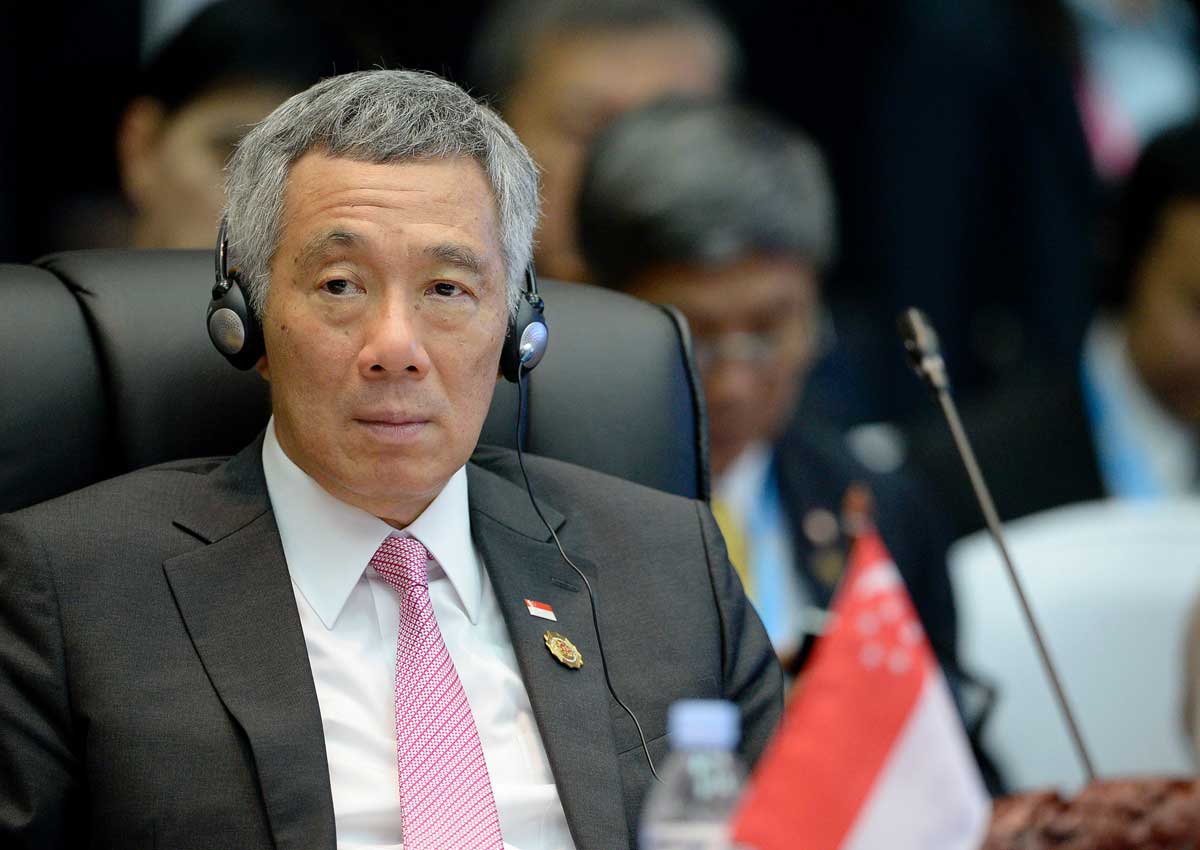
VIENTIANE – There are enough qualified Singaporeans of all races to vie for the post of an elected president, even with the qualifying criteria looking set to become more stringent, Prime Minister Lee Hsien Loong said on Thursday (Sept 8).

“There are qualified Malays, there are qualified Singaporeans of all races,” he told reporters at the end of the Asean Summit in Laos.

Mr Lee had been asked if there were enough qualified Malay candidates for the elected presidency, after the government accepted in-principle on Wednesday the main recommendations of the Constitutional Commission that reviewed the elected presidency

Among the proposed significant changes is the doubling of the period potential candidates must have held their positions at work which qualifies them to run for the presidency. It was raised from three to six years.

The commission also suggested that the definition of a large and complex company be revised from $100 million in paid-up capital to $500 million in shareholders’ equity.

Mr Lee said the Government wants the criteria strengthened in order to ensure the president who is elected is well-qualified.

“Furthermore, we minimise the risk that we will not have minorities become president from time to time,” he said, referring to another recommendation by the commission that an election be reserved for a particular race if no one from that racial group had been elected president for 30 years.

“That is very important – I’ve explained this multiple times – and that’s the fundamental reason why I asked the commission to study how we can make an arrangement so that we make sure that minorities get a chance to be president from time to time.

“They’ve made a good proposal – we’re studying their proposal,” Mr Lee said.


This article was first published on Sept 8, 2016.
Get a copy of The Straits Times or go to straitstimes.com for more stories.

Image: 
Category: 
Publication Date: 
Friday, September 9, 2016 – 09:00
Keywords: 
Send to mobile app: 
Source: 


Story Type: 
Others

Source link
Telcos cut fibre broadband costs, offer perks at Comex

0

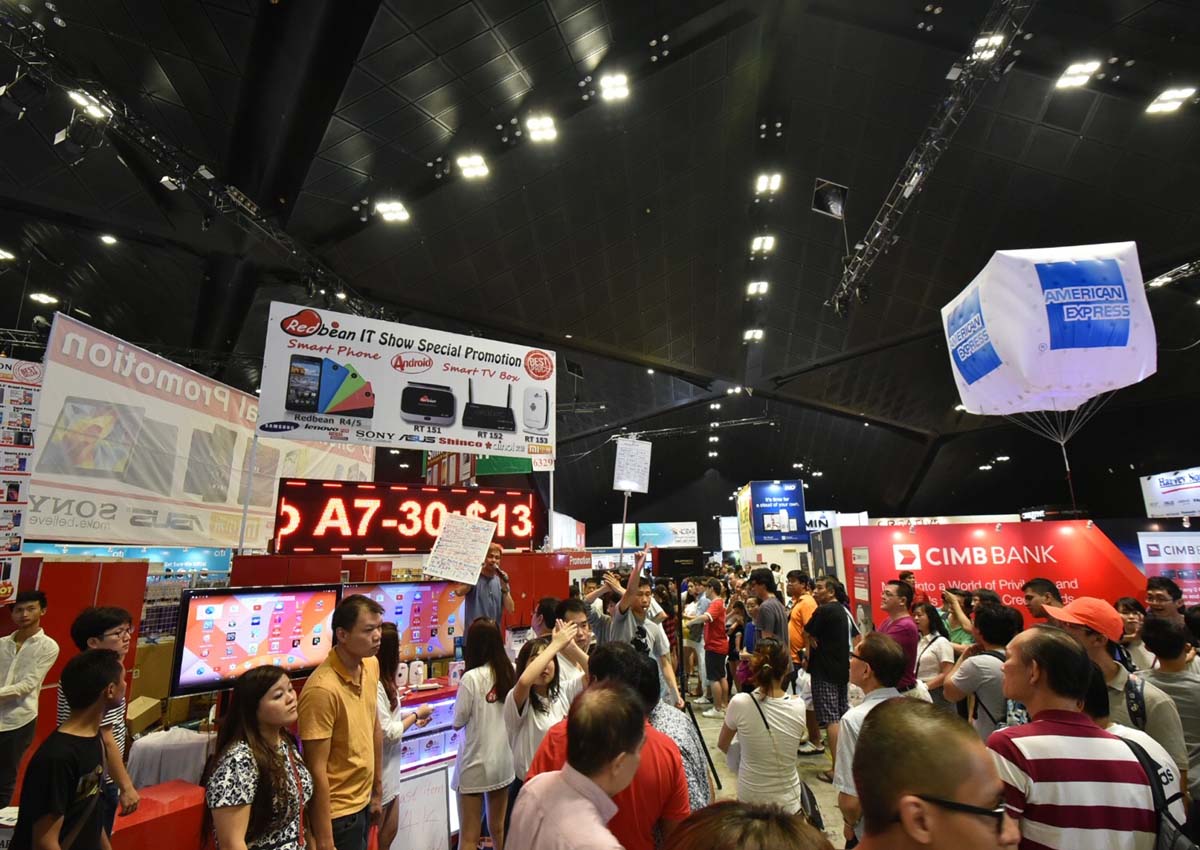
Broadband deals have become a tad sweeter, after Singtel and MyRepublic both lowered the prices of their 1Gbps fibre broadband plans at consumer electronics fair Comex.

Singtel’s plan now costs $49.90 a month, down from its $54.90 offer at June’s PC Show.

MyRepublic’s deal is $49.99 a month, with six months free. Over the required 24-month contract, this works out to be $37.49 a month, cheaper than its PC Show price of $44.99.

Comex, organised by Singapore Press Holdings subsidiary Sphere Exhibits, opened yesterday at Suntec Singapore Convention and Exhibition Centre.

Eric Ng, head of marketing at Exhibits, said 2Gbps plans are also available at a “very competitive price”.

The other three telcos here – StarHub, M1 and ViewQwest – stuck with their PC Show prices of $37.43 to $49.90 a month.

Many telcos also sweetened the deal with perks like lucky draws and free routers.

Analysts said telcos should not compete just on price.

Clement Teo, principal analyst at market research firm Ovum, said: “Competition should not be based on a race to the lowest pricing, as this is good for new sign-ups, but bad for existing customers who are paying a higher price. Instead, telcos should compete on value-added services.”

But consumers are glad that competition has led to cheaper prices.

Teacher Chong S. K., 41, who was at the show, said: “When MyRepublic first entered, it was the cheapest but now traditional telcos have cut their prices as well.”

For the first time, Comex is offering services such as laptop memory and storage upgrades, which will be done for a fee.

Used electronics such as television sets, laptops and tablets can also be traded in for vouchers to use at the show.

Gamers can check out the latest gaming laptops and desktops at the Gamex area, and take part in tournaments for video games such as Dota 2, Overwatch and Counter-Strike: Global Offensive.

Comex 2016

Where: Suntec Singapore Convention and Exhibition Centre, Levels 3, 4 and 6

When:Now until Sunday. Level 3 is open from 11am to 9pm, and levels 4 and 6 from noon to 9pm.

Admission: Free For more information, go to www.comexshow.com.sg

lting@sph.com.sg


Get MyPaper for more stories.

Image: 
Publication Date: 
Friday, September 9, 2016 – 08:49
Keywords: 
Send to mobile app: 
Source: 


Story Type: 
Others

Source link

NSFs will get to pick from 33 vocations

0

Young men starting national service (NS) in November next year will be able to choose from 33 vocations across the Singapore Armed Forces (SAF), police and civil defence, but not the Commandos and naval diving unit, whose requirements are more stringent.

Yesterday, more details were released after Defence Minister Ng Eng Hen announced in July that the interests of new enlistees will be considered in assigning NS vocations, alongside factors such as physical fitness, suitability to perform tasks and operational needs.

The 33 vocations, from armour, fire and rescue to dog handling, will be grouped into seven categories.

Pre-enlistees, who cannot choose whether they go into the SAF, police or civil defence, have to pick at least two choices from each category, or 14 choices in all.

They may also indicate that they have no specific interest.

Full-time national servicemen (NSF) enlisting in November next year will be the first to indicate their vocation preferences.

They will do so when they report to Central Manpower Base (CMPB) for pre-enlistment procedures. They state their choices in the same sitting as the computerised aptitude test during pre-enlistment medical screening.

They will receive their vocation posting after their basic training.

CMPB takes in more than 20,000 enlistees a year over intakes in November, February, May and August.

Jordan Low, 17, will go for his NS medical screening on Nov 11.

The first-year student at Anderson Junior College likes the idea of being able to state his vocational interests, as it will make him and his peers “more positive” about NS.

To help pre-enlistees decide, 19 videos by current NSmen and a handbook will be launched on the CMPB website this Sunday. They will highlight the roles and responsibilities of each vocation and the training involved.

Assistant chief of general staff (personnel) of the army, Colonel Yew Chee Leung, said: “The whole intent of this initiative is to encourage greater ownership by our servicemen in the roles they will play during NS.”

However, he emphasised that operational needs of the vocations still take priority as the key consideration in the deployment of NSFs.

Rupert Gwee, director of National Service Affairs Directorate at the Ministry of Home Affairs, said: “This initiative… will further encourage our Home Team national servicemen to take greater ownership of their contributions in ensuring Singapore’s safety and security.”

Should enlistees not get their preferred vocation and appeal, these will be looked at case by case. However, there is a low chance they will be redeployed from the originally assigned vocation.

fabkoh@sph.com.sg


Get MyPaper for more stories.

Image: 
Category: 
Publication Date: 
Friday, September 9, 2016 – 08:43
Keywords: 
Send to mobile app: 
Source: 


Rotator Image: 
Story Type: 
Others

Source link

AirAsia boss Tony Fernandes to apologise to flight attendant

0

AirAsia Group chief executive officer Tony Fernandes yesterday issued an apology after the public raised a furore after a member of the cabin crew was forced to lie prostrate before an autistic passenger, after her mother complained of being insulted.

“[It was] my fault. I’m the leader. We need better procedures on both sides,” Fernandes wrote on his Facebook page yesterday after meeting with Thai AirAsia staff. “An investigation will be done and action taken. I met cabin crew and it was good. Tomorrow I go to Hat Yai to meet her parents [to extend apologies].”

on Facebook

Good session with Thai staff. An investigation will be done and action taken that. I met cabin crew and was good….

Posted by Tony Fernandes on Wednesday, 7 September 2016

Fernandes travelled to Thailand to reward Thai Olympic medal winners, and also used the opportunity to address the controversy that has created an uproar on the Internet.

On Tuesday, a post on popular webboard Pantip.com asked if it was true that the mother of a 29-year-old autistic female passenger had demanded that a member the Air Asia cabin crew lay prostrate before her daughter as a gesture of apology.

Not only did that post attract huge interest, it also kicked off a storm of criticism about how AirAsia handles passengers’ complaints. Many also complained about the airline violating its staff’s rights and hurting her dignity.

“She [the cabin crew] was my friend … she only asked that passenger [the mother] how her daughter was doing because she appeared to be having convulsions,” one reply said. “[My friend] asked her twice, but there was no response, so she decided to report it to the flight captain. She never thought that this would be seen as an insult.”

Tassapon Bijleveld, chief executive officer of Thai AirAsia, confirmed the story, saying it was a “common misunderstanding” between passengers and cabin crew. “The mother filed a complaint with us so we invited both sides to settle. It ended up with the crew member having to lie prostrate in front of the daughter once,” Tassapon said.

This was followed by Fernandes’ replies on Twitter to curious observers, insisting that staff remains his priority.

Tassapon and Fernandes yesterday issued a joint statement expressing regret, acknowledging their responsibility and elaborating that they highly value the feelings of their employees. “We maintain that our executives never forced our staff to perform an act of prostration,” the statement said. “We are disheartened by what has happened to the staff member in question.”

The CEOs also assured that they would amend their policies accordingly and have their customer relations department handle future complaints without the need for a confrontation between passengers and cabin crew.


Image: 
Category: 
Publication Date: 
Friday, September 9, 2016 – 08:29
Send to mobile app: 
Source: 


Story Type: 
Others

Source link

Locally transmitted Zika has been in S-E Asia since 1960s

0

The Zika virus strains in locally transmitted cases and that of a case imported from Brazil in May are different, the authorities said yesterday.

Scientists found that the Zika virus strain affecting the recent cases in the Aljunied Crescent/Sims Drive cluster is similar to strains that have been circulating in South-east Asia since the 1960s.

This was announced at a briefing by the Ministry of Health’s (MOH) National Public Health Laboratory (NPHL) and A*Star’s Bioinformatics Institute (BII) yesterday.

The virus later spread to French Polynesia in 2013 and to Brazil in 2015, they said.

On the other hand, the virus strain from a case imported to Singapore in May was similar to strains currently found in South America.

While both virus strains are of the Asian lineage, analysis suggests that the locally transmitted virus strain belongs to an earlier type, and was not recently imported from South America.

These were the findings of the NPHL and BII after sequencing the virus from the first imported case in May and two recent cases in Singapore.

There is no evidence to suggest that the different strains are linked to differences in severity or type of disease, researchers said.

“While there was no link established between microcephaly and Zika until the Brazil outbreak, we have to assume it is possible, hence the precautions that pregnant women are advised to take,” said Raymond Lin, head of the NPHL.

The findings will help with tracking the global spread and evolution of the Zika virus.

The sequences from the analyses will be put on public databases for the benefit of scientists elsewhere and for the World Health Organisation.

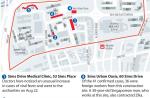
Meanwhile, a new potential cluster of Zika infection was identified by the authorities, in the Ubi Crescent area.

As of noon yesterday, MOH confirmed nine new cases of locally transmitted Zika.

This brings the number of cases in Singapore to 292.

One more case was linked to Bishan Street 12, and one to Elite Terrace, which was highlighted as a potential cluster on Wednesday.

linettel@sph.com.sg

chuimin@sph.com.sg


Get MyPaper for more stories.

Image: 
Publication Date: 
Friday, September 9, 2016 – 08:33
Keywords: 
Send to mobile app: 
Source: 


Story Type: 
Others

Source link

Baby boy for couple who lived in a lorry at Changi Beach carpark

0

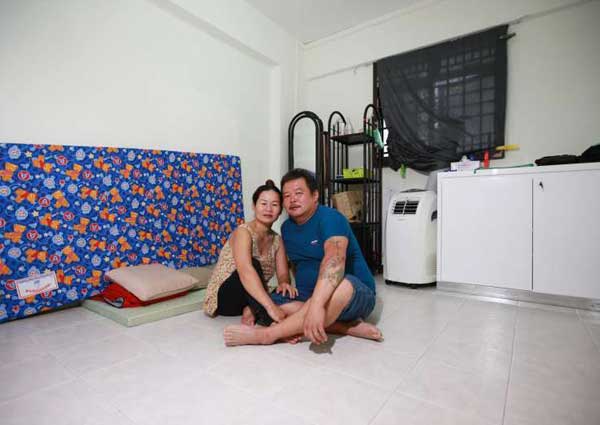
SINGAPORE – A couple who lived in a lorry for two years because they could not afford to rent a flat have welcomed a newborn son into their lives, a report said.

Rice delivery man Ong Poh Hwa and his Vietnamese wife had made the news because they weathered the elements in the lorry Mr Ong drives for work.

His wife, Ms Nguyen Thi Phu Vinh, 34, was pregnant and the birth was due in August, said a Straits Times report in March.

In April, the couple moved into a temporary two-room flat in Bedok North, which the Housing Board agreed to rent to Mr Ong after he made a commitment to buy a home after his son was born.

Ms Nguyen gave birth on August 17 to a healthy baby boy who tipped the scales at 4.07kg, Lianhe Wanbao reported on Thursday (Sept 8).

The baby has Singapore citizenship as he was born here.

“I hope my wife can become a citizen or a permanent resident soon. Then we can buy an HDB flat, and build a stable family,” he said.

Mr Ong, 44, told Wanbao that he cannot wait to get home each day to see his son and wife.

He now packs homecooked food for lunch and dinner so he can save up for additional expenses such as diapers and medical fees.

Earlier, Mr Ong would park his lorry at Changi Beach where he and his wife used public toilets to do their laundry and take showers.

They slept on cardboard sheets on the back of the lorry.


This article was first published on Sept 8, 2016.
Get a copy of The Straits Times or go to straitstimes.com for more stories.

Image: 
Category: 
Publication Date: 
Friday, September 9, 2016 – 09:00
Keywords: 
Send to mobile app: 
Source: 


Story Type: 
Others

Source link

New town Tengah integrates nature into estate

0

WHERE?

The new town of Tengah will occupy about 700ha of land – about the size of Bishan town.

It will be bounded…

Source link