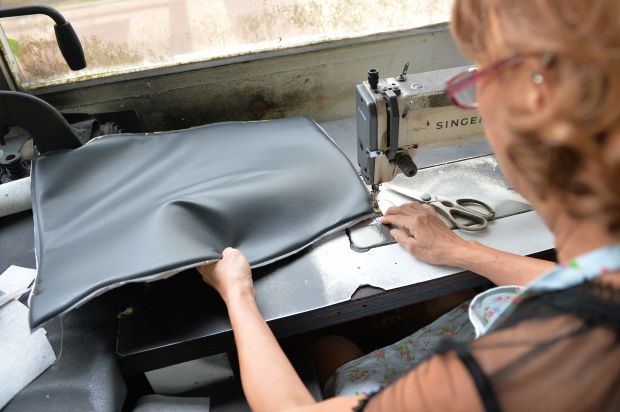
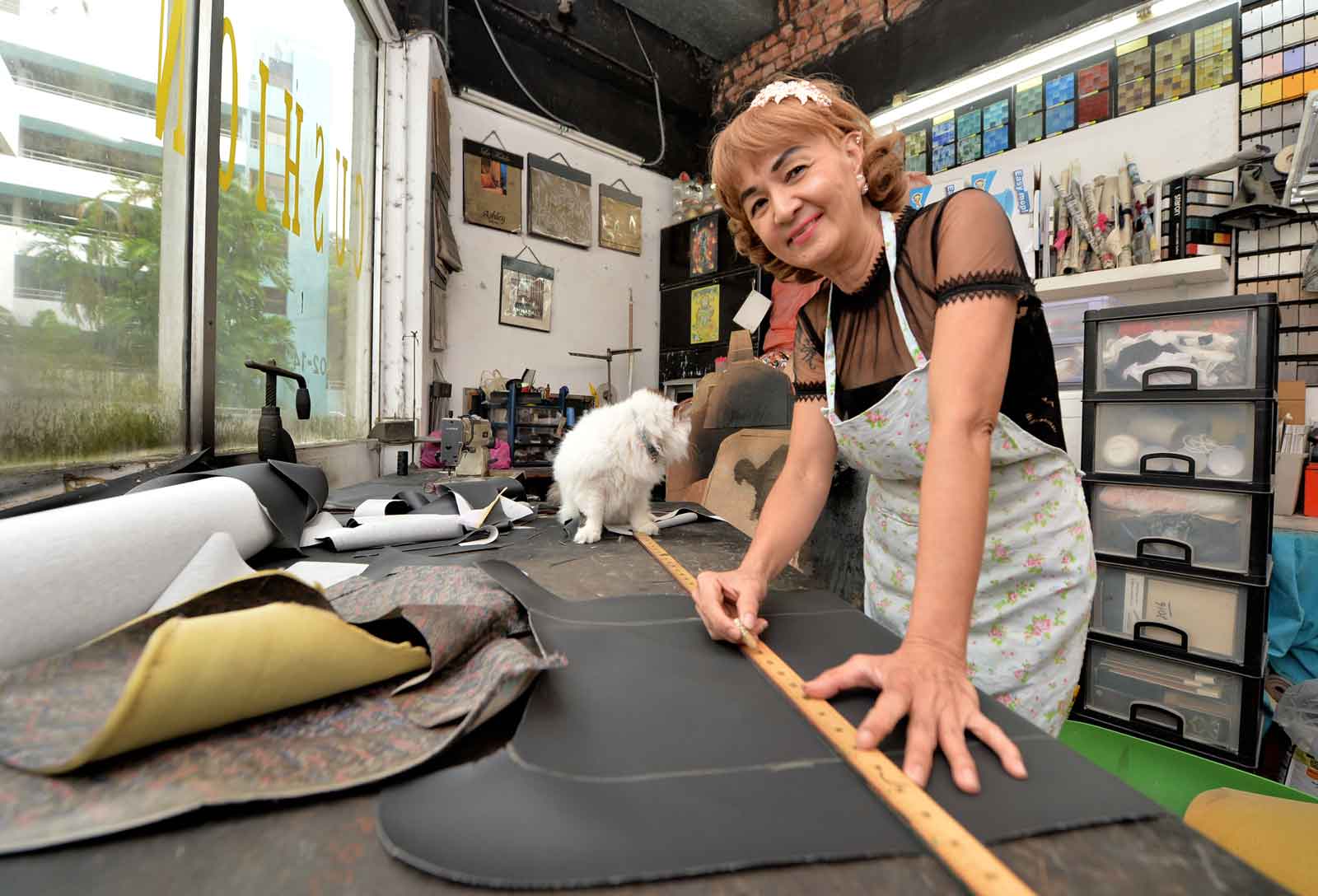
Located in a corner of Beauty World Plaza is a shop is filled with leather, sponge and four cats.
Madam Jenese Chuah’s love for making furniture and items by hand has kept her going for 43 years.
The 61-year-old owner of Cushion Specialist at Beauty World Plaza specialises in a range of upholstery and re-upholstery services.
They include commercial, industrial, residential, and also seat upholstery for cars, bikes, heavy-equipment and mobile machinery.
She says: “I just love working and making new things every day.
“Customers come to me if they want to restore their vehicle seats or furniture and I’ll get it done within one to two days.”
EXPERT: Madam Chuah has been in the upholstery business for 43 years. Photo: The New Paper
To replace the leather seats for a typical car, she charges $1,000 and gets the job done within two days.
She also designs and makes her own clothes to complement her coloured hair and bold jewellery.
Madam Chuah got into the furniture business in 1973 when her late husband, who had experience in the field, started a new business venture.
“Since I was 18, I observed how my husband would sew and cut materials,” she says.
After trials and multiple cuts, she too mastered the skill.
The couple originally worked as sofa importers, but after about 10 years, they got into re-upholstery.
She says: “In the 80s, new competitors were emerging and we were working long hours with little profit.”
“Even in recent times, furniture shops are closing down because there are so many competitors coming from neighbouring countries.”
EASY SWITCH
Shifting to re-upholstery was easy because she was already making all sorts of cushions.
She recalls an interesting customer who approached her about changing the material and colour of his coffee table about five years ago.
Madam Chuah says: “This customer showed me his brand new hourglass-shaped coffee table and I immediately told him it was impossible for me to replace the fibreglass base with leather because leather is softer.
“He was so persistent and kept insisting that I could do it. True enough, I gave it a shot and he was so happy with the results.”
The finished product? A pink hourglass table made out of leather.
She says: “This customer still drops by every now and then to tell me how much he loves the table.”
Such interesting customers motivate her even more, she says.
“If I stop working, I don’t think I will be able to live,” she says.
She runs the business with her son and daughter-in-law. Her husband died in 1997.
Her daughter-in-law, who wanted to be known only as Vanessa, says she loves working for Madam Chuah.
Vanessa says: “Among the three of us, my mother-in-law is the creative one.
“Most of our customers tell us they’re very grateful because no one else can do re-upholstery services for them.”
She also says the business is doing well.
Madam Chuah says: “We feel the business has been better than it was 10 years ago and we are very thankful for all the people who have supported us all these years.”
This article was first published on Sep 11, 2016. Get The New Paper for more stories.
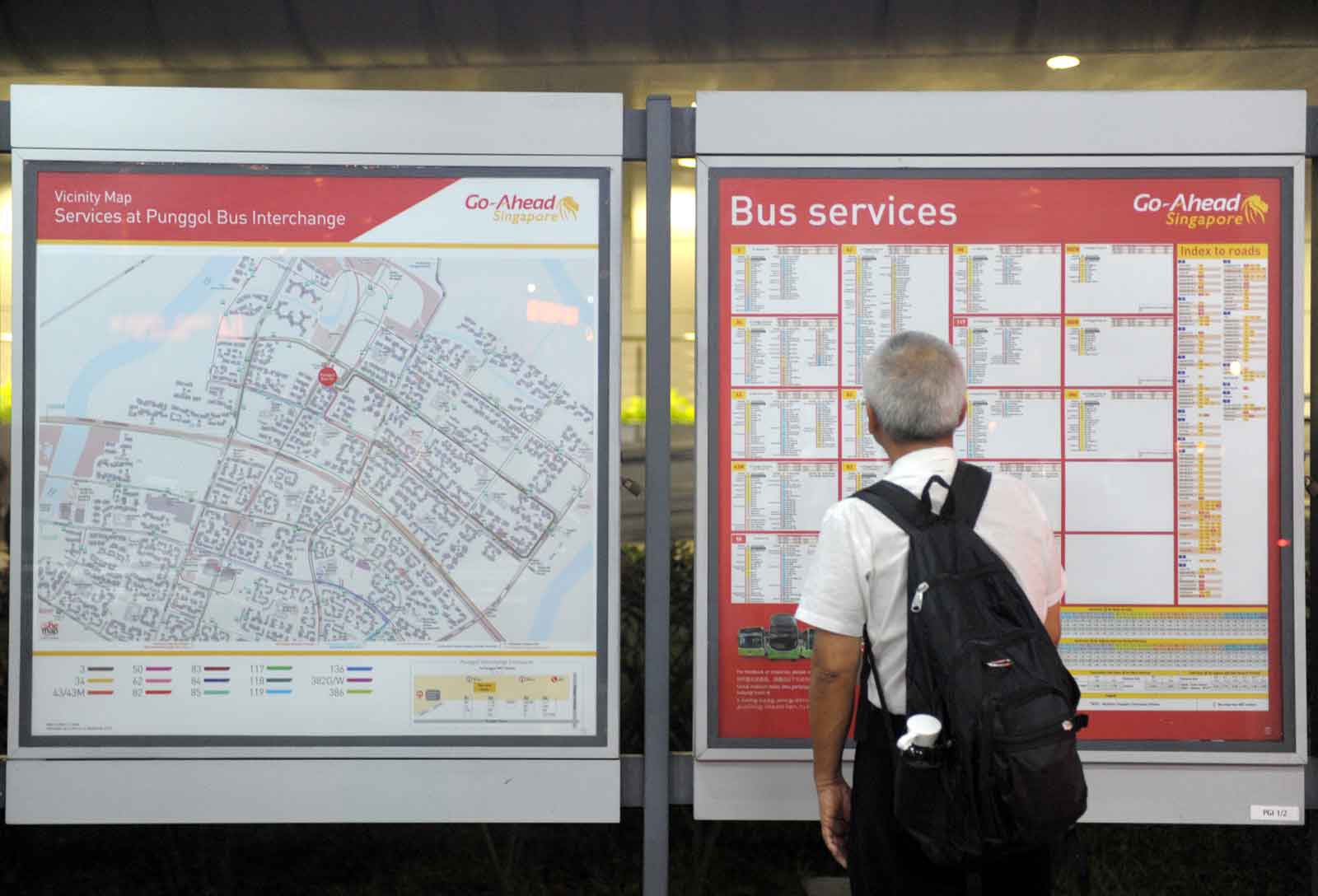
Even as the island’s fourth public bus operator Go-Ahead Singapore began its services earlier this month, commuters will see the debut of more new players down the road.
Interest in the third and latest government bus tender, called in June, is strong with at least five companies and consortiums – all new to the local public bus industry – looking to throw their hats into the ring.
They are Australia’s Busways, Singapore’s Woodlands Transport, Britain’s National Express and two consortiums, Kumho Buslines-Tian San Shipping, and Travel GSH- Jiaoyun Group, The Straits Times has learnt.
Travel GSH and Tian San are local firms, while Kumho is from South Korea and Jiaoyun from China.
The potential bidders, with the exception of National Express, have taken part in previous tenders, making this their second or third tries.
They are up against SBS Transit, SMRT, Tower Transit and Go- Ahead, which have expressed interest in competing for the Seletar tender package, comprising 26 routes.
National University of Singapore transport researcher Lee Der Horng expects that there could still be more competitors. He told The Straits Times: “Since the industry has completely moved into the bus contracting model, we can expect more (bus) contracts to be released in the future. Companies will want to come in early to ‘exercise’ their bids, and get themselves familiar with the local market.”
On Sept 1, the public bus industry was restructured to a contracting model, in which bus routes are tendered out to operators in packages. All bus assets and infrastructure are owned by the Government, which pays winning bidders a fee to run the services.
Commuters can expect more reliable services as the operators have to meet standards, failing which they can be penalised financially. If they do well, they will be given monetary incentives.
While three bus packages have been put up for tender, with two awarded, there are 11 others currently run by incumbents SBS Transit and SMRT. Their contracts range in durations of between two and 10 years, and these packages will be put up for tender as they expire.
For the third tender, Dr Lee predicts that price will be one of the important factors. Tower Transit won the first tender, the $556 million five-year Bulim package, while Go-Ahead clinched the Loyang deal for $497.7 million.
Go-Ahead’s tender offer was the lowest among the eight short-listed bidders in that round, and the Land Transport Authority (LTA) said then that the overall bids were “closely matched” in quality.
Dr Lee said: “It shows the operators are closely matched in technical capabilities, for example, in terms of how they schedule and monitor buses, and their plan for recruiting bus captains.”
With the Seletar tender closing on Oct 6, potential bidders are gearing up for their submissions.
A Busways spokesman said: “We have been researching other markets… We have visited London, France, Germany and Hong Kong to study ‘best practice’ operators… We have learnt a lot that is relevant to improving our offer to Singaporeans.”
This article was first published on Sep 12, 2016. Get a copy of The Straits Times or go to straitstimes.com for more stories.
Singapore actress Rebecca Lim, 29, was honoured with an acting award at the Seoul International Drama Awards last Thursday.
But her friends were probably more excited about her sharing the same space as Song Joong Ki, the star of popular South Korean drama Descendants Of The Sun – she was seated right behind him during the ceremony that took place at KBS Hall in Seoul.
Speaking to The Straits Times from the South Korean capital, she says: “When my friends heard that Song was attending the award ceremony, they texted me and asked me to take pictures with him.
“I didn’t think much about it because I didn’t know whether it was possible to do so. He was in the front row and I was seated right behind him.”
She scored her photograph with Song and also bagged the Asian Star Prize, which recognised her convincing turn as a bar hostess in Channel 8 period drama The Journey: Our Homeland (2015).
The annual awards ceremony is organised by the Seoul Drama Awards Organizing Committee and Korean Broadcasters Association.
Click on thumbnail to view photos. Source:
AFP, Instagram/ @limrebecca
Other recipients of the Asian Star Prize included Hong Kong’s Anthony Wong, Japan’s Mina Fujii and Taiwan’s Jasper Liu.
The prize was extra sweet for Lim because she shared it with Wong.
She says: “I loved how Anthony Wong worked his way to the top. His movie Infernal Affairs (2002) was a huge hit when I was in school.
“To win an award was already such a huge deal. To be on the same stage as Wong, whom I have admired from a young age, and winning the same award as him was a very huge deal for me.”
Encountering South Korean star Song also felt surreal as she had binge-watched his military romance drama in four days earlier this year.
“Descendants Of The Sun is the only Korean drama I have watched from start to finish. The story is very fast-paced and to-the-point. It had lots of unexpected twists. It was very romantic,” she says.
Descendants, a huge hit across East Asia, snagged three awards in the Korean Wave drama category, said Yonhap News Agency.
The Best Actor award went to its lead actor Song. It also earned Best Drama, as well as Best Original Soundtrack for its theme song, You Are My Everything.
Seoul’s whirlwind of events may have come to an end for Lim, but the busy actress barely has any downtime.
Back in town for a few days, she says: “I will be flying off to film a travelogue, The Travellers, in Hong Kong tomorrow. Later this month, I have a work trip to Japan. So I will spending my birthday in Japan.”
This article was first published on Sep 12, 2016. Get a copy of The Straits Times or go to straitstimes.com for more stories.
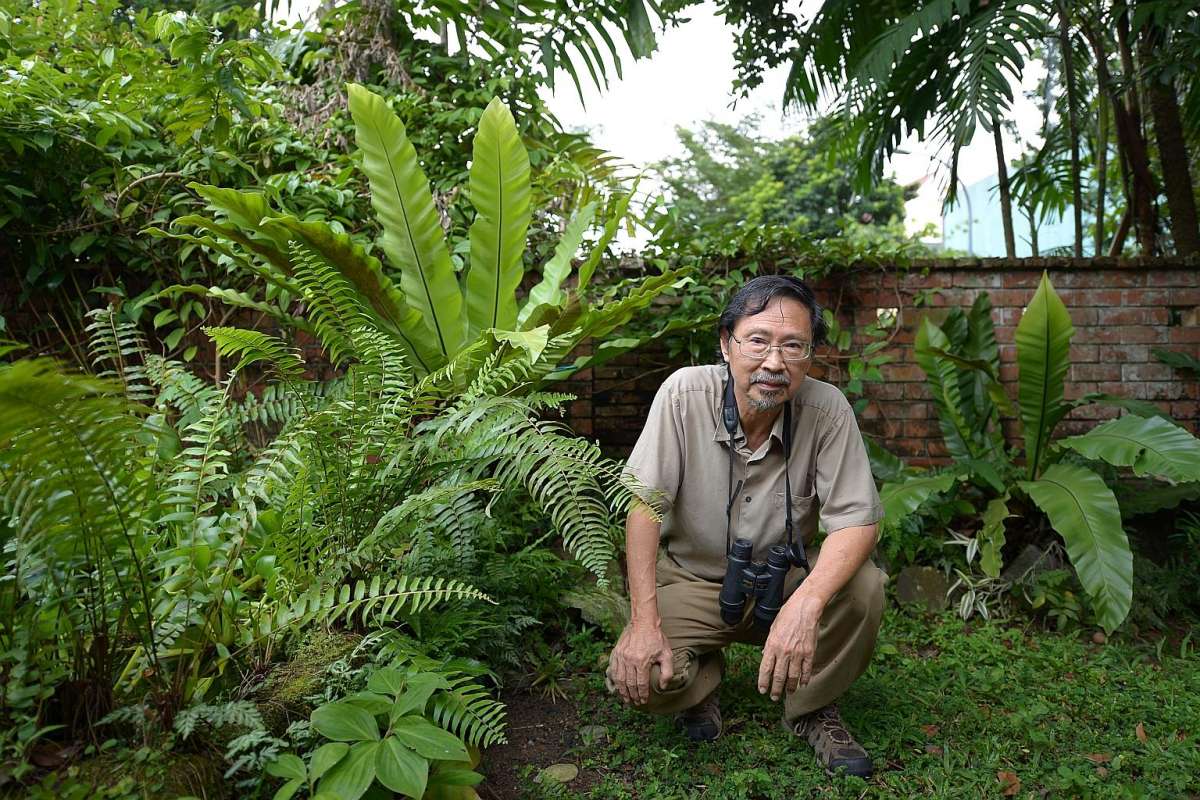
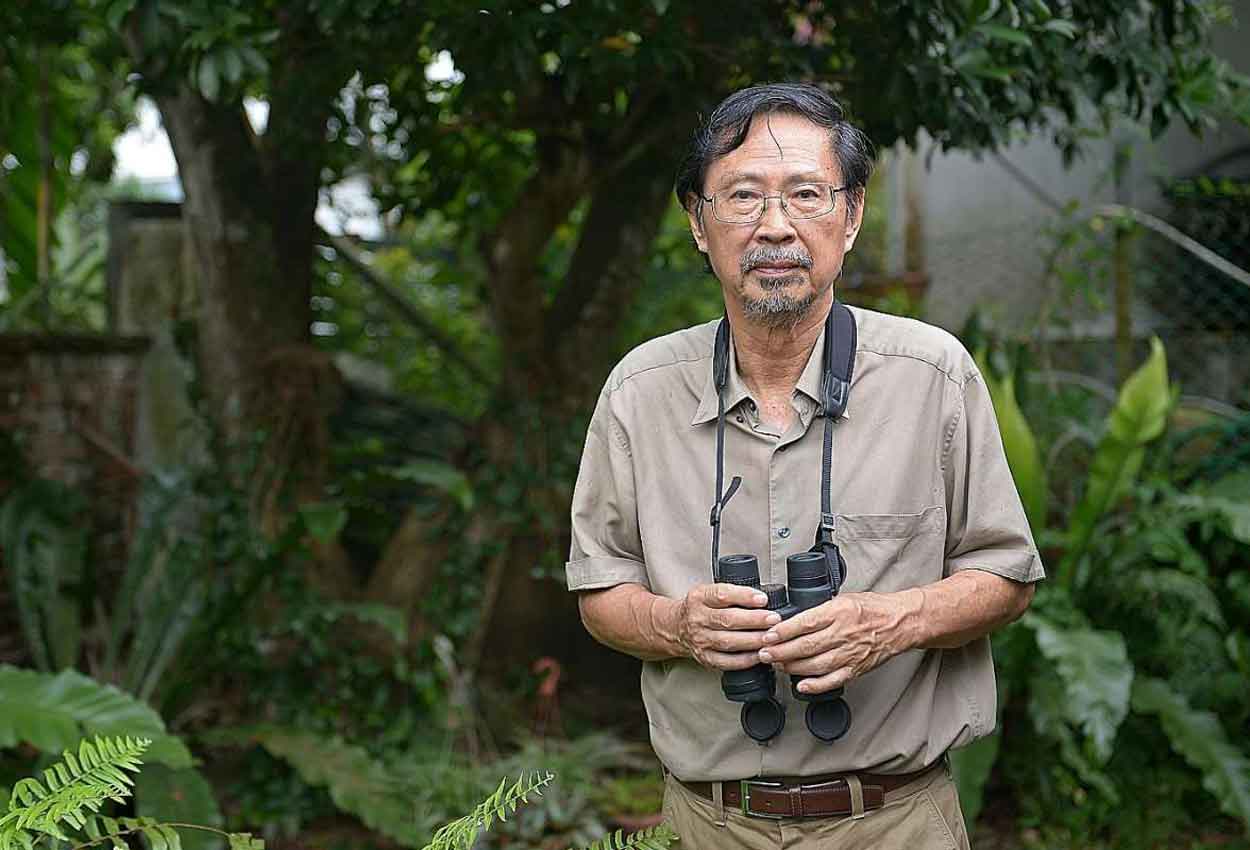
A few monkeys bound across the roof of conservationist Ho Hua Chew’s house. These long-tailed macaques have come from the forest in the Central Catchment Nature Reserve, which lies behind his detached single-storey house in the Upper Thomson area.
Dr Ho, 70, and his wife bought their property in the 1980s because they wanted to be close to the wilderness in Singapore. They do not mind that creatures from the woods periodically spill over into their space. Once, an endangered slow loris found shelter in the sprawling bohemia plant on their garden wall.
This proximity to nature is more than literal; it reflects what Dr Ho calls a love of the land, an ethos that has sustained the former philosophy lecturer’s conservation work. Over decades, he and the Nature Society (Singapore), where he serves as the vice-chairman of the conservation committee, have engaged with the authorities in a bid to curb the tide of development in Singapore and retain bio-diverse pockets of the wild.
Almost 30 years ago, he led the Nature Society (Singapore) in its efforts to conserve the bird haven Sungei Buloh, which was slated for redevelopment. It was the first time a civil society group successfully lobbied the government to change its plans.
His life’s work earned him the “Outstanding Advocate of Our Time” accolade, the first award of its kind, at the Singapore Advocacy Awards last month.
Veteran activist Constance Singam, chair of civil society activist group The Working Committee 3 (TWC3), which organised the awards, says: “It takes a very long time to change attitudes. Dr Ho has been raising awareness about conservation for about 40 years. He has won the respect of both civil society and policymakers.”
The award was created just for Dr Ho, says Mrs Singam, adding that his advocacy was rare when he became active in the 1980s, a period of intense urbanisation in a political climate that was “difficult” for civil society. She credits him with paving the way for other groups and movements, such as the voices raised against the planned development of the historic Bukit Brown cemetery in recent years, which concerned issues of both conservation and heritage.
Dr Ho, who quit full-time work in 1999 to dedicate his time to conservation work, could be said to have a lofty idealism. But a bureaucrat’s pragmatism shines through him as well.
With competing needs in population-dense Singapore, such as housing and infrastructure, the battle for conservation is sometimes lost. “We fight for 100 per cent; we’re lucky if we get 20 per cent,” says Dr Ho, who joined the nature society in 1971.
The seeds of this belief were planted in a free-roaming childhood spent exploring forests and longkangs (Malay for drains).
He was born in Kuala Lumpur, the third of five children. His late father Ho Toon Seng relocated his young family to Singapore when he found employment as a cook with a British family. Dr Ho has few memories of his mother, who died of illness when he was in primary school.
They lived in the servants’ quarters in a colonial bungalow in Dalvey Estate, surrounded by woods and fields. He used to fling away his schoolbag after school and dash out, together with the gardener’s son and his younger brother, Wah Loong, to explore the area.
It was the 1950s then, and the children caught spiders and climbed trees to pick rambutans. He saw cattle being herded along Bukit Timah Road, followed by flocks of egrets scrambling to devour the insects stirred by the cows. He caught a soft-shelled turtle in a longkang, the site of fishing expeditions. When he tried to take it home, it bit him and he was forced to release it.
“I would say my love of nature began and evolved from my childhood,” says Dr Ho.
During the 1960s, he found national service training tough under the supervision of Israeli advisers, but marching in remote, rural areas intensified his fascination with the beauty of the Singapore countryside.
While pursuing postgraduate studies at the University of Washington with his wife, Dr Khoo Kim Choo, in the 1970s, he took up birdwatching, later joining fellow hobbyists in the Bird Group in Nature Society (Singapore) in the mid-1980s, which conducted surveys and research on bird species in Singapore.
Dr Ho Hua Chew was part of a group of birdwatchers from the Nature Society (Singapore) who initiated a proposal to create a nature reserve in Sungei Buloh. Photo: The Straits Times
An agnostic, he was drawn to the study of philosophy as it pondered the meaning of life. Apart from his studies for his philosophy doctorate in Washington, he read the classic nature writings of 19th-century authors such as American Aldo Leopold, who wrote about the love of the land and wilderness.
After his childhood view of exploring nature as a great adventure, Dr Ho embraced this perspective. Now a Singapore citizen, he describes it as a kind of patriotism.
“If you love nature, you’ll love your land. This is your country. You love the beauty of the wildlife. Wildlife also deserves a place in the sun,” he says.
He took two Master’s degrees, in conservation and ecology, in Britain, to learn more about the “scientific and technical” aspects of these subjects, to aid his conservation work.
Back in Singapore, he was part of a group of birdwatchers from the Nature Society (Singapore) who initiated a proposal in December 1987 to create a nature reserve in birdlife-rich Sungei Buloh, which was originally designated by the Government for agrotechnology development.
The late president Wee Kim Wee was among the officials who visited the wetland, which officially opened in 1993 as the Sungei Buloh Nature Park. It was gazetted as a nature reserve on Jan 1, 2002.
The success of Sungei Buloh made Dr Ho feel “bold”, he recalls.
Then came subsequent challenges.
In the 1990s, the government rejected an appeal, backed by 25,000 Singaporeans and coordinated by Dr Ho, to conserve 70ha of land in Senoko as a nature park.
It was the last of a series of bids to save the bird habitat in Sembawang after initial efforts to conserve all 168ha was turned down in 1994 because that would have meant a loss of 17,000 housing units.
Dr Ho recalls it was a “big blow” after spearheading the appeal and working with others to garner signatures from the public everywhere, from parks to shopping centres.
The Senoko decision played a role in his resignation from his job as a lecturer at the Department of Philosophy at National University of Singapore in 1999. He had been working at NUS since the early 1970s and has since earned what he calls “pocket money” teaching ad hoc courses in environmental and conservation issues at NUS and other tertiary institutions.
He felt he had to choose between philosophy and conservation.
“It was urgent. There was a lot of development in the 1980s and 1990s. I had to make a choice. (After Senoko) I thought, well, we have to work harder. Maybe I was a bit naive, but I have no regrets. Life became more meaningful.”
His wife was supportive in becoming the family’s main breadwinner. Dr Khoo, 69, is the founder of Preschool for Multiple Intelligences and a consultant for early childhood development.
She says: “We’re both doing the work we love to do, but he doesn’t get paid for it.”
She describes her husband of more than 40 years as intense and determined. Besides his work, she recalls how Dr Ho, an avid reader, once took a road trip from Seattle, across the United States to the country’s east coast to check out second-hand bookshops for his library of more than 3,000 second-hand books.
The couple have one son, Hee Juan, an IT engineer in his 40s who is married with two sons and lives in Melbourne, Australia.
Since 1999, Dr Ho has been doing conservation work full-time on behalf of the Nature Society (Singapore), which he describes as a supportive family.
Since the early 1990s, with fellow volunteers, he has been coordinating and writing detailed reports and proposals for the conservation of wildlife-supporting areas including Marina South, Kranji Marshes, Khatib Bongsu, South Simpang, Kent Ridge and Sentosa.
Coming up with surveys, monitoring wildlife and meeting with officials can be challenging, he says. The process can take decades. For example, the society’s proposal to conserve the Kranji Marshes was first mooted in 1990 and the area opened to the public as the largest freshwater marshland in Singapore earlier this year. It is home to 54 species of butterflies and more than 170 species of birds, including the critically endangered straw-headed bulbul.
Dr Ho points to challenges along the way over some 25 years for the Kranji Marshes and its environs, such as the building of a transmission station and a golf course.
A frequent letter-writer to The Straits Times’ Forum about conservation issues, he has spent sleepless nights worrying about the impact of the letters he writes, explaining the stand of Nature Society (Singapore).
It used to be tense in the early decades of his work when he met with government officials, he says, declining to be specific.
“I wasn’t scared because I believe that what I’m doing is not political. It’s something neutral. But we are affected by the tension,” he says.
People warned him that if he did something that contradicted the Government’s plans, there might be consequences. But he has not experienced anything adverse.
“Things are better now. Officials are getting more open, more friendly,” he says, adding that concerns such as climate change have come to the forefront as well, in recent years.
Mr N. Sivasothi, 50, a biological sciences lecturer at NUS, says Dr Ho’s detailed research and polite approach have paid off and inspired younger conservationists like himself. “He has a very gentlemanly demeanour about him, (yet) he is persistent. He tries to argue using information and people respond to a passionate speaker,” says Mr Sivasothi.
For his part, while Dr Ho is encouraged that young people have been taking up causes such as the preservation of Bukit Brown, he feels that more focus should be given to less known areas that are unprotected, such as the biodiversity in the Tagore area.
Since stepping down as conservation committee chairman of the Nature Society (Singapore) about seven years ago, he still does research and reports.
He is modest about his accomplishments.
“I don’t have a talent for administration. We’re amateurs. We fumble, we struggle… I concentrate on the birdlife. If you believe in a cause, that nature has value, you just push on.”
This article was first published on Sep 12, 2016. Get a copy of The Straits Times or go to straitstimes.com for more stories.
In the run-up to exam time, sit down together with your children and work out the best times for revision. Make a revision timetable on a big piece of paper and pin it up somewhere prominent.
When it comes to revision, research shows that little and often is better than overlong sessions. Cramming at the last minute is also counterproductive, so it is best to start early and put in the groundwork while there is still time.
LEARN WHAT WORKS
We know that different people have different styles of learning, and it is important your children are working in the way that is right for them. Find out what motivates them and use it to your advantage – be it a goal, such as doing well in an exam, or building a skill, such as learning a language. But do not use bribes. This puts undue pressure on your children and sets the wrong precedent. They should want to achieve for their own sake, not yours or because there is a cash reward in it.
GET SNACKS ON THE GO
Put the kettle on and buy plenty of healthy snacks for your studious workers – the healthier, the better. Any food high in omega-3, such as oily fish, flaxseed and walnut, supports concentration and cognitive function.
Foods high in antioxidants, such as fruit – especially berries and tomatoes – and moderate amounts of caffeine can help concentration.
Green tea and dark chocolate, which are especially rich in specific antioxidants called polyphenols, can also support brain function. Ripe bananas or sunflower seeds are great to snack on because they naturally increase dopamine – a brain chemical involved in increasing motivation and concentration.
WORK THE SPACE
Set aside a calm room or space for revision, and invest in some large plastic boxes to keep books and resources tidy and easily accessible. Ensure that, where possible, this space is kept well organised and clutter-free, because it turns out that the old “tidy desk, tidy mind” saying might actually have some truth to it.
Researchers at Princeton University have found that if our environment is cluttered, the chaos restricts our ability to focus. Clutter can also limit the brain’s ability to process information – so keep those desks clear.
POOL YOUR SKILLS
It may be that some parents in your social group are better at science or maths than you are, so a skill swop to support your respective offspring might be the answer.
Parents more knowledgeable in physics could facilitate a tutorial, while you could coach a group in English. You could even rope in other family members with expert knowledge or subject specialisms to help handle the task of revision.
TAKE A BREAK
Research has shown that spending time outdoors in green spaces such as parks or woodlands decreases stress and anxiety, so try and incorporate some of the great outdoors into your child’s revision routine in the lead-up to exam time.
Encourage your teenagers to take a break from the studying – it will help to recharge their minds.
The writer is a senior lecturer for PGCE Primary, Cardiff Metropolitan University.
This article first appeared in The Conversation (http://theconversation.com), a website which carries analysis by academics and researchers.
This article was first published on Sep 12, 2016. Get a copy of The Straits Times or go to straitstimes.com for more stories.
Morganfield’s Singapore turns 4 this month, and they will be celebrating it with everyone! Enjoy free half slabs of their Hickory BBQ Sticky Bones to the first 200 dine-in guests at the VivoCity outlet on their birthday, Saturday 17 September. Yes – free!
Students and colleagues paid tribute to former St Margaret’s Secondary School principal Liza George, hailing her as an exemplary leader for educators and an inspiration to her students.
Mrs George, who died last Thursday of heart failure at age 86, was one of the school’s long-serving principals.
The educator, who retired in 1990 after serving 23 years as the principal of St Margaret’s, is fondly remembered by many in the teaching fraternity as one who brought enthusiasm to her lessons.
To her former students, she was a graceful and approachable principal who was firm when the situation called for it.
Mrs George was also an inspiration to many of her students who went on to choose a career in education.
Teacher Susan Thomas, 52, who attended St Margaret’s in the late 70s, when Mrs George was principal, said the girls respected her.
“Even for the girls who were sometimes difficult to handle, Mrs George knew how to manage them in her own gentle way,” she added.
Mrs George was one of her inspirations for taking up a career in teaching. “She was a role model for many of us. We looked up to her,” Mrs Thomas said.
Former St Margaret’s student Josephine Yeo, 54 , said the former principal wore a stern demeanour but had a loving heart for the girls.
“She was a gem of a principal and is well loved by many of her students, whose lives she has touched over the years,” she added.
Another old girl, Mrs Tay-Lang Ren Jee, 59, said the former school leader carried herself well. “We’ve never seen her shout,” she added. “Whenever we saw her, we knew that we ought to behave.”
Mrs Tay-Lang, a teacher, added that Mrs George focused “a lot on character” and was nurturing in that aspect. “We will definitely miss her,” she said.
Outside the education arena, Mrs George was a treasured friend.
Retired teacher Yee Teck Peng, 83, who had known Mrs George for more than 60 years since they were teachers, said she was an “excellent, quiet disciplinarian”.
“She never had to raise her voice, and everything still ran smoothly,” he added.
Mrs George, who celebrated her birthday last month, leaves behind three children – Mathew, 58, Mary, 57, and Cherian, 51 – and four grandchildren.
Her daughter, Mary, said she was a “good storyteller”, who had the ability to take something and turn it into an amazing story. “For her, it was a natural thing,” she added.
A funeral service will be held at Purity Hall, Mount Vernon Sanctuary today at 2pm.
After the service, Mrs George will be cremated at Mandai Crematorium at 3.45pm.
This article was first published on Sep 12, 2016. Get a copy of The Straits Times or go to straitstimes.com for more stories.
Three pairs of celebrity newly-weds share how they will be celebrating their first Hari Raya Haji, which is today, as married couples
He is no stranger to how the Muslim community here celebrates Hari Raya Haji even though he converted to Islam only last October.
Having lived in Singapore for the past seven years, Mr Bilal Jeanpierre, 30, who married local actress Nadiah M. Din last month after dating for two years, is well-accustomed to many Malay and Muslim traditions and customs.
The client engagement manager, who is a French national, finds the way Muslims here celebrate Hari Raya Haji more familiar as the celebrations are short.
It is unlike Hari Raya Puasa, when celebrations can go on for weeks. Nadiah, 26, told The New Paper: “Eid celebrations usually last only a couple of days in Europe, so Hari Raya Haji celebrations are more to Bilal’s tastes.”
The couple plan to spend their first Hari Raya Haji as a married couple at Nadiah’s aunt’s home with the rest of her family.
They also spent yesterday helping Nadiah’s mother to cook.
Nadiah said: “Bilal said he wanted to help out in the kitchen, so that was a first experience for him.”
Actress Nadiah M Din marries French beau
Click on thumbnail to view photos. Source:
The New Paper, Berita Harian
FAMILY
Mr Jeanpierre told TNP: “This is my second time celebrating Hari Raya Haji, so I know what to expect.
“I am looking forward to spending precious time with family, and remembering God together.”
As for the tradition of sacrificing animals such as sheep and lamb, Mr Jeanpierre said he would like to perform the korban himself someday.
“The process is more complicated than people think, so I hope to learn all about it and try it myself in the future,” he said.
Nadiah added that she feels blessed that her husband is always trying to learn more about Islam.
“I am very blessed that he is so humble and adapts very easily,” she said.
Newly-weds Sezairi Sezali, 29, and Syaza Qistina Tan, 25, have no big plans for this Hari Raya Haji even though it is their first time celebrating it as a married couple.
The pair, who held their wedding reception last month at the SAF Yacht Club in Changi after getting married in January, plan on spending today visiting Sezairi’s parents and eating with their families.
Sezairi, who won Singapore Idol 3, told The New Paper: “It has been a while since we celebrated a special occasion at my parents’ place since Hari Raya Puasa was celebrated at my grandmother’s house.”
The couple live in Pasir Ris with Ms Syaza’s mother and younger sister.
Singapore Idol’s nuptials end with sunset serenade
Click on thumbnail to view photos. Source:
The Straits Times
SACRIFICE
Sezairi has never performed the korban, but he is able to recall visiting his grandmother’s house in Johor when he was younger to help out with the sacrificing.
With a smile, he said: “I will not be doing it this year because I do not think I would have the guts, but who knows in the future?”
But if there is one thing he is looking forward to, it is starting his own traditions with Ms Syaza.
He said: “It has been a pretty hectic year with the wedding just over. We still have not really settled in to our new lives together.
“Visiting the elders would be a nice place to start.”
Instead of honeymoon couple spends Hari Raya Haji with relatives
Aliff Aziz and wife Miss Dayang Ara Nabellah Awang Astillah. Photo: Aliff Aziz
Local singer-actor Aliff Aziz’s mother was in tears as he walked through the door for his marriage solemnisation.
“I could not help myself,” Madam Siti Hafizah Sheikh Mohamad told The New Paper.
“It has been a long journey not just for Aliff, but for the whole family.
“I was so proud to see my son in his baju kurung and about to take the next big step in his life.”
Madam Siti gave Aliff a hug and shared a few words with him before he took his vows in front of family and close friends on Friday morning in Kuala Lumpur.
“I told him that he would always have my blessing,” said Madam Siti. “At that point, he reassured me and told me not to worry.”
The 25-year-old had gone through a rough patch with his mother after he was caught on the wrong side of the law twice in 2014 – when he punched a Malaysian hotel employee and when he was summoned to court for the theft of two mobile phones.
Without going into details, Aliff told TNP that he and his mother “did not talk for quite some time” because Madam Siti was “very angry” with him.
Madam Siti said: “At the end of the day, he is still my child, no matter what he does, and I have long forgiven him for his mistakes.
“I am very honest with him and I tell him as it is without any no sugar coating. I am that tough love kind of parent and sometimes, young adults his age do not want to hear it.
“But he is my firstborn and I will always love him no matter what he does.”
After dating for almost two years and being engaged for nine months, Aliff and Malaysian broadcasting undergraduate Dayang Ara Nabellah Awang Astillah, 22, took their marriage vows and held a wedding reception for about 1,000 guests at the Top Glove Tower in Shah Alam, Selangor.
Aliff, who spoke to TNP yesterday afternoon, said: “I was so nervous. The walk down the aisle was the longest I have ever made in my life.”
Aliff and his wife, who is known as Bella to friends and family, walked into the ballroom to a tune with bagpipes. The music then changed to US singer Christina Perri’s award-winning hit A Thousand Years.
“The entire walk was a good four minutes and I had to continuously maintain a smile while my nerves acted up,”Aliff said with a laugh.
“And I could tell that my wife was also extremely nervous, especially with the many cameras around us.
“I am glad we did not trip and fall especially with Bella’s dress being so heavy.” Even though two days has passed, Aliff said it still has yet to sink in that he is now married.
Photo: Silverline Photography
SURREAL
“It is just so surreal,” he said.
“Maybe because I am still very tired from the whole thing and my mind has not been able to quite grasp it just yet.”
Instead of going on a honeymoon immediately, the couple revealed yesterday that they are planning on heading to Singapore to celebrate Hari Raya Haji today.
“Bella and I might drive back to Singapore to celebrate Haji with my family and visit relatives who were not able to make it for the wedding,” Aliff said.
“After spending two nights there, we will come back to KL before heading to Sandakan (a town in Sabah) to visit Bella’s family.”
Amid the many family-visiting plans, Aliff said he is “most excited about just one thing”.
“I am so eager to embark on this journey with my wife and our future family,” he said.
“It is going to be amazing and I could not have asked for more.”
This article was first published on Sept 12, 2016. Get The New Paper for more stories.
Newspapers, empty shoeboxes and even microwave ovens.
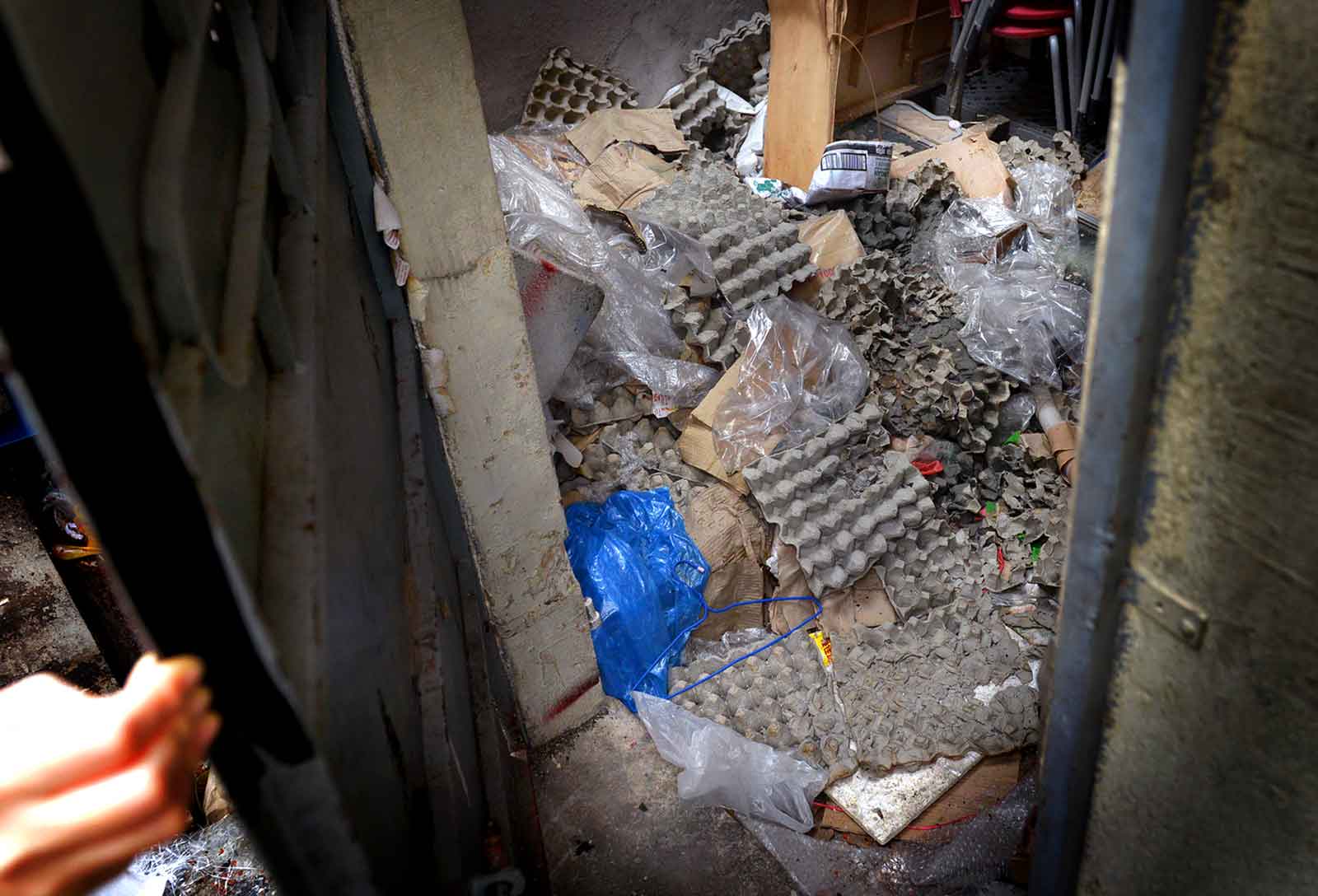
These are just some of the items Aljunied Crescent residents say they see under their void decks, even after the neighbourhood had been identified as a Zika hot spot.
Ms Sulaiha Ngatiman, 29, a housewife who is six months pregnant, told The New Paper she had expected residents to play their part in fighting Zika.
She said: “I can’t believe that people still leave these items under the blocks, knowing that litter can cause mosquitoes to breed.”
The mother of four children, aged 10, nine, seven and three, said: “I am afraid my children will get bitten.”
Since Aljunied Crescent and Bedok North Avenue 3 were identified as Zika clusters late last month, residents like Ms Sulaiha have been worried about mosquitoes breeding in their residential area.
The improper disposal of litter such as newspapers, unwanted household items and furniture can become breeding grounds for mosquitoes.
When TNP visited the Aljunied Crescent area on Sept 5, the situation seemed to have improved.
Our team did not spot any bulky household items near the lift landings or rubbish chutes, but there were shoeboxes strewn under the blocks and plastic bags of rubbish in the drains – ideal breeding grounds for the Aedes mosquito, which carries the Zika virus.
Ms Sim Poh Gek, 63, who lives in Block 106, Aljunied Crescent, said: “I still see people disposing stacks of newspapers, cardboard boxes and plastic wrappers under the void decks.”
What is the Zika virus?
Click on thumbnail to view photos. Source:
Reuters, The Straits Times, The New Paper, NEA
TRAP WATER
She said: “If it rains, the paper will absorb and trap water. My fear is that when the rubbish is not cleared, the void decks could easily turn into mosquito breeding spots.”
TNP also spoke to residents in the Bedok North Avenue 3 vicinity.
One resident, who wanted only to be known as Ms Swee, said: “I see bulky household items like cupboards and even sofas left in void decks and near lift landings.”
The 36-year-old mother of one said: “These people are quite selfish. They leave these unwanted items under our flats for their convenience, but they don’t see how it can be a potential threat to other residents, especially when Zika cases have been reported in the area.”
When TNP visited the Bedok North Avenue 3 area on Sept 5, we saw a discarded cupboard left near the rubbish chute of one of the blocks.
Wooden chair frames and soiled pillows were also left near the lift landing of another block.
Ms Sulaiha said: “You cannot just leave your unwanted items at the lift landings or void decks and expect the cleaners to take them to the proper disposal sites.
“The responsibility lies with each individual to clear his or her own litter and keep the area clean.”
Ms Sulaiha also said that the town councils should step up efforts against persistent dumping by imposing strict fines.
The town councils in charge of Aljunied Crescent and Bedok North Avenue 3 told The New Paper they have stepped up cleaning efforts and are working closely with the National Environmental Agency (NEA) to monitor the litter situation.
Professor Annelies Wilder-Smith, who directs the Global Health and Vaccinology Programme at Nanyang Technological University’s Lee Kong Chian School of Medicine, told TNP: “Litter that carries small amounts of water can become breeding sites.
“Litter or rubbish can also add to shady areas under which larvae can grow. The shade could also protect breeding sites even during fogging and enhance mosquito breeding.
“Litter should be cleared away at least twice a week to stop the mosquito cycle. Clearing litter is just one of many approaches that should be done at the community level to reduce breeding sites.”
Despite the increased efforts by the town councils and the NEA to keep Zika hot spots clean, some residents feel that this should not only be done when an outbreak happens.
Ms Sim said: “Residents and the town council should always take cleanliness and hygiene matters seriously.
This article was first published on Sep 12, 2016. Get The New Paper for more stories.
In last week’s elections, Hong Kong residents voted into the Legislative Council seven young lawmakers who espouse greater political freedom and a stronger identity for the city. The Straits Times’ Hong Kong correspondent Joyce Lim takes a measure of two of them.
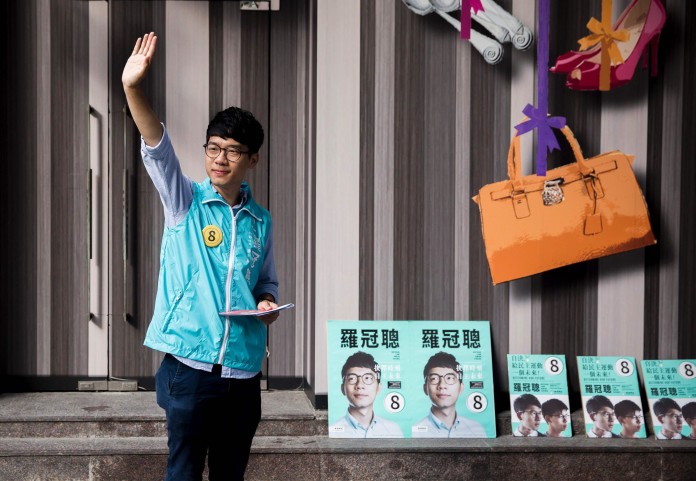
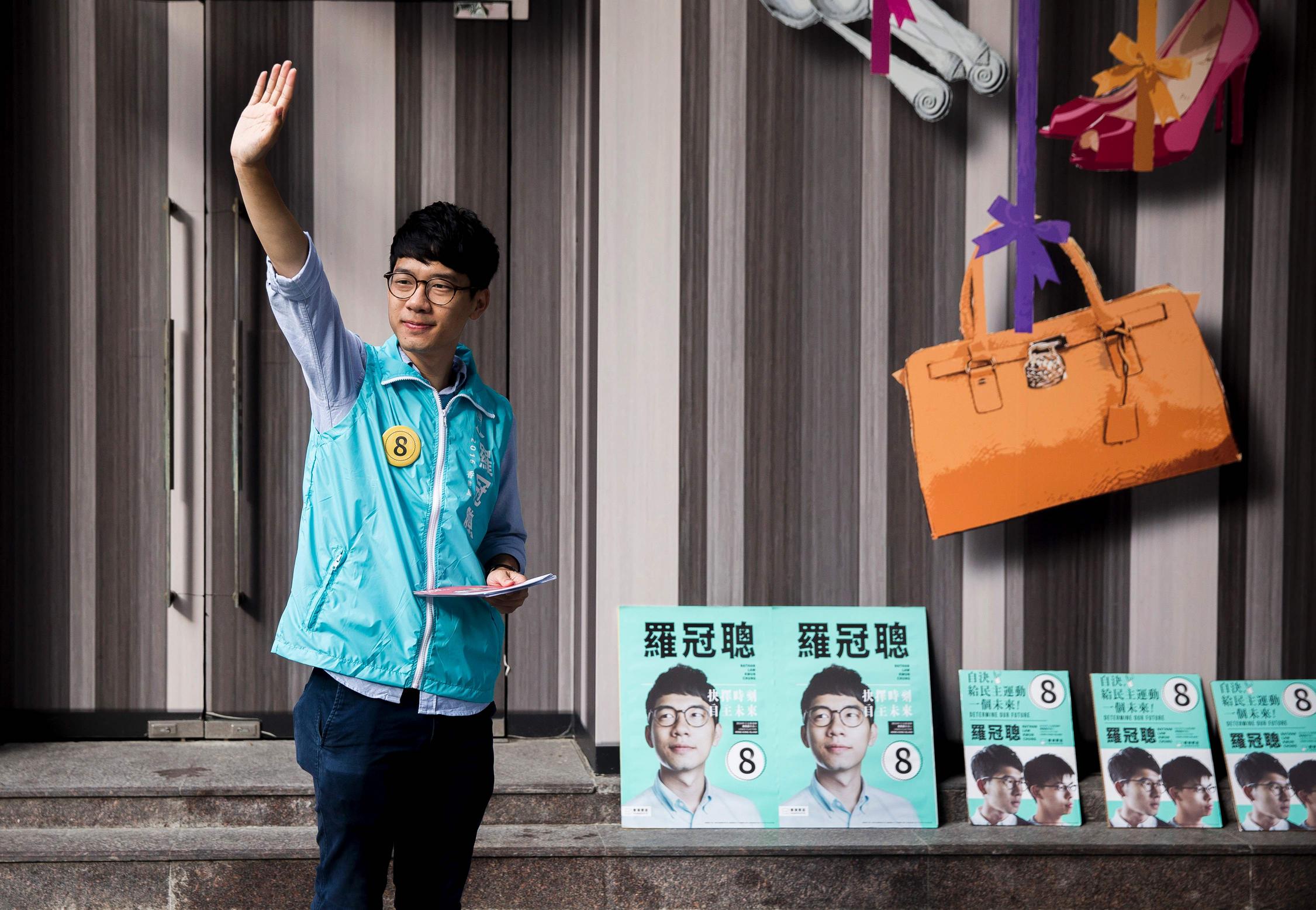
Two years ago, Hong Kong student leader Nathan Law made a name for himself during the Occupy Central protests when he was one of five student representatives to hold talks with Chief Secretary for Administration Carrie Lam.
Last week, the 23-year-old Lingnan University undergraduate was elected to the Legislative Council (Legco), becoming the youngest lawmaker in the city’s history.
“In my past performance (in the Occupy protests), I believe I have shown my ability to talk about policies and to be a very capable legislator,” Mr Law told The Straits Times after his impressive win.
He received 50,818 votes, the second highest in the six-seat Hong Kong Island constituency.
He asked that Hong Kongers continue to watch his performance in the new Legco.
Often seen in a light blue or white shirt with rolled-up sleeves and a backpack, the soft-spoken Mr Law presented a non-threatening image in the run-up to the elections in a slate of 15 candidates.
And that image has apparently worked with young and older voters, given that one in three voters in the constituency is above 60.
Anxious to get to know his constituents better and to devote more time to his work as a legislator, he plans to study part-time instead of full-time for a degree in cultural studies.
He was born in 1993 in mainland China, in Guangdong province’s Shenzhen city, across the border from Hong Kong. In 1999, he moved with his family to Hong Kong, two years after the city was returned to China by its British colonial masters.
Hong Kong student leader Nathan Law made a name for himself during the Occupy Central protests. Photo: AFP
He was raised in a blue-collar family that sent him to schools run by Beijing sympathisers, according to Time magazine.
Perhaps it was because what he was taught was different from what he saw – lessons portrayed China’s political system as “uncorrupt and democratic”, which school field trips to the mainland reportedly did not bear out – but he was in the forefront of the 2014 Occupy movement pressing for more political freedoms and greater autonomy for Hong Kong.
The 79-day protests failed and he was in and out of the courts, one of three activists arrested on protest-related charges.
He was sentenced last month to 120 hours of community work after he was found guilty of inciting people to join an unlawful assembly.
In April this year, he co-founded political party Demosisto to continue the pursuit of self-determination and universal suffrage.
“The first thing I will do (as lawmaker) is to propose a referendum law in the Council,” he said. This would pave the way for a referendum to allow Hong Kongers to choose their own future.
He knows it will be tough to get the law passed. But he said he is willing and open to working with the traditional pan-democrats on this. “I can bring new energy, a new vision to the Council. And I have to convince them that I have a long-term vision for Hong Kong. I am mature enough… to talk about policies in the Council.”
Fighting for dignity ‘almost stolen by rich and powerful’
On Oct 1, Mr Eddie Chu will be one of 26 new faces who will be sworn into the 70-seat Legislative Council (Legco) or Parliament. Photo: Reuters
A former investigative journalist, environmentalist and radical social activist, Mr Eddie Chu will soon take on a new role as a lawmaker.
On Oct 1, Mr Chu will be one of 26 new faces who will be sworn into the 70-seat Legislative Council (Legco) or Parliament.
Many were surprised when he garnered 84,121 votes in the New Territories West – the highest number of votes to be won by a candidate across all five geographical constituencies – at last week’s Legco elections.
Hong Kong elections 2016
Click on thumbnail to view photos. Source:
AFP
But the 38-year-old independent candidate, whose low-cost campaign featured hand-painted banners, started his political and social activism a decade ago.
Hong Kongers first came to know of him in 2006 when he camped at a construction site at the iconic Star Ferry Pier in Edinburgh Place, in an attempt to prevent the demolition of the pier. His protest failed and Star Ferry Pier, together with the nearby Queen’s Pier, was demolished to make way for a shopping mall and a road.
During the fight to save Queen’s Pier, Mr Chu had told then-Secretary for the Development Bureau Carrie Lam: “I have to keep this place for the next generation because I need to tell them a different story of Hong Kong.
“My Hong Kong is not a fishing village-turned-financial centre in which the laws of the jungle apply.”
He noted this in his election campaign leaflet, adding: “My Hong Kong is a free city where people join forces to retain our dignity, which is almost stolen by the rich and powerful.” The campaign saw him raising issues, from self-determination to preserving Hong Kong’s heritage, to unjust land use.
But what has appeared closest to the heart of the former freelance journalist, who has covered news in Iran and war-torn Afghanistan, is the issue of rich and influential developers changing the landscape of the city where he was born and grew up in, at the expense of the people and the environment.
In the past 10 years, he has led several campaigns and was often seen on the front line protesting against what he deemed as unjust land use, illegal dumping of waste in the New Territories and overspending on the high-speed rail project.
In 2010, he knelt and walked in turns with a group of villagers in protest against their having to relocate their homes for the construction of the Guangzhou-Shenzhen-Hong Kong Express Rail Link project. In 2014, he joined the Occupy Central movement.
With his authority as a lawmaker, he wants to challenge and reform the Heung Yee Kuk, a statutory advisory body in the New Territories dominated by the pro-Beijing elite and landlords, which is widely accused of corruption and anti-environmental practices.
“I will use my skills as an investigative journalist to expose all the wrongdoings of these people…
“I will use the support of 80,000 Hong Kong voters to push for an immediate reform of Heung Yee Kuk and the rural system,” said Mr Chu, who has received death threats allegedly linked to his declaration of war on the powerful body.
This article was first published on Sep 12, 2016. Get a copy of The Straits Times or go to straitstimes.com for more stories.