The National Transport Workers’ Union says it will review the situation, study the grounds for dismissal and work with the affected staff on their next steps.
Source link
2 SMRT staff, including train driver, sacked over fatal Pasir Ris accident
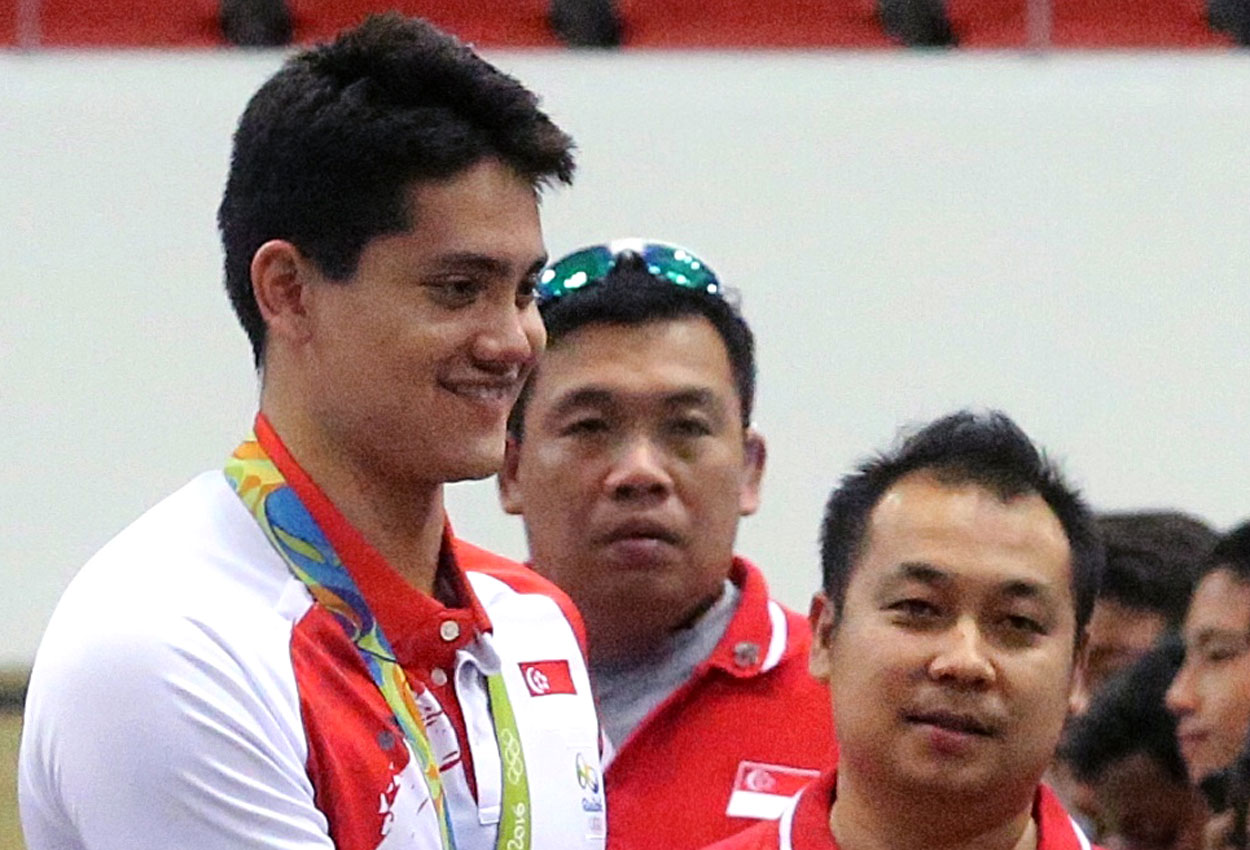
Ex-SSA man Hafidz to assist Schoolings

The family of Singapore’s first Olympic champion Joseph Schooling yesterday appointed a representative to handle all their media and commercial engagements.
In an e-mailed statement, Colin, Joseph’s father, said former Singapore Swimming Association (SSA) marketing and communications director Hafidz Ja’afar “will act on behalf of the Schooling family in all possible (matters) that are related to the family”.
Joseph’s engagements have swelled since his historic win in Rio de Janeiro last month.
The 21-year-old swimmer beat the likes of Michael Phelps, Chad le Clos and Laszlo Cseh to bag the 100m butterfly crown in an Olympic-record time of 50.39 seconds.
Colin, 68, said: “We went with Hafidz because he is efficient, he is good at planning and is already familiar with the relevant parties from his time in the SSA, which allows for continuity. Most importantly, I trust him.”
Crowds gather to catch glimpse of Joseph Schooling on victory parade
Click on thumbnail to view photos. Source:
AsiaOne




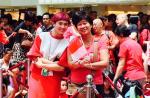








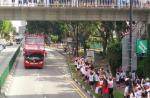

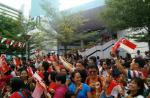
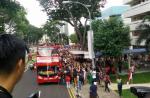









Hafidz, 33, resigned from the SSA last week, citing personal reasons. He said he is excited about the learning opportunities his new role presents.
It is believed the Schoolings are still on the lookout for suitable talent management agencies, several of whom have approached them. But that is not a priority as Joseph, a University of Texas student, has to abide by National Collegiate Athletic Association rules on amateurism, one of which forbids an “agreement to be represented by an agent”.
Instead, Hafidz will help organise the Schoolings’ engagements, the same way he oversaw Joseph’s return last month.
The swimmer’s four-day stint in Singapore to celebrate his win was packed with activities from the off. Hafidz was an ever-present figure by his side.

This article was first published on September 14, 2016.
Get a copy of The Straits Times or go to straitstimes.com for more stories.
Image:
Publication Date:
Wednesday, September 14, 2016 – 14:00
Keywords:
Send to mobile app:
Source:
Story Type:
Others
House pays tribute to former president S R Nathan

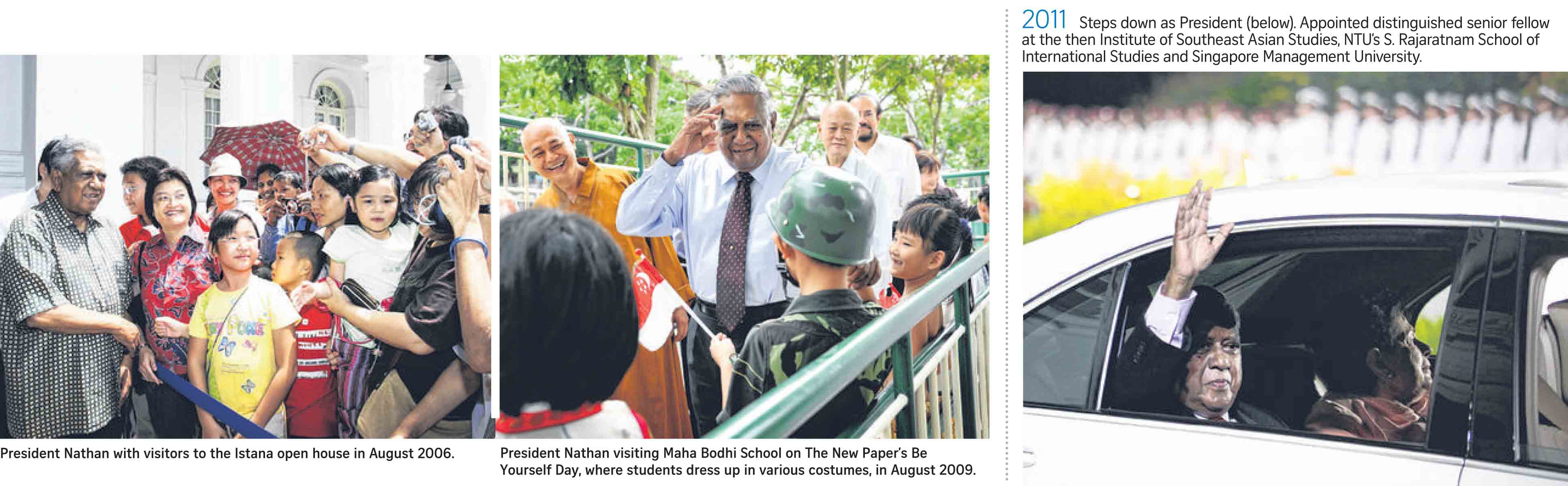
When some statutory board officials and businessmen left early instead of staying on for networking sessions at the end of a 2009 state visit, then President S R Nathan’s message to them was “far from serene”, Mr Christopher de Souza (Holland-Bukit Timah GRC) recalled yesterday.
Mr de Souza, who was present, remembered Mr Nathan saying: “You may think the socials are unimportant, but they are important. Staying back, discussing and engaging with your host is how we make Singapore relevant.
“I have come here to do that. Send this message back to those who left the trip early.”
This anecdote from a state visit to Istanbul was among several personal encounters related yesterday by nine members of the House during a parliamentary tribute to Mr Nathan who died last month, aged 92.
Singapore says farewell to former president S R Nathan
Click on thumbnail to view photos. Source:
The Straits Times



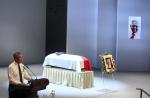
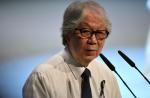


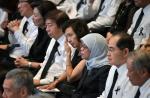
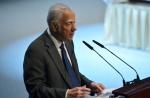






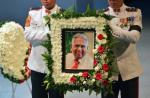

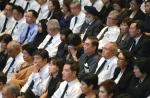

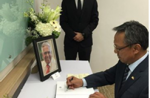
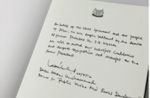

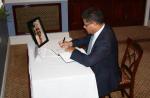
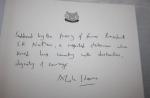



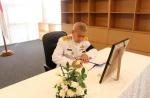

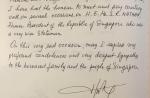



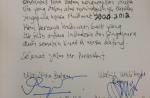

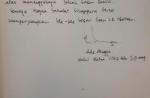
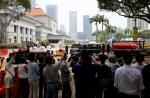

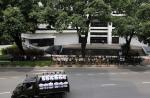

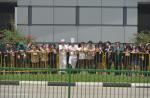




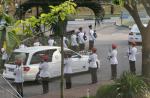



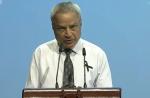


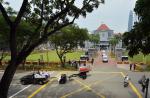






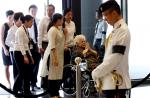







It took place at the start of the sitting, with Speaker of Parliament Halimah Yacob celebrating the life of Singapore’s sixth and longest-serving president by charting his career from a social worker to the highest office in the land.
Her personal memory was Mr Nathan’s handwritten note to her after she became Speaker in 2013. He shared his and his wife’s joy at her appointment, and his prayer that “God will be with you as you undertake your new responsibilities”.
Said Madam Halimah: “Such was the measure of the man. He had walked among kings and presidents but he remained fully rooted to the ground, never losing his bearings and keeping his humanity to the end.”
Her voice wavering, she added: “The House records with deep regret the passing of one of our esteemed sons of Singapore, Mr S R Nathan.”
Mr de Souza’s story held a special meaning for the MP. It illustrated how the late Mr Nathan – like pioneers Lee Kuan Yew, Goh Keng Swee and Hon Sui Sen – led by example and gave the nation his all.
For Mr Nathan, nothing less than one’s best was sufficient when on national duty, he said.
“That is what standard bearers do – they maintain standards for a cause. Mr Nathan’s cause was Singapore.”
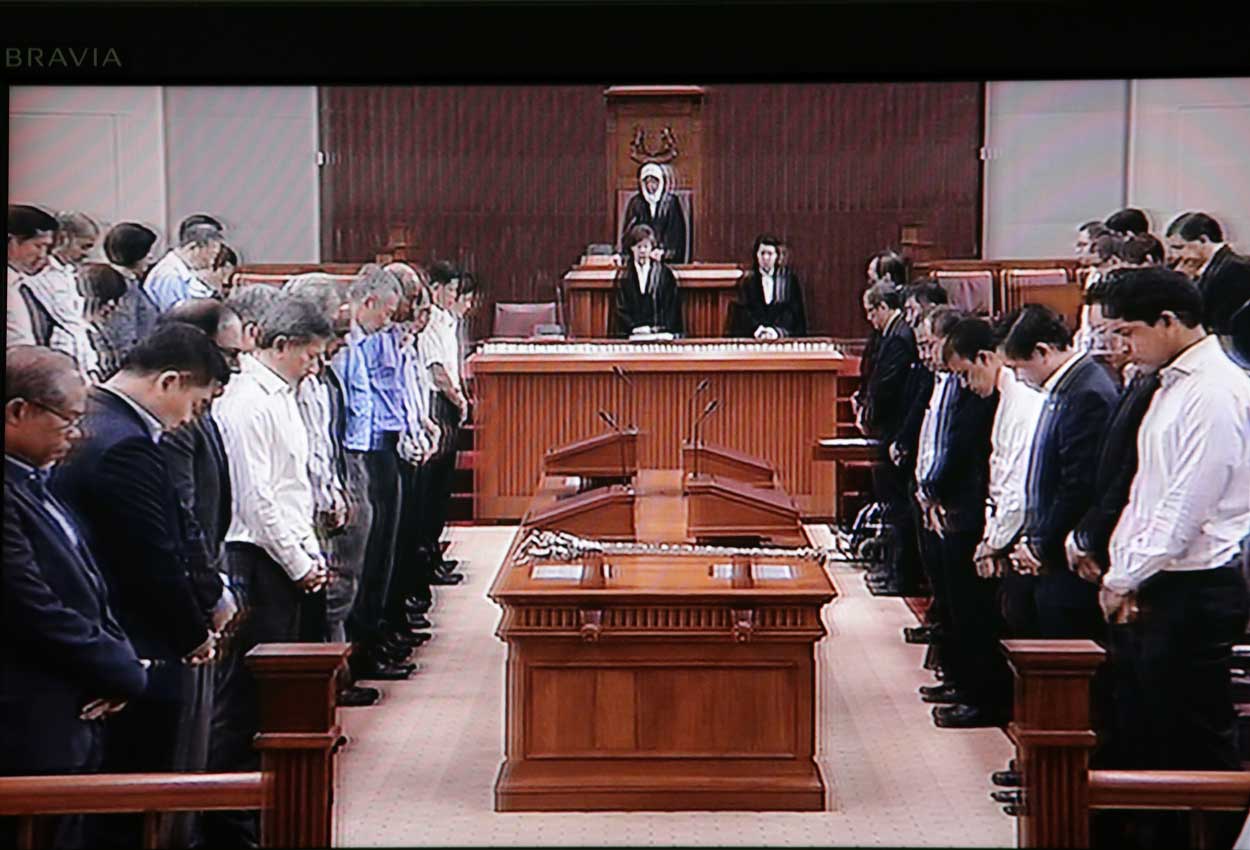
Mr Nathan’s wife Urmila, children Juthika and Osith, and grandson Kiron were present for the tributes, at the end of which the House observed a minute of silence.
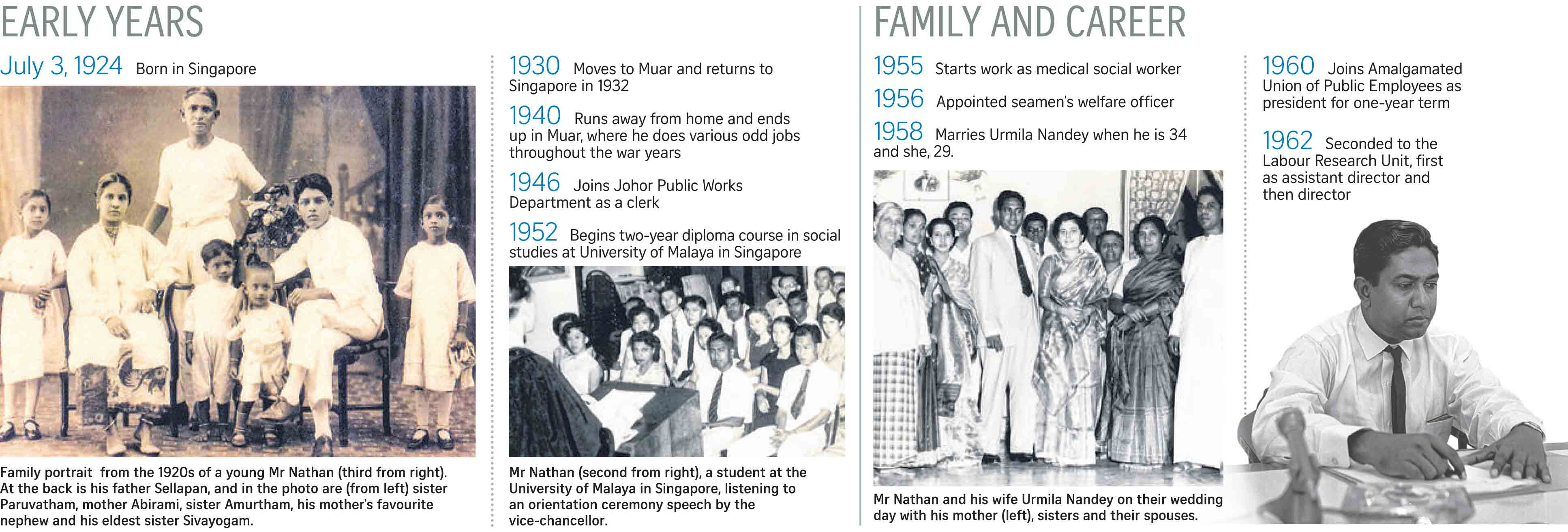
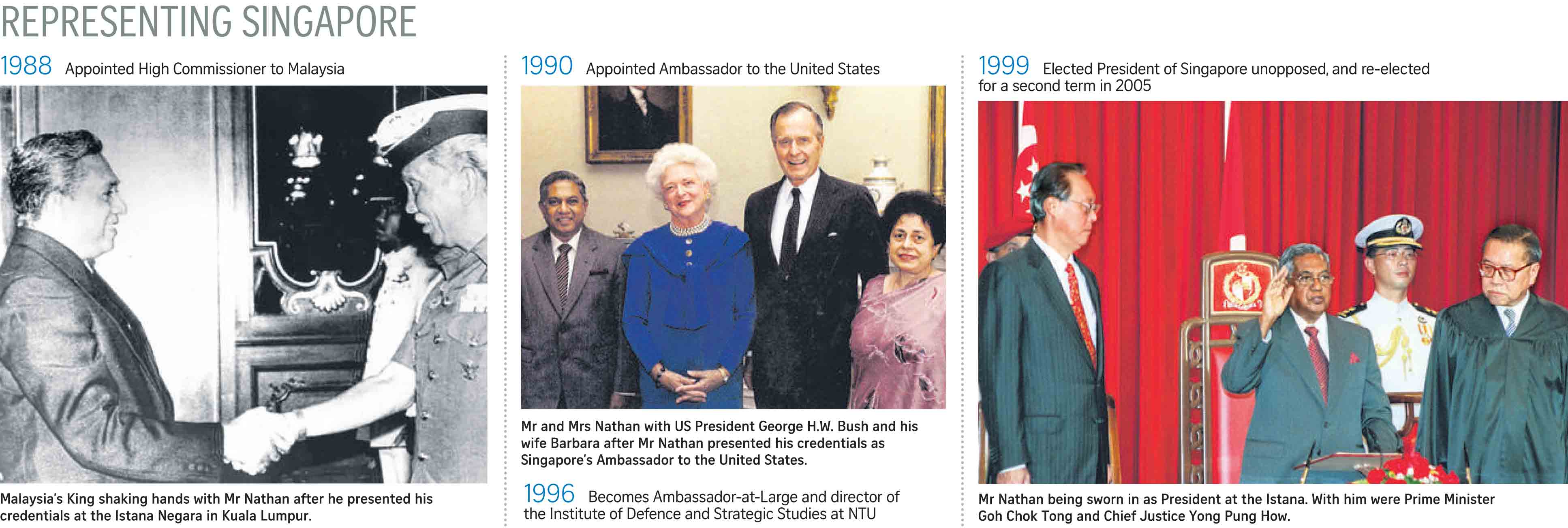
The stories told had a common thread in how he touched the many groups he encountered.
Speaking in Mandarin, House Leader Grace Fu noted the close relationships he had with the Chinese community. He attended many cultural festivals and had a talent for Chinese calligraphy, she said.
Ms Rahayu Mahzam (Jurong GRC) said in Malay that Singaporeans could learn three things from Mr Nathan: the desire to upgrade oneself, eagerness to inculcate knowledge in the next generation, and concern for all around him.
Unionist Desmond Choo highlighted his enduring impact on the labour movement, including modernising unions that led to more efficient collection of union dues and standardised subscription rates.
Other speakers included Workers’ Party chairman Sylvia Lim (Aljunied GRC), Mr Murali Pillai (Bukit Batok) and Nominated MP Chia Yong Yong.
Mr Pritam Singh (Aljunied GRC) recounted how he ended up sitting with the former president at a Lions XII football game in 2013.
At one point when the Lions XII nearly conceded a goal, Mr Nathan pointed out to Mr Singh the Lions XII player who lost possession earlier and thus allowed the opponents to create a chance to score.
Said Mr Singh: “In a very different context and rather unanticipated way, I bore witness to his eye for detail and his ability to focus on the issues that mattered, traits for which he was widely known for in public service.”
RICH DIPLOMATIC EXPERIENCE
On one such occasion, one person in the lunch group was sharing some observations he made about political leaders in another country he had just visited. This person concluded that one of the ministers there was not up to the mark as the minister had remained silent throughout an official meeting with Singapore’s high-level delegation.
This drew a swift rebuttal from President Nathan, who proceeded to give all of us a primer about the way governmental power was organised in that particular country, and why a minister there would deliberately remain silent in certain contexts.
By the time lunch was over, President Nathan had not only shown his depth of world view, but also simultaneously put some of us in our places. Diplomatically, of course.
– WORKERS’ PARTY CHAIRMAN SYLVIA LIM (ALJUNIED GRC), on the late S R Nathan’s wealth of diplomatic experience, which he shared during small group lunches at the Istana.
PUTTING NATION FIRST
When I met him at the Singapore General Hospital, the first thing he asked me was, ‘How much time do you have for me?’ I have never seen anyone else with such humility. I told him I was in his hands and he could take as long as he liked.
After I sat down, he presented to me a bottle of savoury Indian bites. He told me Mrs Nathan specially prepared this for my wife Gowri, whom she learnt was a fellow teacher. I was immediately put at ease by his kind gesture.
I then noticed that, to his right, he had a two-page handwritten note entitled ‘Points to cover with Murali’. He had obviously made preparations in advance of the meeting.
This was a man who had spent the better part of his life serving Singapore and Singaporeans. He was unwell at the last leg of his life, yet he took the trouble to spend his time talking with me about issues our nation faced.
– MR MURALI PILLAI (BUKIT BATOK), on his first meeting with Mr Nathan two months ago.
EXTREME SELFLESSNESS
Great is the man remembered for his legacy, above his achievements. Greater is he remembered for his goodness, above his legacy. Mr Nathan was such a man…
When Mr Nathan was honoured by the Social Innovation Park as an SIP Distinguished Fellow in 2014, he was asked why he volunteered to be one of the hostages for the terrorists in the Laju hostage incident. Did he not fear for his own safety? Did he not worry for his family with young children? How heroic!
From his wheelchair, his reply was matter of fact, understated, and brief. He said he was not a hero. There was no time to lose, the stakes were high; you had to do what you had to do.
– NOMINATED MP CHIA YONG YONG, on Mr Nathan’s selflessness.
TAKING THE LEAD
In the 60s, Dr Goh Keng Swee was trying to attract foreign investment. Assisting Jurong Shipyard, a joint venture involving Japan’s Ishikawajima-Harima Industries and the Economic Development Board, Mr Nathan negotiated to establish a fair and efficient wage structure.
Without any precedent, he combed through countless collective agreements filed with the Industrial Arbitration Court to work out a structure that both the union and employers accepted.
This structure paved the way for properly regulated working conditions and terms of employment for workers. It laid the foundation of wage structure, applicable even today.
This episode shifted the labour movement’s mindset. Our union leaders realised that they had a vital role to play in the economic growth of Singapore.
– UNIONIST DESMOND CHOO (TAMPINES GRC), on how Mr Nathan initiated many labour union moves, despite not having any precedents to rely on.
This article was first published on September 14, 2016.
Get a copy of The Straits Times or go to straitstimes.com for more stories.
Image:
Publication Date:
Wednesday, September 14, 2016 – 14:00
Keywords:
Send to mobile app:
Source:
Story Type:
Others
'Not reasonable' to expect teens to take crisis calls from peers
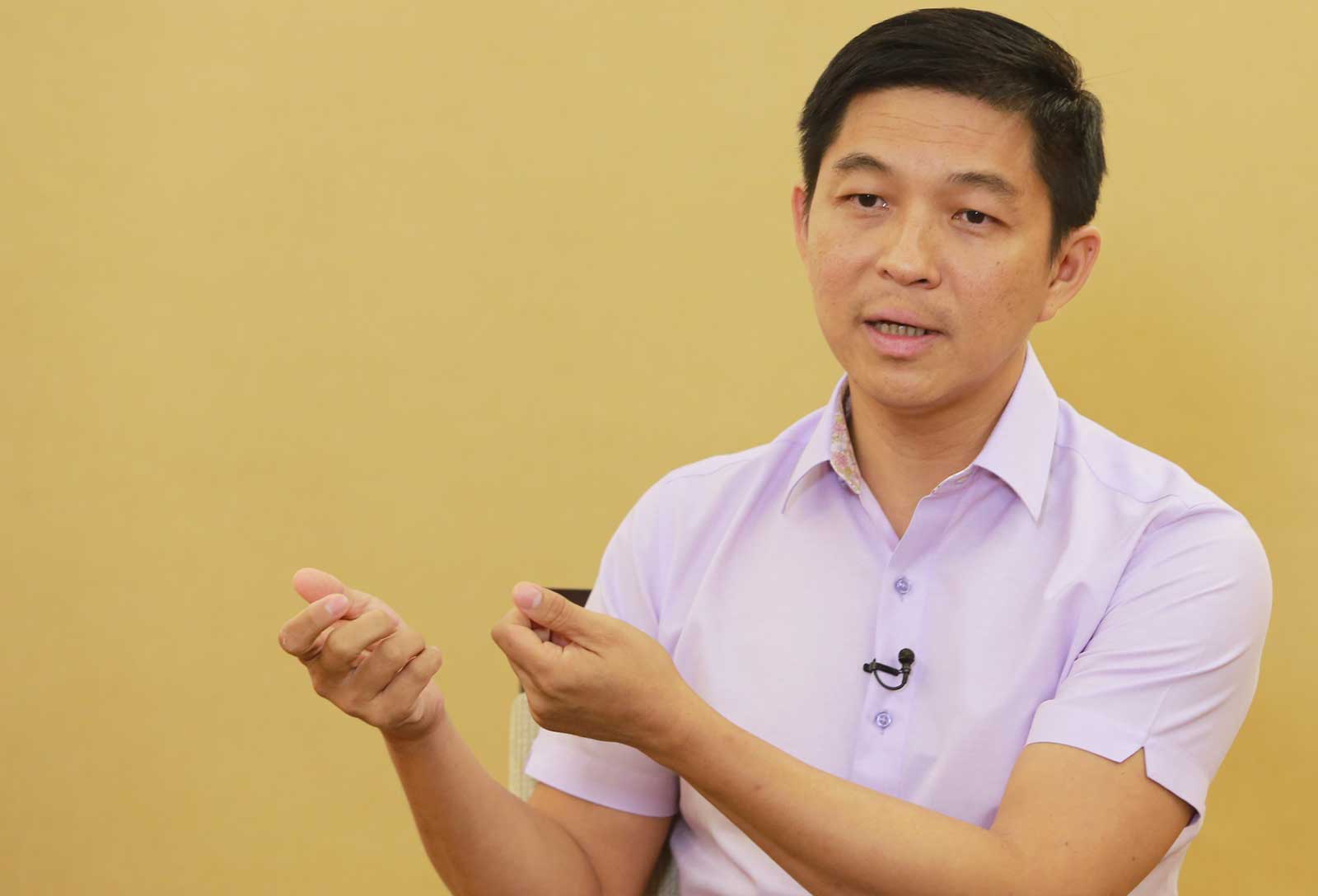
It is not reasonable to expect teenagers to take crisis calls from their suicidal peers, said Minister for Social and Family Development Tan Chuan-Jin in Parliament yesterday.
He was responding to Mr Saktiandi Supaat (Bishan-Toa Payoh GRC), who asked if there is a need to set up a special hotline for teenagers that is manned by their fellow teens trained in counselling.
“Counselling such persons requires relevant training, skills, emotional maturity and understanding of life’s challenges. I think it would not be reasonable to expect teenagers to possess all these pre-requisites,” said Mr Tan.
“For better awareness and dedication of resources, there should be just one hotline for such calls,” he added.
Charity groups such as the Samaritans of Singapore (SOS) run a 24-hour crisis hotline. Trained adult volunteers man the SOS hotline.
However, some counsellors feel it is important to involve the youth as young people tend to be more comfortable sharing these issues with their friends.
Teen suicides hit a 15-year high last year with 27 cases. This was double that in 2014, despite a drop in the overall number of suicides. Last month, two students from a top junior college killed themselves within 10 days of each other.
Citing those recent cases, Mr Lim Biow Chuan (Mountbatten) asked if the Ministry of Education (MOE) has reviewed all circumstances to determine why the warning signs from such students were not detected earlier and how to prevent such suicides from recurring.
Minister of State for Education Janil Puthucheary said the MOE reviews every case.
“Often, there were no warning signs. So we need to find out what are the other stressors that perhaps were not picked up by the existing systems and processes that we have,” said Dr Puthucheary.
He added that his ministry is undertaking a further review of its strategies to prevent suicides.
A multi-agency group that aims to better understand why young people take their own lives and devise ways to help them was also set up recently.
The group comprises the Health Ministry, the Institute of Mental Health, the Forensic Medicine Division of the Health Sciences Authority, SOS and the State Courts.
HELPLINES
SAMARITANS OF SINGAPORE: 1800-221-4444
SINGAPORE ASSOCIATION FOR MENTAL HEALTH: 1800-283-7019
INSTITUTE OF MENTAL HEALTH’S MOBILE CRISIS SERVICE: 6389-2222
CARE CORNER COUNSELLING CENTRE (MANDARIN): 1800-353-5800
SILVER RIBBON: 6386-1928
TINKLE FRIEND (FOR PRIMARY SCHOOL-AGED CHILDREN): 1800-274-4788
This article was first published on Sep 14, 2016.
Get a copy of The Straits Times or go to straitstimes.com for more stories.
Image:
Publication Date:
Wednesday, September 14, 2016 – 15:00
Keywords:
Send to mobile app:
Source:
Story Type:
Others
Unfair to pin all blame on National Stadium

Murky, muffled, echoey. These are some of the unflattering adjectives used to describe the sound at music concerts held at the National Stadium since home-grown music star Stefanie Sun held the first pop gig there on July 5, 2014.
Far from improving, the situation has become so bad that fans of Taiwanese singer Jay Chou petitioned for refunds after what they said was a disastrous concert there on Sept 3.
To be fair, not all comments about the sound at the National Stadium have been disparaging. Past reviews by this newspaper have included more positive comments such as “decent” sound quality at English-Irish boyband One Direction’s show and that the sound system was “clear enough” to make out the nuances in Taiwanese diva A-mei’s voice.
Still, the persistent negative feedback has raised several questions: Is the National Stadium an ultimately unsuitable venue for live music? Can its sound woes be fixed?
The venue management says it is not dedicated to music alone. A Singapore Sports Hub spokesman says: “The National Stadium’s characteristics, including amenities, location and, especially, capacity, make it a multipurpose venue with the ability to host large-scale, mega-stage concerts and shows in addition to sporting events.”
Ironically, the complaints about the venue’s sound is the latest in a litany of woes faced by the arena, which includes difficulty in getting the grass in the pitch to grow properly and protracted negotiations over rental cost for National Day Parade rehearsals. Many Singaporeans also seem to prefer the parade to be held at the Marina Bay Floating Platform because live audiences at the stadium cannot view highlights such as the flypast and parajumpers.
Sound engineers and concert producers The Straits Times spoke to offer a variety of technical solutions for concerts held at the stadium, noting that some may be unfeasible or too expensive.
For Chou’s recent concert, Multimedia Entertainment engaged sound engineers from abroad to provide advice on the sound system and set-up and said the quality of the speakers used had improved from those for 2014’s Opus 2 gig.
A spokesman for Unusual Entertainment, which was behind Sun’s and A-mei’s gigs, says: “Our local team supports the overseas tour team in the set-up and installation. However, the overall sound is controlled by the appointed sound engineers travelling with the tour. How to design and configure the sound system, taking into consideration the stage location, the show’s requirements and the audience capacity, is a challenge.”
Multimedia’s spokesman adds that other factors such as the building’s structure and design, height and material of the roof, arrangement of arena seats and safety requirement would determine the positioning of speakers.
He declined to reveal the technical specifications for Chou’s The Invincible gig or the amount spent on the sound component.
“The Invincible” Jay Chou concert tour
Click on thumbnail to view photos. Source:
The New Paper







The cost of the set-up may be key. Mr Ngiam Kwang Hwa, 55, managing director of concert promoter One Production, puts it bluntly: “It’s not quite fair to say the National Stadium is a lousy venue. So far, unfortunately, most concert promoters haven’t done a wonderful job. Because of costs, they’re not investing enough in the sound.”
Mr William Lee, 46, project director at concert technical producer Showtec Group, says the addition of equipment could help to ameliorate the situation. He proposes using more delay towers – which help propagate sound to areas further from the stage – but noted that this might end up obstructing some views. “To have good sound, you need to sacrifice something.”
Another idea he has is to install overhead speakers, but the 2,000kg weight of each cluster has to be taken into consideration.
He estimates it would cost $80,000 to set up the sound at the Singapore Indoor Stadium, which has a capacity of 12,000, and at least three times that for the National Stadium, with a capacity of 55,000.
While there is anecdotal evidence that venues with larger capacities – from London’s Wembley Stadium (90,000) to the Beijing National Stadium (100,000) – are able to deliver good sound, the fact is that each venue comes with its own set of challenges. Singapore’s National Stadium, which opened in June 2014, has the largest freespanning dome structure with a diameter of more than 310m.
Veteran sound engineer Shah Tahir, 57, says of the venue: “It naturally has a lot of echo and reverb. The dome makes things worse as it’s permanent and the opening is only a small area. It’s a hard metallic surface and there’s no acoustical treatment of design.”
He notes there is no easy fix, given the structure contains cabling and other elements. The dome was meant to make the stadium an all- weather venue, but this has led to other problems. “This is the worst place to do live music for me.”
Mr Shah, who has been the audio consultant for the National Day Parade since 2009, says an “elaborate system” was used for this year’s event at the National Stadium. “It produced something acceptable that anybody seated anywhere can hear, but it’s not the pristine sound you get in a concert hall.”
To him, this is not something that can be plastered over with speakers. “Take the F1, for example. If the car is a fast car, but the track is not right, then it can’t perform. The speakers can produce the correct sound, but because the space is challenging, the result is bad sound.”
Sound engineer Alan Mathew, 38, who has worked on gigs by American group Backstreet Boys and Hong Kong singer Aaron Kwok, says that Singapore Sports Hub should not bear the brunt of the blame. He notes that the arena was designed for big events and the acoustics were “not bad”.
Moreover, he believes it is a concert organiser’s responsibility to bring in the right sound designer and sound system. “If you have only a small budget, get a smaller venue,” he says.
This was what happened with Taiwanese band Mayday’s gig here last month. Mr Ngiam brought their concert producer Baboo Ting, 43, to the National Stadium to scope out the venue during A-mei’s concert in January.
Mr Ting told The Straits Times that the sound problem was not insurmountable, “but you’d have to spend a lot of time, money and expertise to upgrade” the speakers.
Mayday are no strangers to mega venues, having performed at the Beijing National Stadium thrice. The set-up involved installing more than 220 speakers of the same brand. But Mr Ting had concerns over the availability of hardware in Singapore and whether there was a need to import equipment, which would lead to a spike in costs.
In the end, Mayday performed at the indoor stadium.
While there are alternatives to the National Stadium, they come with other considerations and potential problems.
American hard-rock band Metallica played for 40,000 at Changi Exhibition Centre in August 2013. While the sound quality did not appear to be an issue, crowd dispersal at the venue was a problem, with massive queues for taxis and a long wait to get out of the carpark.
But, as Mr Ngiam says, the more the National Stadium comes under fire for poor sound, the harder it is for promoters to hold events there as concertgoers equate the two.
Engineer Tay Chin Meng, 37, who attended Chou’s latest concert, says he would be “scared” to attend future gigs at the venue because of its poor acoustics.
Health coach Jennat Tan, 40, who caught Sun, A-mei and Chou’s concerts there, says: “It doesn’t do any justice to the artists, especially when they’d have practised hard for the concert… only to be criticised due to the bad sound system.”
Past concert reports
STEFANIE SUN 2014 KEPLER WORLD TOUR
When: July 5, 2014
Crowd size: 20,000
“As a venue for pop concerts, the National Stadium gets a mixed score. The overall sound had quite a bit of reverb to it and was rather murky though Sun’s distinctive timbre and evocative singing came through clearly enough.”
MARIAH: THE ELUSIVE CHANTEUSE
When: Oct 24, 2014
Crowd size: 12,000
“It did not help that Carey would ramble into the microphone, eating her words so you caught just the barest snippets of what she was saying. It could also be that high up in the stadium seats, the microphone sound did not travel very well as she spoke.”
OPUS 2 JAY 2014 WORLD TOUR
When: Dec 27, 2014
Crowd size: More than 30,000
“Unfortunately, the messy, murky sound never really cleared up. He mostly sounded echoey and, at times, was barely audible. The acoustics were particularly bad during Mr Magic, when other singers came on board, as some voices were swallowed up completely.”
ONE DIRECTION – ON THE ROAD AGAIN TOUR 2015
When: March 11, 2015
Crowd size: 33,000
“While the sound quality at the National Stadium is decent, the screams from the fans drown out the group’s singing for a good part of the show.”
SING50 CONCERT
When: Aug 7, 2015
Crowd size: 41,300
“While there were complaints about the acoustics – just like there were for Jay Chou’s concert at the same venue – it was clear the audience had a great time.” “Pop queen Stefanie Sun performed a medley of some of her best-known hits and tried to get the crowd going but was hampered by the muffled sound.”
AMEI | AMIT UTOPIA WORLD TOUR
When: Jan 9, 2016
Crowd size: 20,000
“While she sounded noticeably raspier, her voice still retained its warmth and power. It started to get a little ragged, though, towards the end and the strain of the high notes began to show.
“This also meant that the sound system was clear enough to make all this out; the poor acoustics that plagued the concert by Mandopop king Jay Chou at the same venue in December 2014 did not surface.”
MADONNA REBEL HEART TOUR 2016
When: Feb 28, 2016
Crowd size: 25,000
“Apart from the complaints about the venue’s bad sound quality, which also plagued other concerts there, fans also said they could barely see their idol – because the jumbo video screens on stage were not jumbo enough for the large venue and also because of ticketing and seating issues.”
THE INVINCIBLE JAY CHOU CONCERT TOUR 2016
When: Sept 3, 2016
Crowd size: 40,000
“At least, the problem of murky sound that plagued his previous concert at the same venue did not resurface. From where the media were seated – centre and near the front – the sound was a little echoey at times, but not enough to be ruinous.”
This article was first published on September 14, 2016.
Get a copy of The Straits Times or go to straitstimes.com for more stories.
Image:

Publication Date:
Wednesday, September 14, 2016 – 14:00
Keywords:
Send to mobile app:
Source:
Story Type:
Others
Indonesian clerics issue fatwa against forest fires

Jakarta – Indonesia’s top Islamic clerical body said Wednesday it has issued a fatwa against intentionally starting forest fires in a bid to stop the blazes that cloak Southeast Asia in haze every year.
The religious edict by the Indonesian Ulema Council said it was “haram”, or against Islamic law, for Muslims to start fires on purpose in forests or on plantation land.
“The Quran states that we are not allowed to harm the environment, and forest burning causes damage not only to the environment but also to people’s health – even neighbouring countries are complaining,” Huzaemah Tahido Yanggo, head of the body’s fatwa council, told AFP.
The fires and subsequent smog occur annually to varying degrees in the archipelago’s Sumatra island and the Indonesian part of Borneo during the dry season, and are started to quickly and cheaply clear land for palm oil and pulpwood plantations.
The blazes last year were among the worst in memory and cloaked large parts of Indonesia, Malaysia and Singapore in choking smog for weeks.
Environment and Forestry Minister Siti Nurbaya Bakar welcomed the fatwa and said she hoped Islamic preachers would spread news of it to local communities: “The most important follow-up is communicating it to the public.”
Fatwas have no legal force and are aimed at encouraging the devout in the world’s most populous Muslim-majority country against taking a certain course of action.
Click on thumbnail to view photos. Source:
The Straits Times, Stomp, facebook, Twitter


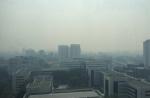

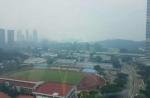
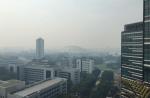

But it remained unclear whether the latest edict, issued Tuesday, would have any practical effect in the sprawling archipelago of more than 17,000 islands and 255 million inhabitants.
The council has previously issued fatwas to protect the environment, including one against the illegal hunting and trade in endangered animals in the biodiverse country, which environmentalists said was the world’s first.
The move by the clerics follows efforts by Jakarta to prevent a repeat of last year’s haze disaster.
Authorities plan to stop granting new land concessions for palm oil plantations, and have established a new agency to restore millions of hectares of carbon-rich peatlands susceptible to fires.
The blazes have not been as serious this year with Singapore so far suffering just one day of serious haze, although it is unclear whether that is due to official efforts or a late rainy season.
Image:

Publication Date:
Wednesday, September 14, 2016 – 13:11
Keywords:
Send to mobile app:
Source:
Story Type:
Others
Choosing an NS vocation – with help from dad and uncles
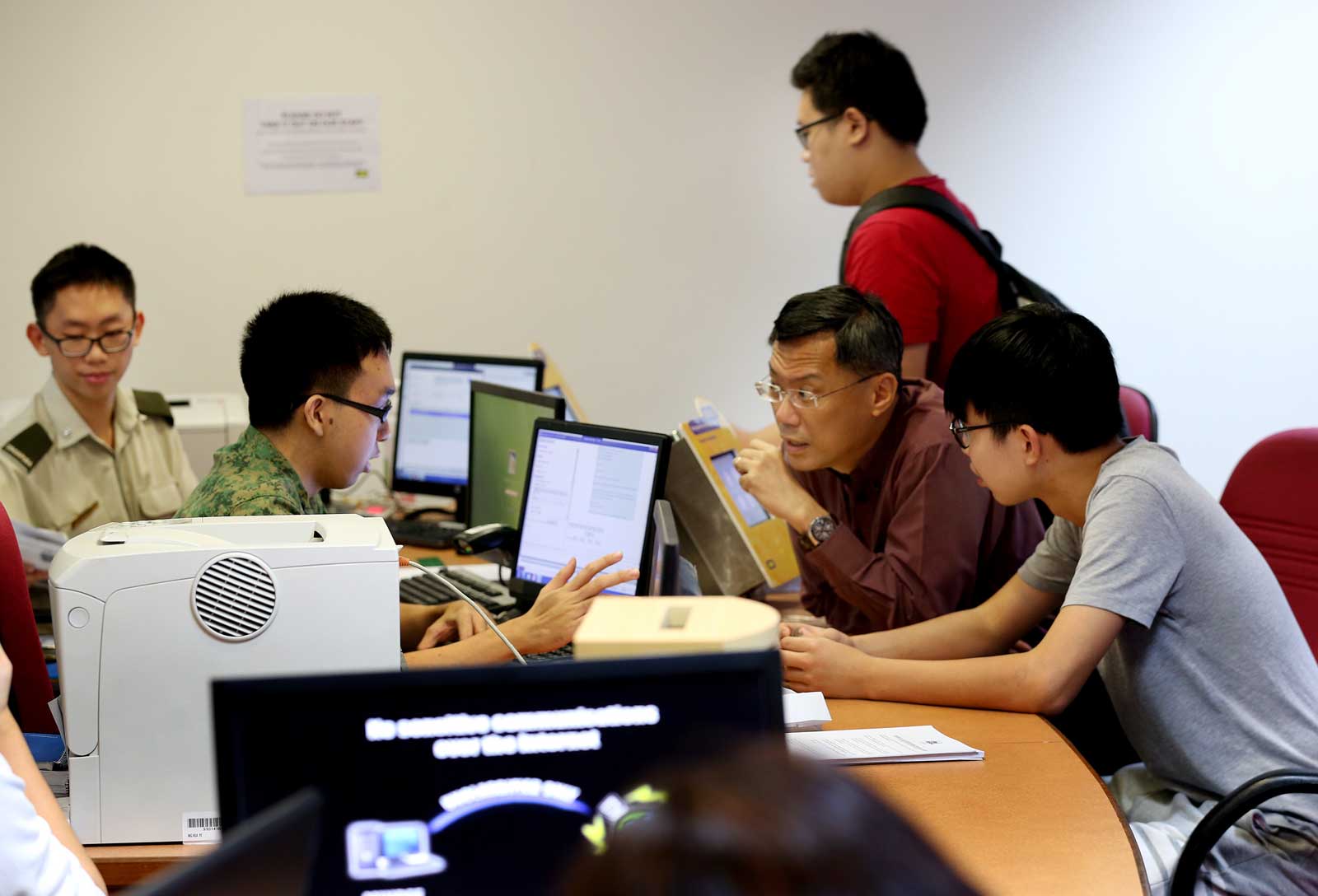
Fathers have found an unprecedented role in the new initiative to let future national servicemen indicate their vocational interests, as the move gives fresh impetus to share their knowledge and experiences with their sons.
Starting November, pre-enlistees can make their vocational interests known during their medical check-up – choosing from 33 vocations.
On Sunday, the Central Manpower Base (CMPB) released on its website 19 videos and a handbook with detailed write-ups on these vocations.
The initiative presents “an opportunity” for more conversation about NS between fathers and sons, said defence analyst Ho Shu Huang from the S. Rajaratnam School of International Studies.
“While it does come down to each family’s dynamics, there might be more to talk about as vocational choices now need to be indicated and decisions therefore made.”
While a father’s NS vocation experience might be different and outdated, such a conversation might lead to others about NS in general, he said.
Some sons are looking to their fathers in other ways to make the decision about vocations.
First-year Anderson Junior College student Jordan Low, 17, who will be going for his medical screening on Nov 11, hopes to follow in his father’s footsteps.
“All sons look up to their dads, and I look up to mine, too. My dad was in Guards. I heard it is quite tough.”
While he says he does not have much knowledge about the various vocations, he intends to go online to find out.
Read also: Which of the 33 NS vocations to choose?
“I’ll ask my seniors who are already in the army, as their information will be the most raw and current.
“But I’ll also speak to my dad and uncles for advice.”
His father Thomas Low, 47, said that while he tells his son about his own NS days, he does not know what has changed since.
The regional service director, who did his 2½-year stint from 1990, said: “I can share my experiences with him, and it could have an impact on his vocational choices.”
Real estate salesman Bernard Wu, 45, also believes the new initiative is “worth exploring”.
He entered NS in 1993 and tells his son, first-year Hwa Chong Junior College student Brandon, about his experiences.
Seventeen-year-old Brandon said: “I would prefer to go to a vocation which is more physical. I don’t want to be a clerk.”
Puay Sam Yu, 17, a first-year student at Hwa Chong Junior College, knows what he wants to avoid choosing for his NS stint.
“Just steer clear of the waters can already,” he said with a laugh.
He would prefer either the air force, or the infantry, which he has heard is where most people go.
“I will ask my dad and uncles for their opinion. But I think it would have changed quite a bit from their time. Nonetheless, it’s good to have their advice.”
His father, regional sales director Puay Eng Chuan, 49, thinks NS was very different in his days.
“It is different now with more welfare and professional training.”
Mr Puay, who entered NS in 1986 and later became an infantry officer, agreed that sharing his experiences with his son is a bonding opportunity.
His son, who has not yet received the call-up letter for his medical screening, said: “His stories would affect my decision, as the general job scope for most vocations shouldn’t have changed too much.”
The videos and the handbook on the CMPB website can be found at www.cmpb.gov.sg/ns-vocations.
This article was first published on Sep 14, 2016.
Get a copy of The Straits Times or go to straitstimes.com for more stories.
Image:
Publication Date:
Wednesday, September 14, 2016 – 15:00
Keywords:
Send to mobile app:
Source:
Story Type:
Others
Silkair: Early Bird, Two-to-Go & More Promo Fares fr $139 to over 35 Destinations till 30 Sep 2016

UPDATED w/ NEW fares: Silkair 2-to-go & Early Bird fares fr $139 to over 35 destinations
Silkair: Early Bird, Two-to-Go & More Promo Fares fr $139 to over 35 Destinations till 30 Sep 2016
Check out Silkair’s latest promo fares from $139 all-in to over 35 destinations. Early bird fares must be booked 90 days in advance. Two-to-go fares require a minimum two passengers to travel
Lego honours Singapore para-swimmers Yip Pin Xiu, Theresa Goh with mini-figures
The toy brickmaker posted a photo of mini-figures in the likeness of the two swimmers and a congratulatory message on its Facebook page on Tuesday.
Source link
Singapore's water supply 'still at the mercy of the weather': PM Lee
In a Facebook post, Prime Minister Lee Hsien Loong showed the difference when Johor’s Linggiu Reservoir is at 25 per cent and completely full, and its impact on Singapore’s water supply.
Source link


