Home Blog Page 2823

MOE's latest ad is making many remember their great teachers

0

SINGAPORE – The Ministry of Education’s (MOE’s) latest advertisement is reminding many people of teachers who made a difference in their lives.

In the ad, which is based on a true story, geography teacher Madam Pua helps struggling student Shirley – staying back after school to give her extra lessons.

Shirley, with Madam Pua’s help, goes from scoring 10 out of 100 points in her test to scoring…40 in her next test.

But even though she failed, Shirley still received a “well done!” from the teacher. Disappointed and perplexed, Shirley asked Madam Pua what she meant, and was told that it was more important that she had “worked hard and made a big improvement”.

The ad ends by saying that Shirley “is doing well in her career” and still keeps in touch with Madam Pua.

The ad, released two weeks ago for Teacher’s Day, seems to have struck a chord with many people, prompting more than a few to recall memories of teachers who helped and nurtured them.

“(Teacher’s name), this reminds me of you! I failed mathematics during O levels and you came to give me a hug, and said it was okay because I did my best. I will never forget that,” wrote a woman on MOE’s Facebook page, in response to the video post.

“I was fortunate to have met Mrs Yeo, who never gave up on me. Without her, my mathematics will always be ‘F9’,” wrote another.

However, some netizens have voiced out that the ad is misleading, as some believed that grades still played a big part in Singapore’s education system. 

“This ad is so misleading. I have seen teachers contacting parents if their kids don’t do well in school…the Singapore education system is crazy,” wrote one person.

“The grades don’t matter? Try convincing all Singaporean parents,” wrote a man, before adding: “A big thank you to all my teachers who have played a pivotal role in my life.”

The video has been viewed more than 300,000 times on YouTube. The Facebook post with the video has been seen over 700,000 times, shared close to 3,500 times, and has gathered over 8,000 responses (“likes”, “hearts” and “tears”) so far.

See also: Parents compile list of top PSLE scores

sinsh@sph.com.sg

Image: 
Category: 
Publication Date: 
Monday, September 19, 2016 – 16:55
Send to mobile app: 
Source: 


Rotator Image: 
Story Type: 
Rewritten Story
W.T.M. (Why This Matters): 
The Educations Ministry's latest heart-warming advertisement is resonating with people who are recalling teachers who inspired them or touched their lives. While the teacher in the ad encouraged a student for her improvement despite failing a test, many are wondering if grades still play a part in Singapore's education system.

Source link

Study: Indonesian fires possible cause of 100,000 deaths

0

NEW research has revealed Indonesian forest fires that choked a swath of Southeast Asia with a smoky haze for weeks last year may have caused more than 100,000 premature deaths.

The latest findings by scientists from Harvard University and Columbia University will likely add to pressure on Indonesia’s government to tackle the annual crisis.

The study to be published in the journal Environmental Research Letters is being welcomed by other researchers and Indonesia’s medical profession as an advance in quantifying the suspected serious public health effects of the fires, which are mostly set to clear land for farming.

The number of deaths is an estimate derived from a complex analysis that has not yet been validated by analysis of official data on mortality.

According to the Associated Press, the research has implications for land-use practices and Indonesia’s vast pulp and paper industry. The researchers showed that peatlands within timber concessions, and peatlands overall, were a much bigger proportion of the fires observed by satellite than in 2006, which was another particularly bad year for haze.

SEE ALSO: Indonesia: Haze investigators held captive, threatened with death

Haze largely caused by illegal slash-and-burn agricultural policies in Indonesia has affected the Southeast Asian region annually for decades.

Uncontrolled burning from fires in Riau, South Sumatra, and Kalimantan causes the smoke to spread hundreds of kilometers across the region to Malaysia, Singapore, Thailand, and the Philippines, resulting in major deterioration in air quality levels, health problems, and economic losses.

The study’s researchers surmise that draining of the peatlands to prepare them for pulpwood plantations and other uses made them more vulnerable to fires.

Haze brought on by Indonesian peat fires blanket the Malaysian capital of Kuala Lumpur on April 22, 2016. Pic: Asian Correspondent.

Haze brought on by Indonesian peat fires blanket the Malaysian capital of Kuala Lumpur on April 22, 2016. Pic: Asian Correspondent.

The estimate of early deaths linked to respiratory illness and other causes covers Indonesia and its neighbors Singapore and Malaysia.

The bulk of the estimated deaths, however, are in Indonesia, by far the most populous of the three countries as well as the nation within the biggest land area affected by haze.

SEE ALSO: Indonesia urges neighbors to stop complaining about haze

The study, according to the news agency, finds there is a high statistical probability that early deaths ranged between 26,300 and 174,300. Its main estimate of 100,300 deaths is the average of those two figures. It predicts 91,600 deaths in Indonesia, another 6,500 in Malaysia and 2,200 in Singapore.

The researchers involved in the study say the model they developed can be combined with satellite and ground station observations to analyze the haze in close to real time. That gives it the potential to be used to direct firefighting efforts in a way that reduces the amount of illness caused, they say.

However, the possible scale of serious health consequences was indicated by a statement from the country’s disaster management agency in October that said more than 43 million Indonesians were exposed to smoke from the fires and half a million suffered acute respiratory infections.
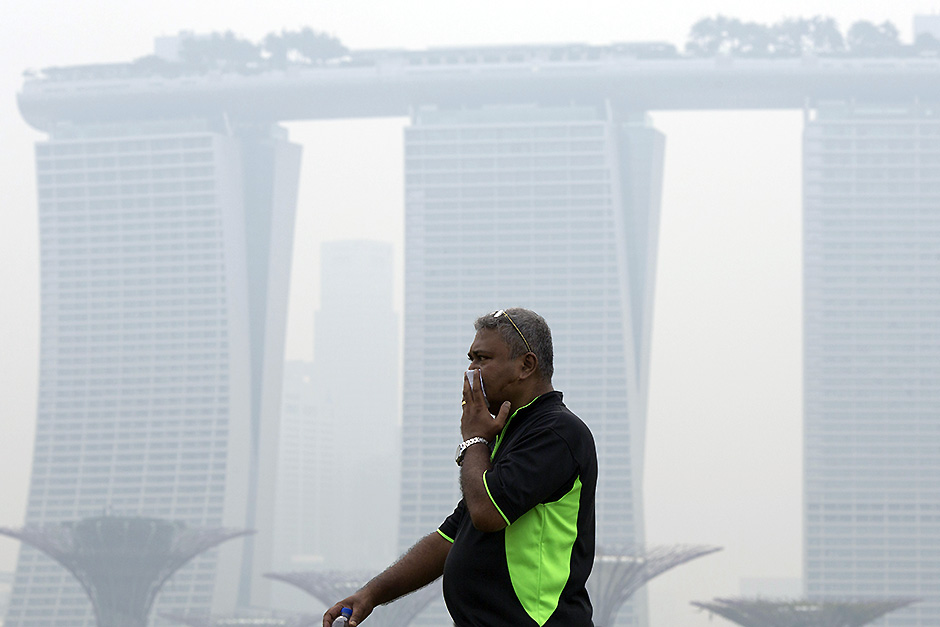
A man covers his nose during a hazy day in Singapore. Pic: AP

A man covers his nose during a hazy day in Singapore. Pic: AP

The study considered only the health impact on adults and restricts itself to the effects of health-threatening fine particulate matter, often referred to as PM2.5, rather than all toxins that would be in the smoke from burning peatlands and forests.

SEE ALSO: Indonesia: State of emergency declared in six provinces over haze

The fires from July to October last year in southern Sumatra and the Indonesian part of Borneo were the worst since 1997 and exacerbated by El Nino dry conditions.

About 261,000 hectares of land burned. Some of the fires started accidently, but many were deliberately set by companies and villagers to clear land for plantations and agriculture.

Rajasekhar Bala, an environmental engineering expert at the National University of Singapore, one of five experts who reviewed the paper for The Associated Press and were not involved in the research, said the study is preliminary and involved a “very challenging” task of analyzing the sources and spread of fine particulate matter over several countries and a lengthy time frame.

Even with caveats, it should serve as a “wake-up call” for firm action in Indonesia to curb peatland and forest fires and for regional cooperation to deal with the fallout on public health, he said.

“Air pollution, especially that caused by atmospheric fine particles, has grave implications for human health,” he said.

The AP also quoted Frank Murray, an associate professor of environment science at Australia’s Murdoch University, as saying that the death estimates are not “precise health outcomes”.

However, Murray said their overall scale should trigger intensified efforts to deal with the crisis. The study is a major contribution to addressing an international problem, he said.

Late last month, Indonesia declared states of emergency in six provinces as peat fires shroud parts of neighboring Singapore and Malaysia in smog.

Additional reporting from The Associated Press

The post Study: Indonesian fires possible cause of 100,000 deaths appeared first on Asian Correspondent.

Source link

Scoot: Fr $45 all-in 2hr Take Off Tuesday Promo to over 20 Destinations (7am to 9am) on 20 Sep 2016

0

STARTS TOMORROW: Scoot fr $45 all-in promo fares (20 Sep, 7am-9am)

Scoot: Fr $45 all-in 2hr Take Off Tuesday Promo to over 20 Destinations (7am to 9am) on 20 Sep 2016

Escape the ordinary with Super Scootee. We’re all about spontaneous escapes, especially when they don’t burn a hole in our pockets. Lassi where the sale takes you with all-in fares fr $45 to over 20 destinations

Source

Chinese actor in suspected suicide

0

BEIJING – Chinese actor Kimi Qiao Renliang, 28, who had roles in television dramas, including Tiny Times 1.0, was found dead in a Shanghai apartment following a suspected suicide.

His agent told Sina.com after news of the death last Friday that he suffered from severe depression, which was aggravated by online rumours about him last year.

Shanghai police last Friday night said a man was found dead in a Qishun road home.

Homicide was ruled out after preliminary investigations. The Shanghai native’s death was later confirmed by his management company.

Police responded to a call made by Qiao’s live-in girlfriend, according to reports. Wounds found on his body were thought to be self-inflicted, reported China Radio International.

His agent, identified as a Miss Zuo in reports, said she was making Qiao’s illness public to refute online speculation about how he died. “There was none of it. He did not play any games.

I need to clear his name,” she said, in a reference to talk that he died from sexual asphyxia.

She said Qiao suffered for years from insomnia. He sought perfection and placed harsh demands on himself, which led to much pressure, added Miss Zuo.

“There were rumours and slander about him, especially last year, which worsened his condition,” she told Sina.

Qiao gained popularity after taking part in the 2007 talent show My Hero, winning second place to Monster Hunt (2015) star Jing Boran. He was also in Legend Of Lu Zhen, To Youth 2 and Our Ten Years.

Helplines:

Samaritans Of Singapore: 1800-221-4444

Singapore Association For Mental Health: 1800-283-7019

Institute Of Mental Health’s Mobile Crisis Service: 6389-2222

Care Corner Counselling Centre (Mandarin): 1800-353-5800

Silver Ribbon: 6386-1928

Tinkle Friend (For Primary School-Aged Children): 1800-274-4788


This article was first published on September 19, 2016.
Get a copy of The Straits Times or go to straitstimes.com for more stories.

Image: 
Category: 
Publication Date: 
Monday, September 19, 2016 – 16:01
Send to mobile app: 
Source: 


Story Type: 
Others

Source link

Hardy made-in-S'pore rice hits shelves

0

There is a new brand of rice on the shelves, and it is made in Singapore.

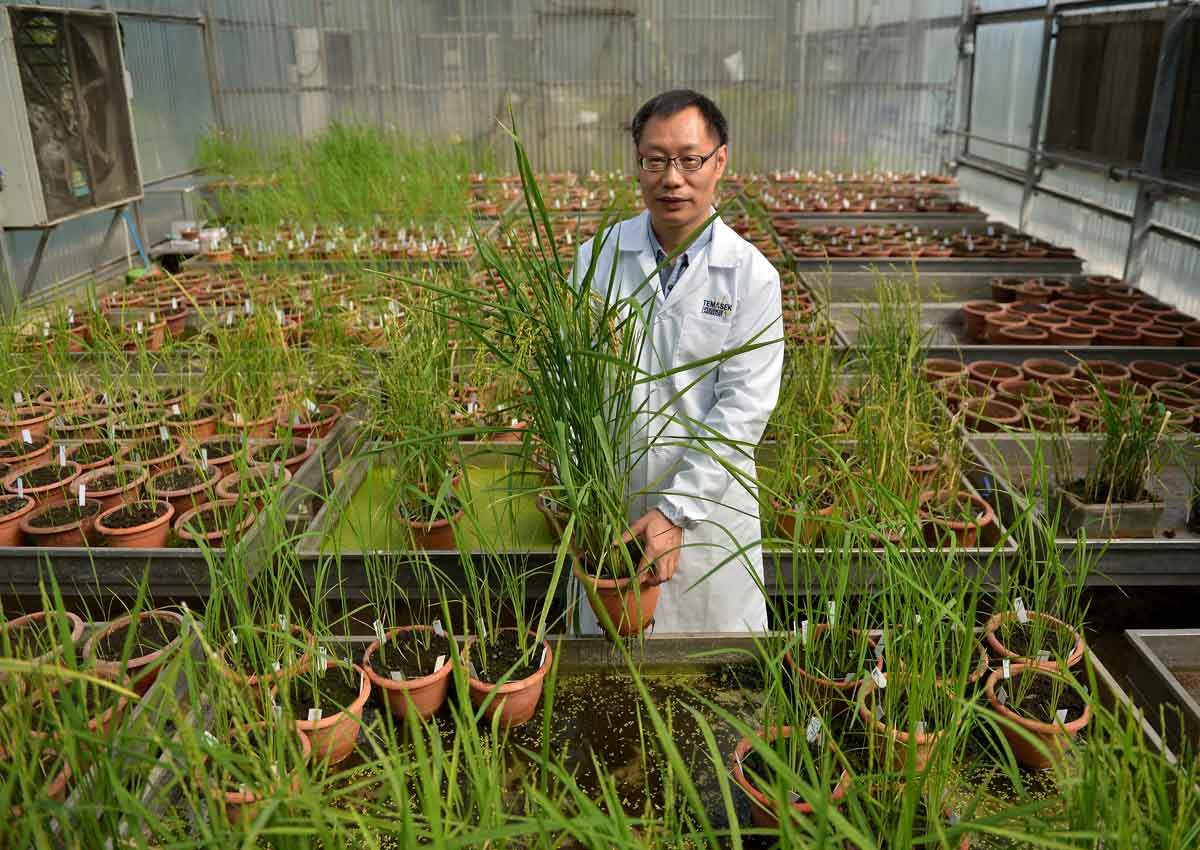
Called Temasek Rice, it is the first – and only – rice variety to be created and sold here.

That is not the only thing special about it. It is specially formulated to be a hardy breed that is able to withstand floods – for instance, it “hibernates” for up to two weeks when submerged in water – and droughts.

Following eight years of research and field trials, Temasek Rice is now ready for the ultimate test – the taste test.

It was launched at Meidi-Ya supermarket in Liang Court last month.

Its lead inventor Yin Zhongchao says his grains are of good quality, softer and as tasty – or even tastier, compared with other brown rice varieties.

The senior principal investigator at Temasek Life Sciences Laboratory said the new grain represents a piece of the puzzle in the global quest for long-term food security.

The rice is designed to withstand extremely dry and wet weather for extended periods of time.

It is also fortified against fungal and bacteria attacks, and engineered to produce a higher yield.

He hopes Temasek Rice will yield benefits for both farmers and consumers in the long run.

Crop aimed at a more stable food supply

“Farmers work very hard and their income is very low, so we want to create good rice that allows for stable production, and produces grains of good quality so that they can be sold for high prices,” he said.

“As for the consumers, rice that can survive poor weather conditions would ultimately mean a more stable food supply.”

Rice is the main staple food crop for more than half of the world’s population of 7.4 billion people, but studies have predicted that increasing demand will require its production to grow by 30 per cent by 2025.

Temasek Rice was created by cross-breeding a type of jasmine rice grown in South-east Asia with five other types grown in the region, or what Dr Yin calls donors.

The process, which is simple but tedious, uses the age-old method of cross-pollination where pollen from the donors is transferred to the original fragrant rice plant.

Temasek Rice produces six tonnes of rice grains per hectare on average, nearly four times more than the original unmodified type.

Its rice stalks are also shorter, making them sturdier and less likely to topple from strong winds.

Dr Yin said he is looking to partner more rice companies to increase the production of Temasek Rice, which is being grown in Tasikmalaya, Indonesia, on a small scale.

If so, it can be sold at other supermarkets here. Currently, it is sold only at Medi-Ya. Each 1kg packet sells for between $6.95 and $7.45.

Professor William Chen of Nanyang Technological University’s School of Chemical and Biomedical Engineering said Temasek Rice will help address the challenges of climate change, such as longer and more frequent droughts and floods in many food-growing countries.

However, the food science expert noted that there might be a need to consider ways to tackle the emergence of new bacteria strains, which would become resistant to Temasek Rice over time.


This article was first published on September 19, 2016.
Get a copy of The Straits Times or go to straitstimes.com for more stories.


Image: 
Category: 
Publication Date: 
Monday, September 19, 2016 – 15:53
Keywords: 
Send to mobile app: 
Source: 


Story Type: 
Others

Source link

Stroke of genius was crucial for swim duo

0

In a mere 20 months, he shaped Yip Pin Xiu into a double Paralympic champion and ended Theresa Goh’s 17-year wait for a Paralympic medal.

Many have looked to swimming coach Mick Massey as the key reason for Singapore’s three-medal harvest at the Rio Games, but the Briton modestly played down his role in transforming the swimmers’ fortunes.

There is no silver bullet, no major overhaul. Instead, the trio relied on old and reliable virtues as their basis for success.

The former British Paralympic head coach told The Straits Times in a phone interview from Rio de Janeiro: “For example, Pin Xiu’s very intelligent and determined. In training, when I give her targets, she rarely fails to meet them.

“She knows what’s best for her more than I do. She makes my job easier, if I’m really truthful.”

Another key is trust. Massey, whose daughter Natalie represented Britain at the 2012 Paralympics, said: “It takes a lot to build that relationship with a swimmer where they can actually trust you and not be afraid to come and speak to you.”

So if Yip was tired, she would tell Massey, who trusted that his swimmer was not taking the easy way out.

It helps that the coach is also attuned to Yip’s competitiveness.

An example of Pin Xiu’s inherent drive, and the moment that convinced the coach that his protege was on to something special, came three months ago during the annual IDM Berlin swim meet.

While they were discussing strategy over breakfast,Yip was so tired she dozed off mid-conversation.

Massey, who was trying out an intense training programme with the swimmers then, said: “We had trained through the meet, we didn’t rest at all. It was very unusual, and I thought, ‘Blimey, she’s really suffering.’ I was really worried.”

He was on his way to the airport to catch an earlier flight back to Singapore when he learnt that Yip had clocked 2min 10sec for her 100m backstroke (S2) race, just off her then-world record mark of 2min 9.79sec.

“I was just shocked. I thought she was joking,” said Massey. “But that’s PX. She is a fighter, she will not yield. Even if she’s tired, she’ll give everything she’s got.

“That (incident) sort of told me what sort of shape PX was in – she was in amazing shape.”

When he first began training the two para-swimmers, he took pains to slowly build up their workload, and used his experience of coaching para-swimmers since 2001 to make tweaks to their training regimen.

Both Yip and Goh were recovering from injuries then, and were not training much. Aware that the Rio Paralympics were the ultimate goal, he took weeks to increase their load to the current 2.25km they swim per session.

He would also pace the pool deck while Yip swam, to pick up signs indicating her form, such as the way she floated, her body position in the water, and how she tended to clench her fists tightly if she’s tired.

That effort to understand Yip’s condition convinced him to get her re-classified from S3 to S2. In para-swimming, the lower the classification number, the more severe the athlete’s disability.

Massey also made sure Goh and Yip, who usually swim different strokes at different paces, swim side by side by varying the distance of their respective sets, as “it is very difficult to swim alone”.

Massey, who has coached the likes of British Paralympic champions Natalie Jones and Jim Anderson in his previous job, said: “Your programme has to be flexible enough to accommodate them, especially if the swimmer has a complex disability. For me personally, that’s the most skilful part of my job.”

One thing that did happen by chance was Massey’s appointment as their coach.

In 2014, he came to Singapore as coach of Dulwich College (Singapore), an international school in Bukit Batok. He was then approached by the Singapore Disability Sports Council and Singapore Sports Institute to coach Yip and Goh.

Massey said he is grateful to Dulwich headmaster Nick Magnus for granting him time away from work and added: “Coming to Singapore was the best decision.

“I love the people, it’s a fantastic place to live and work in.”

On what lies ahead for Yip, he said: “I’m convinced she can go on to Tokyo, absolutely, without any shadow of a doubt. But whatever happens after that, I’d like to feel that we can end up as friends because of what we do together.”


This article was first published on September 19, 2016.
Get a copy of The Straits Times or go to straitstimes.com for more stories.

Image: 
Category: 
Publication Date: 
Monday, September 19, 2016 – 15:36
Send to mobile app: 
Source: 


Story Type: 
Others

Source link

Jail, caning for man who pushed girlfriend's son off bed, cracking his skull

0

Franklie Tan Guang Wei had abused the one-year-old boy over a five-month period from November 2014 to March 2015.

Source link

Train to Busan prequel to show in Singapore on Sept 29

0

SINGAPORE – Can’t get enough zombie action?

If you’re one of those who have been left high and dry by the Korea’s zombie flick Train to Busan, then you’re in luck.

The movie’s co-distributors Clover Films and Golden Village Pictures have announced that a prequel, Seoul Station, will be out in cinemas on Sept 29.

Unlike the first movie, Seoul Station will be an animation voiced by Korean artistes Ryu Seung-ryong, Shim Eun-kyung and Lee Joon, ex-member of Kpop boyband MBLAQ.

The prequel tells the story of a runaway teenager Hye-sun, who broke up with her boyfriend when he forced her into prostitution. Similar to the central plot of family ties in the first film, the animation also explores Hye-sun’s relationship with her father who is bent on tracking her down amidst the zombie apocalpyse. 

Watch the trailer here:

debwong@sph.com.sg

Image: 
Category: 
Publication Date: 
Monday, September 19, 2016 – 15:28
Send to mobile app: 
Source: 


Story Type: 
Rewritten Story

Source link

Pat's new pre-school chain goes global

0

The first Pat’s Schoolhouse, set up in Whitley Road in 1988, was built on a promise to deliver top-notch early childhood education.

In an era when the sector was staffed mostly by O- and A-level certificate holders with little formal training, its founder, Mrs Patricia Koh, wanted more: She insisted on hiring graduate teachers to deliver that promise.

She had left her “cushy job” of 10 years at the National Institute of Education’s pre-primary department, feeling that the biggest difference in education began with a child’s foundational years.

“I wanted to create a happy school environment where children do not fear getting things wrong,” she said.

Within a year, the first pre-school was full, and it soon had a waiting list of up to two years. That passion drove the brand – now synonymous with premium fees, strong pedagogy and bilingual classes – to the upper end of its ilk.

At the time, it could command about $300 a month for three-hour programmes, when government- linked pre-schools charged between $12 and $50.

Today, the chain has 18 branches and two infant care centres. The latest outlet will open for previews on Sept 24 in Sembawang. Monthly fees of about $1,800 for full-day programmes rank it alongside Brighton Montessori – ahead of the $700 to $1,100 charged by other centres such as Cherie Hearts, but lower than the $2,000 to more than $3,000 charged at the likes of Avondale Grammar School, EtonHouse and One World International School.

The good news? The waiting list is down to nine months.

The 65-year-old – a mother of three and grandmother of five – began teaching at 17. She calls Pat’s Schoolhouse her “first child”, and sold the chain in 2007, then with 12 centres, hoping to see it grow overseas, even in the United States.

Its buyer, global education group Knowledge Universe (KU), doubled her last best offer, she said, though she declined to reveal the amount. KU promised to support her as she fronted Pat’s Schoolhouse, but when that fell through, she left the group in 2012.

That lesson learnt, she is going about things differently. Now chief executive of her second chain, three-year-old MapleBear Singapore, she oversees its 14 pre-schools, with a 15th opening next month.

Also next month, she will launch MapleBear in Manila, adapting her template to teach teachers in the Philippine city to capitalise on the strengths of their inherent musical culture while incorporating stronger pedagogical techniques. From November, Mrs Koh plans to evolve other centres in Hong Kong and Shenzhen in a similar vein.

“We will take it step by step and find the right opportunities with the right partners,” she said, adding that she still intends to reach the US, Australia and England, but is unlikely to sell her chain again. “I want to grow, but with me in charge all the time.”

The one-time teacher at now-defunct Silat Primary School still gets most excited interacting with children. During this interview at the MapleBear Horse City centre, she stopped a few times to engage the children as they showed her their collages, and to speak to parents as they came and went.

Not keen on retirement, she is working towards leaving a legacy of having taught teachers so well that as a result, “we’ve made a difference in the life of children”.

“Work is not work to me,” she said. “Looking at the face of a child, hearing them call you and hug you, that’s what delights me.”


This article was first published on September 19, 2016.
Get a copy of The Straits Times or go to straitstimes.com for more stories.

Image: 
Publication Date: 
Monday, September 19, 2016 – 15:00
Send to mobile app: 
Source: 


Story Type: 
Others

Source link

Singapore GP attendance falls as economic slowdown hurts

0

Attendance at the Singapore Grand Prix, one of the most popular races on the calendar fell this year, hurt by a slowdown in the local and global economy.

Source link