Home Blog Page 2794

Saying I do, in sneakers

0

SINGAPORE – Most brides get stressed about what to wear for their wedding day, but Ms Celeste Ang, 29, was relaxed about her requirements: She simply looked for a “comfortable yet stylish” dress that she could wear again.

Ms Ang, a creative lead working for an online grocery store, wore a white T-shirt-style, calf-length dress from London-based womenswear label Self-Portrait, paired with white canvas shoes with lace details from Spanish fashion brand Stradivarius for her wedding in April.

Her dress cost $600 while her shoes were $30 – less than the bill for her groom Roy Lim, co-founder of creative design studio Section.

His designer Commes des Garcon shirt and pants, Topman jacket and leather shoes from British shoe brand Grenson cost about $1,000 in total. His shirt was bought at a 40 per cent discount in Singapore and the jacket was first donned when he was a best man at a friend’s wedding last year.

Ms Ang says: “You just have to know your style and whether you will be comfortable wearing your outfit. When I chose the dress, it was whether I liked it, could walk in it and be comfortable.”

Most of her family and friends thought the dress fit her easygoing, cheerful personality very well – no one had commented about her having to wear a certain type of dress or follow wedding tradition, she says.

She represents a growing group of Singapore brides choosing to wear lighter and more comfortable gowns to beat the humid weather – and wearing sneakers at their nuptials, like what Taiwanese actress Shu Qi did when she wed film-maker Stephen Fung, 42, in Prague recently.

The 40-year-old actress put on sneakers with a T-shirt-style wedding dress that was reportedly a gift two years ago from Swedish fast-fashion brand H&M.

In Singapore, the casual flair of non-conventional brides finds a parallel in their preference for smaller and more intimate weddings over the grand Chinese wedding dinner in a ballroom.

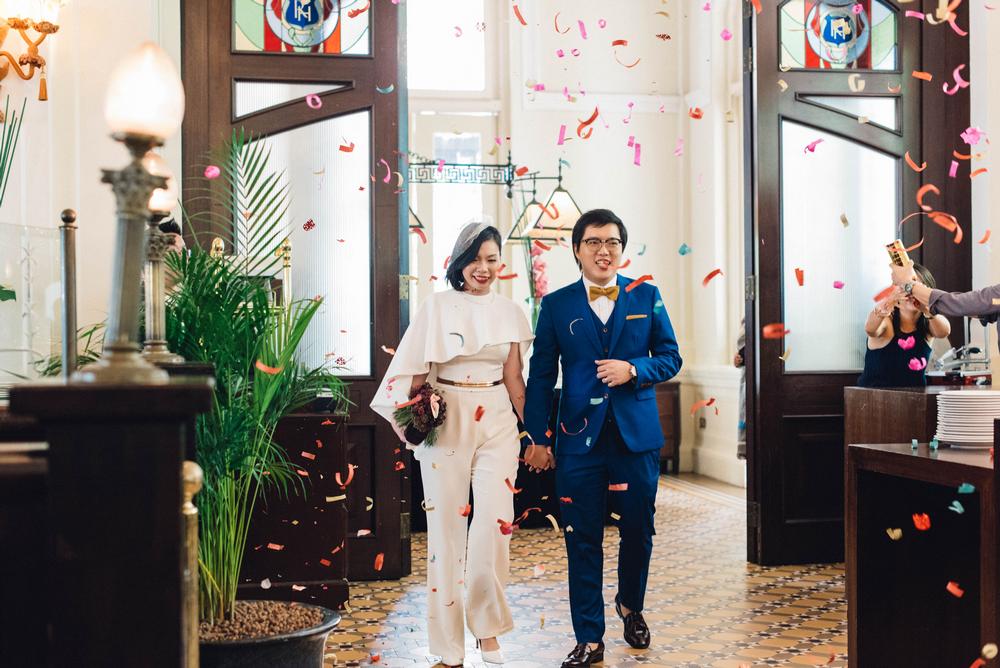
Some even do away with skirts. Bank account manager Goh Ying Ying, 34, wore a white silk crepe backless jumpsuit with a cape, costing about $1,200, by home-grown dress- and suit-maker Caramel & Co.

Ms Goh, who married at the Raffles Hotel in May, knew from the start she wanted to wear a jumpsuit “purely for comfort’s sake”. She professes not to be “a girly-girl” and does not usually wear skirts.

She says of her jumpsuit: “My relatives were opened-minded about it and my husband said it was cool and different. I’m a very chill person – I like to keep things simple.”

She accessorised with a brown faux leather belt from Australian fashion brand Forever New and white heels from home-grown shoe brand Charles & Keith. Her veil was added to her outfit at the insistence of her great-grandmother.

Bridal studios and wedding gown designers have seen a growing number of brides asking for casual styles because these are easier to handle and move around in, compared withcumbersome ballgowns.

Gown designer Pearlyn Oh says she has seen a 25 per cent increase in the number of brides “inquiring about more comfy gowns”.

She adds: “They are getting more into comfort and prefer the wedding gown to reflect their everyday style.”

Ms Oh, 26, who has been working at bridal designer boutique Amanda Lee Weddings for six years, attributes the increase to more brides doing their wedding research online and getting inspired by different kinds of wedding venues other than the conventional hotel ballroom.

She adds: “When couples opt to hold their wedding at a more relaxed venue, this affects their choice of wedding outfits.”

Alfresco or indoor dining at cafes, bistros and restaurants are among the casual venues.

Thetrend is also seen by Ms Mel Chen, 38, founder and designer of Caramel & Co. When she started her company eight years ago, brides opting for casual weddings were “rare” and “most would wear long gowns and do the big ballroom dinners”.

Ms Chen, who has about 60 clients a year, says about 70 per cent of them opt for cosier weddings and more casual “non-ballgown style” dresses with smaller, more flowy skirts that are “easy to handle”.

She adds: “It’s definitely more comfortable and lighter. You don’t need someone to follow you everywhere to help you with your gown and it feels like you are wearing your normal clothes.”

Ms Shenny Yuh, co-owner of The Prelude Bridal, which carries gowns from brands such as Marchesa and Christos, thinks the trend of rustic and bohemian weddings has resulted in more brides going for casual styles to match.

About half of the 70 gowns at her shop are more relaxed and flowy bohemian-style dresses, up from 30 per cent about two years ago. The rest are classic wedding styles such as ballgowns with full skirts.

She says: “It’s a trend, but it’s also for practical reasons, especially if you do an outdoor wedding here where the weather is so humid.”

For Ms Beverly Tan, it was not just about having a comfortable dress, but having the right sneakers too.

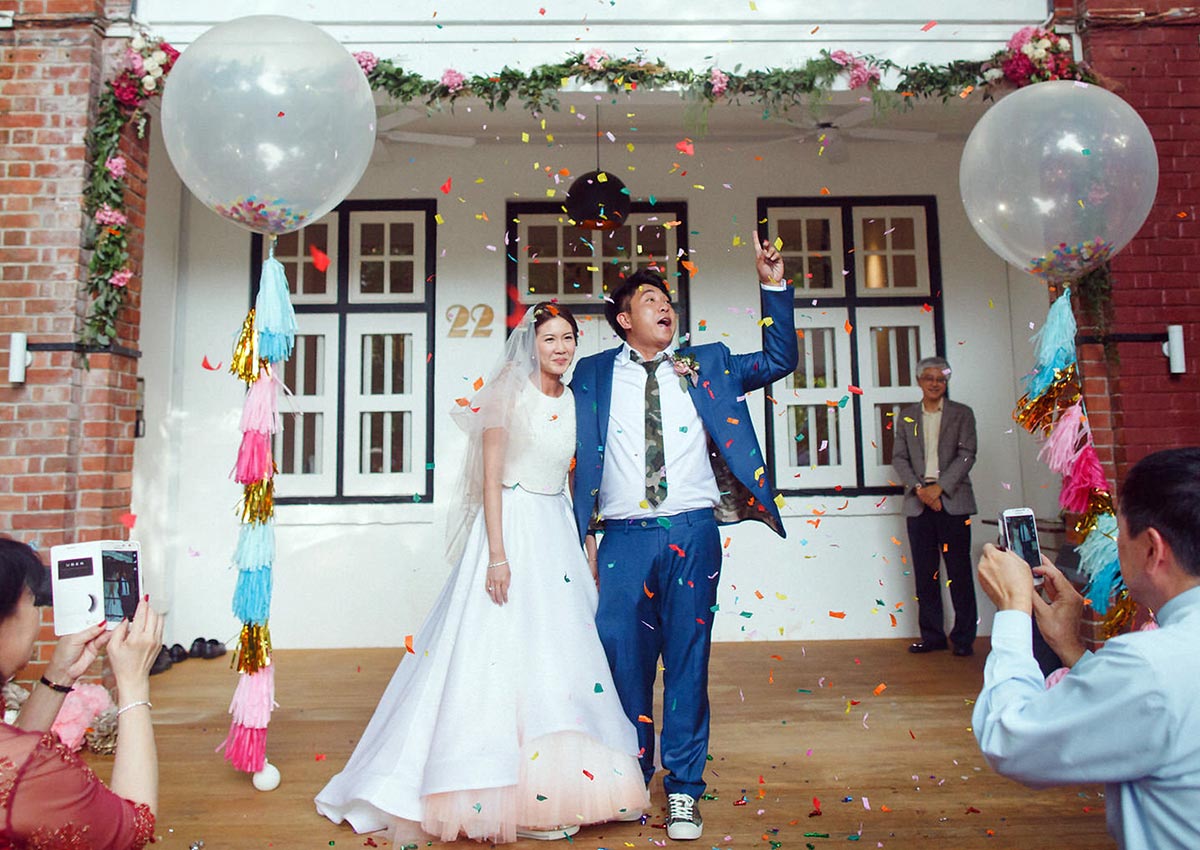
The 30-year-old housewife, who is expecting her first child, had her wedding outfit designed around her gold glitter and gemstone sneakers from French brand Miu Miu, which she bought last year for about $1,200.

She matched her shoes with a beaded crop top and silk organdy skirt, designed by Ms Chen, which cost about $4,000. Her bridesmaids also wore sneakers from brands such as Superga and Toms.

Says Ms Tan: “I loved the shoes. I bought them intending for them to become my wedding shoes.”

Similarly, pre-school teacher Tan Kai Yan wanted sneakers to be part of her wedding outfit. She and her business analyst husband, Mr Lee Tai Yun, both 28, wore matching Nike Air Max sneakers.

Their shoes, which cost US$200 (S$273) a pair, were ordered online from the Nike US website and customised with their names and in their favourite colours: midnight blue, red and gold.

Ms Tan says: “I don’t like wearing heels and we feel the wedding should reflect our personalities. We don’t like to be in formal dress and, when we go out, we usually wear sneakers.”

She paired the shoes with a red ceremonial “kua” dress, bought from Chinese e-commerce website TaoBao, for the tea ceremony. The dress cost about $100, including shipping.

She says their parents, who had “never seen a wedding where the bride is wearing sneakers”, found the shoes “cute”.

They objected only to the wedding dinner venue – Skyve Wine Bistro. Ms Tan says: “They said weddings should be in a hotel. But we didn’t like that because our guests would not be seated close to usand we would not be able to interact with friends.”

Stylists such as Ms Evon Chng, 27, feel that a bride should be able to wear whatever she wants on her big day.But to avoid looking sloppy, she advises brides to go for a “glamorous look” done up by professional hair and make-up artists, and to dress up their outfits with accessories and shoes.

“For brides who prefer flats or sneakers, opt for styles with some shiny sequins,” she says. “This will ensure that they will still look dressed-up in a casual dress.”

Still, brides who desire to go casual do not always get their way.Ms Seow Y.R., 26, planned to wear a crop top, a long skirt without a train and sandals for her wedding next January, but her family wanted her to dress in a gown and heels.

She says: “I wanted something I can wear again and I don’t want to waste money, but my family was not comfortable with that because of the tradition of wearing an elaborate white gown.”

alywoo@sph.com.sg

Shoes first

Photo: Ksana

Who: Mr Roslee Yusof, 40, film director in a video production company; and Ms Beverly Tan, 30, housewife. Married in January at their home in central Singapore.

What he wore: A tailor-made blue suit and two shirts from Rossi at Millenia Walk costing about $1,400; and sneakers with camouflage print from Swedish streetwear brand WESC priced around $150.

What she wore: Beaded top made of Japanese silk kimono crepe and skirt made with silk organdy with soft tulle that cost about $4,000 from home-grown bespoke dress- and suit-maker Caramel & Co; and gold glitter and gemstone sneakers that cost about $1,200 from Miu Miu. She had her wedding outfit designed around her gold sneakers.

Jumpsuit and cape

Photo: Juan Moley

Who: Mr Eddie Yeo, 35, art director; and Ms Goh Ying Ying, 34, account manager at a bank. Married in May at Raffles Hotel.

What he wore: His blue suit, white shirt, bow tie and pocket square were tailor-made in Bangkok at Pinky’s Tailor for about $600; and his brown leather shoes were from Thai brand Mango Mojito and cost about $150.

What she wore: A white silk crepe backless jumpsuit and matching cape from Caramel & Co, which cost about $1,200; brown faux leather belt with gold metal bar from Forever New, which cost about $30; and white pointed pumps from Charles & Keith, which cost about $58. Her veil was handmade by a friend.

Matching footwear

Who: Mr Lee Tai Yun, 28, business analyst; and Ms Tan Kai Yan, 28, pre-school teacher. Married in March at Skyve Wine Bistro.

What he wore: Tailor-made suit from home-grown suit-maker Mr Gentleman, which cost about $390; white shirt from Zalora.sg, $25; bow tie from Zara, $35; and customised Nike Air Max sneakers, US$200 (S$273).

What she wore: For her pre-wedding studio shoot (above), she wore a gown she rented from Bqueens that was part of a three-gown package for about $1,000; and customised Nike Air Max sneakers, US$200.

Casual in canvas

Who: Mr Roy Lim, 31, co-founder of creative design studio Section; and Ms Celeste Ang, 29, creative lead at an online grocery store. Married in April at Amara Sanctuary, Sentosa.

What he wore: Commes des Garcon shirt and pants from Hilton Singapore, a Topman jacket and leather shoes from Grenson, which cost about $1,000 in total.

What she wore: A Self-Portrait dress from Et-i-kit at Mandarin Gallery for $600; and white canvas shoes with lace detail from Stradivarius for $30.


This article was first published on September 22, 2016.
Get a copy of The Straits Times or go to straitstimes.com for more stories.

Image: 
Publication Date: 
Thursday, September 22, 2016 – 14:45
Keywords: 
Send to mobile app: 
Source: 


Story Type: 
Others

Source link

More NorthLight students making it to tertiary institutions

0

More students from NorthLight School – a specialised school that takes in those who failed the Primary School Leaving Examination (PSLE) – are furthering their studies at tertiary institutions.

Currently, about 45 per cent of students move on to the Institute of Technical Education (ITE), up from about 30 per cent in its initial years.

Today, more than 1,400 students have completed their education at NorthLight. Fourteen have done well enough to jump from the ITE to polytechnics and, so far, three have graduated with diplomas.

Others have gone to hospitality institutes such as Shatec and private institutions like Kaplan Singapore.

But when NorthLight started in 2007, many thought it would fail.

The school’s founding principal, Mrs Chua Yen Ching, said many did not think its students would be able to progress to tertiary institutions.

“Some of the students may have a difficult past, so we cannot change the starting of the story,” she said. “But we tell the students and their parents that we can work together to change the ending of the story.”

The school has since proven its critics wrong.

NorthLight’s current principal Martin Tan, who took over in 2011, said: “A model like this works for those who appear to be struggling in their early years of education.”

He said teachers at the school do more than just teach and would make countless home visits, take students to the doctor, buy food for students who are hungry and even provide counselling.

Some former teachers have since brought NorthLight’s best practices, such as its hands-on approach to teaching, to their current schools.

In 2009, the Ministry of Education (MOE), inspired by NorthLight’s progress, started Assumption Pathway School, which also takes in those who fail the PSLE.

In data released by MOE last year, before these two specialised schools were set up, about 60 per cent of pupils who had failed the PSLE would drop out of school. With the two schools, this has been lowered to about 10 to 15 per cent.

Yesterday, NorthLight was lauded by Prime Minister Lee Hsien Loong, who said its success is a result of the effort put in by many different individuals, including passionate educators who volunteered to teach at the school.

“NorthLight has not only changed the lives of its own students, but it has also influenced our wider education system,” Mr Lee said. “It has helped us rethink how we should develop a school’s culture, and how teachers relate to students and to the curriculum.”

He was speaking at an event to mark NorthLight’s 10th anniversary and the official opening of its campus in Towner Road, its home since December 2014. NorthLight welcomed its first 228 students at its former Dunman Road campus.

When Secondary 4 student Syafiee Abdullah, 16, entered NorthLight four years ago, he was disappointed that he had failed his PSLE.

“But the teachers here, they inspire me and tell me to never give up,” he said.

He is now doing well in school and hopes to go to university.

“I hope to show everyone that NorthLight is not a school for failures, but a school of second chances,” he said.


This article was first published on September 22, 2016.
Get a copy of The Straits Times or go to straitstimes.com for more stories.

Image: 
Publication Date: 
Thursday, September 22, 2016 – 15:00
Keywords: 
Send to mobile app: 
Source: 


Story Type: 
Others

Source link

Singapore swimmer Quah Zheng Wen to defer NS till 2020 Olympics

0

Minister for Defence Ng Eng Hen announces the extension of Quah’s deferment after he “got close to a medal” at the 2016 Olympics.

Source link

Beaten and burnt: Myanmar's invisible child servants

0

San Kay Khine stares at her burnt, scarred hands, her twisted fingers a reminder of her years as a child slave in Myanmar, one of thousands of young domestic workers feared to be at risk of exploitation and abuse.

The 17-year-old was rescued from a tailor’s shop in Yangon this month where she and another girl from her village spent five years as housemaids.

There they were allegedly beaten, cut with knives and deprived of sleep and food by the shop owner and her family – all for an occasional few dollars thrown their way.

The pair are among tens of thousands of children from poor rural areas sent to work as domestic helpers for the country’s growing pool of wealthier, urban middle-class households.

Enticed by promises of jobs that can support their families, rights groups say they are at high risk of abuse.

But the issue is under researched in a impoverished country where the justice system favours the wealthy.

San Kay Khine, whose fingers have set at strange angles after being broken by her captors, remains too traumatised to talk about what happened, only whispering that she wants to stay at home.

Instead, it is left to 16-year-old Thazin to give details of the suffering they shared at the tailor’s shop.

“I have a scar from where an iron was stamped on my leg and a scar on my head as well,” she told AFP at her home village, a few hours drive from Yangon.

“This was a wound from a knife, because my cooking was not OK,” she said, showing a mark on her nose.

Like many child workers, the pair were brought to Yangon by a friend from the village who promised to find them good jobs.

After years of failed rescue attempts by their families, who twice confronted the owners but were rebuffed, they were freed when a local journalist alerted the national human rights commission.

The shop owner and her two adult children were arrested this week over the allegations and charged with human-trafficking.

Despite their arrest, San Kay Khine’s mother remains scared of revenge by the tailor’s family.

“I am really afraid,” Nyo Nyo Win, 32, said outside the small bamboo and thatch hut where she lives with her three other children. “I cannot eat or sleep.” “They said they would send us to jail by accusing us of stealing things from them.” Tackling child labour is a key challenge for Myanmar’s new democratically elected government as it seeks to reform the country after half a century of brutal military rule.

The impoverished country is the world’s seventh-worst for child labour, according to risk analysts Verisk Maplecroft, just ahead of India and Liberia.

One in five children aged 10-17 are working – around 1.7 million people – according to a UN analysis in 2014 census data.

Most come from poor, displaced communities in areas scored by ethnic insurgencies or regions hit by natural disasters.

Many can be seen quietly clearing tables in Yangon’s tea houses and roadside cafes, or helping bar owners late into the night.

Thousands more make up an invisible workforce behind closed doors.

“They are the most vulnerable,” said Aung Myo Min, executive director of Equality Myanmar, an NGO that helps former child workers.

“Many of the children live in fear. They feel valueless. They have lost their childhood and they can’t get it back,” he said.

Horrific recent cases of abuse have cast a spotlight on the conditions of Asia’s migrant domestic workers, including of an Indonesian maid who was tortured for months by her Hong Kong employer.

Myanmar temporarily banned its women from going to work in Singapore and Hong Kong after the case hit the headlines in 2014 over concerns they would be vulnerable to abuse and exploitation.

Inside the country, however, child helpers have no legal protection and many fear going to the police.

“There is so much corruption in our country, the owners give money to the police to look the other way,” said Aung Myo Min.

San Kay Khine and Thazin’s families say the police did nothing despite their repeated appeals for help to free the girls.

In the end, they were paid a total of around $4,000 ($5,400) in compensation by the tailor’s family.

San Kay Khine’s mother, Nyo Nyo Win, said she will never let her daughter go away to work again.

“I’m not going to send her anywhere,” she said. “I will keep her at home.”

Image: 
Category: 
Publication Date: 
Thursday, September 22, 2016 – 14:26
Send to mobile app: 
Source: 


Story Type: 
Others

Source link

Death of Chinese actor puts depression in spotlight

0

Case of popular TV, film actor Qiao sparks call for greater understanding

The death of a popular actor and singer, rooted in depression, has stirred public attention and drawn calls from medical experts for better understanding of the condition.

Qiao Renliang, 28, was found dead at an apartment in Shanghai on Friday, the police said online, ruling out the possibility of foul play. The case is under investigation, the statement said.

Warner Music China, with which Qiao had signed a contract, released a statement saying Qiao was depressed last year and suffered from insomnia for several years. He tried medication in recent months and saw some improvement, Warner said.

Qiao was an upbeat personality, and many of his colleagues were not aware that he suffered from depression, according to media reports.

He had 10.8 million followers on his social media account, which noted that he had won a national singing competition organised by a local TV station in 2005 and had acted in several popular TV series.

According to the World Health Organisation, between 1990 and 2013, the number of people suffering from depression or anxiety worldwide increased by nearly 50 per cent to 615 million, which means that close to 10 per cent of the world’s population is affected.

Depression is a mental disorder characterized by sadness, loss of interest or pleasure, feelings of guilt or low self-worth, disturbed sleep, loss of appetite, overall tiredness and poor concentration; and it may lead to suicide, the WHO said.

Yang Lei, a psychiatrist at Peking University Sixth Hospital, said depression often occurs in families. It also affects people suffering from serious disabilities, such as those caused by stroke.

“Those who show symptoms of depression should see a doctor quickly,” he said, adding that people prone to depression can take preventive medication or seek psychological counseling.

“Depression is an experience of low spirit. It’s not common. Most people have no such experience,” he said. “It is different from more common experiences such as tiredness or insomnia.”

To reduce depression, the whole society, not just doctors, should work to eliminate its causes, Yang said. Efforts should include poverty relief, helping the disabled and reducing pressure.

“Publicity is also important to give the public more knowledge,” he said.

There are about 17 million people with mental disorders in China, according to a report by the China Sleep Research Society.

Helplines:

Samaritans Of Singapore: 1800-221-4444

Singapore Association For Mental Health: 1800-283-7019

Institute Of Mental Health’s Mobile Crisis Service: 6389-2222

Care Corner Counselling Centre (Mandarin): 1800-353-5800

Silver Ribbon: 6386-1928

Tinkle Friend (For Primary School-Aged Children): 1800-274-4788

Image: 
Publication Date: 
Thursday, September 22, 2016 – 14:08
Send to mobile app: 
Source: 


Story Type: 
Others

Source link

Go-Ahead scales back multiple route policy

0

New bus operator Go-Ahead is all but doing away with its policy of having drivers undertake more than one route per shift, after a spate of resignations arising from the unpopular practice.

In response to queries from The Straits Times, Go-Ahead spokesman Michelle Yin said that even though bus drivers were told they have to drive multiple routes – which is known as interlining – the firm was scaling back the practice.

“Go-Ahead Singapore has scaled back interlining and adjusted working schedules accordingly,” she said.

From an average of two trunk routes per shift, drivers will now do just one. Industry sources said drivers typically dislike interlining as it can be disorientating and disruptive.

SIM University senior lecturer Park Byung Joon said: “Singapore drivers don’t like interlining. They prefer a certain routine to their day.”

He said the practice, which is not uncommon, lets operators optimise resources and keep costs down.

Go-Ahead – the largest bus operator in London – said interlining “is the basis of our operating model in the UK”.

The British firm is one of two foreign players that have entered the local bus industry with government bus contracting. Last November, it clinched the right to run 25 routes for $497.7 million – the lowest bid.

Earlier, another newcomer, Anglo-Australian firm Tower Transit, had secured a package of 26 routes for $556 million – the third-lowest bid. Tower Transit said it does not implement interlining as extensively as it does elsewhere.

“We were aware that interlining was practised conservatively in Singapore,” said its chairman, Mr Neil Smith. “As a result, we have made only limited use of interlining, and have ensured that the bus captains involved were well trained and prepared for the change.”

Mr Smith noted that this practice is common in cities where buses operate at low frequencies – such as Perth and Sydney – and “a bit less common in cities with high frequencies such as in London”.

A little over two weeks after starting operations, Go-Ahead, which has more than 660 bus drivers, was hit by about 20 driver resignations.

As a result, it entered “short-term sub-contracting arrangements” with SBS Transit and SMRT Buses for the two to loan it 40 drivers in all.

These represent not only replacements for those who quit but also “additional bus captains required due to the scaling down of interlining”, Ms Yin said.

Industry watchers said that with the unforeseen increase in manpower, Go-Ahead’s profit margin from the contract might be shaved.

Resignations are not new to the Singapore bus industry. It has been reported that the overall driver attrition rate is as high as 15 per cent, or over 1,000 resignations a year.

The Land Transport Authority (LTA) said interlining is not new to the local bus industry, but that it has to be “calibrated appropriately”.

“Go-Ahead, like any other bus operator, is responsible for managing its operations to meet service requirements specified by LTA.”

christan@sph.com.sg

Read More:

Go-Ahead Singapore to launch bus services on Sept

Go-Ahead takes over routes, Pasir Ris interchange

Go-Ahead Singapore raises starting basic salary of bus captains to $1,950


This article was first published on September 22, 2016.
Get a copy of The Straits Times or go to straitstimes.com for more stories.


Image: 
Category: 
Publication Date: 
Thursday, September 22, 2016 – 13:42
Keywords: 
Send to mobile app: 
Source: 


Story Type: 
Others

Source link

Wonder Girls' Yeeun dating 2AM's Jeong Jin-woon

0

Wonder Girls’ member Yeeun and 2AM member Jeong Jin-woon have been in a relationship for about three years, Jeong’s agency Mystic Entertainment confirmed Wednesday.

The idol stars has built their romantic relationship starting early 2014, when they were both under JYP Entertainment. Yeeun, 27, debuted with Wonder Girls in 2007, while the 25-year-old Jeong of 2AM debuted in 2008.

Jeong moved to Mystic Entertainment after his contract with JYP Entertainment ended in April 2014.

“The two had music in common,” said the statement. “They continued dating even after Jeong moved to a different agency.”

Online media outlets are issuing a deluge of reports of past clues that that the two were dating. Yeeun was reportedly one of the musicians to sing a congratulatory song for Jeong’s brother in his wedding ceremony in 2014.

Also, a picture of the two at an exhibition event, part of Yeeun’s solo activities in 2014, is going viral. The picture was originally posted on Wonder Girls’ Twitter account.

Image: 
Category: 
Publication Date: 
Thursday, September 22, 2016 – 13:53
Keywords: 
Send to mobile app: 
Source: 


Story Type: 
Others

Source link

Punishment for 14 NUS students for role in inappropriate orientation activities

0

SINGAPORE – At least 14 undergraduate students from the National University of Singapore (NUS) have been punished for their role in inappropriate orientation activities reported in July this year. 

A report by The Straits Times today (Sept 22) said that the university found that the students were guilty of misconduct. They had used “unapproved items” during orientation games, alcohol was consumed beyond university-designated premises and events, and they provided false information during investigations.

Their punishments vary from warnings without record to mandatory community service. 

Students may appeal against the university’s decisions, said the report. 

In July, The New Paper reported on increasingly sexualised games that freshmen were asked to play; some were even told to re-enact rape scenes. 

The local newspaper had claimed that such risque orientation activities have been going on for the past decade despite complaints.

Read also: ‘Sexualised’ uni camps spark fierce debate

NUS’ orientation activities were suspended on July 29, but later allowed to resume from Aug 8. 

Yesterday, the university said in a post on its website that orientation review is underway. 

A 14-member Orientation Review Committee was set up in late August. It comprises respresentatives from the student body, faculty and alumni, and is chaired by Professor Tan Tai Yong, Executive Vice President (Academic Affairs) of Yale-NUS College.

Read also: What NUS students say about orientation camp debacle

According to NUS, the committee has been asked to provide recommendations on: 

– Key principles that underpin freshman orientation, with reference to the NUS Code of Student Conduct;
– Measures that would enable students, particularly student leaders, to understand and embrace these principles, and build a positive and respectful student culture;
– New approaches to freshman orientation at NUS, and whether there are aspects of past orientations that should be preserved;
– Checks against unacceptable student behaviour in orientation activities; and
– Safeguards for students inadvertently placed in potentially vulnerable situations.

The committee aims to submit a final report to the university’s management by October. 

maryanns@sph.com.sg

Image: 
Category: 
Publication Date: 
Thursday, September 22, 2016 – 12:57
Send to mobile app: 
Source: 


Rotator Image: 
Story Type: 
Rewritten Story

Source link

Bradxit: French actress Marion Cotillard breaks silence on Brangelina split

0

LOS ANGELES – French actress Marion Cotillard on Wednesday (Sept 21) broke her silence on any involvement in the sudden split of Hollywood power couple Angelina Jolie and Brad Pitt, wishing that the two will “find peace”, and confirming her pregnancy with her long-time partner.

Cotillard, 40, posted a statement on her verified Instagram page a day after Jolie filed for divorce, amid some reports that Cotillard and Pitt may have been romantically involved.

Pitt and Cotillard star in the upcoming war drama Allied. The Oscar-winning French actress said the statement would be her only comment on the “whirlwind news that broke 24 hours ago and that I was swept up into”.

This is going to be my first and only reaction to the whirlwind news that broke 24 hours ago and that I was swept up into.
I am not used to commenting on things like this nor taking them seriously but as this situation is spiraling and affecting people I

This is going to be my first and only reaction to the whirlwind news that broke 24 hours ago and that I was swept up into. I am not used to commenting on things like this nor taking them seriously but as this situation is spiraling and affecting people I love, I have to speak up. Firstly, many years ago, I met the man of my life, father of our son and of the baby we are expecting. He is my love, my best friend, the only one that I need. Secondly to those who have indicated that I am devastated, I am very well thank you. This crafted conversation isn’t distressing. And to all the media and the haters who are quick to pass judgment, I sincerely wish you a swift recovery. Finally, I do very much wish that Angelina and Brad, both whom I deeply respect, will find peace in this very tumultuous moment. With all my love Marion Ceci sera la première et seule réaction que j’aurai concernant la déferlante inouïe qui à commencé il y a de ça 24 heures et à laquelle je suis mêlée malgré moi. Je n’ai pas pour habitude de commenter ni de prendre au sérieux le tas d’absurdités déversées à mon sujet mais la situation prenant une telle tournure et affectant des gens que j’aime, je me dois de m’exprimer. Pour commencer, j’ai rencontré il y a quelques années l’homme de ma vie , le père de notre fils et du bébé que nous attendons aujourd’hui. Il est mon amour, mon meilleur ami et le seul homme dont j’ai besoin. Ensuite, à ceux qui me prétendent dévastée, je vais très bien merci. Ce genre d’inventions aberrantes ne m’affecte en aucun cas. Et pour finir, à la “presse”, à tous les haters, trolls et consorts qui ont le jugement si rapide je vous souhaite sincèrement… un prompt rétablissement. Ceci dit et un peu plus sérieusement, je souhaite à Angelina et Brad, deux personnes pour qui j’ai un profond respect, de trouver la paix dans ce moment tumultueux. Avec tout mon amour. Marion

A photo posted by @marioncotillard on Sep 21, 2016 at 4:43pm PDT

“As this situation is spiralling and affecting people I love, I have to speak up. Firstly, many years ago, I met the man of my life, father of our son and of the baby we are expecting. He is my love, my best friend, the only one that I need,” she said, referring to French actor Guillaume Canet.

She signed off by saying: “I do very much wish that Angelina and Brad, both whom I deeply respect, will find peace in this very tumultuous moment.”

Her name was mentioned in some reports as media outlets and fans tried to understand what led to the sudden divorce of one of Hollywood’s most visible couples, known for their good looks, successful films and activism.

Jolie, 41 and Pitt, 52, known collectively by the tabloid press and gossip sites as Brangelina, married in 2014 after a decade together and have six children.

They were steady fodder for tabloids with reports focusing on what role Jolie played in the breakup of Pitt’s marriage to actress Jennifer Aniston and, more recently, possible trouble in the marriage.

Image: 
Category: 
Publication Date: 
Thursday, September 22, 2016 – 13:24
Keywords: 
Send to mobile app: 
Source: 


Story Type: 
Others

Source link

Owls, reptiles join cats in Japan's animal cafe boom

0

OSAKA – Riding the coattails of the cat cafe boom, so-called animal cafes have become popular, especially in urban areas. Customers can get up close and personal with a variety of creatures – including snakes, owls and rabbits.

Animal cafes in Osaka have increased eightfold over the last five years, as people seeking solace with the animals, as well as foreign tourists craving novelty, have increasingly sought them out.

Nami Kuroki, an 18-year-old company employee from Osaka, enjoyed the 1-meter-long snake draped around her neck at the Rock Star reptile cafe in the city’s Naniwa Ward.

“I like that she cuddles up to people even though they don’t give her attention. Her mysterious nature is fascinating,” she said.

Rock Star’s reptile collection also includes iguanas and chameleons. The cafe opened in 2014 and, after generating strong word-of-mouth buzz, was able to double its seating capacity to 40 last year.

Eighty per cent of its customers are women, many of whom came to the shop in search of a scary experience and later became regulars after finding the atmosphere comfortable, according to the cafe.

Although the number of animal cafes nationwide is unknown, a tally compiled by the Osaka city government showed the number of such cafes in the city totaled 48 as of late August, an eightfold increase from five years ago. More than half are cat cafes, but the number of cafes with reptiles, owls, small birds, hamsters and other types of animals has also increased.

Fukuro no Mise (Owl shop) in Osaka’s Kita Ward has increased its efforts to lure foreign travellers, posting information on the internet and taking other steps. Fukuro no Mise employs people from Taiwan, and 70 per cent of its customers are now foreigners.

“It’s interesting because we don’t have shops like this in Taiwan,” said a 20-year-old university student visiting Japan. “The big eyes are charming.”

Ashiya Get Plus, a pet rabbit shop in Higashi-Nada Ward, Kobe, added a cafe to its premises in 2012, making it popular among university students and other young people. “Our place even seems to be on a list of popular dating spots,” its operator said.

Learning proper care

The Environment Ministry has conducted surveys on well-known cat cafes. According to a survey carried out last October, cat cafes numbered 314 across the nation, up 89 from two years ago.

At Cat Cafe Nekokaigi, which opened in Nakagyo Ward, Kyoto, in 2008, customers sometimes have to wait an hour to enter on weekends. The cafe is home to 12 cats that were adopted from people who rescue strays.


“I want to make this cafe a place where people can learn the importance of life and proper way to care for cats,” said cafe manager Mayuko Horii, 37.

Akemi Natsuyama, a senior researcher at the Hakuhodo Institute of Life and Living, said, “The use [of animal cafes] has spread widely, as they not only serve as places for healing but also offer people a unique experience that’s easy to post on Facebook and other sites.

“For people living in urban areas who have difficulty keeping pets, the fact they don’t have to take care of the animals all the time is one reason the cafes are popular,” she added.

Seeking sensible customers

Some animal cafes have raised concerns.

In June, the Tokyo metropolitan government revoked the business license of a cat cafe in Sumida Ward for its failure to treat sick cats and other improper management. The revocation is believed to be the first of its kind in the nation.

In Osaka, the city government instructed an animal cafe to improve its management after receiving complaints from customers, including that there were animal hairs in the food.

The Animal Protection Law allows pet stores and other facilities to display dogs and cats from 8 a.m. to 8 p.m. For cats, the rules were eased in June to extend the display time to 10 p.m., following calls from business operators handling cats. However, other animals are not subject to such time restrictions.

“If animals are abused for the sake of business, it’s really defeating the purpose,” said Megumi Yokoi, the head of Animalship classroom for children, a Tokyo-based company offering animal-assisted education.

“I want customers to show good sense by, for example, choosing stores that properly manage the condition of animals.”

Image: 
Category: 
Publication Date: 
Thursday, September 22, 2016 – 16:00
Keywords: 
Send to mobile app: 
Source: 


Story Type: 
Others

Source link