Since its launch earlier this year, the smartphone market has been dominated by the Samsung Galaxy S20 Ultra.
However, it appears that Chinese tech giant Huawei aims to topple the competition with the latest iteration of its flagship photography series, the Huawei P40 Pro+.
And it’s launching in Singapore on June 27.
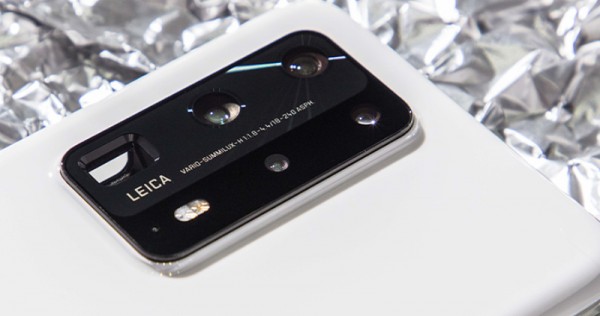
The Huawei P40 Pro+ sports the Ultra Vision Leica Penta Camera system, which, as its name suggests, houses five lenses for content creators to get creative with their shots. PHOTO: HuaweiThis system includes:
40MP Ultra Wide Cine (f/1.8) 50MP Ultra Vision Wide (f/1.9) 8MP Telephoto with up to 3x optical zoom (f/2.4) 8MP Telephoto with up to 10x optical zoom (f/4.4) Time of Flight lens Previously, the Huawei P40 Pro only had a single 12MP telephoto lens with up to 50x zoom.
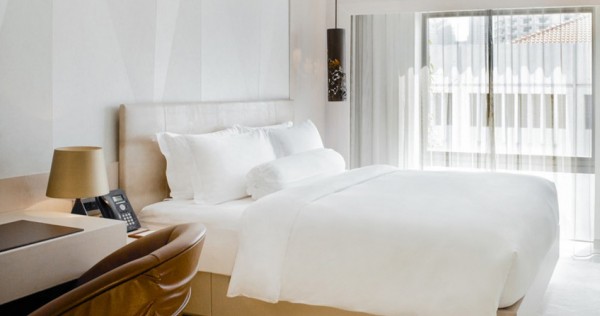
As restrictions ease in phase 2 of Singapore’s reopening, a burning question on the minds of those who are in need of an escape after staying home for the last two months is, “Can I go for a hotel staycation now?”
Well, the short answer is, ‘no’. The Singapore Tourism Board (STB) has issued instructions to hotels not to accept reservations from local residents, so unfortunately, you’ll have to hold back any plans of having a staycation in phase 2.
Exceptions: When you don’t have a home to stay in
However, exceptions are granted to people who fall under these categories:
SINGAPORE: A new species of orchid native and endemic to Singapore was discovered last year by researchers from the Singapore Botanic Gardens.
The species, Nervilia singaporensis, was found in July 2019 at Bukit Timah Nature Reserve, said the National Parks Board (NParks) in a news release on Friday (Jun 19).
The genus Nervilia was, until recently, thought to be locally extinct in Singapore, with the last sighting in 1889.
With this discovery, Singapore now has five species of endemic plants, with four existing only in the nature reserves.
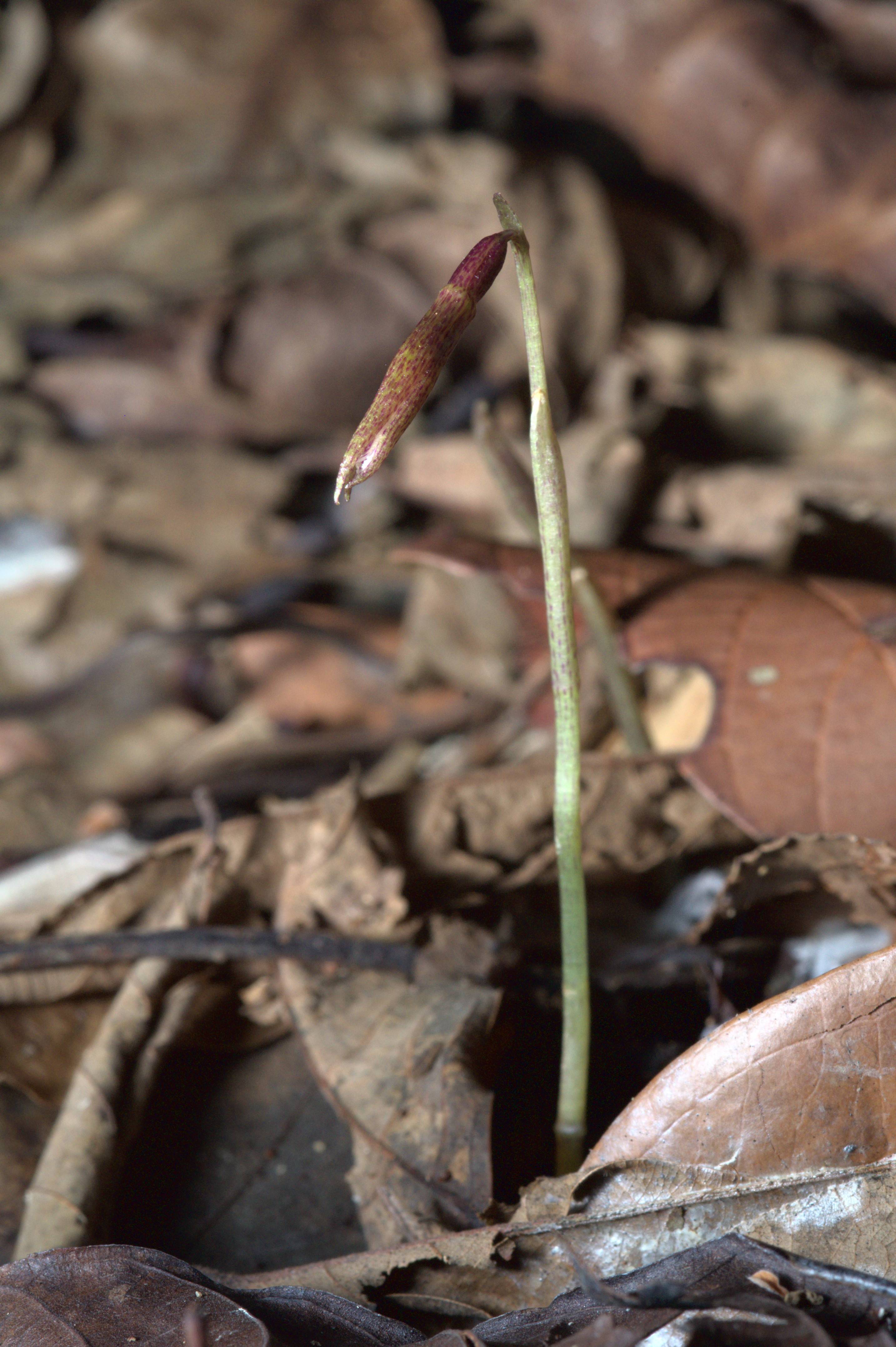
Based on field surveys conducted at nature reserves and areas, this species has been found to occur only in Bukit Timah Nature Reserve in Singapore. (Photo: Matti Niissalo/National Parks Board)
The Nervilia singaporensis has a unique flower shape that is oblong with a truncate tip and flowers that never open. This means it must self-pollinate in order to reproduce.
This species, which grows up to 9cm tall, is “considered highly endangered at national and global levels” because it only produces a low quantity of seeds, making it difficult to propagate, said NParks.
Before the discovery of the Nervilia singaporensis, Singapore had four species of endemic plants comprising of the Singapore Ginger (Zingiber singapurense), Hanguana rubinea, Hanguana triangulata and Splachnobryum temasekensis.
“The discovery of Nervilia singaporensis shows that there is still unknown biodiversity to find and study, even in heavily urbanised Singapore,” said Mr David Middleton, Coordinating Director of Research and Conservation at the Singapore Botanic Gardens.
“As such, continued efforts in documenting and learning about the richness of our habitats is crucial to protect them and their biodiversity.”
SINGAPORE: Crowds were back at Singapore’s Orchard Road shopping district on Friday (Jul 19), with many customers eager to make purchases on the first day that retail outlets were allowed to reopen.
As part of Phase 2 of Singapore’s reopening, physical shops were allowed to resume business after being shuttered for more than two months because of the COVID-19 outbreak.
Long lines were seen at the entrances of malls and some shops when CNA visited Orchard Road on Friday afternoon.
At ION Orchard, people trying to enter the mall from Orchard MRT station were seen gathering around signs with QR codes to check-in using the national SafeEntry system.
There were similar scenes at the entrance from the MRT station to Wisma Atria, as well as 313@Somerset.
A long line to enter Wisma Atria from Orchard MRT station. (Photo: Rachel Phua)
People streaming in to enter 313@Somerset on Friday afternoon. (Photo: Rachel Phua)
Some popular brands, such as Zara at Ngee Ann City, Dior at ION Orchard and Victoria’s Secret at Mandarin Gallery, also saw long queues outside their stores. This was partly because shops were trying to limit the number of customers inside as part of safe distancing measures.
At Victoria’s Secret, a salesperson was seen putting up a sign indicating a 50 per cent sale.
Fashion store Zara at Ngee Ann City. (Photo: Rachel Phua)
Customers queue up to enter Dior in ION Orchard on Jun 19, 2020, the first day the shop was allowed to reopen after Singapore’s circuit breaker. (Photo: Jeremy Long)
A line outside lingerie, clothing and beauty retailer Victoria’s Secret. (Photo: Rachel Phua)
NICE TO FINALLY BE OUT, SHOPPERS SAY
Shopper Celine Tan came to Orchard Road at around 11am. She bought a pot from the Takashimaya department store, had lunch and walked through some of the malls after that.
“It feels good to be out,” she said.
As a housewife, she said she spent most of her time at home during the “circuit breaker” period and Phase 1 of the reopening to take care of her children, as there were few places she visited apart from the supermarket during the two-and-a-half months.
Shoppers inside Takashimaya department store at Ngee Ann City. (Photo: Rachel Phua)
Another visitor at Orchard, Bhavini Gokani, said she has been “so busy” at work with the circuit breaker forcing her to work round the clock that “it just feels so good” to be able to be out, shop, get a hair cut and have brunch.
“We used to take these things for granted,” she told CNA. “I hope we learn to be grateful about doing the small things.”
A road crossing along Orchard Road. Many people were spotted along the famous shopping district in the afternoon on Jun 19, 2020. (Photo: Rachel Phua)
She came out on Friday as she thought most people would be working so the streets would not be that busy.
University students Tay Zhi Qian and Shernice Lim met at Orchard Road because it was a “convenient location”. It was the first time the couple have seen each other physically after more than two months.
“We cherish the freedom,” Mr Tay said.
THE DAY RETAILERS HAVE BEEN WAITING FOR
For Hugo Boss, business has been brisk so far.
According to managing director of Hugo Boss Southeast Asia Steven Lam, although traffic has fallen, sales on Friday at their Orchard outlets have returned to January levels. About 60 per cent of customers who came into the stores on Friday purchased something.
“They come knowing what they want,” he said, adding that usually, about 80 per cent of those who enter the store leave without buying anything.
Hugo Boss has three outlets in Orchard Road – at Ngee Ann City, Paragon and ION Orchard.
Soon after the date of Phase 2 was announced, hair care service provider Papilla Haircare received “a lot of calls” for appointments, said its chief executive Elizabeth Leong. She and her business partner Kim Lim also run Illumia Therapeutics at Wheelock Place.
“Today is a huge relief for all of us,” she said. Her employees, who rely on commissions on top of their basic salary, are finally able to work again.
Mr Andrew Tan, managing director of furniture store atomi, said that Friday morning was off to a slow start, but it was expected as Singapore is “not out of the woods” yet in the fight against COVID-19.
“We are just happy we can get things running,” he said.
Mr Tan added that selling products online is not enough to sustain the business as it relies on a loyal customer base and people prefer to buy big-ticket items after touching and seeing the product physically.
All the business owners said that they had been busy the past few days getting their premises clean and ready for the reopening, and putting in place the necessary safe distancing measures.
Other sales employees CNA spoke to, who did not want to be named as they were not authorised to speak, said that business on Friday was slower than normal. Although there were people constantly walking past their stores, only a handful went in.
One of the stores at 313@Somerset that remained closed is tea brand T2. (Photo: Rachel Phua)
Next door to T2, shoes retailer Melissa was also closed on Friday afternoon. (Photo: Rachel Phua)
Some stores also remained shuttered with no indication on when they will reopen. A notice on tea brand T2’s shopfront said that it will provide updates via its social media channels and email.
In the heartlands, shoppers made a cautious return to the stores, with no rush of people or snaking queues.
There were also fewer people than expected at hawker centres and coffee shops during lunchtime.
SINGAPORE: Singapore is expanding its wastewater testing to tackle COVID-19, with a pilot programme launched at 20 large foreign worker dormitories in the country, the National Environment Agency,National Water Agency PUB and Home Team Science and Technology Agency (HTX) said in a joint news release on Friday (Jun 19).
While the testing of wastewater to assess the COVID-19 situation in a place is not new and has been tried by other countries, the NEA’s Environmental Health Institute has used it to support monitoring and management of COVID-19 transmission among workers living in dormitories.
“This provides an additional indicator to tell us if a specific group, such as those living in a dormitory, has infected people among them,” Mr Wong said on Jun 9.
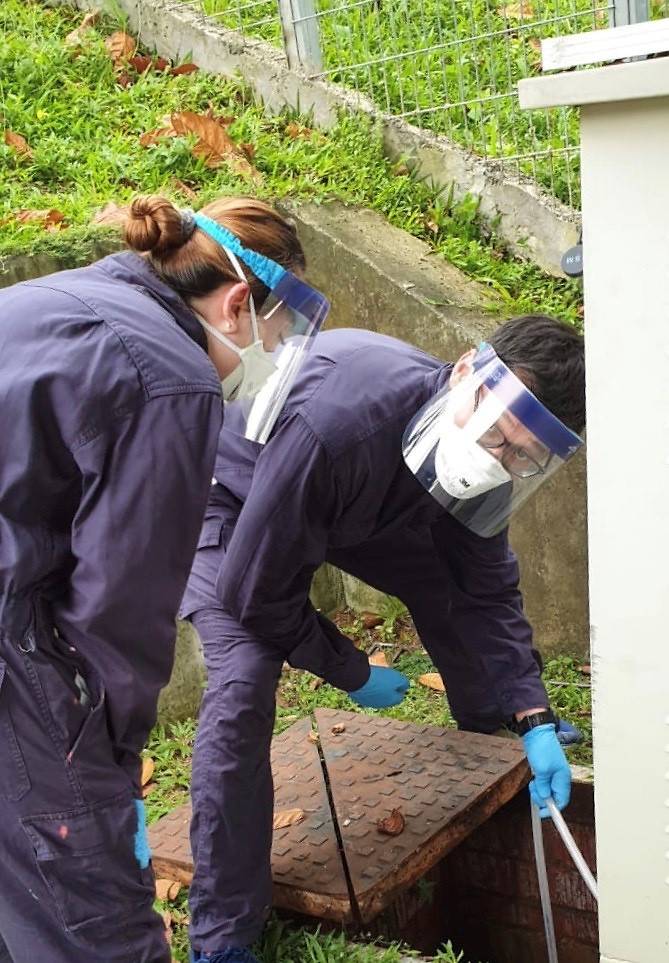
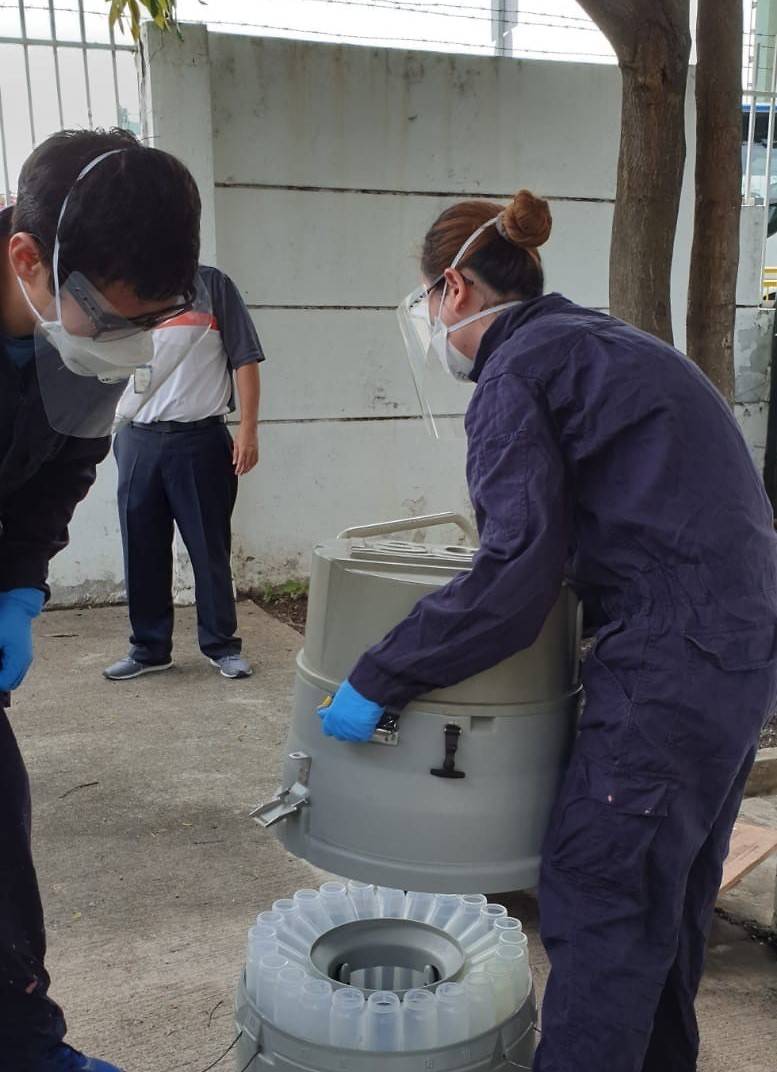
Field work being conducted. (Photo: NEA, PUB, HTX)
As a group, migrant workers living in dormitories in Singapore have been the hardest-hit by COVID-19. As of Thursday, this group made up about 94 per cent of the 41,473 confirmed cases.
According to the press release, the amount of viral material in wastewater from a community could reveal the level of COVID-19 spread there. This can then trigger the necessary response plans and mitigation actions, such as individual testing and isolation.
The team from NEA, supported by PUB and HTX, has been sampling wastewater from water reclamation plants and workers’ dormitories.
Field work being conducted. (Photo: NEA, PUB, HTX)
TRIAL RESULTS AT MIGRANT WORKER DORMS
At the dormitories, the trial results showed the concentration of SARS-CoV-2 material in wastewater is related to the prevalence of COVID-19 in these living spaces, the agencies said.
SARS-CoV-2 is the virus that causes COVID-19.
“For dormitories in the pilot programme with no detected COVID-19 cases, a zero reading for SARS-CoV-2 material in the wastewater provided the added assurance that the dormitories remain free from infection, and to allow the workers to leave the dormitories for work,” according to the media release.
If viral material was detected in the wastewater of some dormitories, more swab tests were performed instead, “leading to more detections and isolation of cases, including asymptomatic ones”.
“This facilitated a more targeted swabbing strategy and contributed to the mitigation of further transmission,” the agencies said.
BENEFITS OF USING WASTEWATER TESTING
Wastewater testing can therefore act as a warning system for the presence of COVID-19 cases, and the trending of SARS-CoV-2 concentration over time can determine if infection control measures taken have been effective.
Wastewater samples can also show information on a cross-section of the community, which allows for the monitoring of large groups.
Lab work being conducted. (Photo: NEA, PUB, HTX)
“If positive signals are detected from wastewater at a particular site, clinical testing for COVID-19 can be carried out for the affected community, allowing screening for COVID-19 to be carried out in a more targeted manner,” said the agencies.
However, detection of viral material or ribonucleic acid in the wastewater does not suggest the presence of viable or infectious virus.
“Without a host, the virus will not be able to propagate over time in wastewater,” read the news release.
More research is needed to understand the sensitivity of the method in detecting early or a few number of cases, the agencies said.
“At low level transmission, wastewater surveillance at the treatment plant appears to be less sensitive than clinical surveillance of cases in Singapore,” explained Associate Professor Ng Lee Ching, director of NEA’s Environmental Health Institute.
“Monitoring is ongoing to determine the trending of the concentration of viral material at the water reclamation plants, and the relationship between the viral material concentration and prevalence of COVID-19 in Singapore.”
The methodology for wastewater sampling and testing for COVID-19 was developed by NEA’s Environmental Health Institute, with scientific inputs from the Singapore Centre for Environmental Life Sciences at the Nanyang Technological University, Singapore-Massachusetts Institute of Technology Alliance for Research and Technology and the National University of Singapore.
PETALING JAYA: The government is in talks with Singapore to open the borders to citizens of both countries, says Datuk Seri Ismail Sabri Yaakob (pic).
The Senior Minister (Security) said that the Health Ministry has determined that Singapore and Brunei are green zone countries and the government has agreed to allow citizens from both the countries to enter Malaysia.
“However, if we are opening our country to Singapore and Brunei and allow them to enter without getting prior approval from the Immigration Department and not require them to undergo Covid-19 screening test, it must be reciprocated.
“Singapore and Brunei must also allow our people to enter their countries without restrictions,” he said in his press conference on Friday (June 19).
He said currently, however, Wisma Putra is in talks with its Singaporean counterparts.
“So the decision will now depend on the outcome of the talks on our proposal. We will wait and see,” he added.
Ismail Sabri also announced that foreigners seeking medical treatment under the medical tourism industry can also do so without the Immigration Department’s approval.
SINGAPORE: Singaporeans may be allowed to enter Malaysia without the need to undergo COVID-19 screening and home quarantine, but there should be a reciprocal arrangement for Malaysians, said Putrajaya on Friday (Jun 19).
Speaking during a press conference on COVID-19 measures, Senior Minister Ismail Sabri Yaakob said that the Malaysian government has agreed to allow citizens from both Singapore and Brunei to visit freely provided the same flexibility is extended to Malaysians entering both countries.
Mr Ismail Sabri, who is also defence minister, said this was because both Singapore and Brunei are categorised as green zones by the Malaysian Health Ministry.
“We have agreed to allow Singapore citizens that live in Singapore or Brunei citizens who live in Brunei to come into our country. Hence, we are opening up our country to Singapore citizens and Brunei citizens to come in without the need for approval from our immigration department or to undergo COVID-19 screening tests or home quarantine,” he said.
Malaysia’s Senior Minister Ismail Sabri Yaakob giving a daily briefing on Jun 8, 2020. (Photo: Bernama)
However, he noted that this was on the condition that Malaysians would also be afforded the same privileges.
“The loosening of the border restrictions must be reciprocated and both these countries must allow our citizens to enter without restrictions, as we have allowed,” said Mr Ismail Sabri.
For the case of Singapore, he stressed that the decision is dependent on the outcome of discussions between the foreign ministries of both sides.
“This is being negotiated by our foreign ministry with Singapore’s foreign ministry. They are still discussing … If they agree to our suggestions, we will agree to relax the restrictions and open our borders. So we have to wait and see how the discussions pan out,” the minister added.
In a separate press conference on Friday, the Malaysian health ministry’s director-general Noor Hisham Abdullah said that Singapore was one of the six countries Malaysia was in negotiations with to facilitate the movement of citizens across their borders.
He noted that most of the COVID-19 cases in Singapore comprised foreign workers and that the proposed arrangement with Malaysia would only involve Singapore citizens.
“(The arrangement with Singapore and other countries) is doable but we need to explore … The discussions are ongoing. If it is reciprocal, we can implement,” said Dr Noor Hisham.
Mr Wong, who co-chairs the COVID-19 multi-ministry task force, said that before such travel can resume, testing may have to be carried out, a quarantine period may have to be imposed, or a combination of both measures.
He added that the volume of travel at the land checkpoints would not be as high as before COVID-19 hit both countries.
“We are talking about resumption of travel, but in a controlled manner and in a safe manner for both sides. That’s in our mutual interest,” he said.
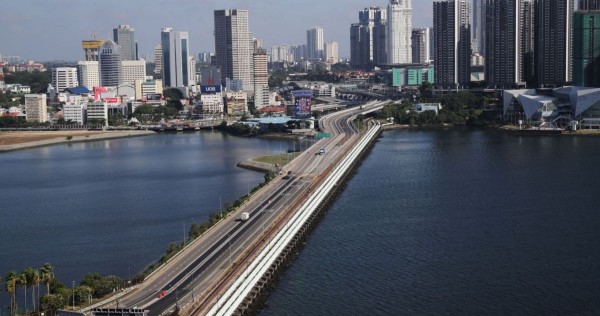
Malaysia’s movement control order (MCO) has been in place since Mar 18, restricting domestic and international travel due to the COVID-19 pandemic. It is now in the recovery phase of the MCO, which will last until Aug 31.
Similarly, Singapore implemented a circuit breaker period from Apr 7 to Jun 1, which tightened border controls. It is currently in phase 2 of post-circuit breaker reopening.
To break the chain of infection, both governments mandated a 14-day quarantine for people entering the countries. These measures made it impossible for Malaysians, who live in Johor but work in Singapore, to travel across the strait.
SINGAPORE: It’s been more than two months since people in Singapore were allowed to dine in at food and beverage establishments around the country, but when businesses were ready to welcome customers on Friday (Jun 19), there was no rush for tables and seats.
This is the first day of Singapore’s Phase 2 of reopening. Retail outlets were allowed to reopen, as with beaches and sports facilities such as gyms and swimming pools. Dining in is allowed if people keep to a maximum of five in a group among other safe distancing measures.
It was a slow start to Phase 2 at some hawker centres and coffee shops, with only small crowds forming at peak lunchtime.
When CNA visited a coffee shop in Ang Mo Kio at 11am, there were few customers at the tables.
Student Ong Teng Ghee, 23, was having breakfast with his sister after visiting a vet nearby.
“It’s better to eat downstairs. It’s more convenient and I can eat when the food has just been prepared,” he added.
Mr Ong said he was worried that the coffee shop would be crowded, but it turned out to be emptier than expected.
An Ang Mo Kio food court on Jun 19, the first day of Phase 2 of Singapore’s reopening (Photo: Ang Hwee Min)
Mr Alvin Chiao, who runs Home Taste Chicken Rice at the coffee shop with his father, hopes that business will pick up as more people leave their homes to eat out.
While he is expecting business to grow, he thinks it will still be slow for about one week as people are likely to remain at home and avoid crowds.
“Luckily enough, I have some regular customers. So one week they will come down three to four times, which is good enough, a lot of them are housewives,” he said. “This is also a point for Grab taxi uncles to relax and drink coffee, so they will also come and buy my chicken rice.”
An Ang Mo Kio food court on Jun 19, the first day of Phase 2 of Singapore’s reopening (Photo: Ang Hwee Min)
The 33-year-old told CNA that the COVID-19 “circuit breaker” started just two weeks after he opened the stall, which also sells steamboat.
With the start of Phase 2, he hopes that dine-in customers will return for steamboat, which used to bring in about S$500 to S$600 in earnings every day pre-circuit breaker.
“I’ve started to reorder the ingredients. I hope the crowd will come in to eat my steamboat,” he told CNA.
During the circuit breaker, however, he did not sell steamboat dishes for takeaway or delivery because of the equipment and transport required.
“When we set up the shop, we obviously didn’t know about the circuit breaker, and I was very confident that my brand could work. But once the shop opened, the coronavirus was already in Singapore,” said Mr Chiao.
“I was worried, but the deposit was already paid and everything was settled so I decided to just go ahead, because I believed that good things may happen.”
At Yuhua Village Market and Food Centre, some queues formed at lunchtime, but crowds dissipated after 2pm. Some stalls have not reopened, and there were notices informing customers that they would resume business next week instead.
Mr Cao Yong, who runs a zichar stall in Yuhua Village Food Centre. (Photo: Ang Hwee Min)
Mr Cao Yong, who runs a zichar stall at the hawker centre, told CNA that he saw 20 per cent more in earnings during lunchtime on Friday compared to the situation over the past two months.
“When I was only doing takeaways and deliveries, most of the orders were single-dish like fried rice or noodles. But today, families with three or four people came here to eat, and they ordered more dishes,” he said in Mandarin.
The 31-year-old said revenue dropped about 30 per cent over the whole circuit breaker period, and is satisfied with the 20 per cent increase in sales today.
“Our business was still stable, especially with the government support. It’s also not good if everyone leaves their house now. If everyone comes outside now, it would be worrying because the virus is not completely gone,” he added.
Madam Nancy Ho, 63, had lunch with her husband at Yuhua Village Food Centre before visiting her daughter’s home for the first time in weeks to see her grandchildren.
“(It’s been) too long we keep packing food (back home), and it’s a bit troublesome. The food is not hot, so I prefer to eat outside,” she said, adding that she was worried that it would be crowded.
“We looked around to see if it’s crowded. Since it’s not crowded, we decided it’s ok to eat together. And I chose to come not during peak lunchtime, with a lot of office people here.”
CBD STILL QUIET, OFFICE WORKERS YET TO RETURN
While people were out and about in the heartlands, many F&B outlets and restaurants in the central business district still saw few customers despite reopening on Friday.
When CNA visited the Tanjong Pagar area at 12.30pm, most restaurants had two to four tables of customers, although none of them were full.
Co-founder of Moonstone Bar in Amoy Street Jeremy Lim said he expected that there would be few customers because most office workers have not returned to the office. While he felt excited to reopen the restaurant, he was “not completely confident” that the business could sustain itself.
“I think it’s a little bit of a conflict for us also. When you run a business obviously you want to see the place packed, you want to earn money,” he told CNA.
“But at the same time, we also have a part of us where we don’t want things to get worse.”
Co-founder of Moonstone Bar Jeremy Lim. (Photo: Ang Hwee Min)
The restaurant has seen a 90 per cent loss in sales over the past two months, said Mr Lim. It now offers free delivery for orders from the nearby offices, and saw a few deliveries for lunchtime on Friday.
“Even with the offices being back, a lot of workers or people are still a little bit afraid of what’s to come. If you go and see, there are still lots of people holding plastic bags walking back to the office. They still prefer to eat in, rather than take a chance and dine out,” said co-founder Vincent Ho.
Mr Keith Koh, who owns Lad & Dad in Tanjong Pagar Plaza said the restaurant is unlikely to be busy and is expecting mostly regular customers to return.
Lad & Dad, an eatery at Tanjong Pagar on Jun 19, the first day of Phase 2 of Singapore’s reopening (Photo: Ang Hwee Min)
“On Friday we mostly cater to the lunch crowd, the office crowd, and then happy hour and dinner as well. If you notice, the area is still quiet because most offices are not back yet,” he said.
“Most of the customers we’re expecting today are regulars. We’ve been shut for the last three months so they’re looking forward to coming back.”
When the circuit breaker period was announced, the restaurant expanded its delivery orders from a 2km radius to islandwide delivery. Compared to a regular day, business dropped by about 80 per cent while the restaurant was closed during the circuit breaker, he added.
When asked why he decided to reopen the restaurant even though he predicted that there would be few customers, Mr Koh said that for F&B outlets, it is better to reopen than stay closed.
“Because the moment we open for dining, we have one more option. People get to eat here, outside of the deliveries and takeaways that we offer,” he added.
“It’s just another avenue for us to stay afloat during this period. The crowd might not be as good as before, but at least it will help us cover our overheads.”
The next election has yet to be called but the claws are already out.
In an article published on the People’s Action Party (PAP) website today (June 19), PAP MP Tan Wu Meng hit out at Workers’ Party (WP) chief Pritam Singh for his “support” of playwright Alfian Sa’at.
Titled “Mr Pritam Singh supports Alfian Sa’at”, the essay referenced Singh’s speech in Parliament on June 5.
What Singh said in Parliament
Speaking in defence of critics who had raised concerns about foreign workers’ living conditions, Singh had said: “In my view, Mr Speaker, we should count ourselves fortunate that we have citizens who are the loving critics amongst us, some of whom have been questioned in this very House in this term of government.”
SINGAPORE: Hackers may be planning a potential phishing campaign using a spoofed Ministry of Manpower (MOM) email address and the COVID-19 support fund as a lure, said the ministry in a Facebook post on Friday (Jun 19).
The ministry said on Friday it had “received information regarding a potential phishing campaign that will be targeting businesses during this period”.
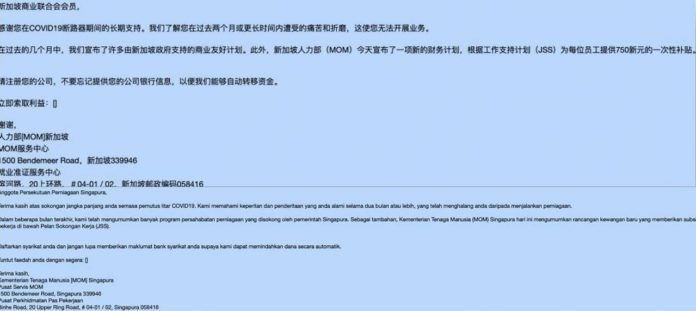
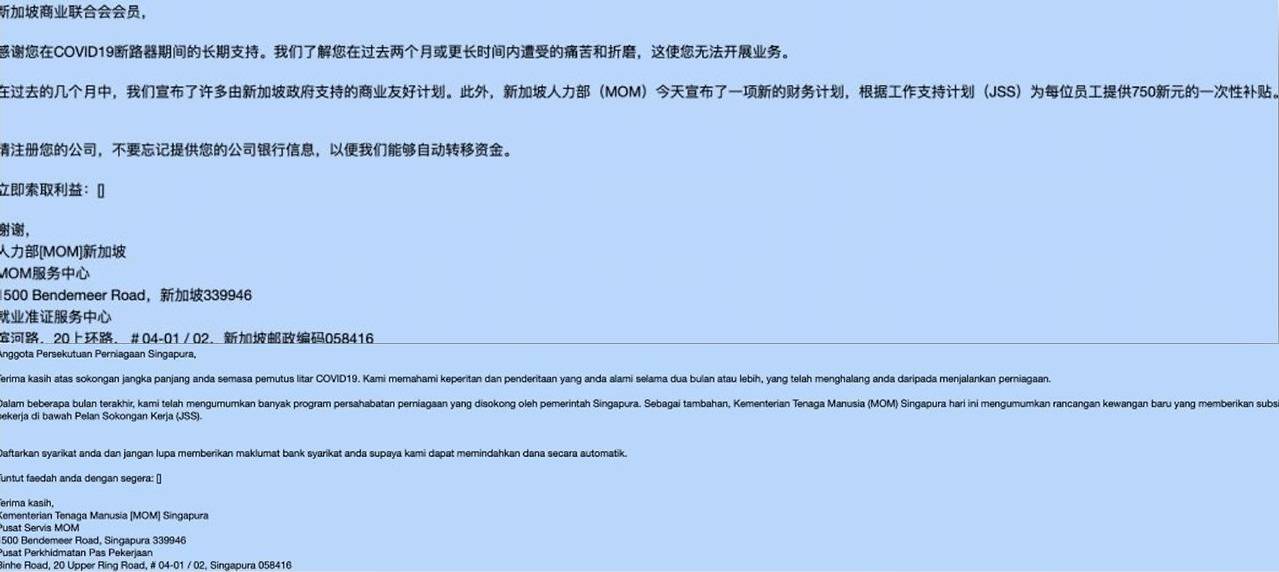
It added that hackers plan to use a spoofed email address – covid-support@mom.gov.sg – to bait recipients to click on the embedded phishing link.
“These phishing emails are designed to drive recipients to fake websites where they will be deceived into divulging personal and financial information,” said MOM.
Samples of emails using a spoofed MOM email address.(Image: MOM)
MOM also reminded the public to use only the official ministry website and to refer to this FAQ for manpower issues related to COVID-19.